
Life, 1913-09-25 · page 16 of 43
Life — September 25, 1913 — page 16: what you’re looking at
What you’re looking at
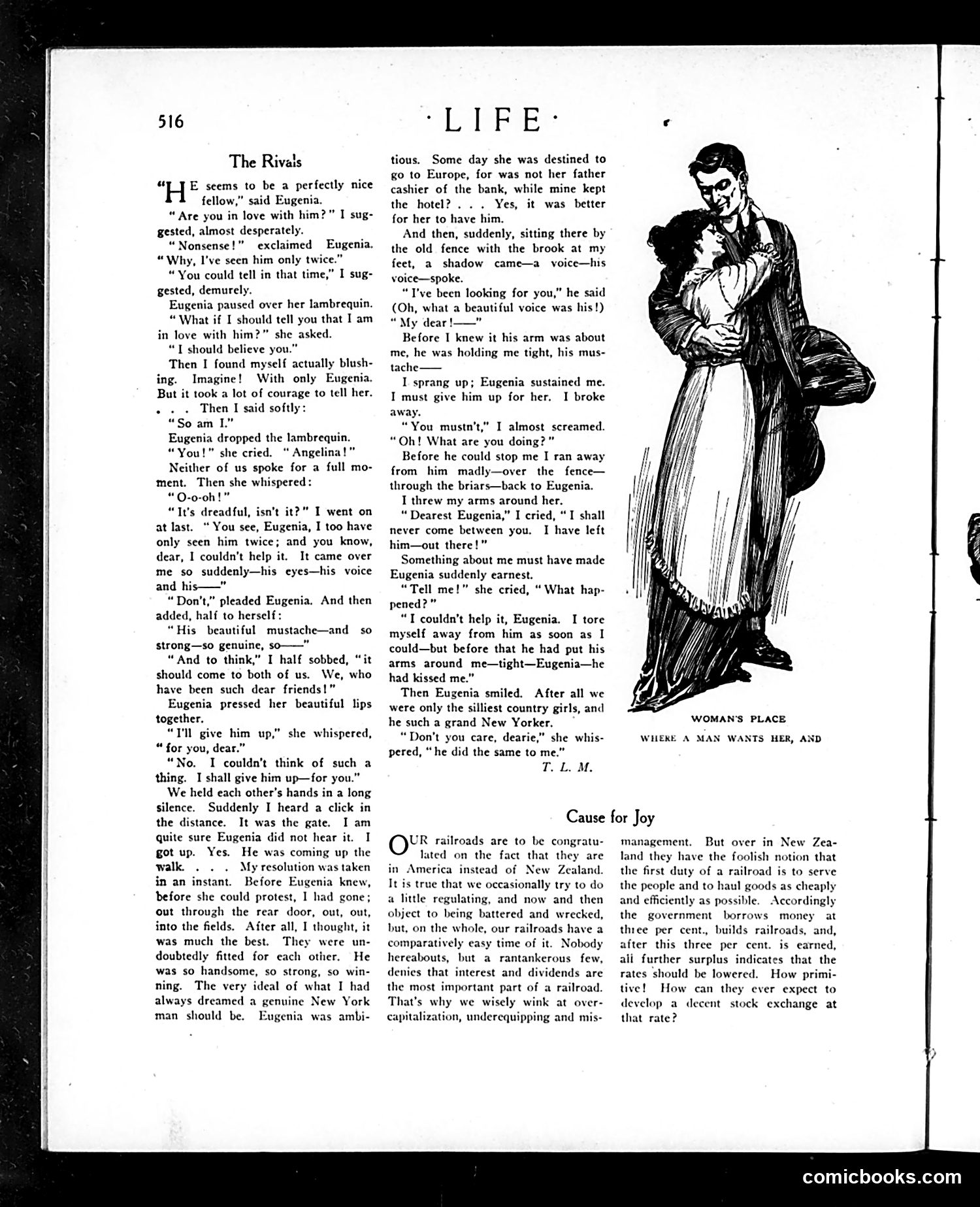
This page contains two separate pieces from *Life* magazine: **"The Rivals"** (left): A romantic comedy story about two female friends, Angelina and Eugenia, who discover they're both attracted to the same man—a charming New Yorker. After an emotional confrontation where each claims to sacrifice him for the other's sake, Angelina flees when he arrives. She later learns from Eugenia that he kissed them both. The story satirizes melodramatic sentiment and female rivalry, ending with the caption "Woman's Place: Where a Man Wants Her"—mocking how women were portrayed as competing for male attention. **"Cause for Joy"** (right): An editorial praising American railroads for being less regulated than New Zealand's, emphasizing that shareholder dividends matter more than safety. The piece sarcastically celebrates corporate interests over public welfare—typical *Life* satire of Gilded Age capitalism and corporate excess. Both pieces exemplify the magazine's social commentary on gender relations and business ethics.
📄 Transcribed text from this page (OCR, searchable)
Machine-transcribed from the original scan — historical spelling and the odd misread are preserved.
516 The Rivals < E seems to be a perfectly nice fellow,” said Eugenia. “ Are you in love with him?” I sug- gested, almost desperately. “Nonsense!” exclaimed Eugenia. “Why, I've seen him only twice.” “You could tell in that time,” I sug- gested, demurely. Eugenia paused over her lambrequin. “ What if I should tell you that I am in love with him?” she asked. “T should believe you.” Then I found myself actually blush- ing. Imagine! With only Eugeni: But it took a lot of courage to tell her. « «+ Then I said softly: “So am I.” Eugenia dropped the lambrequin. “You!” she cried. “ Angelina!” Neither of us spoke for a full mo- ment. Then she whispered: “O-o-oh!” “T's dreadful, isn’t it?" I went on at last. “You see, Eugenia, I too have only seen him twice; and you know, dear, I couldn't help it. It came over me so suddenly—his eyes—his voice and his——" “Don't,” pleaded Eugenia. And then added, half to herself: “His beautiful mustache—and so strong—so genuine, so—" “And to think,” I half sobbed, “it should come to both of us. We, who have been such dear friends!” Eugenia pressed her beautiful lips together. “Tl give him up, “ for you, dear.” “No. I couldn't think of such a thing. I shall give him up—for you.” We held each other’s hands in a long silence. Suddenly I heard a click in the distance. It was the gate. I am quite sure Eugenia did not hear it. I got up. Yes. He was coming up the walk. . My resolution was taken in an instant. Before Eugenia knew, before she could protest, I had gone; out through the rear door, out, out, into the fields. After all, I thought, it was much the best. They were un- doubtedly fitted for each other. He was so handsome, so strong, so win- ning. The very ideal of what I had always dreamed a genuine New York man should be. enia was ambi- she whispered, “LPR tious. Some day she was destined to go to Europe, for was not her father cashier of the bank, while mine kept the hotel? . Yes, it was better for her to have him. And then, suddenly, sitting there by the old fence with the brook at my feet, a shadow came—a voice—his voice—spoke. “T've been looking for you,” he said (Oh, what a beautiful voice was his!) “My dear!——” Before I knew it his arm was about me, he was holding me tight, his mus- tache— I sprang up; Eugenia sustained me. I must give him up for her. I broke away. “You mustn't," I almost screamed. “Oh! What are you doing?” Before he could stop me I ran away from him madly—over the fence— through the briars—back to Eugenia. I threw my arms around her. “Dearest Eugenia,” I cried, “I shall never come between you. I have left him—out there!” Something about me must have made Eugenia suddenly earnest. “Tell me!” she cried, “ What hap- pened?” “T couldn't help it, Eugenia. I tore myself away from him as soon as I could—but before that he had put his arms around me—tight—Eugenia—he had kissed me.” Then Eugenia smiled. After all we were only the silliest country girls, and he such a grand New Yorker, “Don’t you care, dearie,” she whis- pered, “he did the same to me.” T. LM. WOMAN'S PLACE WHERE A MAN WANTS HER, AND Cause for Joy UR railroads are to be congratu- lated on the fact that thi in America instead of New It is true that we occasionally try to do a little regulating, and now and then object to being battered and wrecked, but, on the whole, our railroads have a comparatively easy time of it. Nobody hereabouts, but a rantankerous few, denies that interest and dividends are the most important part of a railroad. That's why we wisely wink at over- capitalization, underequipping and mis- management. But over in New Zea- land they have the foolish notion that the first duty of a railroad is to serve the people and to haul goods as cheaply and efficiently as possible. Accordingly the government borrows money at three per cent. builds railroads, and, after this three per cent. is earned, ali further surplus indicates that the rates should be lowered. How primi- tive! How can they ever expect to develop a decent stock exchange at that rate? comicbooks.com