
Life, 1913-09-25 · page 21 of 43
Life — September 25, 1913 — page 21: what you’re looking at
What you’re looking at
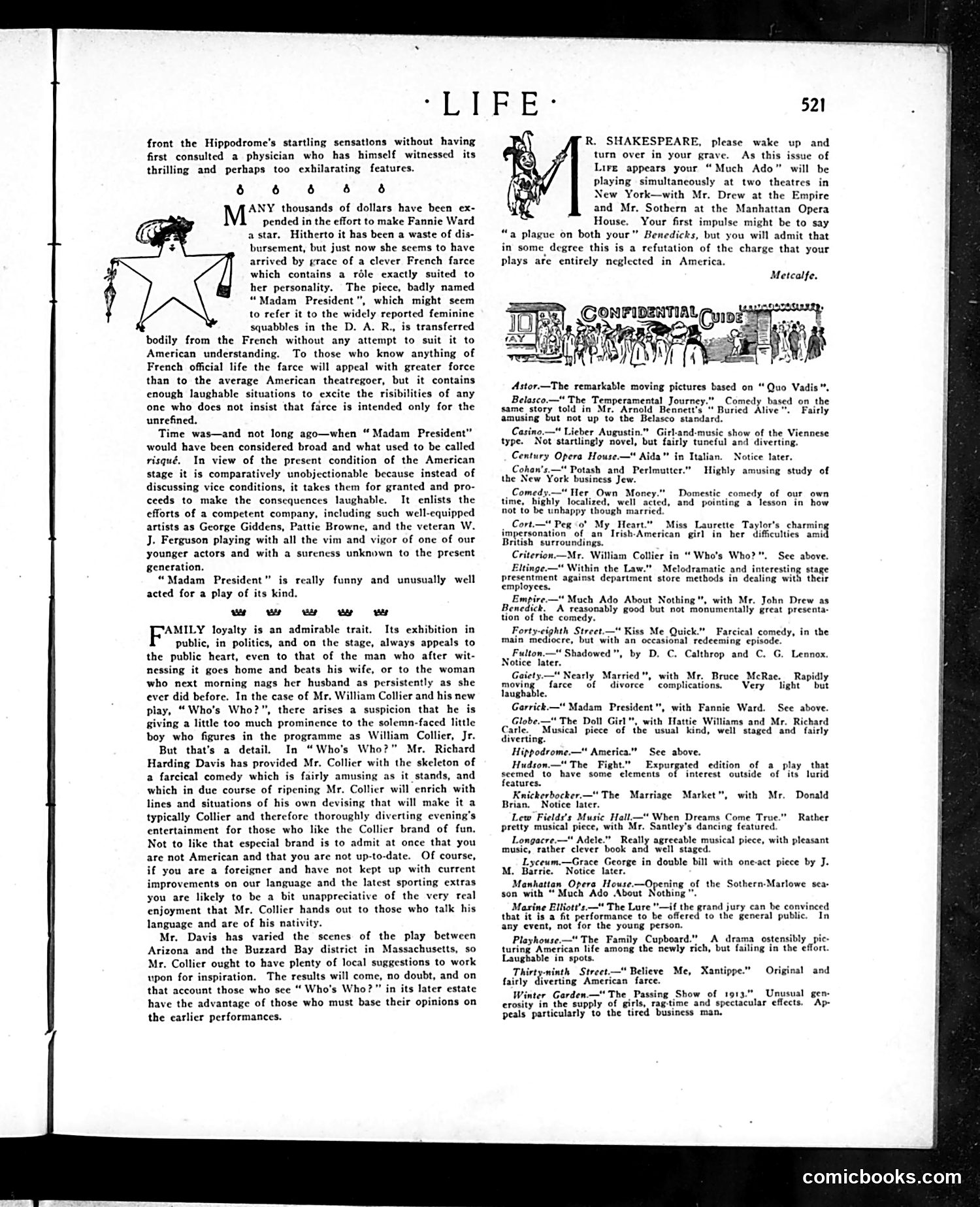
This page contains theatrical reviews rather than political cartoons. The small illustration shows a figure dangling from a star—likely satirizing the effort to make actress Fannie Ward a star through the French farce "Madam President." The reviews critique contemporary Broadway productions. The "Madam President" section notes the play is "badly named" and unsuitable for American audiences, originally referencing French governmental scandals. The reviewer suggests modern American theater has become so permissive that once-risqué farce now seems tame—a commentary on changing theatrical standards. The second review discusses William Collier's "Who's Who?", based on a Richard Harding Davis sketch, praising Collier's comic timing while gently mocking his prominence of his young son in the cast. The Shakespeare reference at page's end humorously notes his "Much Ado About Nothing" is playing simultaneously at two New York theaters—suggesting his work remains perpetually relevant to current entertainment.
📄 Transcribed text from this page (OCR, searchable)
Machine-transcribed from the original scan — historical spelling and the odd misread are preserved.
SU REE 521 front the Hippodrome’s startling sensations without having first consulted a physician who has himself witnessed its thrilling and perhaps too exhilarating features. é 6 é 4 8 ANY thousands of dollars have been ex- pended in the effort to make Fannie Ward astar. Hitherto it has been a waste of dis- bursement, but just now she seems to have arrived by grace of a clever French farce which contains a réle exactly suited to her personality. The piece, badly named “Madam President”, which might seem to refer it to the widely reported feminine squabbles in the D. A. R., is transferred bodily from the French without any attempt to suit it to American understanding. To those who know anything of French official life the farce will appeal with greater force than to the average American theatregoer, but it contains enough laughable situations to excite the risibilities of any one who docs not insist that farce is intended only for the unrefined. Time was—and not long ago—when “Madam President” would have been considered broad and what used to be called risqué. In view of the present condition of the American stage it is comparatively unobjectionable because instead of discussing vice conditions, it takes them for granted and pro- ceeds to make the consequences laughable. It enlists the efforts of a competent company, including such well-equipped artists as George Giddens, Pattie Browne, and the veteran W. J. Ferguson playing with all the vim and vigor of one of our younger actors and with a sureness unknown to the present generation, “Madam President” is really funny and unusually well acted for a play of its kind. woe ell ‘AMILY loyalty is an admirable trait. Its exhibition in public, in politics, and on the stage, always appeals to the public heart, even to that of the man who after wit- nessing it goes home and beats his wife, or to the woman who next morning nags her husband as persistently as she ever did before. In the case of Mr, William Collier and his new play, “Who's Who?”, there arises a suspicion that he is giving a little too much prominence to the solemn-faced little boy who figures in the programme as William Collier, Jr. But that’s a detail. In “Who's Who?” Mr. Richard Harding Davis has provided Mr. Collier with the skeleton of a farcical comedy which is fairly amusing as it stands, and which in due course of ripening Mr. Collier will enrich with lines and situations of his own devising that will make it a typically Collier and therefore thoroughly diverting evening's entertainment for those who like the Collier brand of fun. Not to like that especial brand is to admit at once that you are not American and that you are not up-to-date. Of course, if you are a foreigner and have not kept up with current improvements on our language and the latest sporting extras you are likely to be a bit unappreciative of the very real enjoyment that Mr. Collier hands out to those who talk his language and are of his nativity. Mr. Da has varied the scenes of the play between Arizona and the Buzzard Bay district in Massachusetts, so Mr. Collicr ought to have plenty of local suggestions to work upon for inspiration. The results will come, no doubt, and on that account those who see “ Who's Who?” in its later estate have the advantage of those who must base their opinions on the earlier performances. R. SHAKESPEARE, please wake up and turn over in your grave. As this issue of Lire appears your “Much Ado” will be playing simultaneously at two theatres in New York—with Mr. Drew at the Empire and Mr. Sothern at the Manhattan Opera House, Your first impulse might be to say “a plague on both your” Benedicks, but you will admit that in some degree this is a refutation of the charge that your plays ate entirely neglected in America. Metcalfe, Astor—The remarkable moving pictures based on Belasco.— The Temperamental Journey.” Comed: same story told in Mr. Arnold Bennett's “ Buried amusing but not up to the Belasco standard. Casino.—" Lieber Augustin.” Girl-and-music show of the Viennese type. Not startlingly novel, but fairly tuneful and diverting. Century Opera House.—" Aida” in Italian. Cohan's.—" Potash and Perlmutter.” Highly amusing study of the New York business Jew. * “ Comedy.—" Her Own Money." Domestic comedy of our own time, highly localized, well acted, and pointing a lesson in how not to be unhappy though married. _ Cort.—" Peg ot My Heart." Miss Laurette Taylor's charmin impersonation of an Irish-American girl in her difficulties ami British surroundings. Criterion.—Mr. William Collier in “ Who's Who?". See above. Eltinge —" Within the Law.” Melodramatic and interesting stage presentment against department store methods in dealing with their employees. Empire—* Much Ado About Nothing", with Mr. John Drew as Benedick, A reasonably good but not monumentally great presenta: tion of the comedy. Forty-eighth Street—" Kiss Me Quick.” Farcical comedy, in the main mediocre, but with an occasional redeeming episode. Fulton.—" Shadowed", by D. C. Calthrop and C. G. Lennox. Notice later. Gaiety.—" Nearly Married", with Mr, Bruce McRae. Rapidly moving farce of divorce " complications. Very light» but laughable. Garrick —" Madam President", with Fannie Ward. See above. | Globe.—" The Doll Girl", with Hattie Williams and Mr. Richard Carle. “Musical piece of the usual kind, well staged and. fairly diverting. Hippodrome.—" America.” See above. Hudson.—" The Fight." Expurgated edition of a play that seemed to have some elements of interest outside of its lurid features. Knickerbocker.—"" The Marriage Market”, with Mr. Donald Brian, Notice later. Lew Fields’s Music Hall. When Dreams Come True.” preity musical piece, with Mr. Santley’s dancing featured. Longacre.—" Adele.” Really agreeable musical piece, with pleasant music, rather clever book and well staged. Lyceum.—Grace George in double bill with one-act piece by J. M. Barrie. Notice later. Manhattan Opera House.—Opening of the Sothern-Marlowe sea- son with “Much Ado About Nothing”. Mazine Elliott's." The Lure "—if the grand jury can be convinced that it is a fit performance to be offered to the general public. In any event, not for the young person. Playhouse.—" The Family Cupboard.” A drama ostensibly pic- turing American life among the newly rich, but failing in the effort. Laughable in spots. Thirty-ninth Strect—" Believe Me, Xantippe. fairly diverting American farce. Winter Garden.—" The Passing Show of 1913." Unusual gen- erosity in the supply of girls, rag-time and spectacular effects. Ap- peals particularly to the tired business man, Quo Vadis”. based on the live. Fairly Notice later, Rather Original and comicbooks.com