
Life, 1913-09-25 · page 24 of 43
Life — September 25, 1913 — page 24: what you’re looking at
What you’re looking at
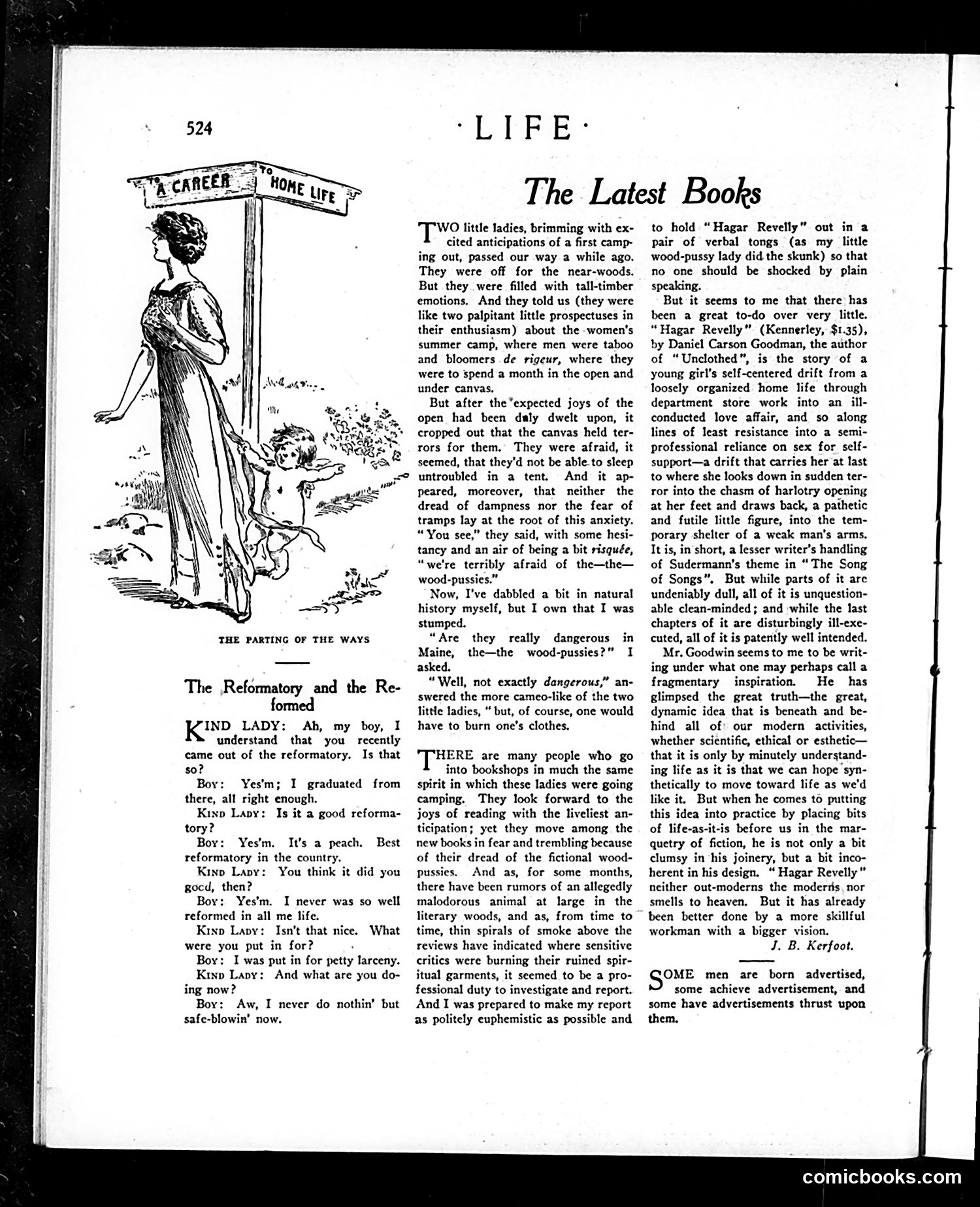
This page contains two distinct satirical pieces from early 20th-century Life magazine. **"The Parting of the Ways"** (left) mocks the ineffectiveness of reformatories. A "Kind Lady" congratulates a boy on graduating from reform school, praising its quality. The joke's dark twist: he's now committing safe-breaking instead of petty larceny—the reformatory apparently trained him in more serious crime rather than rehabilitation. **"The Latest Books"** (right) uses a clever extended metaphor. Two young women fear "wood-pussies" (skunks) at their camping trip, requiring them to burn contaminated clothes. The reviewer compares this to readers' anxiety about the novel *Hagar Revelly*—treating it as a dangerous literary "animal" that might corrupt them. He argues the book, while dull, is actually "clean-minded" and not the moral threat critics claim. The satire targets both overly-cautious literary critics and readers' prudishness about candid fiction addressing sexuality and women's economic vulnerability.
📄 Transcribed text from this page (OCR, searchable)
Machine-transcribed from the original scan — historical spelling and the odd misread are preserved.
Avdog mh THE PARTING OF THE WAYS The ,Reformatory and the Re- formed IND LADY: Ah, my boy, I understand that you recently came out of the reformatory. Is that so? Boy: Yes’m; I graduated there, all right enough. Kinp Lapy: Is it a good reforma- tory? Boy: Yes'm. It’s a peach. Best i reformatory in the country. i Kino Lapy: You think it did you gocd, then? Boy: Yes'm. I never was so well reformed in all me life. Kip Lavy: Isn't that nice. 1 were you put in for? Boy: I was put in for petty larceny. Kino Lavy: And what are you do- | ing now? i Boy: Aw, I never do nothin’ but q safe-blowin’ now. from What * DPE? Te. little ladies, brimming with ex- cited anticipations of a first camp- ing out, passed our way a while ago. They were off for the near-woods. But they were filled with tall-timber emotions. And they told us (they were like two palpitant little prospectuses in their enthusiasm) about the women’s summer camp, where men were taboo and bloomers de rigeur, where they were to spend a month in the open and. under canvas. But after the “expected joys of the open had been daly dwelt upon, it cropped out that the canvas held ter- rors for them. They were afraid, it seemed, that they'd not be able.to sleep untroubled in a tent. And it ap- peared, moreover, that neither the dread of dampness nor the fear of tramps lay at the root of this anxiety. “You see,” they said, with some hesi- tancy and an air of being a bit risquée, “we're terribly afraid of the—the— wood-pussies.” Now, I’ve dabbled a bit in natural history myself, but I own that I was stumped. “Are they really dangerous in Maine, the—the wood-pussies?” I asked. “Well, not exactly dangerous,” an- swered the more camco-like of the two little ladies, “ but, of course, one would have to burn one’s clothes, "THERE are many people who go into bookshops in much the same spirit in which these ladies were going camping. They look forward to the joys of reading with the liveliest an- ticipation; yet they move among the new books in fear and trembling because of their dread of the fictional wood- pussies. And as, for some months, there have been rumors of an allegedly malodorous animal at large in the literary woods, and as, from time to time, thin spirals of smoke above the reviews have indicated where sensitive critics were burning their ruined spir- itual garments, it seemed to be a pro- fessional duty to investigate and report. And I was prepared to make my report as politely euphemistic as possible and The Latest Books to hold “Hagar Revelly” out in a pair of verbal tongs (as my little wood-pussy lady did the skunk) so that no one should be shocked by plain speaking. But it seems to me that there has been a great to-do over very little. “Hagar Revelly” (Kennerley, $1.35), by Daniel Carson Goodman, the author of “Unclothed”, is the story of a young girl’s self-centered drift from a loosely organized home life through department store work into an ill- conducted love affair, and so along lines of least resistance into a semi- professional reliance on sex for self- support—a drift that carries her at last to where she looks down in sudden ter- ror into the chasm of harlotry opening at her feet and draws back, a pathetic and futile little figure, into the tem- porary shelter of a weak man’s arms. It is, in short, a lesser writer’s handling of Sudermann’s theme in “The Song of Songs”. But while parts of it are undeniably dull, all of it is unquestion- able clean-minded ; and while the last chapters of it are disturbingly ill-exe- cuted, all of it is patently well intended. Mr. Goodwin seems to me to be writ- ing under what one may perhaps call a fragmentary inspiration. He has glimpsed the great truth—the great, dynamic idea that is beneath and be- hind all of: our modern activities, whether scientific, ethical or esthetic— that it is only by minutely understand- ing life as it is that we can hope ‘syn- thetically to move toward life as we'd like it. But when he comes to putting this idea into practice by placing bits of life-as-it-is before us in the mar- quetry of fiction, he is not only a bit clumsy in ‘his joinery, but a bit inco- herent in his design. “ Hagar Revelly” neither out-moderns the moderris, nor smells to heaven. But it has already been better done by a more skillful workman with a bigger vision. J. B. Kerfoot. OME men are born advertised, some achieve advertisement, and some have advertisements thrust upon them, comicbooks.com