
A complete issue · 40 pages · 1913
Life — August 21, 1913
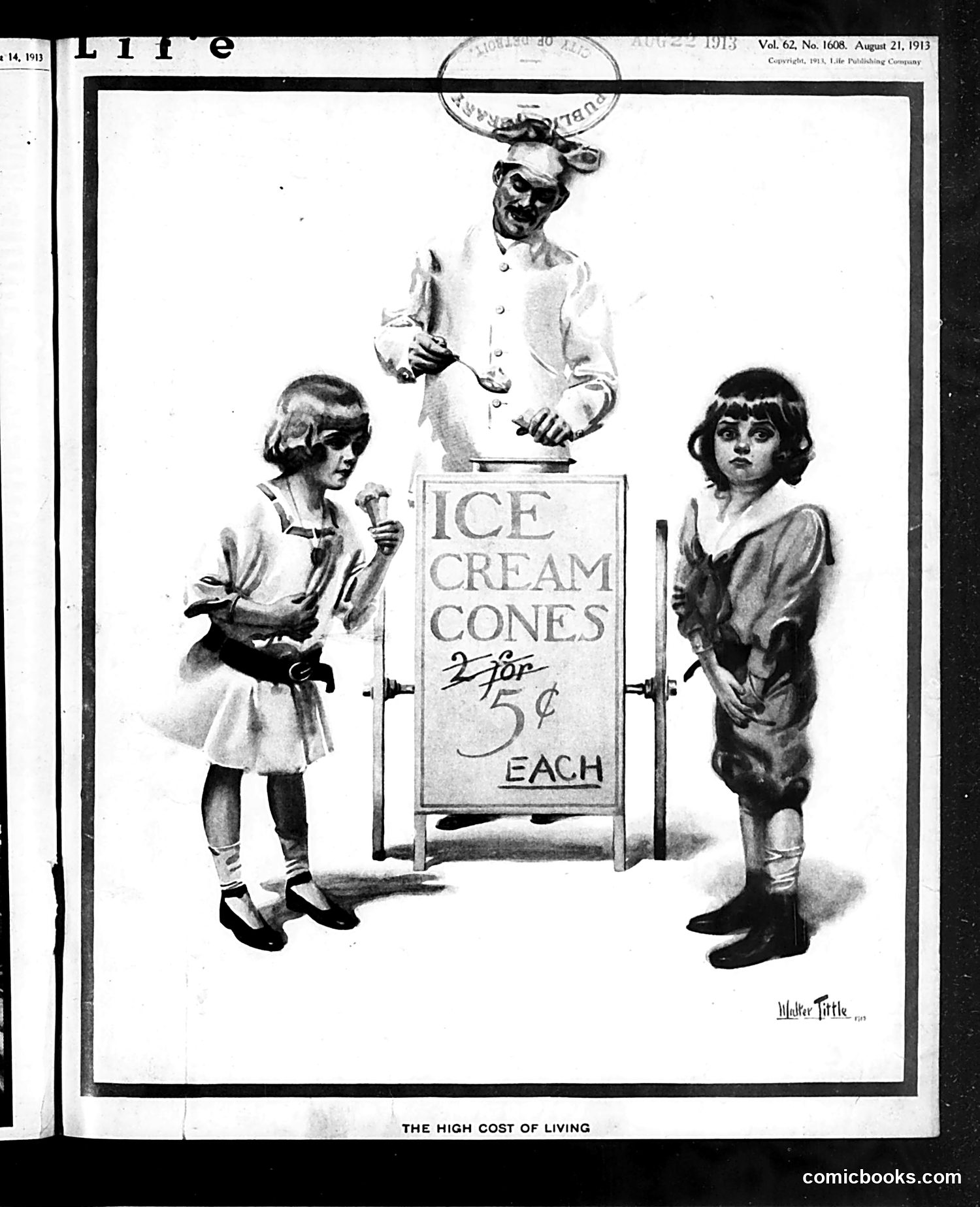
This is a satirical commentary titled "THE HIGH COST OF LIVING," addressing economic inflation in 1913 America. The cartoon depicts an ice cream vendor serving two young girls, with a prominent sign reading "ICE CREAM CONES 2 for 5¢ EACH." The satire works through contradiction: the sign claims "2 for 5¢" while stating "EACH," suggesting the vendor is obscuring actual pricing—likely that cones now cost 5¢ individually, not two for that price. This reflects real public frustration over rising costs of everyday goods during this inflationary period. The innocent children represent ordinary consumers caught in this pricing deception. The cartoon critiques how merchants used confusing or misleading marketing to disguise price increases from consumers during a time of economic strain.
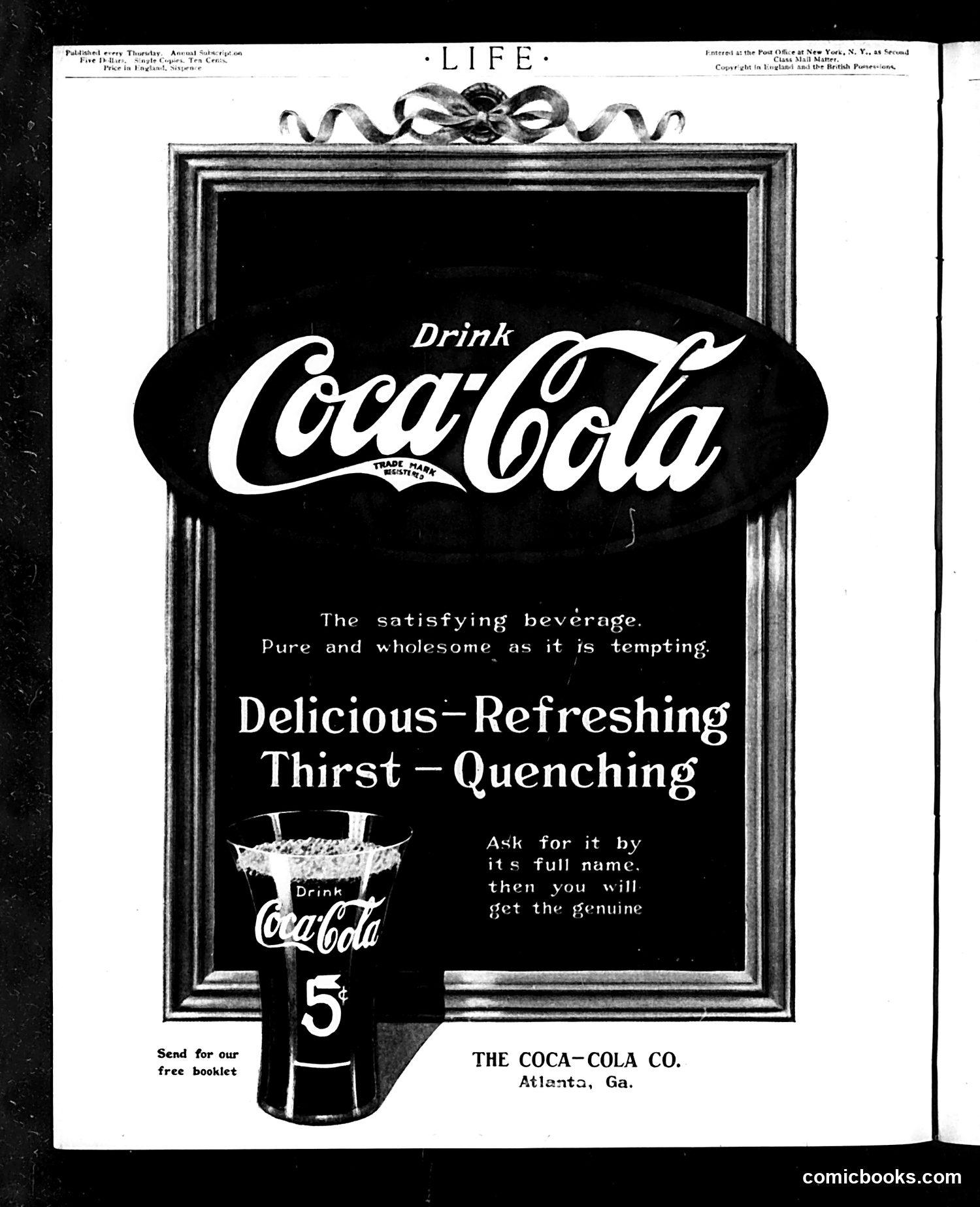
This is **not a cartoon or satirical content** — it's a straightforward advertisement for Coca-Cola from an early period of the magazine *Life*. The ad emphasizes the product's qualities ("satisfying beverage," "pure and wholesome," "delicious-refreshing") and price (5¢). The decorative frame with ribbon bow suggests luxury and elegance typical of early 20th-century advertising design. Notable elements for modern readers: the emphasis on purity and wholesomeness reflects historical concerns about patent medicines and beverages of that era. The instruction to "ask for it by its full name" suggests competitors or imitations existed. The free booklet offer was a common marketing tactic before mass media. This represents corporate advertising, not satirical commentary.
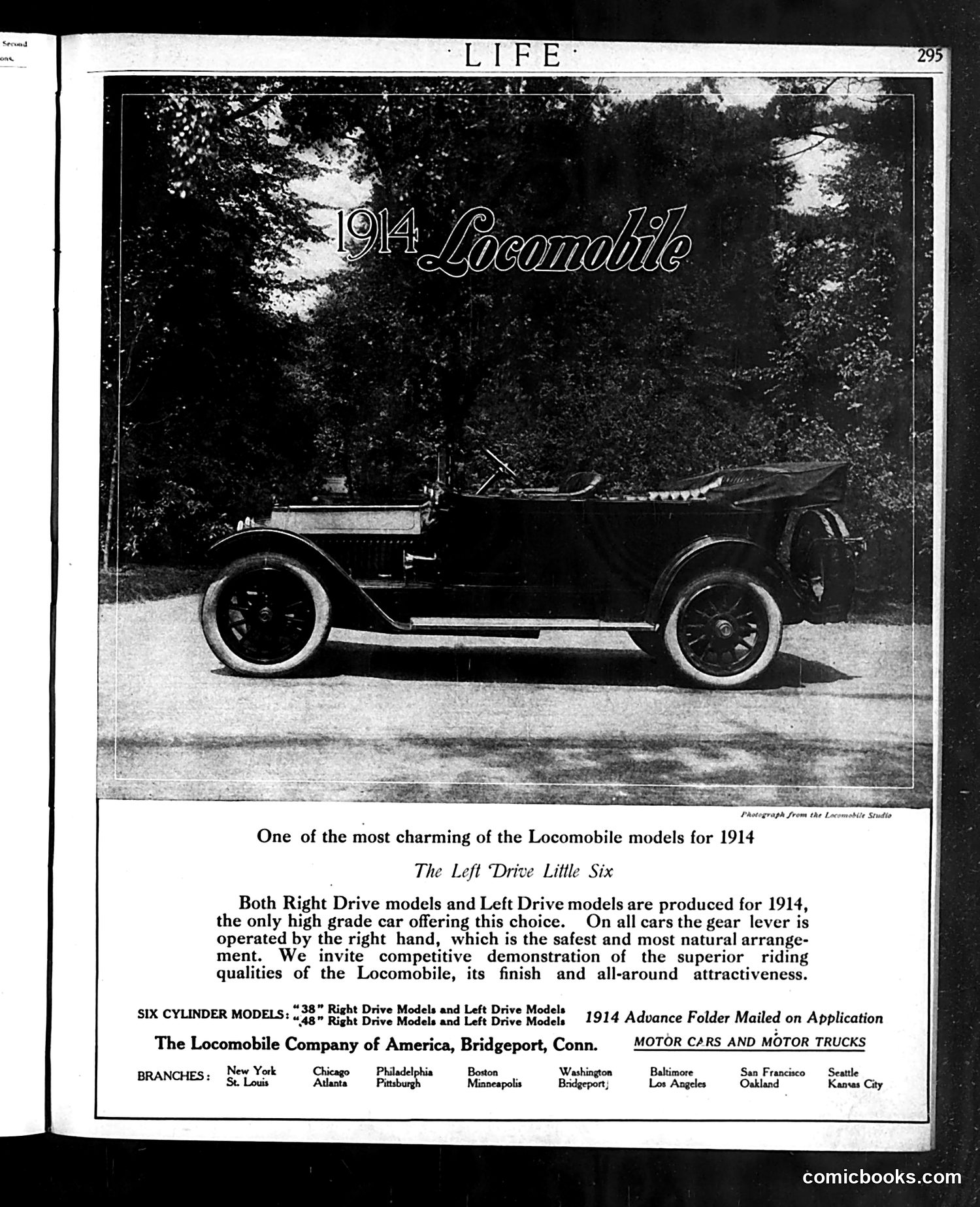
This page is **not a cartoon or satire**—it is a straightforward automobile advertisement from *Life* magazine (page 295). The image shows a 1914 Locomobile automobile photographed in profile against a wooded background. The text promotes "The Left 'Drive Little Six," highlighting that Locomobile offered both right-hand and left-hand drive models—apparently a distinctive feature among "high grade" cars in 1914. The ad emphasizes practical selling points: the gear lever operated by hand (described as "safest and most natural arrangement"), superior riding qualities, and finish. It concludes with contact information for The Locomobile Company of America in Bridgeport, Connecticut, listing multiple branch locations across the United States. This represents early automotive advertising targeting affluent buyers.
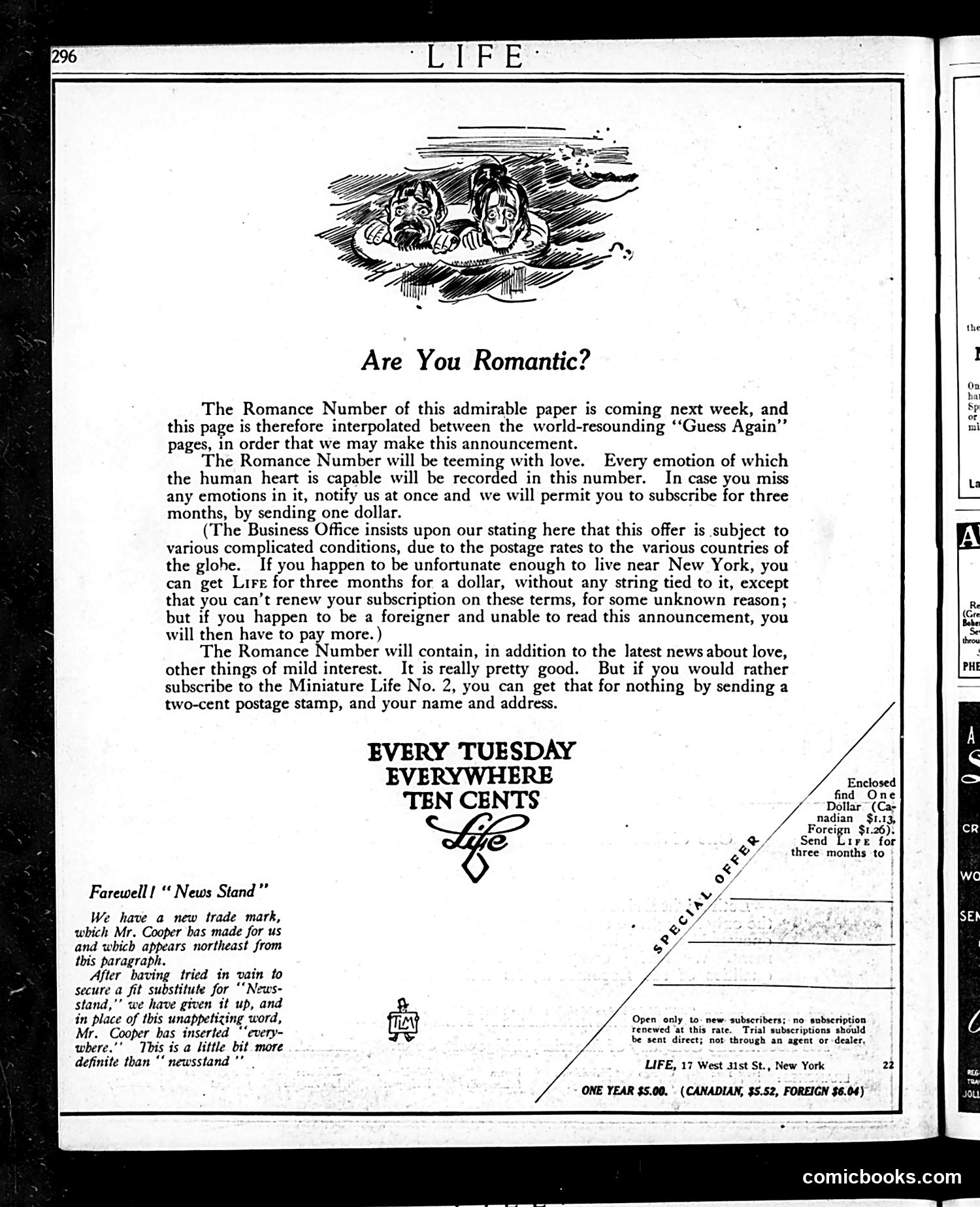
This page is primarily a **magazine subscription advertisement** rather than political satire. The illustration shows two romantic faces emerging from clouds, accompanying copy promoting Life's upcoming "Romance Number." The ad uses humorous exaggeration typical of Life's satirical style, playfully mocking both romantic sentiment and magazine marketing practices. It mentions the "Guess Again" pages and jokes about the Business Office's overly complicated subscription terms for various countries. The satire targets **mass-market romance publishing itself**—Life is self-consciously promoting sentimental content while simultaneously poking fun at romance magazine conventions and the earnest emotions they exploit. The page includes a secondary note about replacing "News Stand" with a new trade mark by Mr. Cooper, a minor editorial housekeeping matter.
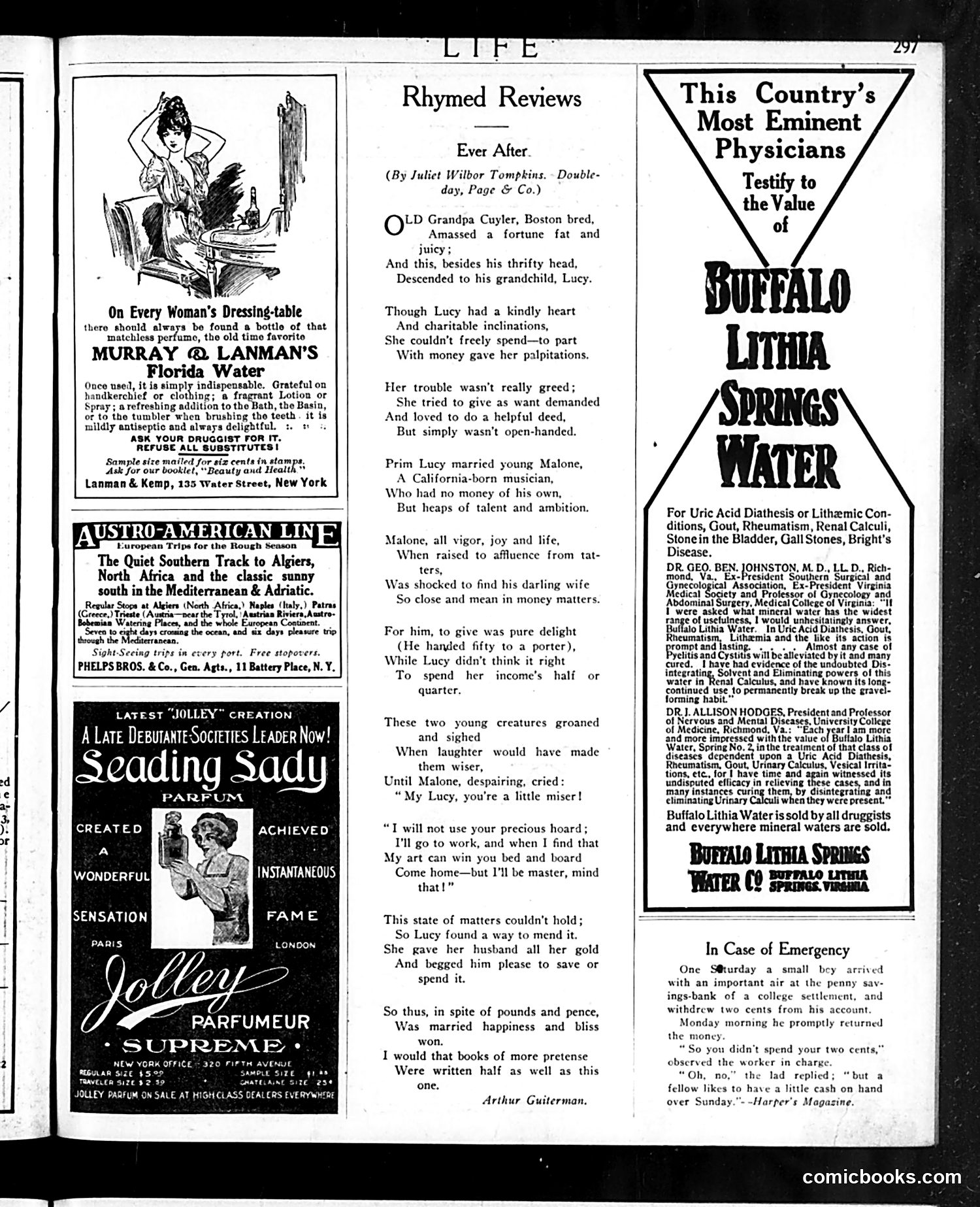
This page contains primarily **advertising and light satirical content** rather than political commentary. The main illustrated content includes: 1. **"Murray & Lanman's Florida Water"** advertisement—a perfume ad emphasizing the product's utility for handkerchiefs and clothing, presented as an indispensable item on women's dressing tables. 2. **"Sealing Sady" perfume ad**—a "Jolley" creation claiming to create "instantaneous fame" in Paris and London, using visual humor with a stylized female figure. 3. **"Rhymed Reviews: Ever After"** by Juliet Wilbor Tompkins—a satirical poem about a young couple's financial struggles after marriage, mocking romantic ideals versus economic reality. The page reflects early 20th-century consumer culture and modest social satire about courtship and marriage economics, rather than serious political content.
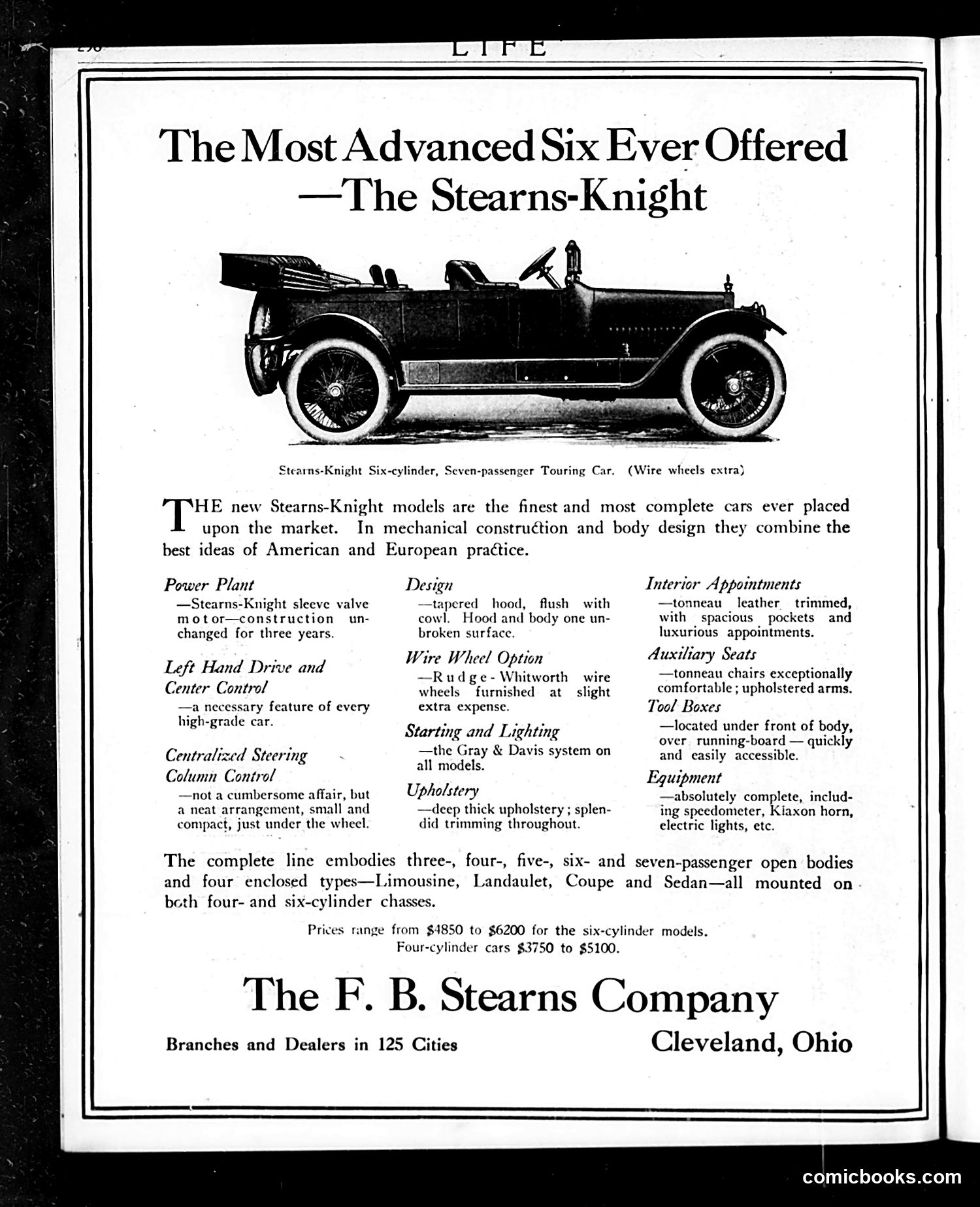
This page is **primarily an automobile advertisement**, not political satire or a cartoon. It promotes the Stearns-Knight automobile, manufactured by The F. B. Stearns Company in Cleveland, Ohio. The ad emphasizes the car's advanced features: a six-cylinder engine, left-hand drive, centralized steering, optional wire wheels, and luxurious interior appointments. It highlights the vehicle's combination of "American and European practice" in design. The image shows a seven-passenger touring car with the distinctive open-body style typical of early 1910s automobiles. The advertisement lists various body configurations available and price ranges ($1,850-$6,200 for six-cylinder models). This appears in *Life* magazine as a full-page advertisement showcasing a premium consumer product of the era.
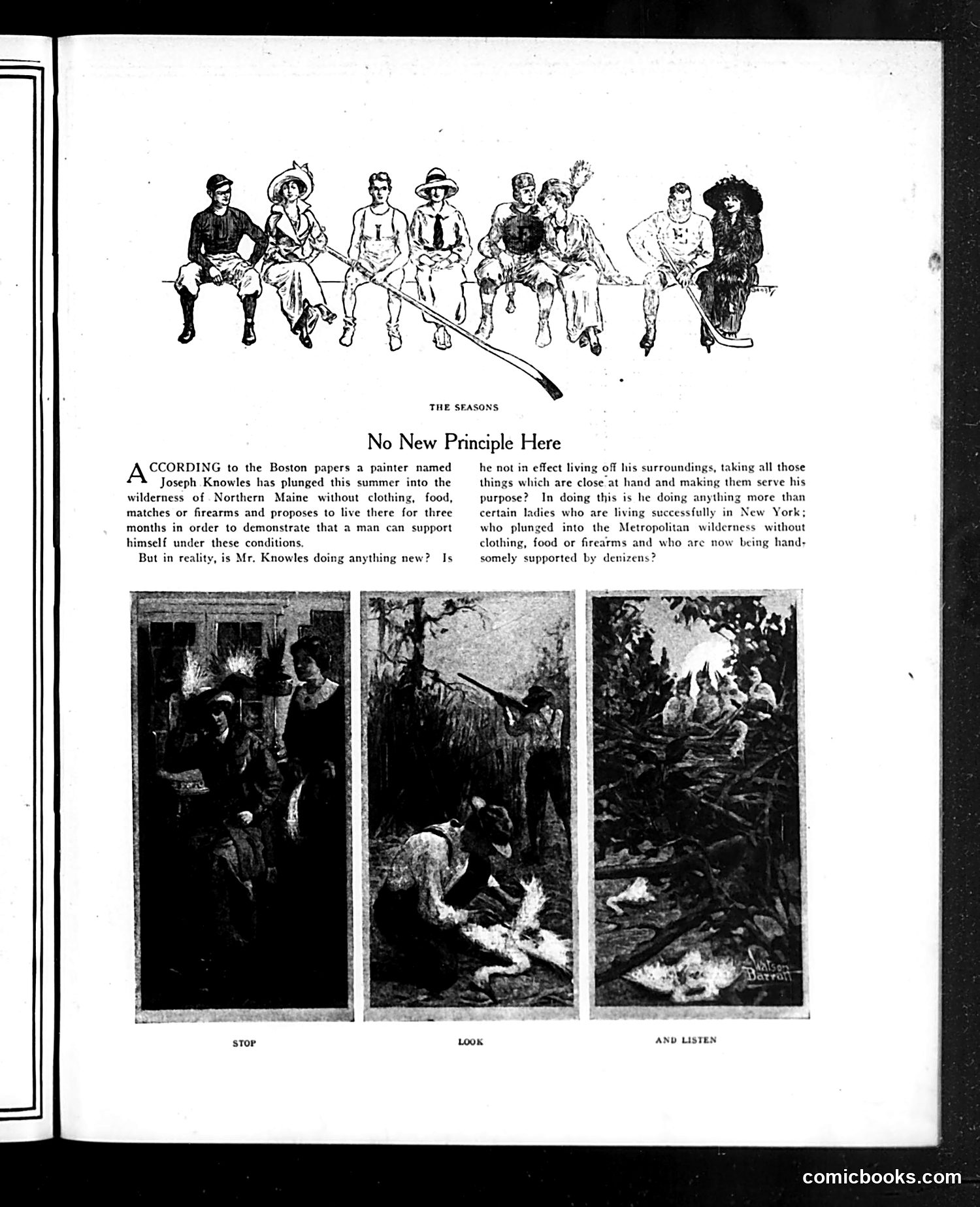
This page mocks a Boston painter named Joseph Knowles who proposed living three months in the Northern wilderness with minimal supplies to prove self-sufficiency. The article questions whether this is genuinely novel, noting wealthy New York women already live similarly—taking resources "close at hand" without "handsome support by citizens." The top illustration shows fashionable people lounging while fishing, suggesting idle leisure. The three photographs below labeled "STOP," "LOOK," and "AND LISTEN" depict wilderness survival scenes (campfire, hunting, gathering), contrasting the women's urban "wilderness living" with actual survival activities. The satire suggests Knowles's stunt merely mimics what privileged women already practice—living off their surroundings without acknowledged dependence on others' support.
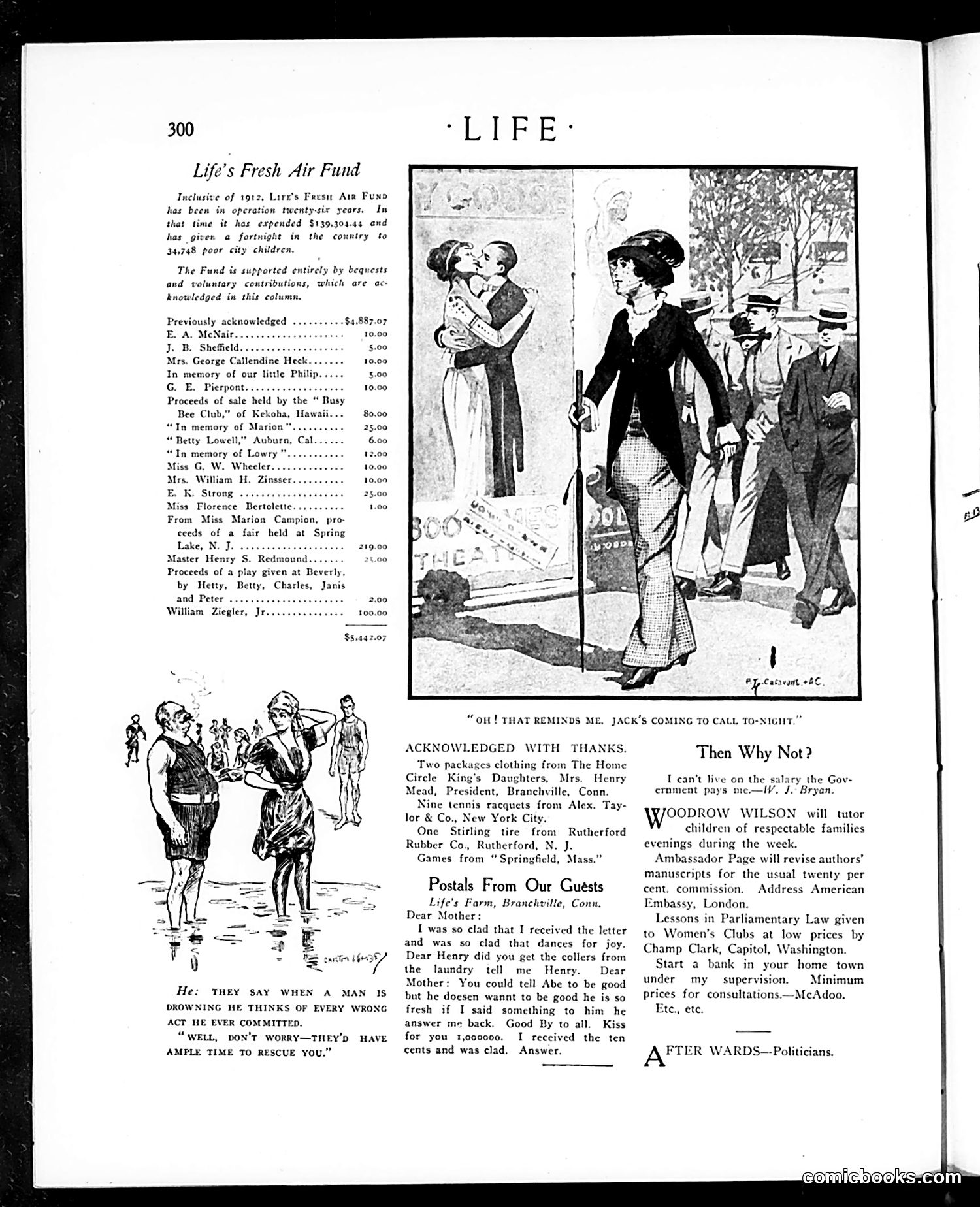
This page combines charity fundraising with social commentary. The main illustration shows a woman in winter clothing encountering well-dressed men on a street, captioned "Oh! That Reminds Me. Jack's Coming to Call To-Night." The cartoon appears to satirize class consciousness—the woman's concern about her suitor's visit reflects anxiety about social appearances and propriety. The lower cartoon depicts two figures at a beach with text: "They say when a man is drowning he thinks of every wrong act he ever committed...Well, don't worry—they'd have ample time to rescue you." This is dark humor about moral reckoning in crisis. The page primarily documents **Life's Fresh Air Fund**—a charitable initiative providing assistance to children—listing donors and contributions. The satirical content works alongside the fund's serious charitable purpose.
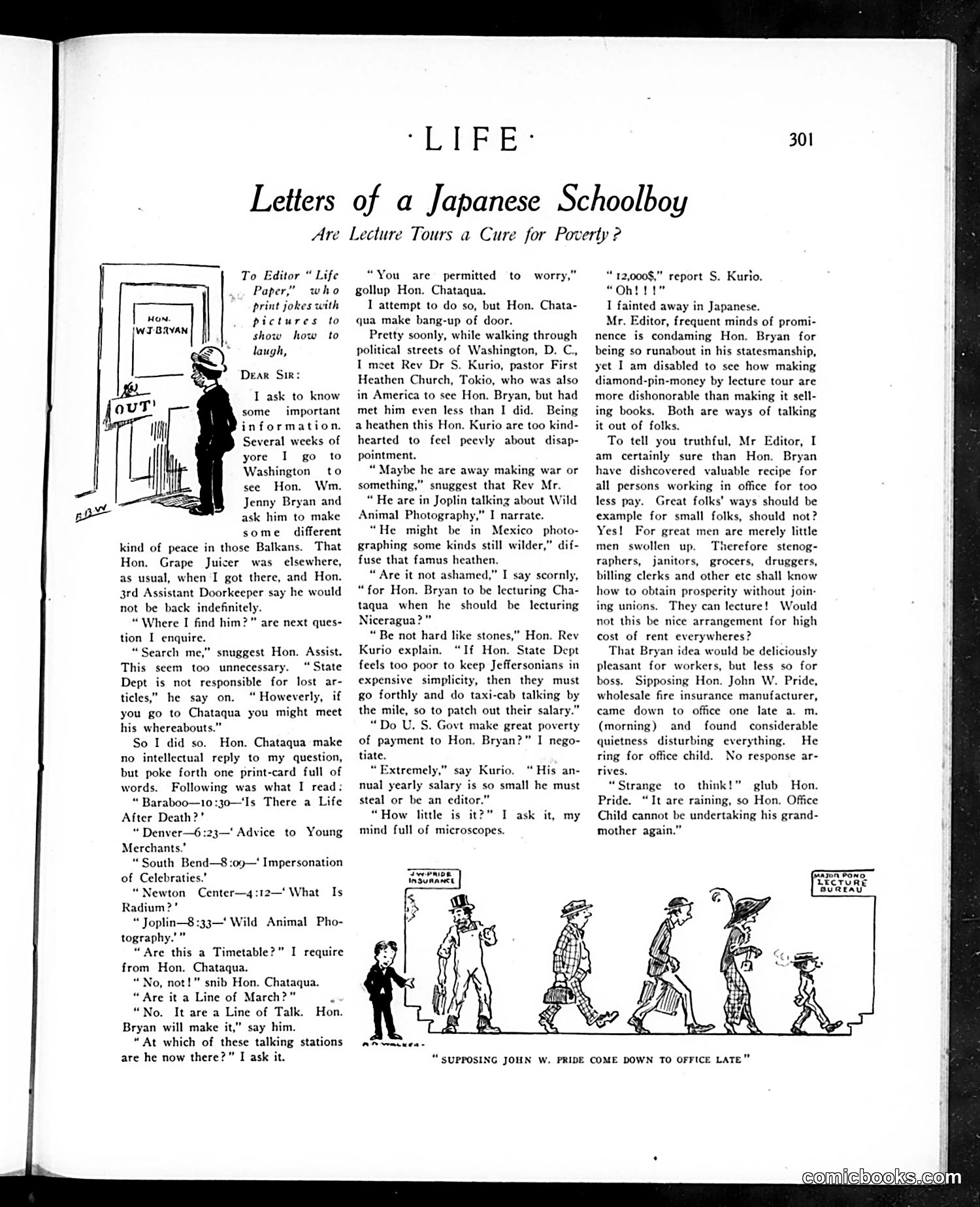
This cartoon satirizes **John W. Pride**, apparently a wholesale grocery insurance manufacturer mentioned in the letter. The sequence shows Pride's progressive transformation—beginning as a well-dressed man in the first panel, he deteriorates through increasingly disheveled states, eventually becoming barely human by the final panel. The joke relates to the letter's discussion about office worker salaries and prosperity. The implication is that if Pride—a successful businessman—were forced to live on the meager salary of an office worker (the salary Hon. Bryan supposedly couldn't survive on), he would literally fall apart, implying office workers are expected to function on impossible wages.
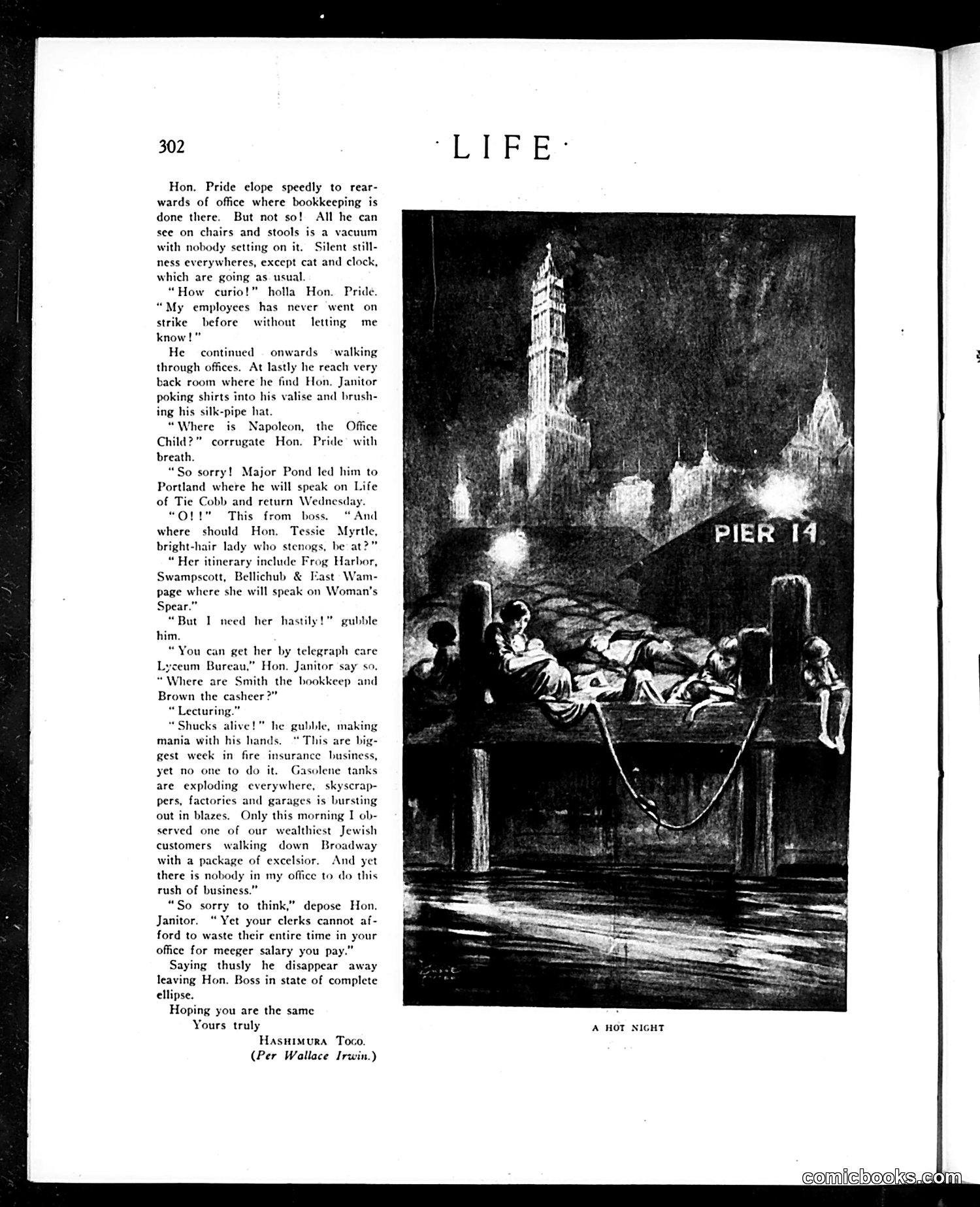
This page contains a satirical letter from "Hon. Janitor" to "Hon. Boss" complaining about workplace chaos during what appears to be a labor crisis. The janitor sarcastically catalogs absurdities: employees conducting business on chairs (suggesting no desks available), missing staff members, and insurance/industrial disasters occurring while the boss demands office productivity. The accompanying illustration titled "PIER 14" depicts people resting or sleeping at a waterfront location, likely referencing homeless individuals or those displaced during an economic crisis—possibly the Great Depression or a period of labor unrest. The satire criticizes management's unrealistic expectations during genuine hardship, mocking the disconnect between executive demands and workers' actual circumstances. The tone suggests frustration with capitalist indifference to workers' welfare.
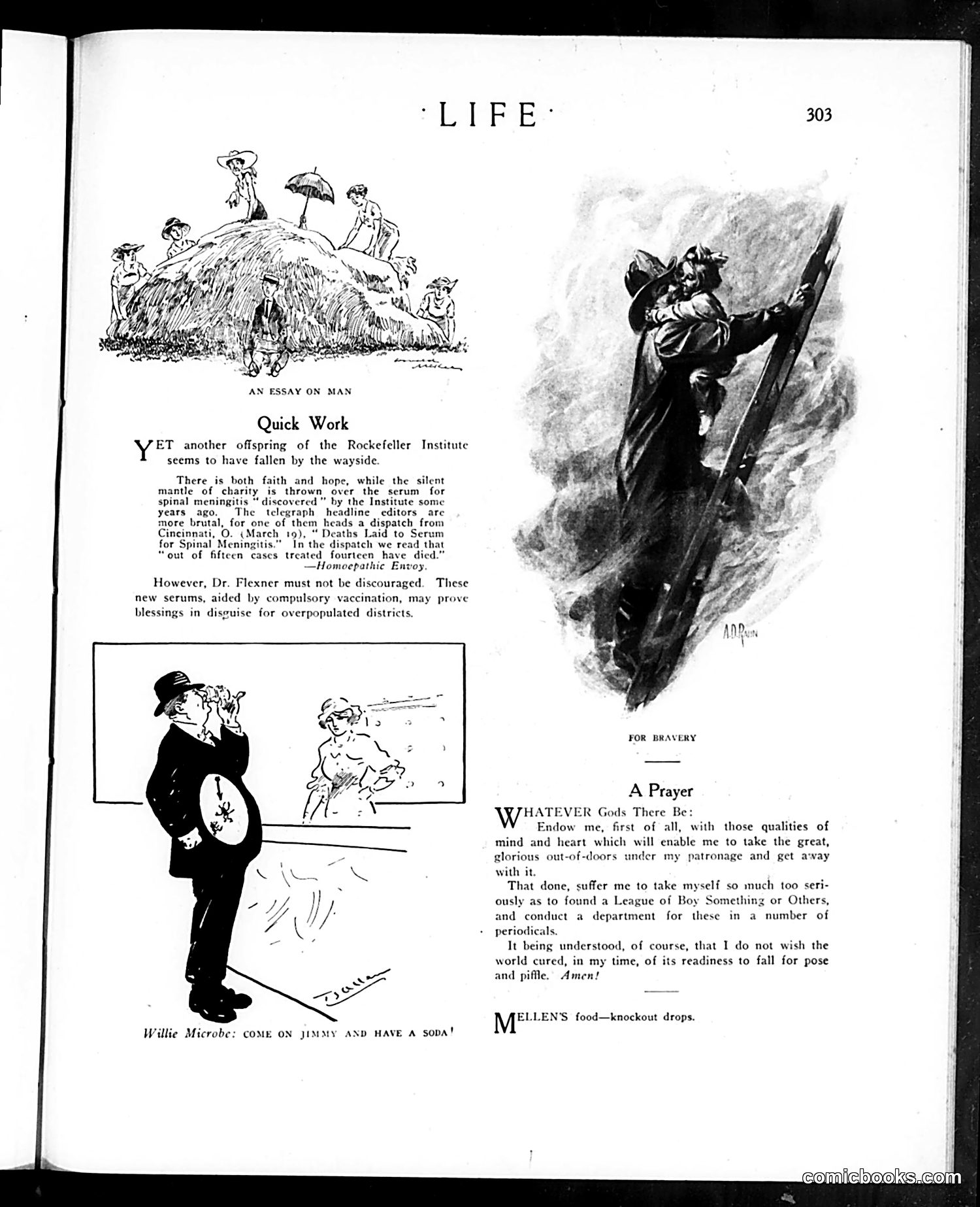
This page contains social commentary rather than political cartoons. The main article, "Quick Work," discusses a Rockefeller Institute serum for spinal meningitis, expressing both hope and skepticism about new medical treatments and compulsory vaccination. The cartoon shows "Willie Microbe" (personified germ) telling someone to "come on Jimmy and have a soda" — a dark joke about disease transmission, suggesting casual social interaction spreads illness. "For Bravery" depicts a figure climbing a ladder, likely satirizing dangerous or foolish acts of courage. "A Prayer" mocks someone seeking to lead an organization while avoiding serious commitment — the humor lies in the contradictory desires expressed. The Mellens food advertisement appears at bottom. Overall, the page blends medical skepticism with social satire typical of early 20th-century Life magazine humor.
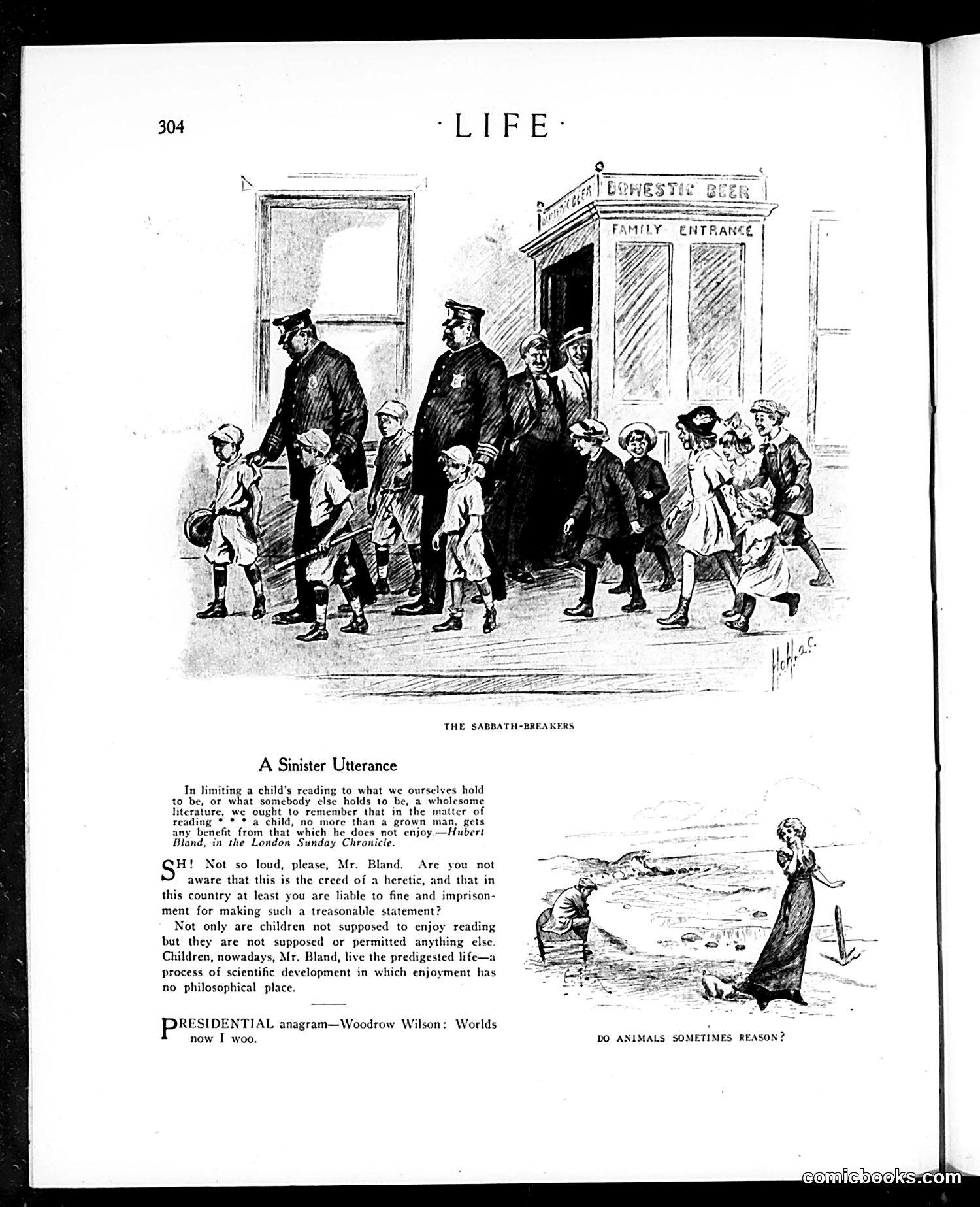
**Top Cartoon - "The Sabbath-Breakers":** Police officers and uniformed officials escort children into what appears to be a public establishment (marked "Lowesic Beer" with "Family Entrance"). The satire criticizes allowing children into beer halls on Sundays, which violated religious observance norms of the era. The caption "A Sinister Utterance" introduces a quote from Hubert Bland criticizing restrictions on children's reading as censorship. **Bottom Illustration - "Do Animals Sometimes Reason?":** Shows a woman and animals on a beach, likely a humorous observation about animal behavior. **Editorial Text:** Bland argues that limiting children's reading violates free speech and that modern child development shouldn't involve "philosophical" restrictions on enjoyment. A Woodrow Wilson anagram joke concludes the page. The content reflects early-20th-century debates about childhood, temperance laws, and censorship.
This page contains reader submissions answering "What is the Worst Summer Resort and Why?" Rather than a cartoon, it presents humorous written responses from readers. The main contributions mock European vacation destinations. One writer (R.D. Brooks) argues Europe—London, Paris, the Riviera—is overcrowded with American tourists seeking status, yet offers no genuine comfort compared to American alternatives like South Bend or Scranton. Another (Thomas L. Lennon) sarcastically names "Home" as worst, criticizing Eureka's lack of hospitality: absent tipping culture, poorly cooked meals, and no amenities for children. The satire targets early-20th-century American status-seeking through expensive European travel while mocking the actual unpleasantness of such trips and the pretension of resort culture generally.
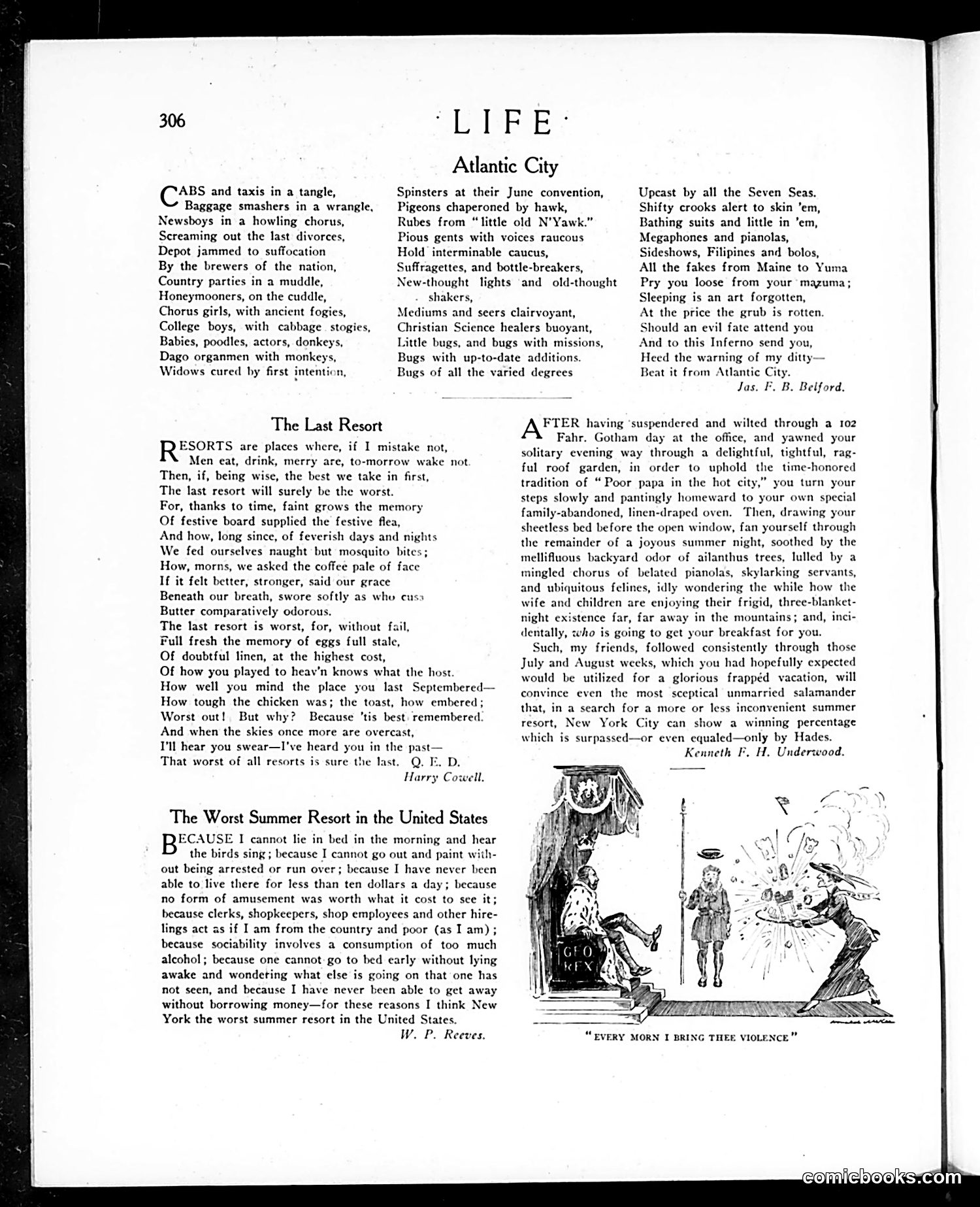
This page contains three humorous essays about summer resorts rather than political cartoons. The illustration accompanying "After having suspended and wilted through a 102 Fahr. Gotham day" depicts a domestic scene with the caption "Every morn I bring thee violence." The cartoon shows what appears to be a husband bringing a newspaper or similar object to bed, with a woman and child present. The caption's reference to "violence" suggests satirical commentary on domestic friction during hot, uncomfortable summer months in the city. The essays themselves mock Atlantic City tourism, resort culture generally, and New York City's summer conditions. They're authored by various writers (Belford, Underwood, Reeves) and use exaggerated complaints about crowds, poor accommodations, and unbearable heat to satirize both vacation expectations and urban summer hardships.
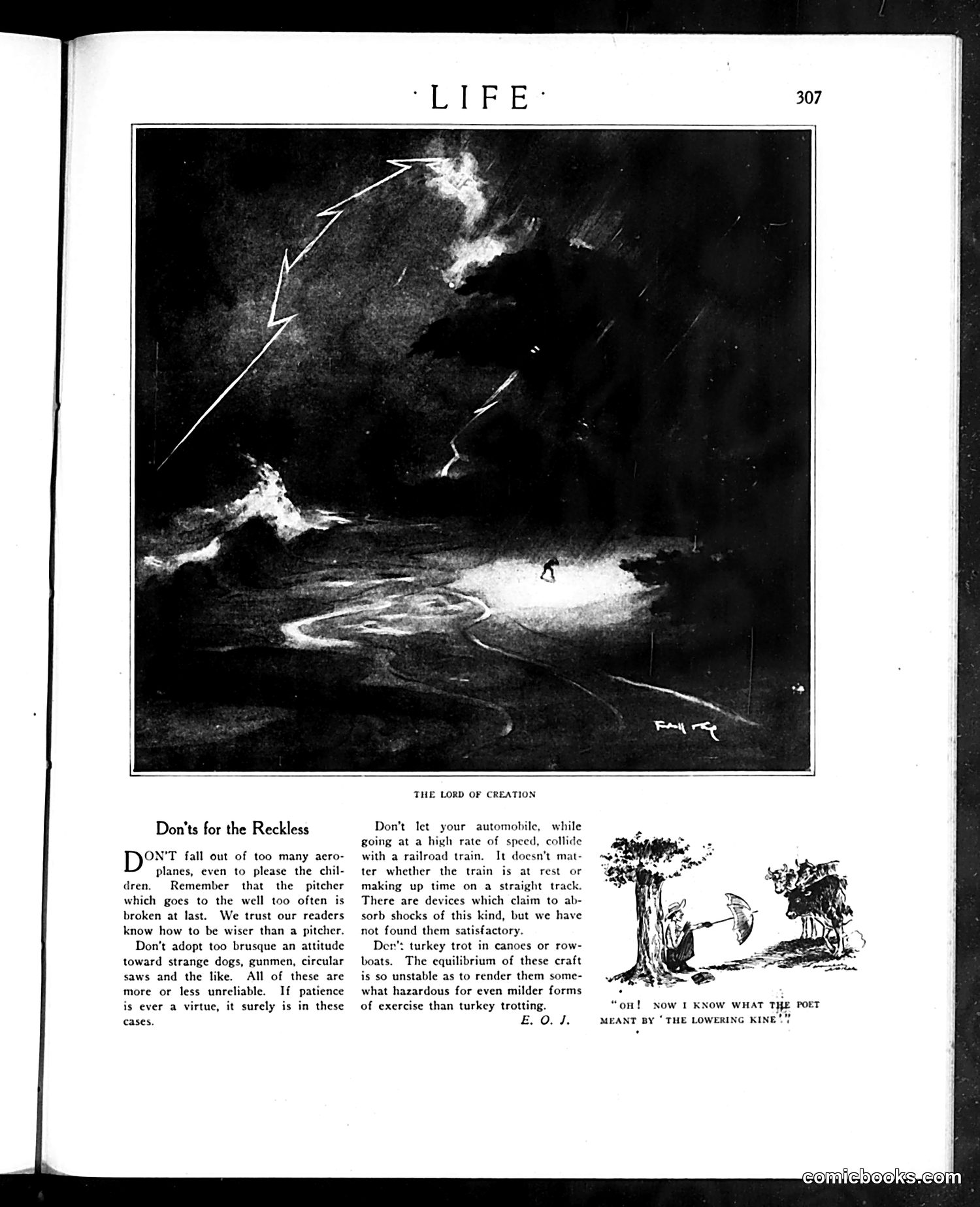
This page presents humorous safety advice titled "Don'ts for the Reckless," offering absurdist warnings against obviously dangerous activities: falling from airplanes, antagonizing dogs and gunmen, colliding automobiles with trains, and turkey trotting in canoes. The dramatic black-and-white illustration at top appears to depict divine or cosmic creation—possibly referencing Michelangelo's famous painting—establishing an ironic contrast with the mundane safety tips below. The cartoon at bottom shows a figure recognizing what a poet meant by "the lowering kine," likely referencing agricultural imagery or classical allusion, though the specific literary reference is unclear without additional context. The satire's point: mocking reckless behavior through exaggerated, obviously absurd warnings—satirizing both human carelessness and the era's emerging safety-conscious culture (automobiles, airplanes were still novel, dangerous technologies). The tone is lighthearted ridicule of poor judgment.
This is a narrative short story, not a political cartoon. The piece satirizes the "modern girl" of the 1920s—specifically the clash between parental Victorian values and youthful independence. **The Setup:** An older narrator visits his old friends the Van Antlers after years away, having avoided them when their daughter Dorothy was young. He's shocked to find her now seventeen—brash, demanding money for tennis, commandeering guests' automobiles, and displaying casual disrespect for her mother's authority. **The Satire's Target:** The story mocks both generations. Dorothy represents the "New Woman"—bold, self-centered, dismissive of propriety ("What do you hire maids for?"). Her parents represent outdated authority unable to control or understand modern youth. The title's irony is the point: *Who* is to blame for this chaos—the permissive parents, the defiant daughter, or changing times themselves? This reflects genuine 1920s anxieties about youth rebellion, women's independence, and generational conflict following World War I.
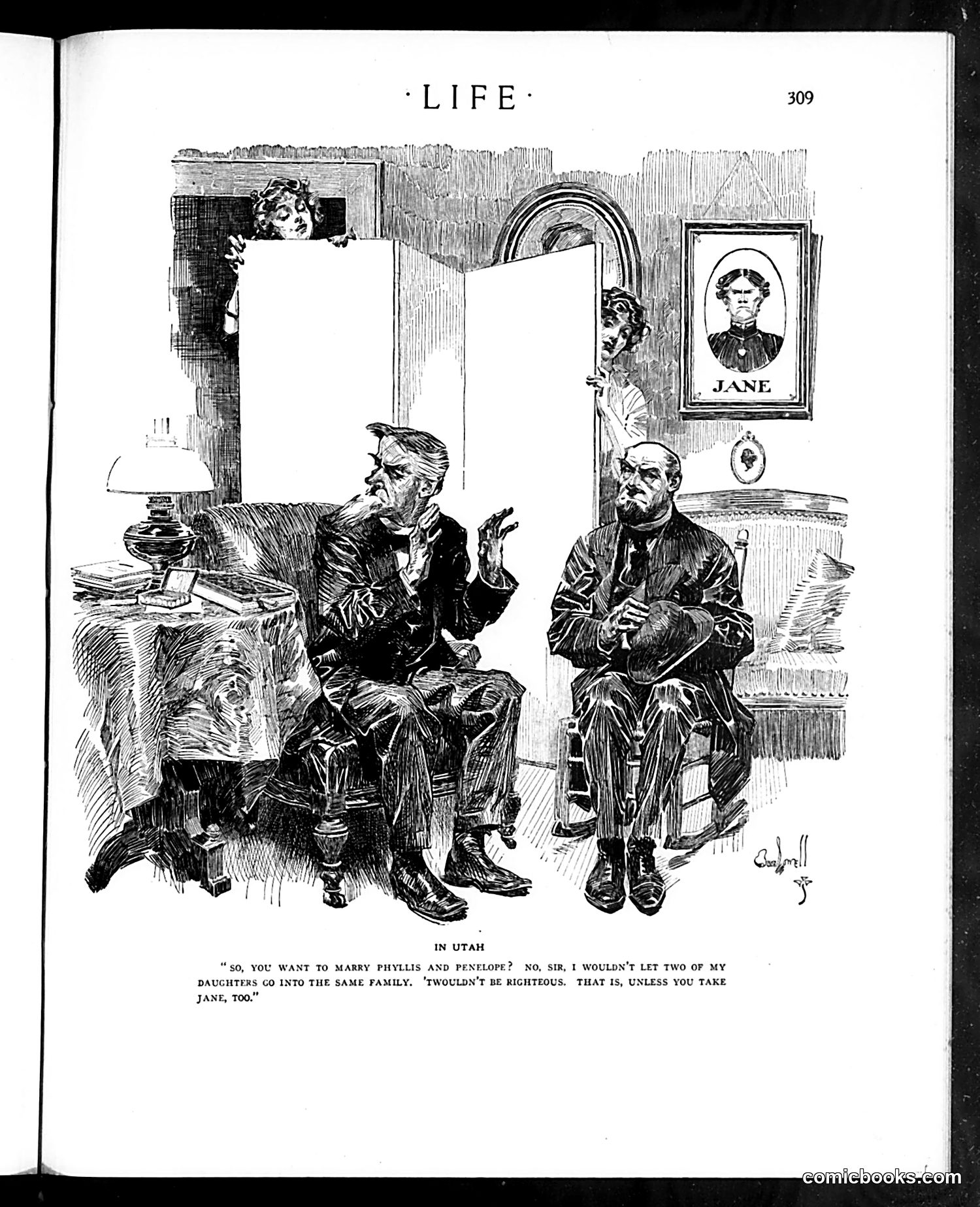
This cartoon satirizes polygamy in Utah, then a contentious national issue. The sketch shows two men in conversation: one appears to be a father negotiating marriage terms, the other a prospective suitor. The father refuses to let two daughters marry into the same family—calling it "unrighteous"—unless the suitor also takes a third daughter, Jane. The satire is darkly comedic: the father invokes morality to justify polygamy while actually promoting it. The joke exposes the contradiction between Utah's religious justification for plural marriage and mainstream American values, which viewed polygamy as immoral. The cartoon mocks both the practice itself and the sophistic reasoning used to defend it. The setting labeled "IN UTAH" emphasizes this as specific regional critique during the era when Utah's statehood was contingent on abandoning polygamy.
This page comments on Reverend Davidson of Charlottesville, Virginia, who publicly burned his prayer book and vestments while resigning from the Episcopal Church ministry. Davidson had issued statements denouncing the Episcopal Church as "the gentleman's church"—socially powerful but intellectually stupid and spiritually dead. The editorial satirizes Davidson's theatrical protest, comparing his zeal to John Wesley's criticisms of the Church of England (Wesley protested but didn't burn books). The writer argues that churches disappoint zealots because perfection is impossible, not because of institutional failings. The piece defends religious tolerance and notes that different Protestant denominations—and even Protestants and Catholics—now share common ground through newspapers, transportation, and daily life. The central joke: Davidson sees only the Episcopal Church's flaws, not its merits. His "mental impression" blinds him to reality. A church is "not so much a fact as an idea in a man's mind."
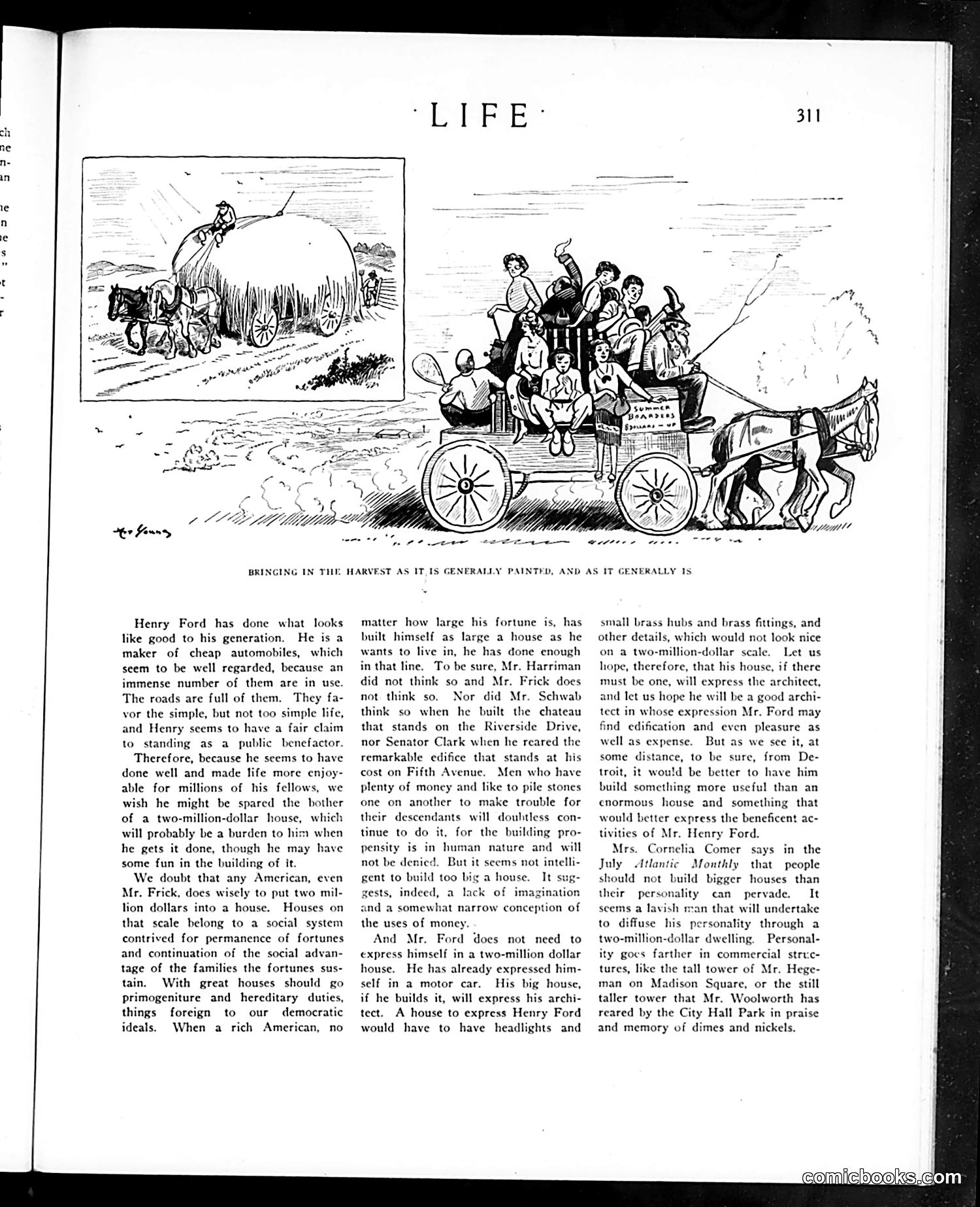
This Life magazine editorial cartoon mocks Henry Ford's reported plan to build a $2 million mansion. The cartoons contrast "how it is generally painted" (left: idealized pastoral harvest scene) with "how it generally is" (right: a chaotic wagon overflowing with people). **The Point:** Ford, celebrated as a public benefactor for making affordable automobiles, should not indulge in ostentatious mansion-building. The article argues this contradicts both democratic values and Ford's own character—his true expression is the practical Model T, not architectural grandeur. The text compares Ford unfavorably to other gilded-age industrialists (Frick, Harriman, Schwab, Senator Clark) who built extravagant Fifth Avenue palaces, suggesting Ford should avoid their mistakes. **The Satire:** Ford's house would merely "express his architect," not Ford himself. A true Ford mansion would need "headlights and brass fittings"—a car, essentially. Better to build something useful that reflects his actual achievement: democratizing transportation, not imitating European aristocratic excess.
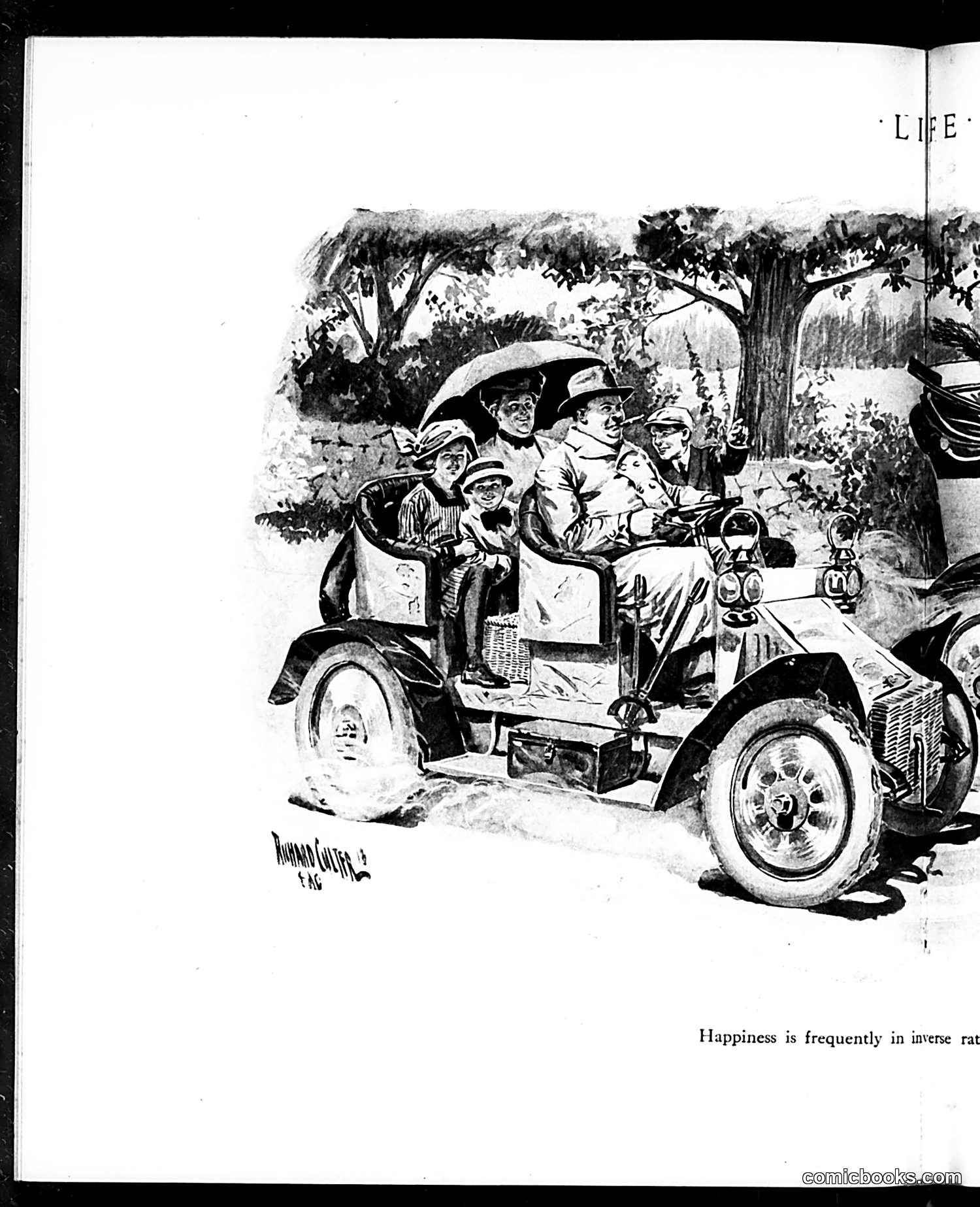
This page shows a satirical illustration of an automobile outing from what appears to be the early 20th century. The cartoon depicts multiple well-dressed adults and children crowded into an open-air motorcar, driving through a scenic landscape with trees. The incomplete caption at bottom reads: "Happiness is frequently in inverse rat[io]..." — suggesting the joke concerns the relationship between happiness and something measured inversely. Given the overcrowded vehicle, the satire likely critiques either: - The fashionable obsession with automobile touring despite discomfort - Class pretensions of displaying wealth through car ownership - The contradiction between claimed "happiness" and the cramped, chaotic reality depicted The artist's signature appears to read "Norman Fulton" or similar. Without the complete caption, the specific target of satire remains somewhat unclear, though the visual joke emphasizes ironic contrast.
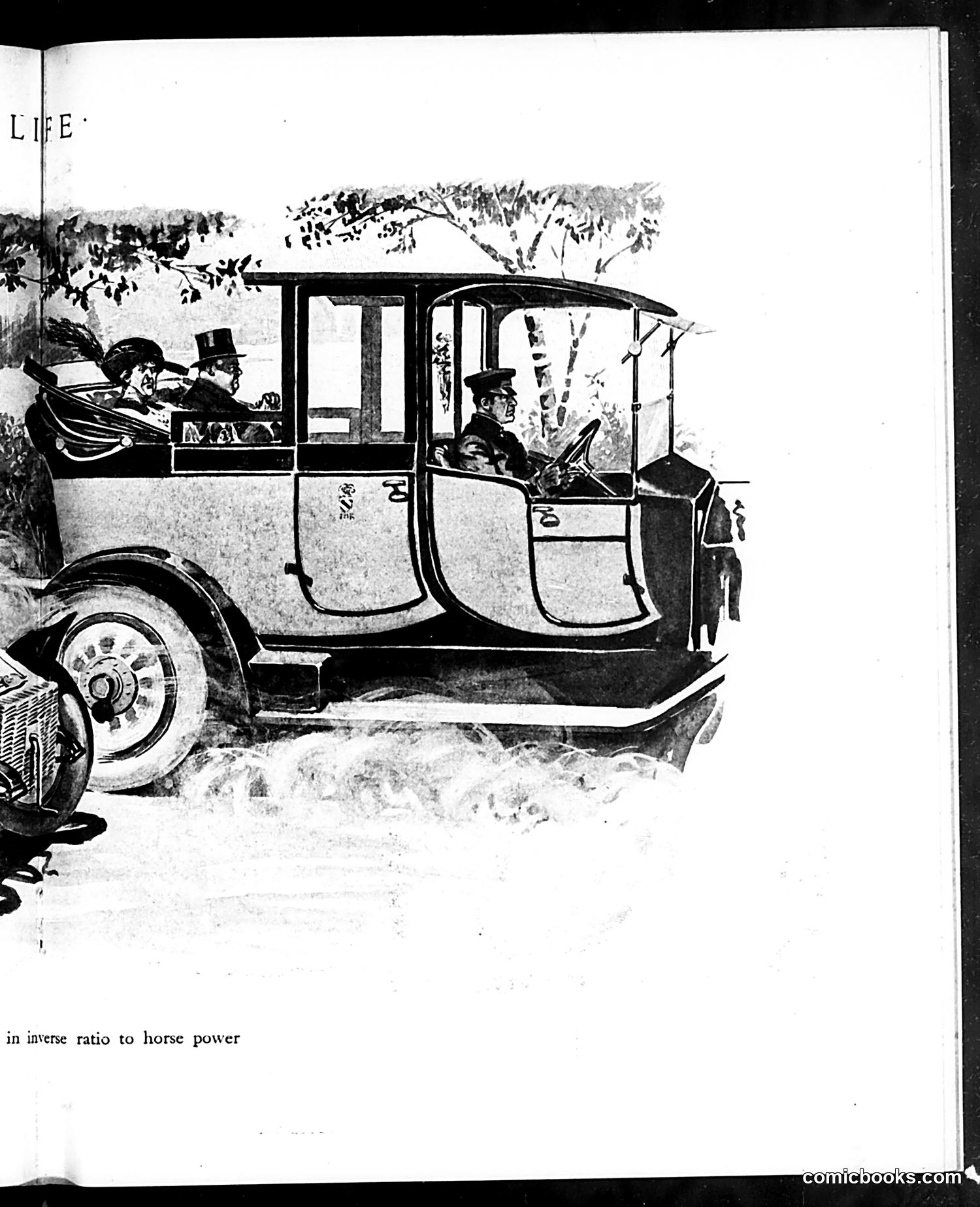
This appears to be a satirical cartoon about early automobiles and their passengers. The image shows a large, enclosed automobile with well-dressed men in top hats inside. The visible text fragment reads "in inverse ratio to horse power," suggesting the cartoon's joke concerns the relationship between vehicle power and passenger behavior or appearance. The satire likely mocks wealthy or pretentious early car owners—their formality (top hats) contrasts with the relatively modest power of early automobiles. The phrase suggests that as mechanical "horse power" increased, something else (possibly dignity, practicality, or social status) decreased proportionally. This reflects early 20th-century anxieties about new automobile technology and changing social norms among the wealthy classes adopting these vehicles.
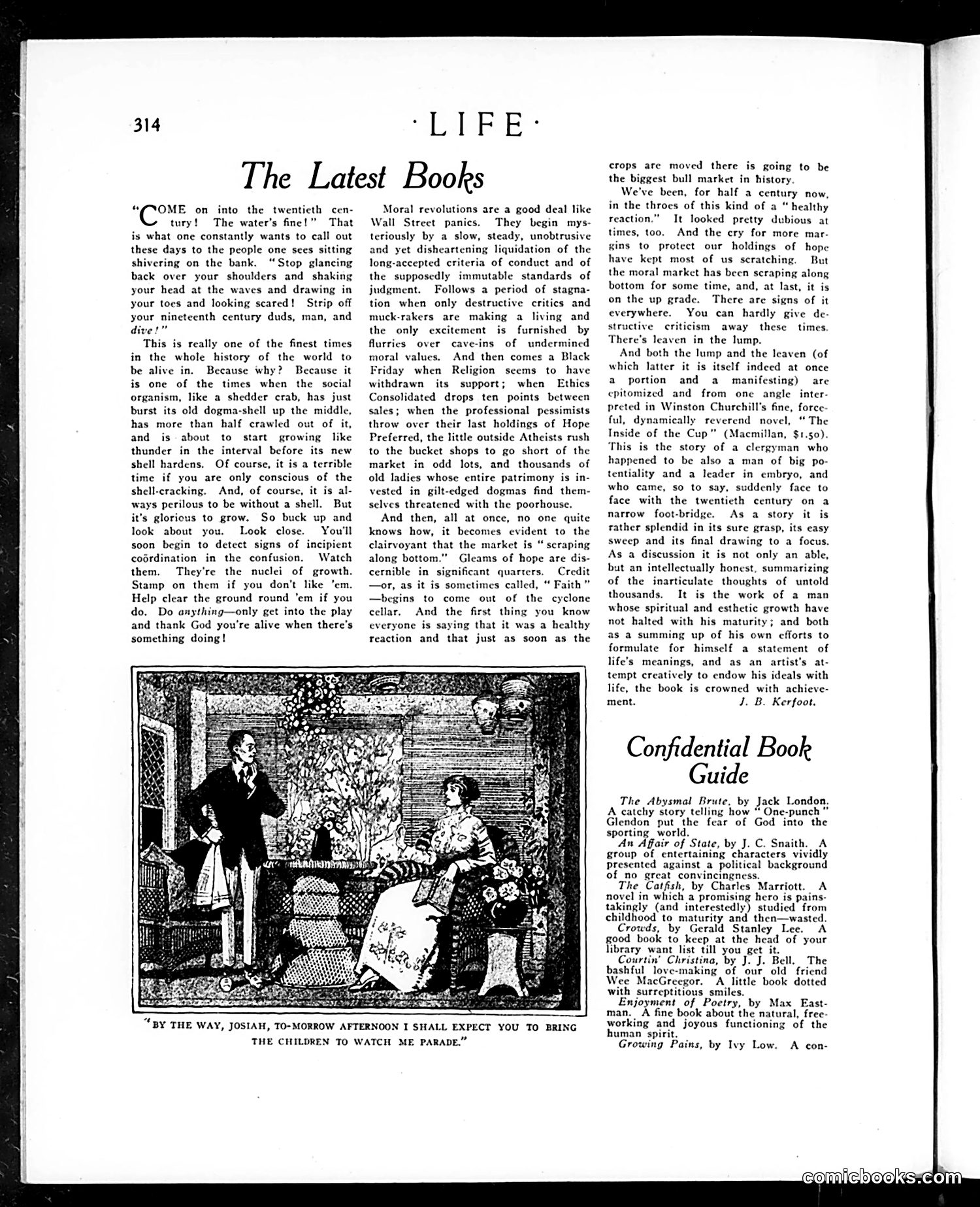
This page from Life magazine presents an editorial essay celebrating early 20th-century social progress. The author uses vivid metaphors—comparing society to a "shedder crab" shedding its shell and moral change to Wall Street market cycles—to encourage readers to embrace rapid modernization. The illustration depicts a domestic scene where a man announces to his family that he'll lead a parade tomorrow, likely satirizing Victorian propriety and rigid social hierarchies. The contrast between the formal indoor setting and the casual announcement subtly mocks outdated social conventions. The essay celebrates "moral revolutions" as healthy, inevitable reforms—a progressive stance typical of early 1900s intellectual circles. The "Confidential Book Guide" section reviews contemporary literature, including Winston Churchill's *The Inside of the Cup*, which apparently examines religious and social modernization. Overall, the page reflects an optimistic, reformist worldview characteristic of the Progressive Era, encouraging readers to abandon "nineteenth century" thinking for modern progress.
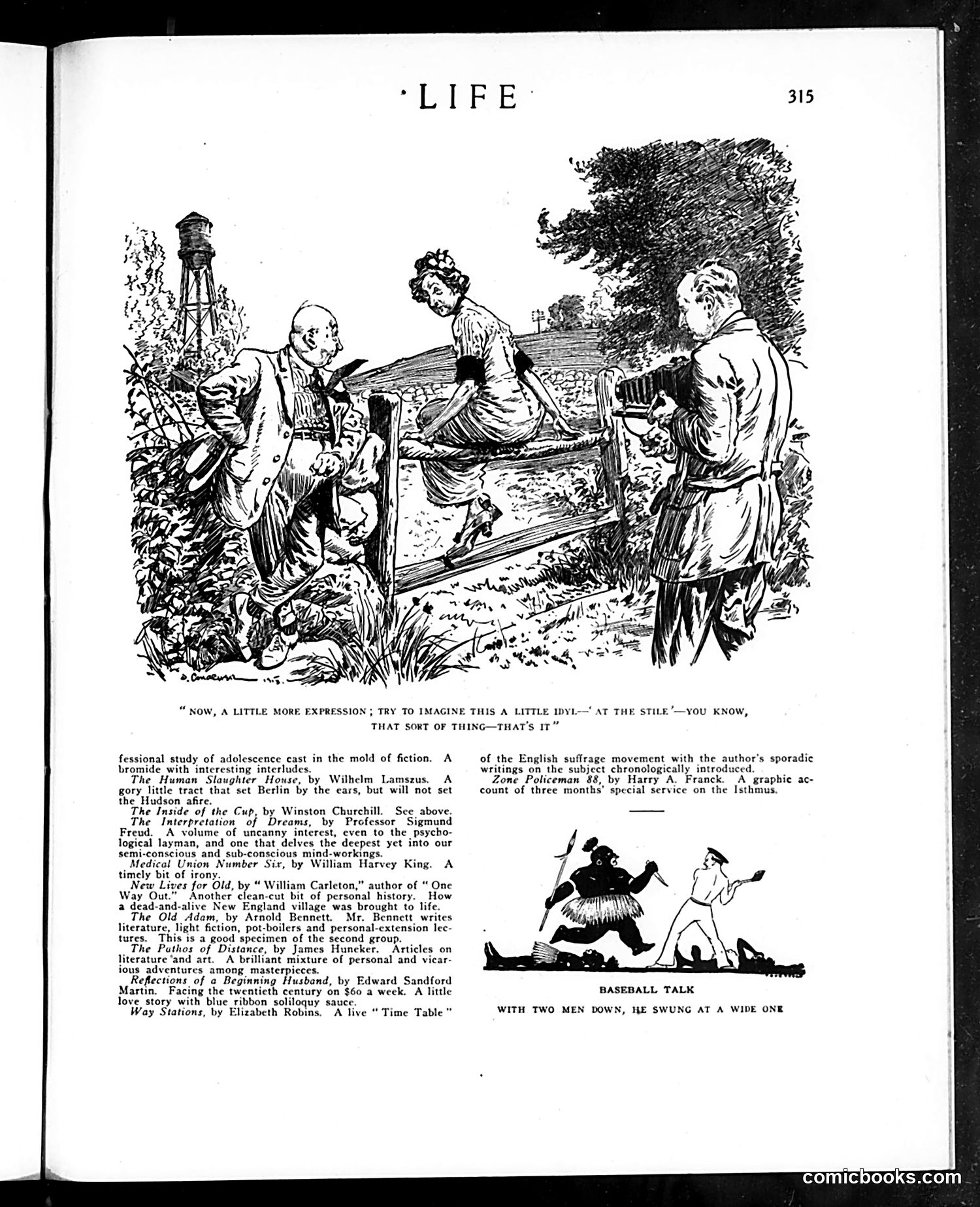
The main cartoon depicts a man instructing a woman at a rural fence ("stile"), asking her to pose with more romantic "expression" for what appears to be an idealized pastoral scene. The caption mocks the artificiality of staged romantic imagery—he's directing her to perform an imaginary "idyl" rather than capturing genuine emotion. The page is primarily a **book review section** listing recent publications, including works by Sigmund Freud, Arnold Bennett, and others. Notable entries include *Way Stations* by Elizabeth Robins, explicitly described as relating to the "English suffrage movement"—indicating this Life issue addresses women's rights activism. The lower cartoon shows a baseball scene with the caption "Baseball Talk: With Two Men Down, He Swung at a Wide One"—a simple sports joke about poor batting judgment. The reviews suggest Life's audience was educated, literary, and engaged with contemporary social issues including feminism and psychology.
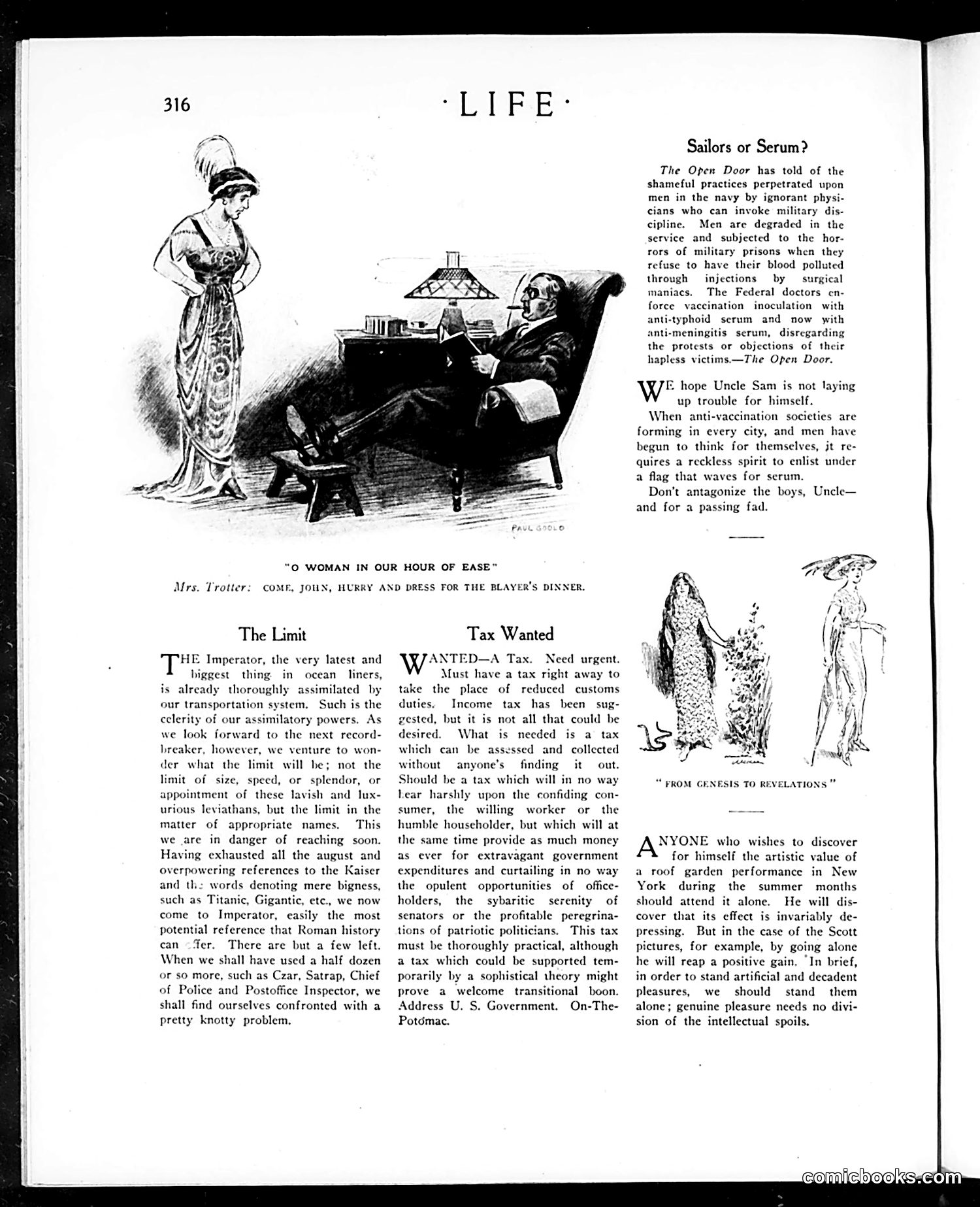
**The Cartoons and Satire:** The page contains three distinct satirical pieces: 1. **"O Woman in Our Hour of Ease"** (top illustration): Shows a woman standing while a man relaxes, captioned with Mrs. Trotter telling John to hurry and dress for dinner. This appears to satirize gender roles and domestic expectations. 2. **"The Limit"**: Mocks the naming of ocean liners. It jokes that as ships grow larger, names escalate from "Titanic" and "Gigantic" to "Imperator," and soon we'll exhaust grand titles, resorting absurdly to "Czar, Satrap, Chief of Police and Postoffice Inspector." The satire targets excessive naval ambition and naming conventions. 3. **"Tax Wanted"**: A mock advertisement seeking a tax that can be collected "without anyone finding it out," providing government funds while sparing "confiding consumers" and "senators." This satirizes government hypocrisy about taxation and spending. 4. **"Sailors or Serum?"**: Criticizes forced military vaccinations, arguing that compulsory medical procedures antagonize enlisted men and damage military morale. The page overall reflects early 20th-century American anxieties about government overreach, taxation, militarism, and medical authority.
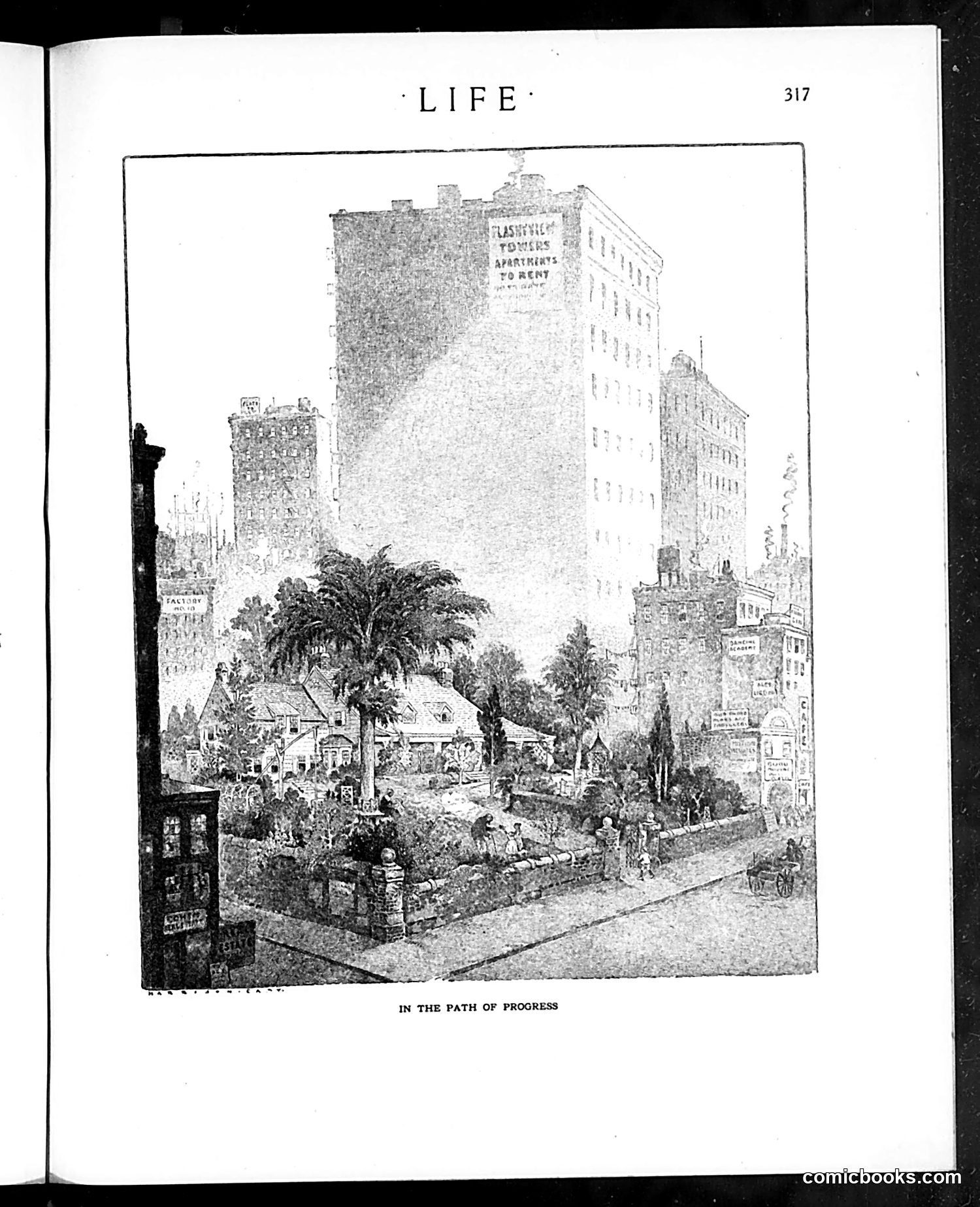
This illustration depicts urban development encroaching on a pastoral neighborhood. The image shows a stark contrast: in the foreground, small houses and green spaces with people enjoying a garden or park; in the background, towering apartment buildings and commercial structures loom dramatically larger. The satire critiques rapid industrialization and urban sprawl of the early 20th century. The title "In the Path of Progress" is ironic—suggesting that "progress" (modern development) inevitably destroys older, quieter residential communities. The composition emphasizes how massive new construction literally overshadows and displaces traditional domestic life. This reflects contemporary anxieties about urbanization, property development, and whether such expansion genuinely improved city life or merely prioritized profit over community preservation.
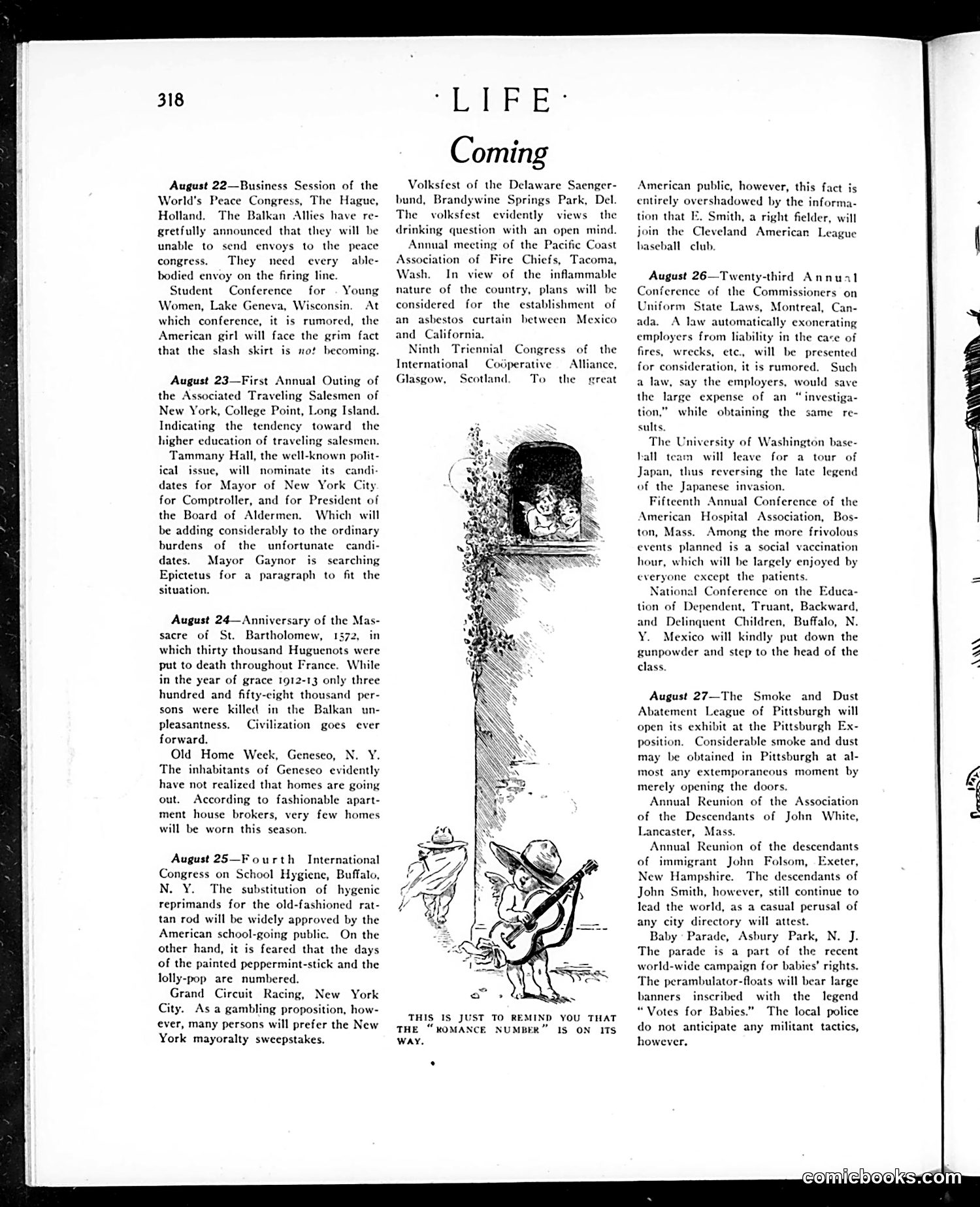
This is a satirical calendar of upcoming events featuring caustic social commentary. The cartoons and text mock contemporary issues through ironic juxtaposition. Key satire targets: **Balkan Wars reference**: The opening joke equates a peace congress with active warfare—the Balkans conflict (1912-13) was so consuming that nations couldn't spare diplomats. **Fashion mockery**: Young women at Lake Geneva will "face the grim fact" that slash skirts aren't flattering—mocking both fashion trends and women's conferences. **NYC Politics**: Tammany Hall nominations burden candidates; Mayor Gaynor must consult Epictetus (ancient Stoic philosopher) to endure the situation. **Historical irony**: The St. Bartholomew's massacre (1572, 30,000 deaths) is compared unfavorably to modern Balkan casualties (358,000)—suggesting "civilization" has worsened. **Urban trends**: "Old Home Week" is outdated since apartments are replacing houses. **Labor/Safety**: Proposed hygiene reforms replacing corporal punishment in schools; employers seek liability exemptions for fires. The cartoons (children playing with weapons/explosives) reinforce themes of recklessness and violence pervading the era.
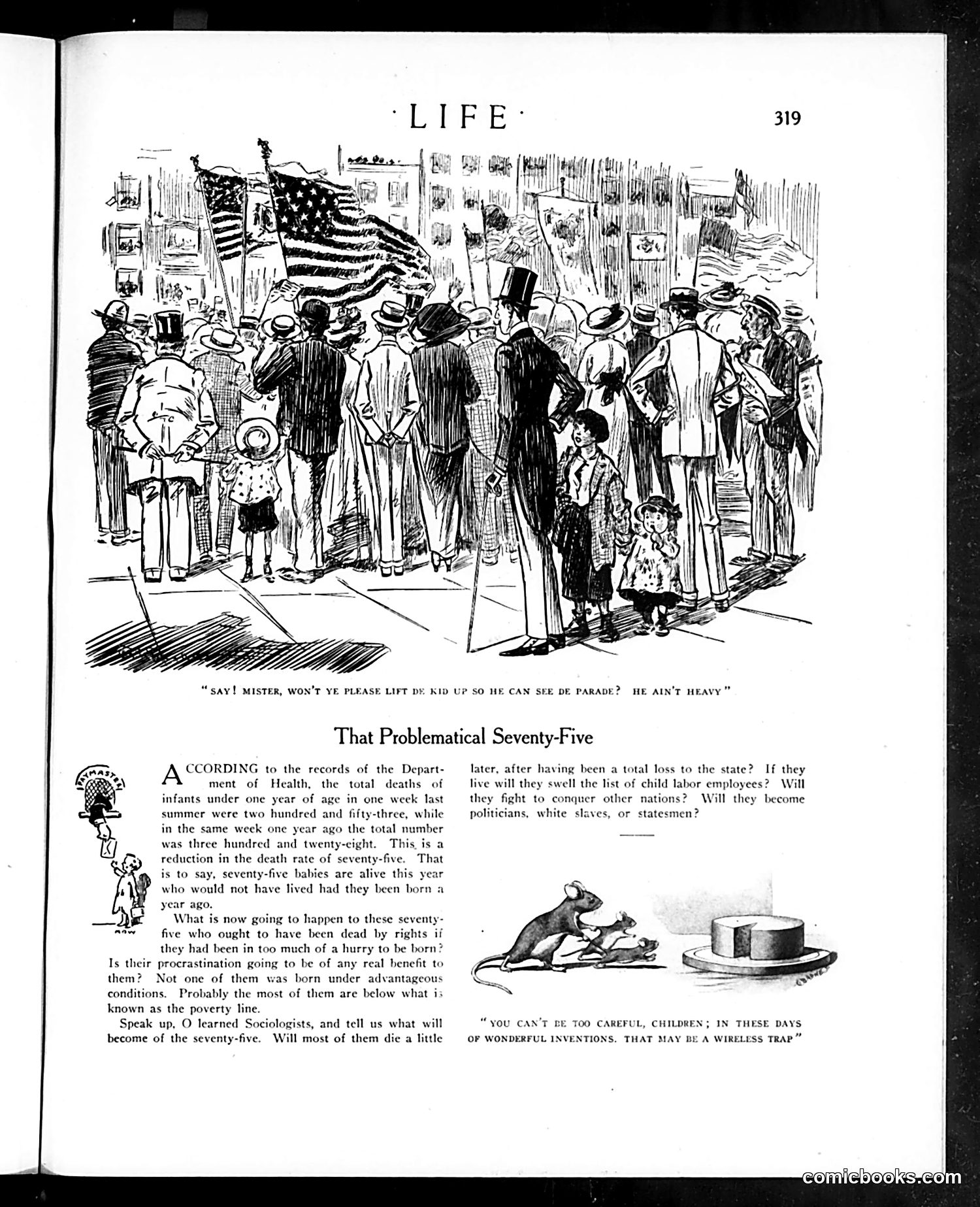
This 1910s *Life* magazine page uses dark satire to critique social indifference to poverty and child welfare. The top cartoon shows a crowded parade with a working-class man asking someone to lift his child to see—a humorous but sympathetic domestic scene. The main article sarcastically celebrates a 75-infant mortality reduction, but then poses bitter rhetorical questions: these 75 surviving babies were born into poverty; what future awaits them? Will they die anyway? Become child laborers? The piece attacks sociologists and politicians for celebrating statistics while ignoring systemic poverty. The lower cartoon warns children against "wireless traps"—likely referencing new electrical hazards of the era, or possibly satirizing how modern inventions pose dangers to the poor. The satire's point: celebrating lower mortality rates is meaningless if society does nothing to improve the actual lives of impoverished children.
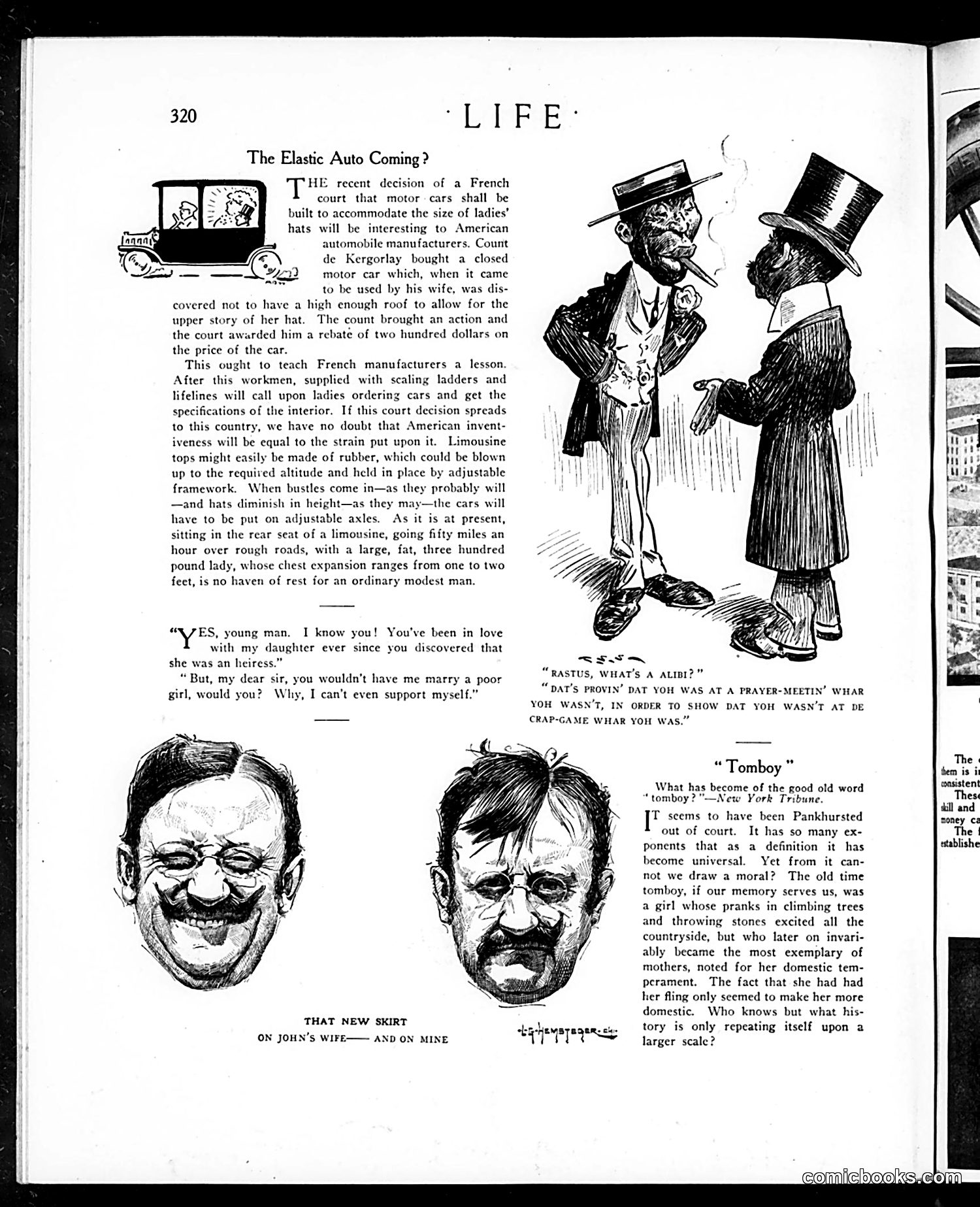
This satirical page contains three distinct pieces mocking early-20th-century social absurdities: **"The Elastic Auto Coming?"** ridicules a French court decision awarding damages because a wife's large hat wouldn't fit in a motor car. The satire suggests American manufacturers will absurdly respond with inflatable rubber tops and adjustable axles to accommodate ladies' enormous hats and bustles—a jab at both automotive engineering pretension and women's excessive fashion. **The middle section** uses two contrasting facial expressions to mock a suitor who admits he pursues an heiress only because she's wealthy, unable to support even himself—satirizing gold-digging and class hypocrisy. **"Tomboy"** references the Pankhurst suffragettes (British women's voting-rights activists), sarcastically suggesting that wild young girls inevitably become dutiful mothers, implying feminist activism is merely a youthful phase women outgrow. This mocks both feminism and women's ambitions. The racist dialect humor in "Rastus" reflects the magazine's period conventions but reflects deeply offensive racial stereotypes standard to that era.
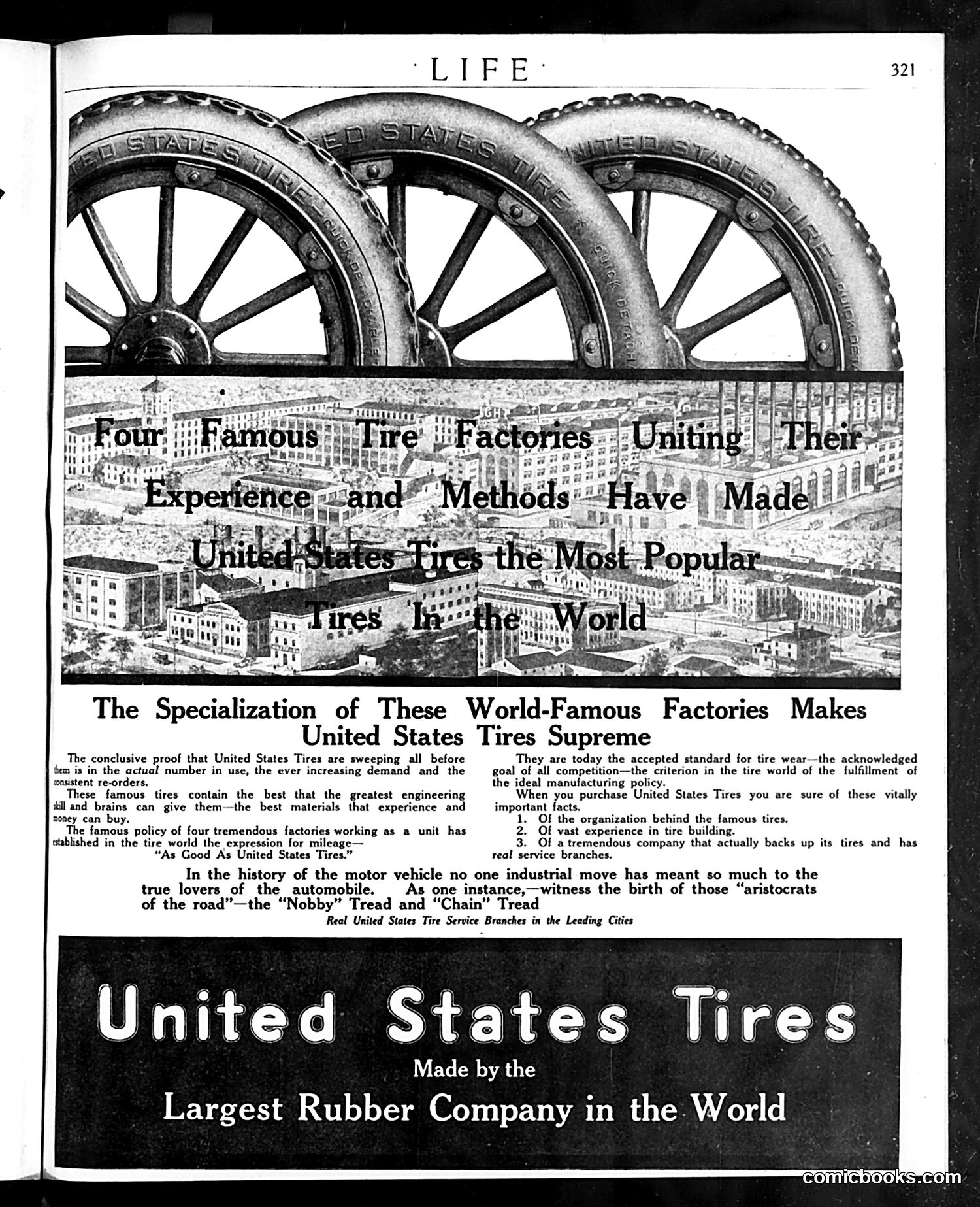
This is primarily **advertising content**, not satire or political commentary. It's a full-page advertisement for United States Tires from an early 20th-century Life magazine. **What's being sold:** Tires, marketed as superior because they're made by "the Largest Rubber Company in the World" with four specialized factories working in coordination. **The pitch:** The ad emphasizes reliability through organizational scale and experience—guaranteeing that buyers get "organization," "vast experience," and a "tremendous company" backing the product with service branches nationwide. **Historical context we'd miss:** This represents an era when industrial scale itself was a novel selling point. The references to "Nobby Tread and Chain Tread" as "aristocrats of the road" suggest tire design was still relatively new and prestigious. The emphasis on service branches reflects early automobile infrastructure development. **No satire detected**—this is straightforward corporate self-promotion using industrial prowess as credibility.
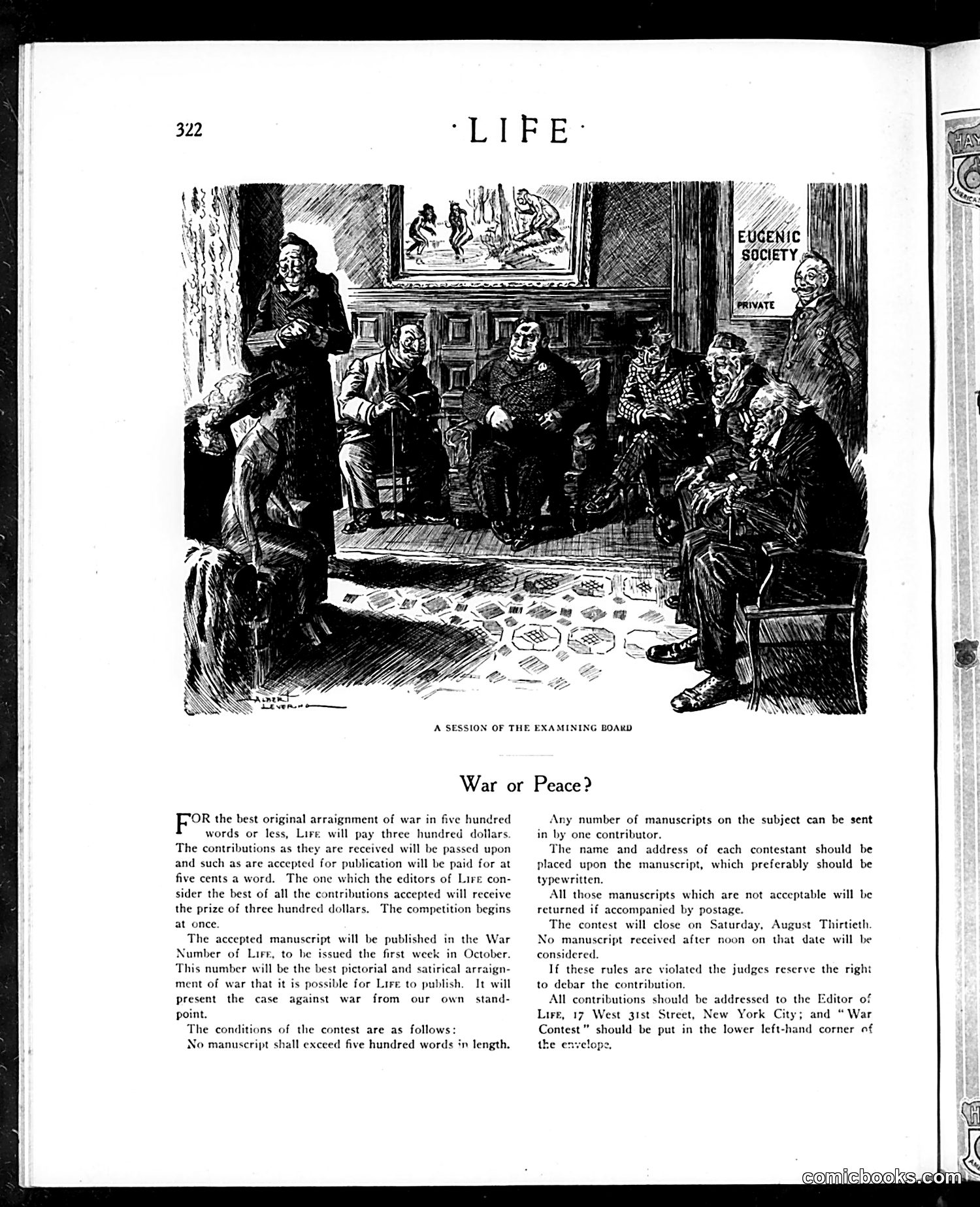
This page announces a writing contest by *Life* magazine offering $300 for the best essay *against war* in 500 words or less. The cartoon above depicts "A Session of the Examining Board"—likely satirizing the judging process itself, showing a panel of distinguished-looking men deliberating over submissions. The context: This appears to be from the pre-WWI era when *Life* was explicitly anti-war, using satire and humor as political advocacy. The magazine positioned itself as presenting "the case against war from our own standpoint," inviting readers to contribute arguments opposing warfare. The cartoon's humor likely mocks the earnest, bureaucratic nature of such judging panels—the formal gentlemen solemnly evaluating peace manifestos. For modern readers, this reveals *Life*'s role as a progressive editorial voice using popular culture and reader participation to shape political opinion on major issues.
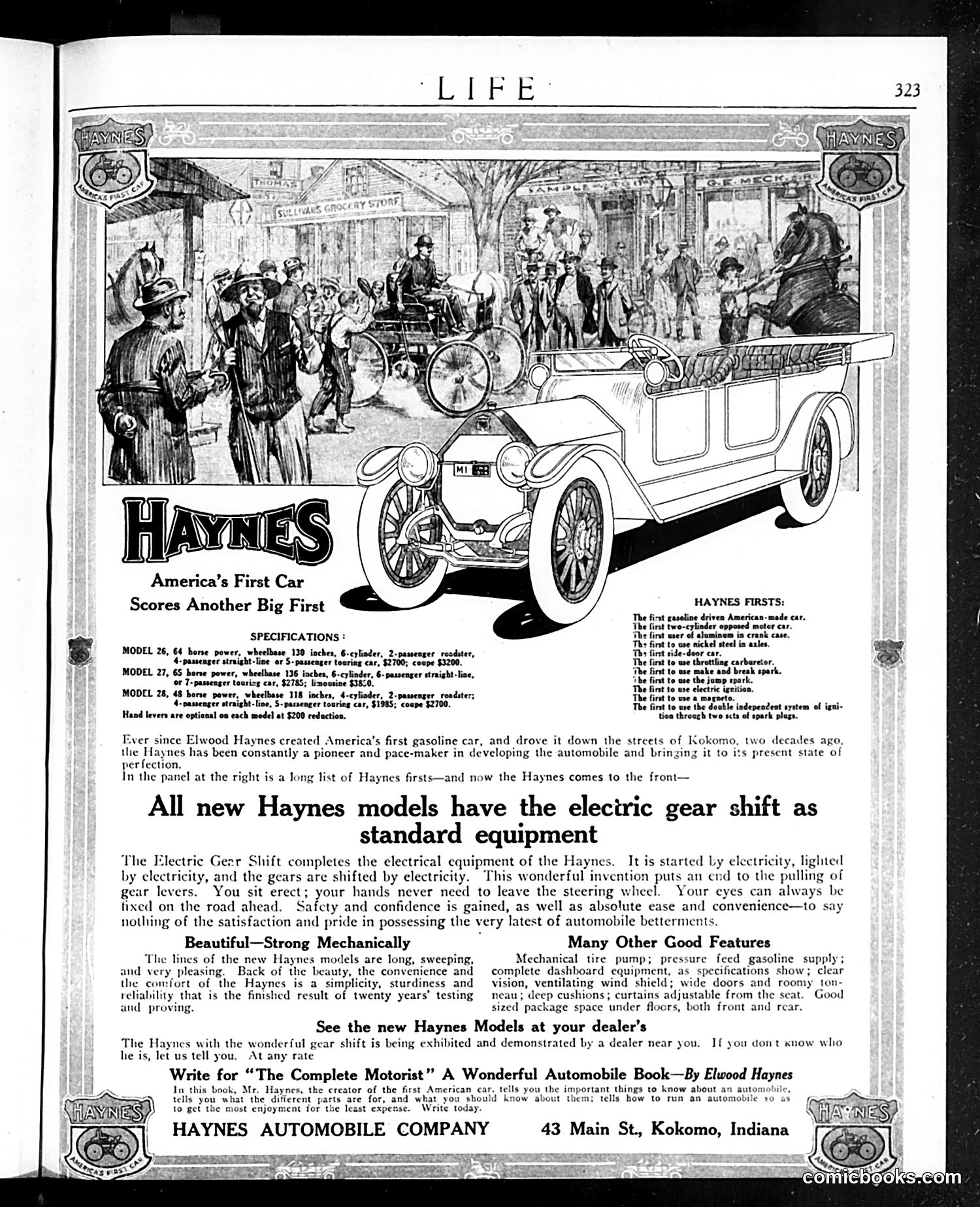
This is primarily **automobile advertising**, not political satire. The page showcases Haynes automobiles, claiming the company created "America's First Car" and highlighting their latest innovation: the electric gear shift. The illustration depicts a street scene where a Haynes automobile is prominently displayed alongside period crowds and storefronts, emphasizing the car's role in modern urban life. The accompanying specifications detail three models with various engine sizes and seating configurations, ranging from $1,985 to $3,200. The "firsts" listed represent genuine technological claims: gasoline-powered engines, specific mechanical innovations, and now electrical transmission control. This was marketed as cutting-edge convenience—drivers no longer needed to manually shift gears, keeping both hands on the wheel. The tone celebrates technological progress and American industrial achievement. There is no discernible political commentary or satire on this page. It's a straightforward early-automotive-era advertisement targeting affluent consumers interested in the latest mechanical innovations.
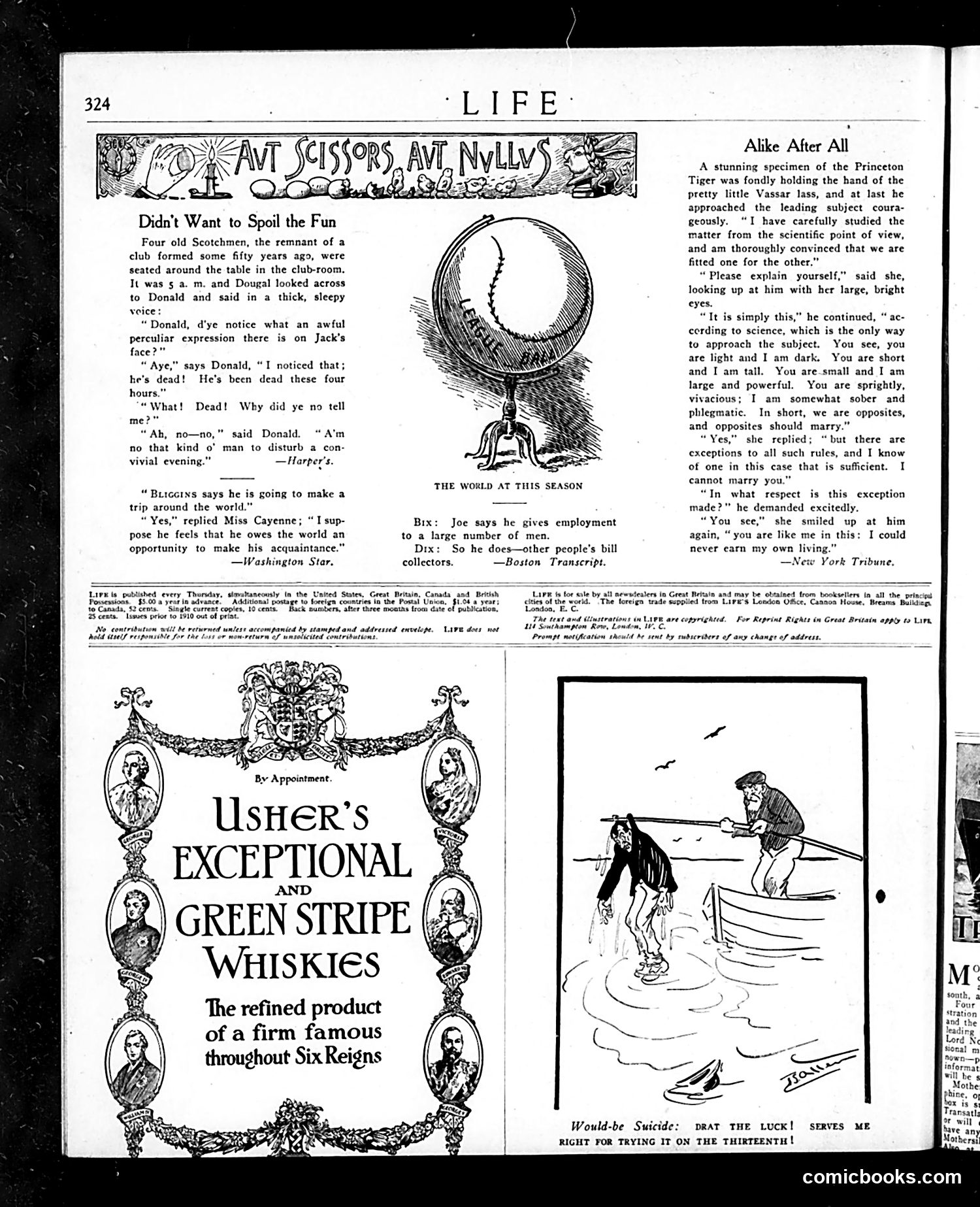
This page contains three separate humorous pieces typical of early 20th-century American satire: **"Alike After All"**: A Princeton student uses pseudo-scientific reasoning to argue that he and a Vassar girl are "fitted" for each other because they're opposites—he's logical, she's emotional; he's tall, she's short, etc. Her witty rejoinder: they're actually alike in one crucial way—neither can support themselves financially. The satire mocks pretentious male logic and highlights women's economic dependence. **"Didn't Want to Spoil the Fun"**: Four elderly Scottish men are drinking at 5 a.m. when one notices their friend Jack is dead. Rather than disturb their social evening, they decide not to mention it. This dark humor satirizes both Scottish drinking culture and the absurdity of prioritizing conviviality over basic facts. **Minor jokes** about a man who owes the world "an opportunity" by traveling, and another whose "employment" comes from debt collectors chasing him. The page also contains a whiskey advertisement, typical of period magazines.
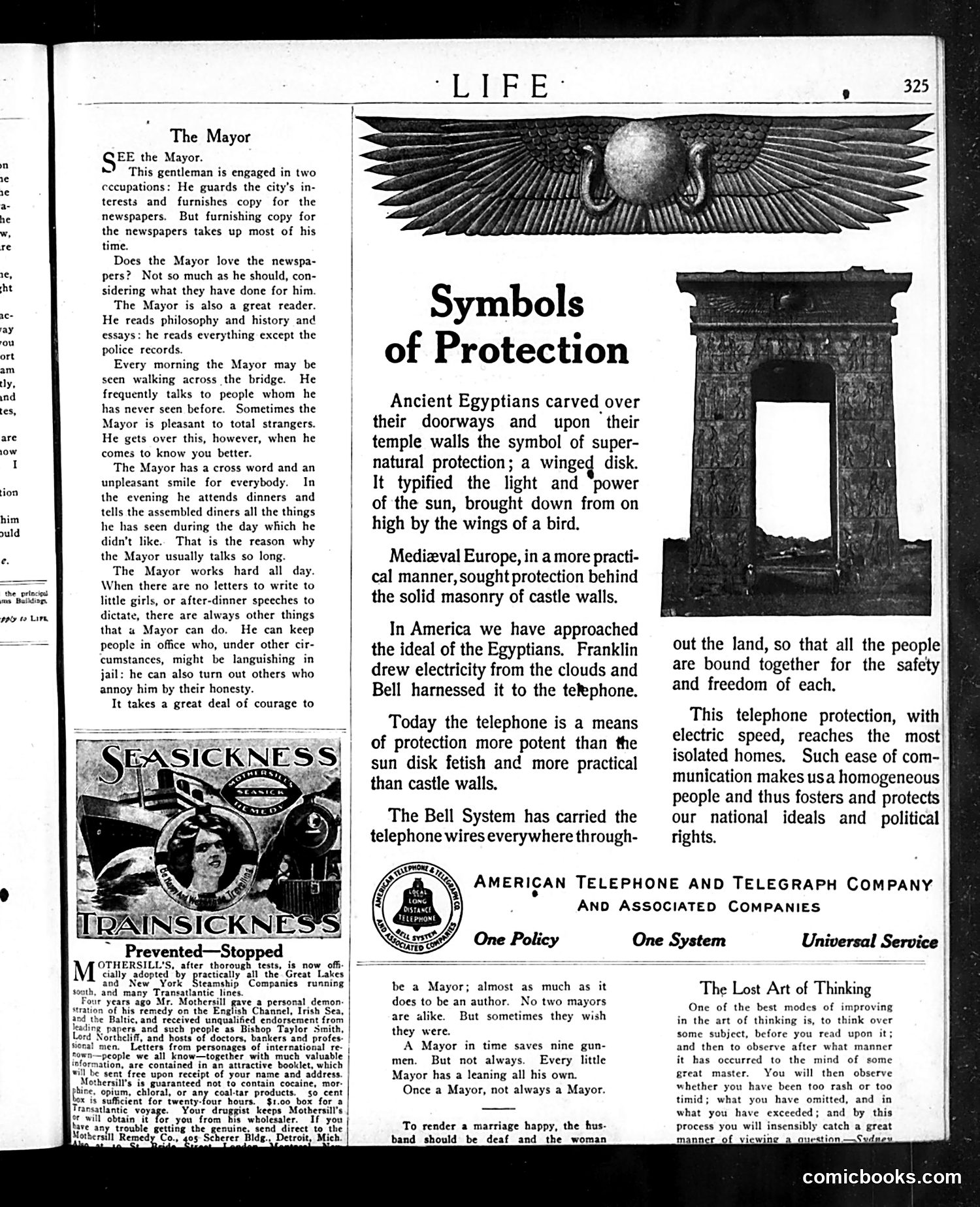
This page contains two distinct pieces: **"The Mayor"** (left column): A satirical character sketch mocking municipal politicians. It portrays a mayor as someone who talks excessively, reads everything except police records, attends dinners to complain about his day, and uses his office to reward loyalists or punish honest enemies. The satire targets the mayor's narcissism, his love of performing for newspapers, and his abuse of patronage power—suggesting he's all talk and political manipulation rather than actual governance. **"Symbols of Protection"** (right): An advertisement for Bell Telephone Company presenting the telephone as America's modern "symbol of protection"—comparing it to Egyptian sun-disk amulets and medieval castle walls. The ad argues that nationwide telephone infrastructure binds Americans together, protects isolated communities, and safeguards "national ideals and political rights" through communication. The juxtaposition is likely intentional: the self-serving mayor contrasts with Bell's idealistic vision of technology uniting the nation.
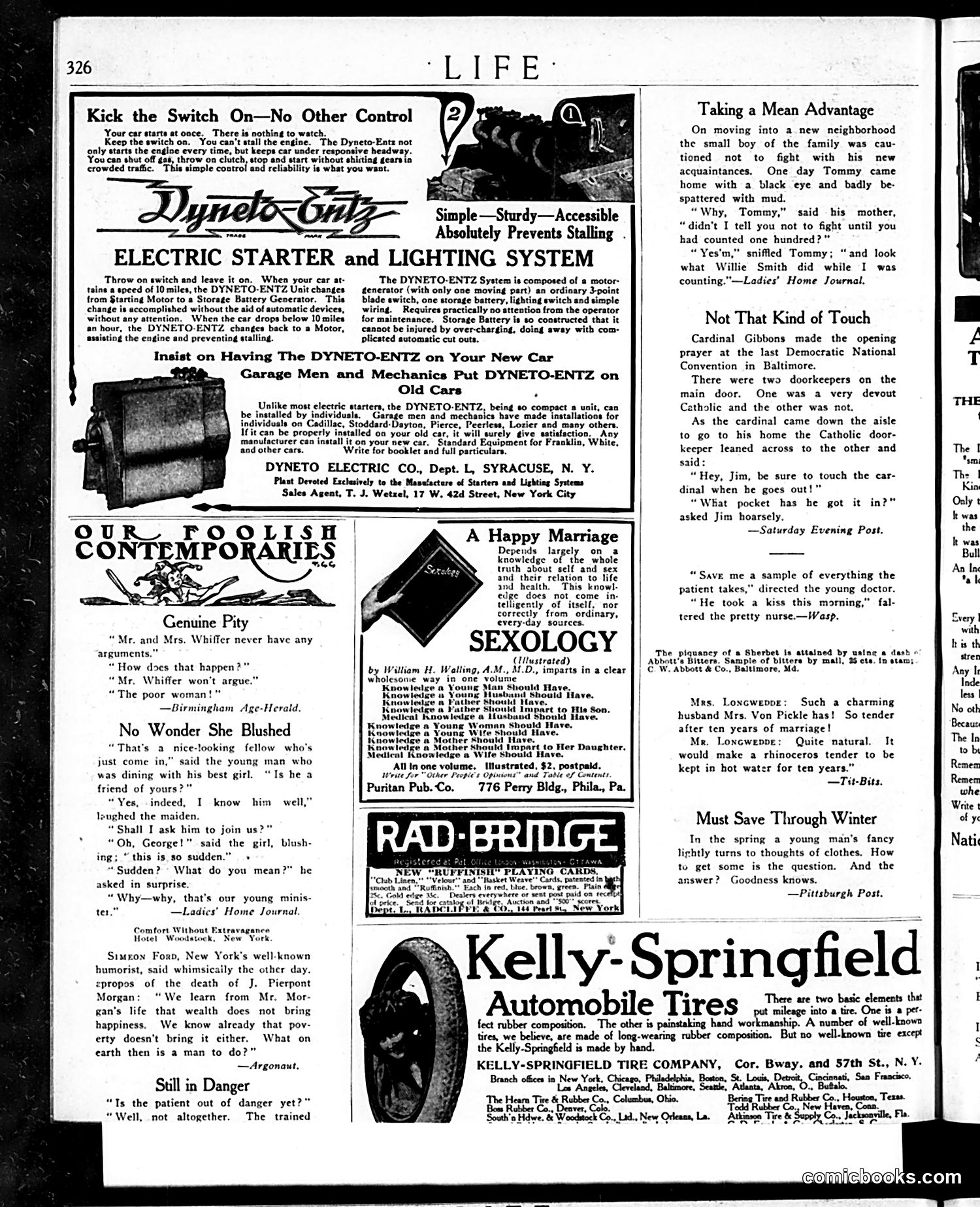
This page is primarily **advertising**, with small humorous anecdotes interspersed. The main advertisements are for automotive products (Dyneto-Entz electric starter systems, Kelly-Springfield tires) and a sex education book called "Sexology" by William H. Walling—typical early-20th-century content reflecting the era's emerging openness about sexuality education. The brief jokes scattered throughout are standard domestic humor: - A joke about a submissive husband ("Mr. Whiffer won't argue") - A misunderstanding about a young minister joining a couple's dinner date - A quip about wealth and happiness referencing J. Pierpont Morgan's recent death These are mild, conventional gags typical of Life's satirical tone—light social commentary on marriage dynamics and class pretension rather than pointed political satire. The page reflects early 1900s concerns: automobile technology becoming accessible, the era's fascination with "scientific" sex education, and genteel humor about courtship and matrimony.
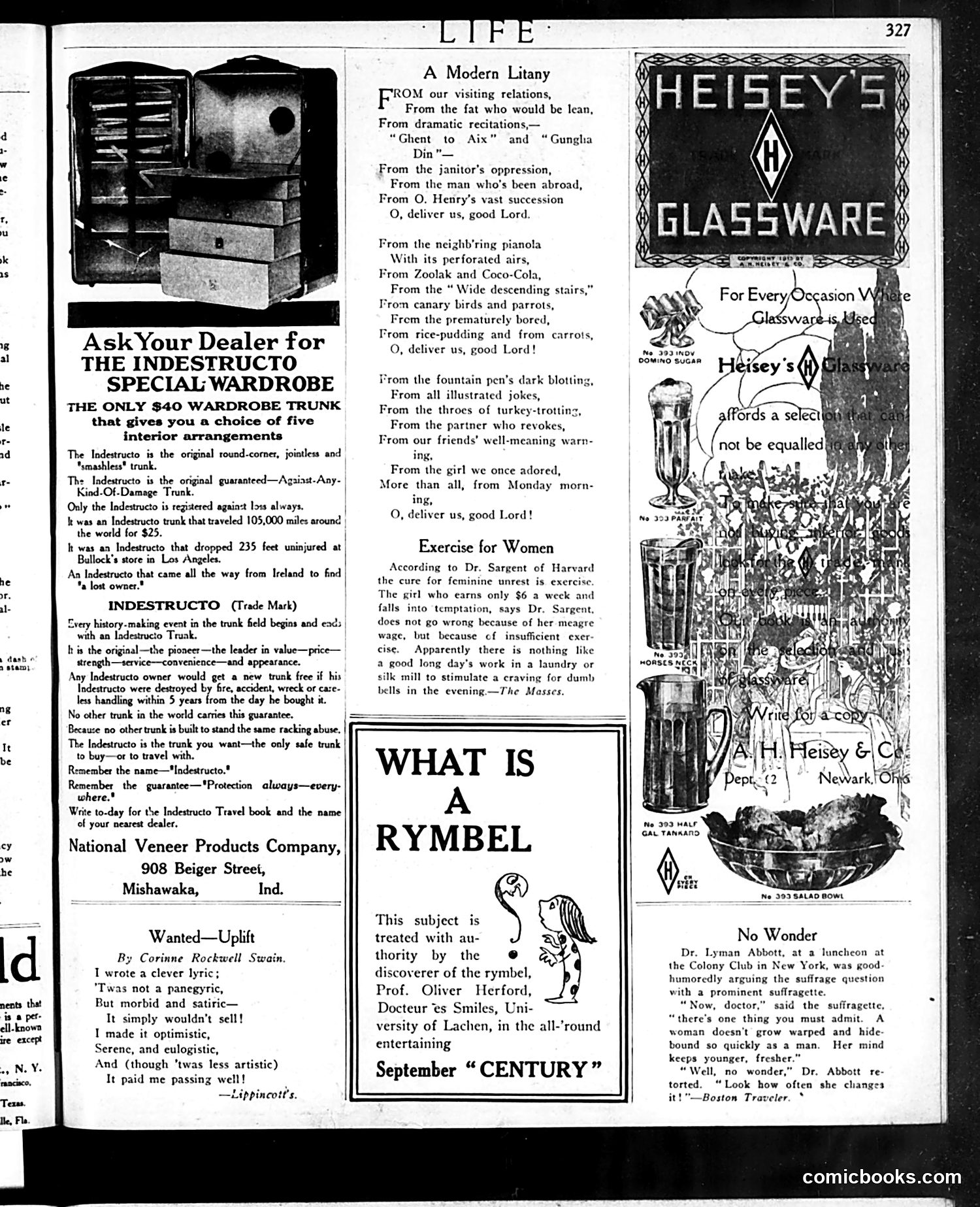
This page is primarily **advertising and light humor content** rather than political satire. Key elements: **Advertisements**: The Indestructo wardrobe trunk (emphasizing durability through hyperbolic claims like surviving a 235-foot drop) and Heisey's Glassware dominate the layout. **"A Modern Litany"**: A humorous poem listing contemporary annoyances (visiting relatives, dramatic recitations, neighbor's player piano, Monday mornings) in mock-religious petition format—satirizing turn-of-century middle-class complaints rather than specific political targets. **"Exercise for Women"**: Quotes Harvard's Dr. Sargent sarcastically; the piece mocks his claim that poor working women need more exercise rather than better wages to prevent moral "temptation"—a dig at victim-blaming social attitudes. **Other items**: Minor humor pieces about trunk durability and suffrage debate. Overall, this is a typical Life magazine miscellany page mixing consumer ads with genteel social satire aimed at educated readers.
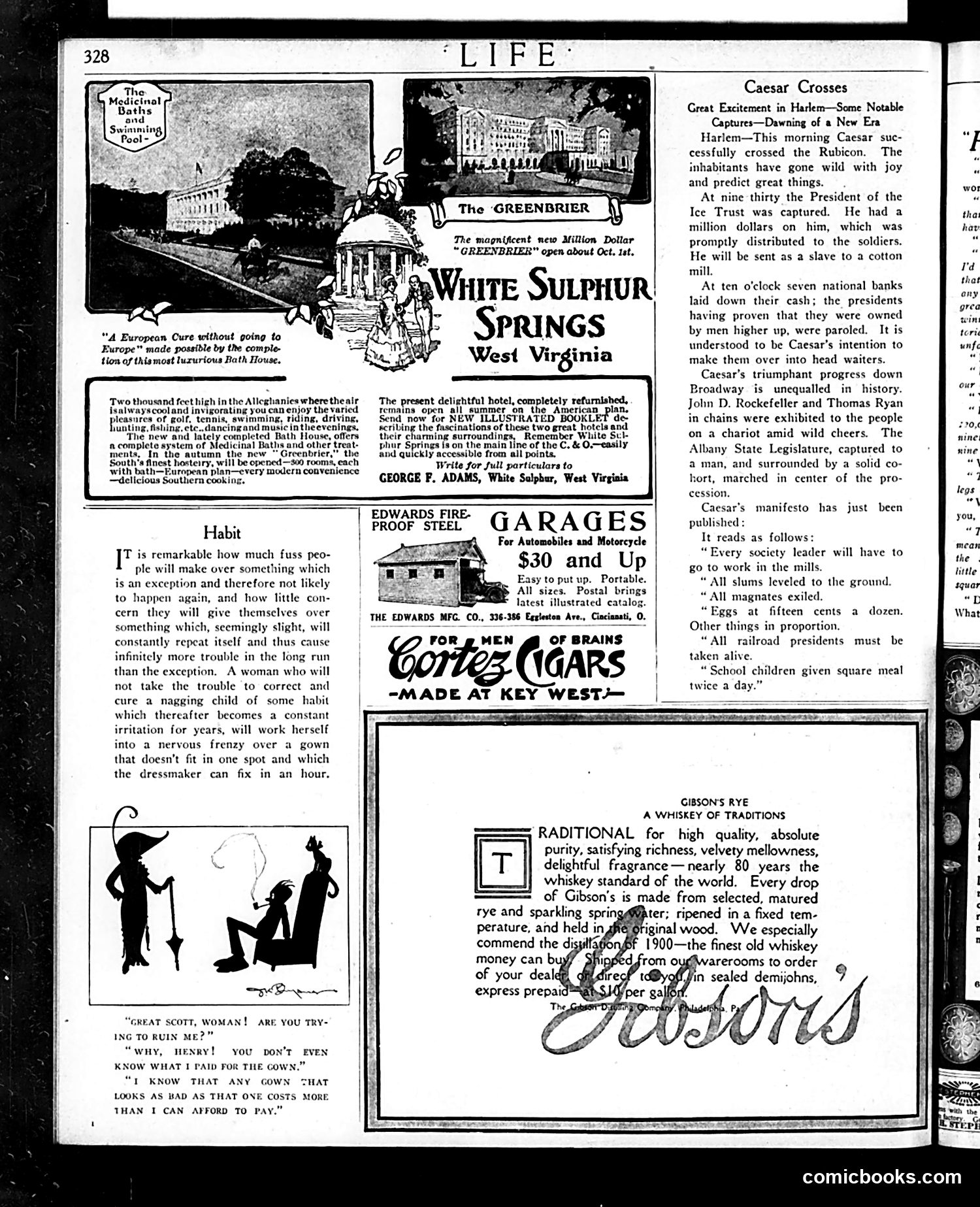
This page contains primarily **advertisements** for luxury hotels and products, with one notable satirical piece titled "Caesar Crosses." ## The "Caesar Crosses" Cartoon This appears to be a **political satire** responding to a specific event in Harlem. The reference to "Caesar" crossing "the Rubicon" (Julius Caesar's famous crossing that started a civil war) suggests someone—likely a prominent figure or movement—has crossed into Harlem, sparking excitement. The satire mocks both the celebratory response and radical demands of the manifesto. The manifesto's targets—ice trust presidents, bankers, Rockefeller, railroad executives, society leaders—reflect **Progressive Era anxieties** about monopolies and wealth inequality circa 1910. The satire ridicules extreme socialist or revolutionary rhetoric by presenting absurdly harsh punishments (slavery, exile) and utopian promises (cheap eggs, school meals) as equally ridiculous. The cartoon's humor depends on knowing contemporary business titans and reform movements of the period. **Note:** Without the specific Harlem event referenced, the exact political target remains somewhat unclear.
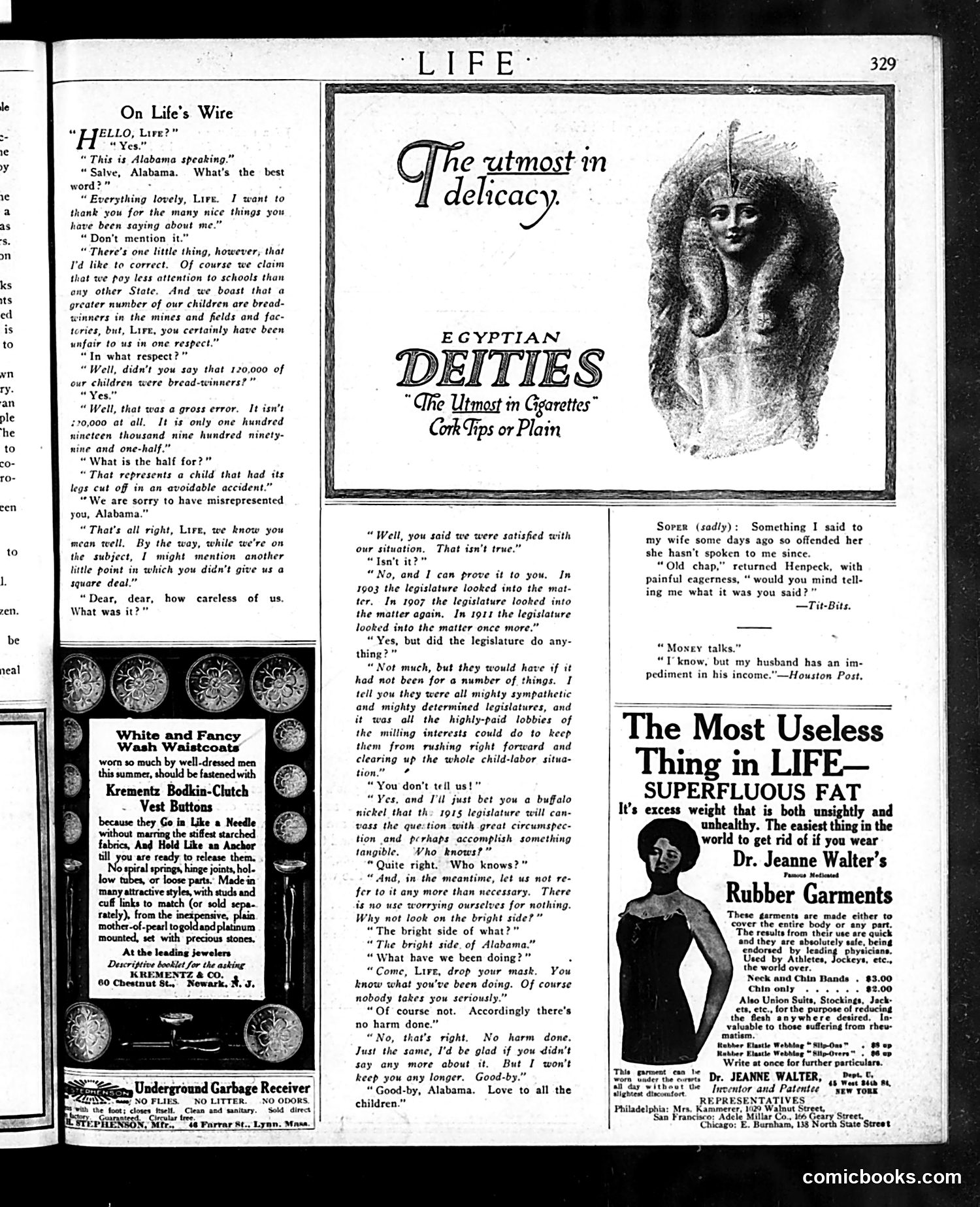
This page features a satirical telephone dialogue between *Life* magazine and "Alabama" (personified as a state). The joke exposes Alabama's hypocrisy and defensiveness about child labor. Alabama claims *Life* misreported the number of child laborers—not 120,000 but "119,999 and one-half," with the half-child representing one who lost its legs in an "avoidable accident." This grotesque correction reveals Alabama's callous acceptance of industrial child injuries. The state also boasts that legislatures repeatedly investigated child labor (1903, 1907, 1911) but accomplished nothing, blocked by milling industry lobbies. Alabama asks *Life* to stop mentioning these failures, urging focus on "the bright side"—a request to ignore ongoing exploitation. The satire targets both Alabama's shameless pride in negligence and its demand for positive coverage despite documented harm to children in mines and factories. The "bright side" comment is deeply ironic.
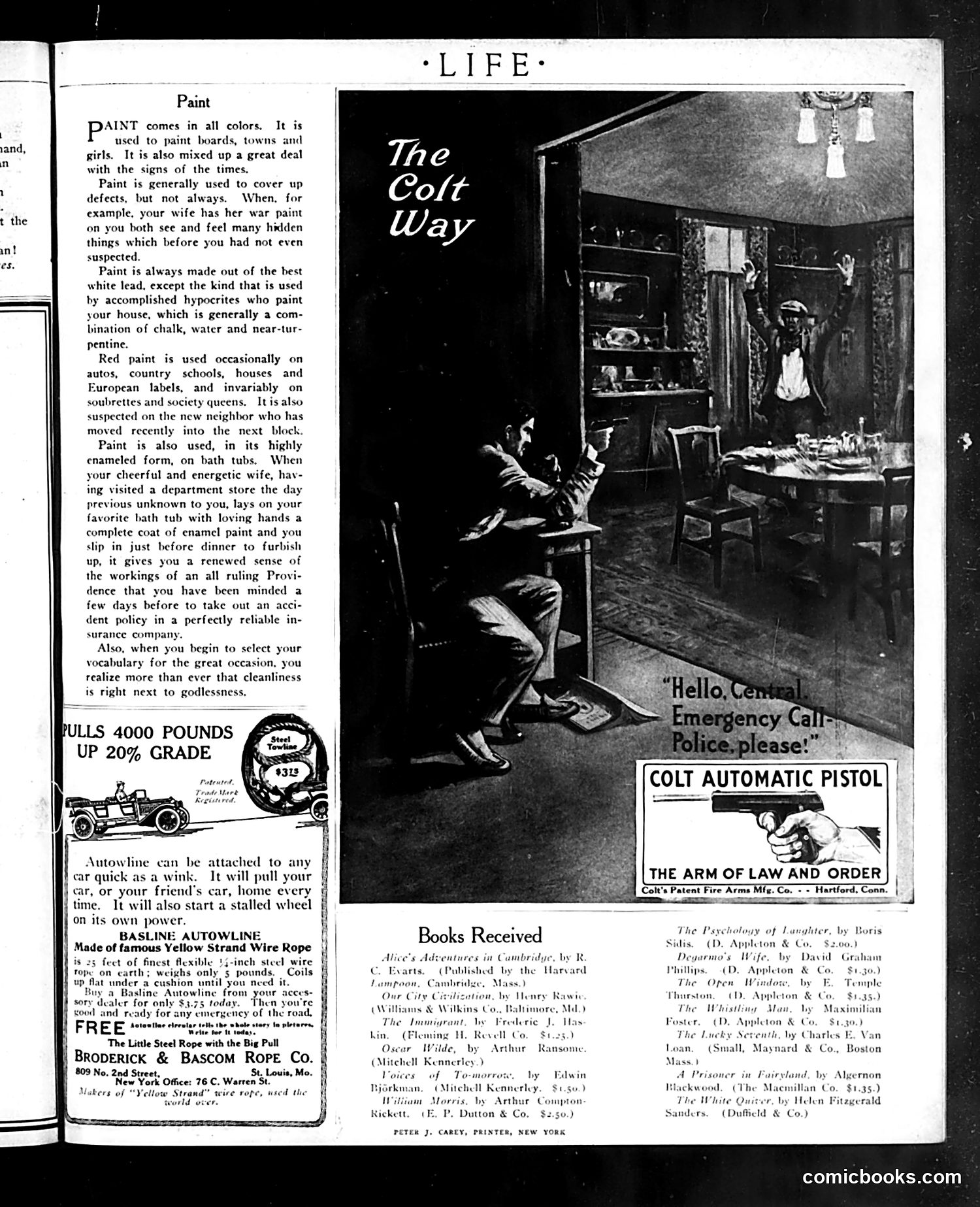
This Life magazine page combines humor about paint with a crime-prevention advertisement. The main cartoon depicts a domestic scene where a woman calls police, saying "Hello, Central, Emergency Call—Police, please!" while a man appears to be committing a crime in their home. The satire connects to the paint essay above: the article humorously discusses how wives use cosmetic "war paint" and how new neighbors are "suspected" based on appearances. The cartoon plays on this theme of suspicion and hidden intentions—suggesting that paint and appearances can mask criminal activity. The accompanying Colt Automatic Pistol advertisement frames the gun as "THE ARM OF LAW AND ORDER," positioned directly below the crime scene. This juxtaposes the magazine's satirical social commentary with a serious pitch for self-defense, reflecting early 20th-century anxieties about urban crime and home security. The advertisement leverages the cartoon's criminal scenario to market the weapon.
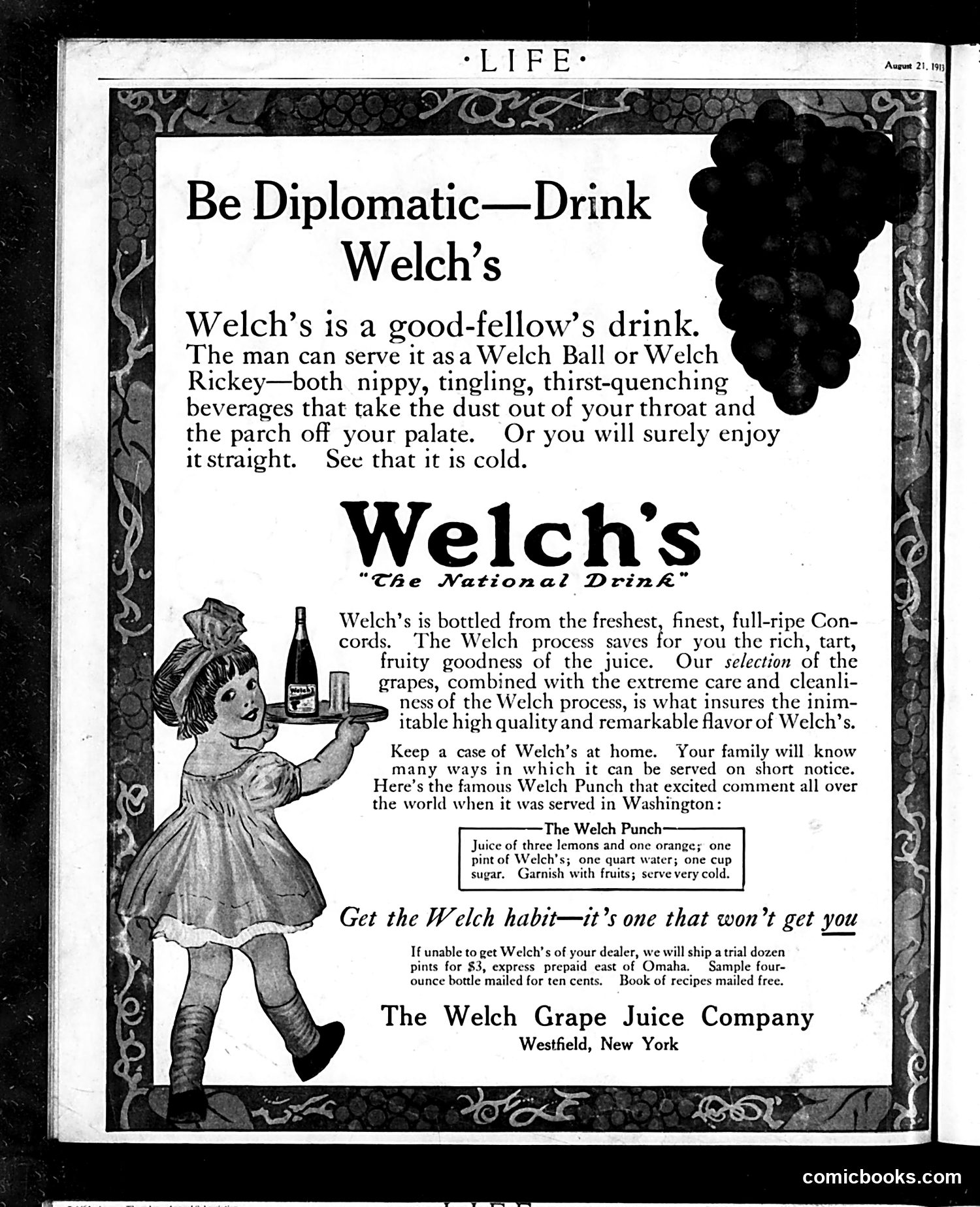
This is primarily a **product advertisement**, not a political cartoon. The page promotes Welch's grape juice with the tagline "Be Diplomatic—Drink Welch's." The humor lies in the implied context: this advertisement likely appeared during the **Prohibition era** (or leading up to it), when alcohol consumption was increasingly controversial. "Be Diplomatic" is a winking suggestion—serving non-alcoholic grape juice allows a host to be socially graceful while avoiding alcohol, which was becoming socially/politically contentious. The illustration shows a cherubic child serving the drink, emphasizing its wholesomeness and safety for all ages. The reference to "Welch Punch served in Washington" suggests official/respectable use. The joke for contemporary readers: Welch's markets grape juice as the sophisticated alternative to alcoholic drinks during a period of moral and political debate over alcohol's place in American society.