
Life, 1913-08-21 · page 19 of 40
Life — August 21, 1913 — page 19: what you’re looking at
What you’re looking at
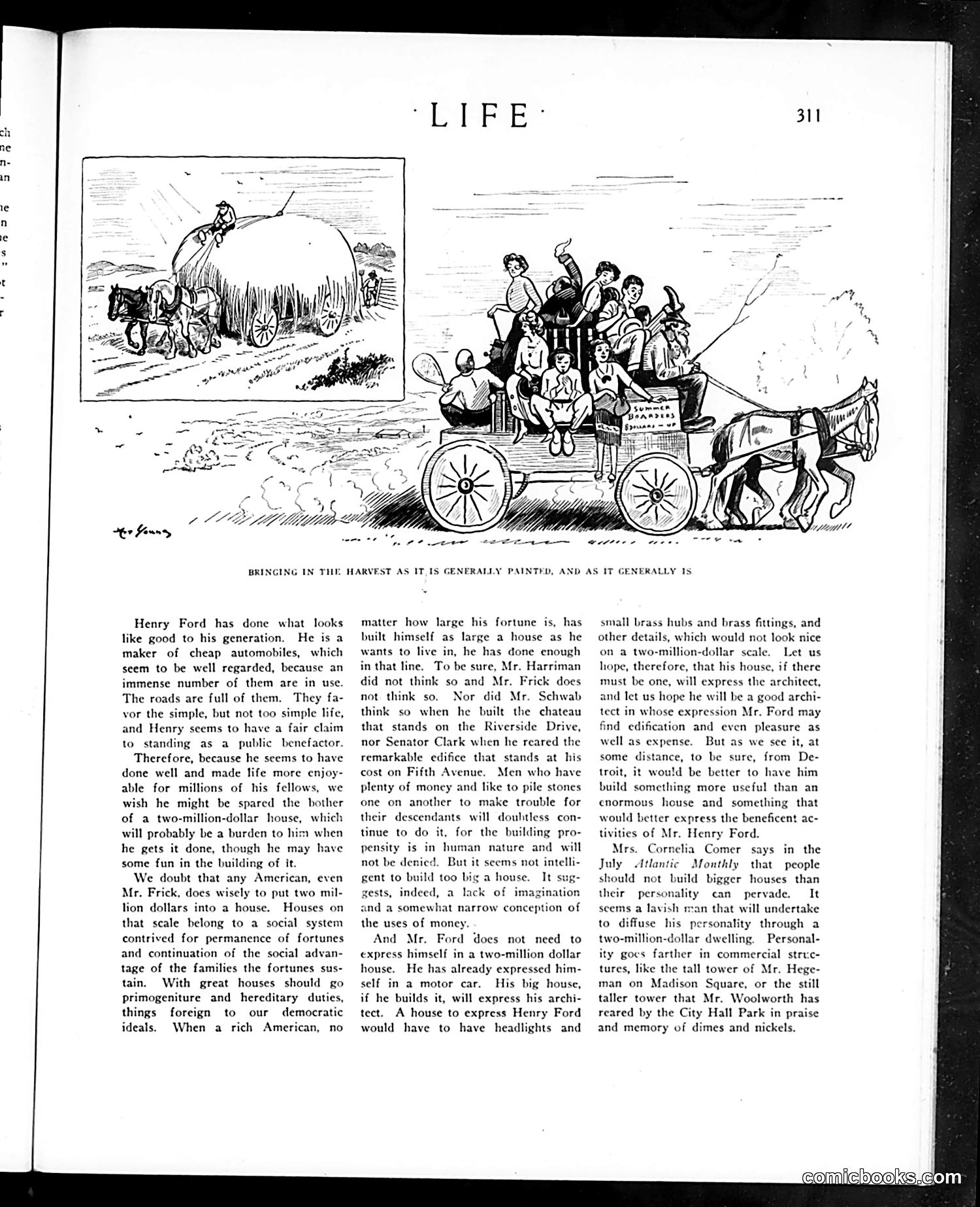
This Life magazine editorial cartoon mocks Henry Ford's reported plan to build a $2 million mansion. The cartoons contrast "how it is generally painted" (left: idealized pastoral harvest scene) with "how it generally is" (right: a chaotic wagon overflowing with people). **The Point:** Ford, celebrated as a public benefactor for making affordable automobiles, should not indulge in ostentatious mansion-building. The article argues this contradicts both democratic values and Ford's own character—his true expression is the practical Model T, not architectural grandeur. The text compares Ford unfavorably to other gilded-age industrialists (Frick, Harriman, Schwab, Senator Clark) who built extravagant Fifth Avenue palaces, suggesting Ford should avoid their mistakes. **The Satire:** Ford's house would merely "express his architect," not Ford himself. A true Ford mansion would need "headlights and brass fittings"—a car, essentially. Better to build something useful that reflects his actual achievement: democratizing transportation, not imitating European aristocratic excess.
📄 Transcribed text from this page (OCR, searchable)
Machine-transcribed from the original scan — historical spelling and the odd misread are preserved.
BRINGING IN THE HARVEST AS IT IS GENERALLY PAINTED, Henry Ford has done what looks like good to his generation. He is a maker of cheap automobiles, which seem to be well regarded, because an immense number of them are in use. The roads are full of them. They fa- vor the simple, but not too simple life, and Henry seems to have a fair claim to standing as a public benefactor. Therefore, because he seems to have done well and made life more enjoy- able for millions of his fellows, we wish he might be spared the bother of a two-million-dollar house, which will probably be a burden to him when he gets it done, though he may have some fun in the building of it. We doubt that any American, even Mr. Frick, does wisely to put two mil- lion dollars into a house. Houses on that scale belong to a social system contrived for permanence of fortunes and continuation of the social advan- tage of the families the fortunes sus- tain. With great houses should go Primogeniture and hereditary duties, things ideals. foreign to our democratic When a rich American, no matter how large his fortune is, has built himself as large a house as he wants to live in, he has done enough in that line. To be sure, Mr. Harriman did not think so and Mr. Frick does not think so. Nor did Mr. Schwab think so when he built the chateau that stands on the Riverside Drive, nor Senator Clark when he reared the remarkable edifice that stands at his cost on Fifth Avenue. Men who have plenty of money and like to pile stones one on another to make trouble for their descendants will doubtless con- tinue to do it, for the building pro- pensity is in human nature and will not be denied. But it seems not intelli- gent to build too big a house. It sug- gests, indeed, a lack of imagination and a somewhat narrow conception of the uses of money. And Mr, Ford does not need to express himself in a two-million dollar house. He has already expressed him- self in a motor car. His big house, if he builds it, will express his archi- tect. A house to express Henry Ford would have to have headlights and AND AS IT GENERALLY IS small brass hubs and brass fittings, and other details, which would not look nice on a two-million-dollar scale. Let us hope, therefore, that his house, if there must be one, will express the architect, and let us hope he will be a good archi- tect in whose expression Mr. Ford may find edification and even pleasure as well as expense. But as we sce it, at some distance, to be sure, from De- troit, it would be better to have him build something more useful than an enormous house and something that would better express the beneficent ac- tivities of Mr. Henry Ford. Mrs. Cornelia Comer says in the July Atlantic Monthly that people should not build bigger houses than their personality can pervade. It scems a lavish man that will undertake to diffuse his personality through a two-million-dollar dwelling. Personal- ity gocs farther in commercial struc- tures, like the tall tower of Mr. He; man on Madison Square, or the still taller tower that Mr. Woolworth has reared by the City Hall Park in praise and memory of dimes and nickels.