
Life, 1913-08-21 · page 18 of 40
Life — August 21, 1913 — page 18: what you’re looking at
What you’re looking at
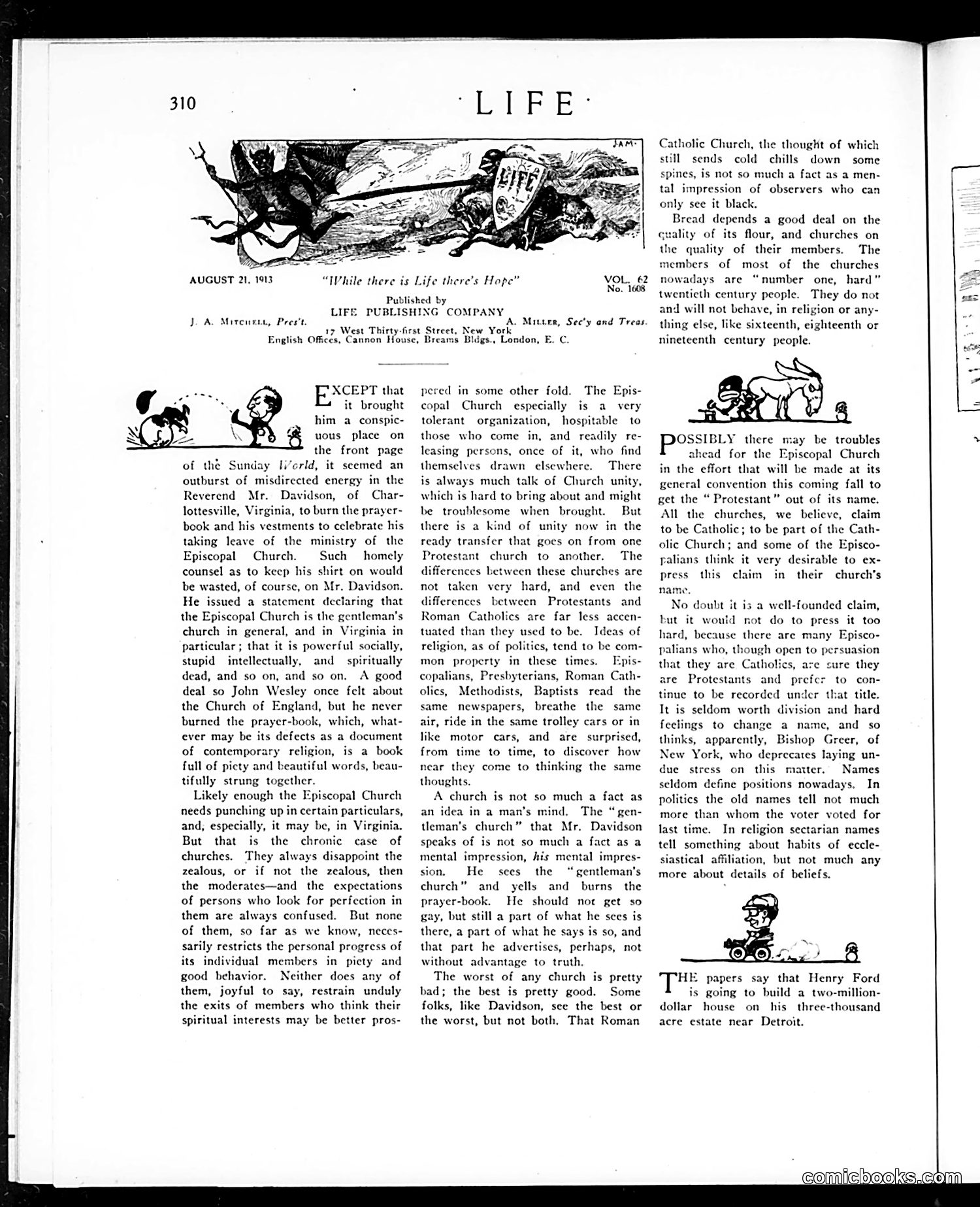
This page comments on Reverend Davidson of Charlottesville, Virginia, who publicly burned his prayer book and vestments while resigning from the Episcopal Church ministry. Davidson had issued statements denouncing the Episcopal Church as "the gentleman's church"—socially powerful but intellectually stupid and spiritually dead. The editorial satirizes Davidson's theatrical protest, comparing his zeal to John Wesley's criticisms of the Church of England (Wesley protested but didn't burn books). The writer argues that churches disappoint zealots because perfection is impossible, not because of institutional failings. The piece defends religious tolerance and notes that different Protestant denominations—and even Protestants and Catholics—now share common ground through newspapers, transportation, and daily life. The central joke: Davidson sees only the Episcopal Church's flaws, not its merits. His "mental impression" blinds him to reality. A church is "not so much a fact as an idea in a man's mind."
📄 Transcribed text from this page (OCR, searchable)
Machine-transcribed from the original scan — historical spelling and the odd misread are preserved.
AUGUST 21, 1913 “While there is Life there's Hope” VOL, 62 No. 1608 Published by LIFE PUBLISHING COMPANY JA. Mircurtt, Pres’. A. Miture, Secty and Treas 17 West Thirty-first Street, New York E <CEPT that it brought him a_conspic- uous place on the front page of the Sunday Ii’erld, it seemed an outburst of misdirected energy in the Reverend Mr. Davidson, of Char- lottesville, Virginia, to burn the p book and his vestments to cclebrate his taking leave of the ministry of the Episcopal Church. Such homely counsel as to keep his shirt on would be wasted, of course, on Mr. Davidson. He issued a statement declaring that the Episcopal Church is the gentleman’ church in general, and in Virginia in particular ; that it is powerful socially, stupid intellectually, and spiritually dead, and so on, and so on. A good deal so John Wesley once felt about the Church of England, but he never burned the prayer-book, which, what- ever may be its defects as a document of contemporary religion, is a book full of picty and beautiful words, beau- tifully strung together. Likely enough the Episcopal Church needs punching up in certain particulars, and, especially, it may be, in Virginia. But that is the chronic case of churches. They always disappoint the zealous, or if not the zealous, then the moderates—and the expectations of persons who look for perfection in them are always confused. But none of them, so far as we know, neces- sarily restricts the personal progress of its individual members in picty and good behavior. Neither does any of them, joyful to say, restrain unduly the exits of members who think their spiritual interests may be better pros- English Offices, Cannon House, Breams Bldgs., London, E. C. pered in some other fold. The Epis- copal Church especially is a very tolerant organization, hospitable to those who come in, and readily re- leasing persons, once of it, who find themselves drawn elsewhere. There is always much talk of Church unity, which is hard to bring about and might be troublesome when brought. But there is a kind of unity now in the ready transfer that goes on from one Protestant church to another. The differences between these churches are not taken very hard, and even the differences between Protestants and Roman Catholics are far less accen- tuated than they used to be. Ideas of religion, as of politics, tend to be com- mon property in these times. Epis- copalians, Presbyterians, Roman Cath- olics, Methodists, Baptists read the same newspapers, breathe the same air, ride in the same trolley cars or in like motor cars, and are surprised, from time to time, to discover how near they come to thinking the same thoughts. A church is not so much a fact as an idea in a man’s mind. The “ gen- tleman’s church” that Mr. Davidson speaks of is not so much a fact as a mental impression, his mental impres- sion. He sees the “gentleman's church” and yells and burns the prayer-book. He should not get so but still a part of what he sces is there, a part of what he says is so, and that part he advertises, perhaps, not without advantage to truth. The worst of any church is pretty bad; the best is pretty good. Some folks, like Davidson, see the best or the worst, but not both. That Roman Catholic Church, the thought of which still sends cold chills down some spines, is not so much a fact as a men- tal impression of observers who can only see it black. Bread depends a good deal on the lity of its flour, and churches on the quality of their members. The members of most of the churches nowadays are “number one, hard” twentieth century people. They do not and will not behave, in religion or any- thing else, like sixteenth, eighteenth or nineteenth century people. in the effort that will be made at its general convention this coming fall to get the “ Protestant” out of its name. All the churches, we believe, claim to be Catholic; to be part of the Cath- olic Church; and some of the Episco- palians think it very desirable to ex- press this claim in their church's name. No doubt it is a well-founded claim, but it would not do to press it too hard, because there are many Episco- palians who, though open to persuasion that they are Catholics, are sure they are Protestants and prefer to con- tinue to be recorded under that title. It is seldom worth division and hard feelings to change a name, and so thinks, apparently, Bishop Greer, of New York, who deprecates laying un- due stress on this matter. Names seldom define positions nowadays, In politics the old names tell not much more than whom the voter voted for last time. In religion sectarian names tell something about habits of eccle- siastical affiliation, but not much any more about details of beliefs. HE papers say that Henry Ford is going to build a two-million- dollar house on his three-thousand acre estate near Detroit.