
Life, 1913-08-21 · page 22 of 40
Life — August 21, 1913 — page 22: what you’re looking at
What you’re looking at
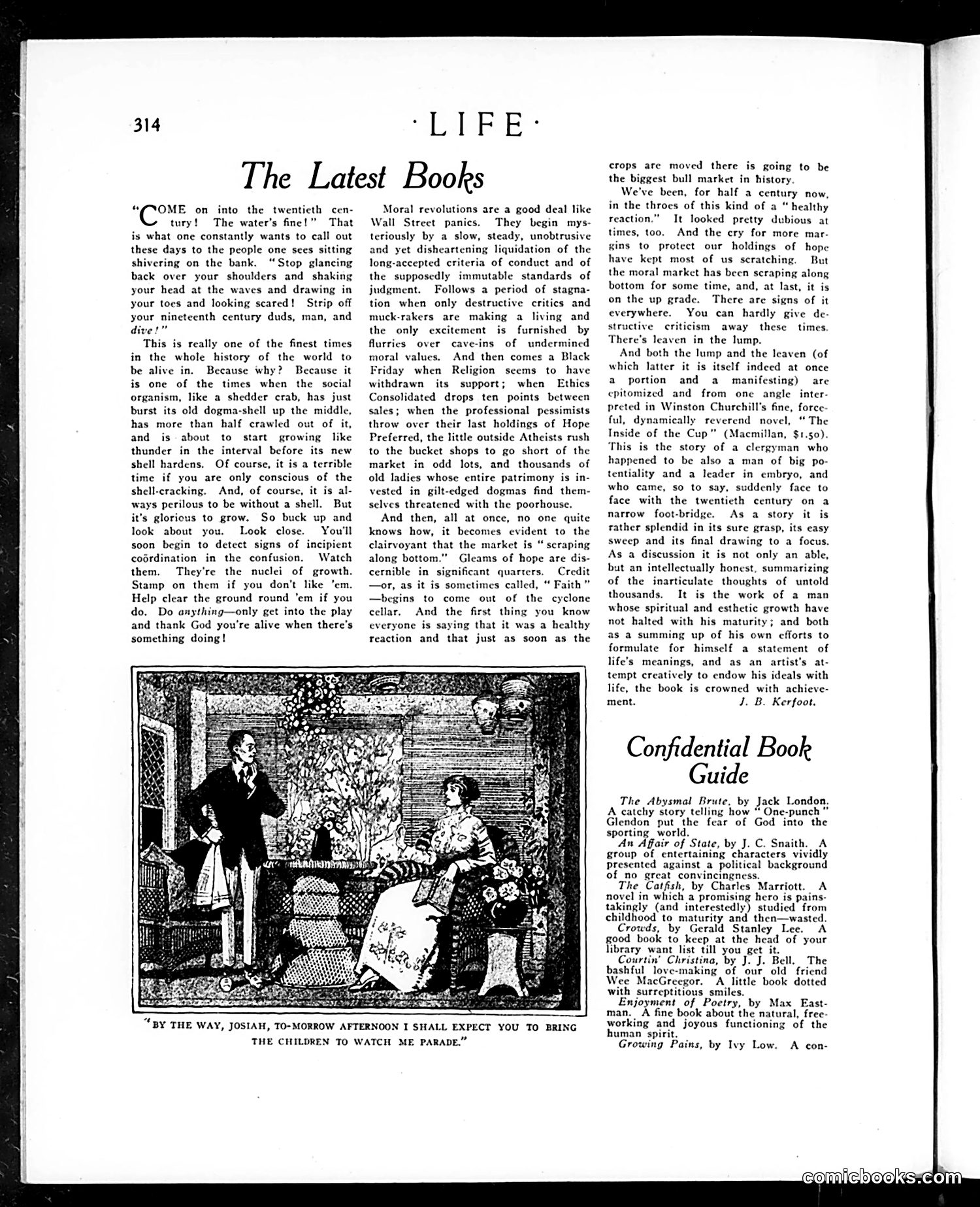
This page from Life magazine presents an editorial essay celebrating early 20th-century social progress. The author uses vivid metaphors—comparing society to a "shedder crab" shedding its shell and moral change to Wall Street market cycles—to encourage readers to embrace rapid modernization. The illustration depicts a domestic scene where a man announces to his family that he'll lead a parade tomorrow, likely satirizing Victorian propriety and rigid social hierarchies. The contrast between the formal indoor setting and the casual announcement subtly mocks outdated social conventions. The essay celebrates "moral revolutions" as healthy, inevitable reforms—a progressive stance typical of early 1900s intellectual circles. The "Confidential Book Guide" section reviews contemporary literature, including Winston Churchill's *The Inside of the Cup*, which apparently examines religious and social modernization. Overall, the page reflects an optimistic, reformist worldview characteristic of the Progressive Era, encouraging readers to abandon "nineteenth century" thinking for modern progress.
📄 Transcribed text from this page (OCR, searchable)
Machine-transcribed from the original scan — historical spelling and the odd misread are preserved.
“LEE The Latest Books “(OME on into the twentieth cen- tury! The water's fine!" That is what one constantly wants to call out these days to the people one sees sitting shivering on the bank. “Stop glancing back over your shoulders and shaking your head at the waves and drawing in your toes and looking scared! Strip off your nineteenth century duds, man, and dive!" This is really one of the finest times in the whole history of the world to be alive in. Because why? Because it is one of the times when the social organism, like a shedder crab, has just burst its old dogma-shell up the middle, has more than half crawled out of it, and is about to start growing like thunder in the interval before its new shell hardens. Of course, it is a terrible time if you are only conscious of the shell-cracking. And, of course, it is al- ways perilous to be without a shell. But it’s glorious to grow. So buck up and look about you. Look close. You'll soon begin to detect signs of incipient codrdination in the confusion. Watch them. They're the nuclei of growth. Stamp on them if you don’t like ’em. Help clear the ground round ‘em if you do. Do anything—only get into the play and thank God you're alive when there's something doing! Moral revolutions are a good deal like Wall Street panics. They begin mys- teriously by a slow, steady, unobtrusive and yet disheartening liquidation of the long-accepted criteria of conduct and of the supposedly immutable standards of judgment. Follows a period of stagna- tion when only destructive critics and muck-rakers are making a living and the only excitement is furnished by flurries over cave-ins of undermined noral values, And then comes a Black Friday when Religion seems to have withdrawn its support; when Ethics Consolidated drops ten points between sales; when the professional pessimists throw over their last holdings of Hope Preferred, the little outside Atheists rush to the bucket shops to go short of the market in odd lots, and thousands of old ladies whose entire patrimony is in- vested in gilt-edged dogmas find them- selves threatened with the poorhouse. And then, all at once, no one quite knows how, it becomes evident to the clairvoyant that the market is “ scraping along bottom.” Gleams of hope are dis- cernible in significant quarters. Credit —or, as it is sometimes called, “ Faith” —begins to come out of the cyclone cellar. And the first thing you know everyone is saying that it was a healthy reaction and that just as soon as the “BY THE WAY, JOSIAH, TO-MORROW AFTERNOON I SHALL EXPECT YOU TO BRING THE CHILDREN TO WATCH ME PARADE.” crops are moved there is going to be the biggest bull market in history, We've been, for half a century now, in the throes of this kind of a “ healthy reaction.” It looked pretty dubious at times, too, And the cry for more mar- gins to protect our holdings of hope have kept most of us scratching. But the moral market has been scraping along bottom for some time, and, at last, it i: on the up grade. There are signs of it everywhere. You can hardly give de- structive criticism away these times. There's leaven in the lump. And both the lump and the leaven (of which latter it is itself indeed at once a portion and a manifesting) are epitomized and from one angle inter- preted in Winston Churchill's fine, force. ful, dynamically reverend novel, “ The Inside of the Cup” (Macmillan, $1.50). This is the story of a clergyman who happened to be also a man of big po- tentiality and a leader in embryo, and who came, so to say, suddenly face to face with the twentieth century on a narrow foot-bridge. As a story it is rather splendid in its sure grasp, its easy sweep and its final drawing to a focus. As a discussion it is not only an able, but an intellectually honest, summarizing of the inarticulate thoughts of untold thousand Tt is the work of a man whose spiritual and esthetic growth have not halted with his maturity; and both as a summing up of his own cfforts to formulate for himself a statement of life’s meanings, and as an artist's at- tempt creatively to endow his ideals with life, the book is crowned with achieve- ment. J. B. Kerfoot. Confidential Book Guide The Abysmal Brute, by Jack London, A catchy story telling how “ One-punch ” Glendon put the fear of God into the sporting world. ‘An Affair of State, by J. C. Snaith. A group of entertaining characters vividly Presented against a political background of no great convincingness. The Catfish, by Charles Marriott. A novel in which a promising hero is pains- takingly (and interestedly) studied from childhood to maturity and then—wasted. Crowds, by Gerald Stanley Lee. A good book to keep at the head of your library want list till you get it. Courtin’ Christina, by J. J. Bell, The bashful love-making of ‘our old friend Wee MacGreegor. A_ little book dotted with surreptitious smiles. Enjoyment of Poetry, by Max East- man. A fine book about the natural, free: working and joyous functioning of the human spirit. Growing Pains, by Ivy Low. A con-