
Life, 1913-08-21 · page 28 of 40
Life — August 21, 1913 — page 28: what you’re looking at
What you’re looking at
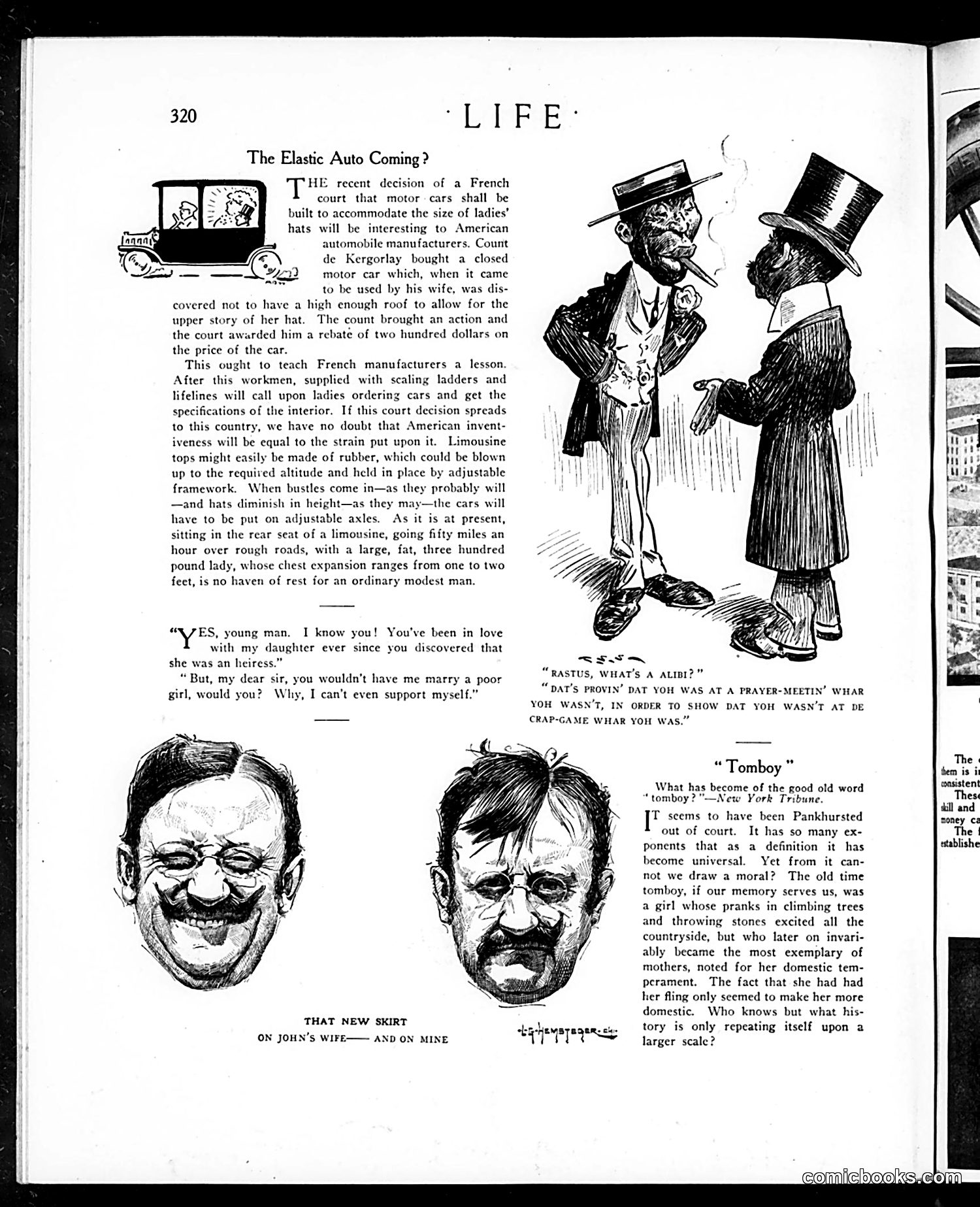
This satirical page contains three distinct pieces mocking early-20th-century social absurdities: **"The Elastic Auto Coming?"** ridicules a French court decision awarding damages because a wife's large hat wouldn't fit in a motor car. The satire suggests American manufacturers will absurdly respond with inflatable rubber tops and adjustable axles to accommodate ladies' enormous hats and bustles—a jab at both automotive engineering pretension and women's excessive fashion. **The middle section** uses two contrasting facial expressions to mock a suitor who admits he pursues an heiress only because she's wealthy, unable to support even himself—satirizing gold-digging and class hypocrisy. **"Tomboy"** references the Pankhurst suffragettes (British women's voting-rights activists), sarcastically suggesting that wild young girls inevitably become dutiful mothers, implying feminist activism is merely a youthful phase women outgrow. This mocks both feminism and women's ambitions. The racist dialect humor in "Rastus" reflects the magazine's period conventions but reflects deeply offensive racial stereotypes standard to that era.
📄 Transcribed text from this page (OCR, searchable)
Machine-transcribed from the original scan — historical spelling and the odd misread are preserved.
“LAPSE The Elastic Auto Coming ? HE recent decision of a French court that motor cars shall be built to accommodate the size of ladies’ hats will be interesting to American automobile manufacturers. Count de Kergorlay bought a closed motor car which, when it came to be used by his wife, was dis- covered not to have a high enough roof to allow for the upper story of her hat. The count brought an action and the court awarded him a rebate of two hundred dollars on the price of the car. This ought to teach French manufacturers a lesson. After this workmen, supplied with scaling ladders and lifelines will call upon ladies ordering cars and get the specifications of the interior. If this court decision spreads to this country, we have no doubt that American invent- iveness will be equal to the strain put upon it. Limousine tops might easily be made of rubber, which could be blown up to the required altitude and held in place by adjustable framework. When bustles come in—as they probably will —and hats diminish in height—as they may—the cars will have to be put on adjustable axles. As it is at present, sitting in the rear seat of a limousine, going fifty miles an hour over rough roads, with a large, fat, three hundred pound lady, whose chest expansion ranges from one to two feet, is no haven of rest for an ordinary modest man. “Vv S, young man. I know you! You've been in love with my daughter ever since you discovered that she was an heiress.” “But, my dear sir, you wouldn’t have me marry a poor girl, would you? Why, I can’t even support myself.” THAT NEW SKIRT ON JOHN’S WIFE—— AND ON MINE “RASTUS, WHAT'S A ALIBI?” “DATS PROVIN’ DAT YOH WAS AT A PRAYER-MEETIN’ WHAR YOH WASN'T, IN ORDER TO SHOW DAT YOH WASN’T AT DE CRAP-GAME WHAR YOH WAS.” “Tomboy ” become of the good old word New York Tribune. ve been Pankhursted out of court. It has so many ex- ponents that as a definition it has become universal. Yet from it can- not we draw a moral? The old time tomboy, if our memory serves us, was a girl whose pranks in climbing trees and throwing stones excited all the countryside, but who later on invari- ably became the most exemplary of mothers, noted for her domestic tem- perament. The fact that she had had her fling only seemed to make her more domestic. Who knows but what his- tory is only repeating itself upon a larger scale?