
Life, 1913-08-21 · page 12 of 40
Life — August 21, 1913 — page 12: what you’re looking at
What you’re looking at
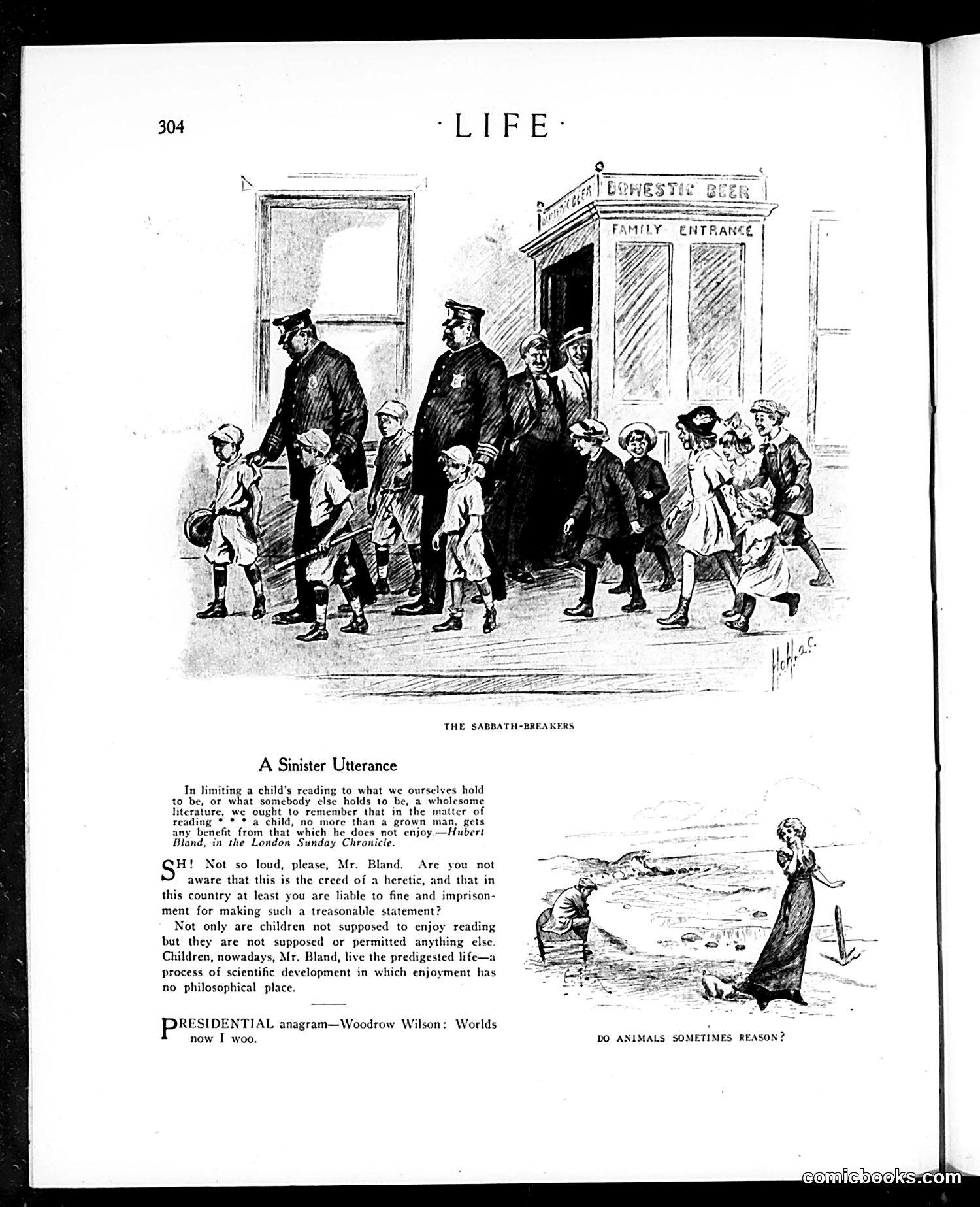
**Top Cartoon - "The Sabbath-Breakers":** Police officers and uniformed officials escort children into what appears to be a public establishment (marked "Lowesic Beer" with "Family Entrance"). The satire criticizes allowing children into beer halls on Sundays, which violated religious observance norms of the era. The caption "A Sinister Utterance" introduces a quote from Hubert Bland criticizing restrictions on children's reading as censorship. **Bottom Illustration - "Do Animals Sometimes Reason?":** Shows a woman and animals on a beach, likely a humorous observation about animal behavior. **Editorial Text:** Bland argues that limiting children's reading violates free speech and that modern child development shouldn't involve "philosophical" restrictions on enjoyment. A Woodrow Wilson anagram joke concludes the page. The content reflects early-20th-century debates about childhood, temperance laws, and censorship.
📄 Transcribed text from this page (OCR, searchable)
Machine-transcribed from the original scan — historical spelling and the odd misread are preserved.
THE SABBATH-BREAKERS A Sinister Utterance In limiting a child's reading to what we ourselves hold to be, or what somebody else holds to be, a wholesome literature, ought to remember that in the matter of reading a child, no more than a grown man, gets any benefit from that which he does not enjoy.—Hubert Bland, in the London Sunday Chronicle. H! Not so loud, please, Mr. Bland. Are you not aware that this is the creed of a heretic, and that in this country at least you are liable to fine and imprison- ment for making such a treasonable statement? Not only are children not supposed to enjoy reading but they are not supposed or permitted anything else. Children, nowadays, Mr. Bland, live the predigested life—a Process of scientific development in which enjoyment has no philosophical place. RESIDENTIAL anagram—Woodrow Wilson: Worlds now I woo. DO ANIMALS SOMETIMES REASON?