
A complete issue · 40 pages · 1913
Life — August 7, 1913
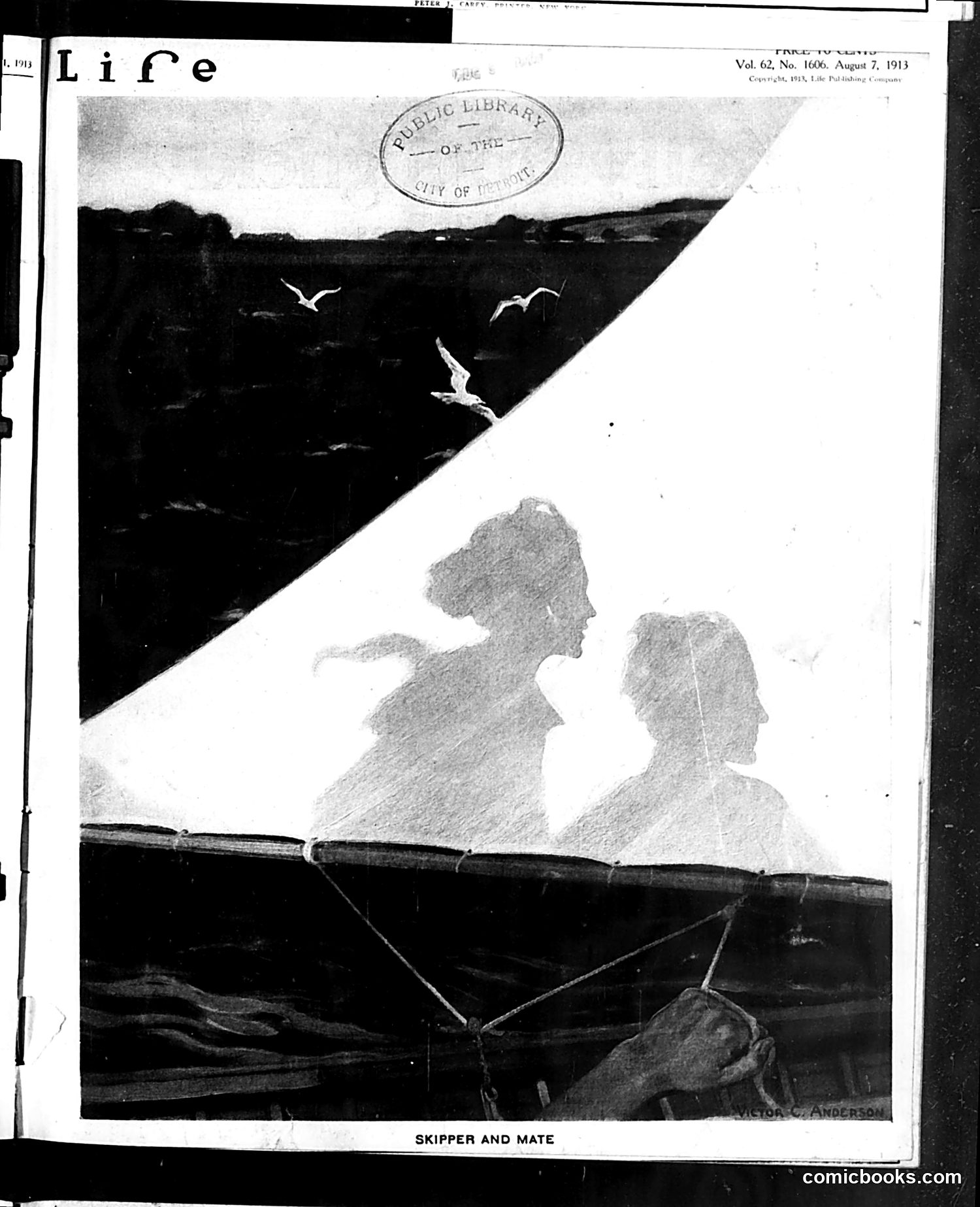
This illustration depicts two silhouetted figures in a boat on water, with seabirds flying overhead. The caption "Skipper and Mate" suggests a nautical scene, likely referencing a romantic or leisurely boating excursion popular among the leisured classes in early 20th-century America. The image appears to be a straightforward romantic illustration rather than political satire—showing a man and woman enjoying time together on the water. Given Life magazine's typical blend of humor and social commentary, this may be commentary on courtship customs or leisure activities of the era, though the specific satirical point remains unclear from the image alone. The artistic style is characteristic of early 1910s magazine illustration.
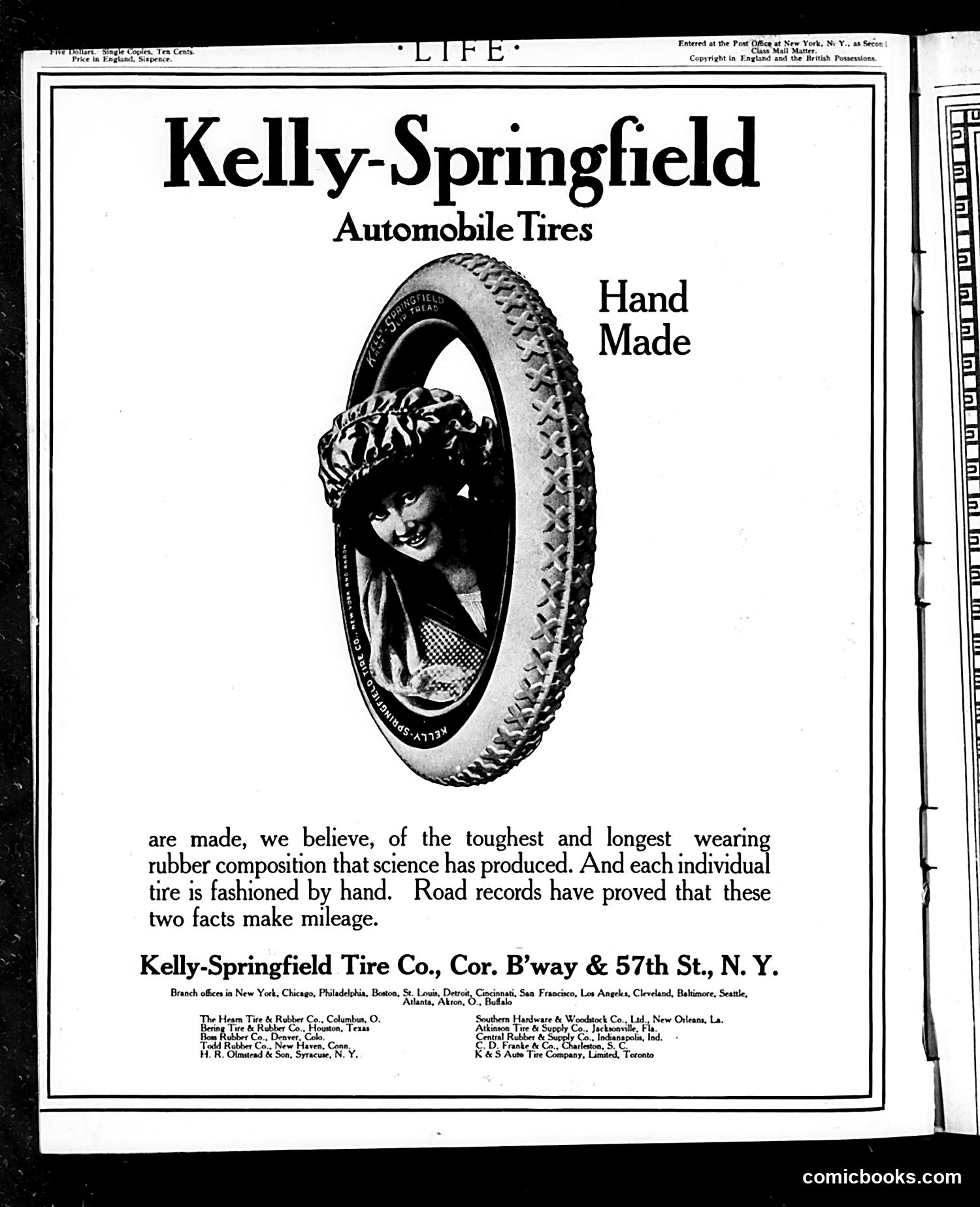
This is a straightforward commercial advertisement, not political satire. It promotes Kelly-Springfield brand automobile tires, emphasizing they are "Hand Made" from durable rubber composition. The central image shows a woman's face and upper body framed within a tire, presenting the product as both functional and aesthetically pleasing. This was a common early-20th-century advertising technique—using attractive female imagery to market industrial products to male consumers (primarily car owners). The ad's claims about "toughest and longest wearing rubber composition" and road-tested durability reflect typical tire manufacturer marketing of the period. The company lists multiple branch offices across major American cities, indicating national distribution. There is no political or satirical content on this page.
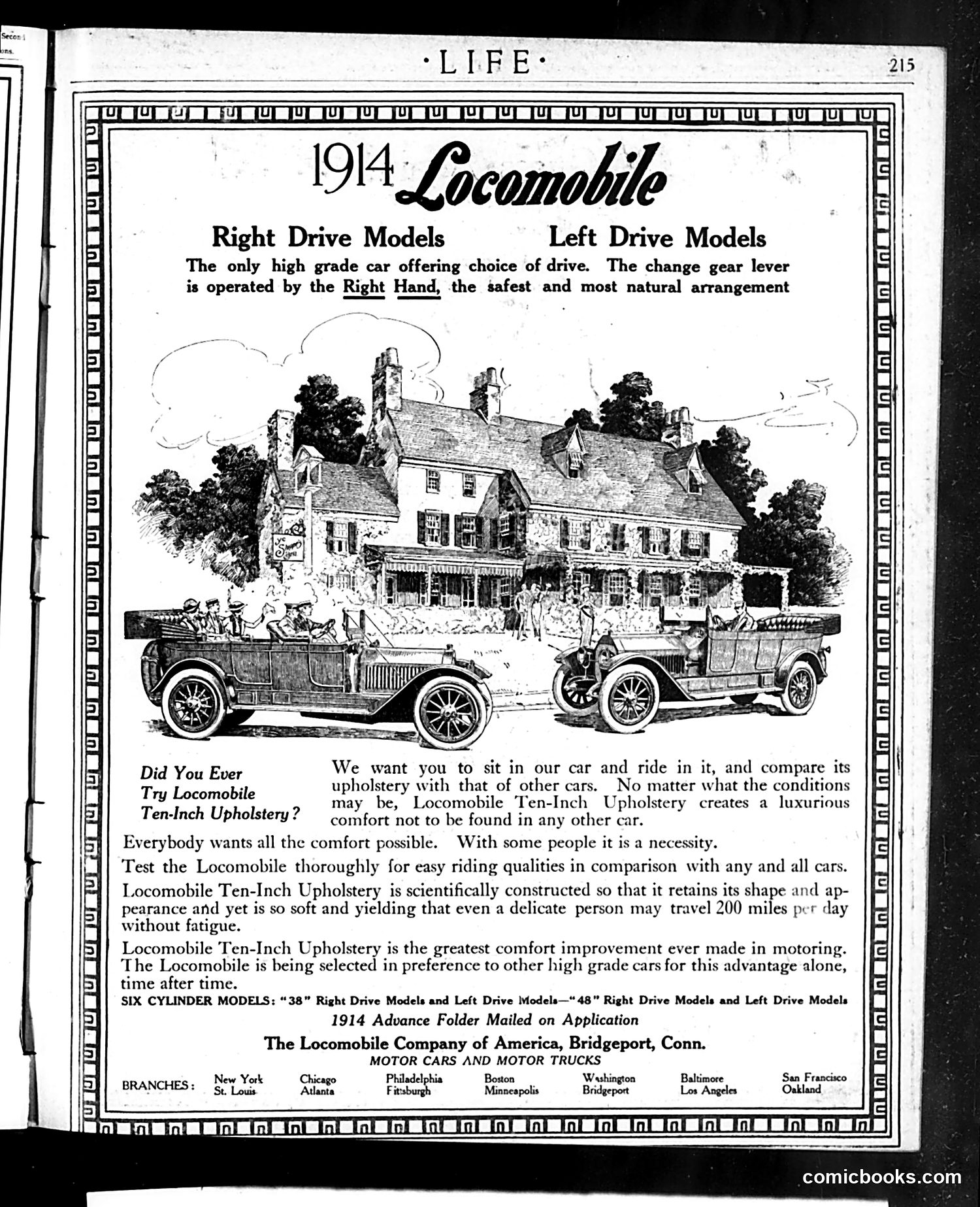
This is **not a political cartoon or satire page**—it's a straightforward **advertisement for the 1914 Locomobile automobile**, published in *Life* magazine. The page promotes the car's "Ten-Inch Upholstery" comfort feature, emphasizing luxury and smooth ride quality. It highlights that Locomobile offers both right-hand and left-hand drive options (relevant when cars were still transitioning between these configurations). The illustration shows two 1914 Locomobiles parked before a stately mansion with well-dressed passengers, establishing the vehicle's association with wealth and refinement. The ad encourages potential buyers to test-drive and compare comfort against competitors. The Locomobile Company of America, based in Bridgeport, Connecticut, had multiple branches listed across major American cities. This represents early 20th-century automotive marketing in a general-interest magazine.
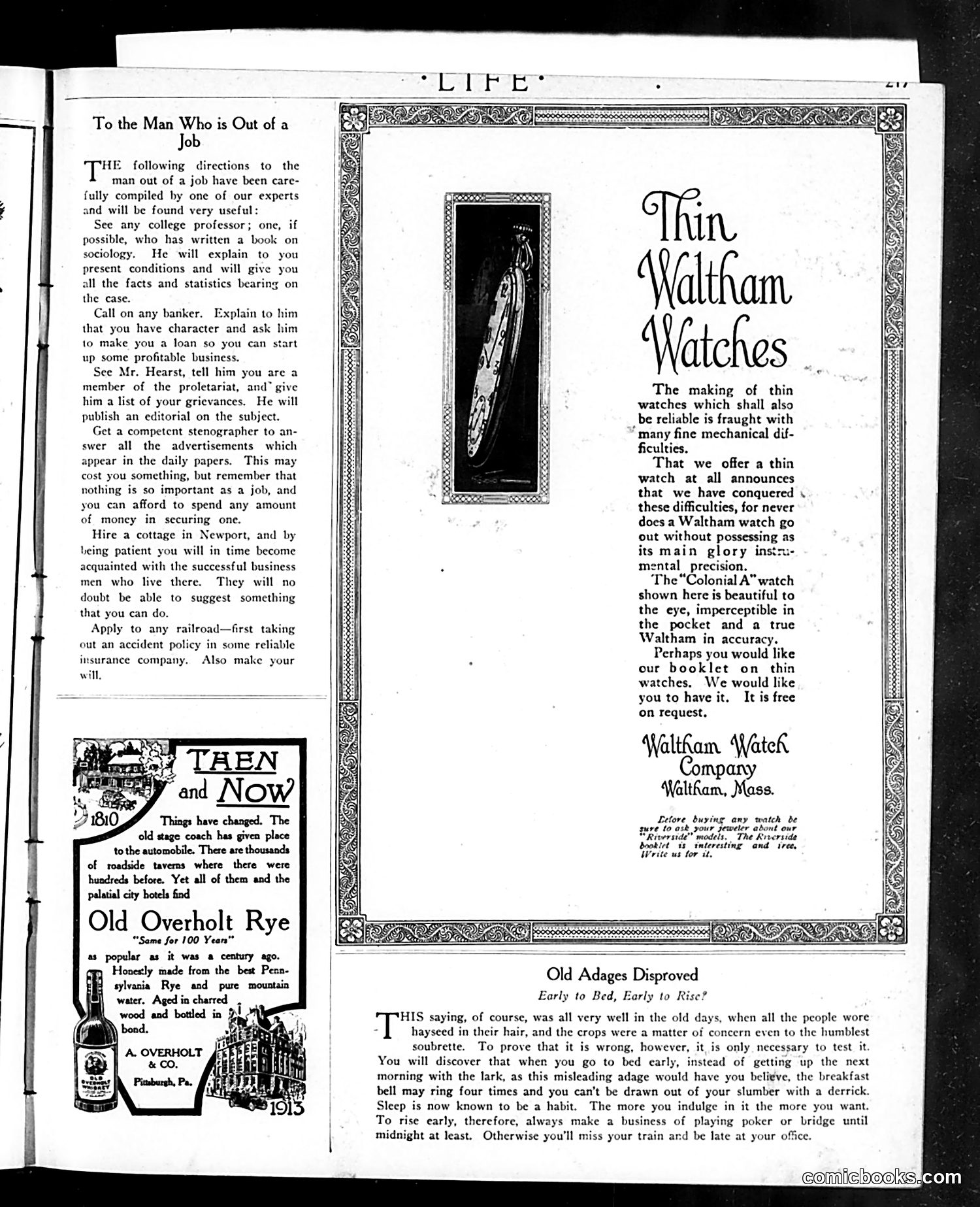
This page contains **no political cartoon**. Instead, it features three separate advertisements and advice columns typical of Life magazine's format: 1. **"To the Man Who is Out of a Job"** — practical career advice suggesting unemployed readers consult professors, bankers, and business contacts to find work or start ventures. 2. **"Thin Waltham Watches"** — an advertisement for precision pocket watches, emphasizing reliability and offering a free booklet. 3. **"Old Overholt Rye"** — a whiskey advertisement referencing the product's 100-year popularity. 4. **"Old Adages Disproved"** — a humorous column debunking the saying "Early to Bed, Early to Rise," arguing that modern sleep science contradicts this old maxim. The page reflects early 20th-century concerns: unemployment, consumer products, and folk wisdom challenged by modern thinking.
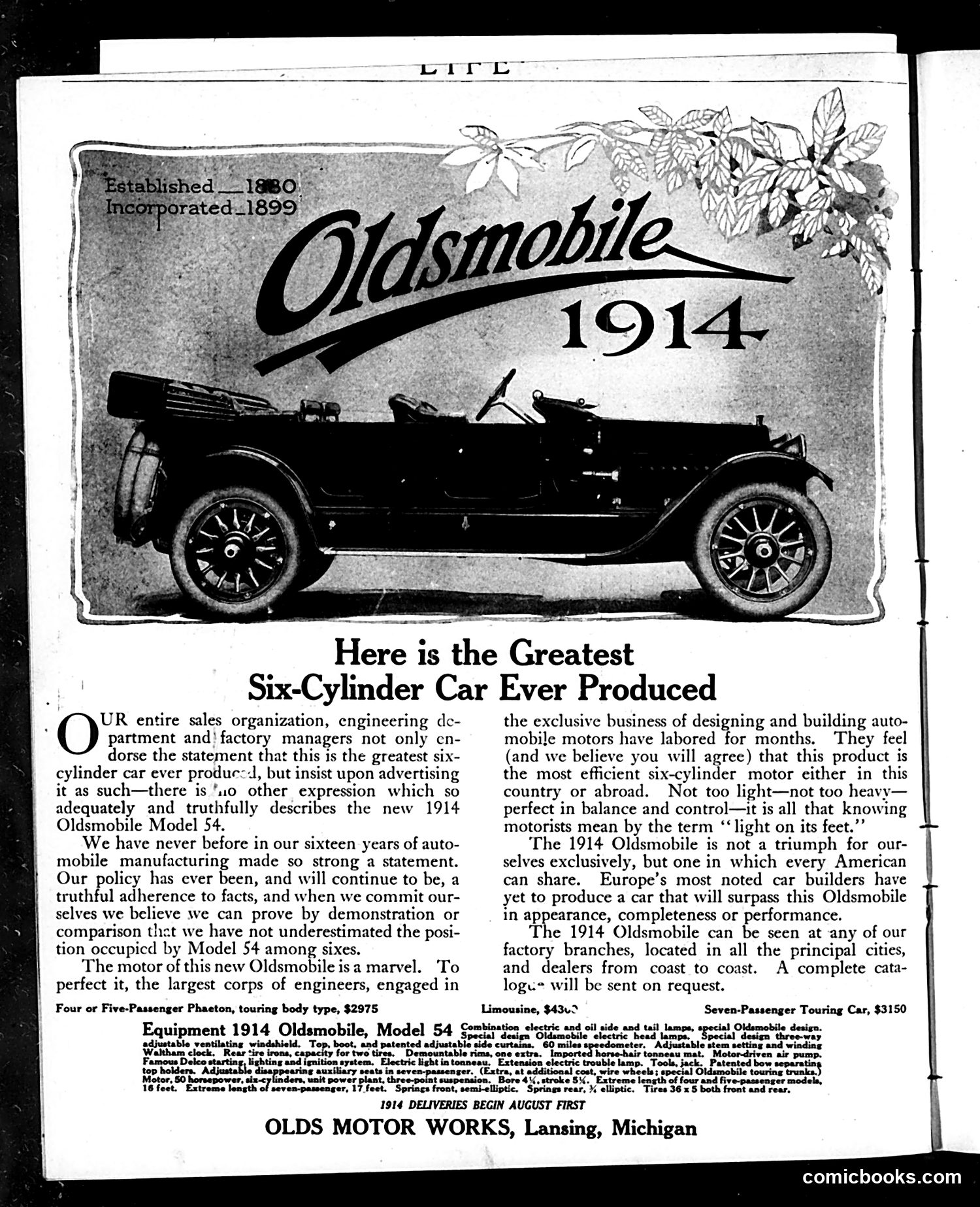
This page is **not a cartoon or satirical content** — it's a straightforward automobile advertisement for the 1914 Oldsmobile Model 54, a six-cylinder car. The ad appears in *Life* magazine, but contains no political or social satire. Instead, it's a genuine product advertisement claiming the 1914 Oldsmobile is "the Greatest Six-Cylinder Car Ever Produced." The text emphasizes engineering achievements, balance, and control, and notes that European builders haven't matched it. The decorative elements (leaves, the side-profile automobile illustration) are typical period advertising design. This represents early automotive marketing rather than the satirical content *Life* magazine was known for. The ad notes deliveries begin August 1st and prices range from $2,975 to $3,150.
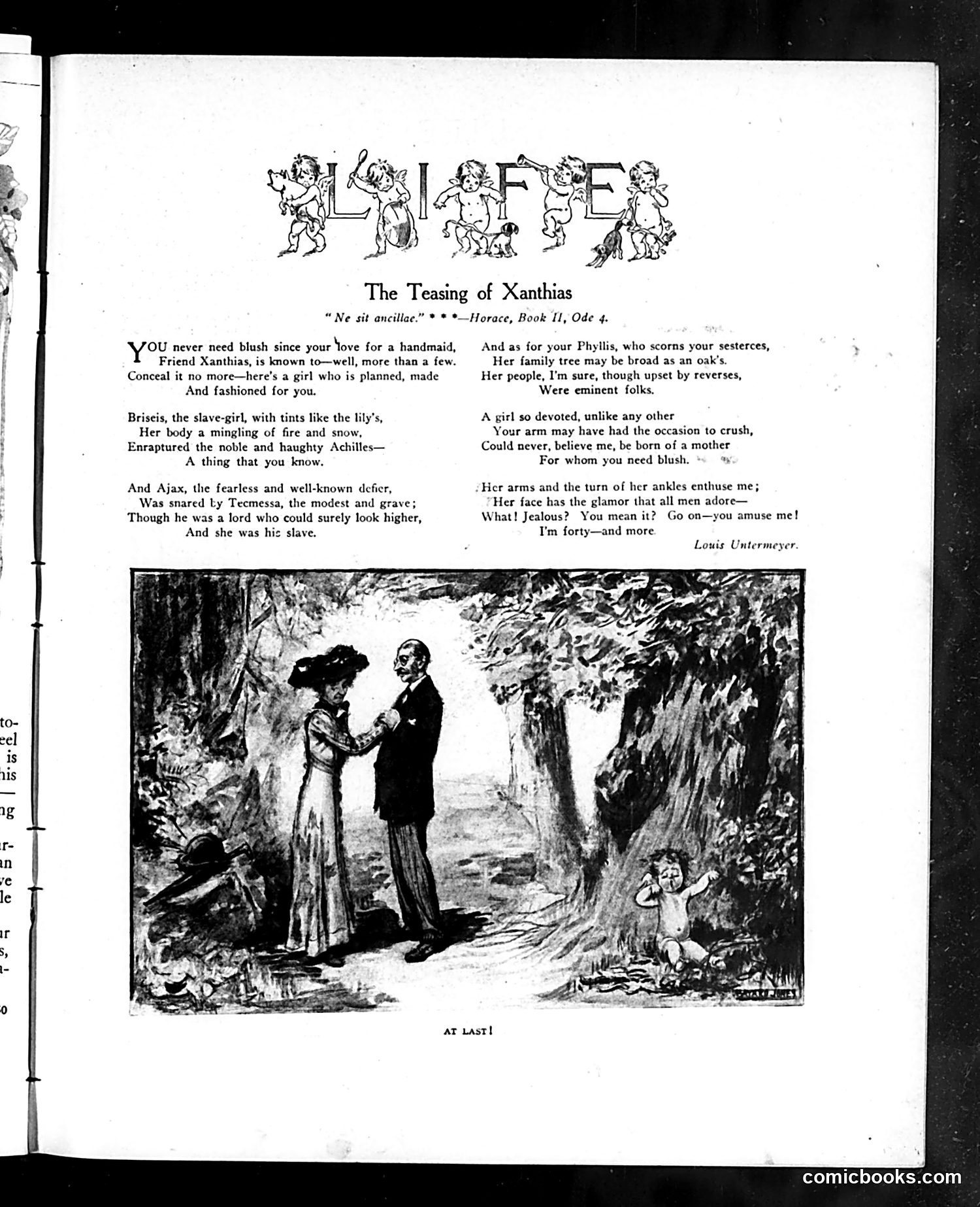
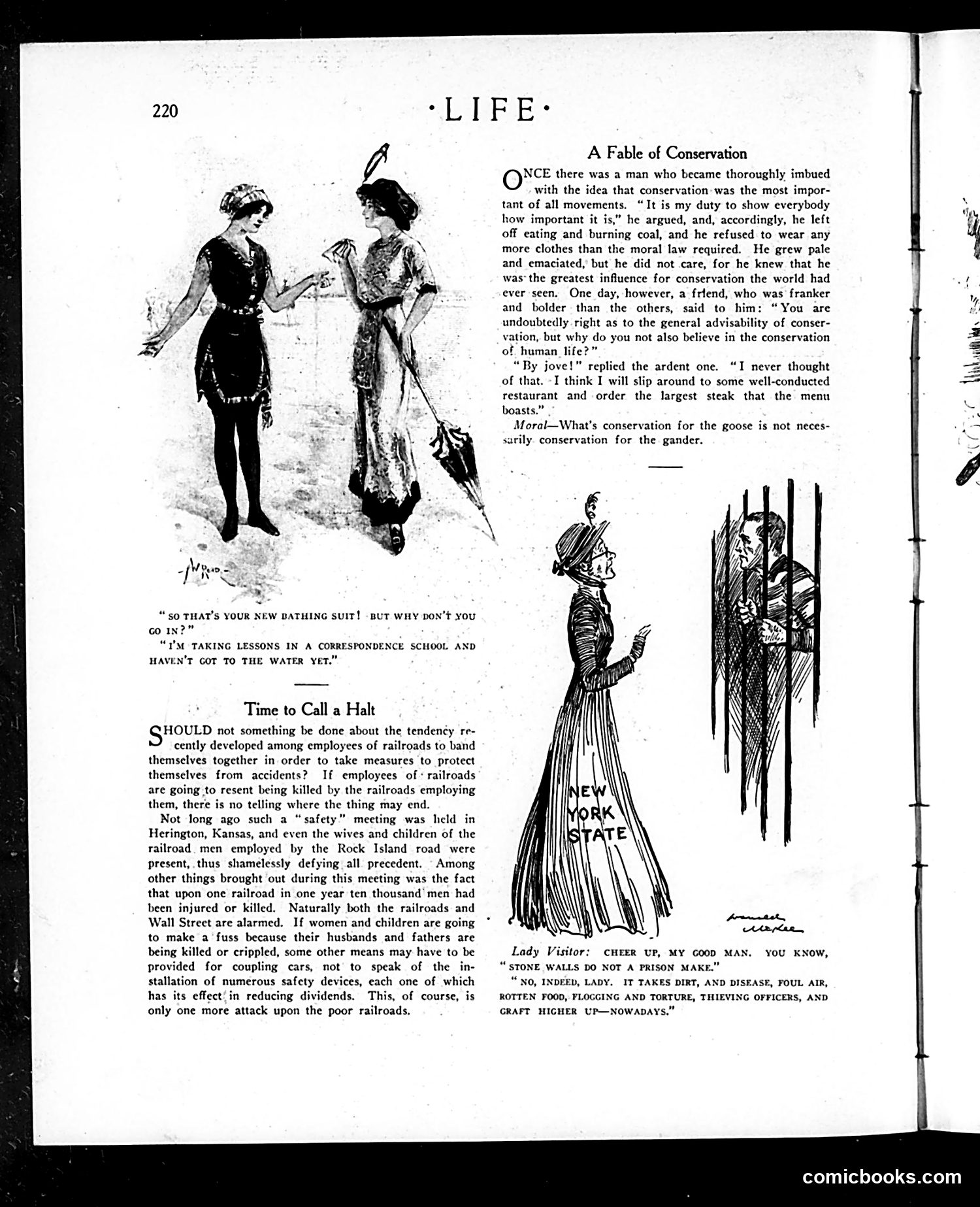
This page contains three distinct pieces of satire: 1. **"A Fable of Conservation"** (top): A man obsessed with conservation refuses basic comforts (eating, heating, clothing) to save resources. A bolder friend challenges his hypocrisy by pointing out he won't apply these principles to *human* life—suggesting his conservation ethics are selective and self-serving. 2. **Top cartoon**: Two women discuss a new bathing suit; one explains she's taking correspondence courses and hasn't reached the water yet—mocking either educational inefficiency or absurdly lengthy self-improvement programs. 3. **"Time to Call a Halt"** (bottom): Discusses railroad employee safety, noting ten thousand men were injured annually. It advocates for safety measures and coupling devices, framing worker protection as economically sensible, not just humanitarian. The page satirizes selective morality, educational pretension, and industrial negligence.
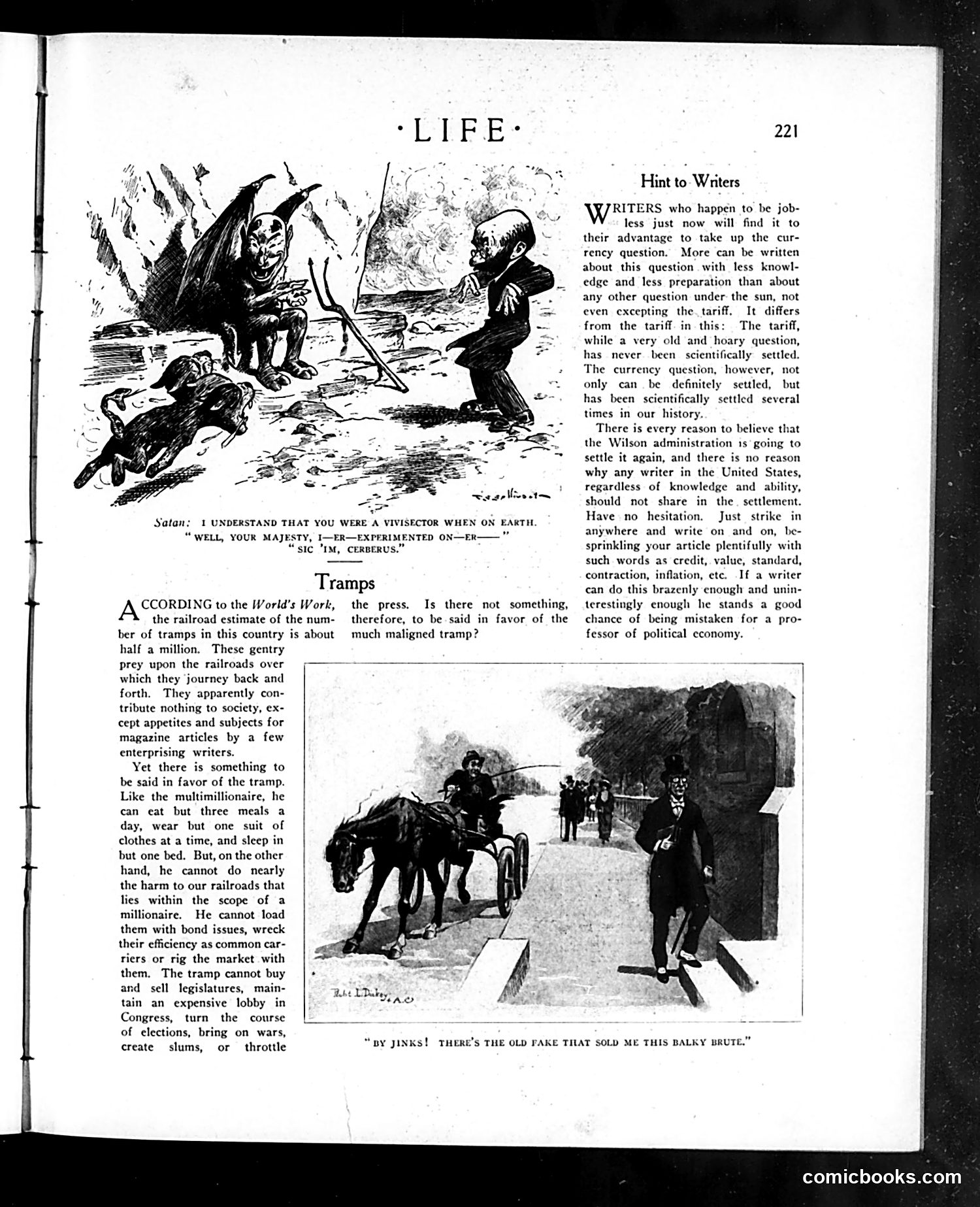
**Top Cartoon ("Satan"):** A devil figure confronts a well-dressed man, with the caption "I understand that you were a visector when on earth. Well, your majesty, I—er—experimented on—er—sic 'im, Cerberus.'" This satirizes vivisection (animal experimentation), presenting it as a sin worthy of hellish punishment. The cartoon condemns scientific testing on animals. **"Tramps" Article & Illustration:** The text discusses hobos and railroad vagrants (numbering about half a million), debating whether they contribute anything to society beyond providing magazine article subjects. The accompanying illustration shows a tramp and horse-drawn cart on a road, with the caption "By Jinks! There's the old fare that sold me this balky brute." This humorously depicts a tramp's complaint about being swindled—a common occurrence among the homeless poor.
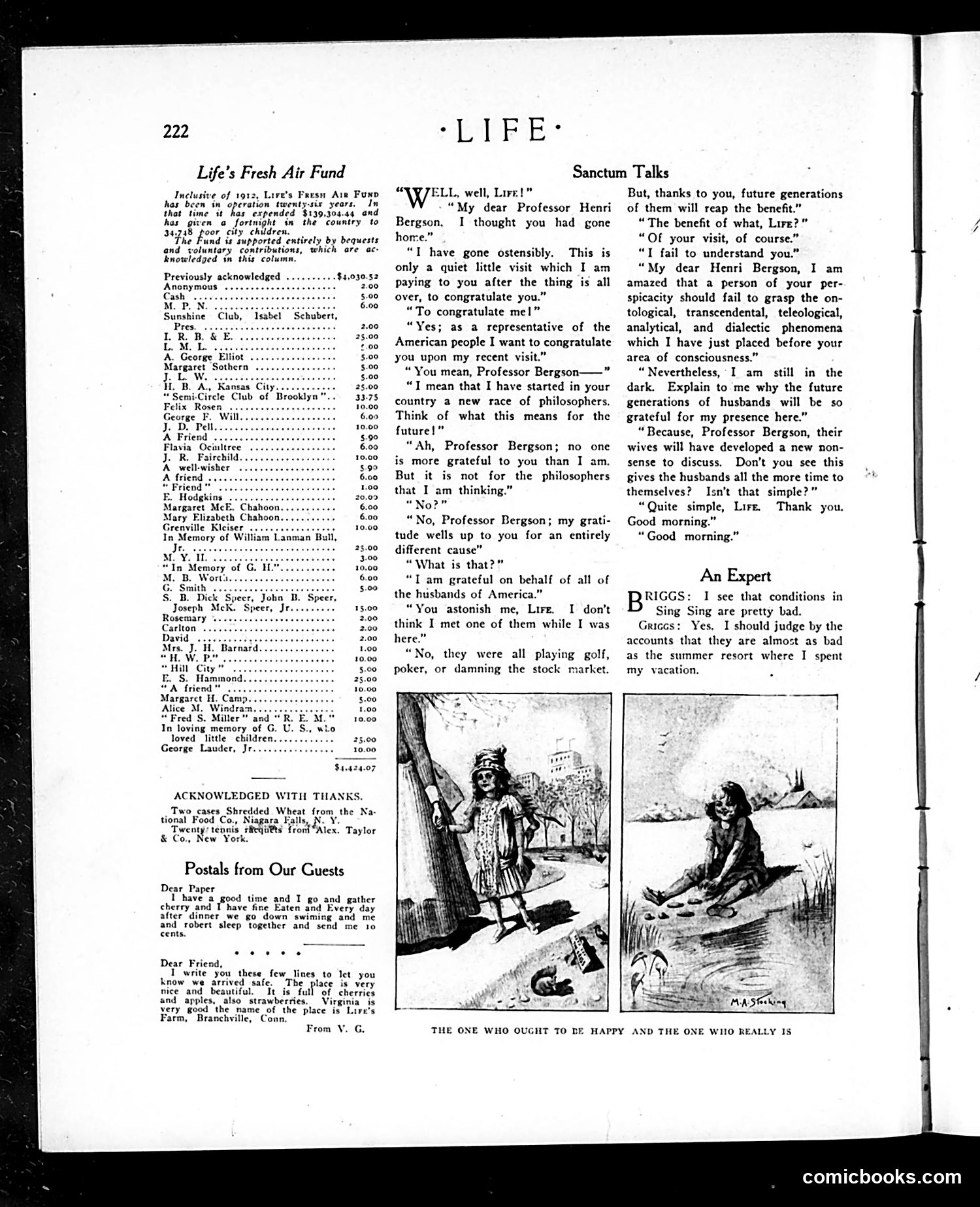
This page contains a satirical dialogue titled "Sanctum Talks" between Professor Henri Bergson (a famous French philosopher who visited America) and an unnamed interlocutor. The joke hinges on Bergson's gratitude: he's thanked for inspiring "a new race of philosophers" in America—but the twist is that the American husbands he's allegedly influenced now neglect their wives because they're "playing golf, poker, or damning the stock market" instead of engaging in philosophy. The accompanying cartoon illustrates this contrast: one figure "ought to be happy" (presumably doing intellectual work) while the other "really is" (relaxing by water). The satire mocks how American materialism and leisure corrupted European intellectual ideals, and how men used philosophy as an excuse for idleness.
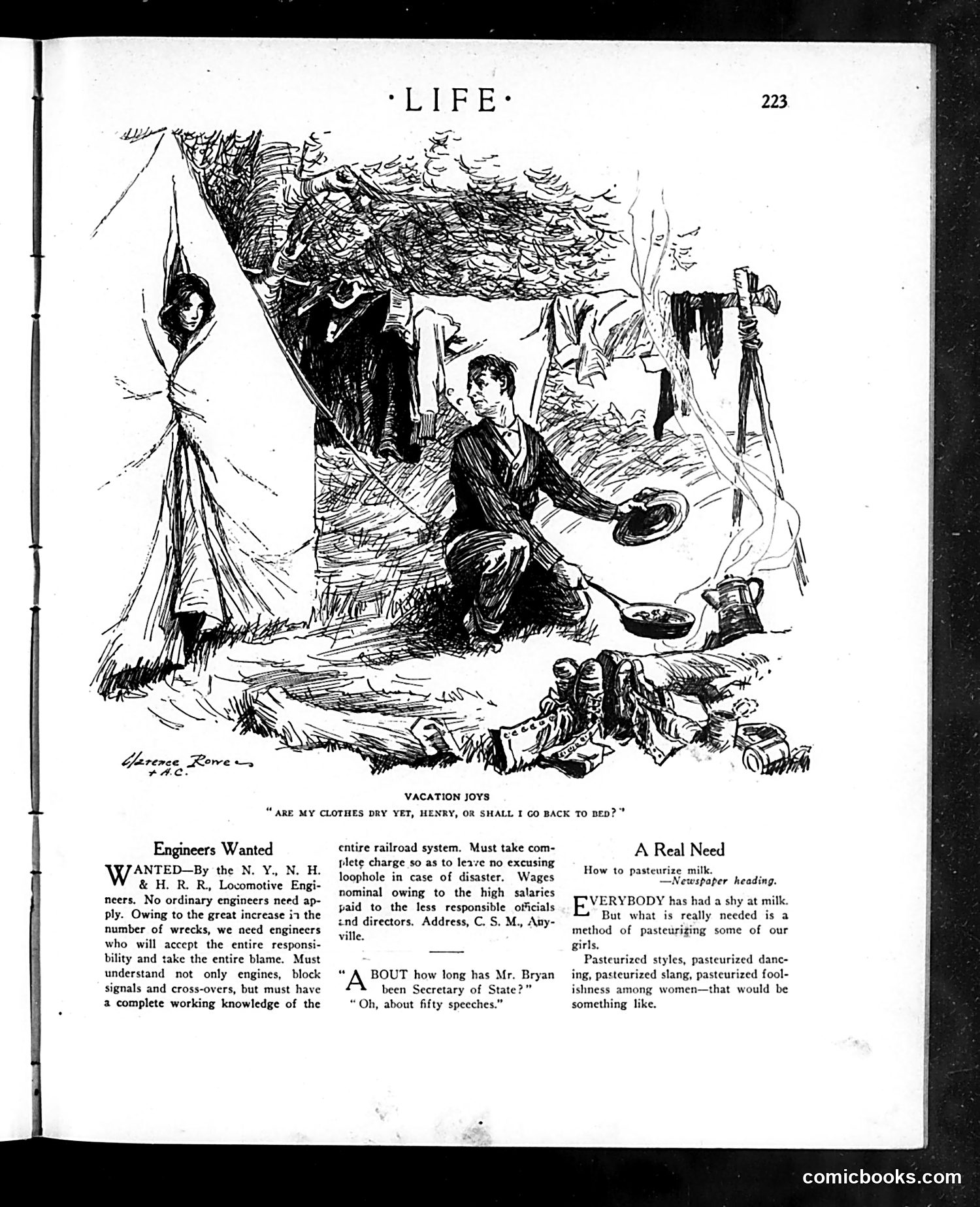
The main cartoon, titled "Vacation Joys," depicts a camping scene with the caption: "Are my clothes dry yet, Henry, or shall I go back to bed?" The humor relies on a common domestic frustration: a wife asking her husband about laundry during a camping trip, implying that even on vacation, household chores (particularly women's work like clothes washing) persist. The setup suggests the couple went camping to escape routine, yet the woman is still preoccupied with domestic tasks. The joke satirizes both the impracticality of maintaining household standards while camping and the assumption that vacation doesn't relieve women from their traditional domestic responsibilities. Below are three separate brief articles: a job posting for railroad engineers, a joke about Secretary of State Bryan's tenure, and a satirical piece titled "A Real Need" mocking the concept of "pasteurizing" girls through social conformity.
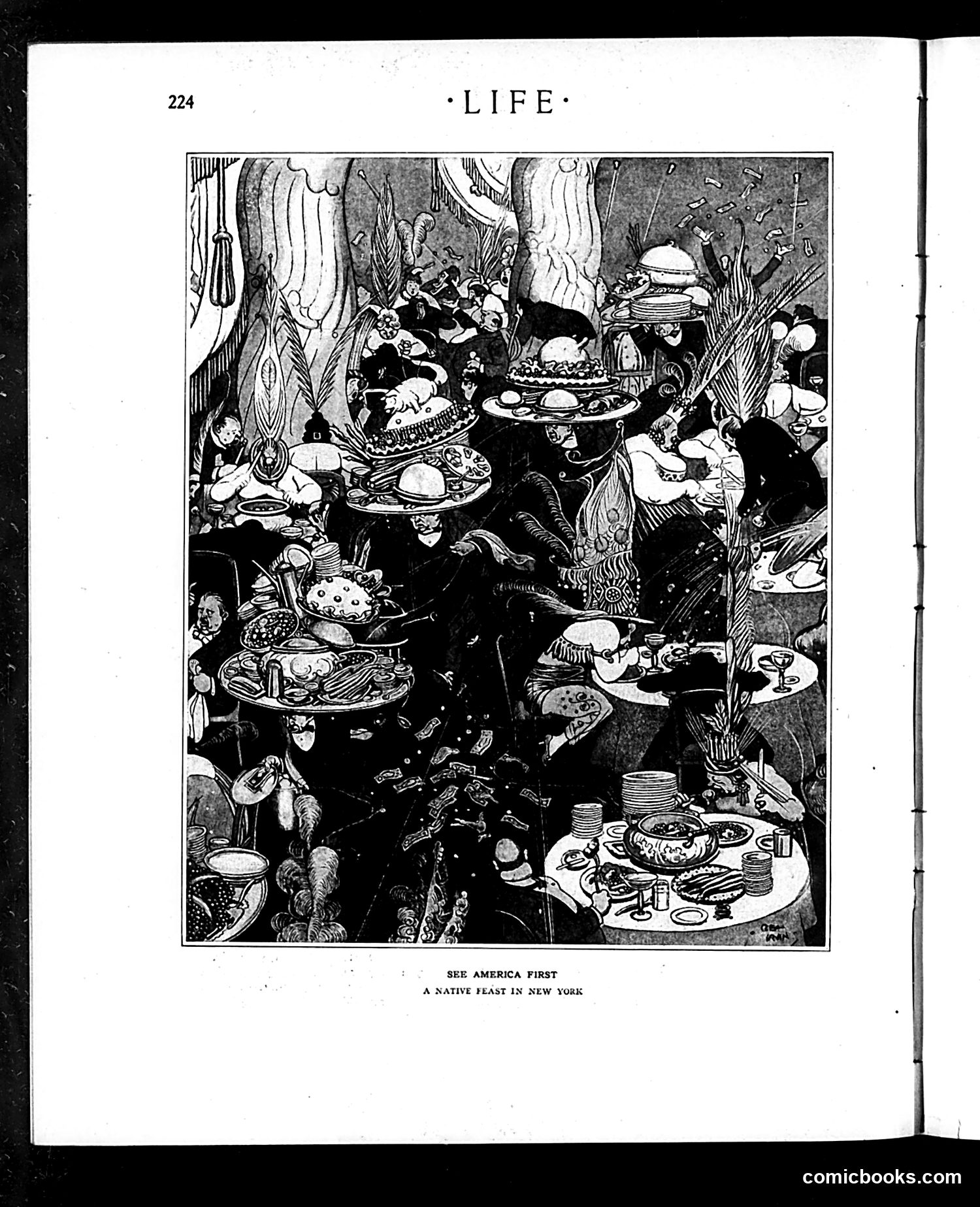
This satirical illustration depicts a lavish indoor banquet scene with numerous well-dressed diners seated at tables laden with abundant food and drink. The title's irony is the key to understanding the satire: "See America First" was a popular early 20th-century tourism slogan encouraging Americans to visit domestic attractions rather than travel abroad. The cartoon likely satirizes wealthy New Yorkers' pretension and excess—depicting an ostentatious "native" feast that mocks the nouveau riche's conspicuous consumption. The ornate interior, numerous servants, and overflowing tables suggest decadence and self-indulgence. By framing this as "native," the artist critiques American materialism and social inequality, contrasting the privileged diners' opulence with broader social realities of the era.
This page contains **two short stories**, not political cartoons: 1. **"The Pink Window Shade"** by O. Henry—a romantic tale about Sperry Van Barger, who finds a banana skin with mysterious purple ink writing ("The Pink Window Shade") dropped from a woman's window on Fifth Avenue. He obsessively searches the city for matching green window shades to locate her, eventually discovering she's his wife—a commentary on romantic mystery and marital disconnection. 2. **"Waiting"** by Andreis Grinszedth—depicts Ivan Pecanostroff, an anxious man repeatedly asking why his companion ("she") hasn't arrived after twenty years of waiting. These are **literary fiction pieces**, not satire or political commentary. The page showcases Life magazine's dual function as both a humor and literature publication during the early 20th century.
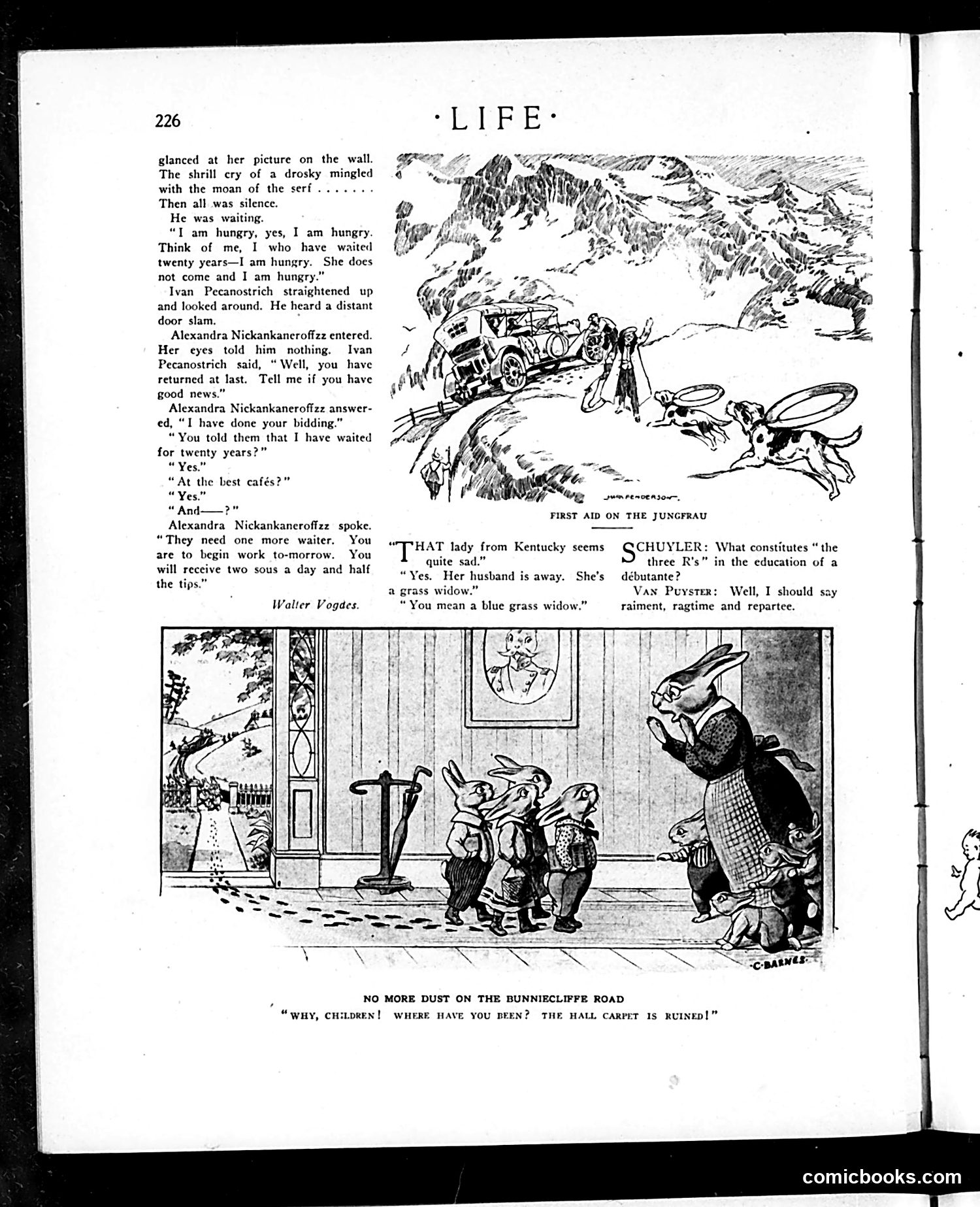
This page contains two distinct satirical cartoons: **Top cartoon ("First Aid on the Jungfrau"):** Depicts a car accident in snowy Alpine mountains. The humor appears to satirize wealthy tourists and their casual attitudes toward emergencies in foreign settings. **Bottom cartoon ("No More Dust on the Bunniclippe Road"):** Shows well-dressed rabbits indoors, with one exclaiming about children ruining a hall carpet. This is visual satire—using anthropomorphic animals to mock upper-class anxieties about maintaining pristine homes and their dismissive attitude toward common people ("dust"). The page also includes a brief dialogue between characters "Schuyler" and "Van Puyster" discussing education's "three R's" (reading, writing, arithmetic), representing genteel, old-money perspectives. The overall theme mocks 1920s-era aristocratic preoccupations with propriety and status.
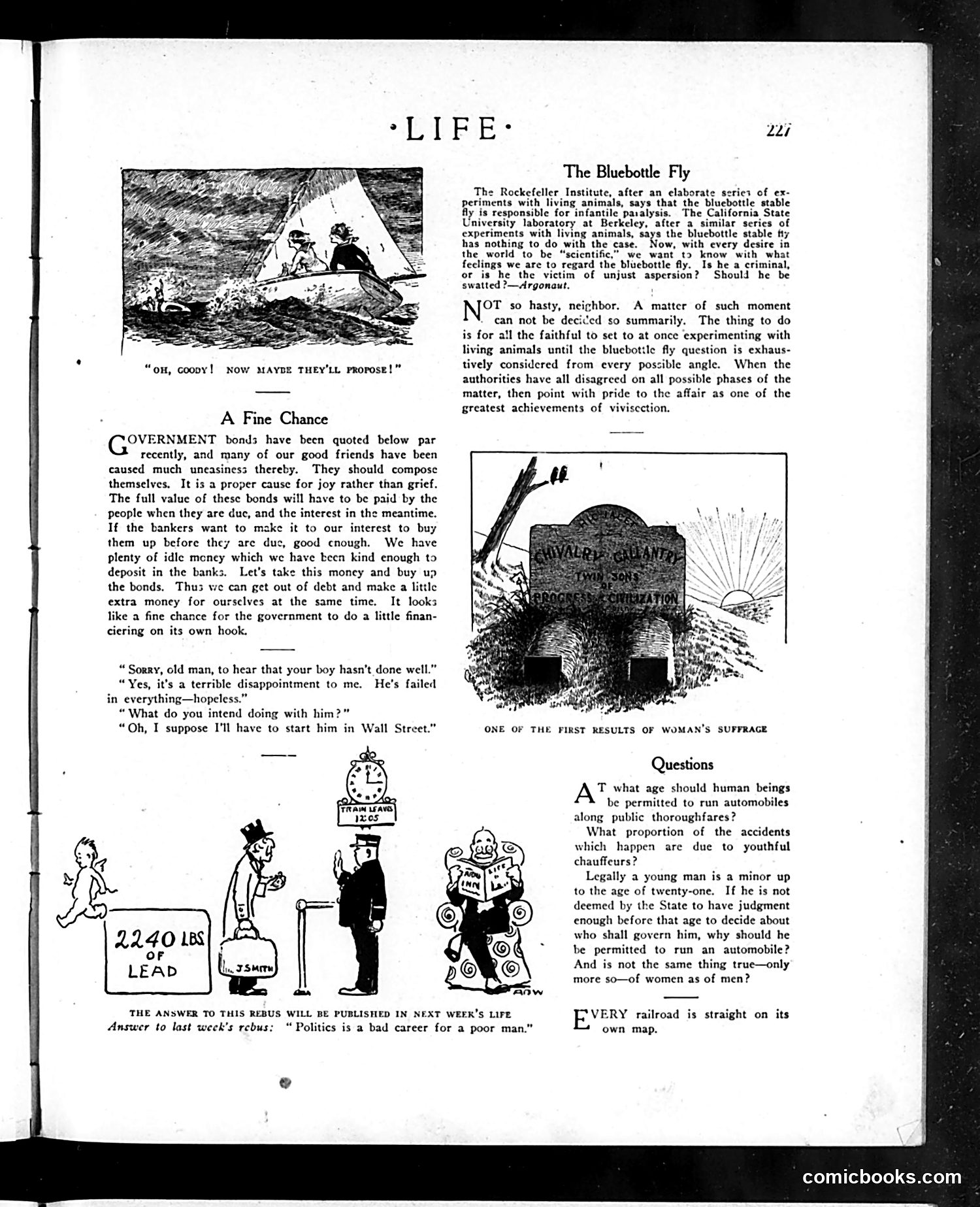
This page contains three satirical pieces typical of early 20th-century American humor: **"A Fine Chance"** mocks both government fiscal policy and class mobility. The dialogue jokes that a failed son fit only for Wall Street—then synonymous with financial speculation and moral corruption—represents parental desperation. The article sardonically suggests citizens should buy discounted government bonds as a patriotic investment while the government profits. **"The Bluebottle Fly"** lampoons competing scientific institutions (Rockefeller Institute vs. Berkeley) that reached opposite conclusions about whether the fly transmits infantile paralysis. The satire suggests that endless animal experimentation—a contemporary controversy—becomes an end in itself, allowing scientists to claim credit regardless of actual results. **"Questions"** uses logically reductive argument to mock both automobile safety regulation and women's suffrage (recently won). If young men lack judgment to vote, the piece argues, they certainly lack judgment to drive—extending this absurdly to newly enfranchised women, whose voting rights the author treats skeptically. The cartoon shows women's suffrage "results": a woman proposing marriage—implying women with political power become inappropriately forward.
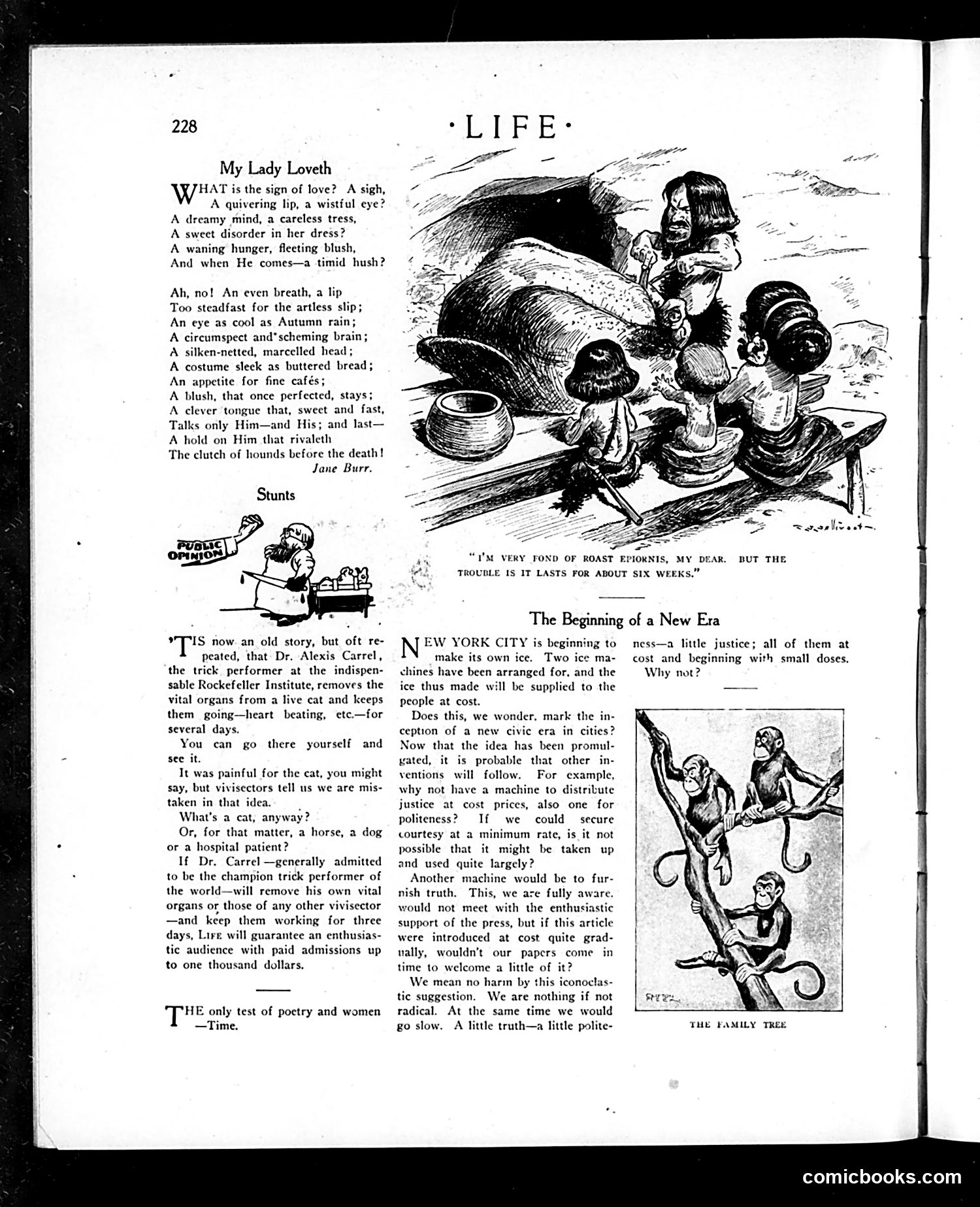
**"My Lady Loveth"** (poem by Jane Burr): A satirical inversion of romantic poetry. Rather than listing genuine signs of love, the poem catalogs calculating, superficial traits—the "modern woman" who performs emotions ("A blush, that once perfected, stays"), maintains strategic control ("A hold on Him that rivaleth / The clutch of hounds"), and prioritizes material pleasures ("An appetite for fine cafés"). The satire critiques women as manipulative and mercenary rather than genuinely affectionate. **"Stunts" section**: Mocks Dr. Alexis Carrel's famous Rockefeller Institute experiments keeping animal organs alive outside the body. Life sardonically challenges him to perform vivisection on himself rather than animals, exposing what it views as morally questionable "scientific" theater. **"The Beginning of a New Era"**: Satirizes New York City's new ice-manufacturing service sold "at cost." Life extends the joke: if the city can commercialize ice, why not manufacture "justice," "politeness," and "truth" as commodities? The sarcasm suggests these civic virtues are already absent and that treating them as purchasable goods reflects the era's commercialism.
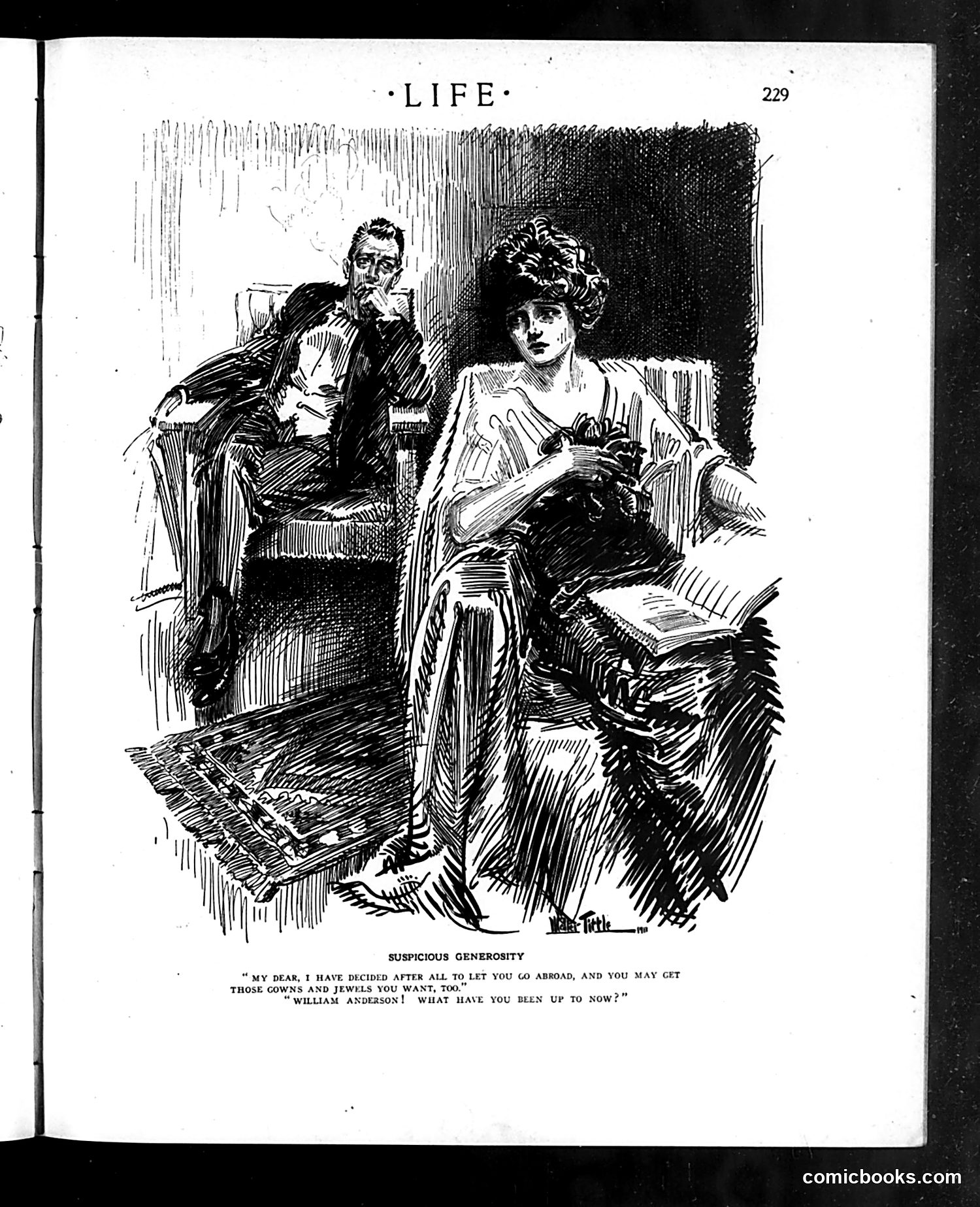
This cartoon satirizes a husband's sudden, unusually generous offer to his wife. The woman is sketched sitting with needlework while a man stands behind her, proposing to let her travel abroad and purchase expensive gowns and jewels—luxuries she apparently desired but couldn't afford or obtain previously. The wife's response—"What have you been up to now?"—reveals the cartoon's joke: such uncharacteristic generosity from a man named William Anderson appears deeply suspicious to her. She immediately assumes he's done something wrong and is attempting to placate her with gifts and permission to spend money. The satire mocks both marital dynamics (wives suspecting husbands' motives) and the era's gender economics, where wives depended on husbands' financial approval for purchases or travel.
This 1913 *Life* magazine piece satirizes Senator Frank Bristow's resolution questioning whether Secretary of State William Jennings Bryan needs a higher salary than $12,000 annually. The article defends Bryan against Senator Townsend's insinuation that he should live within his means rather than request more pay. The author argues Townsend and similar senators misunderstand the hidden costs of high office—not personal maintenance, but the expensive social obligations and hospitality requirements expected of a Secretary of State and his wife. The piece specifically defends Mrs. Bryan, noting that unlike a President's wife (who inherits an established household), a Secretary of State's wife must manage entertainment and tradition-maintaining on inadequate funds, citing Mrs. Taft's health collapse from similar strain. The satire targets senators' ignorance of these realities and their expectation that government wives sacrifice their health without proper financial support.
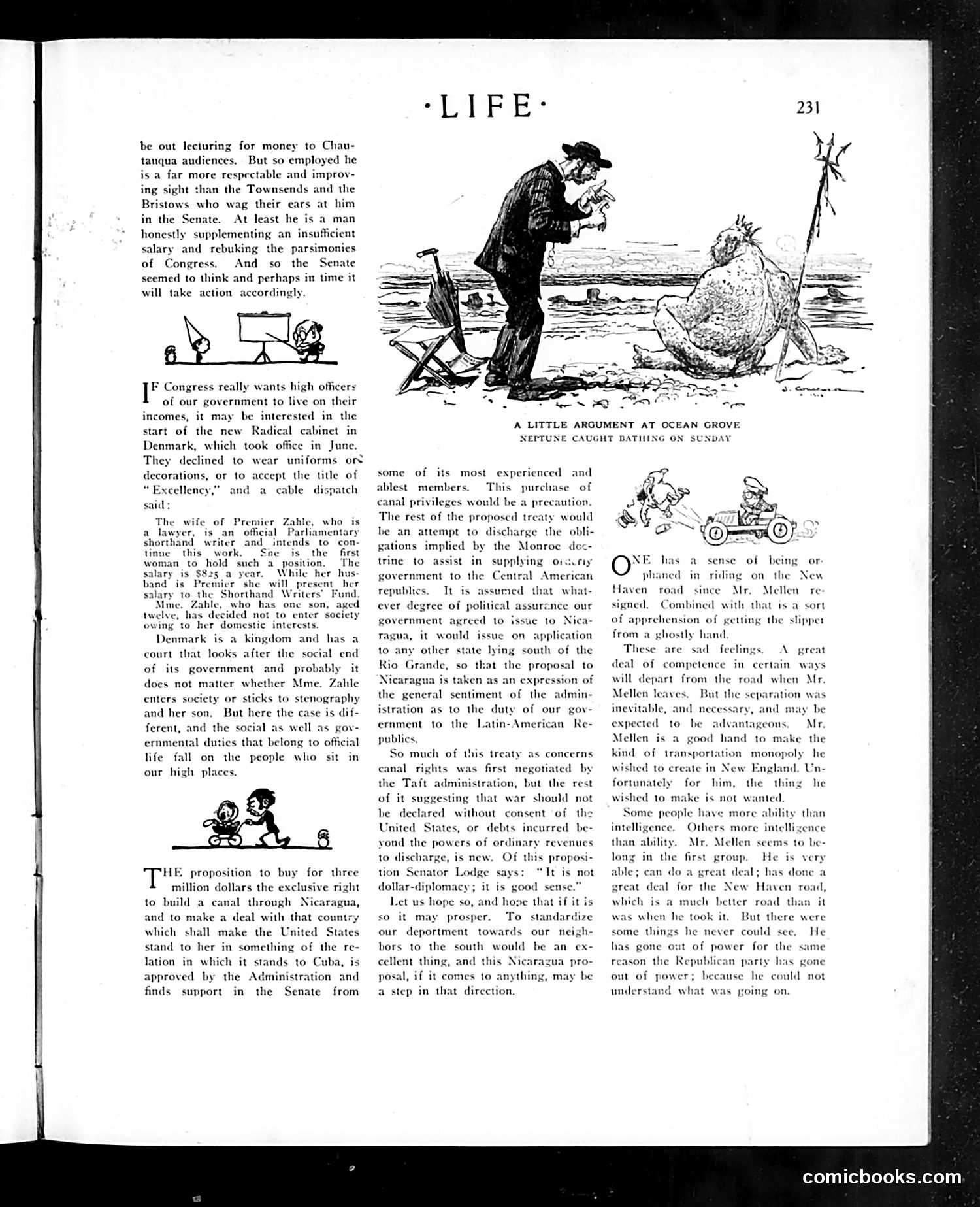
This page contains three distinct editorial cartoons and commentary: **Top cartoon**: "A Little Argument at Ocean Grove" depicts Neptune (the Roman sea god) confronting a rotund bather caught swimming on Sunday. The satire targets rigid religious observance—specifically blue laws prohibiting swimming on the Sabbath. Neptune's aggressive posture mocks the absurdity of enforcing such rules. **Middle cartoon**: A small illustration of a child on a tricycle, accompanying text about Mr. Mellen's resignation from the New Haven road, suggesting concerns about inexperienced leadership. **Main text**: Discusses congressional salary inadequacy, Danish Premier Zahle's progressive cabinet (notably including his wife as a Parliamentary stenographer), and a proposed Nicaragua canal treaty. The writing supports increased government salaries while praising Denmark's radical reformers who rejected aristocratic pretense. The overall theme: American institutions lag behind progressive European models in both compensating officials fairly and embracing social reform.
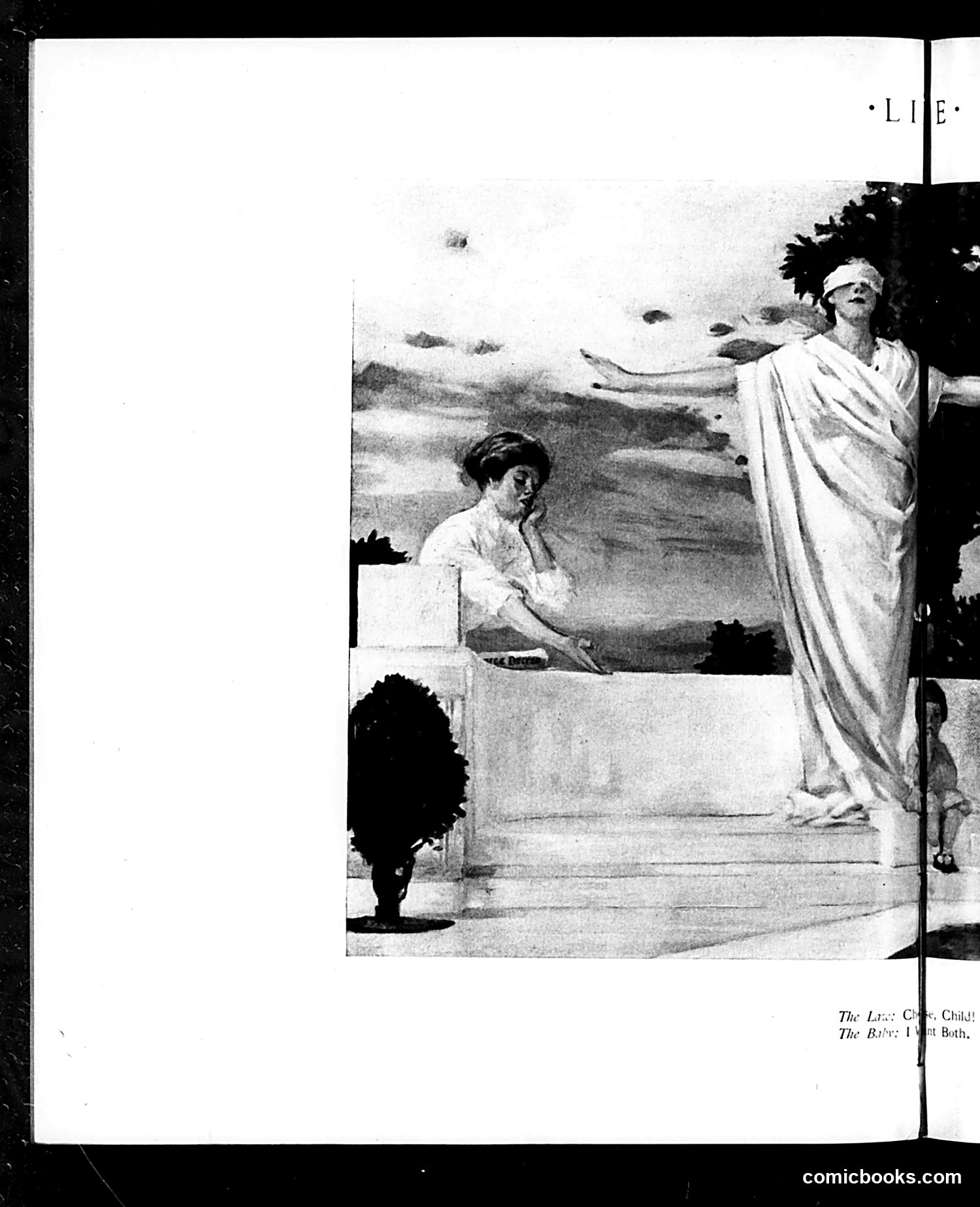
This appears to be a page from *Life* magazine featuring a classical or allegorical illustration rather than a political cartoon. The image shows two figures in Greco-Roman dress beside what appears to be a bathing scene or fountain, with a landscape backdrop. The OCR text is largely illegible ("The Le..." and "The B..."), making it impossible to identify the specific satire or commentary intended. Without clear caption text, I cannot determine whether this depicts particular political figures, social commentary, or if it's purely decorative/illustrative content. The classical aesthetic suggests it may reference contemporary events through historical allegory—a common *Life* technique—but the specific meaning remains unclear from this page alone.
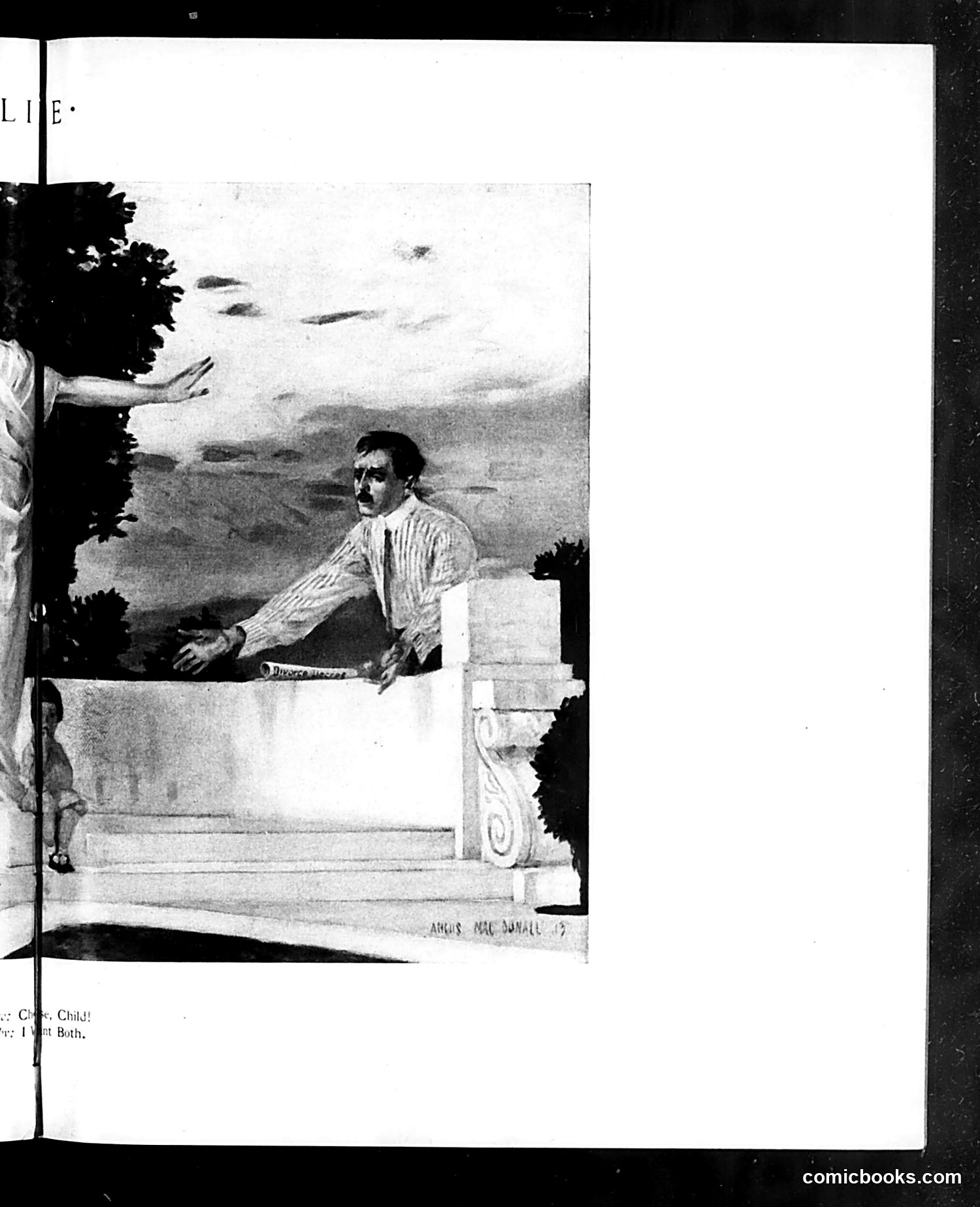
This appears to be a satirical cartoon from *Life* magazine showing a man in period dress (striped shirt) gesturing expressively from what looks like a classical balcony or architectural setting, with decorative urns visible. The landscape behind suggests an idealized or theatrical scene. The OCR text is largely illegible, though "MAG DONALL" appears to be a signature or attribution. Without clearer text identifying the specific political or social reference, I cannot reliably determine which historical figure this caricatures or what contemporary event it satirizes. The theatrical staging and classical architecture suggest it may mock political rhetoric or pretension, but the specific target remains unclear from the image alone.
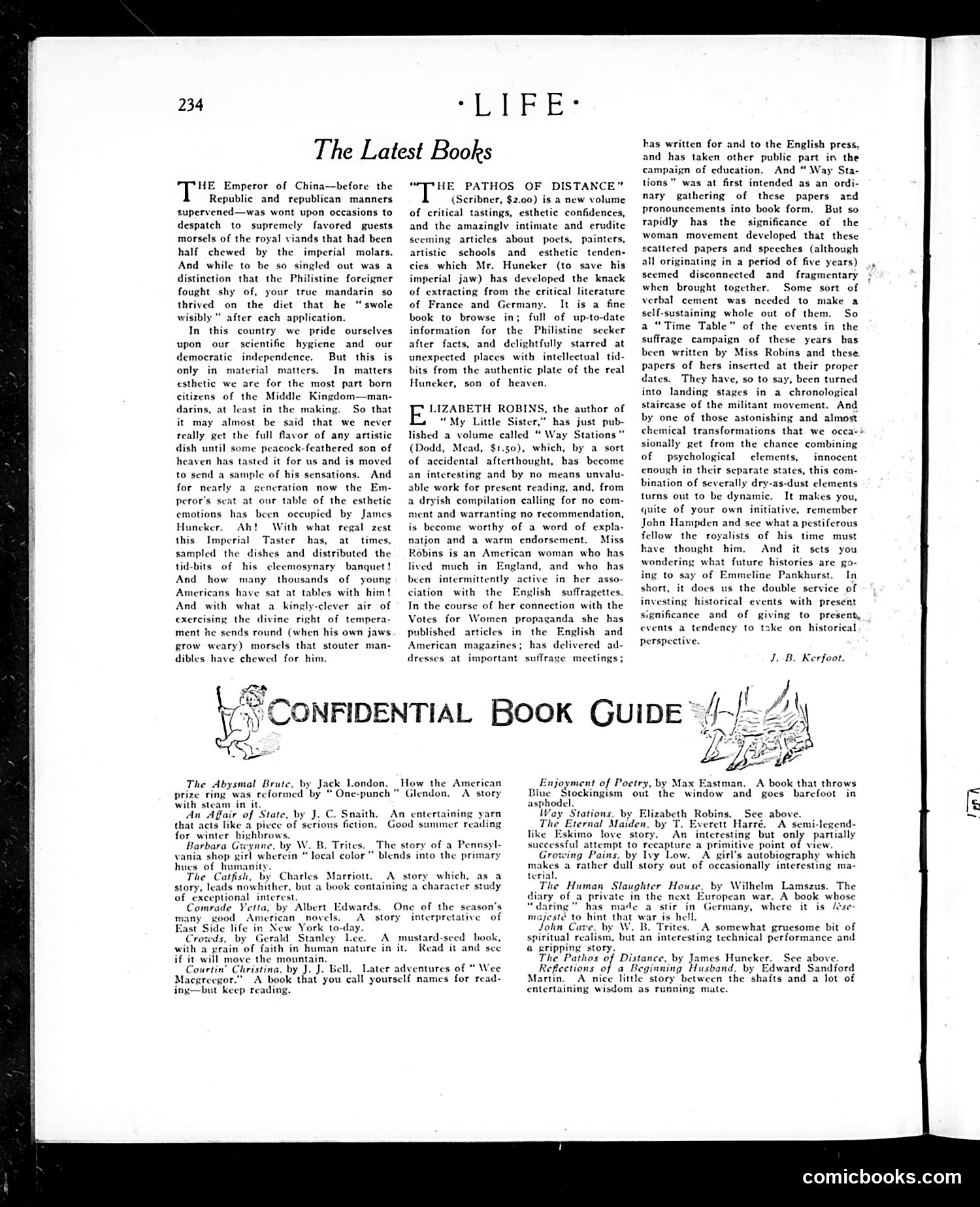
This is primarily a book review section, not a political cartoon page. The satirical content lies in the literary criticism itself. The main extended metaphor compares critic **James Huneker** to China's Emperor, who famously pre-chewed food for favored guests. The author argues that American readers aesthetically depend on Huneker's "taste-tested" cultural judgments the way ancient mandarins relied on the Emperor's palate. The joke: Americans pride themselves on democratic independence yet slavishly follow one critic's aesthetic pronouncements—they're cultural mandarins despite democratic pretenses. The piece reviews Huneker's book *"The Pathos of Distance"* and **Elizabeth Robins's** *"Way Stations,"* noting Robins's involvement with English suffragettes. The humor emphasizes American cultural dependence on European (particularly French and German) artistic authority filtered through Huneker's authority.
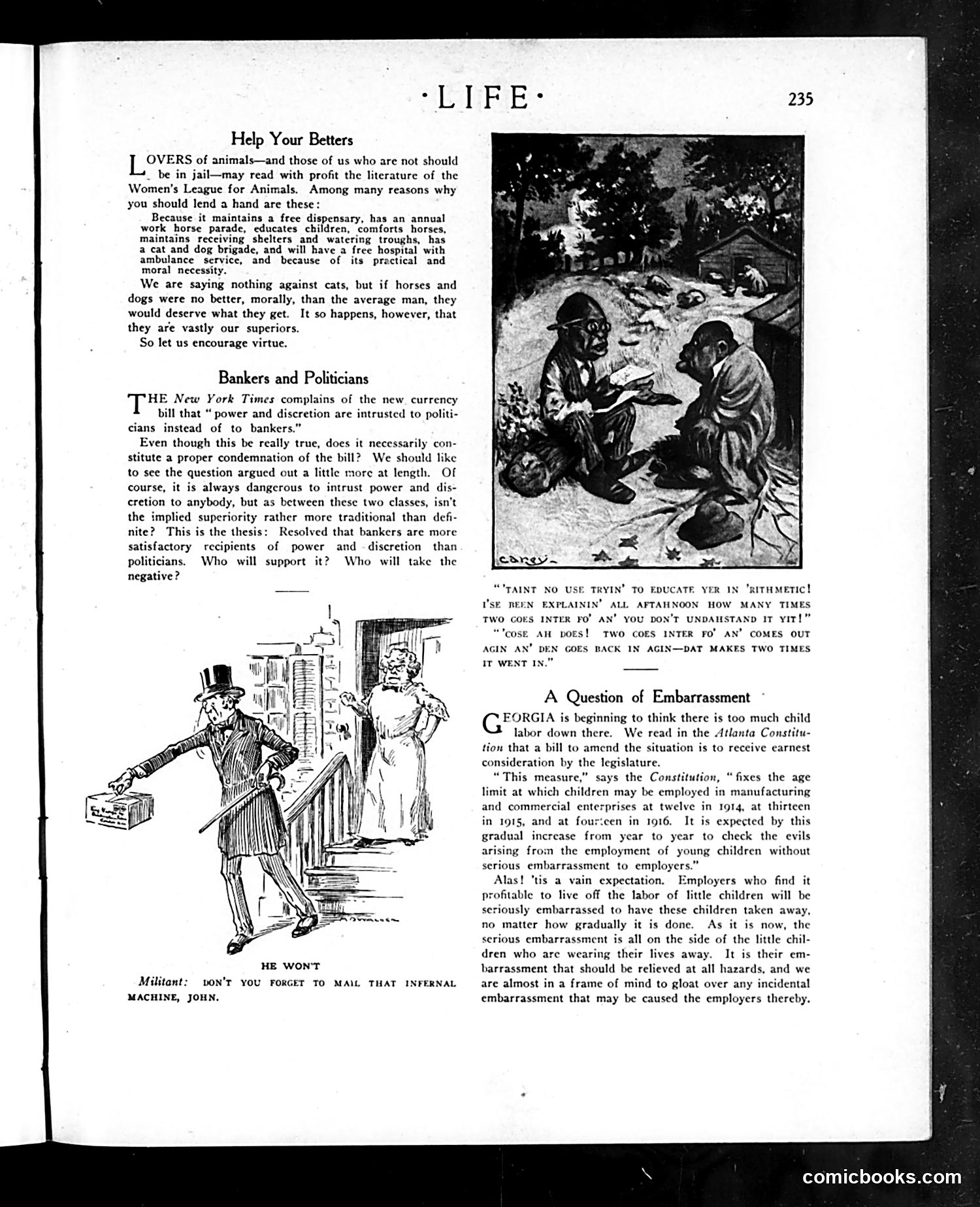
This page contains three distinct satirical pieces: **"Help Your Betters"** advocates for the Women's League for Animals, sarcastically claiming animals are morally superior to humans and deserve protection. **"Bankers and Politicians"** challenges the *New York Times*' complaint that currency bill power goes to politicians rather than bankers. Life poses this as a debate: which group is more trustworthy with power? The satire questions whether bankers' traditional authority is actually justified. **"A Question of Embarrassment"** mocks Georgia's proposed child labor reform. The state plans to gradually raise the minimum work age (12→13→14 over three years) to avoid "serious embarrassment to employers." Life's sarcasm is biting: it's the *children* being exploited who suffer embarrassment—their very lives wasting away—not the profitable factory owners. The piece ridicules the prioritization of employer comfort over child welfare. The cartoons illustrate these critiques visually, including a sketch about arithmetic education and one titled "HE WON'T" about forgetting to mail a machine.
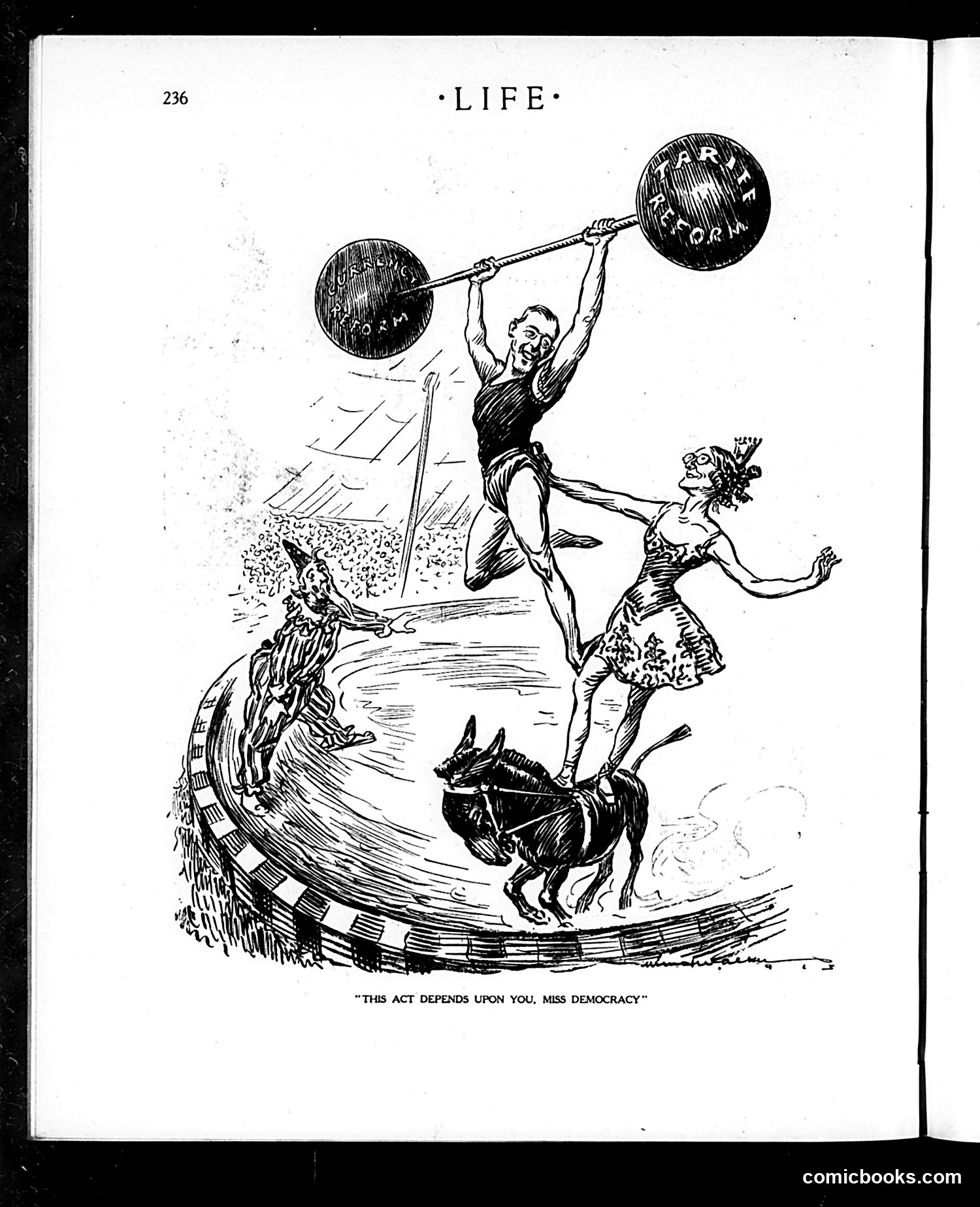
This early 20th-century Life magazine cartoon depicts a circus balancing act, with "Miss Democracy" (a female figure) as the central performer. She balances a male acrobat on one hand while managing other performers and a donkey below. The two spheres labeled "EARTH" represent the weight of global concerns. The caption—"This Act Depends Upon You, Miss Democracy"—suggests democracy itself is a precarious performance requiring careful balance. The competing elements (acrobat, attendants, animals) likely represent different political interests, factions, or nations that must be managed simultaneously. The satire warns that maintaining democratic governance is an unstable, demanding act requiring constant vigilance and skill from citizens.
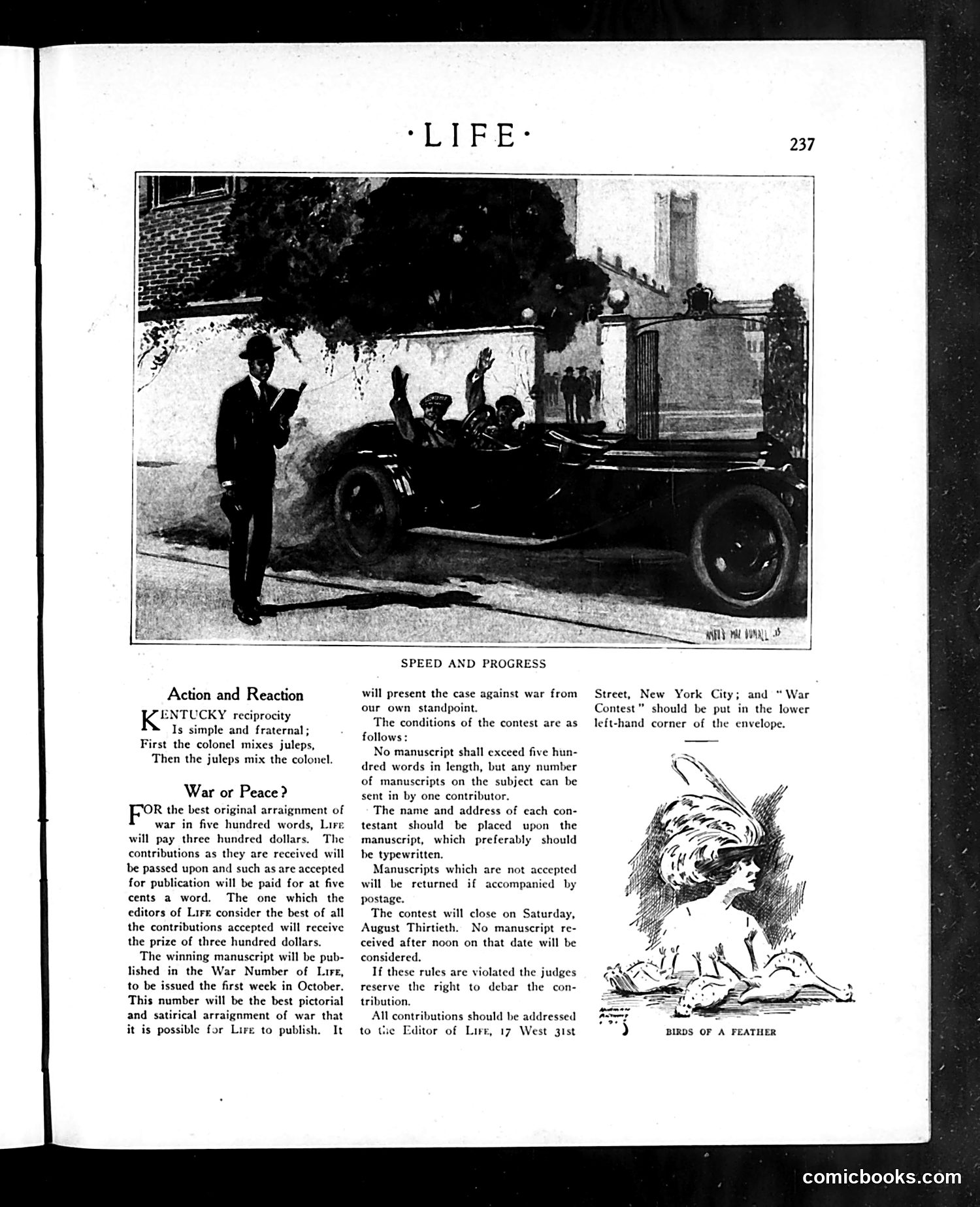
**The Image:** A photograph titled "Speed and Progress" shows a racing car with occupants with arms raised, while a formally-dressed man stands nearby observing. The image appears to ironically juxtapose modern automotive speed with the formal, static figure—suggesting commentary on progress and modernity. **The Text Content:** This page announces a writing contest offering $300 for the best 500-word essay arguing *against war*. The contest will close August 30th, with the winning entry published in Life's October "War Number." **The Satire:** The page's placement of this anti-war contest alongside the "Speed and Progress" photograph—celebrating mechanized velocity—appears darkly ironic. Given the pre-WWI timing suggested by the contest's focus and formal tone, Life seems to be satirizing how modern industrial "progress" (including automotive and military technology) paradoxically accelerates humanity toward war rather than away from it. **Kentucky Reciprocity verse** is unrelated filler humor about Southern drinking culture.
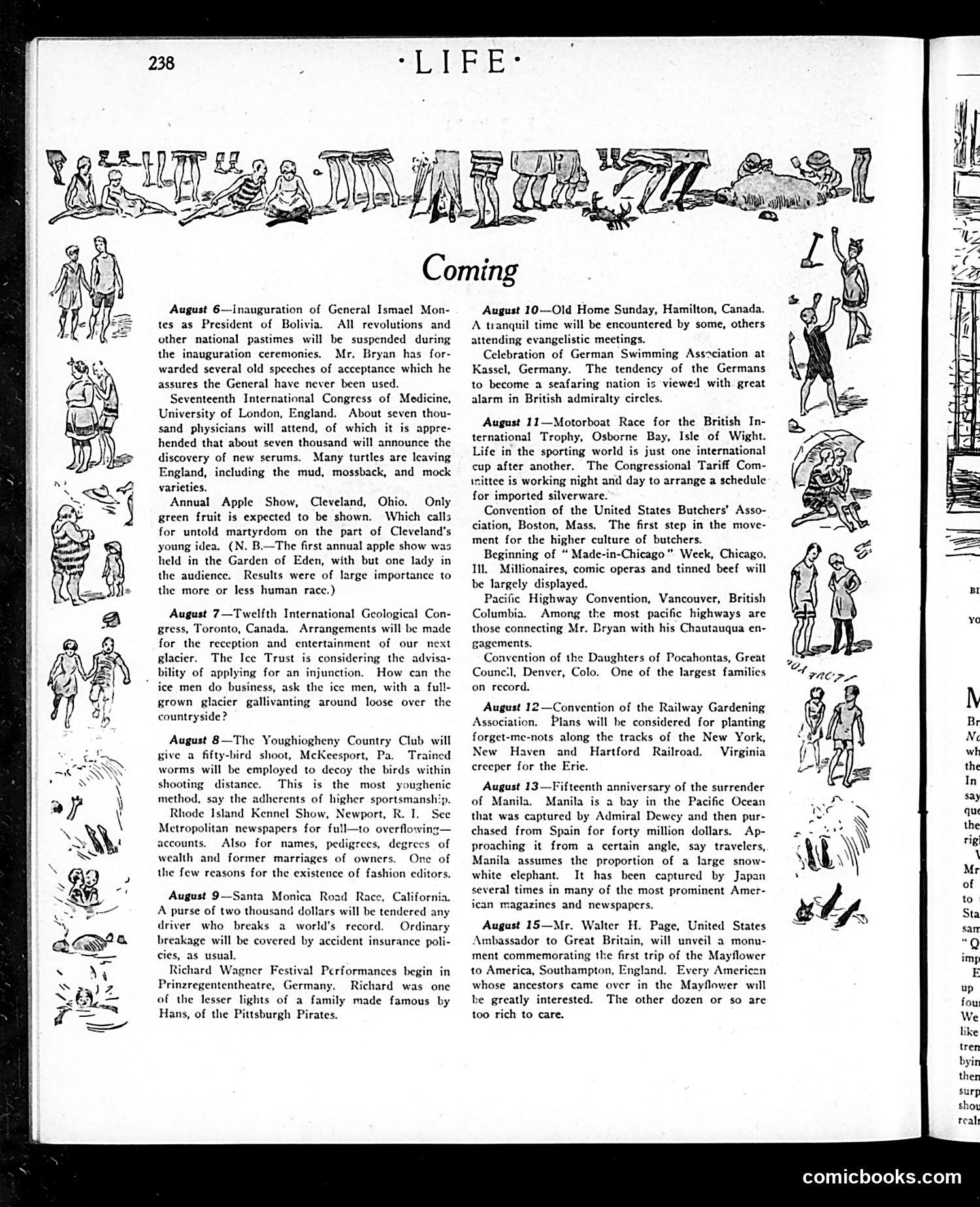
This is a satirical events calendar mocking various conventions, races, and ceremonies scheduled for August. The humor relies on absurdist commentary and political jabs: **Key satirical points:** - **General Ismael Montes (Bolivia)**: Joke that revolutions will be "suspended" during his inauguration—implying Bolivia's instability and frequent upheavals. - **William Jennings Bryan references**: Multiple jokes about Bryan's repeated speeches and his Chautauqua lecture circuit, suggesting he recycles material and travels endlessly. - **Medical Congress**: Sardonic that all 7,000 physicians will claim to have discovered new serums—mocking scientific pretension. - **German swimming/seafaring**: British alarm at German military expansion, reflecting real naval tensions of the era. - **Various conventions**: The absurdist descriptions (trained worms for bird shoots, forget-me-nots on railroad tracks) parody the earnestness of contemporary association meetings. The decorative border illustrations show everyday American life. This reflects *Life*'s role as intelligent satirist of contemporary politics and society.
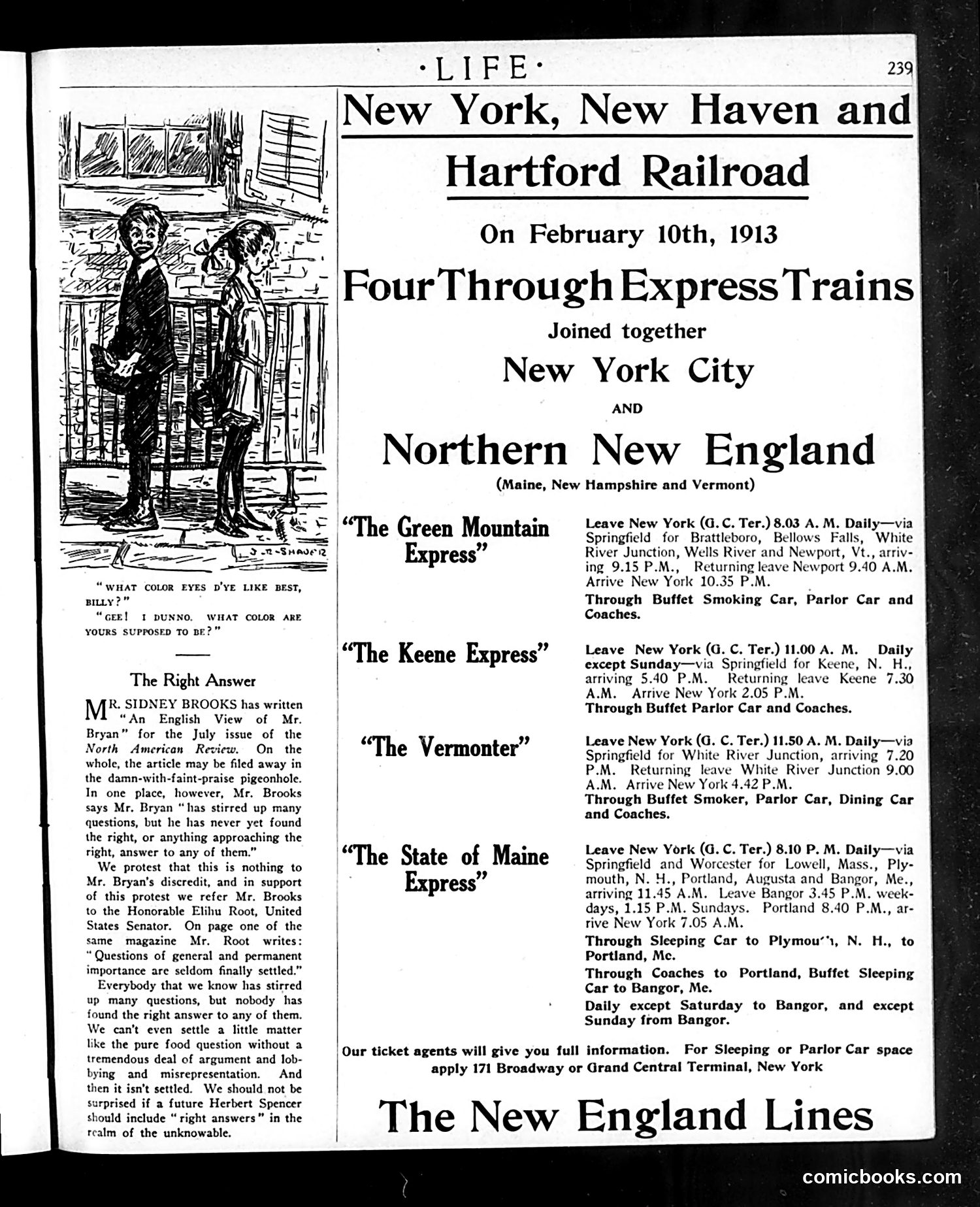
This page contains a small cartoon and primarily railroad advertising, with a brief editorial comment inserted between them. **The Cartoon:** Two boys discuss eye color. One asks what color eyes the other likes best; the second admits he doesn't know and asks what color the first is "supposed to be"—a joke about the boy being uncertain of his own eye color, implying he hasn't looked in a mirror or lacks self-awareness. **"The Right Answer" Editorial:** Life defends William Jennings Bryan (three-time presidential candidate) against British critic Sidney Brooks's claim that Bryan "has never yet found the right answer" to important questions. Life argues this isn't a fair criticism—*nobody* finds definitive answers to major issues. They cite Senator Elihu Root agreeing that important questions are "seldom finally settled," using the pure food debate as an example of perpetual disagreement. The satire suggests that demanding "right answers" to complex political and social questions is itself naive; disagreement and debate are permanent features of democracy, not failures. The remainder is straightforward railroad advertising for New England train service (February 1913).
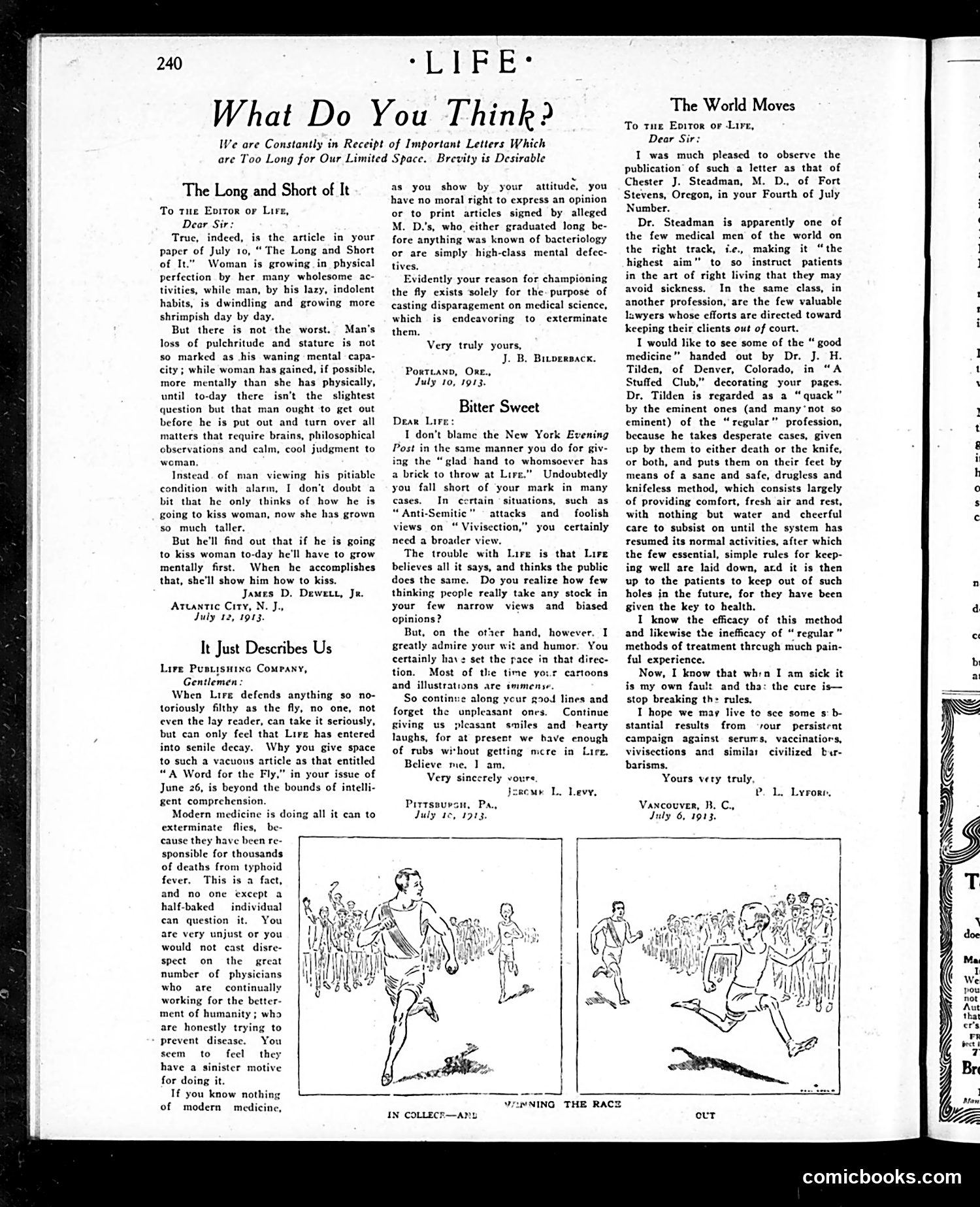
This is a "letters to the editor" section from Life magazine (dated July 1913). Readers respond to recent articles: **Letter 1** ("The Long and Short of It"): A writer argues that women are physically and mentally improving while men are deteriorating—becoming lazier, shorter, and less intelligent. He jokes that men must now "grow mentally" to be worthy of kissing taller women. **Letter 2** ("It Just Describes Us"): A reader attacks Life for defending flies in an earlier article, calling it "senile decay" and arguing it undermines public health efforts against disease. **Letter 3** ("Bitter Sweet"): Praises Life's wit and cartoons but criticizes its narrow views on anti-Semitism and vivisection, asking them to focus on entertainment rather than controversial opinions. **Letter 4** ("The World Moves"): Endorses a doctor's letter promoting patient education about health. The two small cartoons below show children at play—"winning the race" and "out"—illustrating physical activity themes relevant to the letters' discussion of human health and vigor.
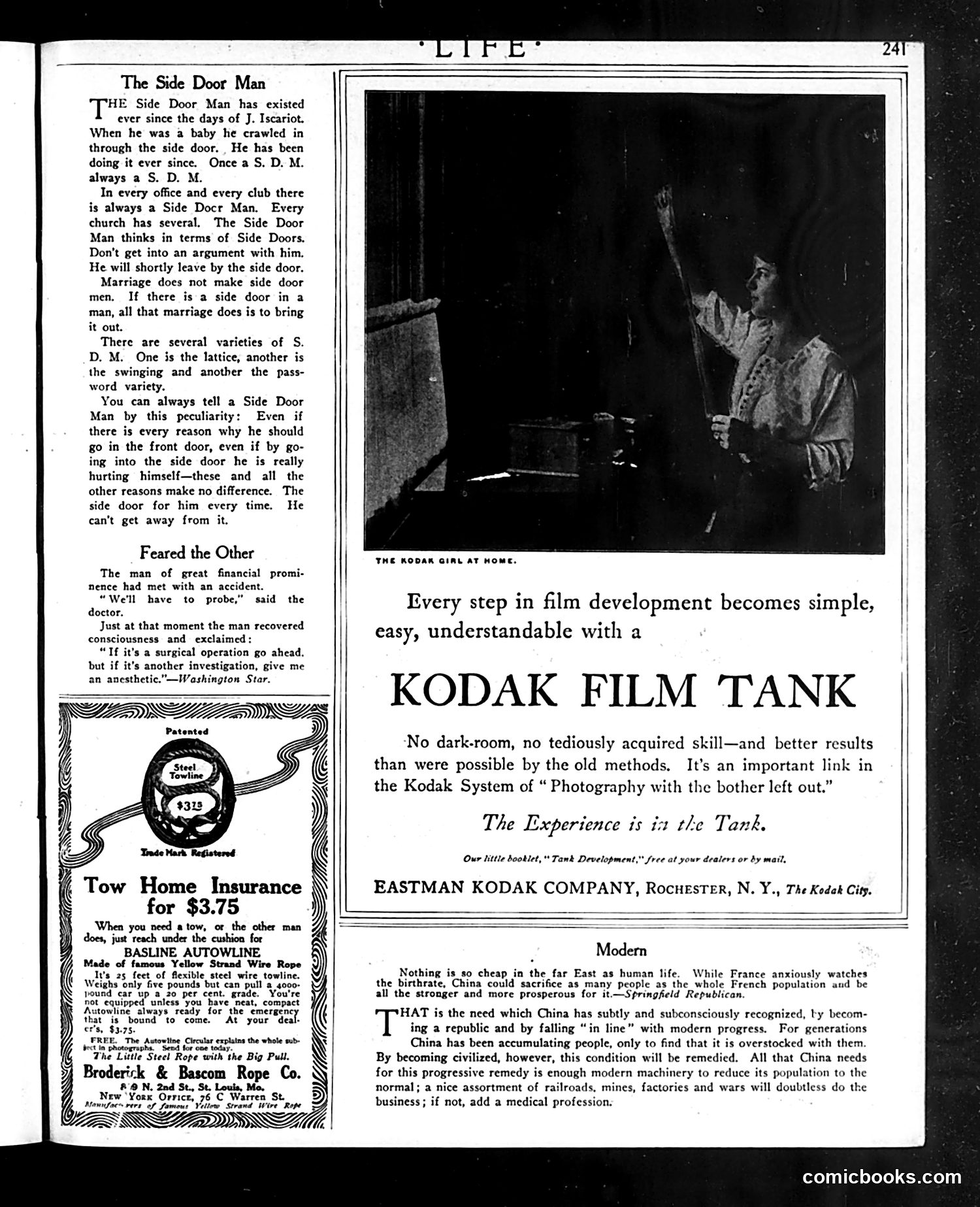
This satirical piece describes a recurring social type: a person who habitually uses "side doors" (shortcuts, backdoors, indirect routes) even when unnecessary or self-harmful. The comparison to Judas Iscariot suggests moral compromise and betrayal. The joke is that this person's nature is fixed—marriage won't change them, arguments won't sway them. They choose indirect paths compulsively, regardless of logic or consequences. The piece catalogs varieties of this behavior (lattice, swinging, password types), implying this evasiveness appears across social institutions: offices, clubs, churches. A companion anecdote mocks a wealthy accident victim who fears "investigation" more than surgery, suggesting similar evasiveness among the powerful. This satirizes people who habitually dodge responsibility, take underhanded approaches, or avoid confrontation even when directness would serve them better—a timeless observation of human nature wrapped in early 20th-century institutional critique.
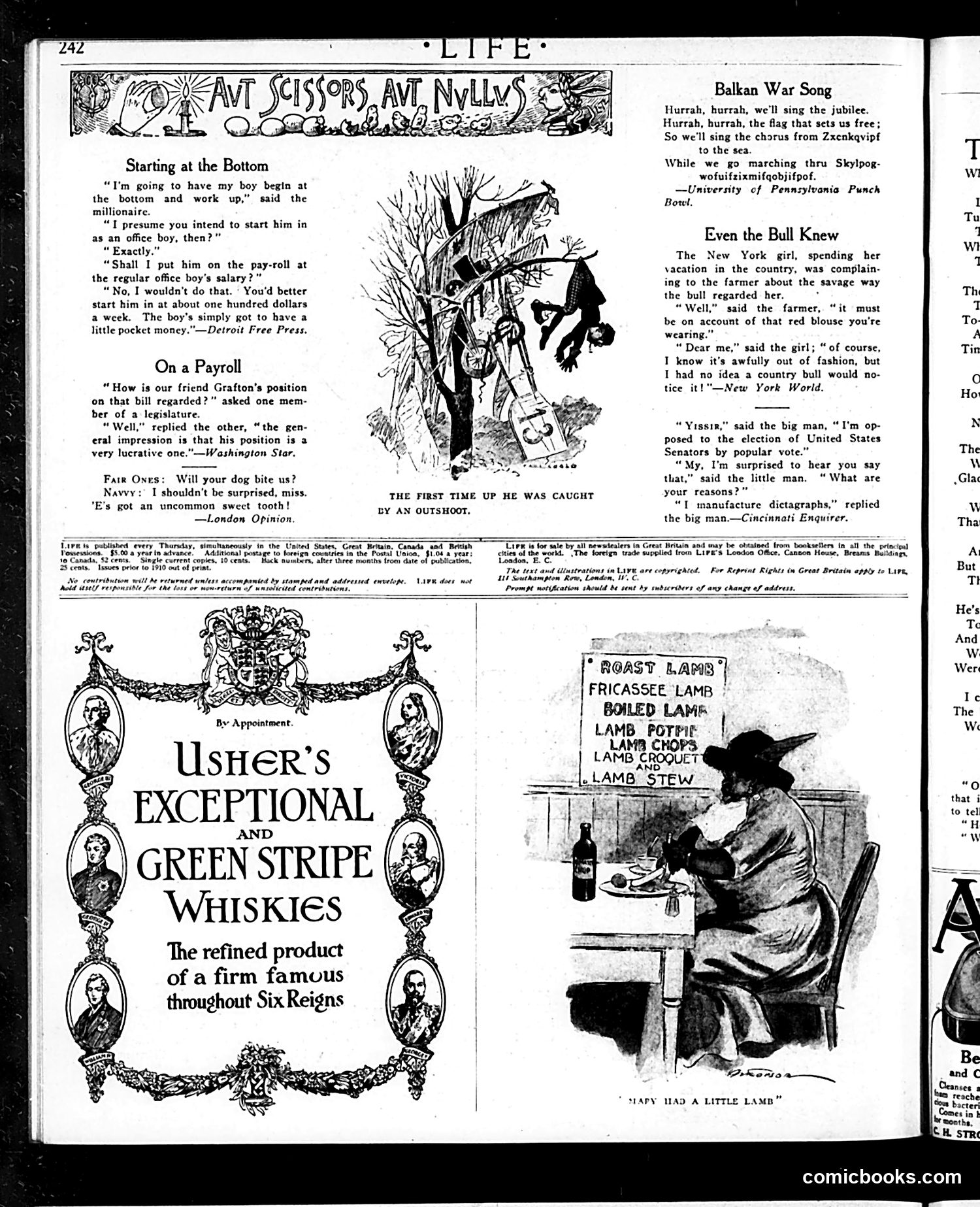
This page contains several short satirical pieces typical of early 20th-century American humor magazines: **"Starting at the Bottom"** mocks wealthy hypocrisy: a millionaire claims he'll teach his son discipline by starting him "at the bottom," but refuses to pay him a regular office boy's salary—instead giving him $100/week in "pocket money." The satire exposes how the wealthy circumvent actual hardship. **"On a Payroll"** jokes about political corruption: legislators discuss a colleague's "position on that bill" being "very lucrative," implying backroom bribery rather than honest legislative work. **"Even the Bull Knew"** plays on urban-rural culture clash: a city girl complains a bull regards her menacingly; the farmer attributes it to her red blouse. She's shocked a "country bull" would notice fashion—satirizing city folk's assumptions about rural ignorance. **The cartoon** shows a man caught by an outshoot while climbing a tree—likely a baseball reference or physical comedy. The page is otherwise filled with period advertisements and recipes.
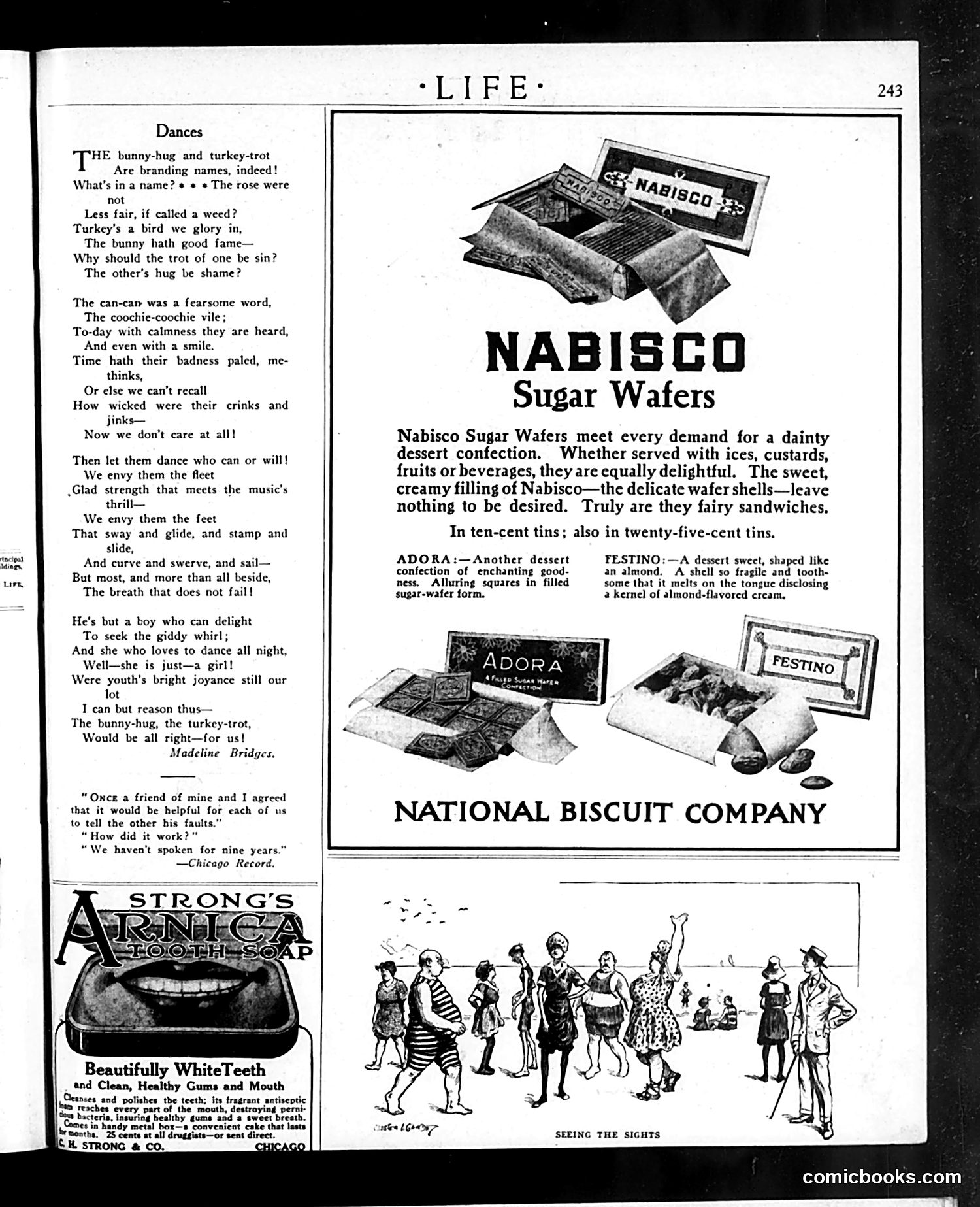
This page is primarily **advertising with a poem**, not political satire. The poem "Dances" by Madeline Bridges defends modern dance crazes—the **bunny-hug and turkey-trot**—against moral criticism. These were controversial early 1900s dances considered scandalous by older generations. The poet argues that society's attitudes shift over time: dances once condemned (like the can-can and coochie-coochie) are now accepted. She reasons youth shouldn't be denied the joy of dancing, ultimately accepting these "modern" dances for young people. The page contains **three advertisements**: Nabisco Sugar Wafers (with product varieties like "Adora" and "Festino"), Strong's Arnica Tooth Soap, and a sketch labeled "Seeing the Sights" (appears to show people at leisure activities). The satirical *intent* is gentle—mocking generational anxiety about changing social norms rather than making sharp political points. It reflects early 20th-century debates about propriety and youth culture.
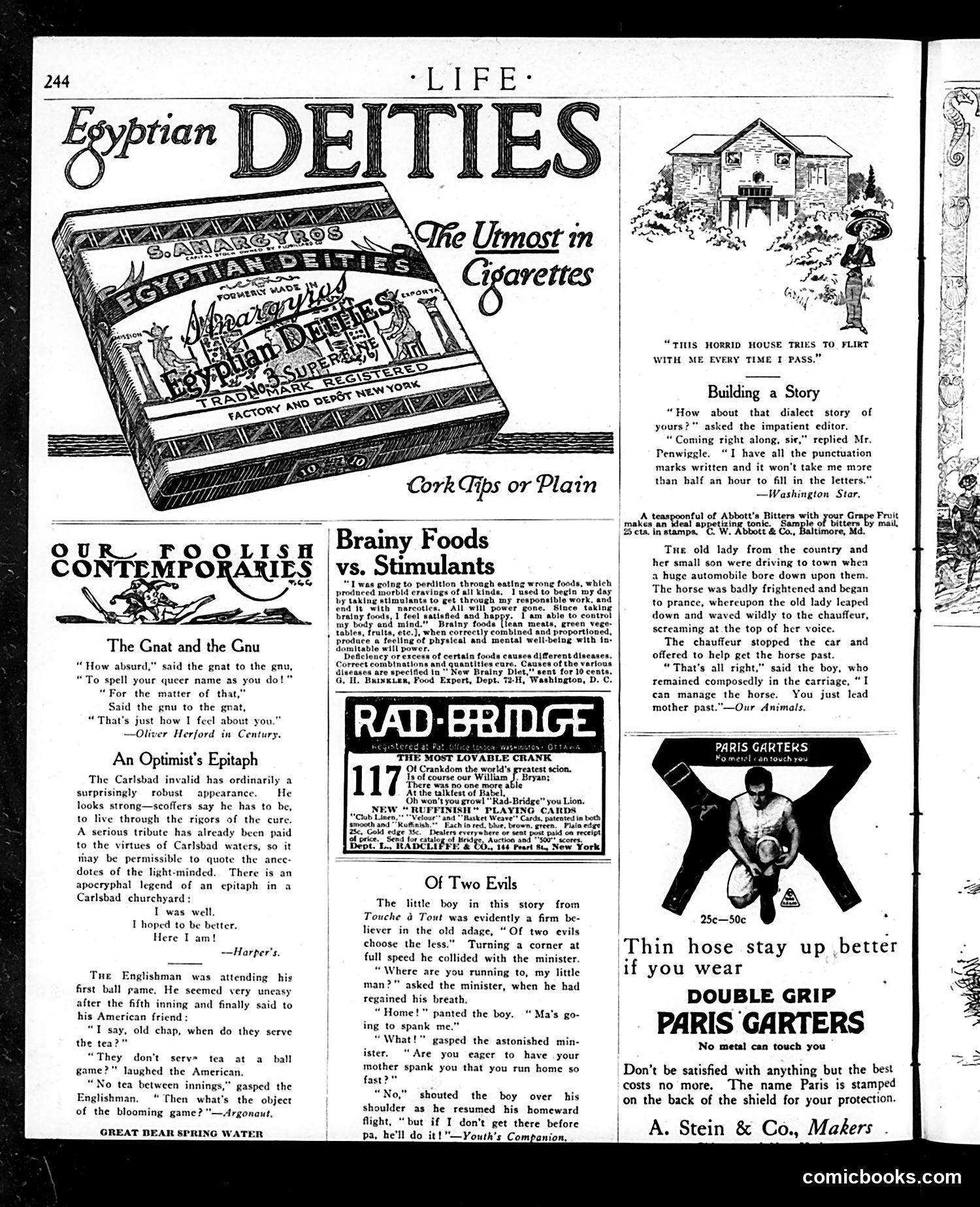
This page from *Life* magazine contains primarily **humorous anecdotes and advertisements** rather than political cartoons. The humor pieces include: - **"The Gnat and the Gnu"**: A light wordplay joke about an animal's unusual spelling, mocking pretension - **"An Optimist's Epitaph"**: A joke about the Carlsbad spa cure in Austria—satirizing wealthy invalids who visit health resorts despite appearing robust - **"The Englishman at a Ball Game"**: Poking fun at British customs; an Englishman expects tea service at an American baseball game, treating it like a formal social event - **"Of Two Evils"**: A children's joke about a boy preferring his mother's spanking to his father's The advertisements promote patent medicines (Abbott's Bitters, Carlsbad water) and hygiene products—typical of the era's unregulated health claims. One ad contrasts "Brainy Foods" against stimulants, reflecting early-1900s dietary fads. The overall tone reflects *Life*'s satirical approach: gentle mockery of social pretension, class differences, and American versus European customs.
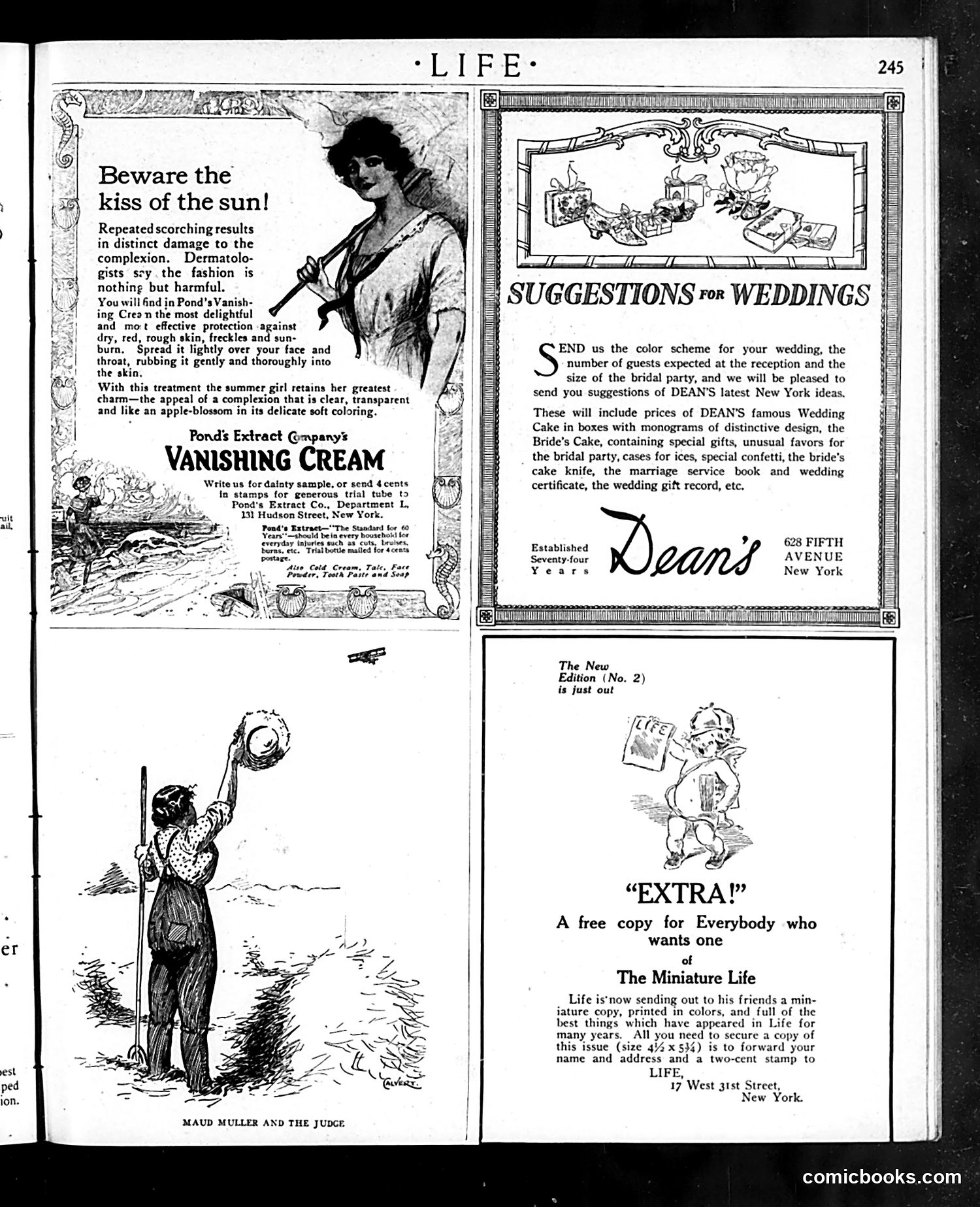
This page is primarily **advertising and promotional content** rather than political satire. The main cartoon, "Maud Muller and the Judge," illustrates a literary reference—likely to John Greenleaf Whittier's 1856 poem "Maud Muller" about a farm girl and a judge. The drawing shows a figure holding up what appears to be a Life magazine, possibly depicting the "regret" theme central to the poem (the famous line: "Of all sad words of tongue or pen, / The saddest are these: 'It might have been'"). The rest of the page consists of three advertisements: Pond's Vanishing Cream (promoting sun protection for women's complexions), Dean's Wedding Cakes and services, and a promotional offer for "The Miniature Life," a condensed color edition of the magazine. The "Beware the kiss of the sun" ad reflects early 20th-century beauty standards emphasizing pale, unblemished skin as desirable for women.
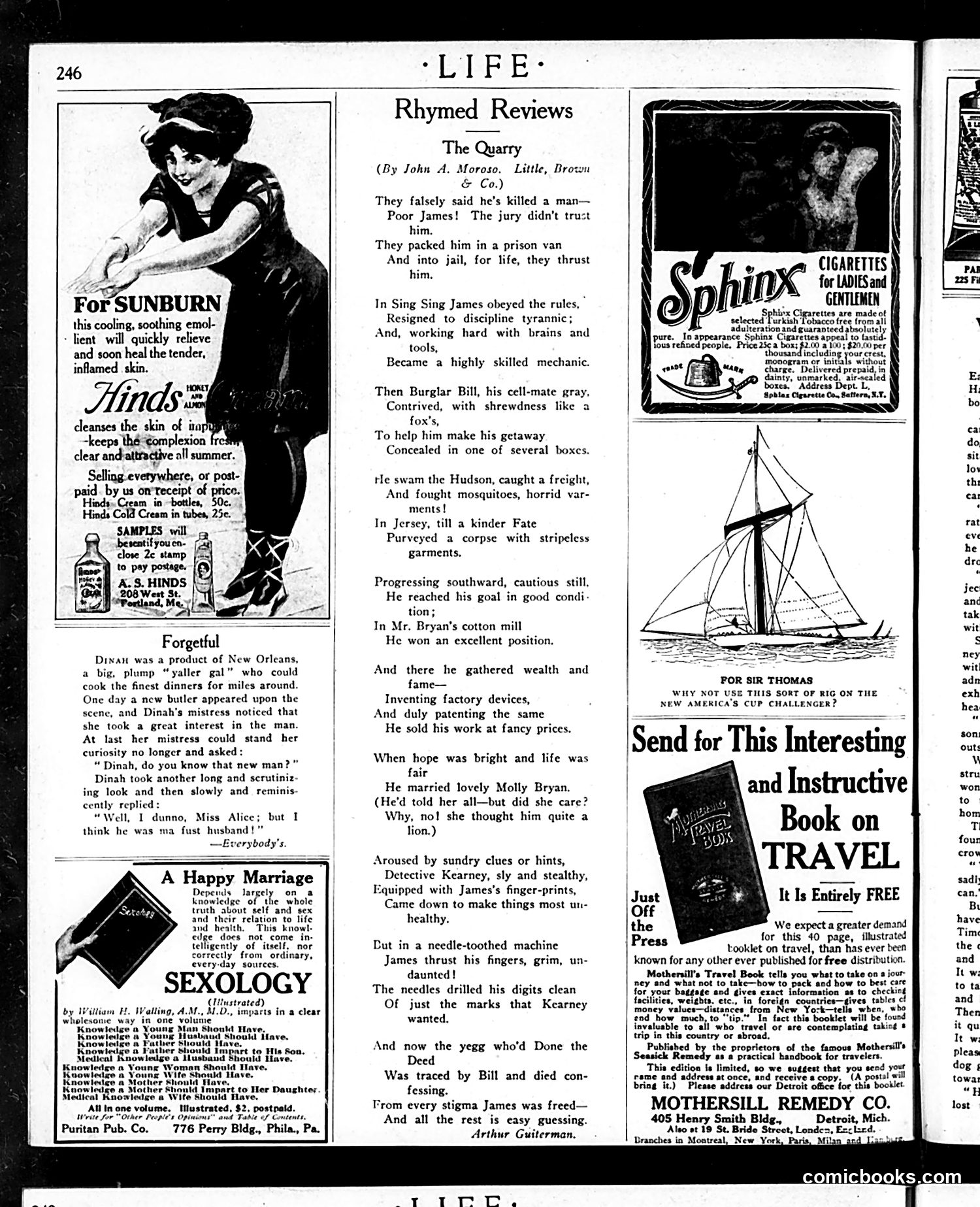
This page contains a book review in verse of "The Quarry" by John A. Moroso—a crime narrative poem about James, wrongly convicted of murder and imprisoned at Sing Sing. The plot follows his escape with cellmate "Burglar Bill," his flight southward, and his eventual capture by Detective Kearney, who uses fingerprint evidence. The climax reveals James destroys his fingerprints using a needle-machine to evade identification. The satire appears to critique the nascent fingerprint identification system as a tool of law enforcement, presenting it as something prisoners might desperately resist. The poem's dark humor—depicting a protagonist trapped by scientific evidence despite his attempts at evasion—reflects early-20th-century anxieties about modern forensic technology and state surveillance. The page also features period advertisements for Hinds cream, Sphinx cigarettes, and Mothersill's Travel Book, typical of Life's revenue model.
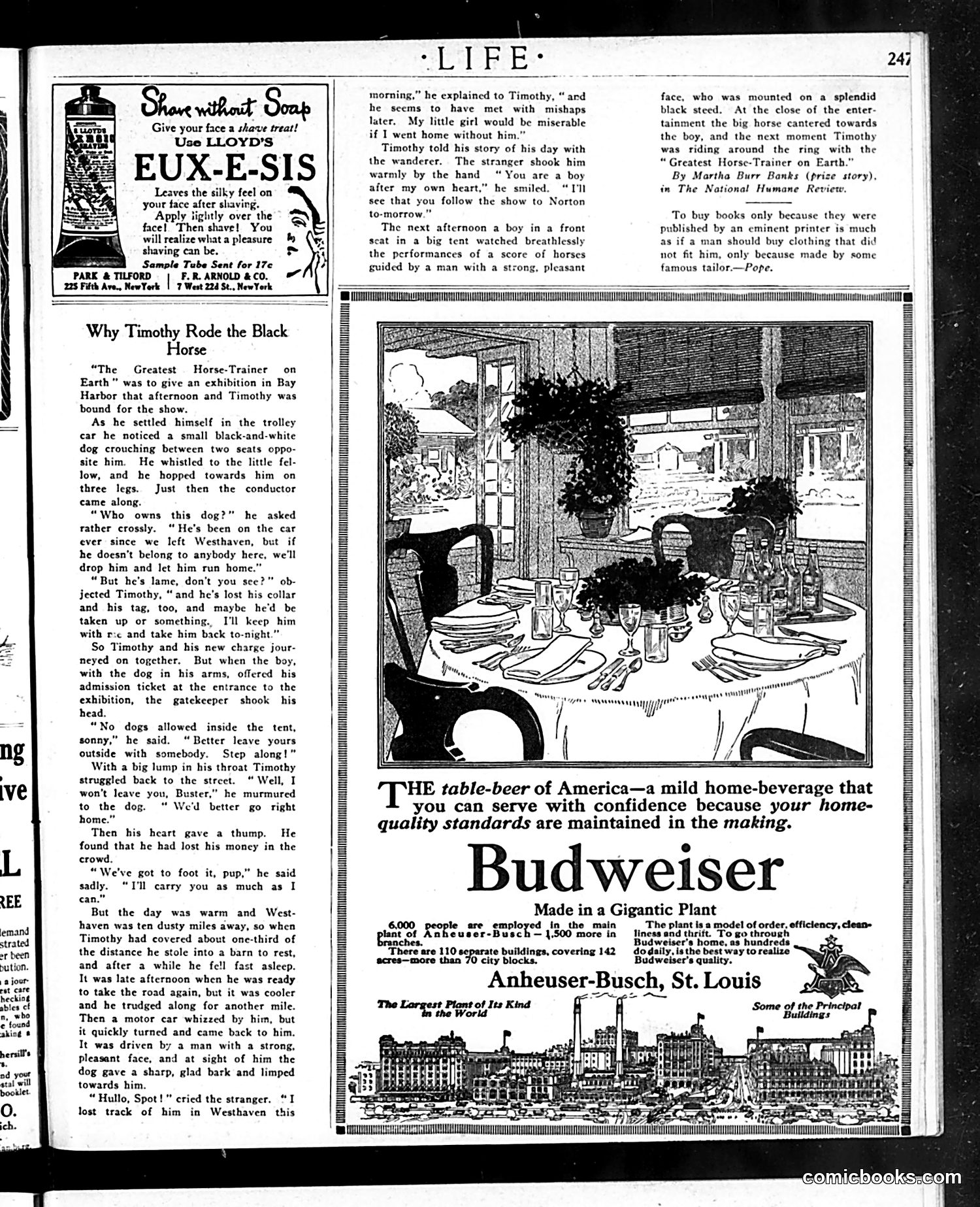
This page contains a short story titled "Why Timothy Rode the Black Horse," not political satire. The narrative concerns a boy who finds a stray, three-legged dog and befriends it despite being unable to attend a horse-training exhibition. Timothy loses his admission money but encounters the dog's owner—revealed to be "The Greatest Horse-Trainer on Earth"—who rewards the boy's kindness by inviting him to the next day's show, where Timothy rides the trainer's black horse. The story exemplifies early 20th-century sentimental fiction emphasizing moral virtue: compassion toward animals and honesty are rewarded. The tale was credited as a "prize story" from *The National Humane Review*, reflecting the era's focus on animal welfare advocacy. The page also features period advertisements (Lloyd's shaving soap, Budweiser beer) typical of *Life* magazine's commercial content. No political figures or satire appears on this page.
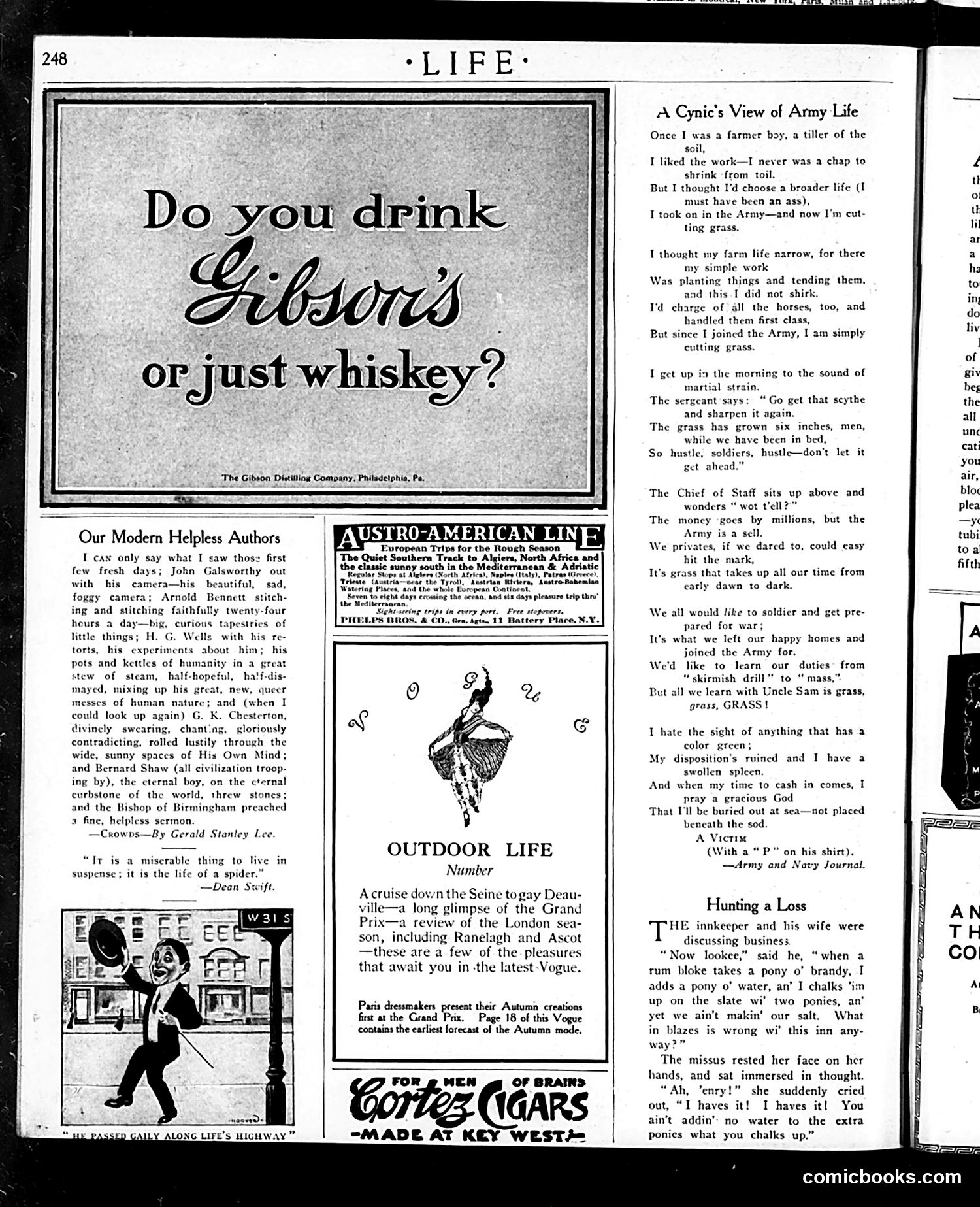
This page from *Life* magazine contains several distinct pieces of social commentary: **"A Cynic's View of Army Life"** is a satirical poem mocking military service during what appears to be WWI. A farmer enlisted expecting meaningful soldiering but instead spends all his time cutting grass under sergeant's orders. The satire targets the disconnect between soldiers' aspirations and mundane reality, plus the wasteful spending ("money goes by millions") on an ineffective military apparatus. The repeated refrain "grass, GRASS!" emphasizes the absurdity and monotony. **"Our Modern Helpless Authors"** satirizes famous contemporary writers (Galsworthy, Bennett, H.G. Wells, Chesterton, Shaw) as earnestly but ineffectually documenting their times—unable to truly affect the world despite their efforts. **"Hunting a Loss"** is a brief humorous anecdote about an innkeeper's wife solving their business problem: they weren't watering down *all* the drinks they were charging full price for. The advertisements (Gibson whiskey, Austro-American shipping line, Cortz cigars) reflect period consumer culture targeting middle-class readers.
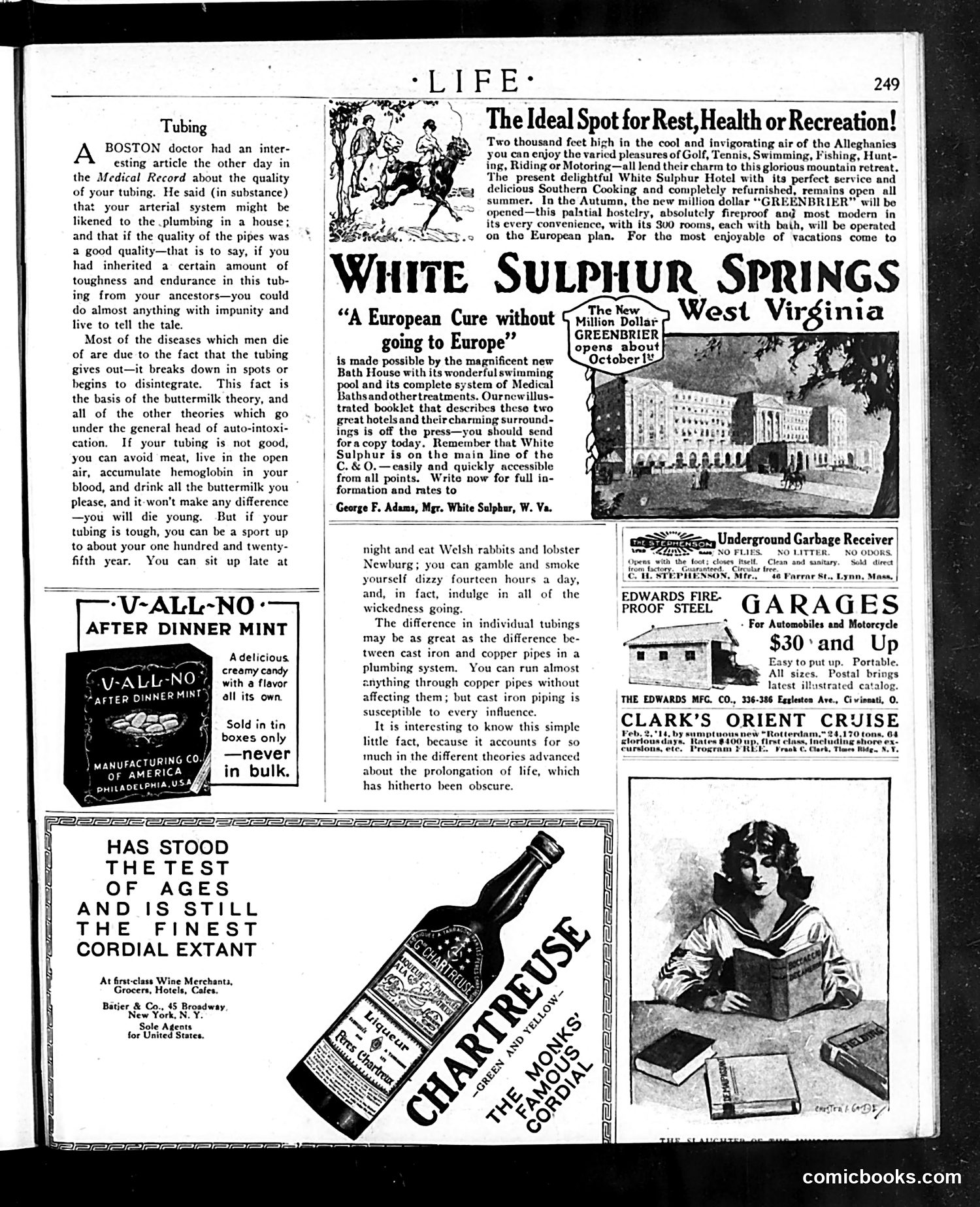
This page is primarily **advertising**, with a lead article on "Tubing" that uses an extended medical metaphor rather than satire. **Main Content:** The "Tubing" article presents a Boston doctor's theory that human longevity depends on inherited arterial quality—comparing blood vessels to house plumbing. The point: if you have naturally tough "tubing," you can live wildly (eat rich foods, gamble, smoke) and still reach 125. If your inherited plumbing is weak ("cast iron" rather than "copper"), no amount of healthy living helps. This explains competing health theories of the era. **Advertisements dominate:** - White Sulphur Springs resort (West Virginia) - The new "Greenbrier" luxury hotel opening - V-ALL-NO after-dinner mints - Chartreusse liqueur - Edwards fire-proof steel garages - Clark's Orient Cruise line - Underground garbage receivers The page reflects early 20th-century concerns with health, inheritance, and leisure—targeting affluent readers who could afford mountain resorts and Caribbean cruises. No political satire is evident; this is commercial publishing.
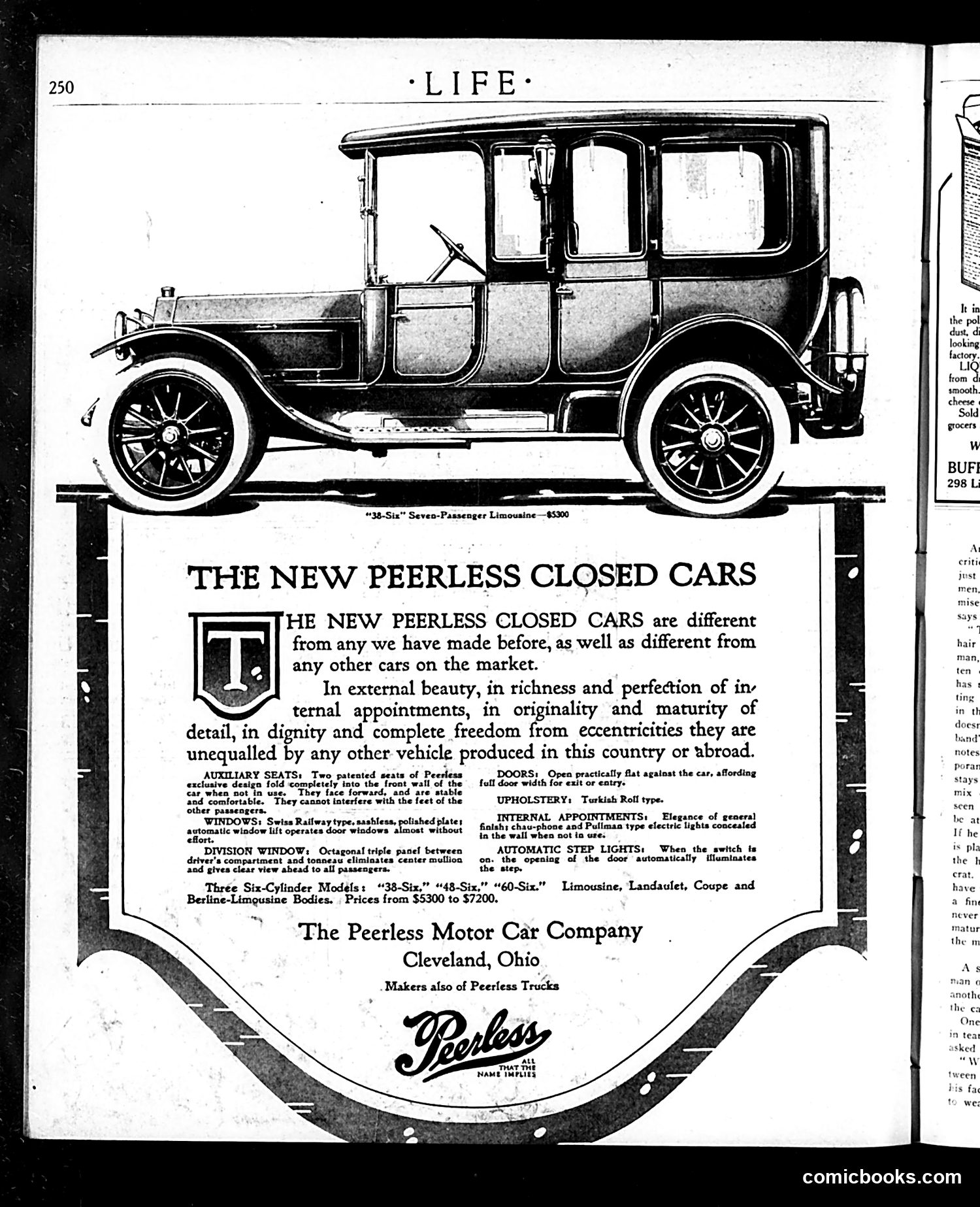
This page is **primarily a luxury automobile advertisement**, not political satire. It showcases the Peerless Motor Car Company's new closed-body limousines from Cleveland, Ohio. For modern readers, the key context: this represents the early automotive era when closed cars were a premium feature—most vehicles had open designs. The advertisement emphasizes innovations now standard: windows (Swiss Railway type), automatic door lights, upholstered interiors, and a division window separating driver from passengers. The "38-Six," "48-Six," and "60-Six" model names reference engine displacement. Prices ($5,300-$7,200) represented luxury goods accessible only to the wealthy. The advertisement's tone—claiming Peerless cars are "unequalled by any other vehicle produced in this country or abroad"—exemplifies period marketing hyperbole. There is **no apparent cartoon or satire** on this page; it is straightforward product advertising typical of *Life* magazine's commercial content.
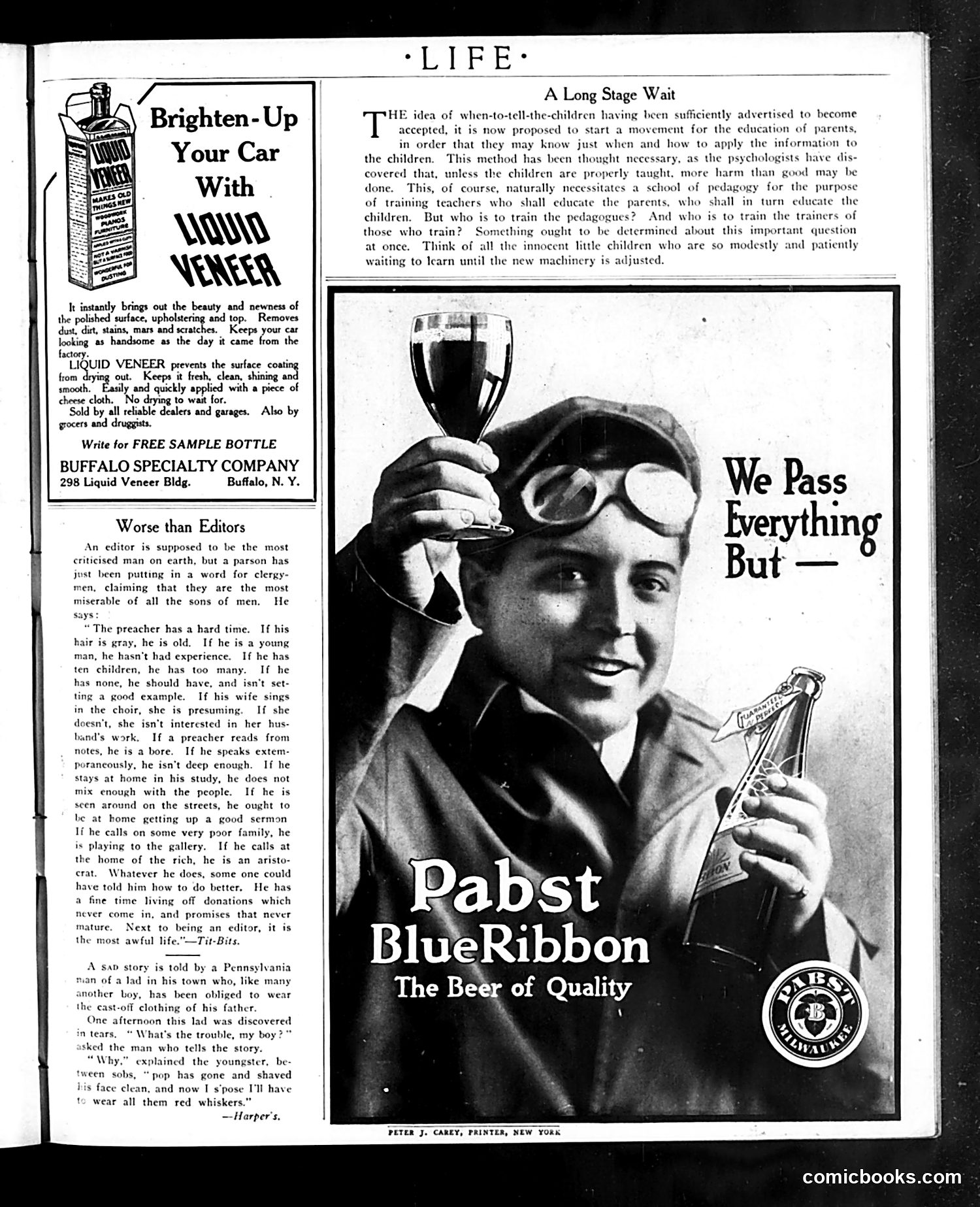
This page contains **three distinct pieces of satirical content** rather than a unified cartoon: 1. **"A Long Stage Wait"** (top): A tongue-in-cheek critique of educational theory. It satirizes the emerging progressive education movement by suggesting an infinite regress: if parents need training to teach children, who trains the parents? Who trains those trainers? The joke mocks the over-intellectualization of child-rearing and the proliferation of "expert" pedagogical systems. 2. **"Worse than Editors"** (left column): A humorous monologue listing the impossible contradictions clergy face—criticized whether they're old or young, whether their wives participate in church or don't, etc. It's sympathetic satire about an underappreciated profession, culminating in the ironic observation that preachers at least get stipends (however unreliable), unlike editors. 3. **"Sad Story"** (bottom): A brief, sentimental anecdote about a poor boy forced to wear his father's hand-me-downs, now worried he'll inherit the father's red whiskers after shaving. The page is primarily **text-based satire with minimal illustration**, interspersed with period advertisements.
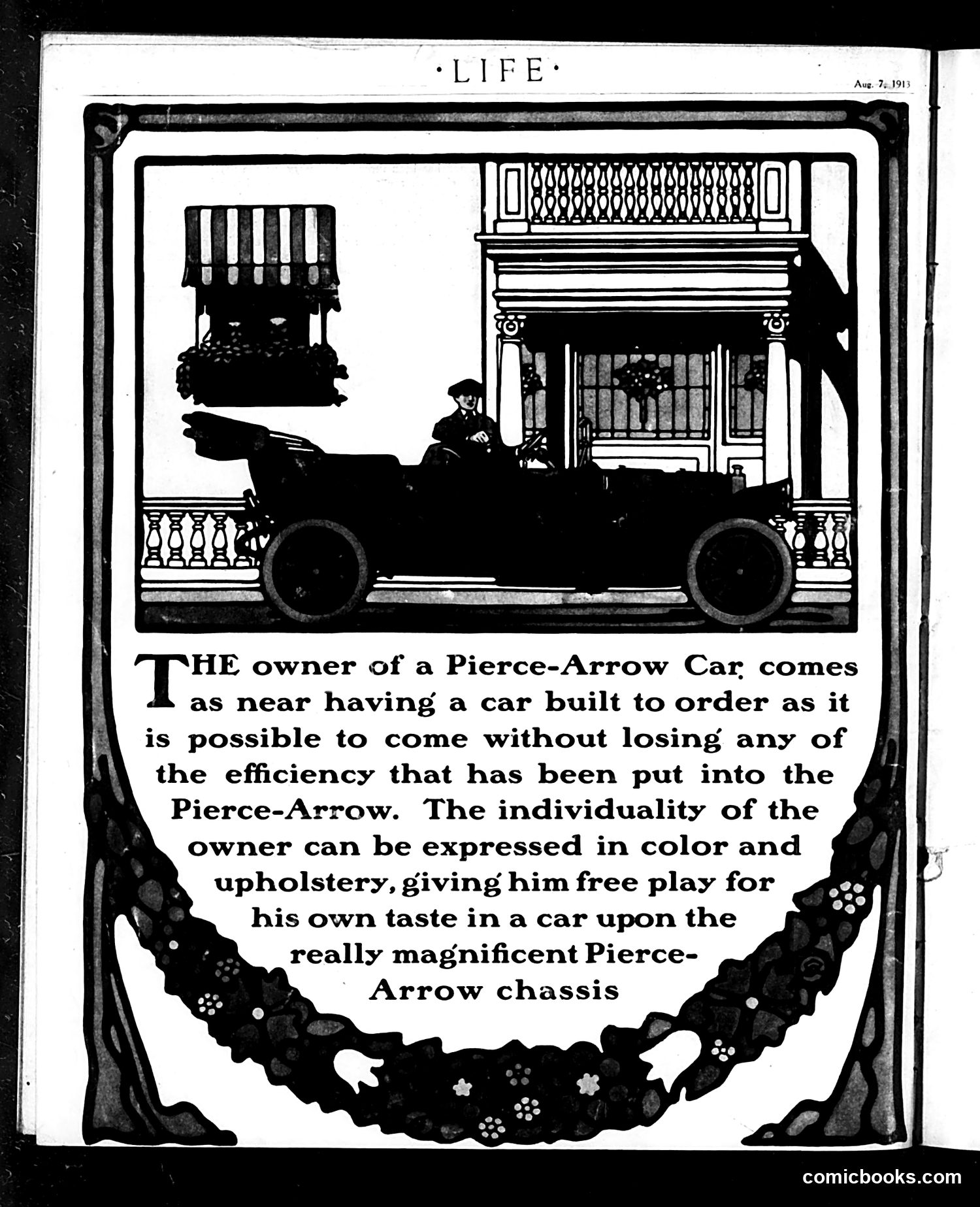
This is a Pierce-Arrow automobile advertisement from Life magazine (August 7, 1911). The silhouette illustration shows an elegant car with a well-dressed driver passing a storefront, emphasizing luxury and style. The ad's pitch appeals to wealthy buyers by claiming the Pierce-Arrow offers customization—allowing owners to express "individuality" through color and upholstery choices—while maintaining the car's superior engineering and efficiency. This was a selling strategy targeting the affluent market: you get a prestigious, high-performance chassis with personalized aesthetics, suggesting both technical excellence and social distinction. The ornate art nouveau-style border frames the advertisement as premium editorial content, typical of early automotive luxury marketing in upscale publications like Life.