
Life, 1913-08-07 · page 36 of 40
Life — August 7, 1913 — page 36: what you’re looking at
What you’re looking at
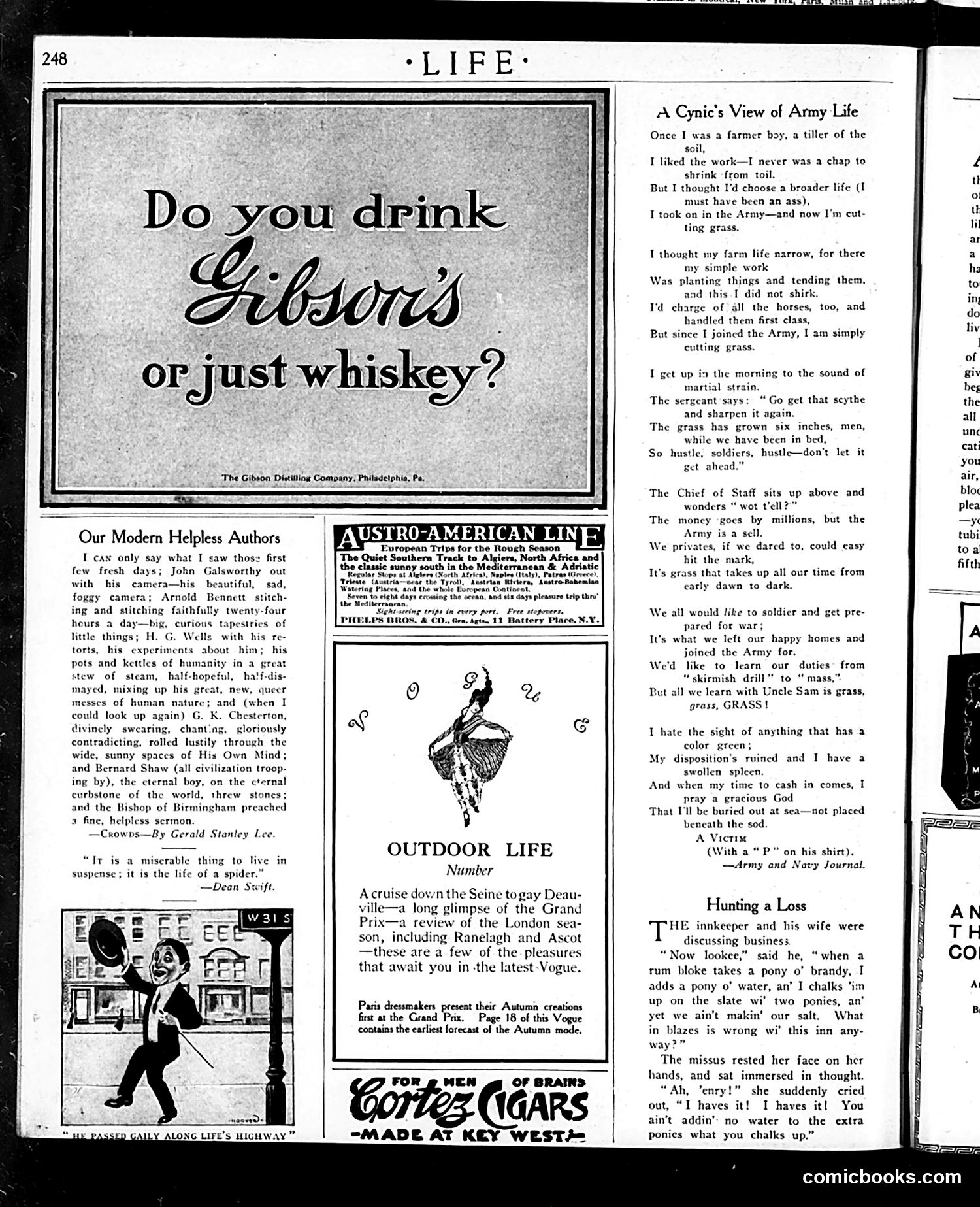
This page from *Life* magazine contains several distinct pieces of social commentary: **"A Cynic's View of Army Life"** is a satirical poem mocking military service during what appears to be WWI. A farmer enlisted expecting meaningful soldiering but instead spends all his time cutting grass under sergeant's orders. The satire targets the disconnect between soldiers' aspirations and mundane reality, plus the wasteful spending ("money goes by millions") on an ineffective military apparatus. The repeated refrain "grass, GRASS!" emphasizes the absurdity and monotony. **"Our Modern Helpless Authors"** satirizes famous contemporary writers (Galsworthy, Bennett, H.G. Wells, Chesterton, Shaw) as earnestly but ineffectually documenting their times—unable to truly affect the world despite their efforts. **"Hunting a Loss"** is a brief humorous anecdote about an innkeeper's wife solving their business problem: they weren't watering down *all* the drinks they were charging full price for. The advertisements (Gibson whiskey, Austro-American shipping line, Cortz cigars) reflect period consumer culture targeting middle-class readers.
📄 Transcribed text from this page (OCR, searchable)
Machine-transcribed from the original scan — historical spelling and the odd misread are preserved.
Our Modern Helpless Authors I cax only say what I saw those first few fresh days; John Galsworthy out with his camera—his beautiful, sad, foggy camera; Arnold Bennett stitch- ing and stitching faithfully twenty-four hours a day—big, curious ts little things; H. G. Wells wit torts, his experiments about pots and kettles of humani stew of steam, half-hopeful, mayed, mixing up his great, new, queer messes of human nature; and (when I could look up again) G. K. Chesterton, divinely swearing, chanting, gloriously contradicting, rolled lustily through the wide, sunny spaces of His Own Mind; and Bernard Shaw (all civilization troop- ing by), the eternal boy, on the cternal curbstone of the world, threw stones; and the Bishop of Birmingham preached a fine, helpless sermon. —Crowns—By Gerald Stanley Lee. “It is a miserable thing to live in suspense; it is the life of a spider. —Dean Swift. The Quiet Southern Track ts the classic sunny south in the Nar Stops at Aghers (Nocth Afric OUTDOOR LIFE Number Acruise dovn the Seine to gay Deau- ville—a long glimpse of the Grand Prix—a review of the London s n, including Ranelagh and Ascot —these are a few of the pleasures that await you in -the latest-Vogue. Paris dressmakers present their Autuma creations first at the Grand Prix. Page 18 of this Vogue contains the earliest forecast of the Autumn mode. “MADE AT KEY WESTS= A Cynic’s View of Army Life Once I was a farmer boy, a tiller of the soil, I liked the work—I never was a chap to shrink ‘from toil. But I thought I'd choose a broader life (I must have been an ass), I took on in the Army—and now I'm cut- ting grass. I thought my farm life narrow, for there my simple work Was planting things and tending them, and this I did not shirk. I'd charge of all the horses, too, and handled them first els But since I joined the Army, I am simply cutting grass. I get up in the morning to the sound of martial strain. The sergeant says Go get that scythe and sharpen it again. The grass has grown six inches, men, while we have been in bed, So hustle, soldiers, hustle—don’t let it get ahead. The Chief of Staff sits up above and wonders “ wot t'ell The moncy goes by millions, but the Army is a sell. We privates, if we dared to, could easy hit the mark, It’s grass that takes up all our time from carly dawn to dark. We all would like to soldier and get pre- pared for war; we left our happy homes and joined the Army for. like to learn our duties from “skirmish drill” to “mass, But all we learn with Uncle Sam is grass, grass, GRASS! I hate the sight of anything that has a color green; My disposition’s ruined and I have a swollen spleen. And when my time to cash in comes, I pray a gracious God That I'll be buried out at sea—not placed bencath the sod. A Victim (With a“ P” on his shirt). —Army and Navy Journal. Hunting a Loss HE innkeeper and his wife were discussing business. “Now lookee,” said he, “when a rum bloke takes a pony o” brandy, I adds a pony o’ water, an’ I chalks up on the slate wi’ two ponies, an’ yet we ain’t makin’ our salt. What in blazes is wrong wi’ this inn any- way?” The missus rested her face on her hands, and sat immersed in thought. “Ah, 'enry!” she suddenly cried out, “I haves it! I haves it! You ain't addin’: no water to the extra ponies what you chalks up.” comicbooks.com