
Life, 1913-08-07 · page 22 of 40
Life — August 7, 1913 — page 22: what you’re looking at
What you’re looking at
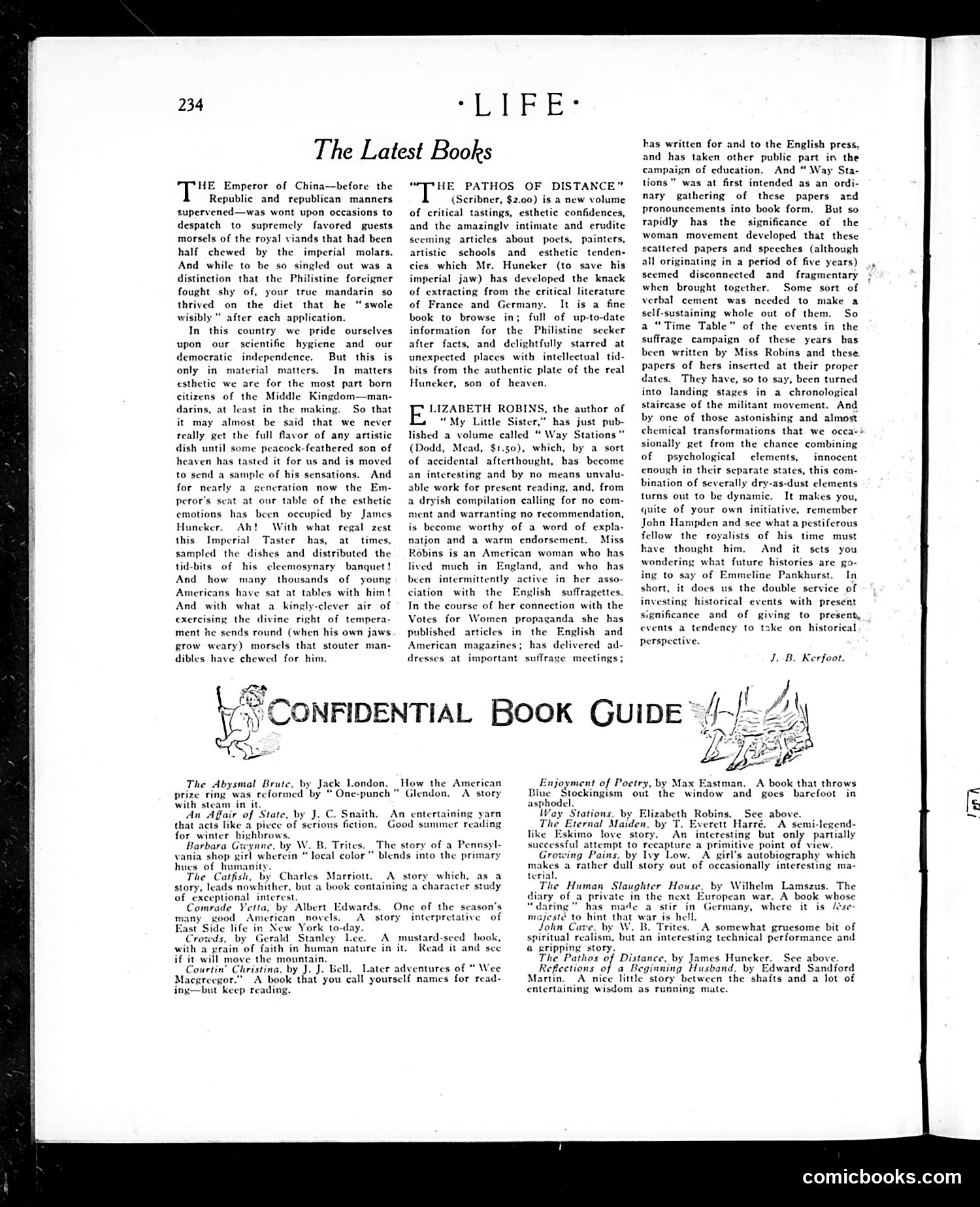
This is primarily a book review section, not a political cartoon page. The satirical content lies in the literary criticism itself. The main extended metaphor compares critic **James Huneker** to China's Emperor, who famously pre-chewed food for favored guests. The author argues that American readers aesthetically depend on Huneker's "taste-tested" cultural judgments the way ancient mandarins relied on the Emperor's palate. The joke: Americans pride themselves on democratic independence yet slavishly follow one critic's aesthetic pronouncements—they're cultural mandarins despite democratic pretenses. The piece reviews Huneker's book *"The Pathos of Distance"* and **Elizabeth Robins's** *"Way Stations,"* noting Robins's involvement with English suffragettes. The humor emphasizes American cultural dependence on European (particularly French and German) artistic authority filtered through Huneker's authority.
📄 Transcribed text from this page (OCR, searchable)
Machine-transcribed from the original scan — historical spelling and the odd misread are preserved.
LIFE The Latest Books HE Emperor of China—before the Republic and republican manners supervened—was wont upon occasions to despatch to supremely favored guests morsels of the royal viands that had been half chewed by the imperial molars. And while to be so singled out was a distinction that the Philistine foreigner fought shy of, your true mandarin so thrived on the diet that he “swole wisibly ” In this country we pride ourselves upon our scientific hygiene and our democratic independence. But this is only in material matters, In matters esthetic we are for the most part born citizens of the Middle Kingdom—man- darins, at least in the making. So that it may almost be said that we never really get the full flavor of any artistic dish until some peacock-feathered son of heaven has tasted it for us and is moved to send a sample of his sensations. And for nearly a generation now the Em- peror’s seat at our table of the esthetic emotions been occupied by James Huneker, Ah! With what regal zest this Imperial ter has, at times, sampled the dishes and distributed the tid-bits of his cleemosynary banquet! And how many thousands of young Americans have sat at tables with him! And with what a kingly-clever air of exercising the divine right of tempera- ment he sends round (when his own jaws grow weary) morscls that stouter man- dibles have chewed for him. after each application. The Abysmal Brute, by Jack London. prize ring was reformed by “ One-punch ” with steam in it ‘An Affair of State, by J. C. Snaith. that acts like a piece of serious fiction. for winter highbrows. Barbara Grynne, by W. B. Trites. vania shop girl wherein “ local color” hues of humanity The Catfish, by Charles of exceptional interest. Comrade Yetta, by Albert many good American novels. A zi New York to-day erald Stanley 1 Edwards. with a grain of faith in human nature in it. if it will move the mountain. Courtin’ Christina, by J. J. Bell. Macereegor.” ing—but keep reading. How the American n entert Good summer reading Th The story of a Pennsyl- blends into the primary Gr Marriott. A story, leads nowhither, but a book containing a character study story story mustard-seed Later adventures of “ Wee A book that you call yourself names for read- HE PATHOS OF DISTANCE” (Scribner, $2.00) is a new volume of critical tastings, esthetic confidences, and the amazingly intimate and erudite sceming articles about pocts, painters, artistic schools and esthetic tenden- cies which Mr. Huneker (to save his imperial jaw) has developed the knack of extracting from the critical literature of France and Germany. It is a fine book to browse in; full of up-to-date information for the Philistine secker after facts, and delightfully starred at unexpected places with intellectual tid- bits from the authentic plate of the real Huncker, son of heaven. LIZABETH ROBINS, the author of “My Little Sister,” has just pub- lished a volume called “ Way Stations” (Dodd, Mead, $1.50), which, by a sort of accidental afterthought, has become an interesting and by no means unvalu- able work for present reading, and, from a dryish compilation calling for no com- ment and warranting no recommendation, is become worthy of a word of expla- natjon and a warm endorsement. Miss Robins is an American woman who has lived much in England, and who has been intermittently active in her asso- ciation with the English suffragettes In the course of her connection with the Votes for Women propaganda she has published articles in the English and American magazines; has delivered ad- dresses at important suffrage meetings ; Blue Stockingism asphodel. Way Glendon, A. story ining yarn like Eskimo love Enjoyment of Poetry, by Max Eastman, out the window and goes barefoot in tations. by Eternal Maiden, by T. story. An successful attempt to recapture a primitive point o ng Pains, by Ivy has written for and to the English press, and has taken other public part in the campaign of education. And “ Way Sta- tions” was at first intended as an ordi- nary gathering of these papers and pronouncements into book form. But so rapidly has the significance of the woman movement developed that these scattered papers and speeches (although all originating in a period of five years) seemed disconnected and fragmentary when brought together. Some sort of verbal cement was needed to make a self-sustaining whole out of them. So a “Time Table” of the events in the suffrage campaign of these years has been written by Miss Robins and these papers of hers inserted at their proper dates. They have, so to say, been turned into landing stages in a chronological staircase of the militant movement. And by one of those astonishing and almost chemical transformations that we occa~ sionally get from the chance combining of psychological elements, innocent enough in their separate states, this com- bination of severally dry-as-dust elements turns out to be dynamic. It makes you, quite of your own initiative, remember John Hampden and sce what a pestiferous fellow the royalists of his time must have thought him, And it sets you wondering what future histories are go- ing to say of Emmeline Pankhurst. In short, it docs us the double service of investing historical events with present significance and of giving to present, events a tendency to take on historical perspective. J.-B. Kerfoot. A book that throws ‘lizabeth Robins. See above. Sverett Harré. A semi-legend- interesting but only partially view. which Low, A girl's autobiography kes a rather dull story out of occasionally interesting ma- which, as a rial, interpretative of John Cave. by book, Read it and see @ gripping story. The Pathos o} Reflections o, Martin The Human Slaughter House, by iary of a private in th One of the scason’s daring f — majesté to hint that war. is hell. ". B. Trites, spiritual realism, but an interesting technical performance and made Distance, by James Huncker. a Beginning Husband. by A nice little story Wilhelm Lamszus. The uropean war. A book whose Germany, where it is /&se: next a stir in A somewhat gruesome bit of See above. dward Sandford between the shafts and a lot of entertaining wisdom as running mate. comicbooks.com