
Life, 1913-08-07 · page 8 of 40
Life — August 7, 1913 — page 8: what you’re looking at
What you’re looking at
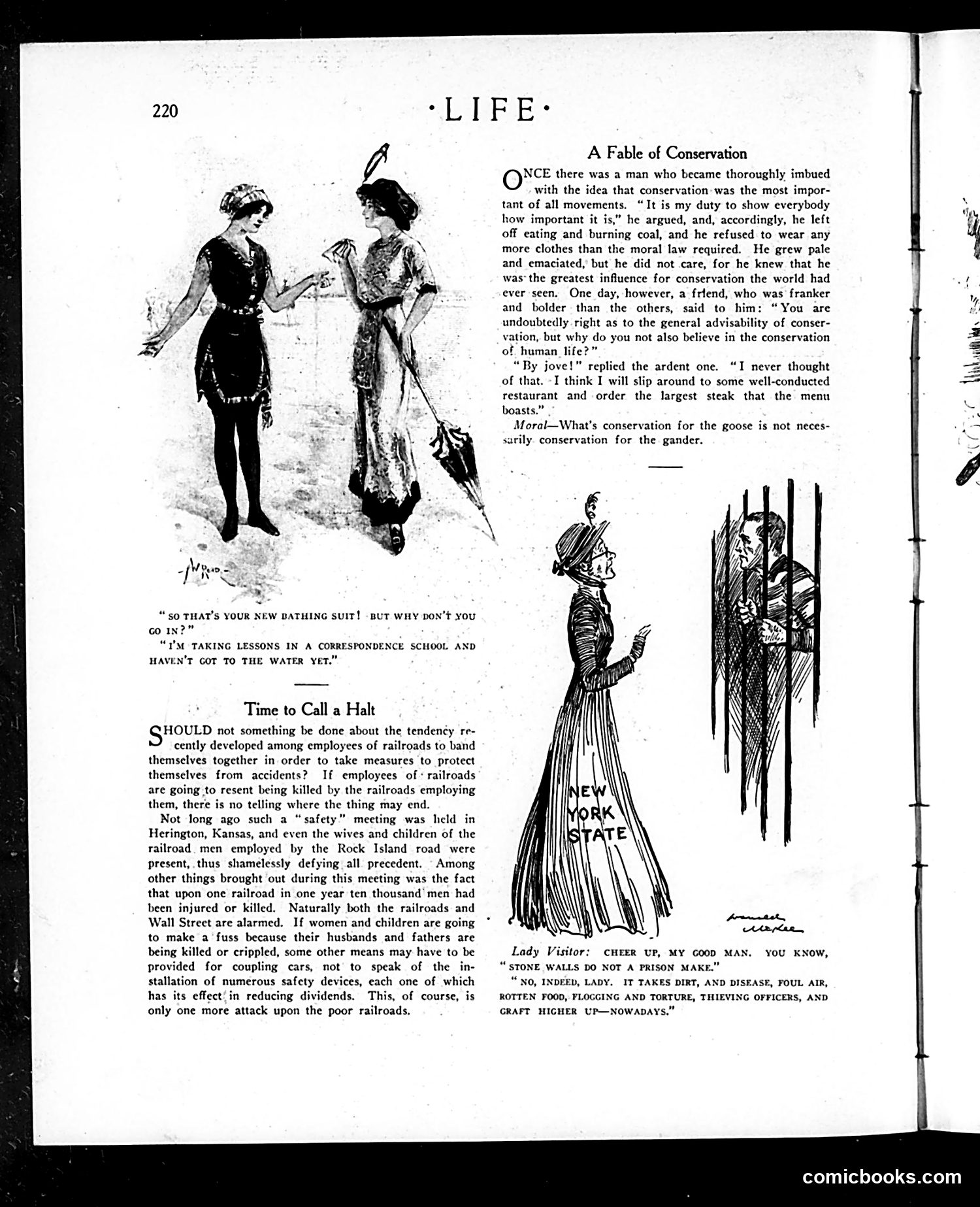
This page contains three distinct pieces of satire: 1. **"A Fable of Conservation"** (top): A man obsessed with conservation refuses basic comforts (eating, heating, clothing) to save resources. A bolder friend challenges his hypocrisy by pointing out he won't apply these principles to *human* life—suggesting his conservation ethics are selective and self-serving. 2. **Top cartoon**: Two women discuss a new bathing suit; one explains she's taking correspondence courses and hasn't reached the water yet—mocking either educational inefficiency or absurdly lengthy self-improvement programs. 3. **"Time to Call a Halt"** (bottom): Discusses railroad employee safety, noting ten thousand men were injured annually. It advocates for safety measures and coupling devices, framing worker protection as economically sensible, not just humanitarian. The page satirizes selective morality, educational pretension, and industrial negligence.
📄 Transcribed text from this page (OCR, searchable)
Machine-transcribed from the original scan — historical spelling and the odd misread are preserved.
Bibi ele A Fable of Conservation NCE there was a man who became thoroughly imbued with the idea that conservation was the most impor- tant of all movements. “It is my duty to show everybody how important it is,” he argued, and, accordingly, he left off eating and burning coal, and he refused to wear any more clothes than the moral law required. He grew pale and emaciated, but he did not care, for he knew that he was*the greatest influence for conservation the world had ever seen. One day, however, a friend, who was franker and bolder than the others, said to him: “You are undoubtedly right as to the general advisability of conser- vation, but why do you not also believe in the conservation of human life?” “By jove!” replied the ardent one. “I never thought of that. -I think I will slip around to some well-conducted restaurant and order the largest steak that the menu boasts.” Moral—What’s conservation for the goose is not neces- sarily. conservation for the gander. » “so THAT'S YOUR NEW BATHING SUIT! -BUT WHY DoN’t You Go IN?” . “I'M TAKING LESSONS IN A CORRESPONDENCE SCHOOL AND HAVEN'T GOT TO THE WATER YET.” Time to Call a Halt SHOUED not something be done about the tendency re- cently developed among employees of railroads to band themselves together in order to take measures to protect themselves from accidents? If employees of: railroads are going to resent being killed by the railroads employing them, there is no telling where the thing may end. Not long ago such a “safety” meeting was held in Herington, Kansas, and even the wives and children of the railroad. men employed by the Rock Island road were present, thus shamelessly defying all precedent. Among other things brought out during this meeting was the fact that upon one railroad in one year ten thousand’ men had been injured or killed. Naturally both the railroads and \ Wall Street are alarmed. If women and children are going oa to make a fuss because their husbands and fathers are . being killed or crippled, some other means may have to be Lady Visitor: CHEER UP, MY GOOD MAN. YoU KNOW, provided for coupling cars, not to speak of the in- “ STONE WALLS DO NOT A PRISON MAKE.” stallation of numerous safety devices, each one of which “NO, INDEED, LADY, IT TAKES DIRT, AND DISEASE, FOUL AIR, has its effect’ in reducing dividends. This, of course, is ROTTEN FOOD, FLOGGING AND TORTURE, THIEVING OFFICERS, AND only one more attack upon the poor railroads. GRAFT HIGHER UP—NOWADAYS.” comicbooks.com