
Life, 1913-08-07 · page 23 of 40
Life — August 7, 1913 — page 23: what you’re looking at
What you’re looking at
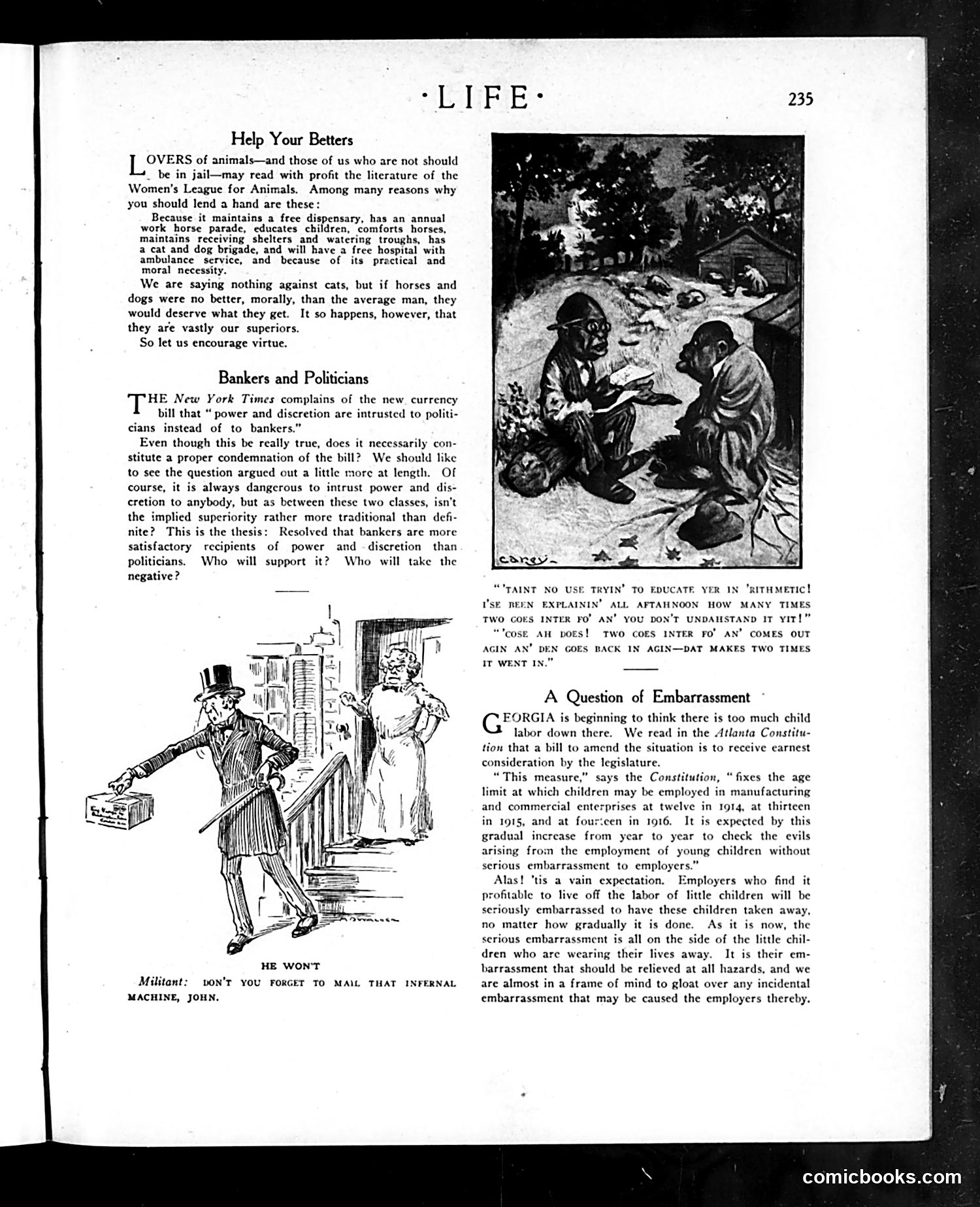
This page contains three distinct satirical pieces: **"Help Your Betters"** advocates for the Women's League for Animals, sarcastically claiming animals are morally superior to humans and deserve protection. **"Bankers and Politicians"** challenges the *New York Times*' complaint that currency bill power goes to politicians rather than bankers. Life poses this as a debate: which group is more trustworthy with power? The satire questions whether bankers' traditional authority is actually justified. **"A Question of Embarrassment"** mocks Georgia's proposed child labor reform. The state plans to gradually raise the minimum work age (12→13→14 over three years) to avoid "serious embarrassment to employers." Life's sarcasm is biting: it's the *children* being exploited who suffer embarrassment—their very lives wasting away—not the profitable factory owners. The piece ridicules the prioritization of employer comfort over child welfare. The cartoons illustrate these critiques visually, including a sketch about arithmetic education and one titled "HE WON'T" about forgetting to mail a machine.
📄 Transcribed text from this page (OCR, searchable)
Machine-transcribed from the original scan — historical spelling and the odd misread are preserved.
Help Your Betters OVERS of animals—and those of us who are not should . be in jail—may read with profit the literature of the Women’s League for Animals. Among many reasons why you should lend a hand are these: Because it maintains a free dispensary, has an annual work horse parade, educates children, comforts horses, maintains receiving shelters and watering troughs, has a cat and dog brigade, and will have a free hospital with ambulance service, and because of its practical and moral necessity. We are saying nothing against cats, but if horses and dogs were no better, morally, than the average man, they would deserve what they get. It so happens, however, that they are vastly our superiors. So let us encourage virtue. Bankers and Politicians HE New York Times complains of the new. currency bill that “ power and discretion are intrusted to politi- cians instead of to bankers.” Even though this be really true, does it necessarily con- stitute a proper condemnation of the bill? We should like to see the question argued out a little more at length. Of course, it is always dangerous to intrust power and dis- cretion to anybody, but as between these two classes, isn’t the implied superiority rather more traditional than defi- nite? This is the thesis: Resolved that bankers are more satisfactory recipients of power and -discretion than politicians. Who will support it? Who will take the negative? “CTAINT NO USE TRYIN’ TO EDUCATE YER IN ‘RITHMETIC! I'SE REEN EXPLAININ’ ALL AFTAHNOON HOW MANY TIMES TWO GOES INTER FO’ AN’ YOU DON'T UNDAMSTAND IT it!” mace AH pos! TWO COES INTER FO’ AN’ COMES OUT AGIN AN’ DEN GOES BACK IN AGIN—DAT MAKES TWO TIMES IT WENT 1) A Question of Embarrassment G ORGIA is beginning to think there is too much child labor down there. We read in the Atlanta Constitu- tion that a bill to amend the situation is to receive earnest consideration by the legislature. “This measure,” says the Constitution, “fixes the age limit at which children may be employed in manufacturing and commercial enterprises at twelve in 1914, at thirteen in 1915, and at fourtcen in 1916. It is expected by this gradual increase from year to year to check the evils arising from the employment of young children without serious embarrassment to employers.” Alas! ‘tis a vain expectation. ployers who find it fitable to live off the labor of little children will be seriously embarrassed to have these children taken away, no matter how gradually it is done. As it is now, the serious embarrassment is all on the side of the little chil- dren who are wearing their lives away. It is their em- HE WON'T barrassment that should be relieved at all hazards, and we Militant: von’r YoU FORGET TO MAIL THAT INFERNAL are almost in a frame of mind to gloat over any incidental MACHINE, JOHN. embarrassment that may be caused the employers thereby. comicbooks.com