
Life, 1913-08-07 · page 16 of 40
Life — August 7, 1913 — page 16: what you’re looking at
What you’re looking at
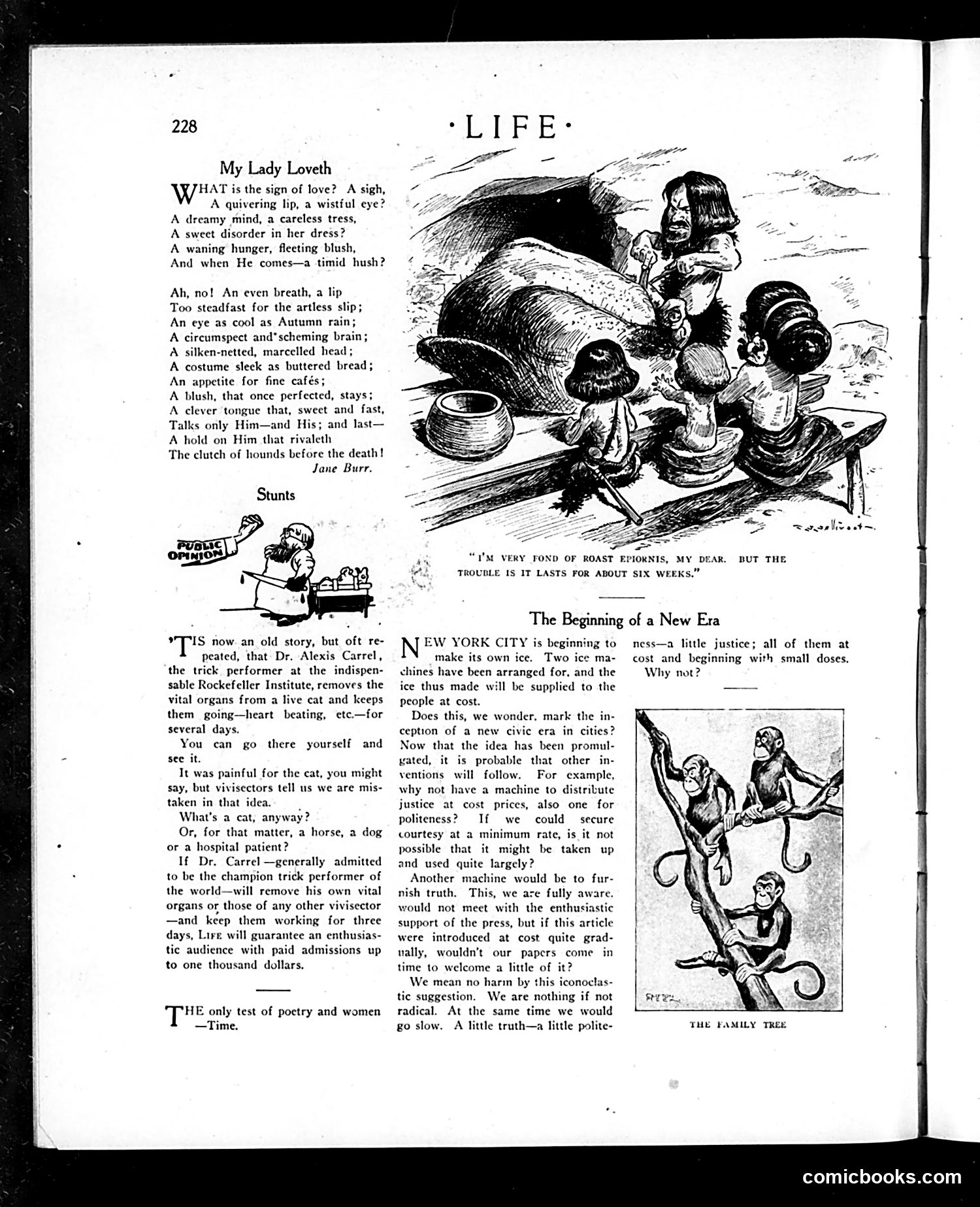
**"My Lady Loveth"** (poem by Jane Burr): A satirical inversion of romantic poetry. Rather than listing genuine signs of love, the poem catalogs calculating, superficial traits—the "modern woman" who performs emotions ("A blush, that once perfected, stays"), maintains strategic control ("A hold on Him that rivaleth / The clutch of hounds"), and prioritizes material pleasures ("An appetite for fine cafés"). The satire critiques women as manipulative and mercenary rather than genuinely affectionate. **"Stunts" section**: Mocks Dr. Alexis Carrel's famous Rockefeller Institute experiments keeping animal organs alive outside the body. Life sardonically challenges him to perform vivisection on himself rather than animals, exposing what it views as morally questionable "scientific" theater. **"The Beginning of a New Era"**: Satirizes New York City's new ice-manufacturing service sold "at cost." Life extends the joke: if the city can commercialize ice, why not manufacture "justice," "politeness," and "truth" as commodities? The sarcasm suggests these civic virtues are already absent and that treating them as purchasable goods reflects the era's commercialism.
📄 Transcribed text from this page (OCR, searchable)
Machine-transcribed from the original scan — historical spelling and the odd misread are preserved.
My Lady Loveth HAT is the sign of love? A sigh, A quivering lip, a wistful eye? A dreamy mind, a careless tress, A sweet disorder in her dress? A waning hunger, fleeting blush, And when He comes—a timid hush? Ah, no! An even breath, a lip Too steadfast for the artless slip; An eye as cool as Autumn rain; A circumspect and* scheming brain; A silken-netted, marcelled head ; A costume sleck as buttered bread; An appetite for fine cafés; A blush, that once perfected, stays; A clever tongue that, sweet and fast, Talks only Him—and His; and last— A hold on Him that rivaleth The clutch of hounds before the death! Jane Burr, 1S now. an old story, but oft re- peated, that Dr. Alexis Carrel, the trick performer at the indispen- sable Rockefeller Institute, removes the vital organs from a live cat and keeps them going—heart beating, ete.—for several days. You can go see it. It was painful for the cat, you might say, but vivisectors tell us we are mis- taken in that idea. ts What's a cat, anyway? Or, for that matter, a horse, a dog or a hospital patient? If Dr. Carrel —generally admitted to be the champion trick performer of the world—will remove his own vital organs or those of any other vivisector —and keep them working for three days, Lire will guarantee an enthusias- tic audience with paid admissions up to one thousand dollars. there yourself and HE only test of poetry and women —Time. M VERY TROUDL FOND OF ROAST EPIORNIS, Is IT LASTS FOR ABOUT SIX WEEKS.” MY DEAR, BUT THE The Beginning of a New Era =W YORK CITY is beginning to make its own ice. Two ice ma- chines have been arranged for, and the ice thus made will be supplied to the people at cost. Does this, we wonder, mark the in- ception of a new civic era in cities? Now that the idea has been promul- gated, it is probable that other in- ventions will follow. For example, why not have a machine to distribute justice at cost prices, also one for politeness? If we could secure courtesy at a minimum rate, is it not possible that it might be taken up and used quite largely? Another machine would be to fur- nish truth. This, we are fully aware, would not meet with the enthusiastic support of the press, but if this article were introduced at cost quite grad- wally, wouldn't our papers come in time to welcome a little of it? We mean no harm by this iconoel: tic suggestion. We are nothing if not radical. At the same time we would go slow. A little truth—a little polite- ness—a little justice; all of them at cost and beginning with small doses. Why not? THE FAMILY TREE comicbooks.com