
A complete issue · 40 pages · 1913
Life — July 24, 1913
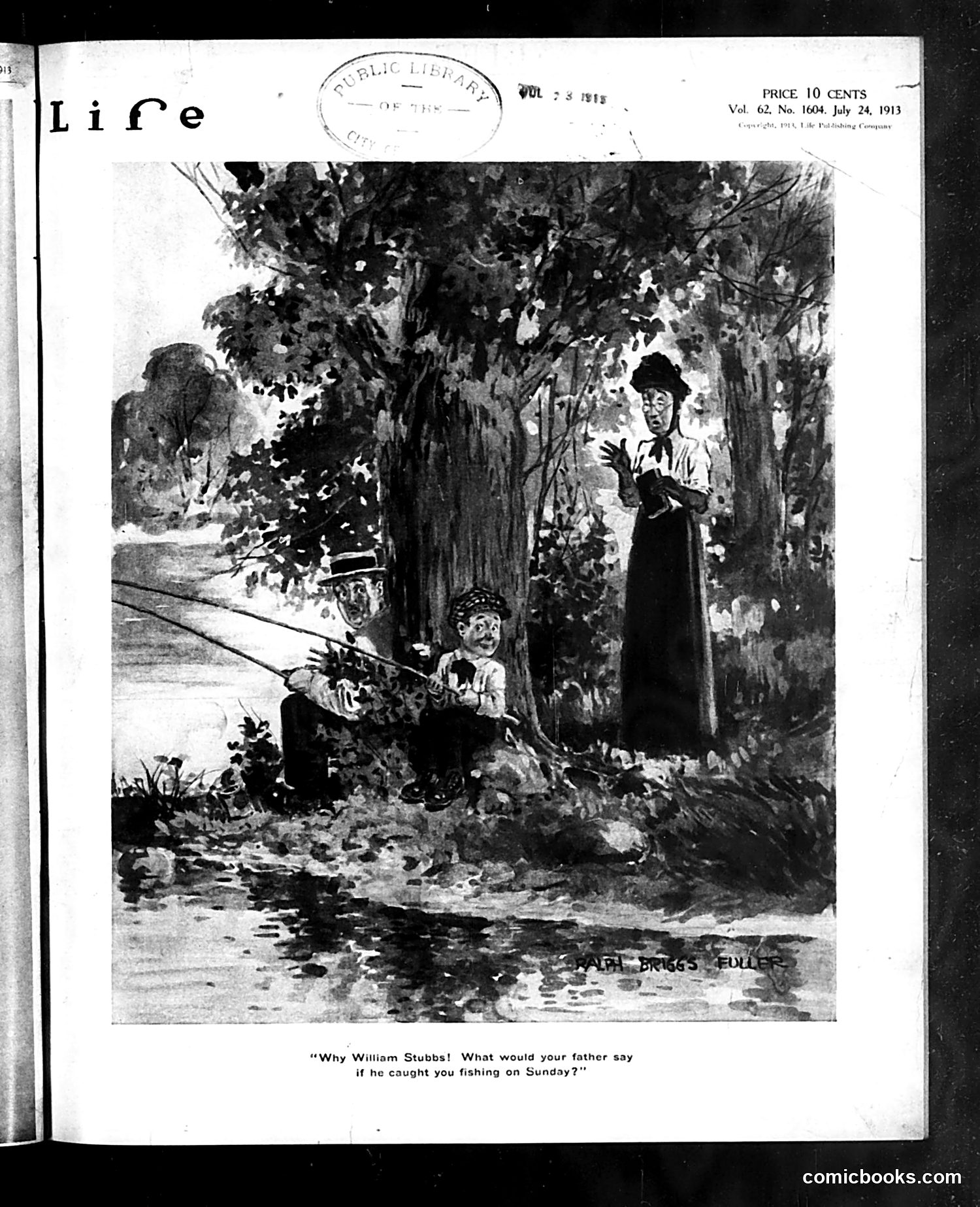
This is a humorous illustration by Albert Briggs Fuller depicting a moral lesson about Sunday observance. The caption reads: "Why William Stubbs! What would your father say if he caught you fishing on Sunday?" The scene shows a young boy fishing by a stream while a woman (likely his mother or another adult authority figure) discovers him. The setting appears to be a wooded area with trees overhanging the water. The joke satirizes religious hypocrisy and parental discipline in early 20th-century America. It reflects strict Protestant values about keeping the Sabbath holy—fishing for leisure on Sunday was considered sinful or at minimum inappropriate behavior that would provoke parental disapproval. The cartoon mocks both rigid religious observance and the threat of paternal punishment used to enforce moral behavior in children.
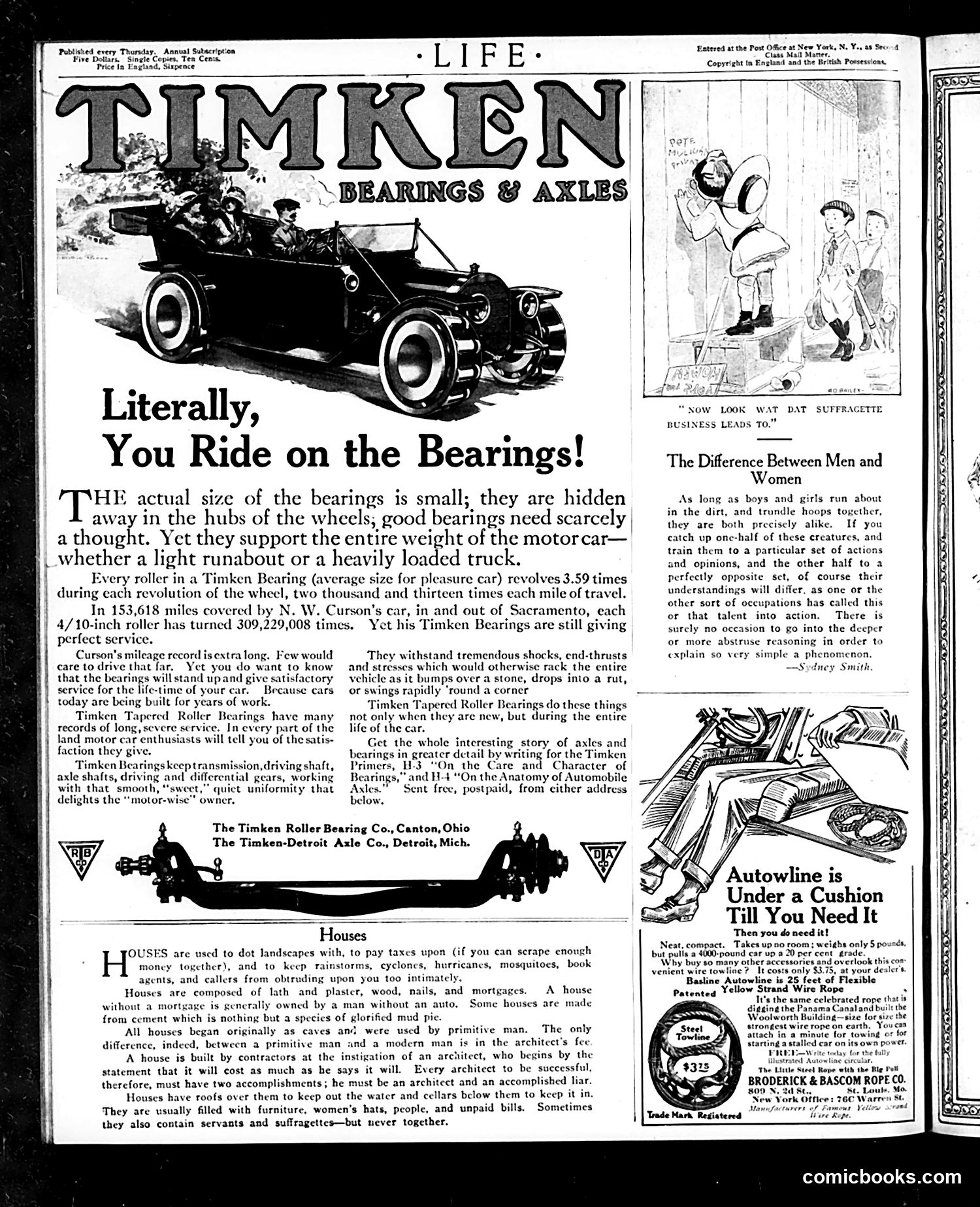
This page is **primarily advertising** rather than political satire. The dominant content features a Timken Bearings & Axles advertisement showcasing an early automobile with passengers, emphasizing that car wheels literally "ride on the bearings." The right side contains unrelated advertisements and a brief satirical piece titled "The Difference Between Men and Women" that presents stereotypical gender observations—suggesting women are more cautious and detail-oriented than men in relationships and decision-making. Below is an essay about houses, contrasting primitive versus modern dwellings in architectural terms. The page reflects early 20th-century magazine format: product advertisements integrated with light social commentary and essays, rather than sustained political cartooning.
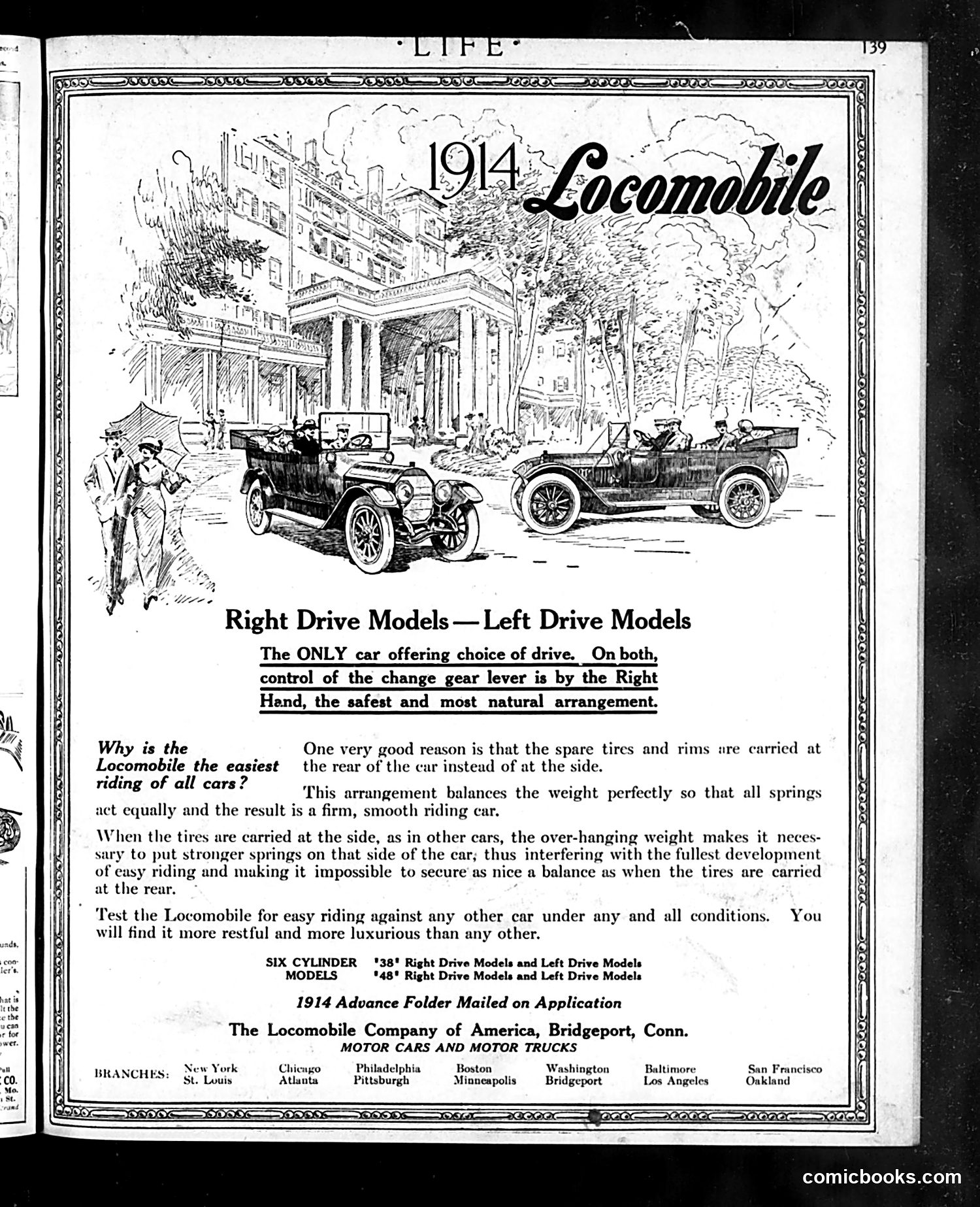
This page is primarily a **commercial advertisement**, not political satire. It promotes the 1914 Locomobile automobile, emphasizing its engineering advantages over competitors. The ad highlights two key selling points: 1. **Choice of drive configurations** - offering both right-hand and left-hand drive models, with right-hand control of the gear lever described as "the safest and most natural arrangement." 2. **Rear tire storage** - a practical innovation that balances weight distribution for smoother riding, contrasted favorably against competitors' side-mounted spare tires. The illustration shows period-appropriate automobiles and well-dressed pedestrians in an urban setting. The Locomobile Company of America, based in Bridgeport, Connecticut, distributed this nationally through multiple branch offices.
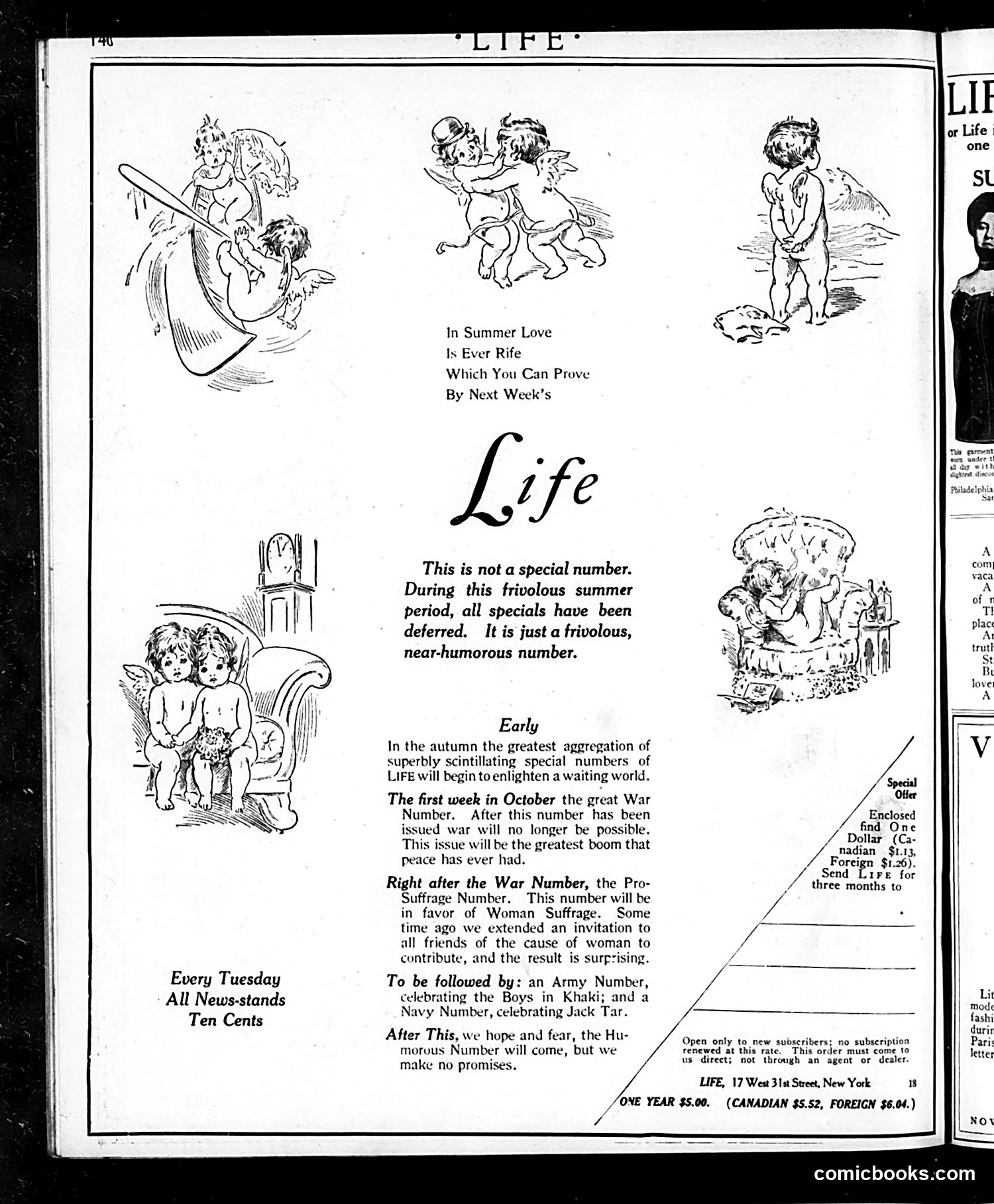
This page announces upcoming special issues while displaying playful summer-themed illustrations of cherubs and children. The text promises satirical content for autumn, referencing major historical events: 1. **"War Number"** - scheduled for early October, described as "the greatest boom that peace has ever had," sarcastically suggesting peace will end after publication 2. **"Pro-Suffrage Number"** - following the War Number, supporting women's voting rights 3. **Army and Navy Numbers** - celebrating military forces, including a "Boys in Khaki" number and one honoring "Jack Tar" (sailors) The satire mocks the magazine's own ability to predict events while poking fun at serious contemporary issues—particularly World War I and the women's suffrage movement—by treating them as casual seasonal entertainment.
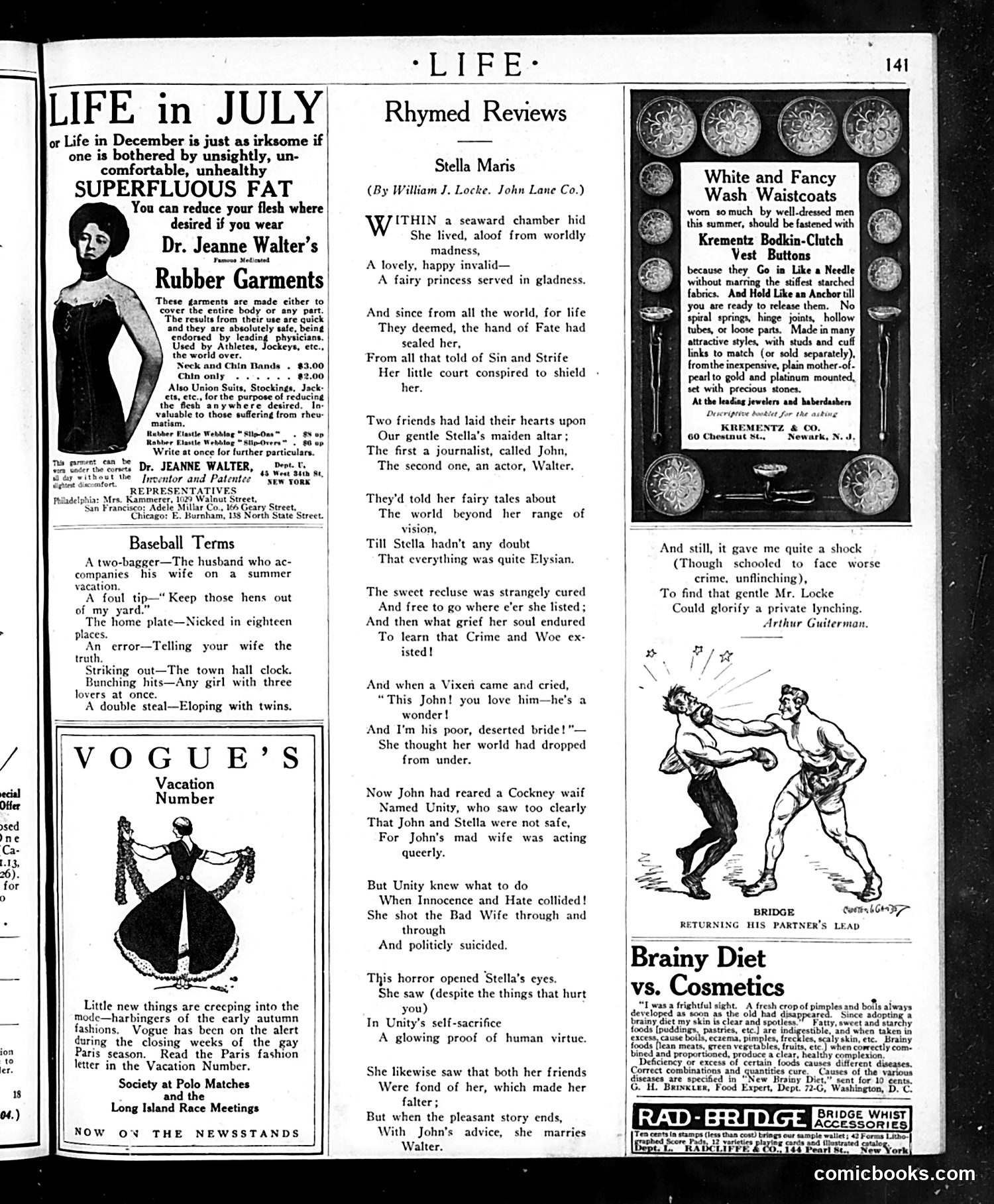
This page contains primarily **advertising and literary content** rather than political cartoons. The main elements are: 1. **"Life in July" advertisement** for Dr. Jaeger's rubber garments (weight-reduction wear) 2. **"Stella Maris" poem** by William J. Locke—a romantic narrative about a sheltered woman whose naive world collapses when she discovers her beloved's infidelity and his wife's madness, ending in tragedy 3. **Baseball terminology definitions**—humorous definitions using baseball terms as metaphors for domestic situations (e.g., "two-bagger" = husband accompanying wife on vacation) 4. **Small cartoon** showing two figures engaged in what appears to be a playful tussle over "returning his partner's lead" (bridge game reference) 5. **Product advertisements** for waistcoats, buttons, and diet/cosmetics The page reflects early 20th-century Life magazine's mix of humor, literature, and commerce—no significant political satire is evident.
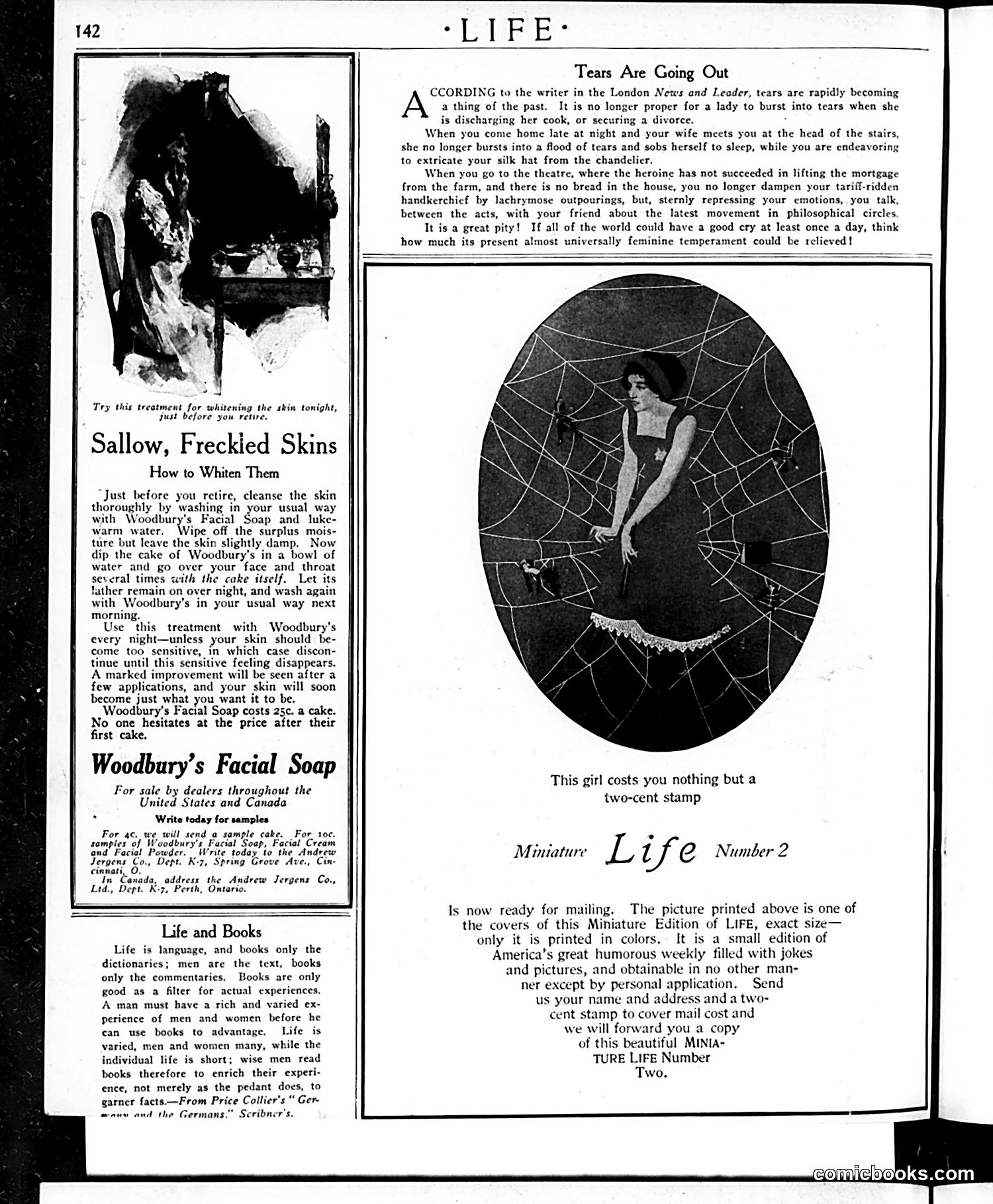
This page is primarily **advertising and editorial content rather than political satire**. The main elements are: 1. **Left side**: An advertisement for Woodbury's Facial Soap, promoting skin-whitening treatments for "sallow, freckled skins." This reflects early 20th-century beauty standards that valued pale complexions. 2. **Center/Right**: An illustration of a woman in a decorative oval frame with text "This girl costs you nothing but a two-cent stamp," promoting a "Miniature Life Number 2"—a small edition of Life magazine available by mail for two cents. 3. **"Tears Are Going Out"**: An essay satirizing modern women's emotional restraint, suggesting ladies no longer cry theatrically as they once did. The page reflects period attitudes about femininity, beauty standards, and consumer culture rather than containing political commentary.
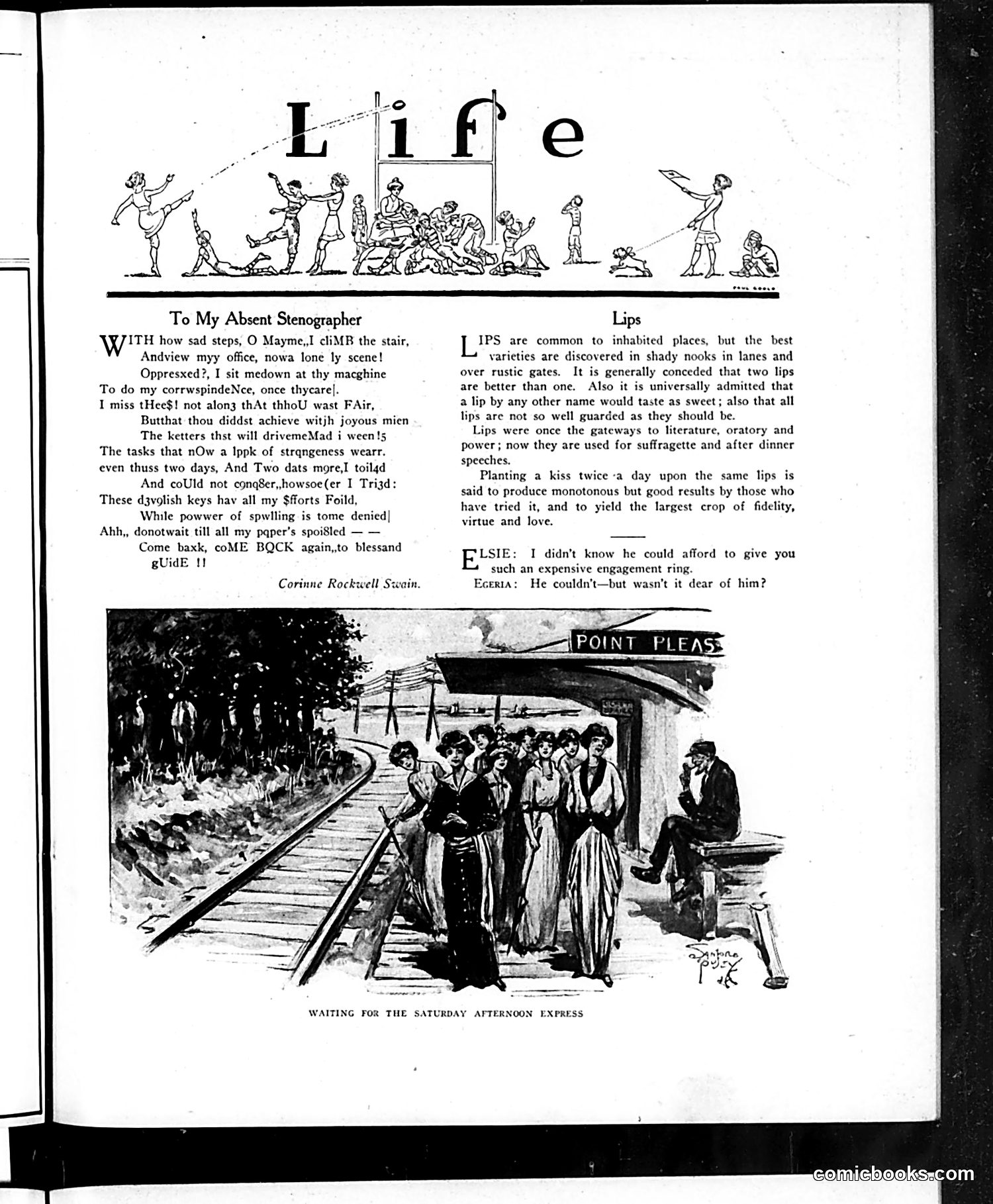
This page contains a poem titled "To My Absent Stenographer" by Corinne Rockwell Swain, addressing a missing office worker with humorous complaints about lacking stenographic assistance. The main illustration below shows a crowd of well-dressed people waiting at a train platform labeled "Point Pleas" for "the Saturday afternoon express." The cartoon satirizes leisure-class weekend travel—likely mocking the predictable, ritualistic nature of affluent Americans' Saturday excursions to seaside or country destinations. The crowded platform suggests this is an established social convention, with the formal dress and organized queue emphasizing the formulaic nature of weekend recreation among the middle and upper classes.
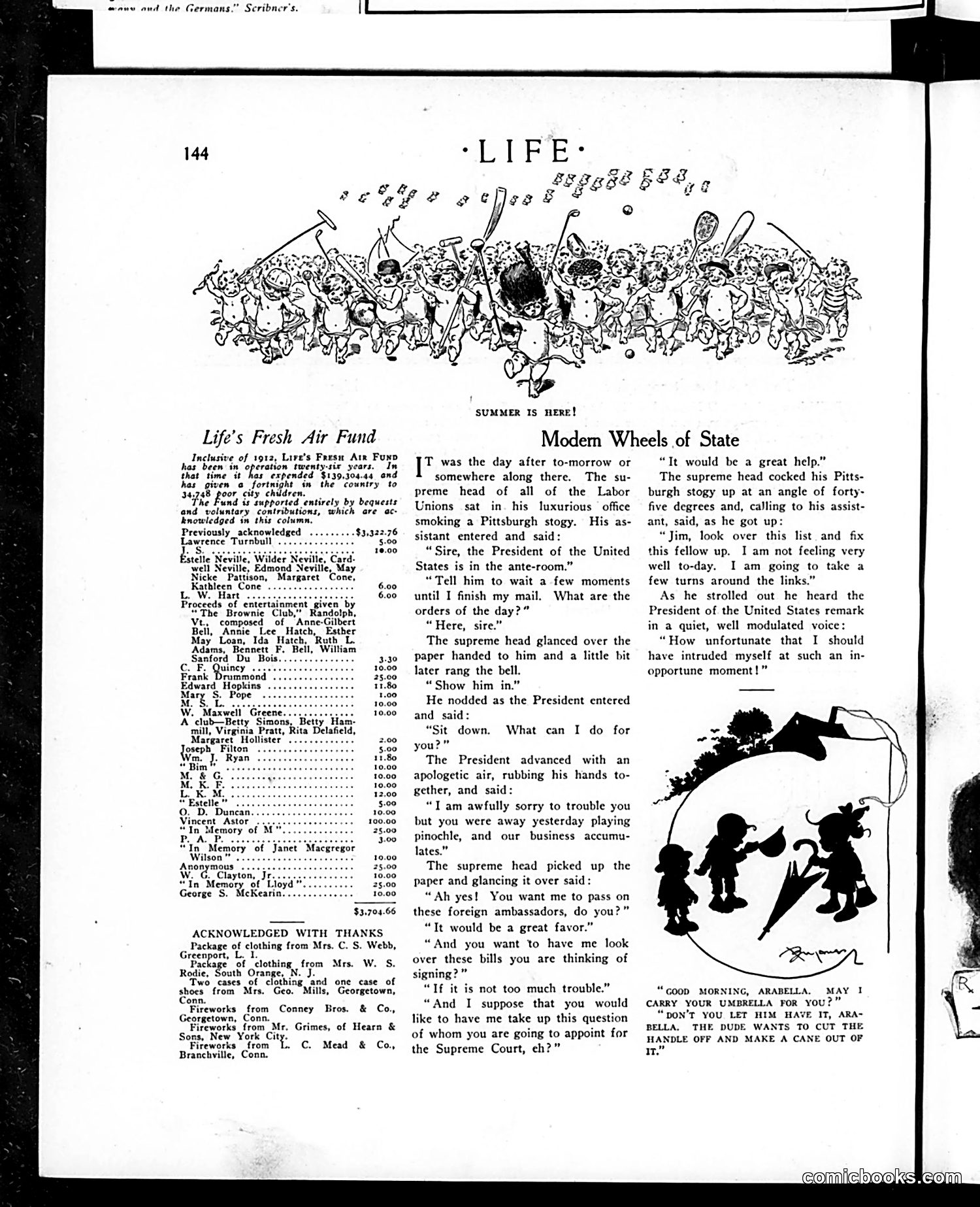
This page contains two sections: **Left side:** "Life's Fresh Air Fund" — a charitable fundraising list acknowledging donations to provide country air experiences for poor children, a common Progressive-era philanthropy. **Right side:** "Modern Wheels of State" — a satirical dialogue between the U.S. President and a supreme court head. The President asks the judge to review pending bills and appointments, but the judge demurs, saying the President intruded at an "inopportune moment" while he was away playing pinochle (a card game). The satire mocks judicial-executive relations and suggests the Supreme Court prioritizes leisure over governance. The silhouette illustration shows children at play, contrasting with the serious political discussion above. The overall tone criticizes government inefficiency and the court's reluctance to engage with presidential business.
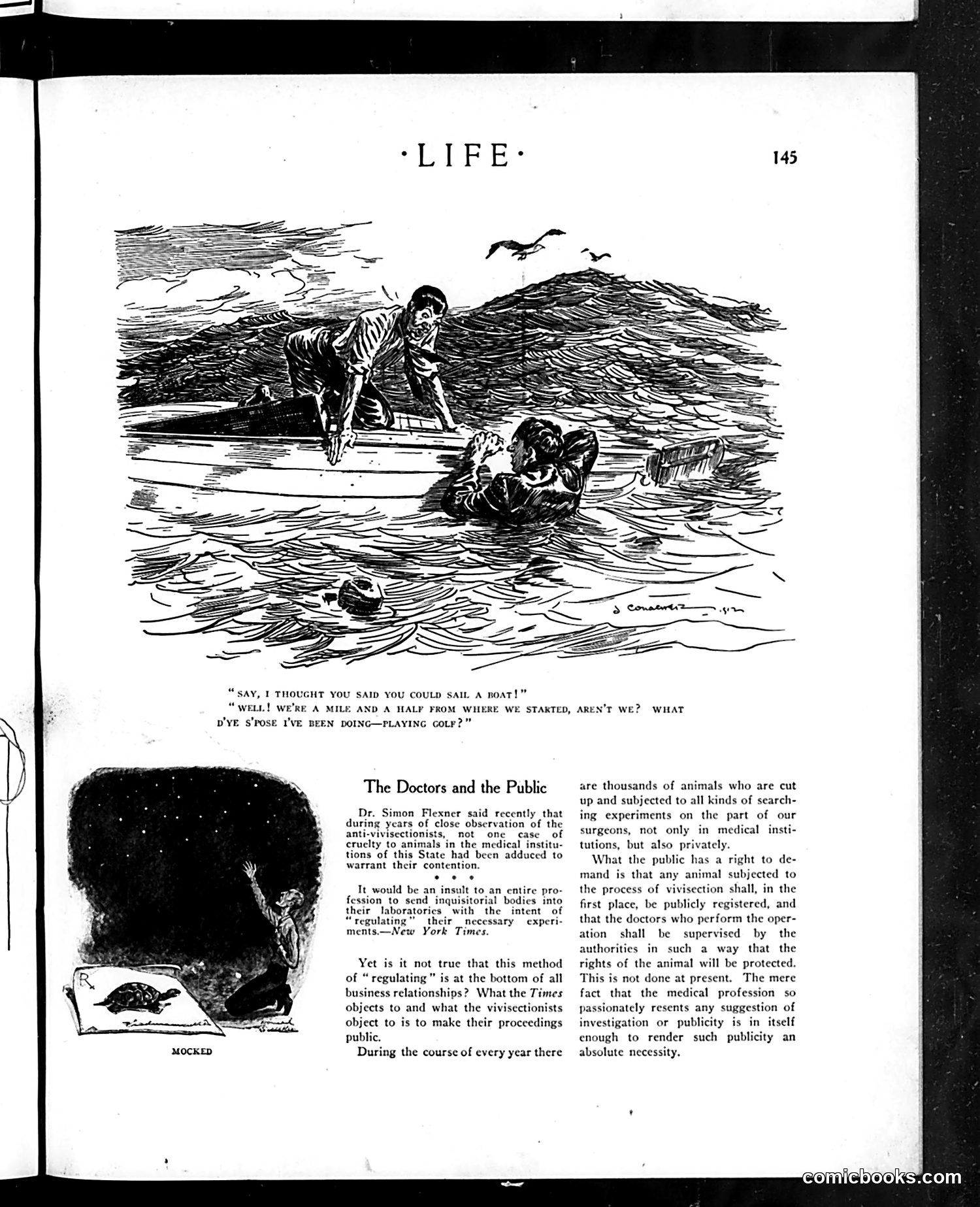
This page contains two distinct pieces: **Top Cartoon**: A humorous scene showing a man in a boat with two others in the water. The caption reveals the joke: one person claims they can sail a boat, but they're actually a mile offshore playing golf instead—a absurdist gag about incompetence or false claims. **"The Doctors and the Public" Article**: This satirical piece criticizes the medical profession's use of animals in vivisection experiments. Dr. Simon Flexner is cited as defending such practices. The accompanying illustration ("Mocked") shows a figure examining a dead animal, visually reinforcing the critique. The article argues that while animal testing occurs in medical institutions, the public demands transparency and regulatory oversight to protect animal welfare—a early 20th-century animal rights advocacy piece.
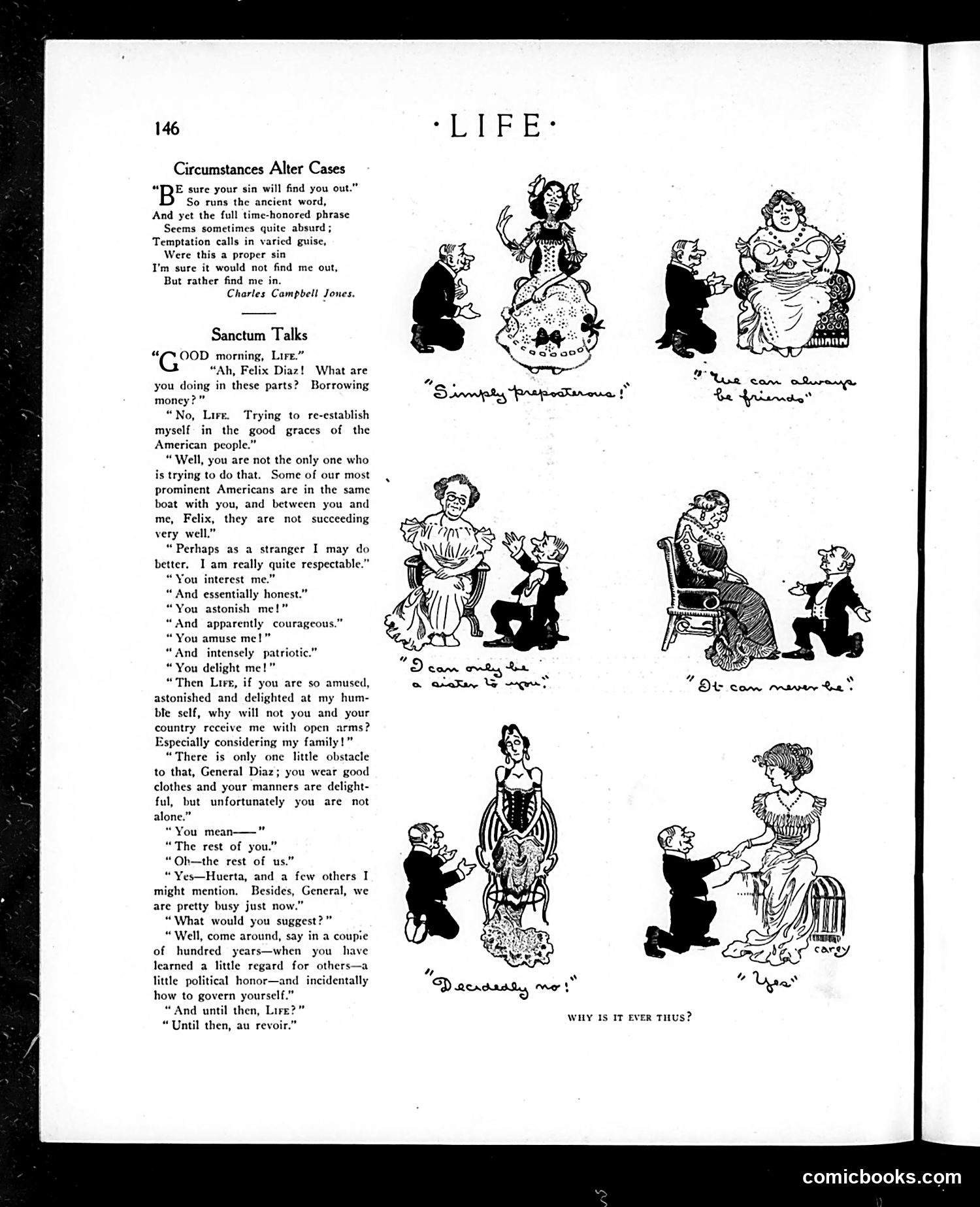
This page contains two sections satirizing American political and social attitudes of the early 20th century. **"Circumstances Alter Cases"** quotes Charles Campbell Jones to mock how principles shift conveniently with circumstance—the epigraph suggests temptation easily overrides stated virtue. **"Sanctum Talks"** features a dialogue where someone named Felix (likely General Félix Díaz, given the Spanish reference) seeks American support, claiming respectability and patriotic credentials. The satire targets American foreign policy: a character promises aid to this stranger while admitting prominent Americans similarly seek favors, yet warns Felix he faces obstacles including needing "good clothes and manners"—mocking how superficial requirements mask deeper prejudices. The final caption "WHY IS IT EVER THUS?" suggests chronic American hypocrisy regarding intervention and aid.
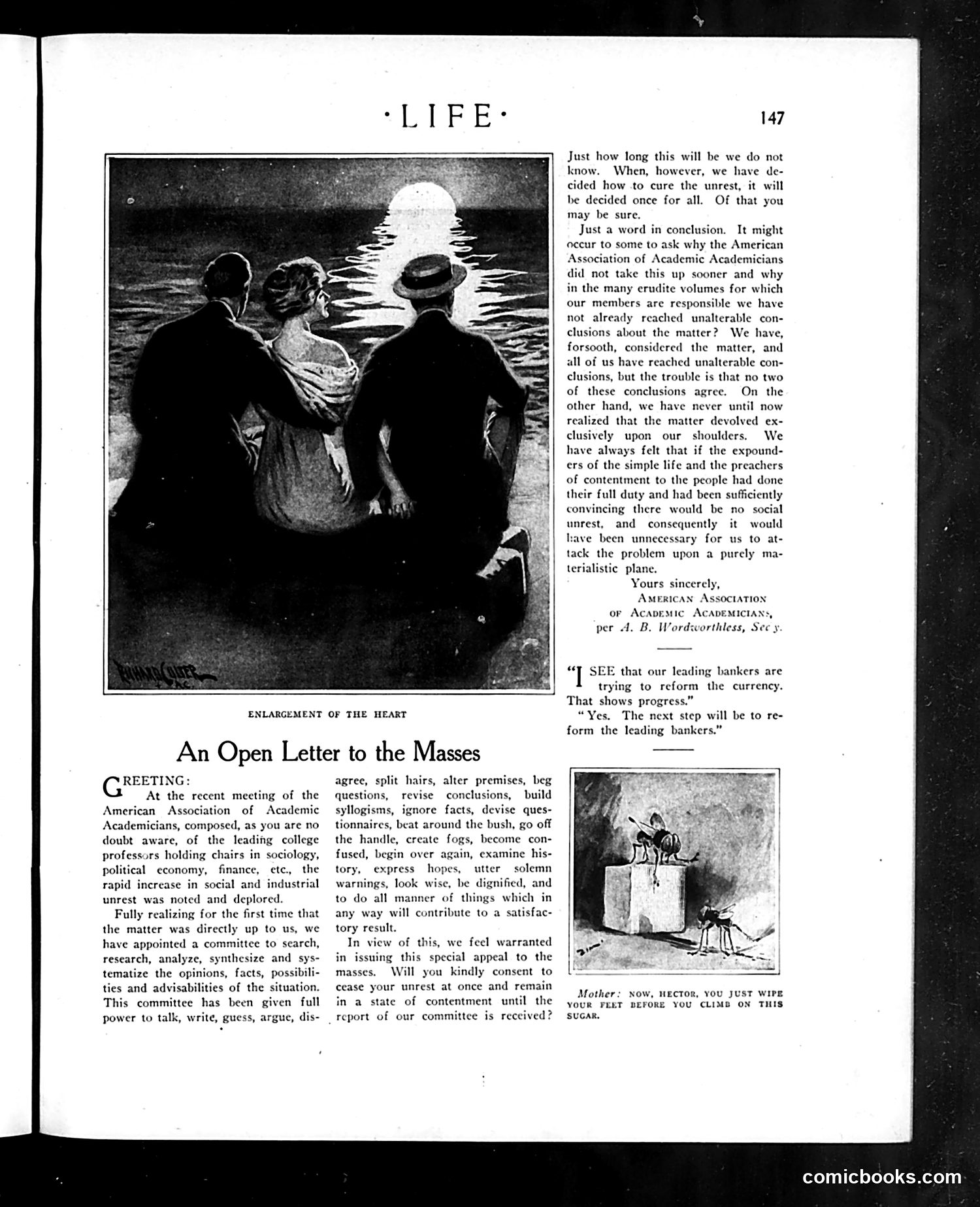
**Top Image ("Enlargement of the Heart"):** Shows three figures gazing at a moonlit seascape—a romantic scene. The caption's ironic title suggests emotional expansion or sentimentality. **Main Article ("An Open Letter to the Masses"):** The American Association of Academic Academicians addresses social unrest, claiming their committee has been studying the situation. They appeal to the public to remain calm while awaiting their report. The satire mocks academic institutions' perceived detachment and ineffectiveness during social crisis—positioning professors as well-intentioned but ultimately toothless observers offering platitudes rather than solutions. **Bottom Cartoon:** A brief domestic exchange where a mother reminds "Hector" to wipe his feet before entering, juxtaposing mundane domestic concerns against the larger social upheaval discussed above. The page satirizes institutional impotence amid turmoil.
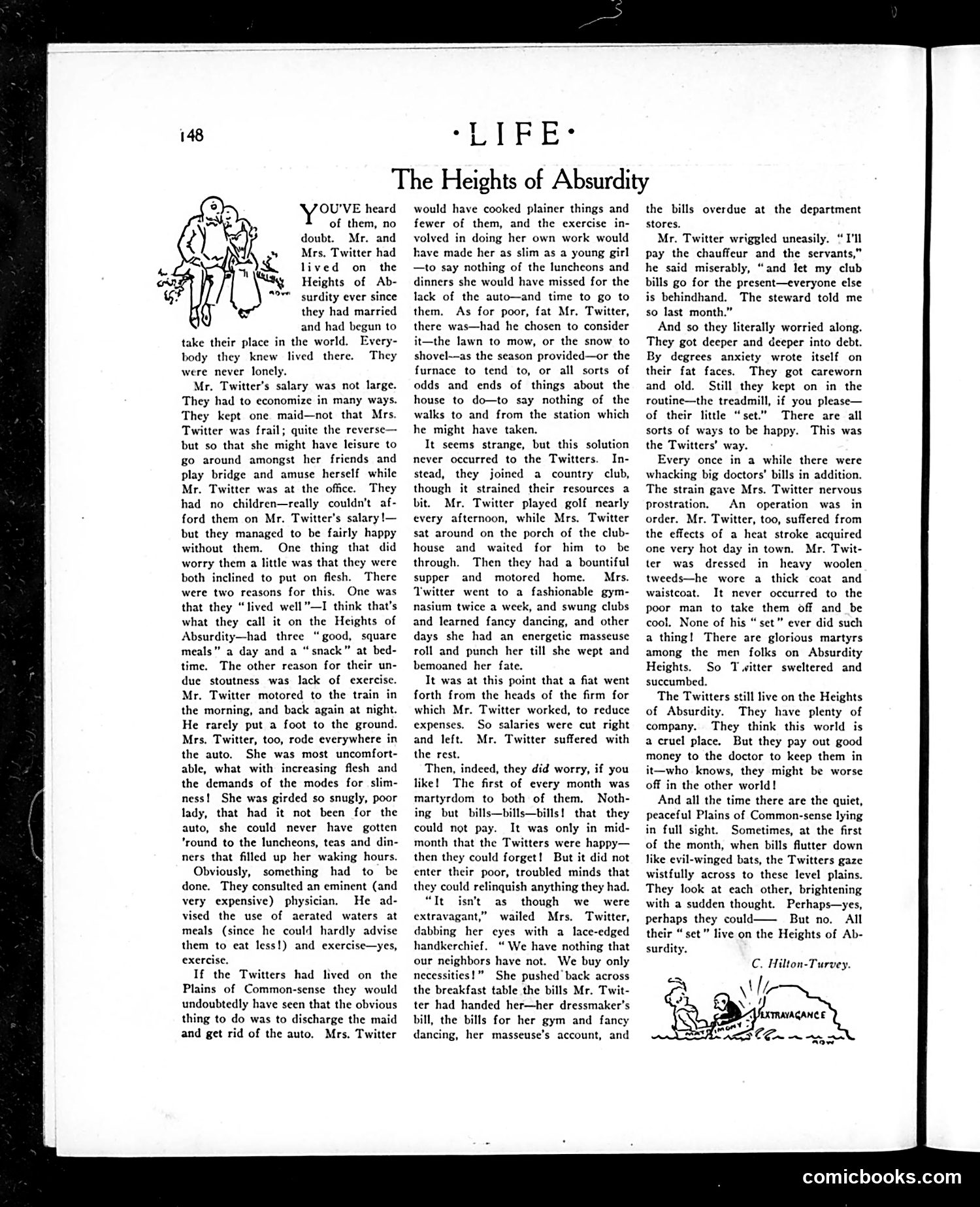
This satirical piece mocks upper-middle-class anxiety about finances and status. The Twitters, a couple living beyond their means, attempt various economy measures—eliminating servants, skipping lunches, Mrs. Twitter taking gym classes—yet their bills never shrink. They join a country club and pursue leisure activities, ironically worsening their financial troubles. The satire targets the absurdity of their situation: they're caught between maintaining appearances (country club membership, fancy dancing) and genuine poverty. The story suggests that their real problem isn't insufficient income but unwillingness to genuinely economize or abandon status-seeking behaviors. The "Heights of Absurdity" refers to their delusional attempts to solve financial crisis while refusing to change their lifestyle fundamentally.
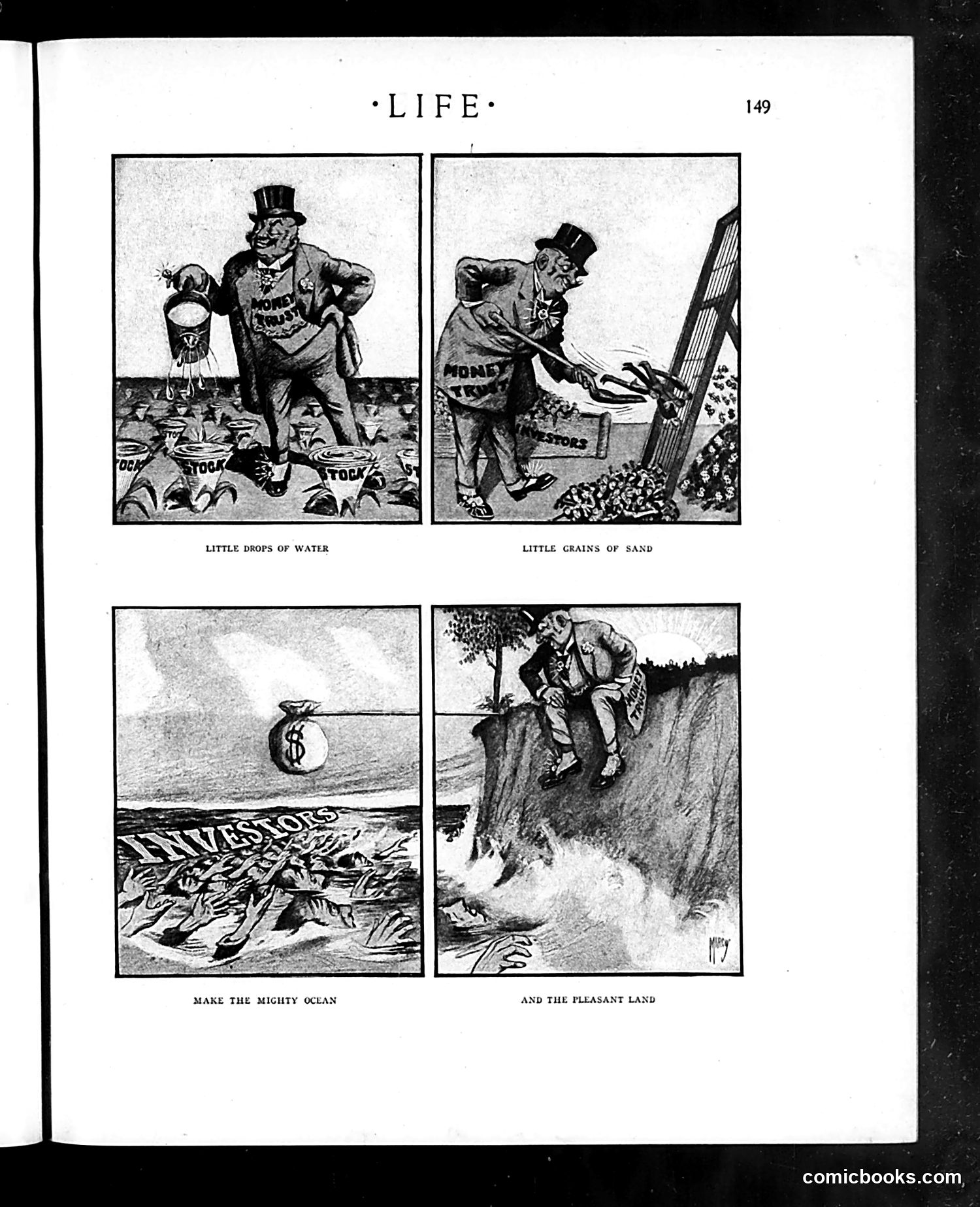
This four-panel satirical cartoon critiques wealthy investors and speculation. The top-left panel shows a portly capitalist figure hoarding water among labeled financial instruments ("STOCK"). The top-right depicts him scattering sand—suggesting worthless schemes or inflated assets. The bottom panels use natural metaphors: one shows money sinking into an ocean labeled "INVESTORS," implying lost fortunes. The final panel depicts a man perched precariously on a cliff above churning waters, titled "AND THE PLEASANT LAND." The overall message satirizes how wealthy speculators manipulate markets, causing ordinary investors to lose their investments while the powerful remain insulated. The "water" and "sand" reference the nursery rhyme about building castles—suggesting these financial schemes are fundamentally insubstantial and destined to fail.
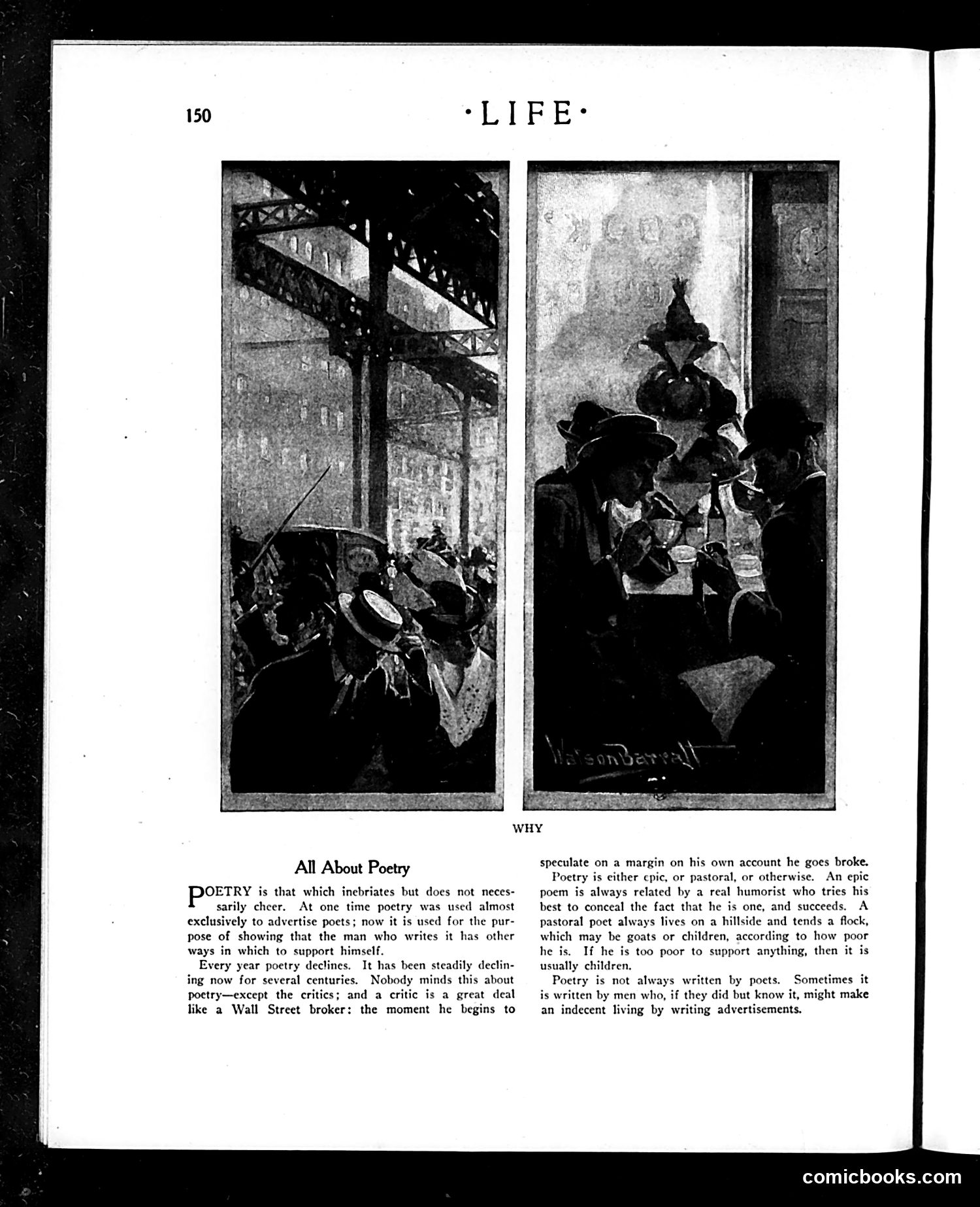
This page critiques the declining state of American poetry through text and paired illustrations. The article argues that poetry has become commercially degraded—poets now write advertisements rather than genuine verse to survive financially. The two photographs show contrasting scenes: the left depicts figures in what appears to be an industrial or urban setting (possibly referencing "working-class" poetry), while the right shows a more refined social gathering, suggesting poetry's traditional association with educated elites. The satire's point: poetry has lost its economic viability and cultural prestige. Modern readers would recognize this as an early commentary on how commercial pressures force artists to compromise their craft—a concern that remains relevant today regarding artistic integrity versus financial necessity.
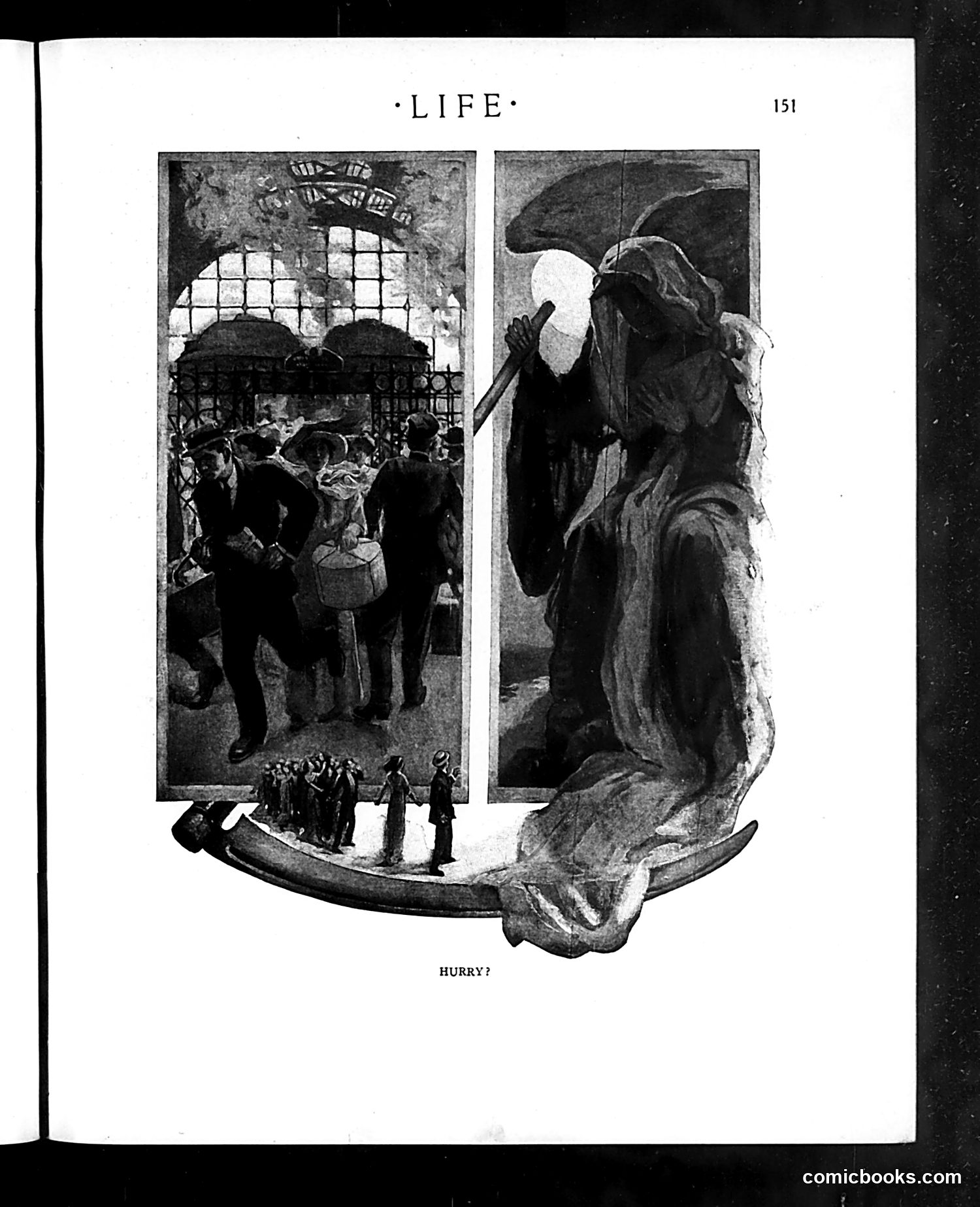
This satirical illustration appears from *Life* magazine (page 151) and depicts a grim reaper figure looming over two contrasting scenes. On the left, a crowded indoor gathering shows numerous people in formal dress in what appears to be an institution or public building. On the right, the skeletal Death figure holds an hourglass, with small figures below awaiting. The cartoon's title "HURRY?" suggests ironic commentary on human urgency and mortality. The juxtaposition implies that despite people's frantic daily activities and social gatherings, death waits inevitably. This reflects *Life* magazine's characteristic satirical approach to social commentary—mocking the futility of human preoccupation with trivial concerns while mortality looms. The specific context (date, institution referenced) remains unclear from the image alone, but the memento mori theme was a recurring satirical device in early 20th-century American humor publications.
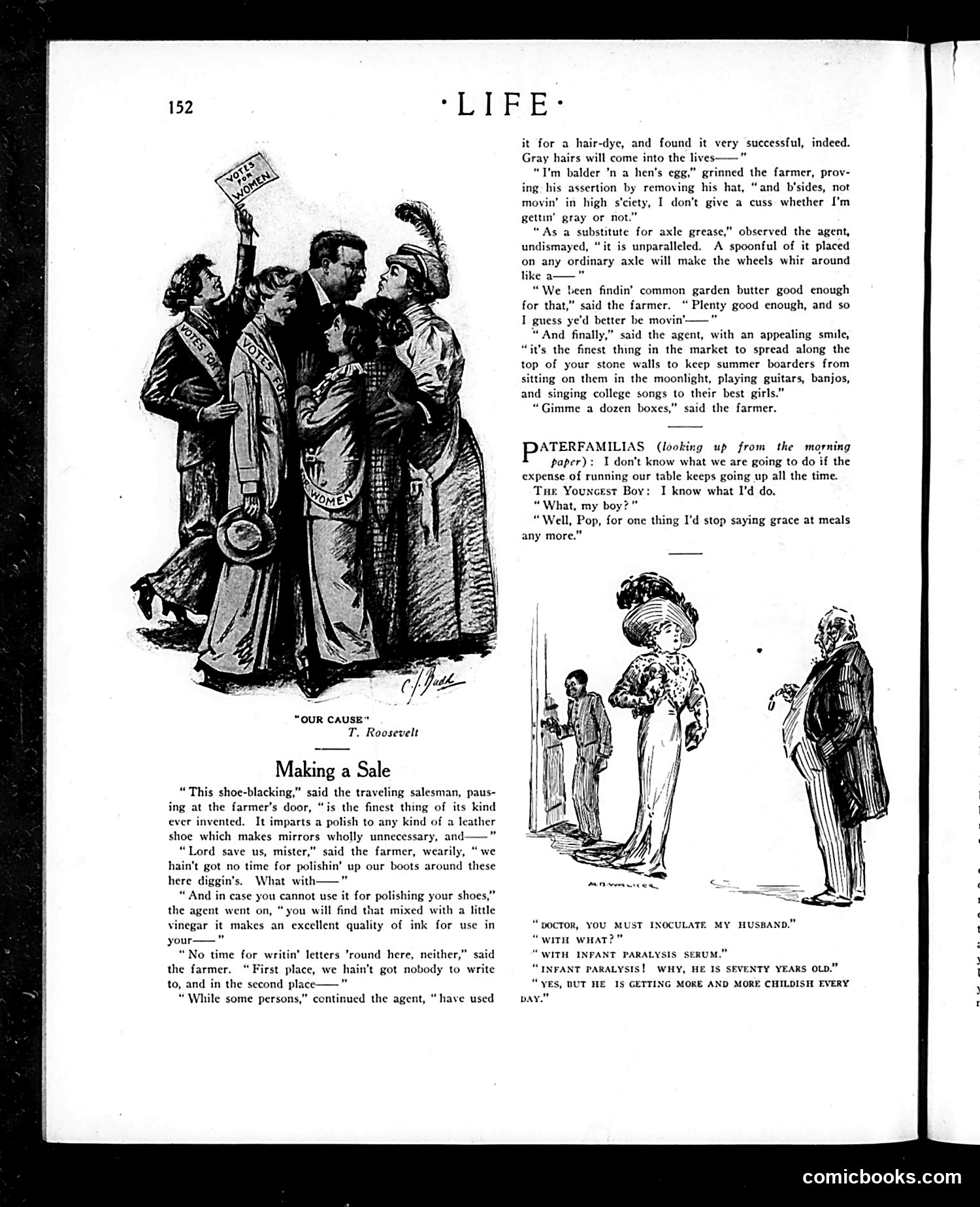
**"Our Cause" (T. Roosevelt cartoon):** The top illustration depicts a traveling salesman pitching a miraculous shoe-blacking product to a skeptical farmer. The satire mocks over-aggressive salesmanship and dubious multi-purpose products—the agent frantically lists uses (shoe polish, ink, hair dye, axle grease, pest deterrent) to overcome every objection. The farmer only relents when told it keeps summer boarders from serenading on stone walls, a rural complaint. This satirizes turn-of-century advertising hype and the gullibility it exploits. **"Paterfamilias" and "Doctor" sections:** Two brief humor pieces. The first jokes about household expenses and grace-saying; the second presents a wife wanting her childish husband inoculated against "infant paralysis"—a dark medical humor bit playing on actual disease concerns of the era while mocking marital dynamics. The overall page reflects Life's satirical style: commentary on commercialism, rural-urban divides, and family absurdities through exaggerated dialogue and caricature.
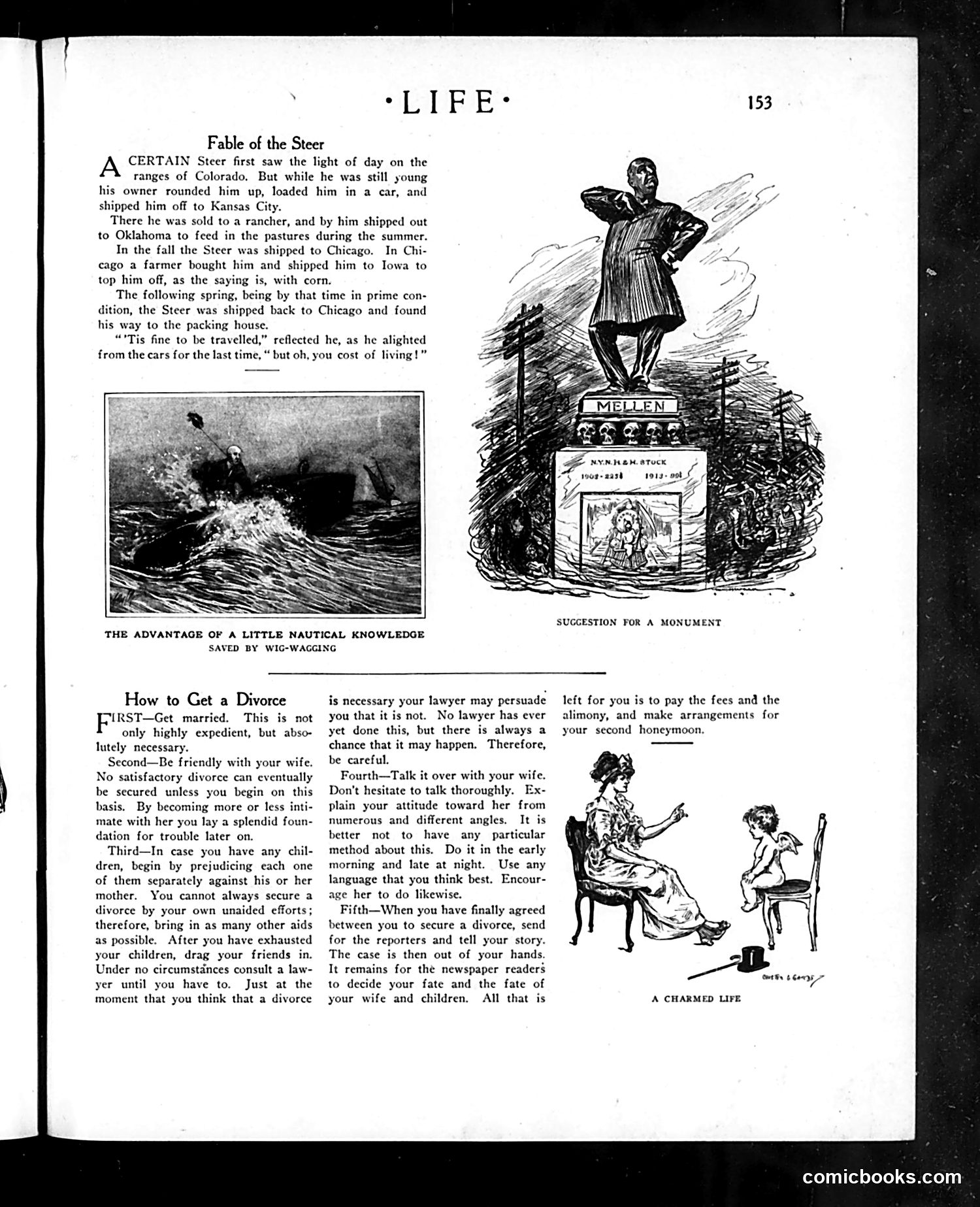
This page contains three satirical pieces mocking American life circa 1910s: **"Fable of the Steer"** satirizes capitalist inefficiency and the "cost of living." A steer is repeatedly shipped between Colorado, Kansas, Oklahoma, Chicago, and Iowa—accumulating transportation costs—before ending at a packing house. The joke: all this pointless traveling represents wasteful economic systems that ultimately benefit no one, with the steer's bitter reflection on "cost of living" serving as dark humor about consumer exploitation. **"How to Get a Divorce"** is sardonic advice mocking divorce proceedings. It recommends marrying first (obviously), then systematically alienating your spouse and children, involving friends, avoiding lawyers' rational counsel, and publicly airing grievances to newspapers—making the process deliberately destructive. The satire targets how adversarial and publicly spectacled divorce had become, where newspapers sensationalized personal tragedy. The other illustrations appear to be unrelated filler cartoons about nautical knowledge and domestic life, typical of satirical magazine layouts.
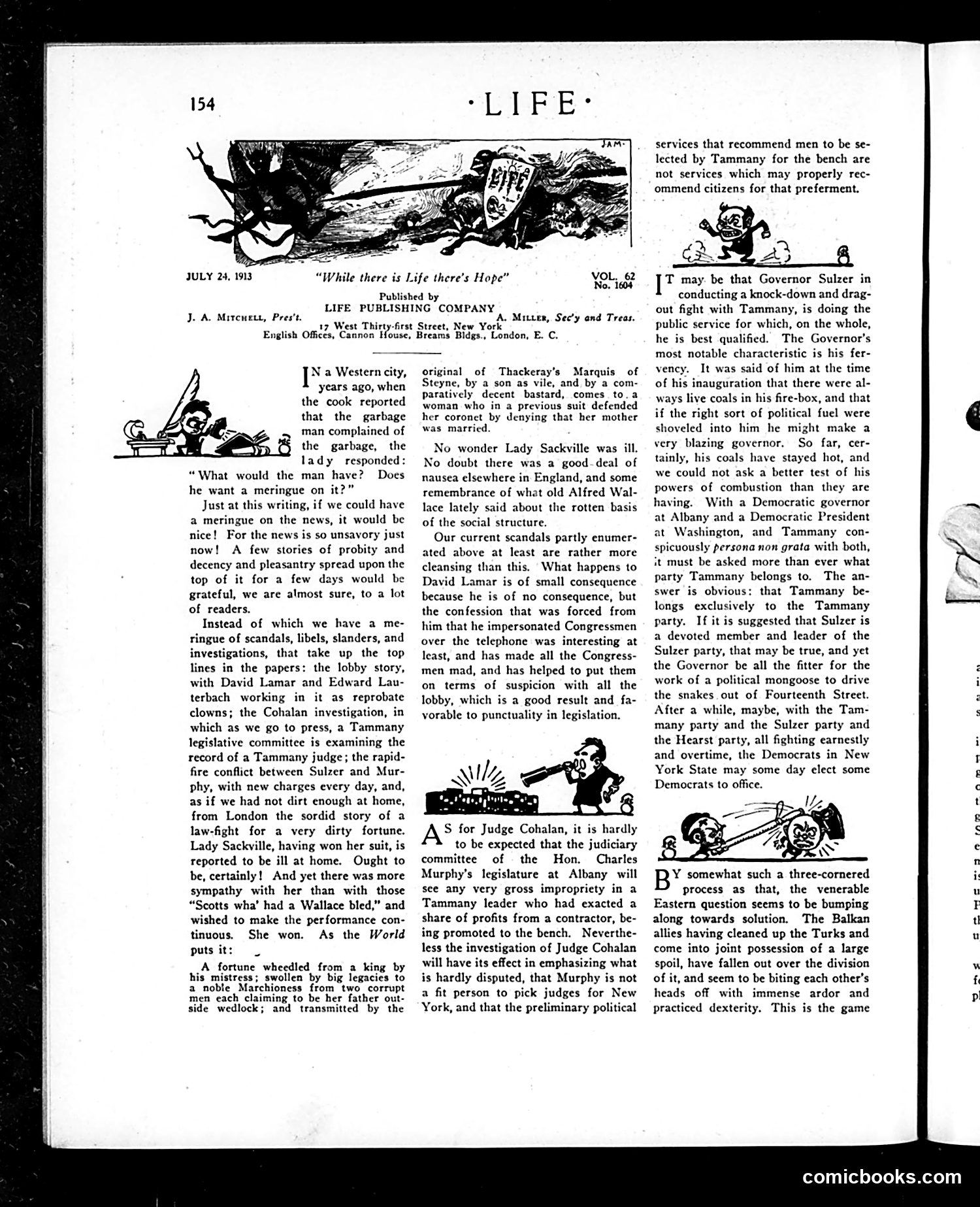
This page satirizes New York's corrupt political scandals of 1913. The editor complains that current news is so "unsavory" it needs a "meringue" (frosting) of pleasant stories on top. The scandals discussed include: 1. **The Lamar-Lauterbach lobby scandal**: David Lamar impersonated Congressmen over the telephone—a genuine crime exposing legislative corruption. 2. **Judge Cohalan investigation**: A Tammany Hall judge allegedly accepted bribes from contractors. The text criticizes Charles Murphy's Tammany organization for promoting unqualified judges based on political loyalty rather than merit. 3. **Governor Sulzer vs. Tammany**: The editor suggests Governor Sulzer, though characterized by excessive "fervency," may be doing public service by fighting Tammany's control. The cartoons (appearing as small illustrations) likely mock these political figures, though specific captions are unclear in this reproduction. The overall message: New York politics is thoroughly corrupt, with Tammany Hall controlling judicial appointments through patronage rather than qualification.
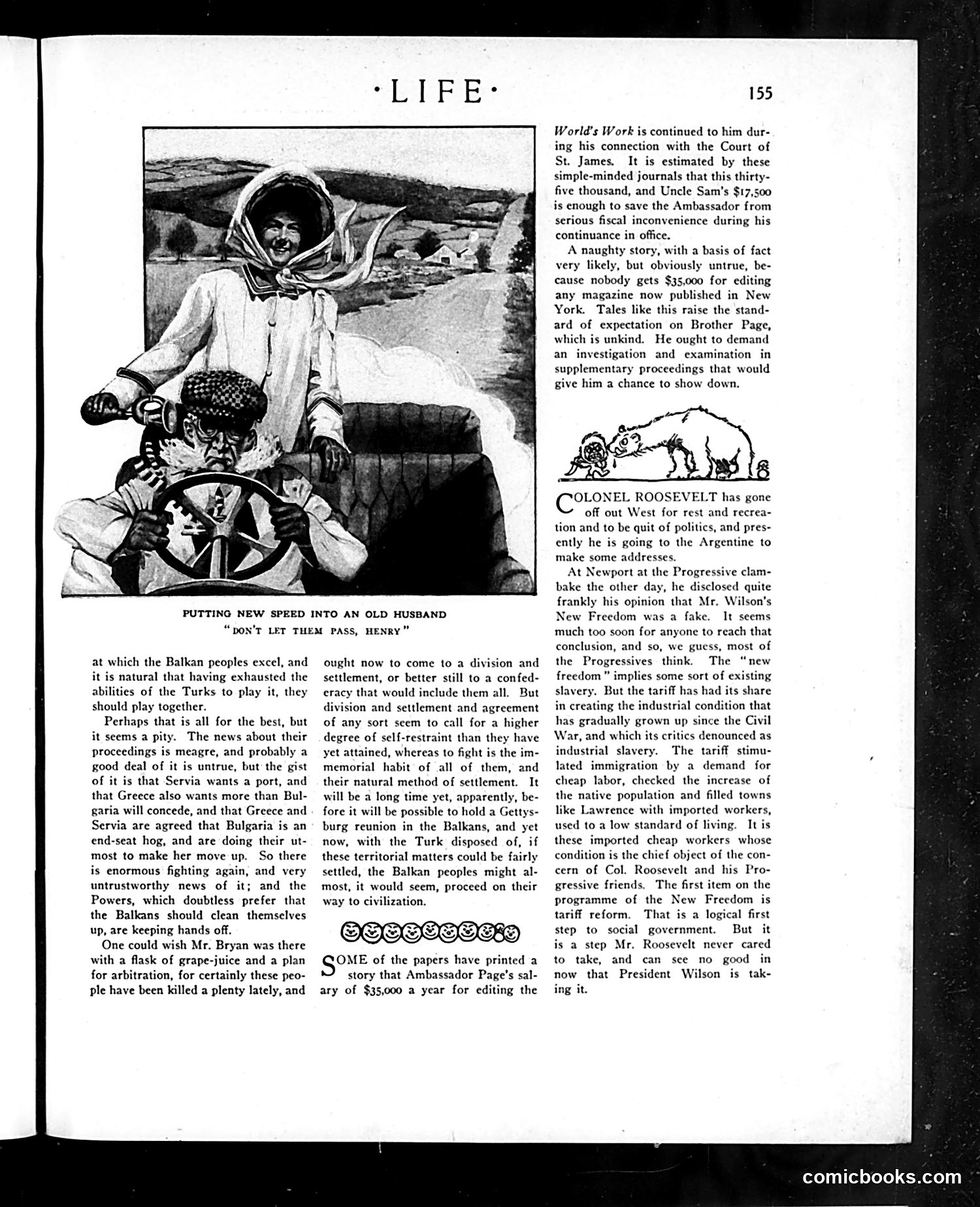
## Main Cartoon: "Putting New Speed Into an Old Husband" The illustration shows a woman (driver) urging on a tired, older man (Henry) at an automobile's wheel with the command "Don't let them pass." This is domestic satire about marital competitiveness and aging—the joke being that the wife is spurring her sluggish husband to prove his virility and speed by racing other vehicles. ## Text Commentary The page contains three separate commentary sections: 1. **Balkan Conflict**: Discussion of territorial disputes between Serbia, Greece, and Bulgaria post-Turkish withdrawal, with skepticism about their capacity for peaceful settlement. 2. **Ambassador Page**: Satirical treatment of rumors that diplomat Walter Page receives $35,000 annually from *World's Work* magazine *plus* his $17,500 government salary—the writer dismissively notes this is absurdly high pay for magazine editing. 3. **Colonel Roosevelt's Critique**: Former President Theodore Roosevelt, now campaigning for the Progressive Party, criticized President Wilson's "New Freedom" as fake. The writer argues Roosevelt's hypocrisy: his own tariff policies had created the industrial slavery conditions he now claims to oppose.
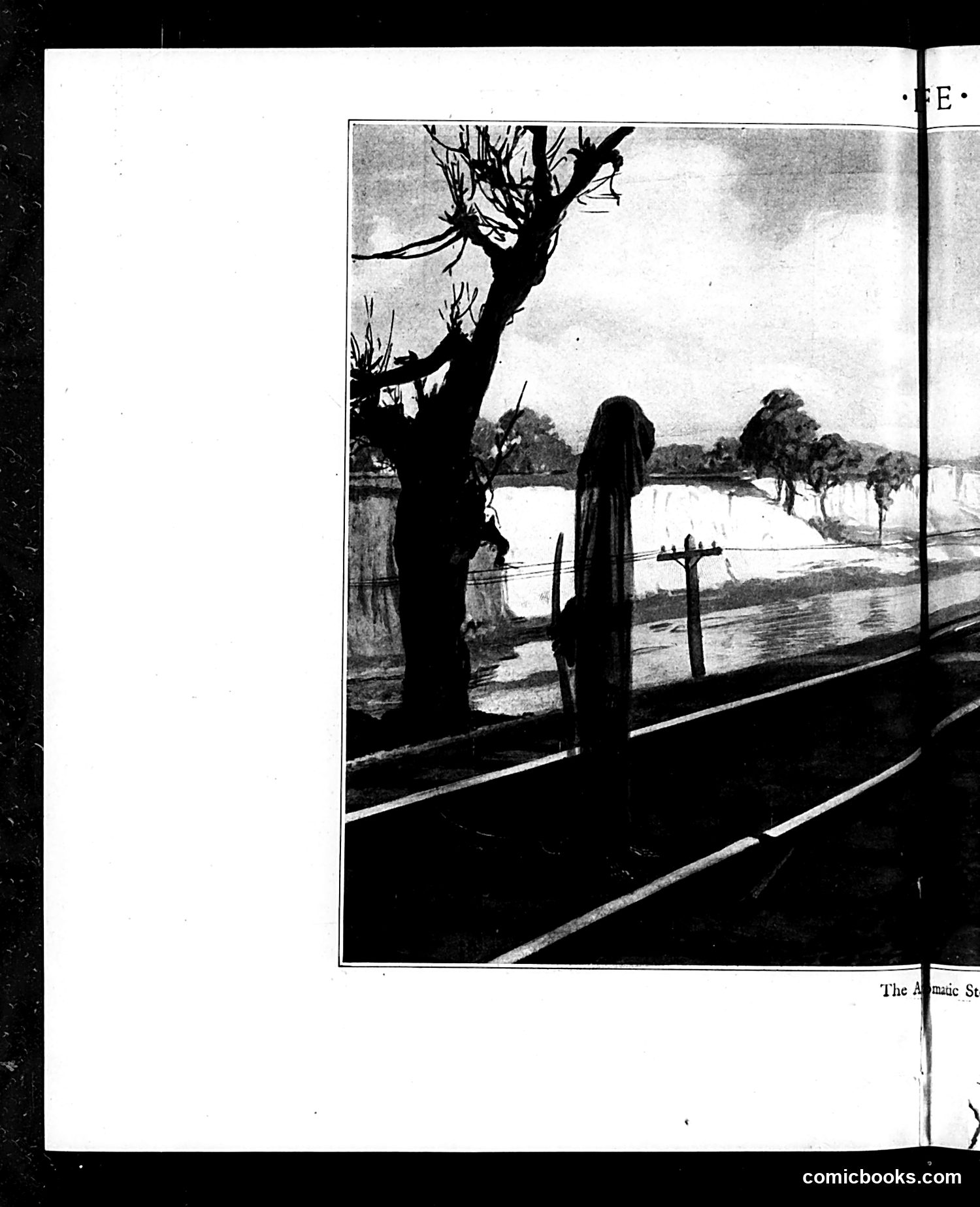
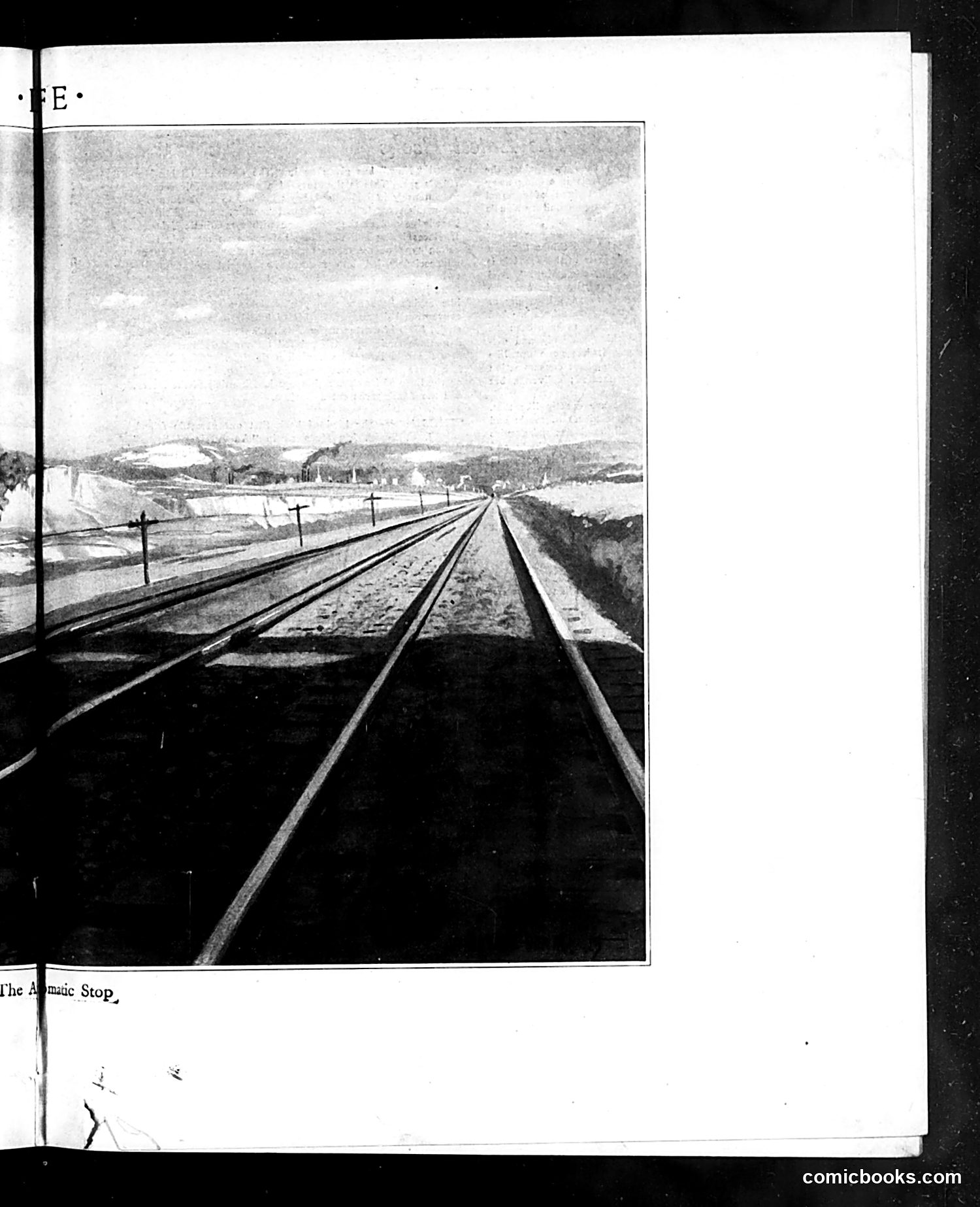
This page features a photograph rather than a cartoon—a black and white image taken from a train or railcar, showing railroad tracks stretching toward the horizon through rural/agricultural landscape, with utility poles visible alongside. The caption reads "The Apmatic Stop," though the text is partially unclear. This appears to be satirical commentary on automated or mechanical railway systems, possibly referencing early 20th-century transportation innovations. The perspective from the train itself—showing the tracks converging toward a vanishing point—emphasizes the mechanical nature of rail travel. Without additional context about what "Apmatic" specifically references (possibly a brand name or portmanteau), the exact satirical target remains unclear, though it likely comments on industrialization or transportation progress.
This page contains literary criticism rather than political cartoons. The reviewer uses an extended metaphor—comparing disappointing books to a "disappearing sneeze"—to critique novels that build dramatic tension but fail to deliver meaningful conclusions. The critic discusses Charles Marriott's *The Catfish*, praising its psychological depth and character study but faulting its conventional ending as unsatisfying and rushed. Similarly, J.C. Snaith's *An Affair of State* is reviewed as an interesting premise about a future political crisis that apparently doesn't follow through on its promise. The "Confidential Book Guide" section lists other contemporary works. The satire here is literary—mocking authors who construct compelling narratives then abandon their own established themes with lazy or formulaic endings, leaving readers intellectually and emotionally unfulfilled.
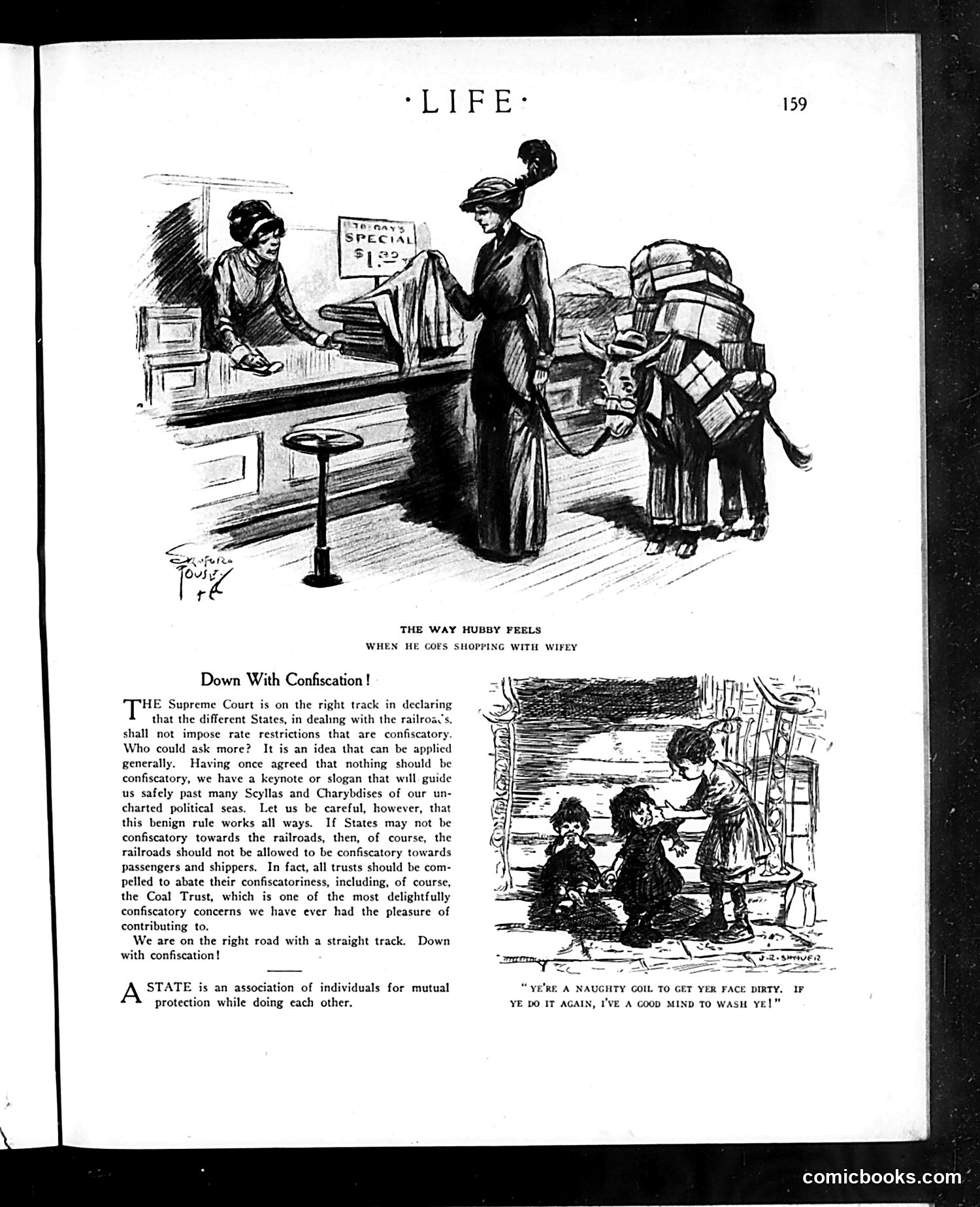
**Top cartoon:** A husband laden with shopping packages trails behind his wife at a store counter. The caption "The Way Hubby Feels When He Goes Shopping With Wifey" humorously depicts domestic life—the husband appearing burdened and resigned, a relatable joke about shopping expeditions. **Main article:** "Down With Confiscation!" responds to a Supreme Court ruling protecting railroads from state rate-fixing deemed "confiscatory" (unjustly seizing profits). The author argues this anti-confiscation principle should apply universally: if states can't confiscate from railroads, railroads shouldn't confiscate from passengers through unfair rates, and monopolies like the Coal Trust shouldn't exploit consumers. **Bottom cartoon:** A mother threatens to wash a dirty child's face, joking about parental discipline through threat of cleanliness—another domestic humor piece. The page satirizes corporate power and trust monopolies while advocating for consumer protection through consistent legal principles.
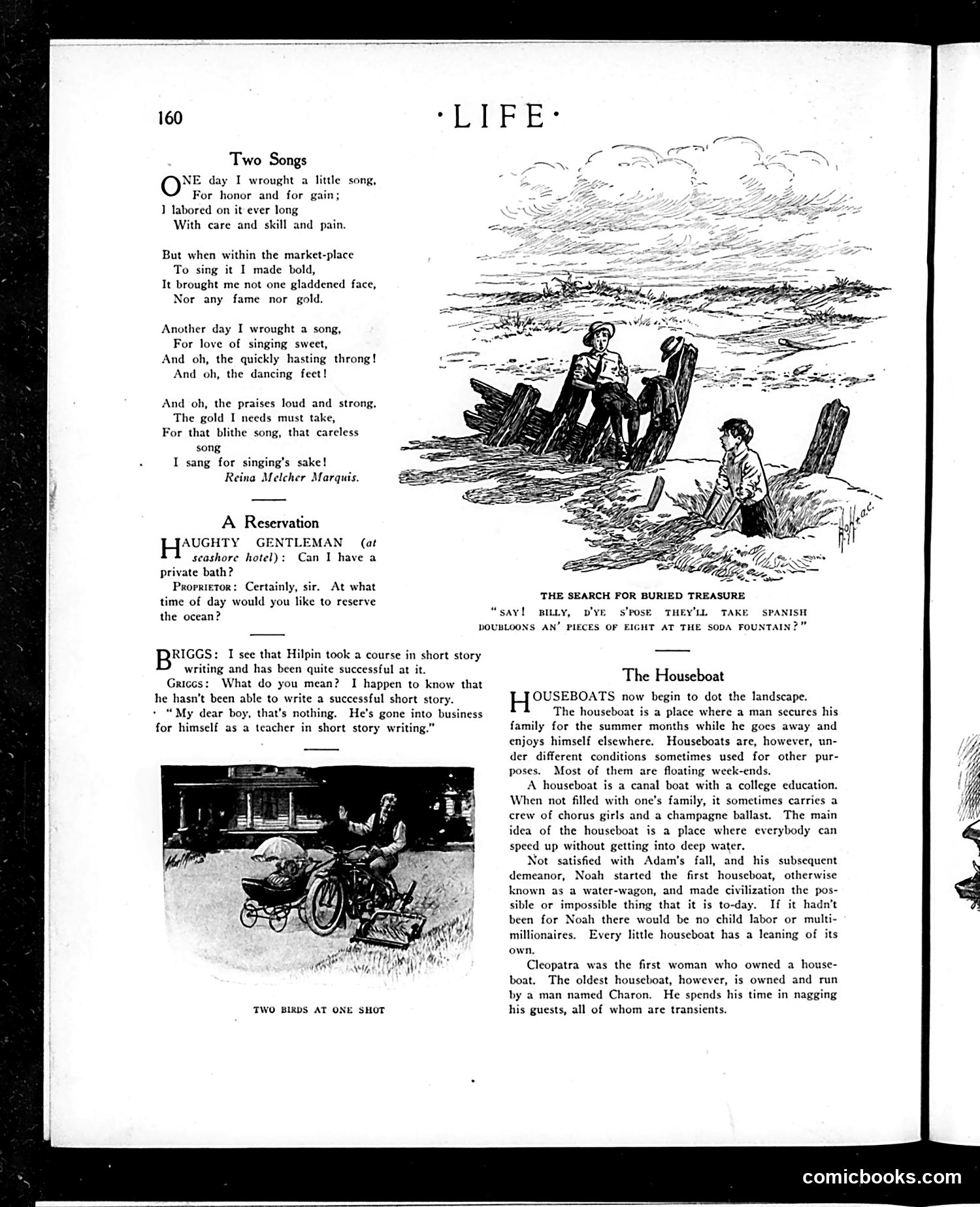
This page contains several satirical pieces mocking contemporary American attitudes: **"Two Songs"** contrasts commercialism with authenticity—a carefully crafted song for profit fails, while a carelessly sung song for pure joy succeeds and earns money anyway. The irony: genuine art outsells calculated work. **"A Reservation"** jokes about wealthy beachgoers' entitlement. A snobbish hotel guest demands a private bath; the proprietor sarcastically suggests he "reserve" the ocean—implying the guest's presumption is absurd. **"The Houseboat"** section satirizes the leisure-class trend of houseboat ownership. It mocks the contradiction that houseboats serve as summer retreats where men escape their families while claiming family purposes. References to "chorus girls," "champagne," and "water-wagon" suggest dissolute behavior. The mythological references (Noah, Charon) add wit—comparing houseboats to both civilization's origins and the mythological ferryman of the dead. Overall, the page ridicules American consumerism, class pretension, and moral hypocrisy regarding leisure and family.
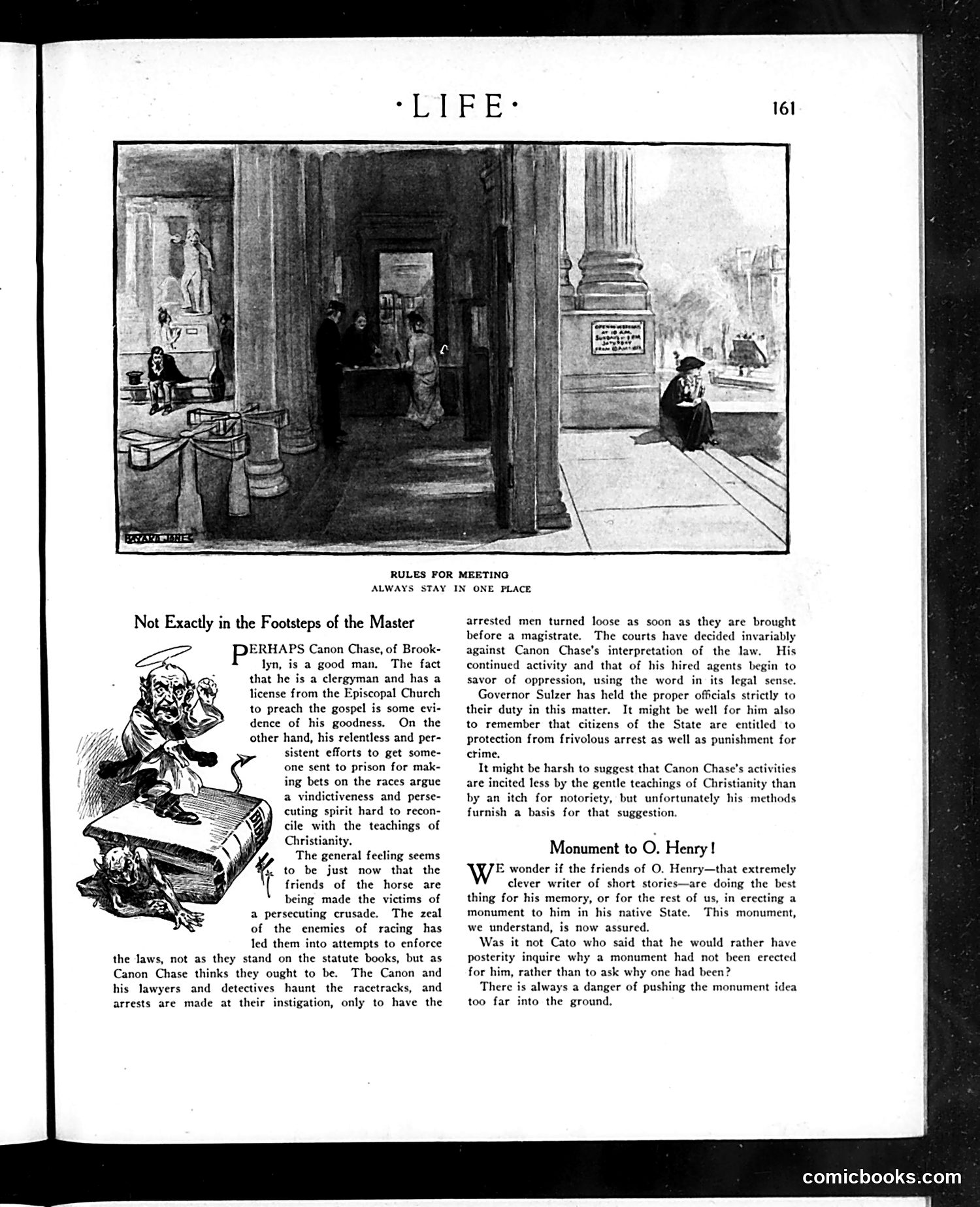
This page contains two separate satirical commentaries: **"Not Exactly in the Footsteps of the Master"** targets Canon Chase, an Episcopal clergyman from Brooklyn who aggressively prosecuted horse-racing bettors. The satire criticizes his relentless crusade as contrary to Christian charity—he hauls suspected gamblers before magistrates, but courts consistently rule against him. Life argues his vindictive "persecuting crusade" suggests personal notoriety-seeking rather than genuine moral conviction, and that Governor Sulzer should protect citizens from his frivolous arrests. **"Monument to O. Henry!"** questions whether erecting a public monument to the deceased short-story writer serves his memory well. The piece references Cato's maxim that it's better people wonder *why* no monument exists than to question why one does—suggesting over-monumentalizing risks diminishing rather than enhancing legacy. Both pieces mock excess zeal masquerading as moral purpose.
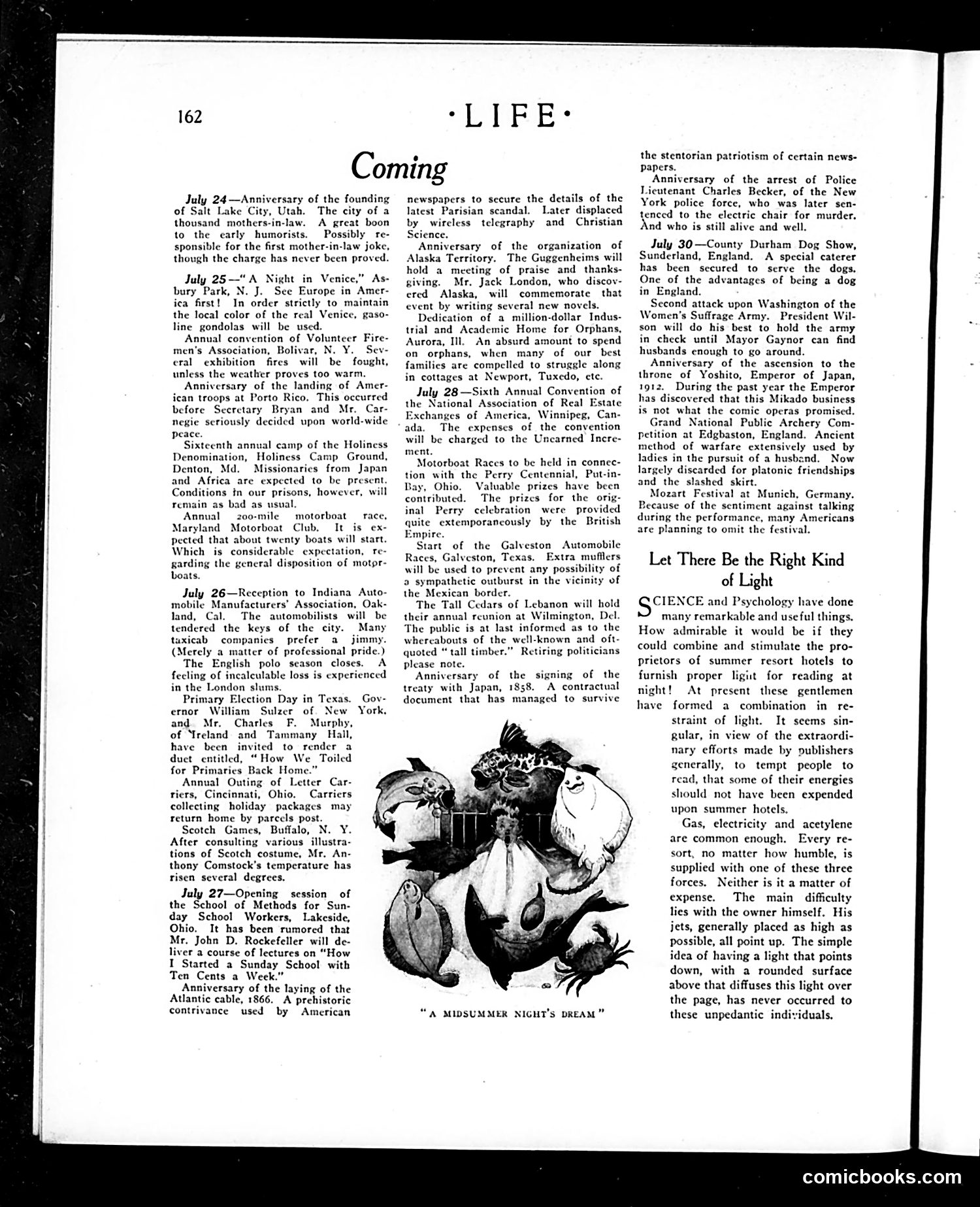
The cartoon depicts what appears to be a grotesque figure—possibly a caricature of a bloated industrialist or politician—sleeping or dreaming. The style is typical of early 20th-century satirical illustration. Without clearer identifying marks or accompanying caption text beyond the Shakespeare reference, the specific target is difficult to determine with certainty. However, given *Life* magazine's consistent satire of wealthy industrialists, political machines, and social hypocrites, this likely represents a wealthy figure whose "dreams" mock their self-importance or reveal their true nature. The "Midsummer Night's Dream" title suggests the cartoon is satirizing someone's delusions of grandeur or exposing the gap between their public image and private reality—a common satirical device in early 20th-century American humor.
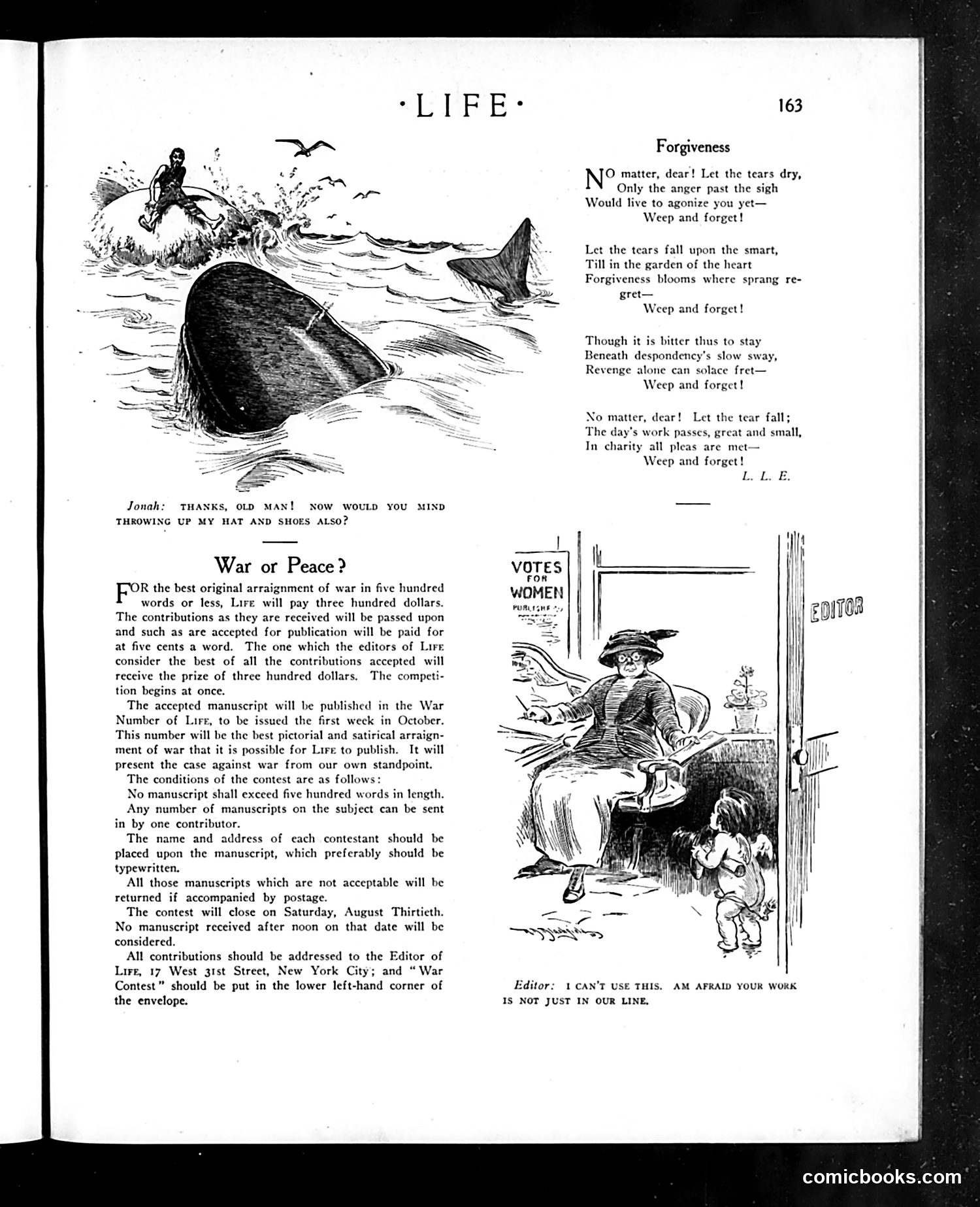
**Top Cartoon:** A biblical reference showing Jonah being expelled from the whale, asking the creature to also regurgitate his hat and shoes. This is a humorous visual pun on the famous Old Testament story, playing on the absurdity of such a request. **Main Content:** Life is announcing a writing contest offering $300 for the best essay (under 500 words) arguing *against* war. The contest emphasizes this will appear in a special "War Number" designed as an anti-war issue—a significant editorial stance for a satirical magazine during what appears to be the World War I era. **Bottom Cartoon:** An editor rejects a manuscript from a hopeful writer, saying the work "is not just in our line"—a common rejection excuse. This mocks the publishing world's gatekeeping. **Poem:** "Forgiveness" advocates letting go of anger and seeking reconciliation rather than revenge—likely reflecting broader post-war sentiment about healing from conflict.
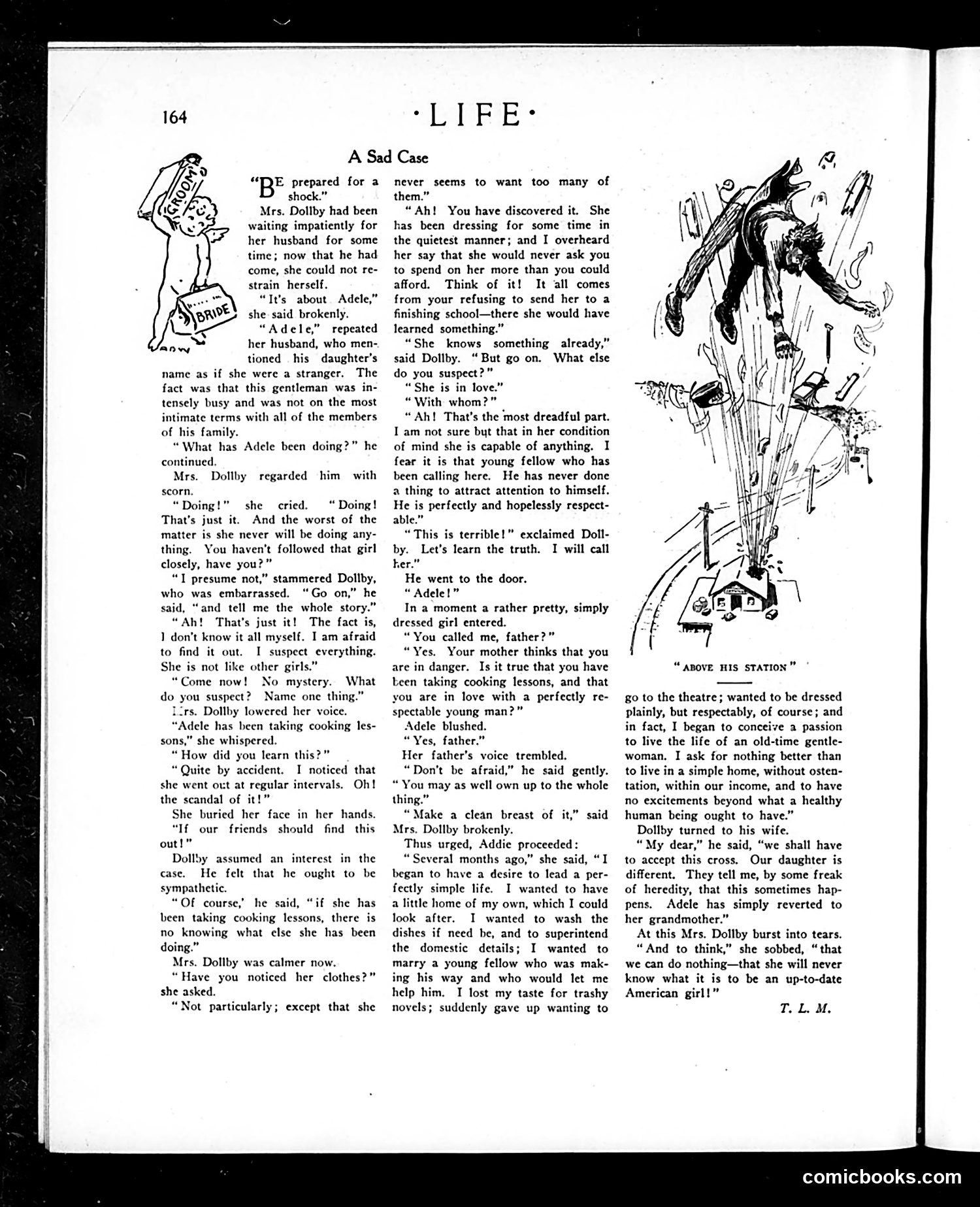
This story satirizes early-20th-century upper-middle-class anxieties about daughters rejecting consumer excess and idle leisure. **The joke:** Mrs. Dollby is scandalized that her daughter Adele has taken cooking lessons, dresses modestly, avoids the theater, and—most damning—has fallen in love with a "respectable" working man she wishes to help support. These signs of self-sufficiency and domestic virtue horrify the mother, who sees them as dangerous departures from proper genteel behavior. **The satire targets:** Parents obsessed with conspicuous consumption and social status; the expectation that daughters remain decorative, dependent consumers rather than capable partners; the snobbish dismissal of respectable but modest suitors. **The cartoon's point:** Adele's "crimes" (thrift, domesticity, meaningful work, love) are actually virtues. The satire mocks the parents' inverted values—their horror at what society should celebrate reveals how absurd status-obsessed materialism has become.
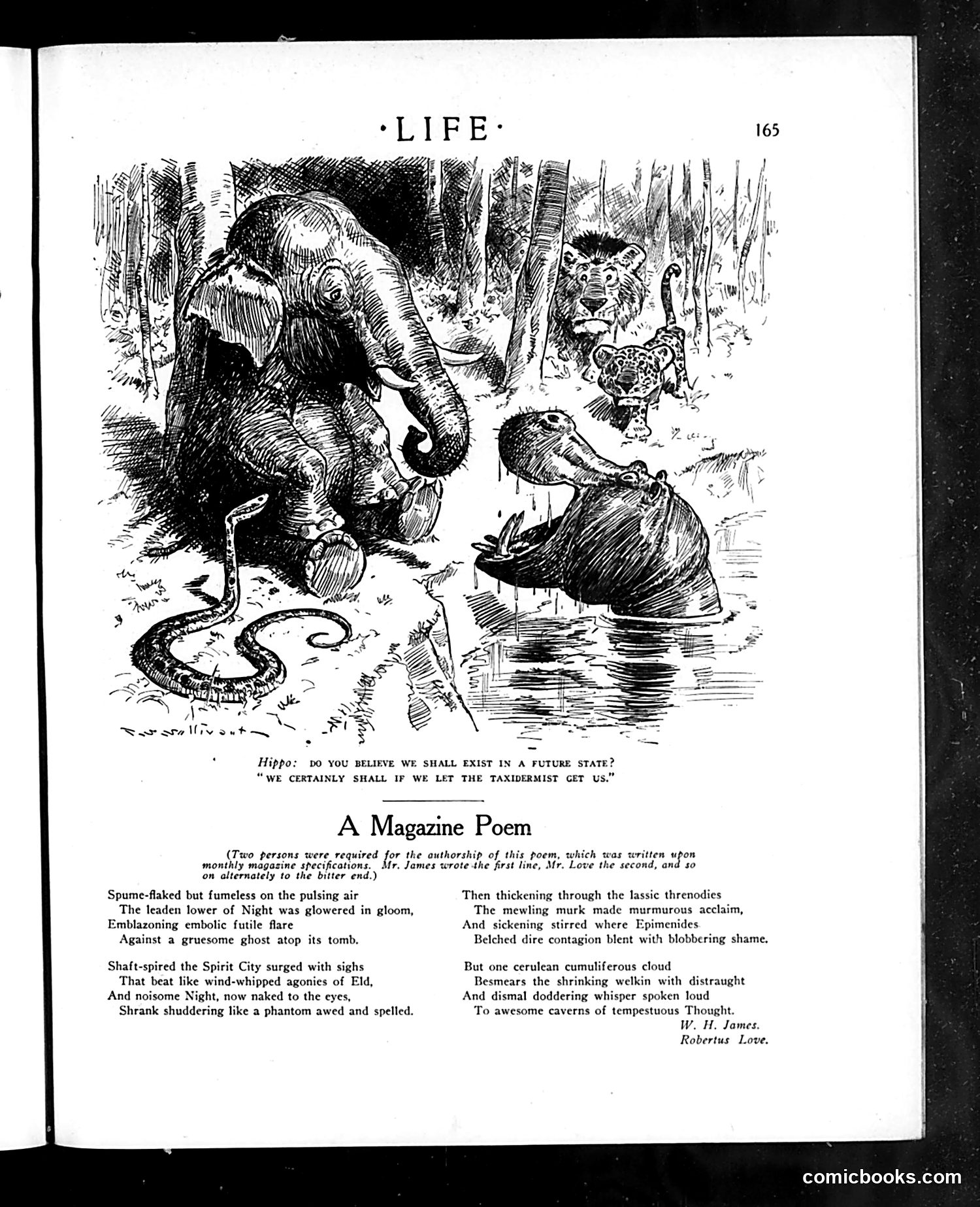
The page contains two satirical elements: **The Cartoon:** A hippopotamus and rhinoceros discuss taxidermy. The hippo worries about existence in an afterlife; the rhino quips they'll certainly exist if taxidermists stuff them—a dark joke about being preserved as museum specimens rather than achieving spiritual immortality. **The Poem:** A collaborative parody of overwrought, pretentious poetry. The credited authors (W.H. James and Robertus Love, likely pseudonyms) alternated writing lines following "monthly magazine specifications," producing intentionally purple, nonsensical verse filled with obscure words ("cerulean cumuliferous," "Epimenides," "lassic threnodies"). The satire targets both magazine editors who impose rigid formulas on creative work and the literary pretension of the era—mocking flowery, meaning-empty verse that prioritizes ornate language over sense. It's satirizing bad poetry and editorial constraints simultaneously.
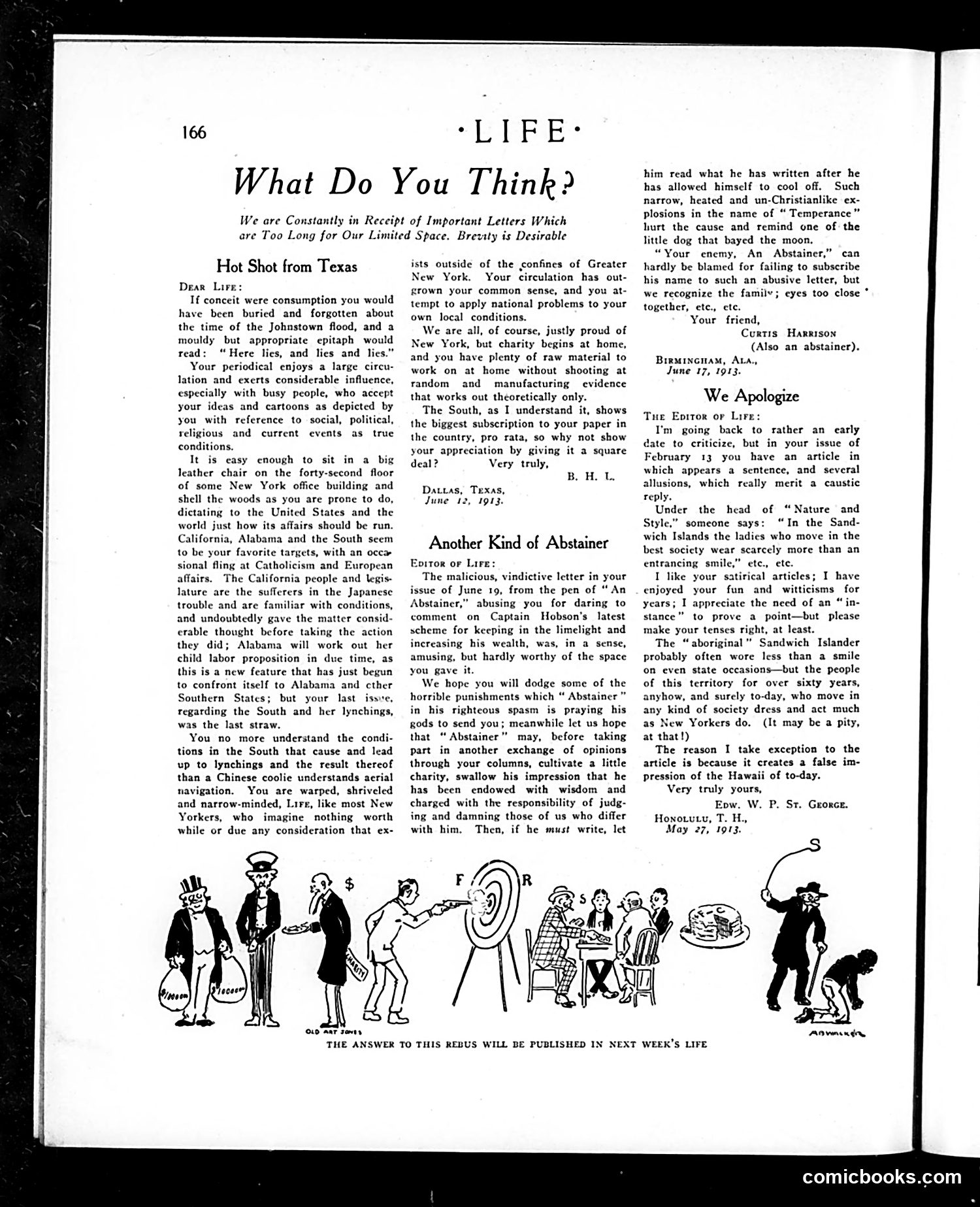
This page presents reader letters responding to Life's editorial positions. A Texas reader attacks Life's New York-based criticism of Southern issues—particularly lynching and child labor in Alabama—arguing the magazine lacks understanding of regional conditions and shouldn't "shoot at random" from Manhattan offices. The writer resents Life's perceived Northern superiority and reminds them the South provides significant readership. A second letter defends Life against an angry "Abstainer" who criticized their coverage of Captain Hobson (a temperance advocate and public figure). The responder sarcastically suggests the angry writer cool off before publishing such "un-Christianlike" tirades. The cartoon below shows various targets/recipients of criticism, suggesting Life's satirical range of social commentary. **Key context**: This reflects early-20th-century regional tensions between progressive Northern media (represented by Life) and defensive Southern sensibilities over social criticism—particularly regarding racial violence and labor practices.
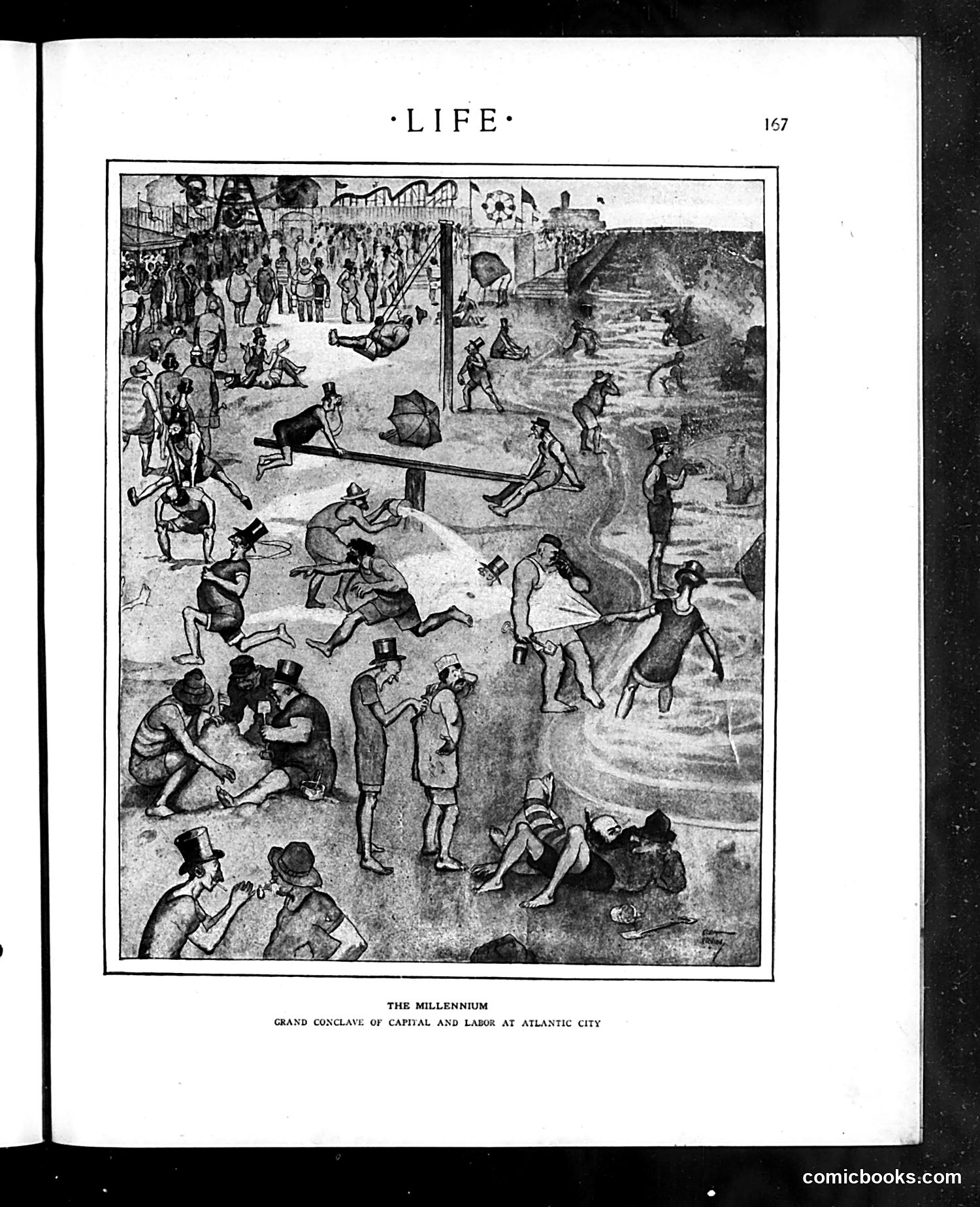
This satirical illustration depicts a chaotic beach scene at Atlantic City titled "Grand Conclave of Capital and Labor," mocking the idea of harmonious cooperation between business interests and workers. The cartoon shows wealthy figures (identifiable by top hats) mingling with working-class people in various recreational activities—swimming, games, socializing. The "millennium" reference sarcastically suggests an imagined future of perfect peace between these traditionally opposing economic classes. The satire lies in portraying such harmony as absurdly fantastical. The crowded, disorderly beach scene ironically undermines any suggestion of actual accord. Life magazine is clearly skeptical that capital and labor could ever genuinely cooperate, presenting their supposed "conclave" as ridiculous fantasy rather than realistic possibility. The scene captures early-20th-century class tensions and labor movement anxieties.
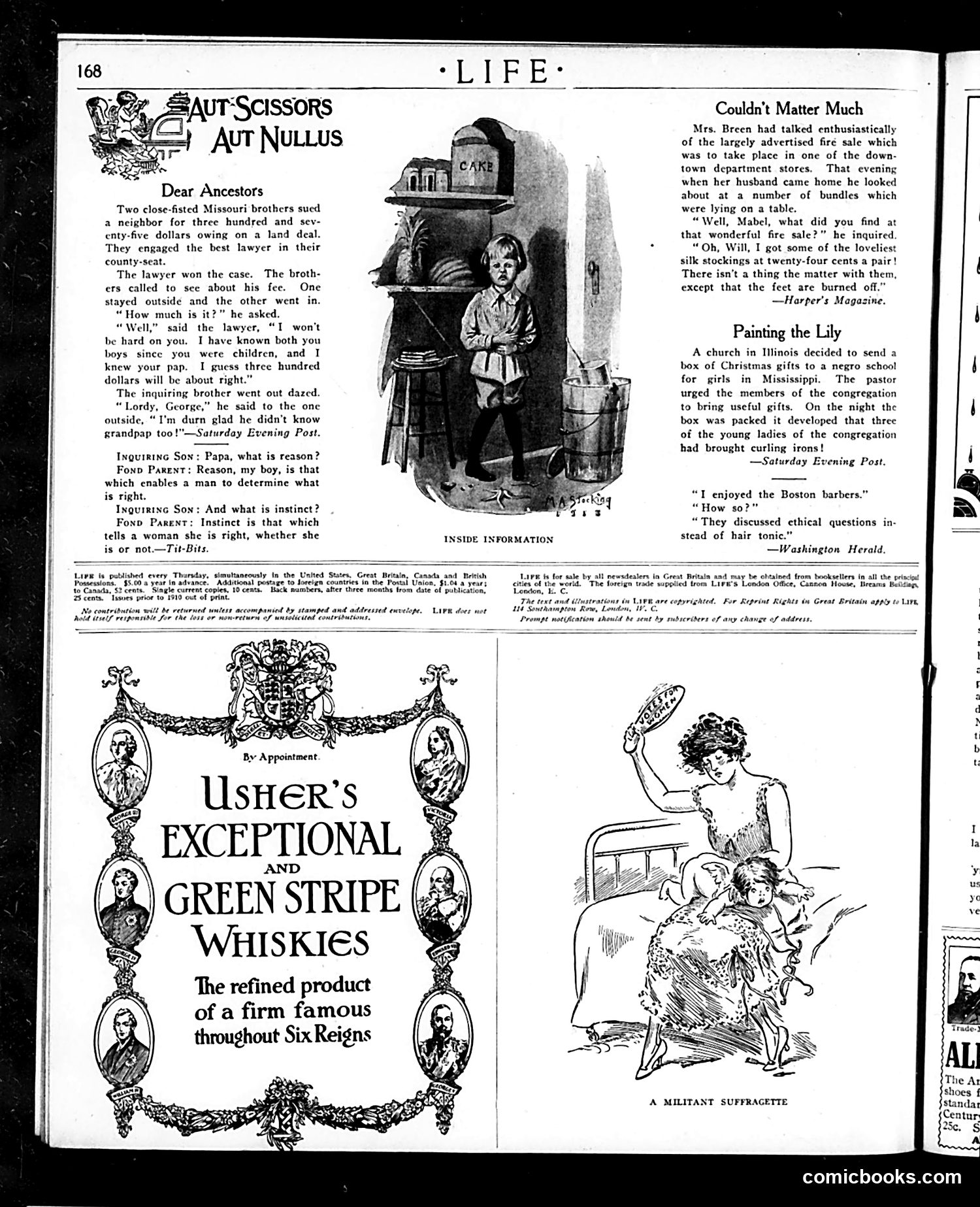
This page contains multiple brief humorous pieces typical of Life's satirical format: **"Dear Ancestors"** mocks penny-pinching behavior through a story about two miserly Missouri brothers who sued over a small debt, then balked at paying their lawyer's reasonable fee—suggesting inherited stinginess. **"Couldn't Matter Much"** jokes about a wife's bargain-hunting at a fire sale, where she proudly purchased stockings at discount despite their feet being burned, suggesting women's illogical shopping priorities. **"Painting the Lily"** satirizes well-intentioned but patronizing charity—a church congregation donating Christmas gifts to a Black school in Mississippi, then embarrassingly discovering three young women had already packed curling irons, revealing unexamined prejudices about appearance standards. The **"Inquiring Son" pieces** present gender stereotypes: men use reason to determine right action; women rely on instinct to assume they're always correct. **"A Militant Suffragette"** (illustration) depicts a woman using a tennis racket as a weapon against a man—contemporary satire of the women's suffrage movement, portraying suffragettes as aggressive rather than principled. The whiskey advertisement anchors the page commercially.
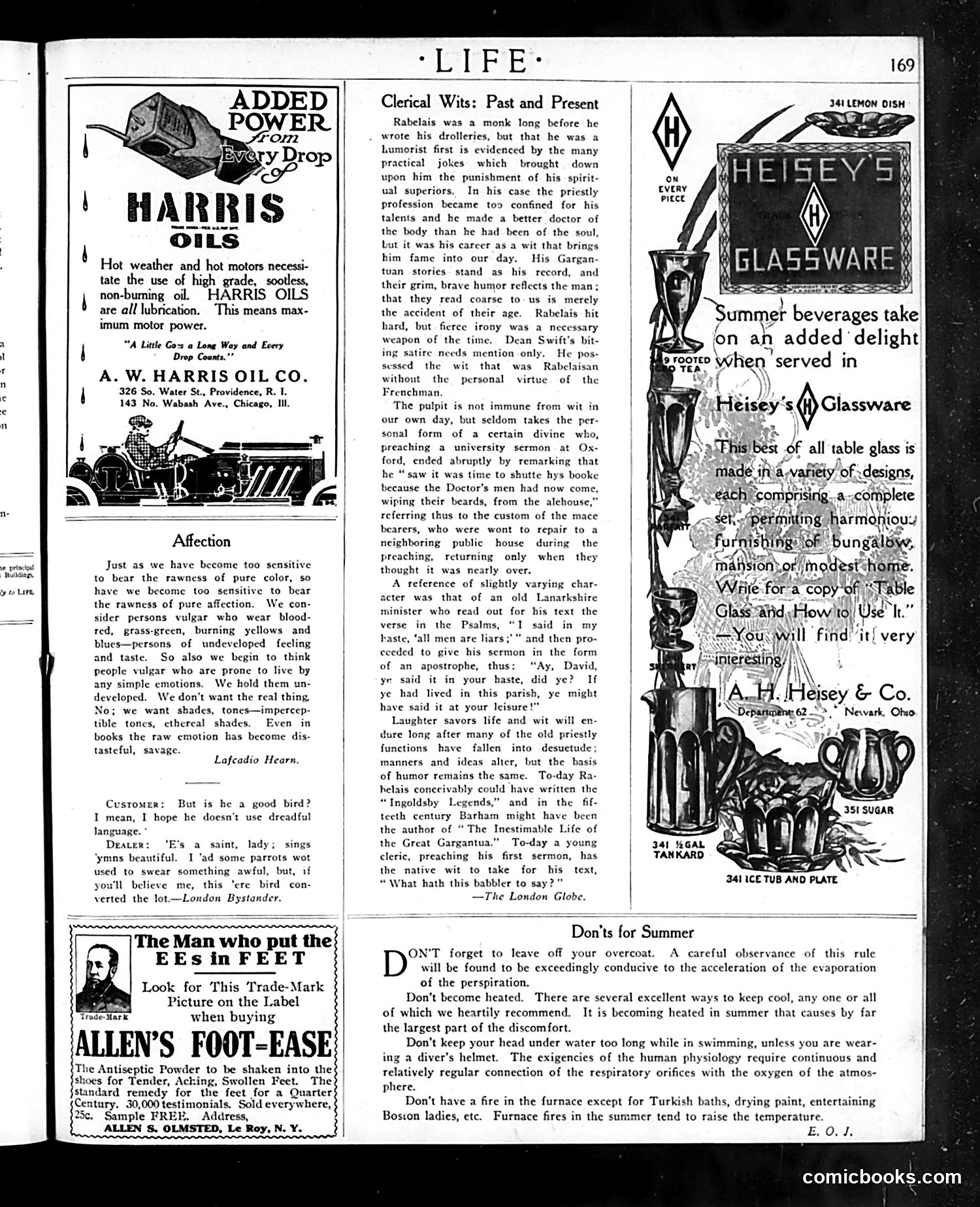
This page is primarily **advertising and humorous anecdotes** rather than political satire. The content includes: **Main Features:** 1. **Harris Oils Advertisement** - promoting motor oil for hot weather 2. **Heisey Glassware Advertisement** - featuring decorative tableware 3. **Allen's Foot-Ease Advertisement** - antiseptic foot powder 4. **Essay on "Affection"** - a Lafcadio Hearn piece criticizing modern emotional restraint as overly refined 5. **"Clerical Wits: Past and Present"** - humorous anecdotes about witty clergy, referencing Rabelais and Dean Swift, concluding with a joke about a modern cleric whose sermon text ("What hath this babbler to say?") amusingly describes his own preaching 6. **"Don'ts for Summer"** - practical health advice 7. **Parrot Anecdote** - a brief comedic exchange about a reformed parrot The page reflects early 20th-century *Life* magazine's mix of consumer advertising, light humor, and cultural commentary—not political cartooning.
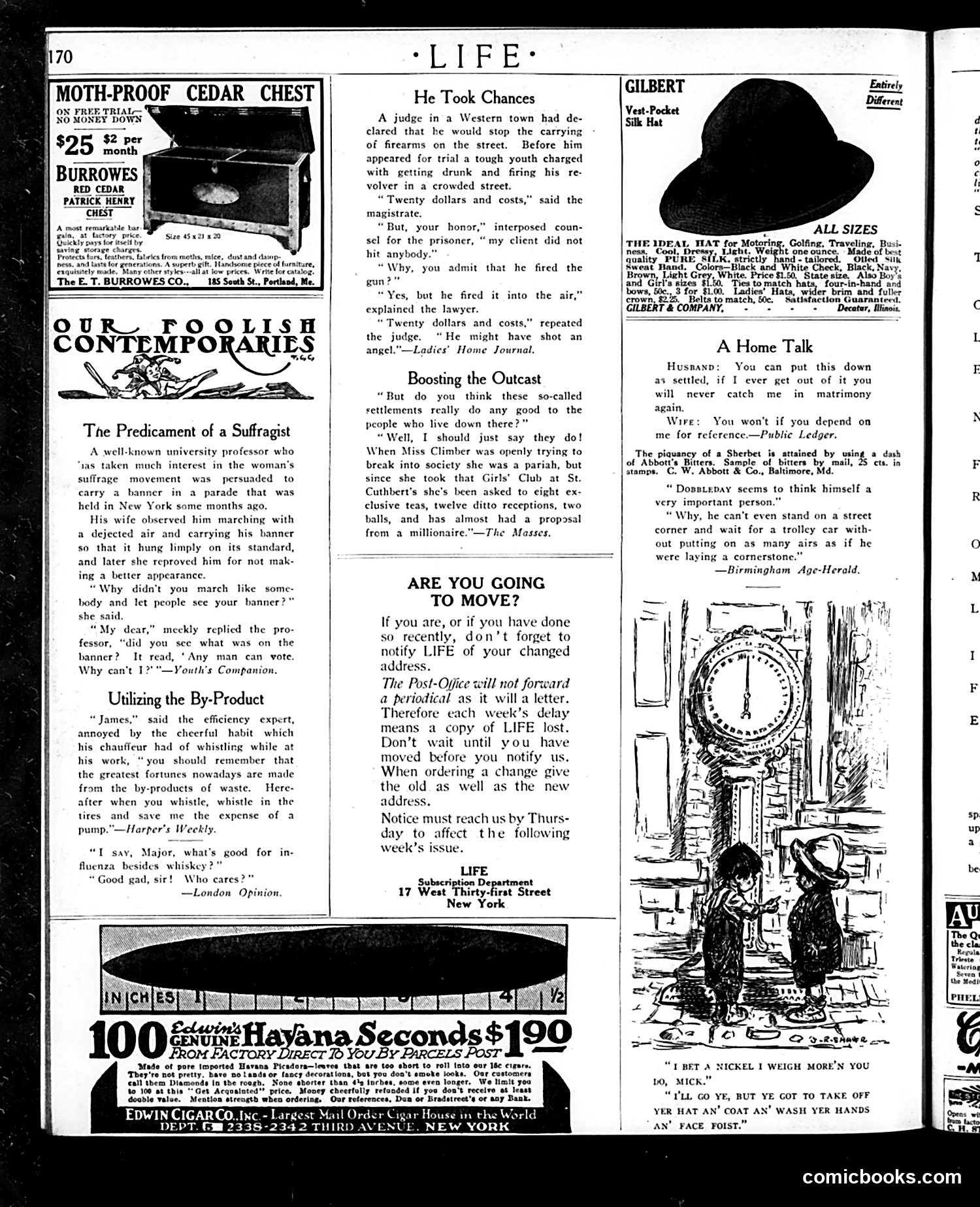
This page contains satirical humor pieces typical of Life magazine's social commentary. The key cartoons/articles are: **"The Predicament of a Suffragist"**: Mocks a university professor who participates in a women's suffrage parade but carries his banner limply and dejected. When his wife criticizes his poor presentation, he replies that the banner reads "Any man can vote. Why can't I?"—a joke implying the professor feels emasculated by advocating for women's rights, or that the slogan is absurdly self-referential. **"He Took Chances"**: A judge sentences a drunk man who fired a revolver in a crowded street to a fine. The defendant's lawyer argues he deserves leniency since he "didn't hit anybody." The judge responds he might have shot an angel—satirizing flawed legal reasoning and the absurdity of attempting to minimize reckless endangerment. **"Boosting the Outcast"**: Comments that settlement houses (charitable organizations) help social climbers gain respectability and marriage prospects rather than genuinely aid the poor. These reflect early-20th-century concerns: women's suffrage debates, gun violence in cities, and class mobility.
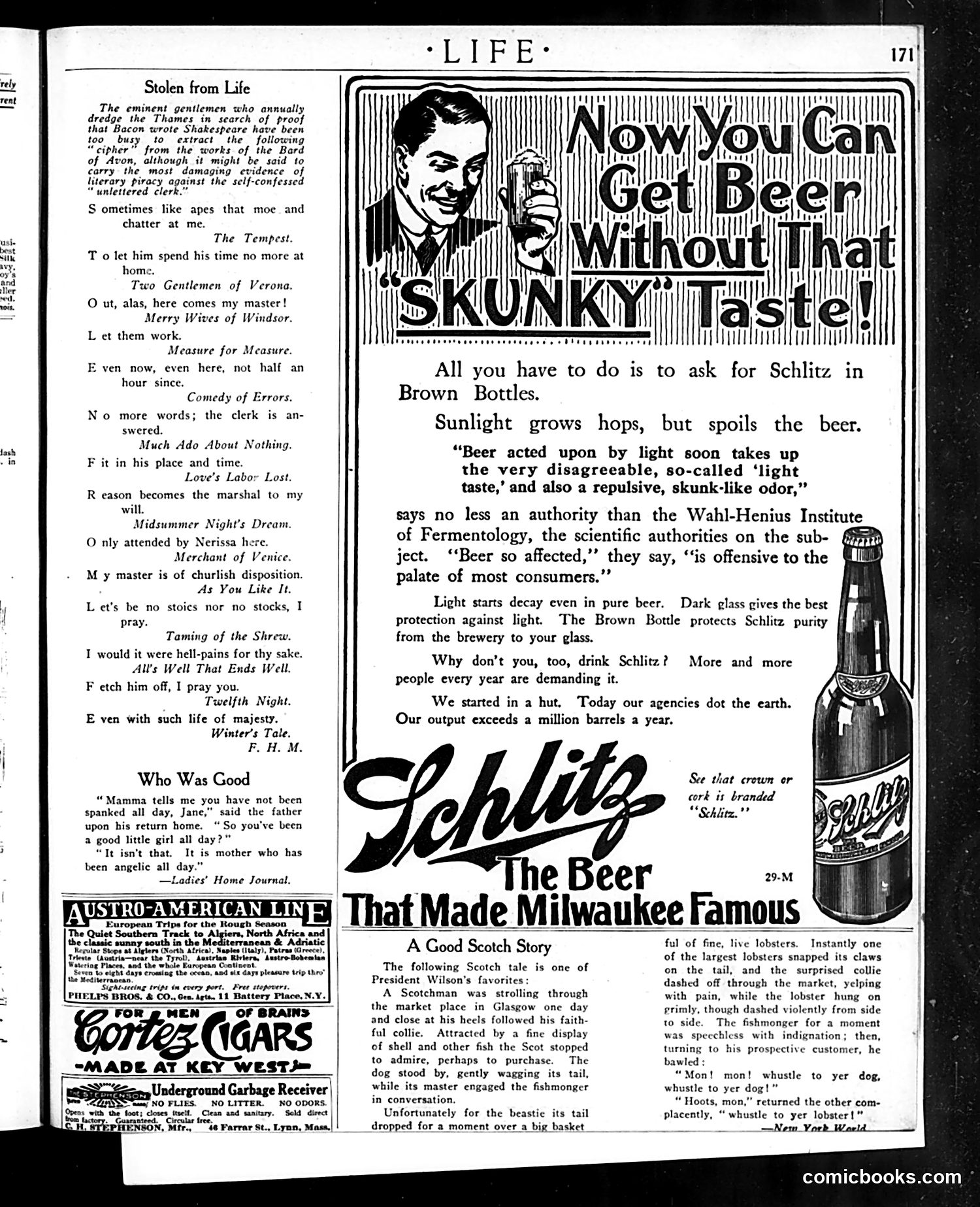
This page from *Life* magazine consists primarily of **advertisements and light humor pieces** rather than political satire. The main content includes: 1. **"Stolen from Life"** — A clever wordplay feature extracting hidden messages from Shakespeare quotations (acrostic poem spelling "Sometimes like apes...let them work"). This is literary humor, not satire. 2. **"Who Was Good"** — A mild domestic joke from *Ladies' Home Journal* about a child avoiding spanking because the mother was angelic. 3. **Schlitz Beer Advertisement** — The dominant feature, using pseudo-scientific authority (the "Wahl-Henius Institute of Fermentology") to argue that brown bottles protect beer from light damage, preventing "skunky" flavors. This is marketing satire—humorously inventing credibility for a commercial claim. 4. **"A Good Scotch Story"** — A dialectal joke about a Scottish fishmonger and a dog attacked by a lobster. The page reflects early 20th-century *Life* magazine's blend of literary humor, domestic comedy, and advertising, with minimal political content.
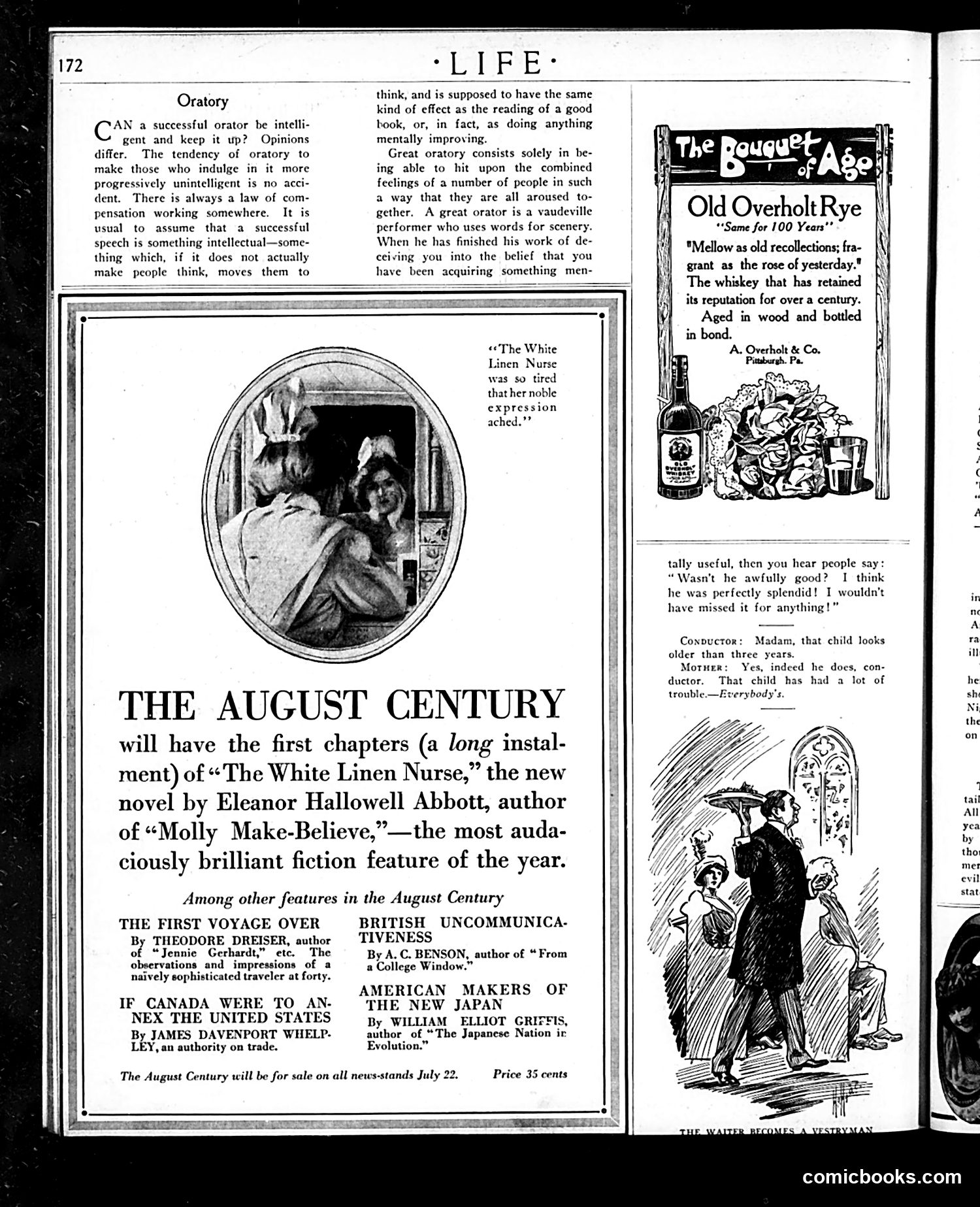
This page combines editorial commentary on oratory with advertising and magazine promotion. **Main Essay on Oratory:** The unsigned piece cynically argues that great oratory isn't intellectually improving but rather manipulative entertainment. It claims successful speakers are "vaudeville performers who uses words for scenery"—they appeal to audiences' combined emotions rather than their reasoning. The author suggests oratory actually makes practitioners "progressively unintelligent" through a law of compensation, and that audiences mistake emotional manipulation for intellectual gain. **Advertisements & Promotion:** The page features ads for Old Overholt Rye whiskey (emphasizing century-old reputation) and promotion for The Century magazine's August issue, highlighting serialized fiction and articles on international topics. **Cartoon/Anecdote:** A brief joke about a conductor questioning a woman's claim that her child is under three—implying the child looks older due to hardship—provides light humor typical of the era's magazine filler. The overall tone reflects Progressive Era skepticism about public manipulation and rhetorical excess.
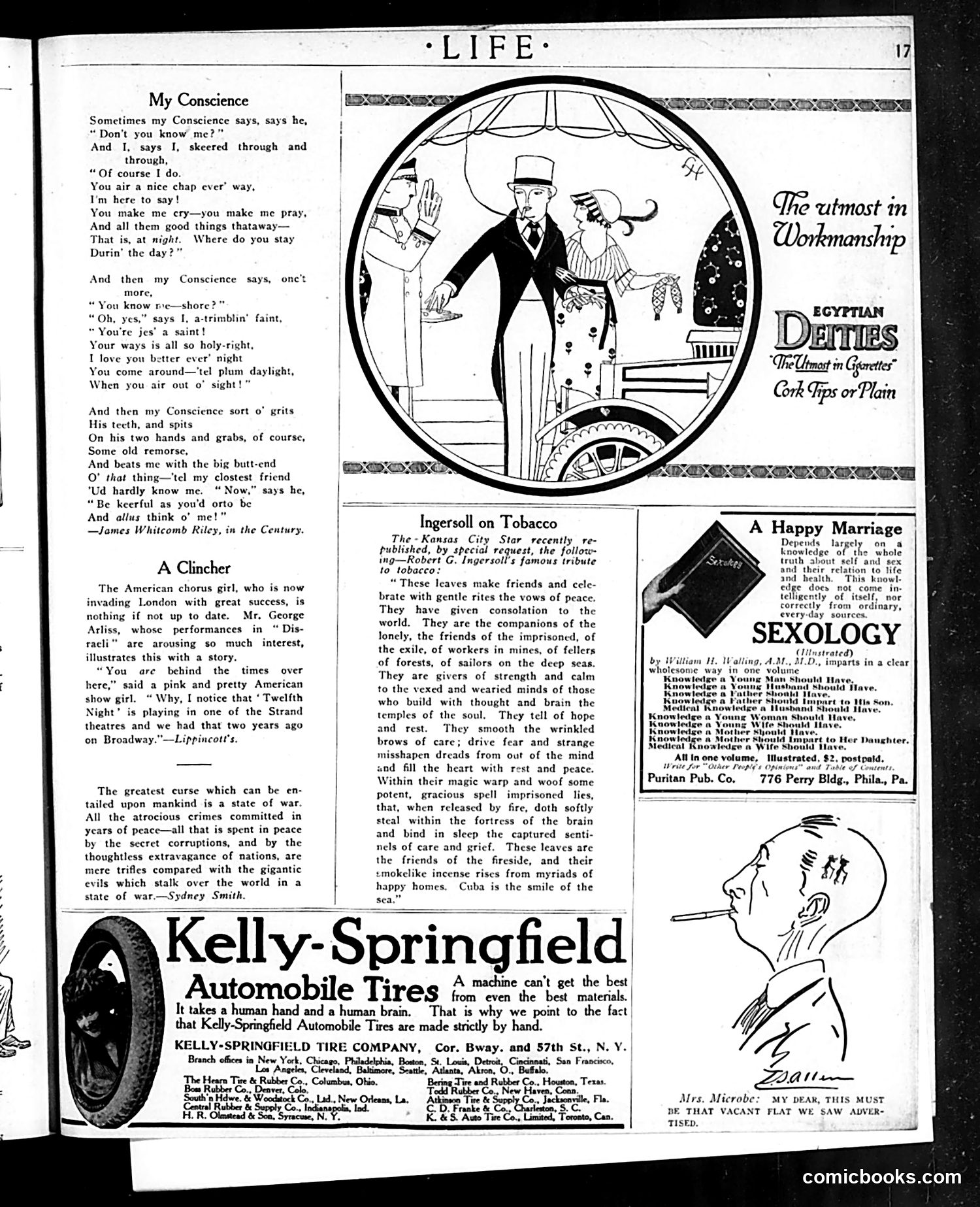
This page contains primarily **advertising and light humor pieces** rather than political satire. The main content includes: 1. **"My Conscience"** — a poem by James Whitcomb Riley using rural dialect, personifying conscience as a nagging companion who beats the speaker with "remorse" for daytime misbehavior, appearing only at night. It's gentle moral humor about hypocrisy. 2. **"A Clincher"** — a joke about an American chorus girl in London boasting that Broadway was ahead of London's theater scene—satirizing American cultural pretentiousness. 3. **Ingersoll on Tobacco** — a reprint of Robert G. Ingersoll's famous poetic tribute romanticizing tobacco as a comfort to workers and the lonely. The page is otherwise filled with **advertisements**: Egyptian Denties cigarettes, a Sexology book on marriage, Kelly-Springfield automobile tires, and other products typical of early 20th-century magazines. The drawings are commercial illustrations rather than political cartoons.
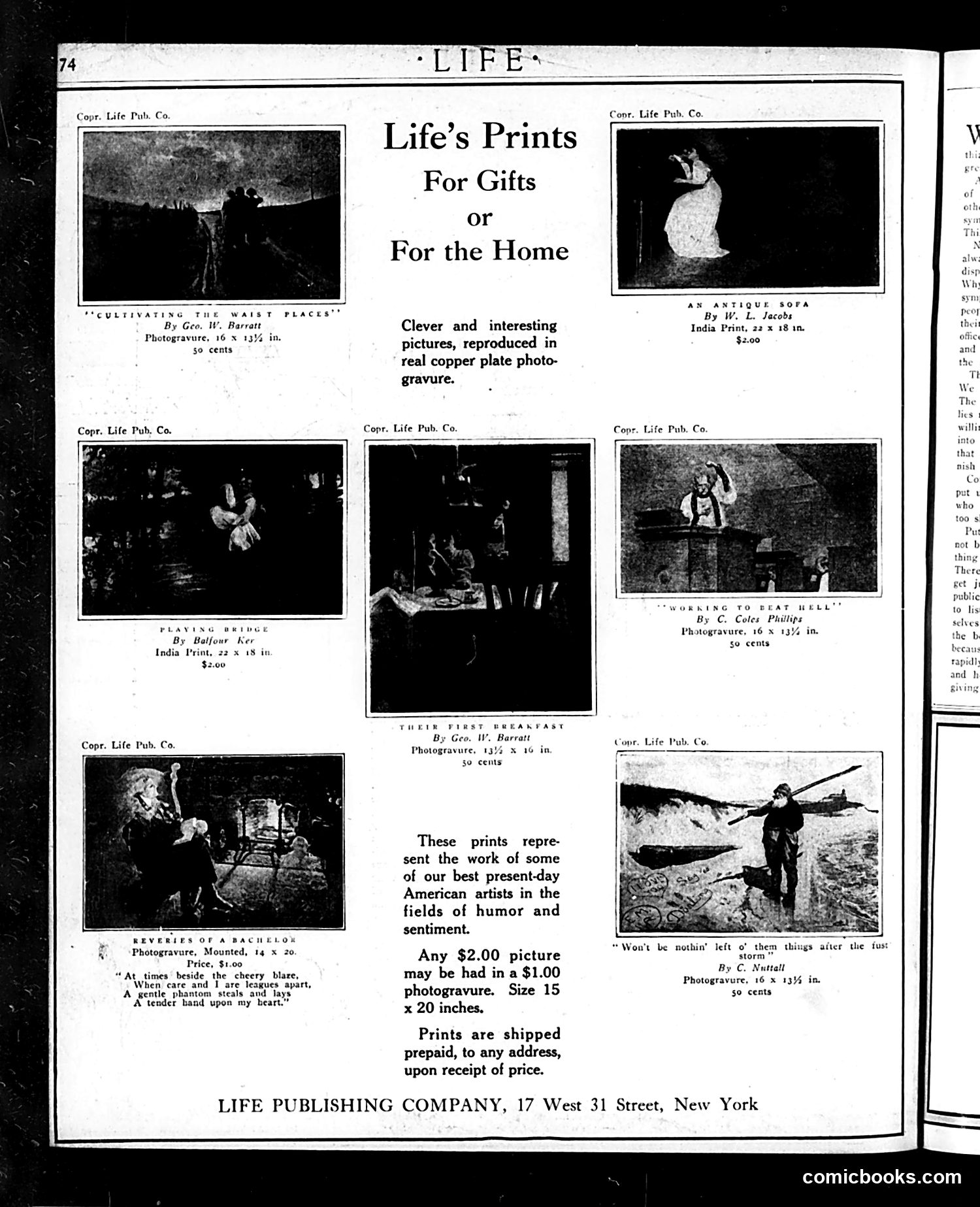
This page is primarily **advertising**, not satirical content. Life Publishing Company is selling photogravure prints (copper-plate reproductions) of artwork by contemporary American artists, priced from 50 cents to $2.00. The featured prints depict domestic and sentimental scenes: a woman at her toilette ("Cultivating the Waist Places"), newlyweds' breakfast, a bachelor's romantic reverie, people playing bridge, and rural/working-class subjects. The text emphasizes these represent "present-day American artists in the fields of humor and sentiment." This reflects early 20th-century middle-class taste: affordable art reproductions for home decoration, emphasizing genteel domestic life and nostalgic rural imagery. The advertisement targets consumers seeking inexpensive, mass-produced artwork for their homes—a significant market during this period before widespread photography in publications.
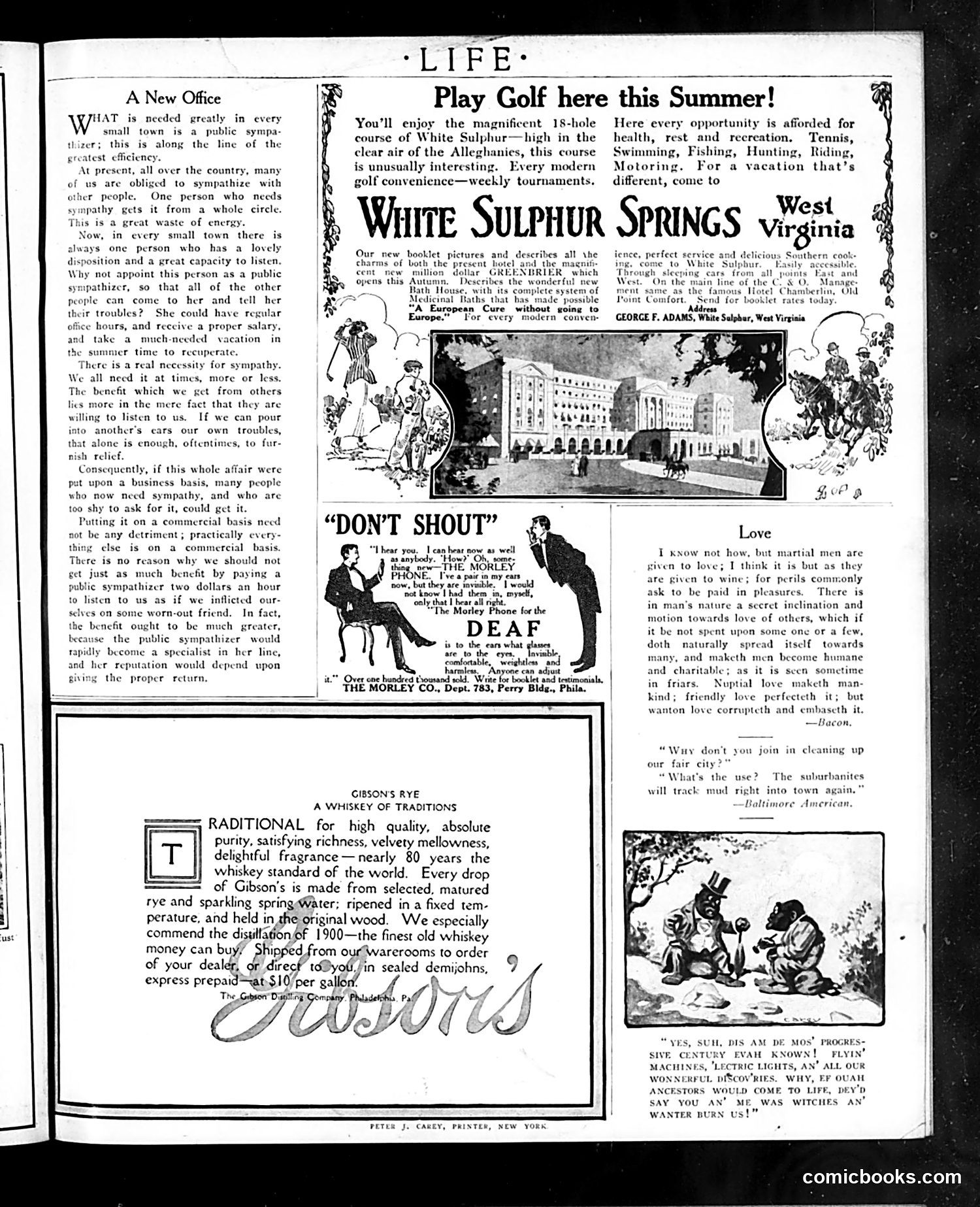
This page contains several distinct satirical pieces: **"A New Office"** (left column) proposes hiring a professional sympathizer—someone paid to listen to people's troubles during office hours. The joke satirizes modern life's emotional isolation: people need someone to vent to but are "too shy to ask for it," so why not commercialize sympathy? It's social commentary on urban alienation and the professionalization of human services. **"Don't Shout"** (center) advertises The Morley Company's hearing aids, using a deaf man's predicament for humor. The visual shows someone shouting at a deaf person; the product promises to eliminate such awkwardness. **The "Love" essay** (right) quotes Bacon on love's nature—distinguishing between marital, friendly, and wanton love. **The final cartoon** mocks suburban commuters tracking mud into the city, suggesting the futility of urban cleanup efforts. The page is primarily **advertising** (Gibson's Rye, White Sulphur Springs resort) interspersed with light satirical commentary on modern inconveniences and social attitudes.
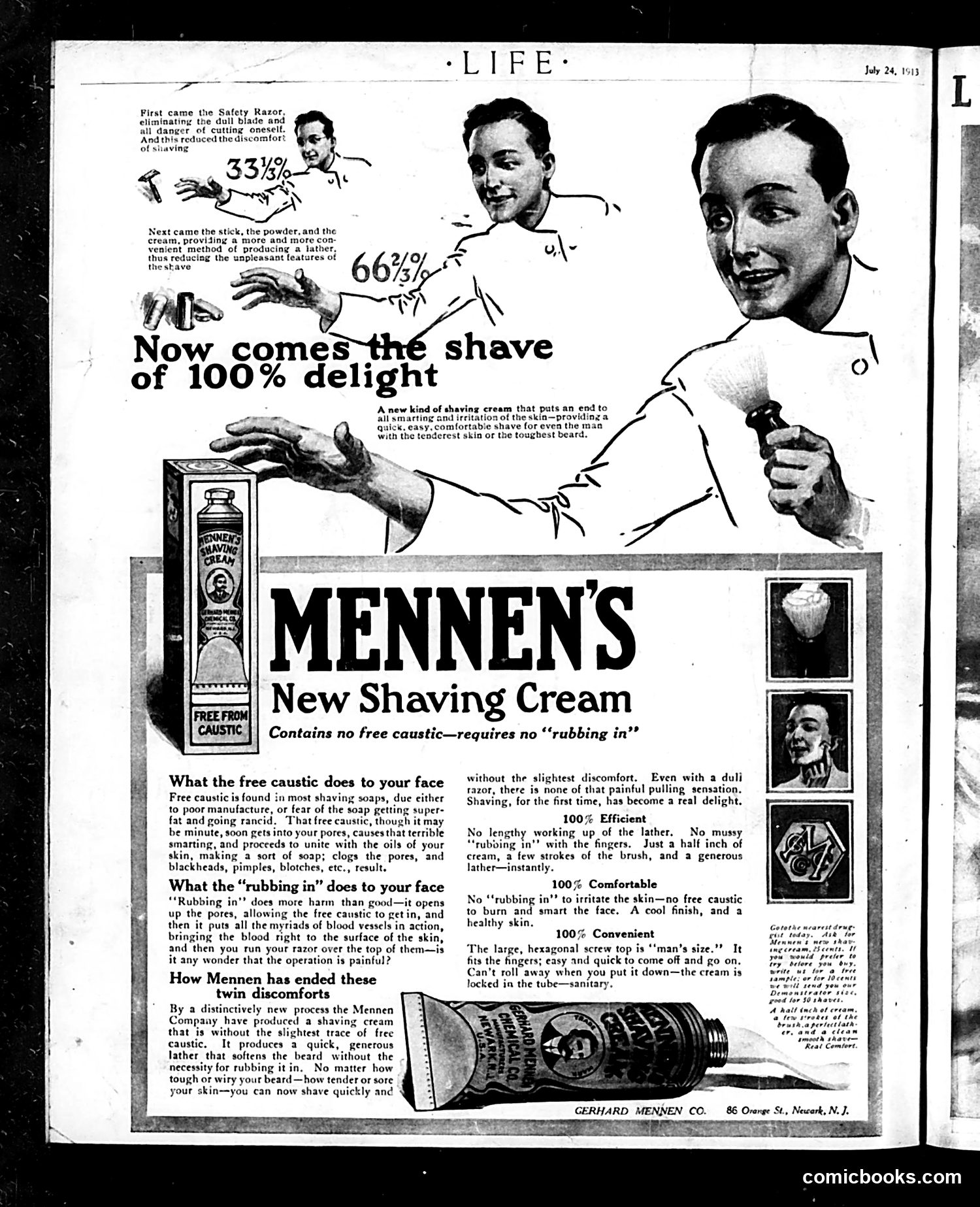
This is a **product advertisement**, not political satire. It promotes Mennen's innovative shaving cream by illustrating the evolution of shaving comfort through three stages, marked with percentages (33⅓%, 66⅔%, 100%). The ad's humor comes from presenting shaving as a progressive scientific triumph. It claims Mennen's cream solves two major problems: free caustic (a harsh chemical in competitor soaps that burns skin) and the damage caused by vigorous "rubbing in" of lather. The smiling man's progression from discomfort to delight visualizes the product benefit. The ad emphasizes modern convenience: no rubbing required, quick application, efficient lather, and a practical hexagonal tube designed for men's hands. This reflects early-1900s advertising strategy—using pseudo-scientific claims and detailed problem-solving narratives to differentiate branded products in a competitive market.