
Life, 1913-07-24 · page 9 of 40
Life — July 24, 1913 — page 9: what you’re looking at
What you’re looking at
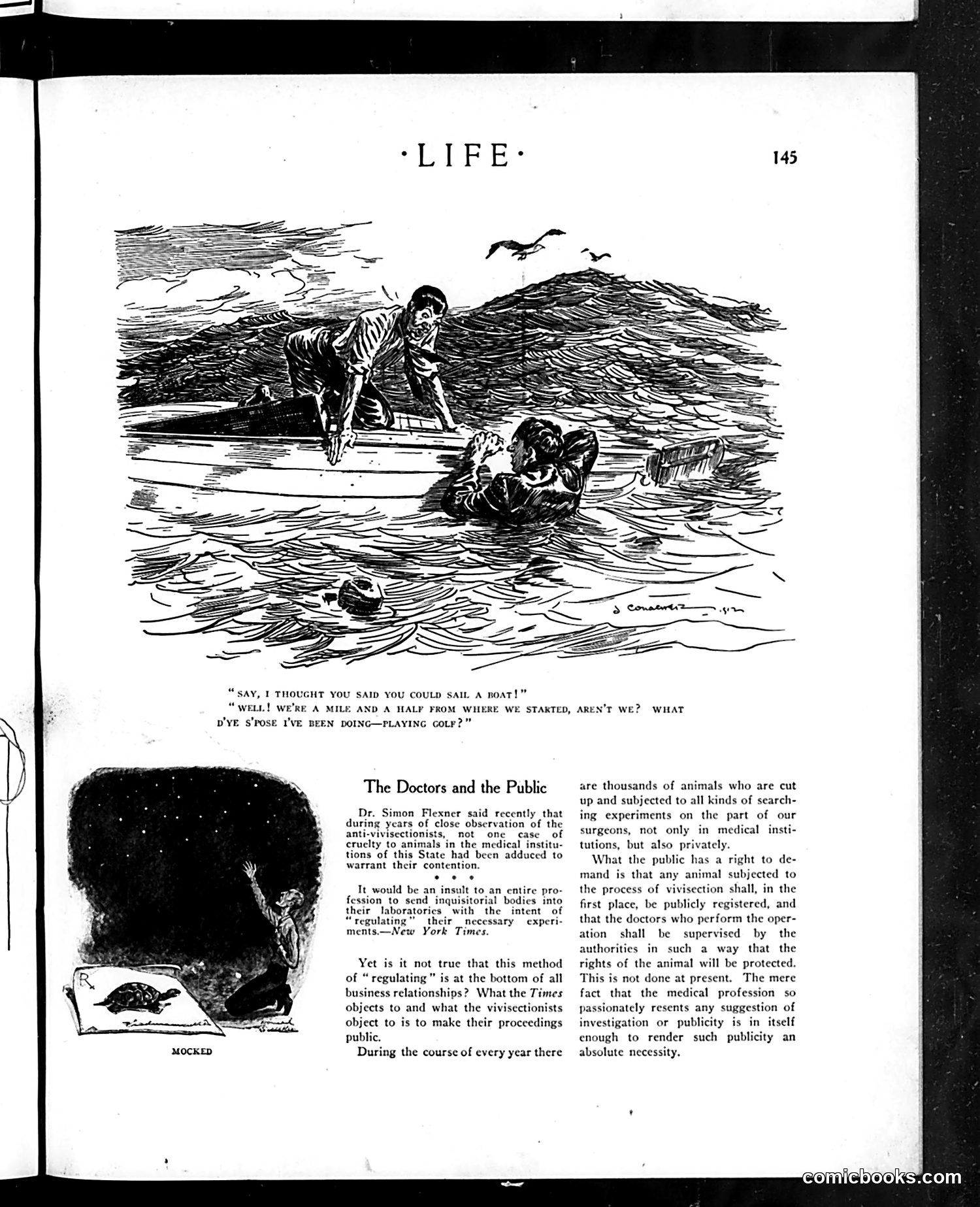
This page contains two distinct pieces: **Top Cartoon**: A humorous scene showing a man in a boat with two others in the water. The caption reveals the joke: one person claims they can sail a boat, but they're actually a mile offshore playing golf instead—a absurdist gag about incompetence or false claims. **"The Doctors and the Public" Article**: This satirical piece criticizes the medical profession's use of animals in vivisection experiments. Dr. Simon Flexner is cited as defending such practices. The accompanying illustration ("Mocked") shows a figure examining a dead animal, visually reinforcing the critique. The article argues that while animal testing occurs in medical institutions, the public demands transparency and regulatory oversight to protect animal welfare—a early 20th-century animal rights advocacy piece.
📄 Transcribed text from this page (OCR, searchable)
Machine-transcribed from the original scan — historical spelling and the odd misread are preserved.
“SAY, I THOUGHT YOU SAID YOU COULD SAIL A noaT!" “WELL! WE'RE A MILE AND A HALF FROM WHERE WE STARTED, AREN'T WE? D'YE S'POSE I'VE BEEN DOING—PLAYING GOL! WHAT The Doctors and the Public Dr. Simon Flexner said recently that during years of close observation of the anti-vivisectionists, not one case of cruclty to animals in the medical institu- tions of this State had been adduced to warrant their contention. It would be an insult to an entire pro- fession to send inquisitorial bodies into their laboratories with intent of “regulating” their necessary experi- ments.—New York Times. Yet is it not true that this method of “regulating” is at the bottom of all business relationships? What the Times objects to and what the vivisectionists object to is to make their proceedings public. During the course of every year there are thousands of animals who are cut up and subjected to all kinds of search- ing experiments on the part of our surgeons, not only in medical insti- tutions, but also privately. What the public has a right to de- mand is that any animal subjected to the process of vivisection shall, in the first place, be publicly registered, and that the doctors who perform the oper- ation shall be supervised by the authorities in such a way that the rights of the animal will be protected. This is not done at present. The mere fact that the medical profession so passionately resents any suggestion of investigation or publicity is in itself enough to render such publicity an absolute necessity.