
Life, 1913-07-24 · page 33 of 40
Life — July 24, 1913 — page 33: what you’re looking at
What you’re looking at
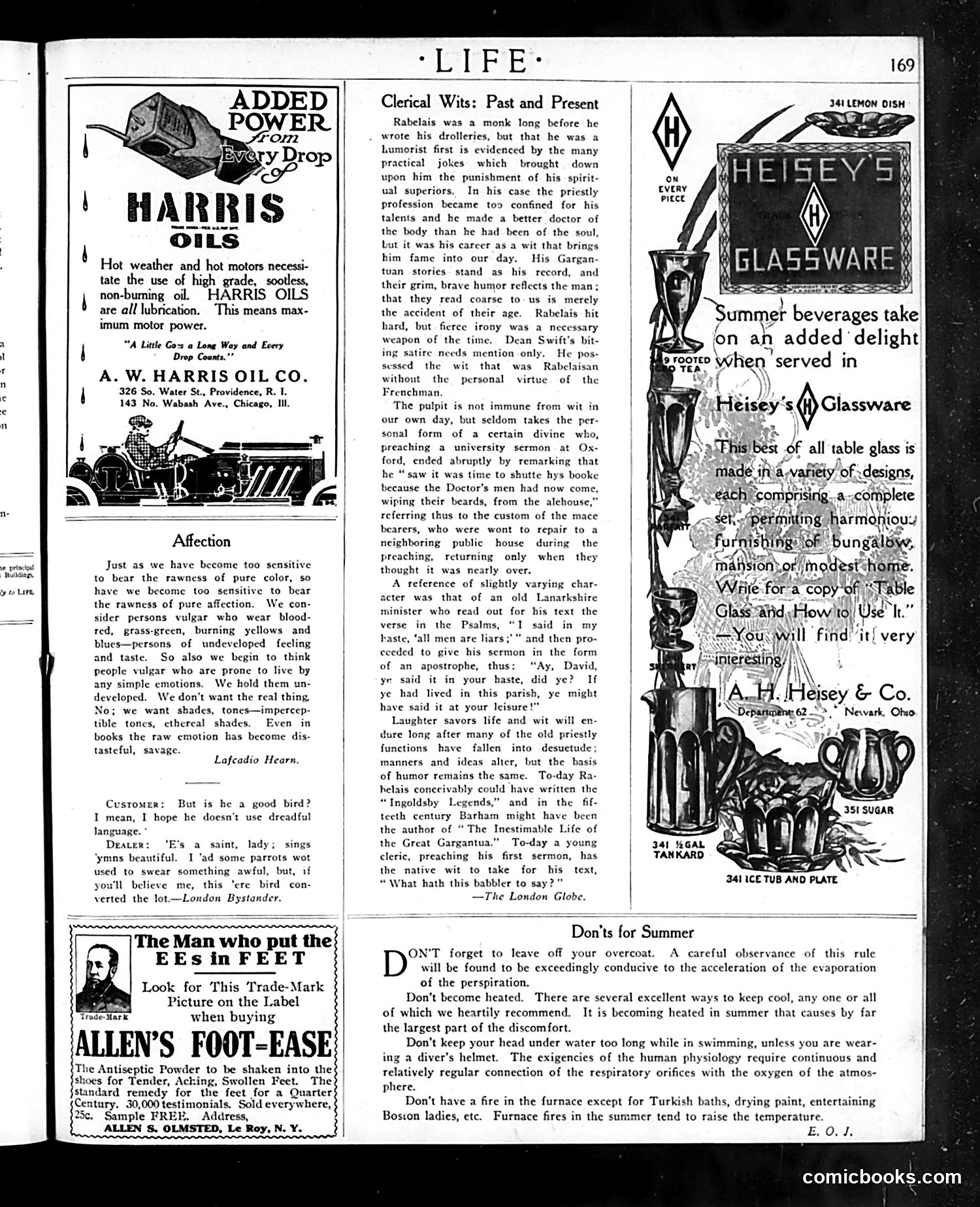
This page is primarily **advertising and humorous anecdotes** rather than political satire. The content includes: **Main Features:** 1. **Harris Oils Advertisement** - promoting motor oil for hot weather 2. **Heisey Glassware Advertisement** - featuring decorative tableware 3. **Allen's Foot-Ease Advertisement** - antiseptic foot powder 4. **Essay on "Affection"** - a Lafcadio Hearn piece criticizing modern emotional restraint as overly refined 5. **"Clerical Wits: Past and Present"** - humorous anecdotes about witty clergy, referencing Rabelais and Dean Swift, concluding with a joke about a modern cleric whose sermon text ("What hath this babbler to say?") amusingly describes his own preaching 6. **"Don'ts for Summer"** - practical health advice 7. **Parrot Anecdote** - a brief comedic exchange about a reformed parrot The page reflects early 20th-century *Life* magazine's mix of consumer advertising, light humor, and cultural commentary—not political cartooning.
📄 Transcribed text from this page (OCR, searchable)
Machine-transcribed from the original scan — historical spelling and the odd misread are preserved.
EEIE 169) Hot weather and hot motors necessi- tate the use of high grade, sootless, non-buming oil. HARRIS OILS are all lubrication. This means max- imum motor power. “A Little Go:s a Long Way and Ecery Drop Counts."* A. W. HARRIS OIL CO. 326 So. Water St., Providence, R. 1. 143 No. Wabash Ave., Chicago, Ill. Just as we have become too sensitive to bear the rawness of pure color, so have we become too sensitive to bear the rawness of pure affection. We con- sider persons vulgar who wear blood- red, grass-green, burning ycllows and blues—persons of undeveloped feeling and taste. So also we begin to think people vulgar who are prone to live by any simple emotions. We hold them un- developed. We don't want the real thing, No; we want shades, tones—impercep- tible tones, ethereal shades. Even in books the raw emotion has become dis- tasteful, savage. Lafcadio Hearn. Cusroster: But is he a good bird? I mean, I hope he doesn't use dreadful language. * Deater: 'E’s a saint, lady; sings ‘'ymns beautiful. I ‘ad some parrots wot used to swear something awful, but, if you'll believe me, this ‘ere bird con- verted the lot—London Bystander. Clerical Wits: Past and Present Rabelais was a monk long before he wrote his drolleries, but that he was a Lumorist first is evidenced by the many practical jokes which brought down upon him the punishment of his spirit- ual superiors. In his case the priestly profession became too confined for his talents and he made a better doctor of the body than he had been of the soul, Lut it was his career as a wit that brings him fame into our day. His Gargan- tuan stories. stand as his record, and their grim, brave humor reflects the man; that they read coarse to us is merely the accident of their age. Rabelais hit hard, but fierce irony was a necessary weapon of the time. Dean Swift's bit- ing satire needs mention only. He pos- sessed the wit that’ was Rabelaisan without the personal virtue of the Frenchman. The pulpit is not immune from wit in our own day, but seldom takes the per- sonal form of a certain divine wh preaching a university sermon at O: ford, ended abruptly by remarking that he “saw it was time to shutte hys booke because the Doctor's men had now come, wiping their beards, from the alchouse,” referring thus to the custom of the mace bearers, who were wont to repair to a neighboring public house during the preaching, returning only when they thought it was nearly over. A reference of slightly varying char- ter was that of an old Lanarkshire nister who read out for his text the verse in the Psalms, “I said in my haste, ‘all men are liars ;'" and then pro- ceeded to give his sermon in the form of an apostrophe, thus: “Ay, David, ye said it in your haste, did ye? If ye had lived in this parish, ye might have said it at your leisure!” Laughter savors life and wit will en- dure long after many of the old priestly functions have fallen into desuetude ; manners and ideas alter, but the basis of humor remains the same. To-day Ra- helais conceivably could have written the “Ingoldsby Legends,” and in the fif- tecth century Barham might have been the author of “The Inestimable Life of the Great Gargantua.” To-day a young cleric, preaching his first sermon, has the native wit to take for his text, “What hath this babbler to say?” —The London Globe. The Man who put the EEs in FEET Look for This Trade-Mark Picture on the Label Trade-Mark when buying ALLEN’S FOOT-EASE The Antiseptic Powder to be shaken into the shoes for Tender, Acting, Swollen Feet. The Standard remedy for the feet for a Quarter, Sentury. 30,000 testimonials. Sold everywhere, 2 Sample FREE. Address, | ALLEN S. OLMSTED, Le Roy, N. Y. Dox forget to leave off your overcoat. 341 LEMON DISH it RGNES take on an added’ delight )) , (Hei s = Glassware iN) , AH = & Co. 341 2GAL TANKARD Don'ts for Summer A careful observance of this rule will be found to be exceedingly conducive to the acceleration of the evaporation of the perspiration. Don’t become heated. There are several excellent ways to keep cool, any one or all of which we heartily recommend. It is becoming heated in summer that causes by far the largest part of the discomfort. Don’t keep your head under water too long while in swimming, unless you are wear- ing a diver’s helmet. The exigencies of the human physiology require continuous and relatively regular connection of the respiratory orifices with the oxygen of the atmos- phere. Don’t have a fire in the furnace except for Turkish baths, drying paint, entertaining Boston ladies, etc. Furnace fires in the summer tend to raise the temperature. E.0. 4. comicbooks.com