
Life, 1913-07-24 · page 22 of 40
Life — July 24, 1913 — page 22: what you’re looking at
What you’re looking at
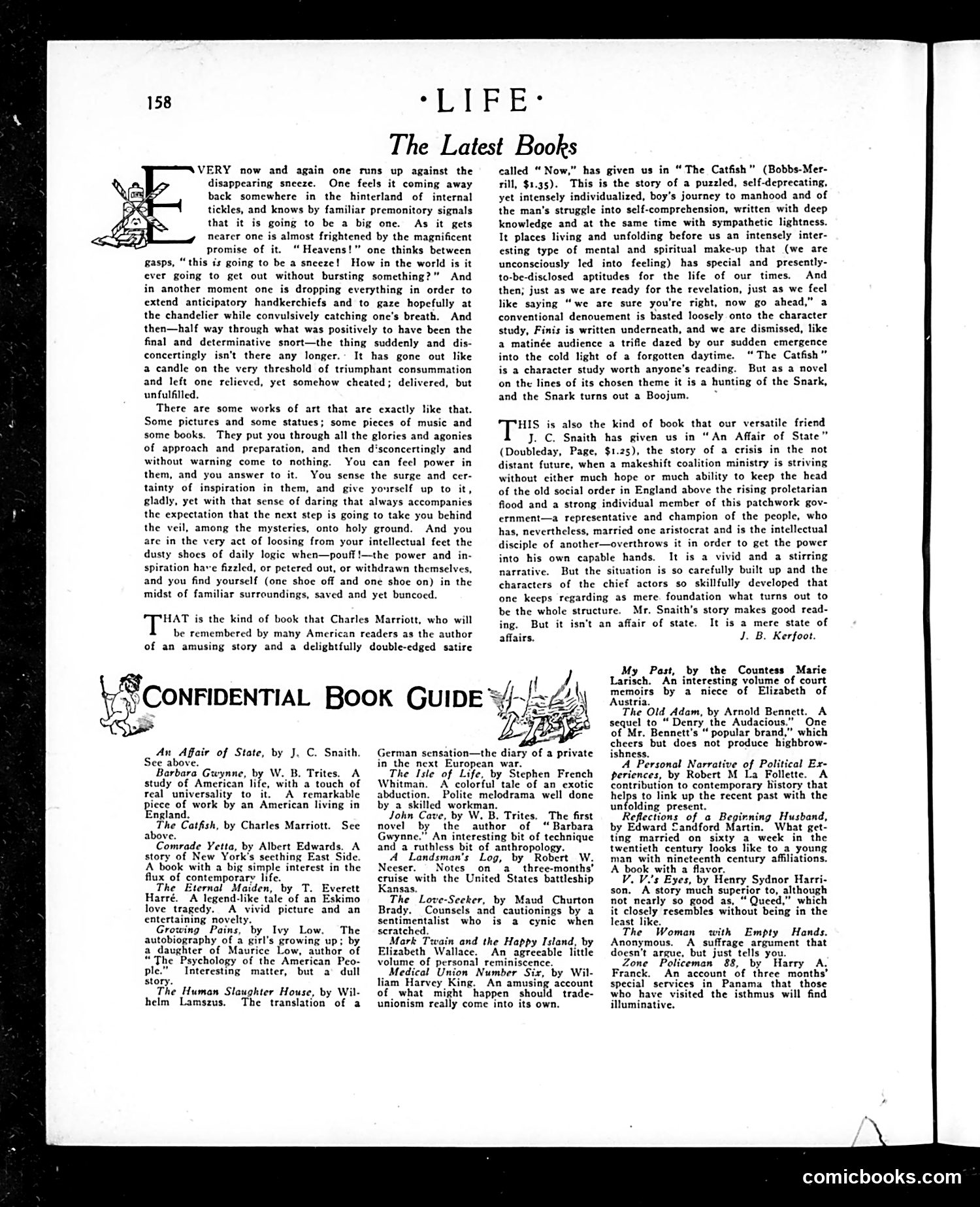
This page contains literary criticism rather than political cartoons. The reviewer uses an extended metaphor—comparing disappointing books to a "disappearing sneeze"—to critique novels that build dramatic tension but fail to deliver meaningful conclusions. The critic discusses Charles Marriott's *The Catfish*, praising its psychological depth and character study but faulting its conventional ending as unsatisfying and rushed. Similarly, J.C. Snaith's *An Affair of State* is reviewed as an interesting premise about a future political crisis that apparently doesn't follow through on its promise. The "Confidential Book Guide" section lists other contemporary works. The satire here is literary—mocking authors who construct compelling narratives then abandon their own established themes with lazy or formulaic endings, leaving readers intellectually and emotionally unfulfilled.
📄 Transcribed text from this page (OCR, searchable)
Machine-transcribed from the original scan — historical spelling and the odd misread are preserved.
“LIFE: The Latest Books VERY now and again one runs up against the disappearing sneeze. One feels it coming away back somewhere in the hinterland of internal tickles, and knows by familiar premonitory signals that it is going to be a big one. As it gets nearer one is almost frightened by the magnificent Promise of it. “Heavens!” one thinks between gasps, “this is going to be a sneeze! How in the world is it ever going to get out without bursting something?" And in another moment one is dropping everything in order to extend anticipatory handkerchiefs and to gaze hopefully at the chandelier while convulsively cate! then—half way through what was posit; final and determinative snort—the thing suddenly and dis- concertingly isn't there any longer.- It has gone out like a candle on the very threshold of triumphant consummation and left one relieved, yet somehow cheated; delivered, but unfulfilled. There are some works of art that are exactly like that. Some pictures and some statues; some pieces of music and some books. They put you through all the glories and agonics of approach and preparation, and then d'sconcertingly and without warning come to nothing. You can feel power in them, and you answer to it. You sense the surge and cer- tainty of inspiration in them, and give yourself up to it, gladly, yet with that sense of daring that always accompanies the expectation that the next step is going to take you behind the veil, among the mysteries, onto holy ground. And you are in the very act of loosing from your intellectual feet the dusty shoes of daily logic when—pouff!—the power and in- spiration have fizzled, or petered out, or withdrawn themselves, and you find yourself (one shoe off and one shoe on) in the midst of familiar surroundings, saved and yet buncoed. HAT is the kind of book that Charles Marriott, who will be remembered by many American readers as the author of an amusing story and a delightfully double-edged satire ‘CONFIDENTIAL BOOK GUIDE %4/ called “ Now,” has given us in “The Catfish” (Bobbs-Mer- rill, $1.35). This is the story of a puzzled, self-deprecating, yet intensely individualized, boy's journey to manhood and of the man’s struggle into self-comprehension, written with deep knowledge and at the same time with sympathetic lightness. It places living and unfolding before us an intensely inter- esting type of mental and spiritual make-up that (we are unconsciously led into feeling) has special and presently- to-be-disclosed aptitudes for the life of our times. And then; just as we are ready for the revelation, just as we feel like saying “we are sure you're right, now go ahead,” a conventional denouement is basted loosely onto the character study, Finis is written underneath, and we are dismissed, like a matinée audience a trifle dazed by our sudden emergence into the cold light of a forgotten daytime. “The Catfish” is a character study worth anyone's reading. But as a novel on the lines of its chosen theme it is a hunting of the Snark, and the Snark turns out a Boojum. HIS is also the kind of book that our versatile friend J. C. Snaith has given us in “An Affair of State” (Doubleday, Page, $1.25), the story of a crisis in the not distant future, when a makeshift coalition ministry is striving without cither much hope or much ability to keep the head of the old social order in England above the rising proletarian flood and a strong individual member of this patchwork gov- ernment—a representative and champion of the people, who has, nevertheless, married one aristocrat and is the intellectual disciple of another—overthrows it in order to get the power into his own capable hands. It is a vivid and a stirring narrative. But the situation is so carefully built up and the characters of the chief actors so skillfully developed that one keeps regarding as mere. foundation what turns out to be the whole structure. Mr. Snaith’s story makes good read- ing. But it isn't an affair of state. It is a mere state of affairs. J. B. Kerfoot. My Past, by the Countess Marie Larisch. An interesting volume of court memoirs by a niece of Elizabeth of Austria. The Old Adam, by Arnold Bennett. A sequel to “ Denry the Audacior One of Mr. Bennett's “ popular brand,” which cheers but does not produce highbrow- An Affair of State, by J. C. Snaith. See above. Barbara Gwynne, by W. B. Trites. A study of American like, with a touch of real universality to it. A remarkable piece of work by an American living in England, The Catfish, by Charles Marriott. above. Comrade Yetta, by Albert Edwards. A story of New York's secthing East Side. A book with a big simple interest in the flux of contemporary life. The Eternal Maiden, by T. Everett Harré. A legend-like tale of an Eskimo love tragedy. vid picture and an entertaining novelty Growing Pains, by Ivy Low. The autobiography of a girl's growing up; by a daughter of Maurice Low, author of “The Psychology of the American Peo- ple.” Interesting matter, but a dull story. The Human Slaughter House, by Wil- helm Lamszus. The translation of a See German sensation—the diary of a private in the next European war. The Isle of Life, by Stephen French Whitman. A colorful tale of an exotic abduction. Polite melodrama well done by a skilled workman. John Cave, by W. B. Trites. The first novel by the author of “Barbara Gwynne.” An interesting bit of technique and a ruthless bit of anthropology. ‘A Landsman's Log, by Robert W. Neeser. Notes on a three-months’ cruise with the United States battleship Kansas. The Love-Seeker, by Maud Churton Brady. Counsels and cautionings by a sentimentalist. who is a cynic when scratched. Mark Twain and the Happy Island, by Elizabeth Wallace. An agreeable little volume of personal reminiscence. Medical Union Number Six, by Wil- liam Harvey King. An ghee} account of what might happen should trade- unionism really come into its own. ishness. A Personal Narrative of Political Ex- periences, by Robert M La Follette. A contribution to contemporary history that helps to link up the recent past with the unfolding present. Reflections of a Beginning Husband, by Edward Sandford Martin. What get- ting married on sixty a week in the twentieth century looks like to a young man with nineteenth century affiliations. book with a flavor. V. V.'s Eyes, by Henry Sydnor Harri- son. A story much superior to, although not nearly so good as, “ Queed,” which it closely resembles without being in the least like. The Woman with Empty Hands. Anonymous. A suffrage argument that doesn’t argue, but just tells you. Zone Policeman 88, by Harry A. Franck. An account of three months’ special services in Panama that those who have visited the isthmus will find illuminative. comicbooks.com