
Life, 1913-07-24 · page 28 of 40
Life — July 24, 1913 — page 28: what you’re looking at
What you’re looking at
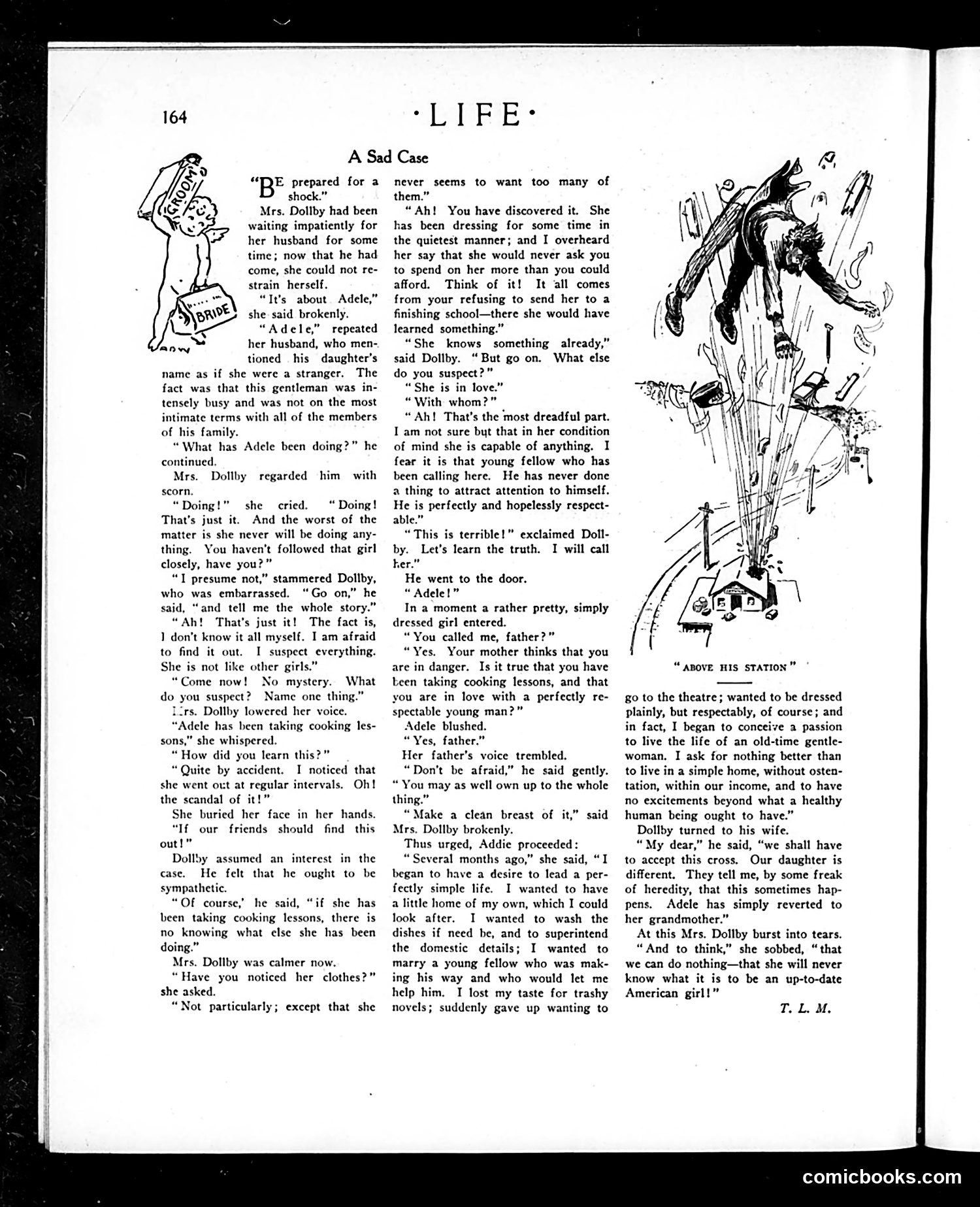
This story satirizes early-20th-century upper-middle-class anxieties about daughters rejecting consumer excess and idle leisure. **The joke:** Mrs. Dollby is scandalized that her daughter Adele has taken cooking lessons, dresses modestly, avoids the theater, and—most damning—has fallen in love with a "respectable" working man she wishes to help support. These signs of self-sufficiency and domestic virtue horrify the mother, who sees them as dangerous departures from proper genteel behavior. **The satire targets:** Parents obsessed with conspicuous consumption and social status; the expectation that daughters remain decorative, dependent consumers rather than capable partners; the snobbish dismissal of respectable but modest suitors. **The cartoon's point:** Adele's "crimes" (thrift, domesticity, meaningful work, love) are actually virtues. The satire mocks the parents' inverted values—their horror at what society should celebrate reveals how absurd status-obsessed materialism has become.
📄 Transcribed text from this page (OCR, searchable)
Machine-transcribed from the original scan — historical spelling and the odd misread are preserved.
US REE: A Sad Case “RE prepared for a shock.” Mrs. Dollby had been waiting impatiently for her husband for some time; now that he had come, she could not re- strain herself. “It's about Adele,” she said brokenly. “Adele,” repeated her husband, who men- tioned his daughter’s name as if she were a stranger. The fact was that this gentleman was in- tensely busy and was not on the most intimate terms with all of the members of his family. “What has Adele been doing?” he continued. Mrs. Dolby scorn, “Doing!” she cried.“ Doing! That's just it. And the worst of the matter is she never will be doing any- thing. You haven't followed that girl regarded him with closely, have you?” “T presume not,” stammered Dollby, who was embarrassed. “Go on,” he said, “and tell me the whole story.” “Ah! That's just it! The fact is, 1 don’t know it all myself. I am afraid to find it out. I suspect everything. She is not like other girls.” “Come now! No mystery. What do you suspect? Name one thing.” Lirs. Dollby lowered her voice. “Adele has been taking cooking les- sons," she whispered. “How did you learn this?” “Quite by accident. I noticed that she went out at regular intervals. Oh! the scandal of it!” She buried her face in her hands. “If our friends should find this out!” Dollby assumed an interest in the case. He felt that he ought to be sympathetic. “OF course,’ he said, “if she has been taking cooking lessons, there is no knowing what else she has been doing.” Mrs. Dollby was calmer now. “Have you noticed her clothes?” she asked. “Not particularly; except that she never seems to want too many of them.” “Ah! You have discovered it. She has been dressing for some time in the quietest manner; and I overheard her say that she would never ask you to spend on her more than you could afford. Think of it! It all comes from your refusing to send her to a finishing school—there she would have learned something.” “She knows something already,” said Dollby. “But go on. What else do you suspect?” “She is in love.” “With whom?” “Ah! That's the most dreadful part. Tam not sure byt that in her condition of mind she is capable of anything. I fear it is that young fellow who has been calling here. He has never done a thing to attract attention to himself. He is perfectly and hopelessly respect- able.” “This is terrible!” exclaimed Doll- by. Let’s learn the truth. I will call her.” He went to the door. “ Adele!” In a moment a rather pretty, simply dressed girl entered. “You called me, father?” “Yes. Your mother thinks that you are in danger. Is it true that you have teen taking cooking lessons, and that you are in love with a perfectly re- spectable young man?” Adele blushed. “Yes, father.” Her father’s voice trembled. “Don't be afraid,” he said gently. “You may as well own up to the whole thing.” “Make a clean breast of it,” said Mrs. Dollby brokenly. Thus urged, Addie proceeded: “Several months ago,” she said, “I began to have a desire to lead a per- fectly simple life. I wanted to have a little home of my own, which I could look after. I wanted to wash the dishes if need be, and to superintend the domestic details; I wanted to marry a young fellow who was mak- ing his way and who would let me help him, I lost my taste for trashy novels; suddenly gave up wanting to “ ABOVE HIS STATION” go to the theatre; wanted to be dressed plainly, but respectably, of course; and in fact, I began to conceive a passion to live the life of an old-time gentle- woman. I ask for nothing better than to live in a simple home, without osten- tation, within our income, and to have no excitements beyond what a healthy human being ought to have.” Dollby turned to his wife. “My dear,” he said, “we shall have to accept this cross. Our daughter is different. They tell me, by some freak of heredity, that this sometimes hap- pens. Adele has simply reverted to her grandmother.” At this Mrs. Dollby burst into tears. “And to think,” she sobbed, “that we can do nothing—that she will never know what it is to be an up-to-date American girl!” T. L. M. comicbooks.com