
Life, 1913-07-24 · page 25 of 40
Life — July 24, 1913 — page 25: what you’re looking at
What you’re looking at
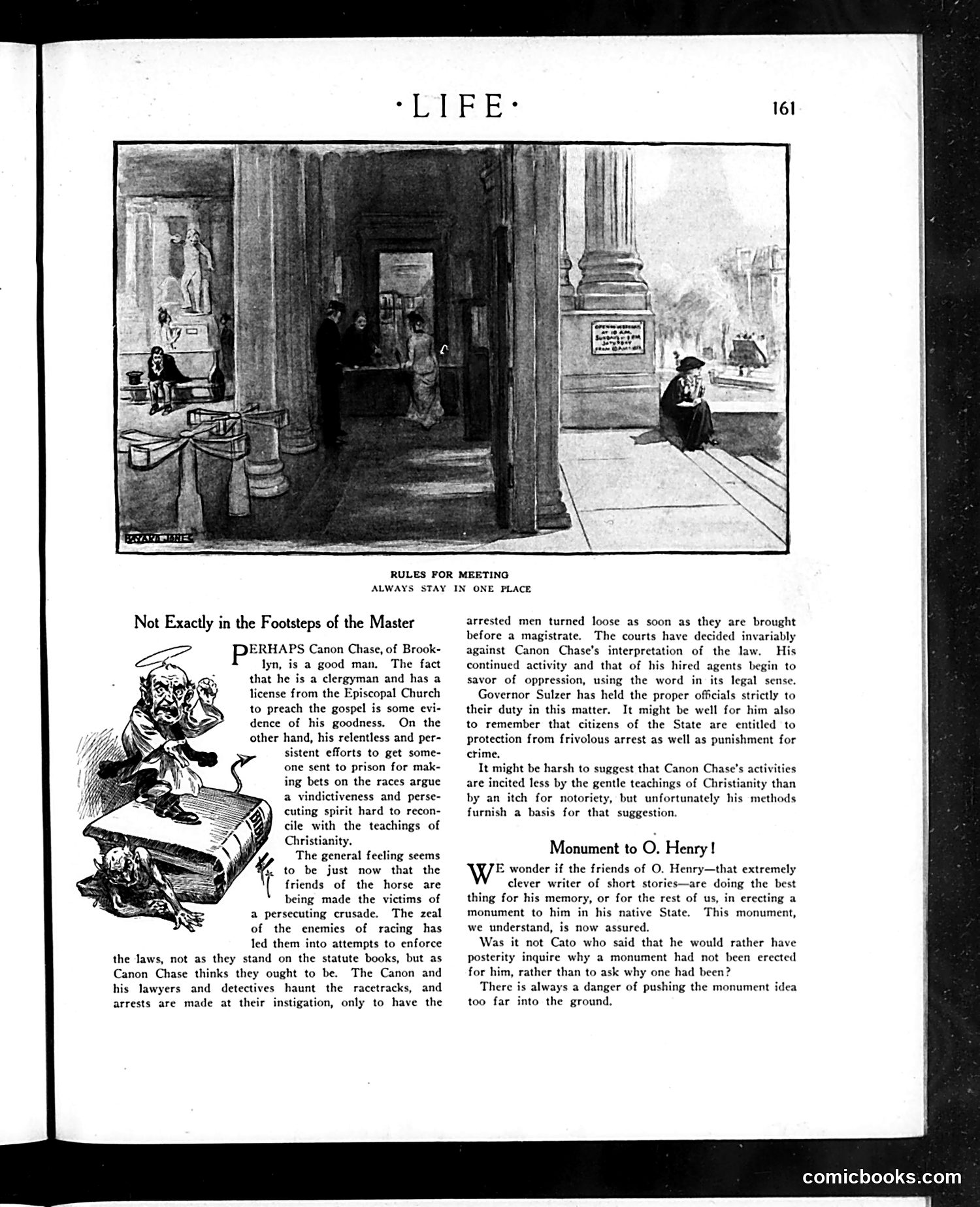
This page contains two separate satirical commentaries: **"Not Exactly in the Footsteps of the Master"** targets Canon Chase, an Episcopal clergyman from Brooklyn who aggressively prosecuted horse-racing bettors. The satire criticizes his relentless crusade as contrary to Christian charity—he hauls suspected gamblers before magistrates, but courts consistently rule against him. Life argues his vindictive "persecuting crusade" suggests personal notoriety-seeking rather than genuine moral conviction, and that Governor Sulzer should protect citizens from his frivolous arrests. **"Monument to O. Henry!"** questions whether erecting a public monument to the deceased short-story writer serves his memory well. The piece references Cato's maxim that it's better people wonder *why* no monument exists than to question why one does—suggesting over-monumentalizing risks diminishing rather than enhancing legacy. Both pieces mock excess zeal masquerading as moral purpose.
📄 Transcribed text from this page (OCR, searchable)
Machine-transcribed from the original scan — historical spelling and the odd misread are preserved.
RULES FOR MEETING ALWAYS STAY IN ONE PLACE Not Exactly in the Footsteps of the Master RHAPS Canon Chase, of Brook- lyn, is a good man, The fact that he is a clergyman and has a license from the Episcopal Church to preach the gospel is some evi- dence of his goodness. On the other hand, his relentless and per- sistent efforts to get some- one sent to prison for mak- ing bets on the races argue a vindictiveness and perse- cuting spirit hard to recon- cile with the teachings of Christianity. The general feeling seems to be just now that the friends of the horse are being made the victims of a persecuting crusade. The zeal of the enemies of racing has led them into attempts to enforce the laws, not as they stand on the statute books, but as Canon Chase thinks they ought to be. The Canon and his lawyers and detectives haunt the racetracks, and arrests are made at their instigation, only to have the arrested men turned loose as soon as they are brought before a magistrate. The courts have decided invariably against Canon Chase’s interpretation of the law. His continued activity and that of his hired agents begin to savor of oppression, using the word in its legal sense. Governor Sulzer has held the proper officials strictly to their duty in this matter. It might be well for him also to remember that citizens of the State are entitled to protection from frivolous arrest as well as punishment for crime, It might be harsh to suggest that Canon Chase’s activities are incited less by the gentle teachings of Christianity than by an itch for notoriety, but unfortunately his methods furnish a basis for that suggestion. Monument to O. Henry ! E wonder if the friends of O. Henry—that extremely clever writer of short stories—are doing the best thing for his memory, or for the rest of us, in erecting a monument to him in his native State. we understand, is now assured. Was it not Cato who said that he would rather have posterity inquire why a monument had not been erected for him, rather than to ask why one had been? There is always a danger of pushing the monument idea too far into the ground. This monument, comicbooks.com