
A complete issue · 48 pages · 1912
Life — September 26, 1912
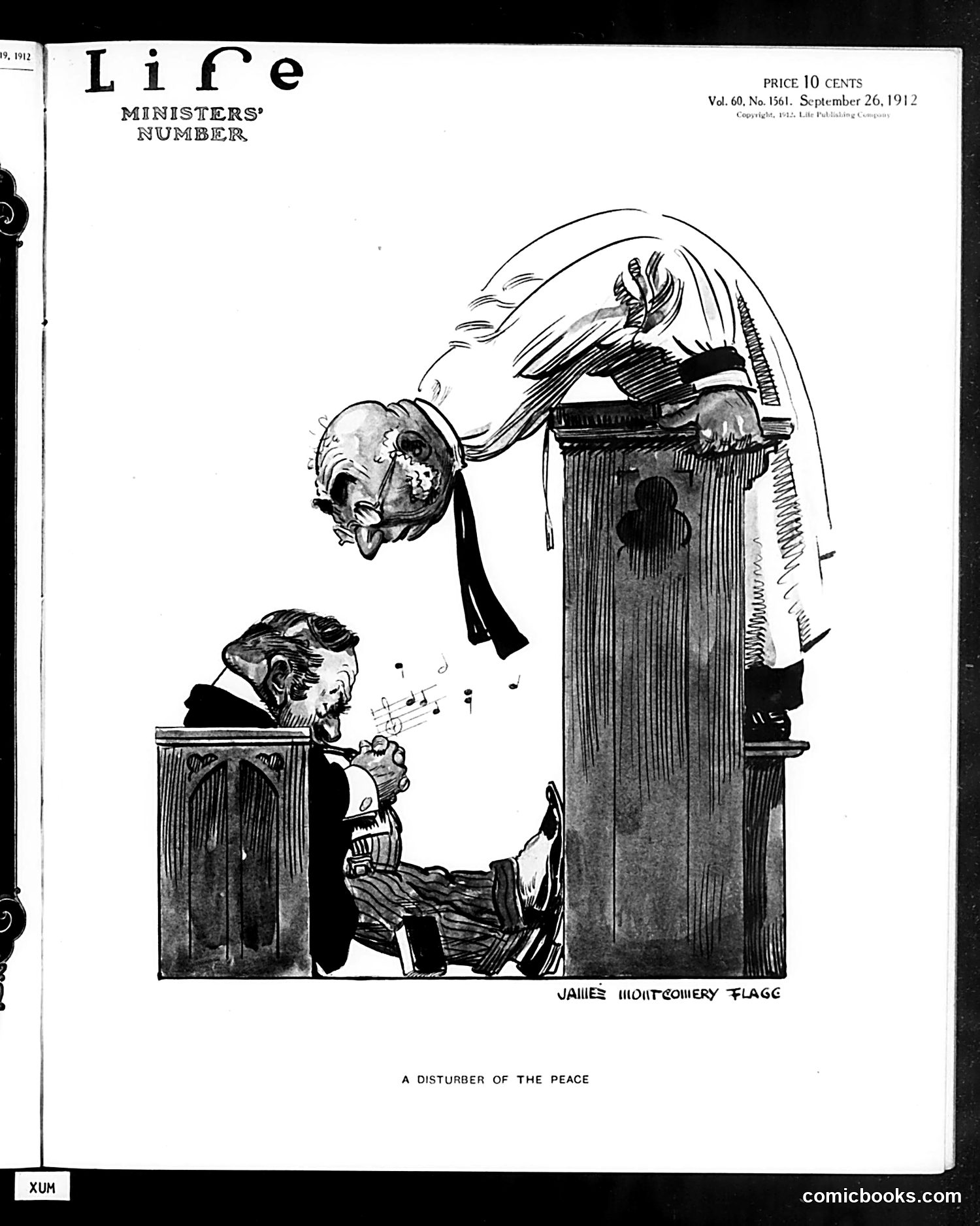
This political cartoon by James Montgomery Flagg depicts a clergyman or minister playing a violin while a large, menacing figure looms above, holding what appears to be a weapon or club. The title "A Disturber of the Peace" suggests the cartoon criticizes someone using religious or moral authority to provoke social discord. Given the 1912 date (a presidential election year), this likely comments on clergy involvement in contentious political or social debates of that era—possibly labor disputes, prohibition, or electoral campaigns. The cartoon's implication is that while the minister makes noise (literally playing music), he's enabling or inviting violent response, making him responsible for disruption despite ostensibly peaceful intentions.
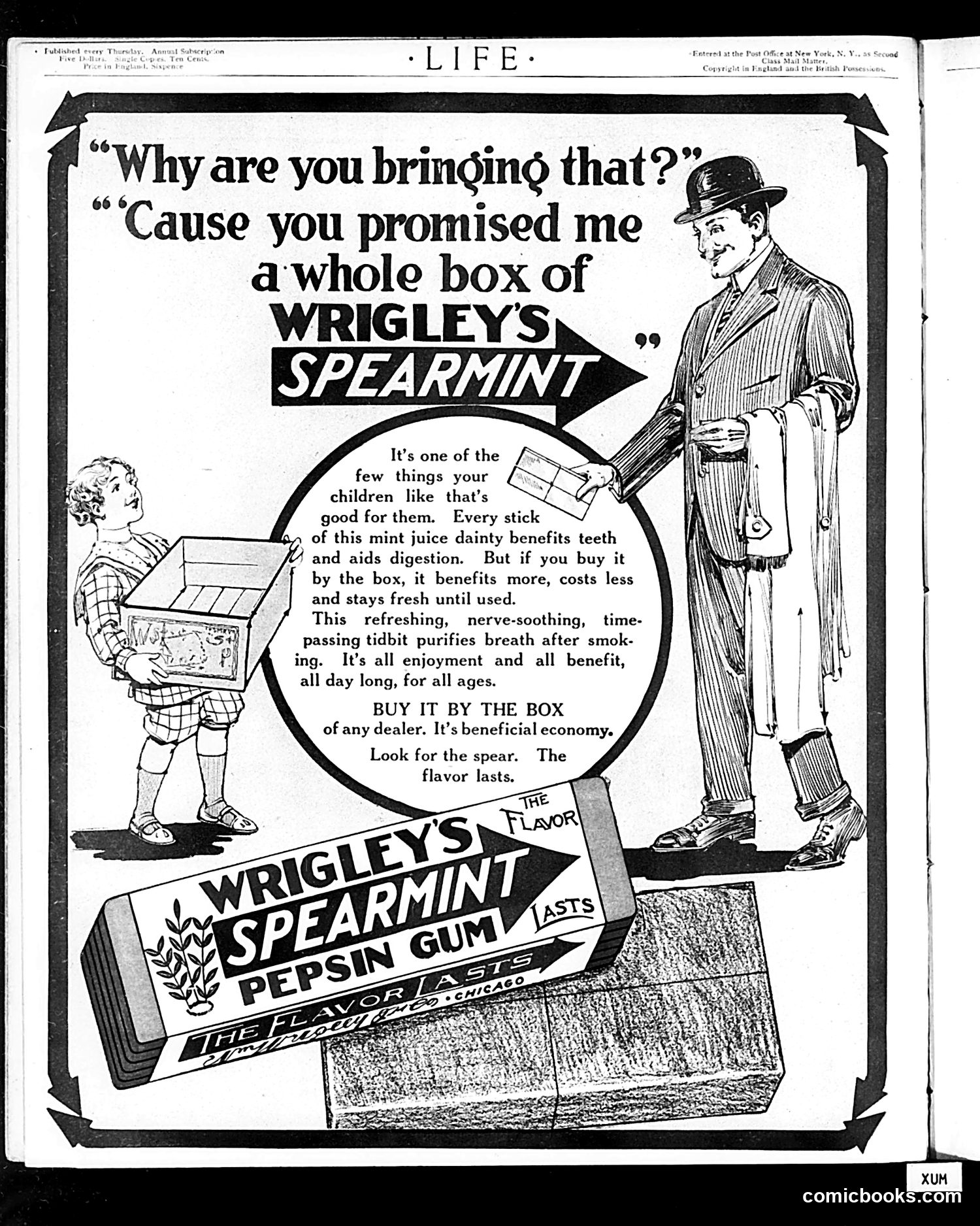
This appears to be a **Wrigley's Spearmint Gum advertisement** rather than political satire. The ad uses a humorous domestic scenario to market bulk gum purchases. The scene depicts a father figure confronting a young boy carrying a box of gum. The child claims the father promised him a "whole box of Wrigley's Spearmint." The advertisement then pivots to explaining the product's benefits: improved breath, digestion, and tooth health. The joke relies on the father's apparent confusion or reluctant acceptance of his promise. The ad's key sales pitch emphasizes buying gum by the box for better economy and freshness compared to individual sticks—a practical consumer advantage during the early 20th century. This is straightforward commercial messaging using domestic humor, not social or political commentary.
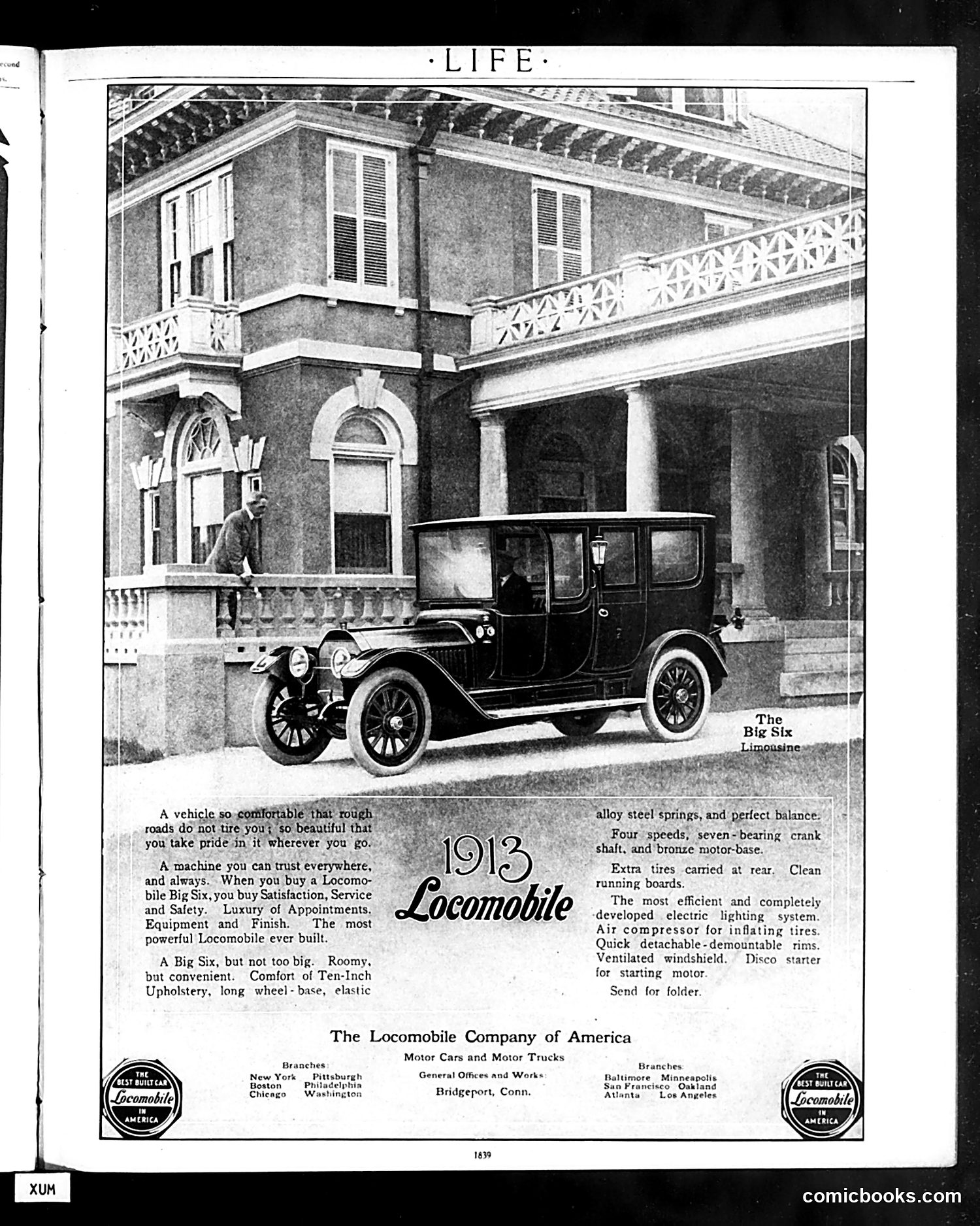
This is **not a cartoon or satire page** — it's a **1913 automobile advertisement** for the Locomotile Company of America, featuring "The Big Six" limousine model. The image shows a luxury car parked in front of an elegant mansion with classical architecture. The ad copy emphasizes comfort, reliability, and prestige ("a vehicle so comfortable that tough roads do not tire you"), targeting wealthy buyers who could afford such vehicles. There is no political satire or social commentary present. This is straightforward product advertising from the early automotive era, when owning a large, well-appointed automobile was a luxury good signaling wealth and status. The mansion setting reinforces the aspirational, high-end market positioning.
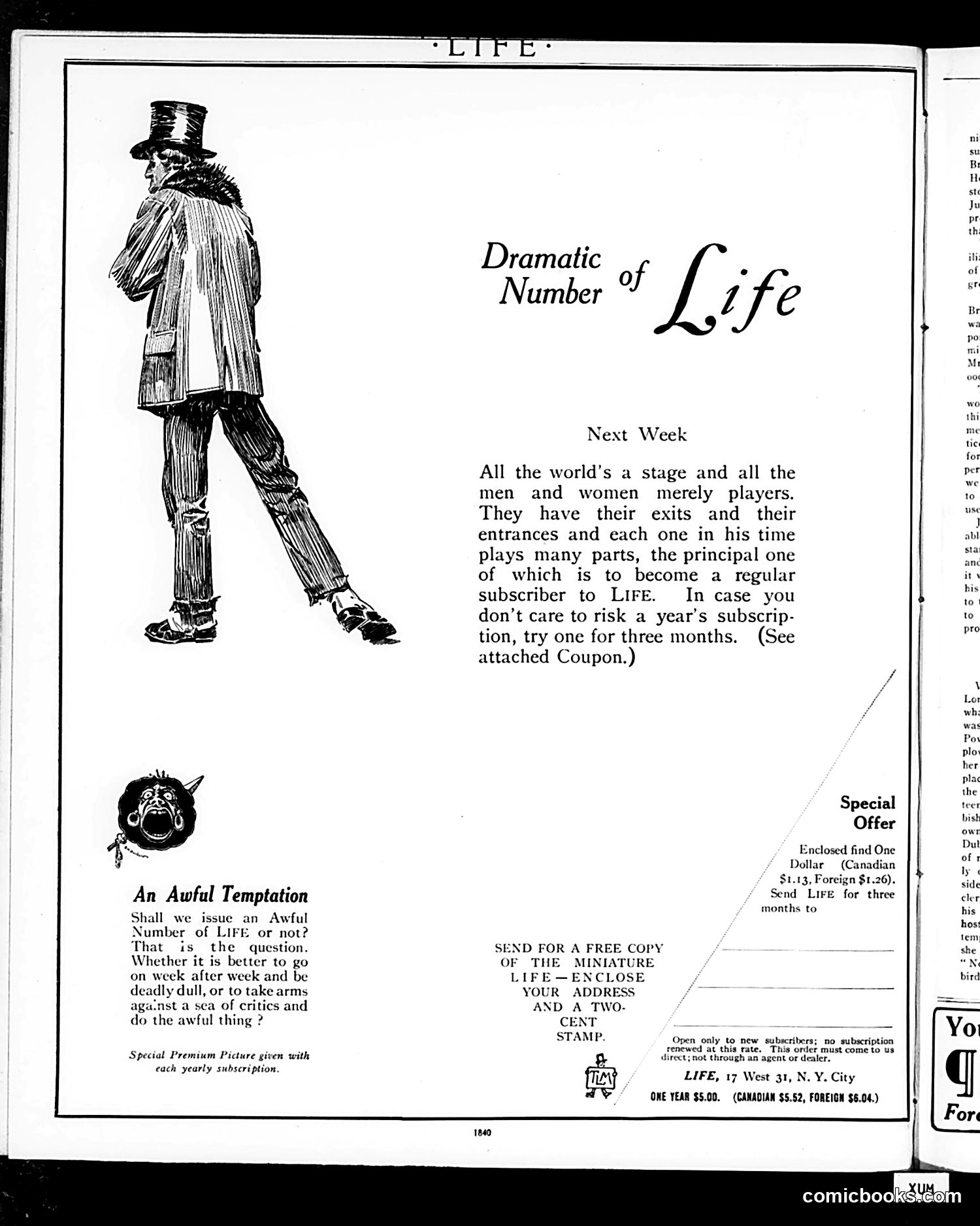
This page is primarily **advertising content** for *Life* magazine subscriptions, presented as a satirical pitch. The illustration shows a tall, thin figure in a top hat and overcoat—a classic representation of a theatrical character or "dandy" type common in satirical art of the era. **"An Awful Temptation"** (lower left) presents a mock philosophical dilemma: whether *Life* should publish a special "Awful Number" featuring dramatic content. The devil-faced character represents temptation itself, playing on the irony that even *Life's* satirical editors struggle with editorial decisions. The main pitch uses Shakespearean language ("All the world's a stage...") to encourage subscriptions, framing readership as participating in life's grand theatrical drama. It's essentially a clever, self-aware advertisement using satire about satire.
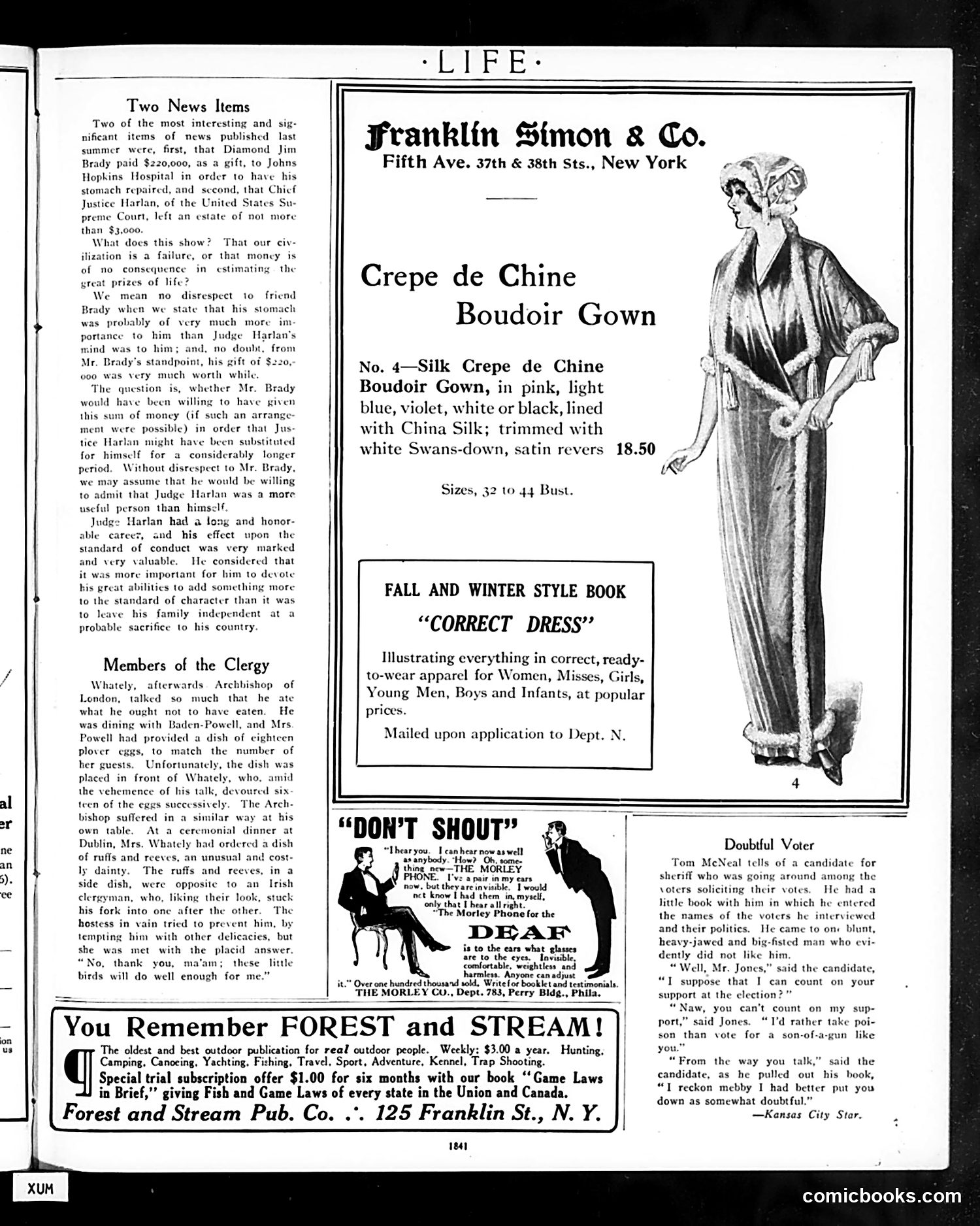
This page is primarily **advertising and social commentary** rather than political satire. The main content includes: 1. **Fashion advertisement** (top): Franklin Simon & Co. promotes a "Crepe de Chine Boudoir Gown" for $18.50, with an illustrated woman modeling the garment. 2. **"Don't Shout" cartoon** (center-right): Shows a man on a telephone, illustrating the Morley Phone's advantage for the deaf—apparently allowing hard-of-hearing users to hear conversations others cannot. The satire mocks exaggerated phone advertising claims. 3. **Miscellaneous items**: Brief anecdotes about charitable donations by wealthy figures (Diamond Jim Brady, Justice Harlan) and clergy members, plus an advertisement for *Forest and Stream* magazine. The "Doubtful Voter" item discusses electoral politics obliquely but without clear partisan reference. Overall, this appears to be a typical early-20th-century *Life* magazine page mixing lifestyle advertising with light humor and social observation.
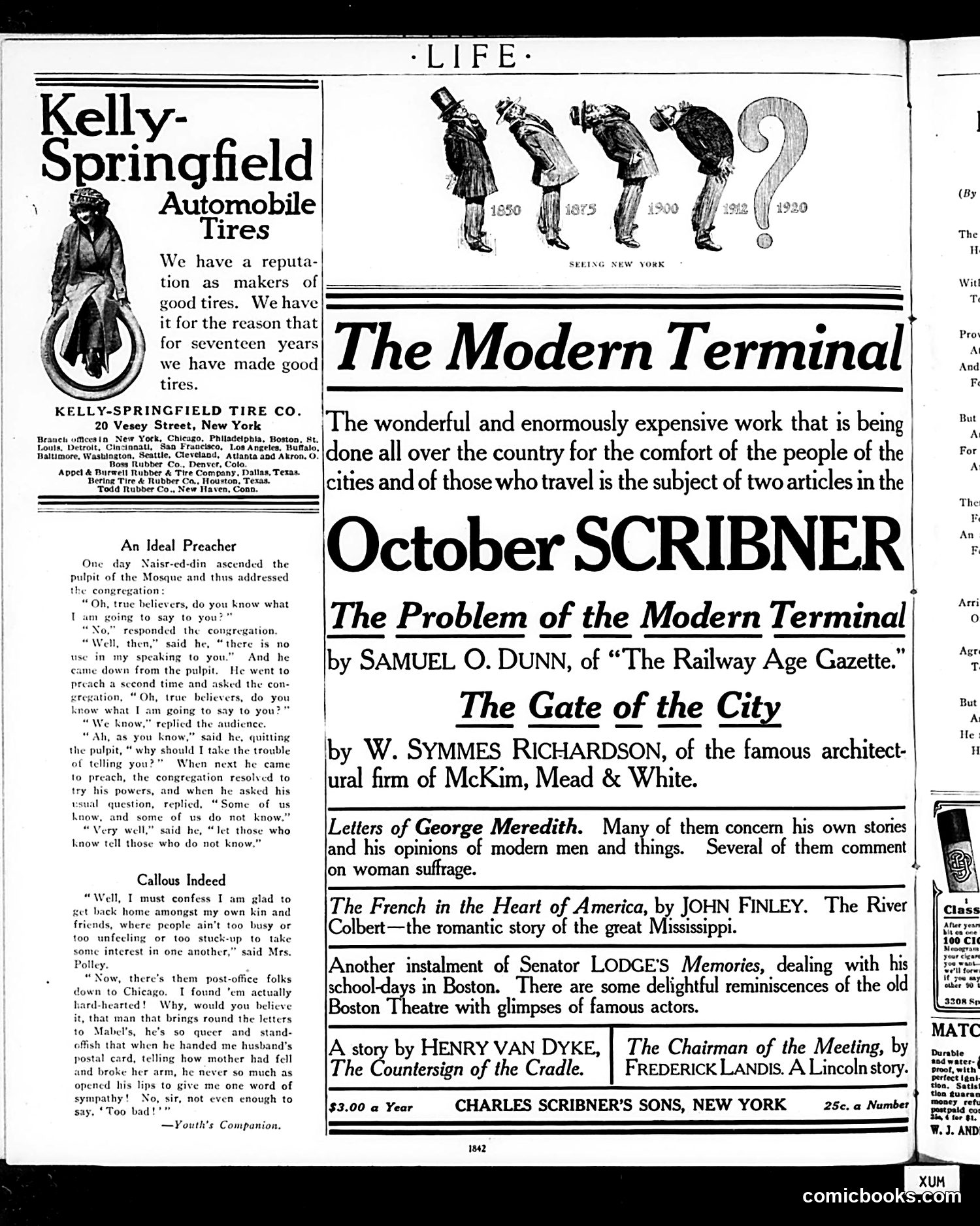
The top center cartoon depicts four figures bowing progressively lower across the decades (1850, 1875, 1900, 1912), followed by a question mark. Titled "SEEING NEW YORK," this satirizes changing fashion and posture in New York City over roughly 60 years. The joke appears to be that visitors' bowing posture—whether from deference, fatigue, or simply changing fashion—has become increasingly exaggerated. The final question mark suggests uncertainty about what comes next, perhaps mocking the rapid pace of urban change or the absurdity of fashion evolution. The page is otherwise dominated by advertisements (Kelly-Springfield tires) and promotional content for the October *Scribner's* magazine issue, making this a typical early 1900s magazine layout mixing editorial and commercial content.
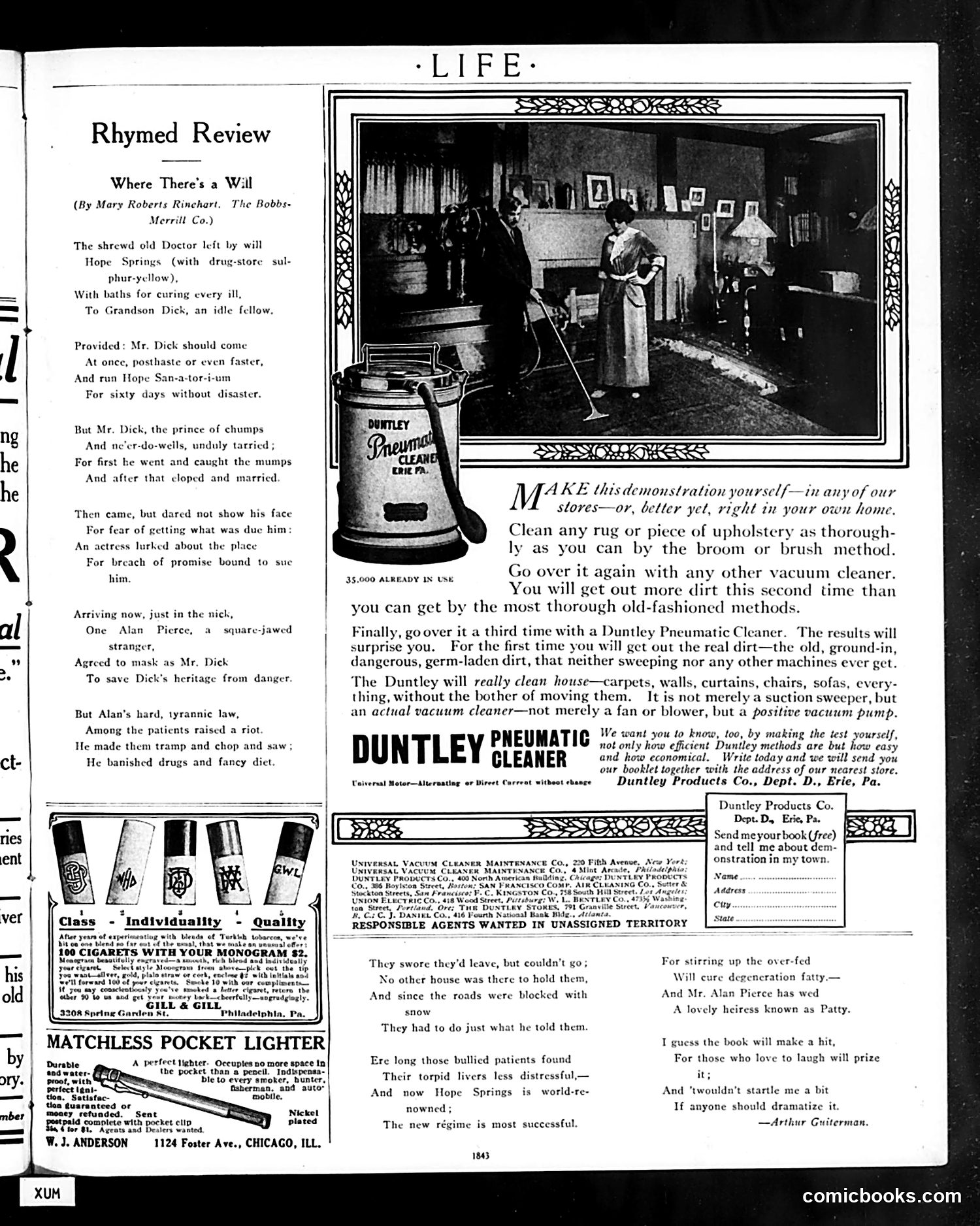
This page is primarily **advertising and commercial content**, not political satire. The dominant feature is a large advertisement for the **Duntley Pneumatic Cleaner**, a vacuum cleaning device, which occupies most of the right side and center. The left side contains a humorous rhymed verse titled **"Where There's a Will"** by Mary Roberts Rinehart, describing a comedic domestic situation involving a character named "Grandson Dick" and a doctor's will—an entertainment piece rather than political commentary. Below are additional product advertisements, including cigarettes and a pocket lighter. The page reflects early 20th-century magazine advertising strategies, mixing light humor with consumer product promotion rather than presenting satirical political commentary.
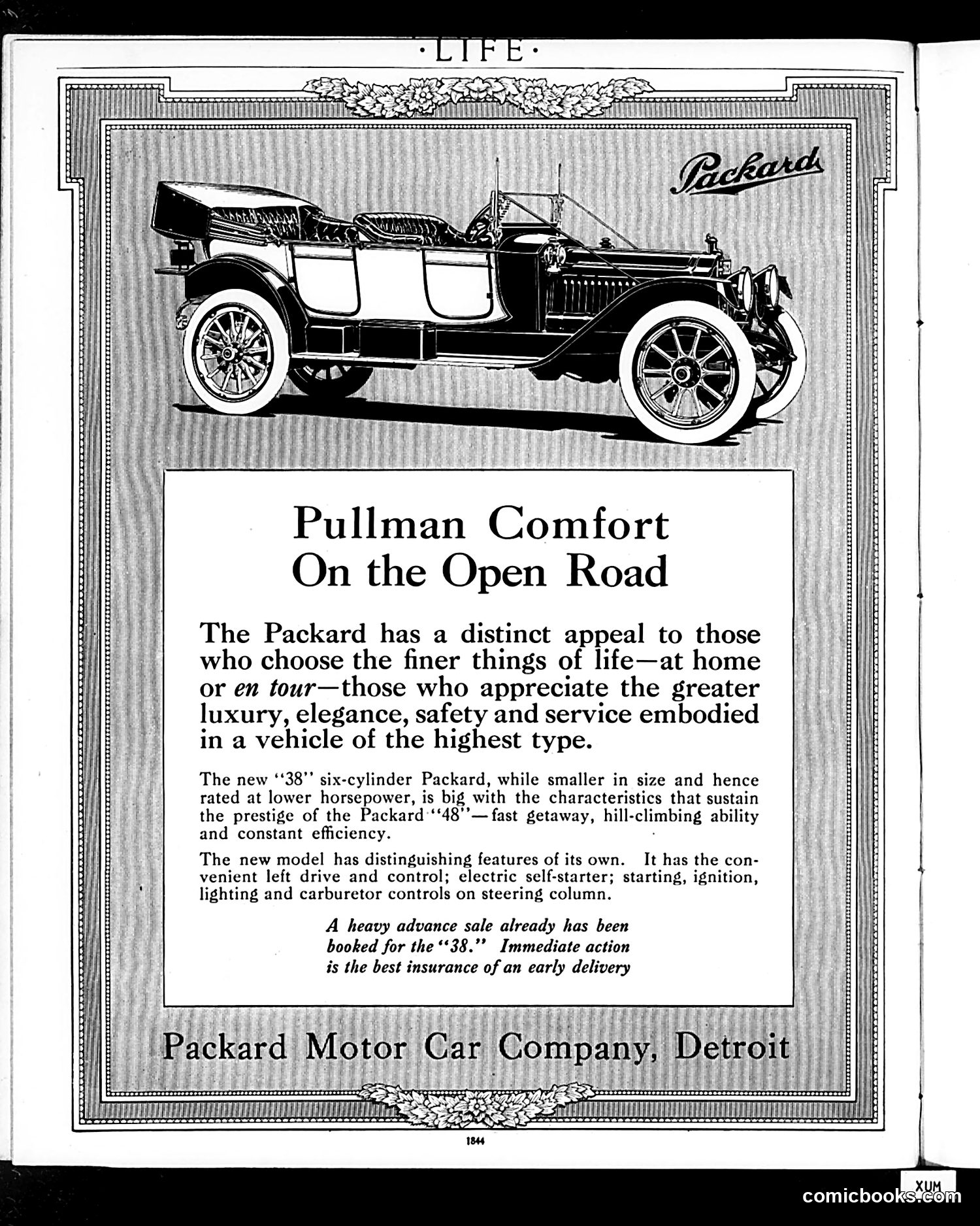
This is a **Packard automobile advertisement**, not political satire. The page promotes the new "38" six-cylinder Packard model to wealthy consumers who appreciate luxury and refinement. The ad emphasizes "Pullman Comfort On the Open Road"—comparing the car's amenities to railroad Pullman sleeping cars, a symbol of upper-class travel. Key selling points include a left-drive design, electric self-starter, and controls on the steering column—features that were relatively novel for the era. The text notes strong advance sales demand, suggesting the vehicle appeals to those seeking "the finer things of life." This is straightforward commercial advertising targeting affluent buyers, not editorial commentary or satire. The Packard Motor Car Company was a prestigious American luxury auto manufacturer based in Detroit.
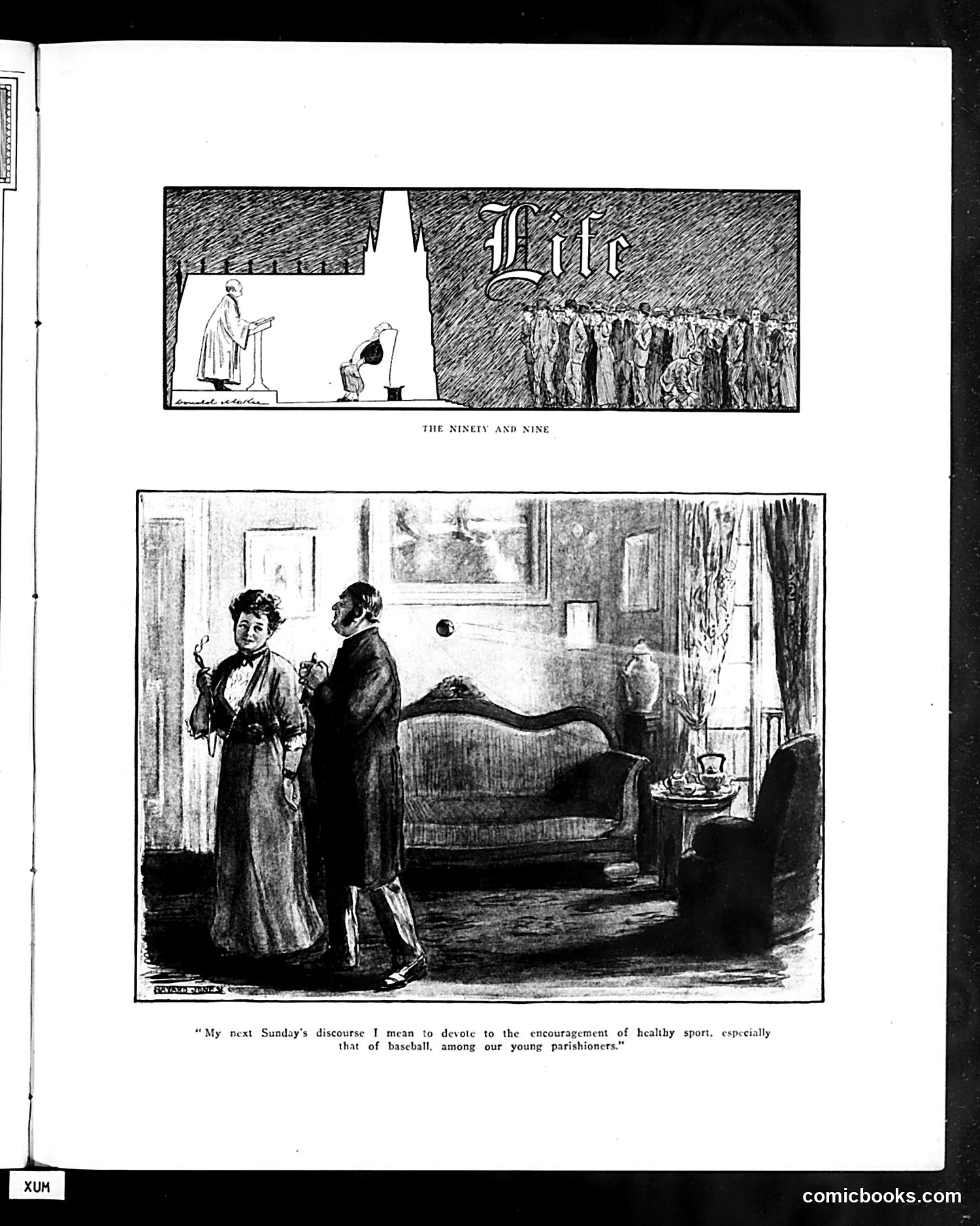
This page contains two cartoons satirizing religious hypocrisy. The top panel's title references the biblical parable of the "ninety and nine" sheep (Matthew 18:12), where a shepherd leaves the flock to find one lost lamb. The bottom cartoon depicts a clergyman telling a woman (likely his wife) that he intends to preach about "healthy sport, especially...baseball, among our young parishioners." The satire targets clergy who selectively focus on moral instruction while ignoring weightier spiritual or social concerns—prioritizing minor recreational guidance over substantive pastoral duties. Both cartoons mock religious establishments for losing sight of their fundamental purpose, using the "lost sheep" metaphor to highlight misplaced pastoral priorities.
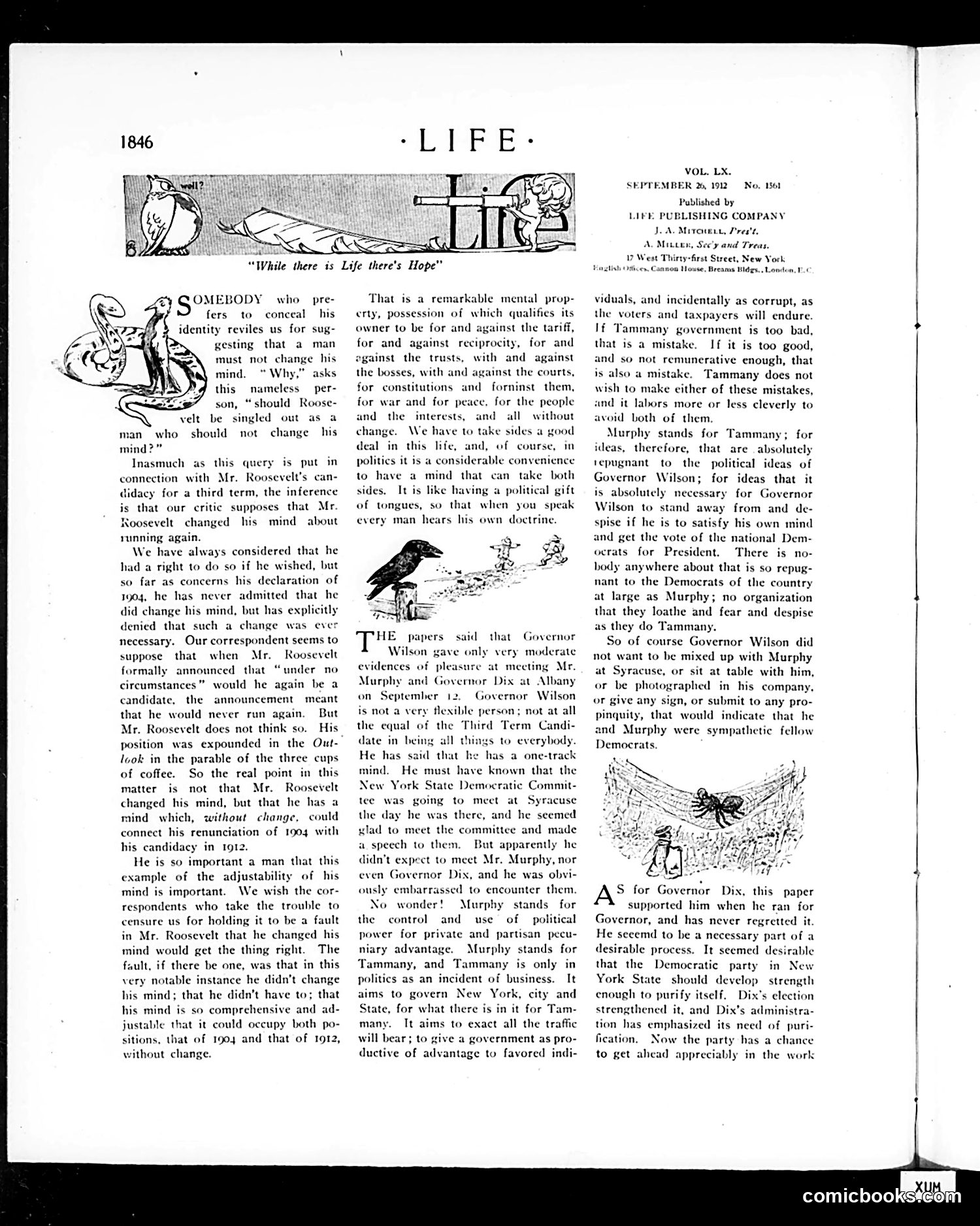
This editorial page discusses Roosevelt's 1912 presidential campaign. The text critiques Roosevelt for changing his mind about running for president—he previously declared he wouldn't seek another term, but later changed course to challenge Taft. The main illustration (a bird with scattered footprints) appears to satirize Roosevelt's inconsistency or erratic path. The article argues Roosevelt's flip-flopping undermines his credibility, despite his intelligence. It contrasts Roosevelt with Governor Murphy and the Democratic party, suggesting Roosevelt's unpredictability makes him unreliable compared to more stable political figures. The piece represents the 1912 split in the Republican party that would ultimately help elect Woodrow Wilson.
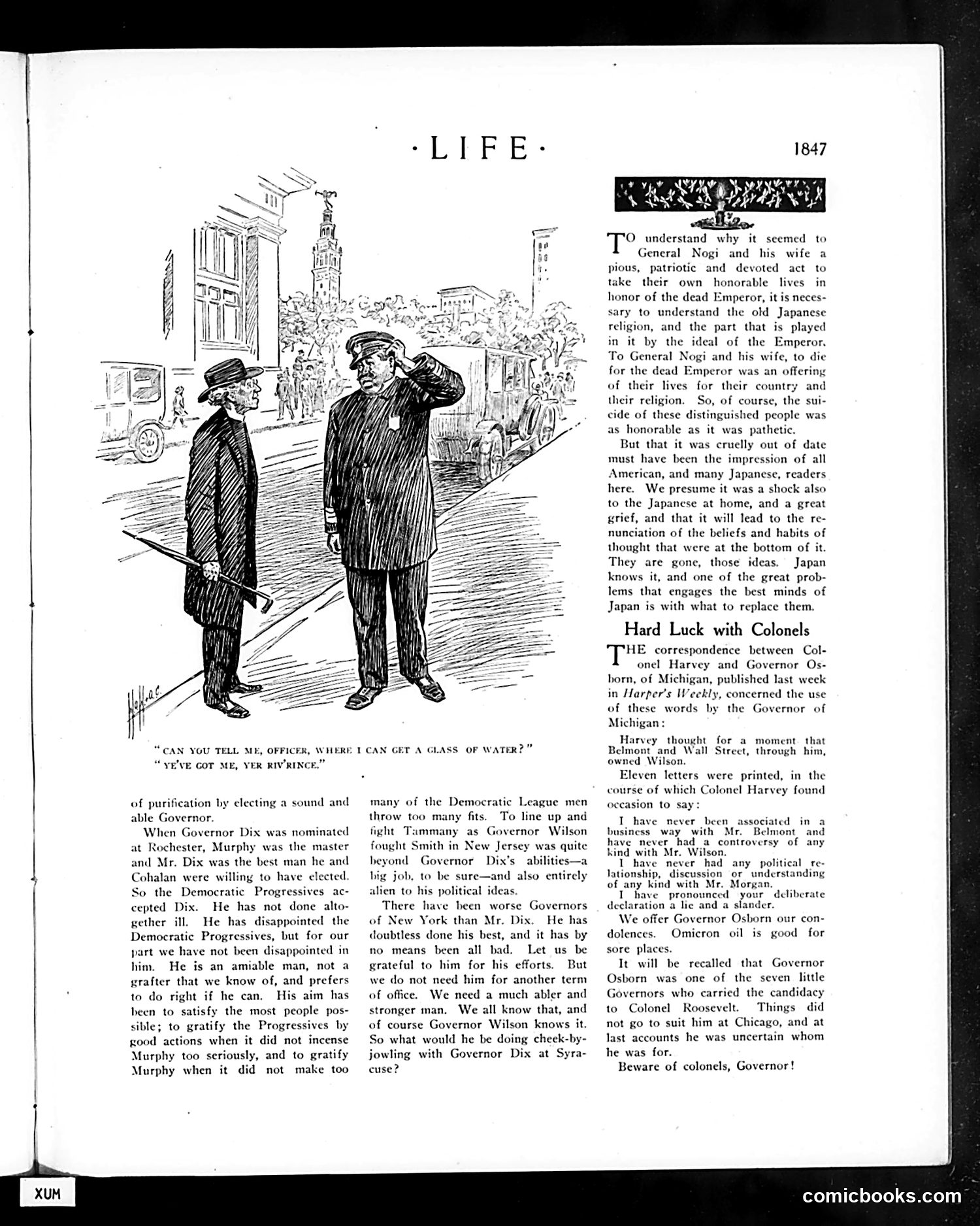
The cartoon depicts two men on a street: one asking "CAN YOU TELL ME, OFFICER, WHERE I CAN GET A GLASS OF WATER?" The officer replies "YOU'VE GOT ME, SIR RIVRENCE." This appears to satirize Governor Dix of New York. The accompanying text discusses his nomination and criticizes Democratic leadership choices. The "glass of water" joke likely mocks Dix's perceived inability or unwillingness to provide basic governance—a standard 19th-century satirical trope suggesting incompetence. The broader article criticizes various governors and discusses internal Democratic Party disputes, suggesting this cartoon ridicules Dix as an inadequate leader unable to handle even simple civic responsibilities.
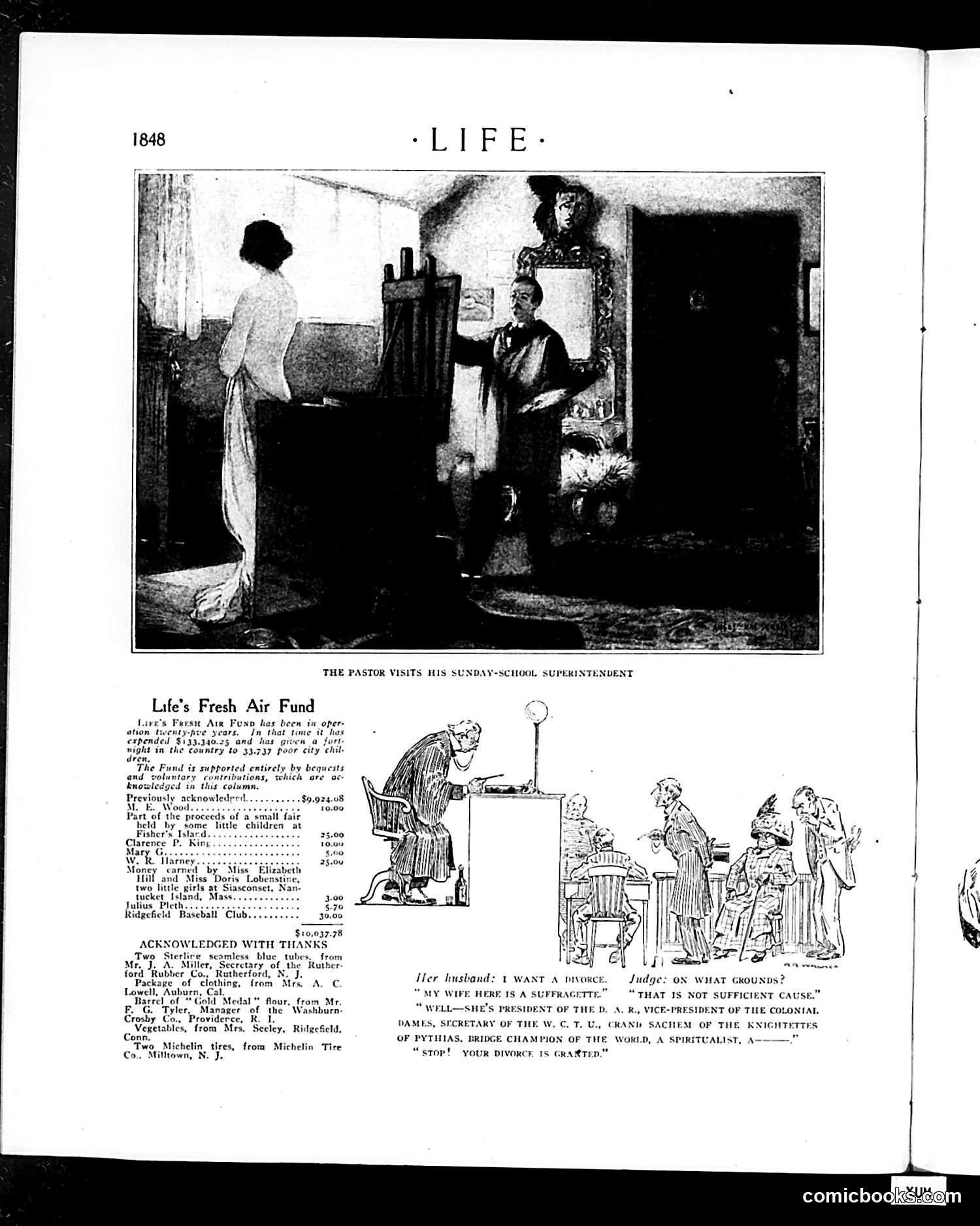
This page contains a photographic scene titled "The Pastor Visits His Sunday-School Superintendent" at top, showing what appears to be a domestic interior visit. Below is a satirical cartoon depicting a divorce proceeding. A woman tells a judge "I want a divorce. My wife here is a suffragette." The judge responds "That is not sufficient cause," with a lengthy caption sarcastically listing the woman's wife's accomplishments: she's president of the D.A.R., secretary of the W.C.T.U., and various other organizations and causes. **The joke:** The satire mocks anti-suffrage arguments by showing a husband complaining his activist wife is "too accomplished"—implying that women's organizational and civic involvement is actually admirable, not grounds for divorce. It's pro-suffrage humor targeting those opposing women's rights. The page also includes "Life's Fresh Air Fund" donation acknowledgments.
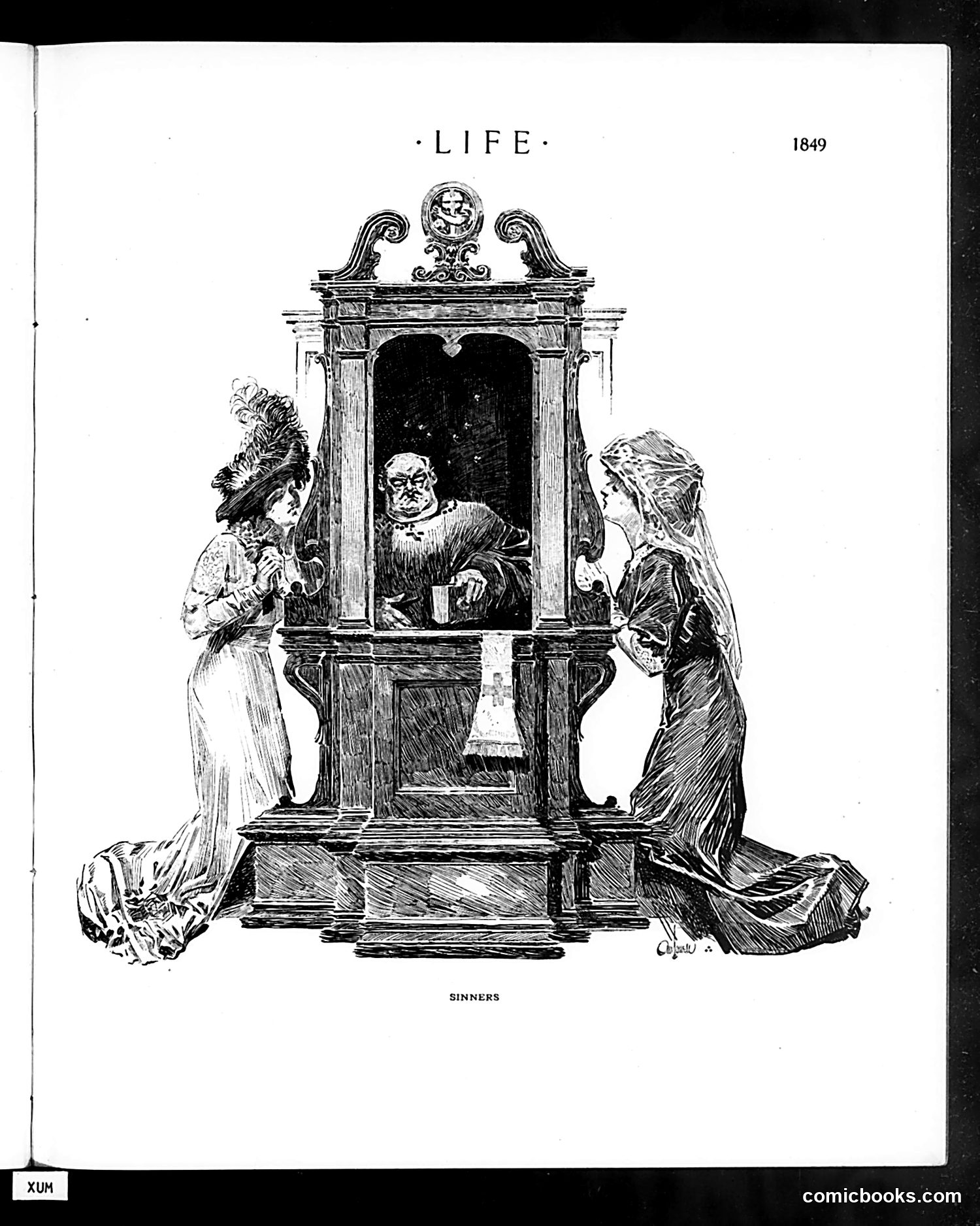
This satirical engraving depicts religious hypocrisy. Two fashionably dressed women in elaborate bonnets kneel before a confessional booth, their expressions pious and penitent. However, the priest inside appears stern and judgmental, suggesting the cartoon's criticism of institutional religion. The title "Sinners" indicates the satire targets the gap between public displays of virtue and private behavior. The women's fashionable dress and the ornate confessional structure suggest commentary on how the wealthy and socially prominent used religious institutions performatively—appearing righteous while the clergy enabled their moral compromises. This reflects 19th-century American Protestant skepticism toward Catholic confession and ritual religion generally, portraying such practices as facilitating rather than preventing sin.
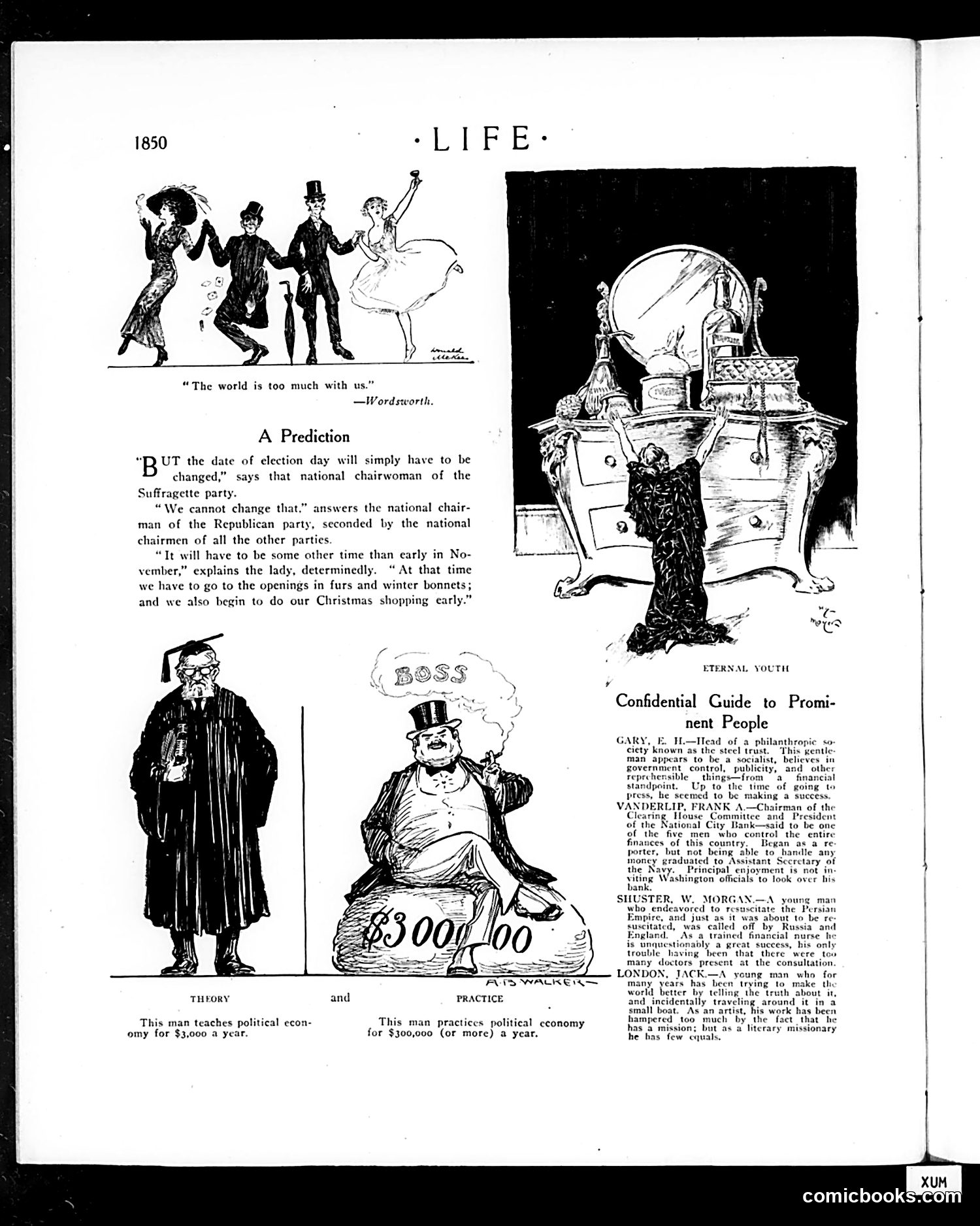
This page contains two satirical pieces critiquing American politics and wealth disparity: **"A Prediction"** (top) mocks suffragists and political parties, quoting Wordsworth about the world being "too much with us." The illustration shows four figures in energetic poses, suggesting chaos from political activity. **"Theory and Practice"** (bottom) contrasts two versions of the same figure: one teaching "political economy for $3,000 a year" versus one *practicing* it for "$300,000 (or more) a year." This directly satirizes the hypocrisy of wealthy businessmen or politicians who preach fiscal responsibility while enriching themselves—a common critique of the era's robber barons and corrupt officials. The right-hand "Confidential Guide" provides brief profiles of prominent contemporary figures, though specific identities are difficult to confirm from this reproduction.
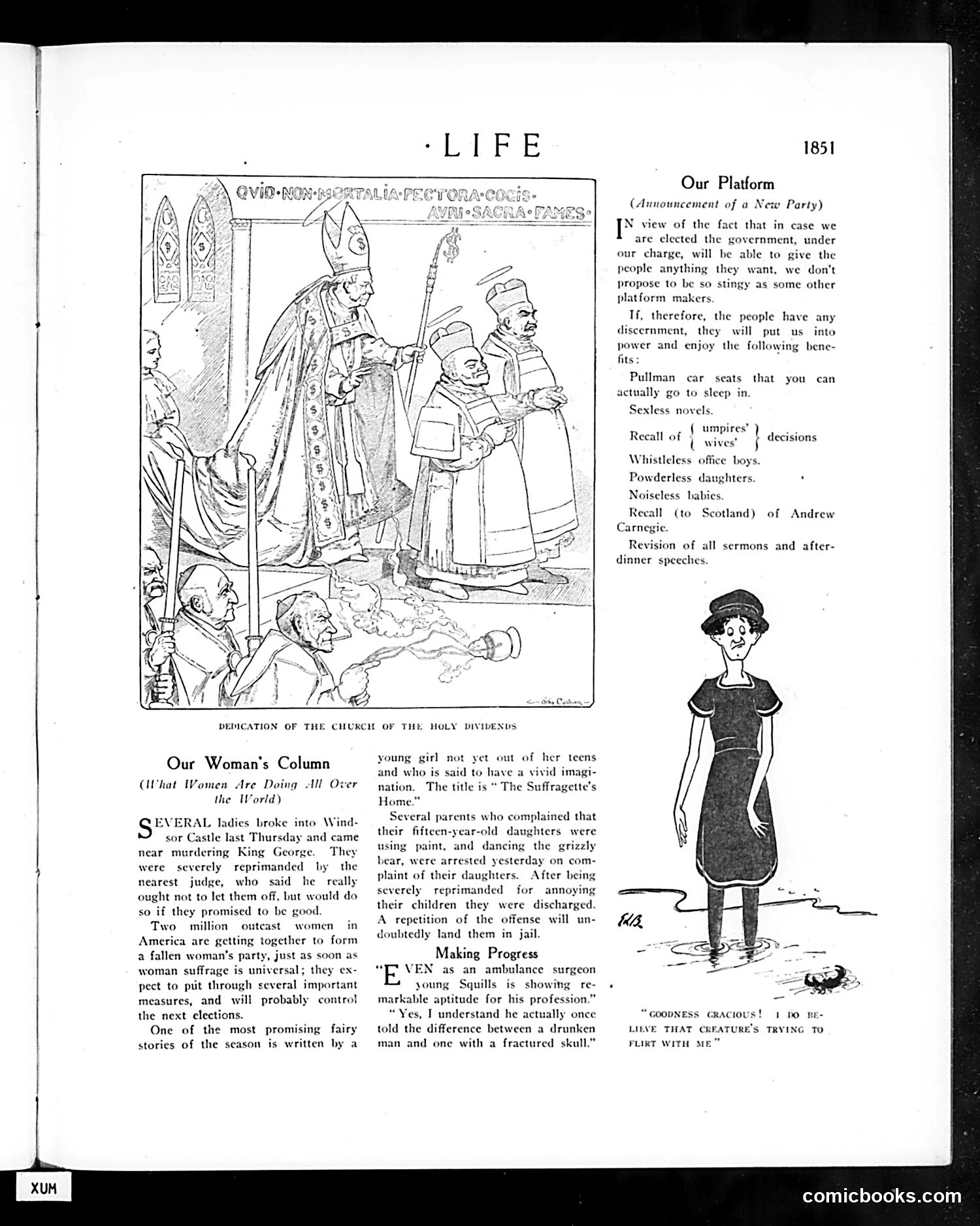
This satirical page mocks emerging political and social reform movements through absurdist humor. **"Our Platform"** parodies a new political party's promises by listing ridiculous "benefits": sleepable train seats, sexless novels, and recall of bothersome things (office boys, daughters, Andrew Carnegie). The satire suggests reformers make extravagant, impractical promises. **"Our Woman's Column"** uses exaggeration to mock women's activism and suffrage movements. References include women "breaking into Windsor Castle" (violent suffragettes), "fallen women" forming a political party, and parents arrested for disciplining daughters who use makeup and dance the "grizzly bear" (modern dance). The tone is dismissive—presenting women's rights advocates as ridiculous troublemakers. **The top engraving** titled "Dedication of the Church of the Holy Dividends" appears to satirize wealth worship, depicting religious ceremony applied to financial gain. Overall, the page ridicules progressive reforms—suffrage, labor improvements, women's independence—as absurd threats to social order.
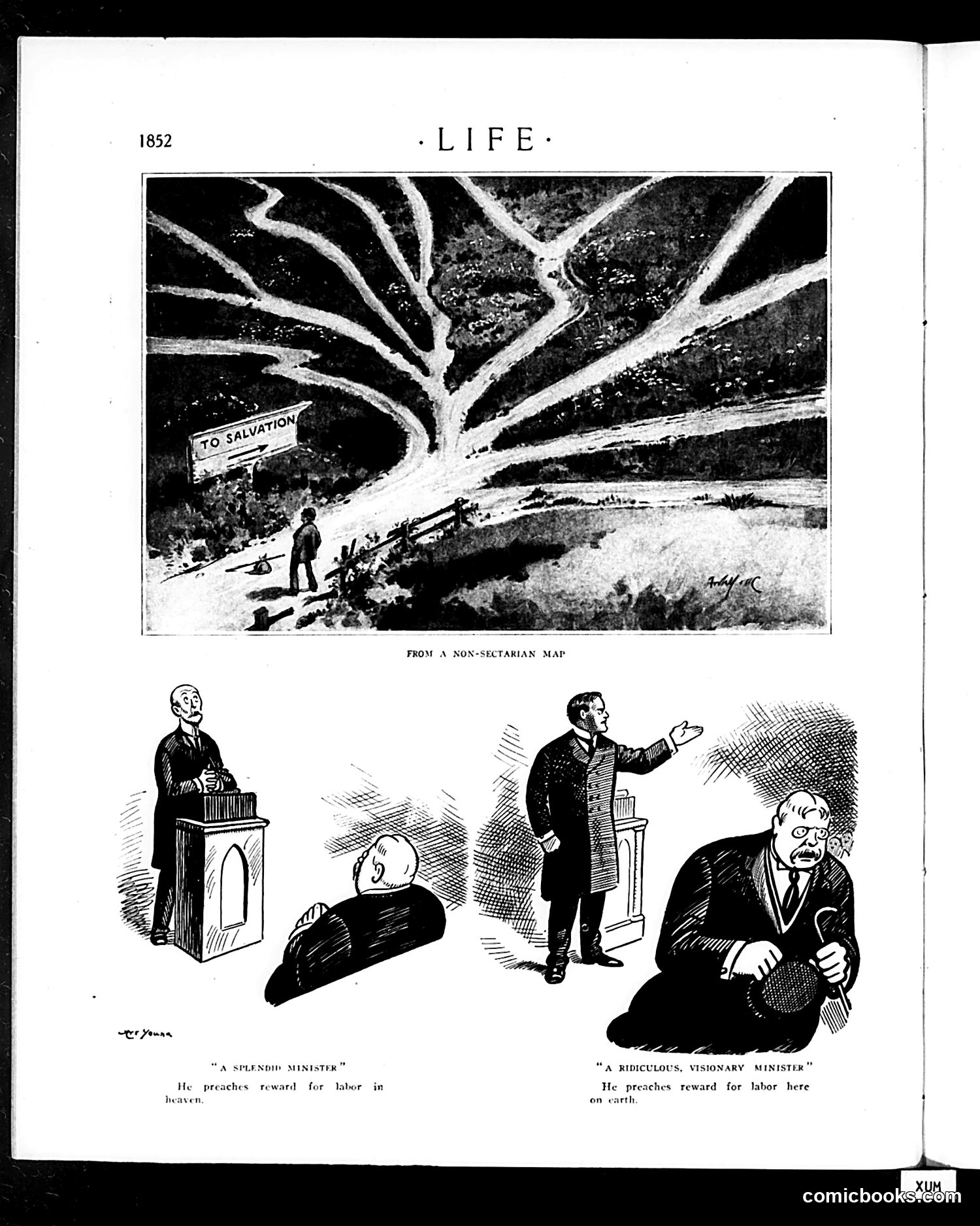
This 1852 *Life* magazine page satirizes two contrasting ministerial approaches to labor and social welfare. The top illustration shows a surreal tree-of-paths labeled "TO SALVATION," depicting spiritual routes diverging—likely referencing competing religious philosophies about earthly versus heavenly rewards. Below, two paired cartoons mock clerical hypocrisy. The left panel shows a "splendid minister" preaching that workers should expect heavenly rewards for their labor—a safe, conservative message. The right panel ridicules the "ridiculous, visionary minister" who actually preaches rewarding labor *on earth*—implying this radical social vision is absurd. The satire targets religious institutions for using spiritual promises to justify economic exploitation, while portraying those advocating for earthly worker benefits as foolish dreamers. This reflects mid-19th-century tensions between traditional religious authority and emerging labor-reform movements.
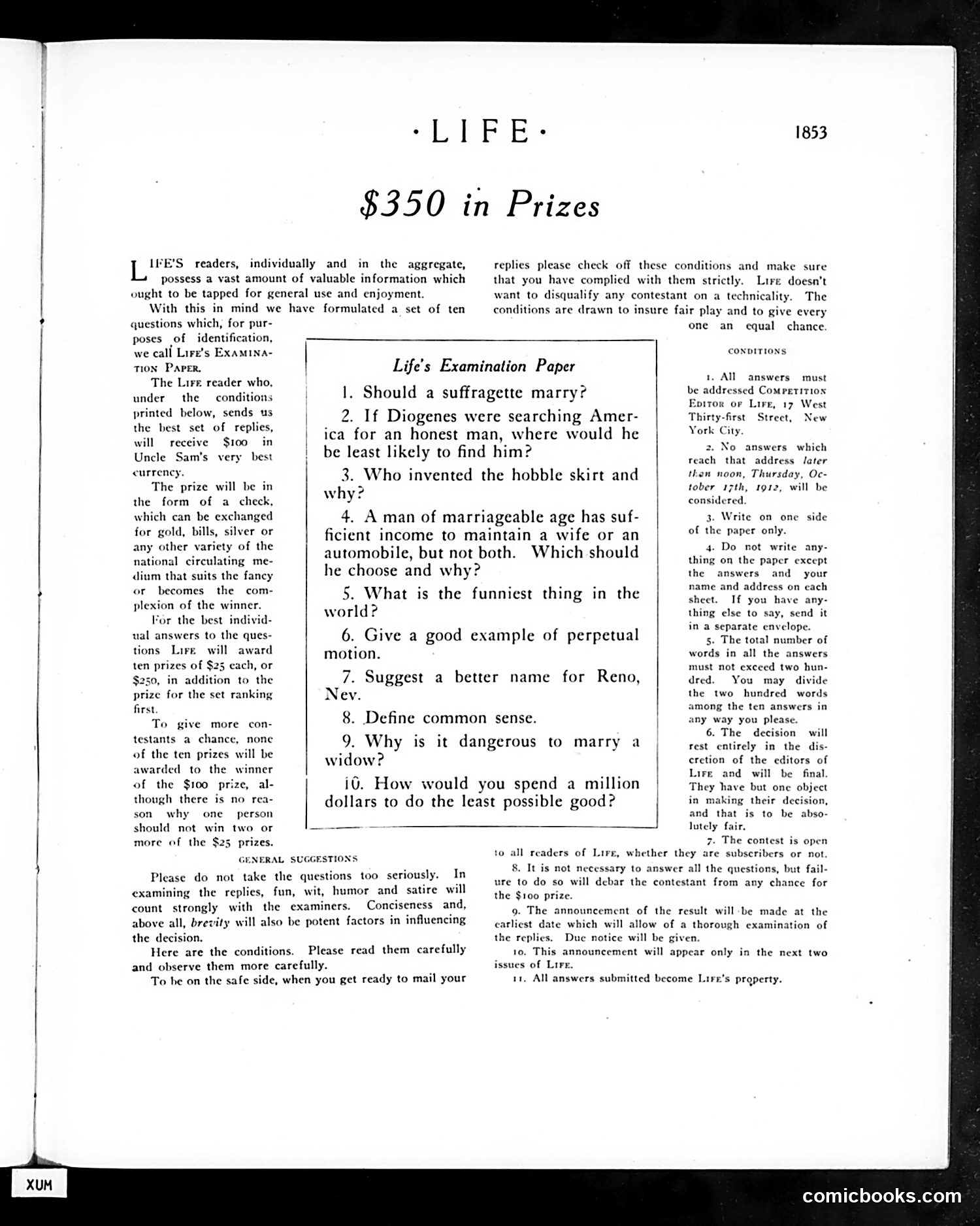
This page announces a $350 satirical contest where Life magazine invites readers to answer ten humorous questions. The "examination paper" uses mock-serious language to pose witty social commentary disguised as quiz questions. The questions target contemporary issues and absurdities: women's suffrage ("Should a suffragette marry?"), the nascent automobile age (choosing between a wife or car), Reno, Nevada's reputation as a divorce destination, and broader social contradictions (finding honest men in America, defining "common sense"). The satire works by framing ridiculous or provocative social questions in academic contest language. Readers are encouraged to respond with "fun, wit, humor and satire" within 200 words total—emphasizing that brevity and cleverness matter more than earnest answers. This reflects Life's role as a satirical publication using humor to critique social conventions, gender roles, materialism, and moral hypocrisy of its era.
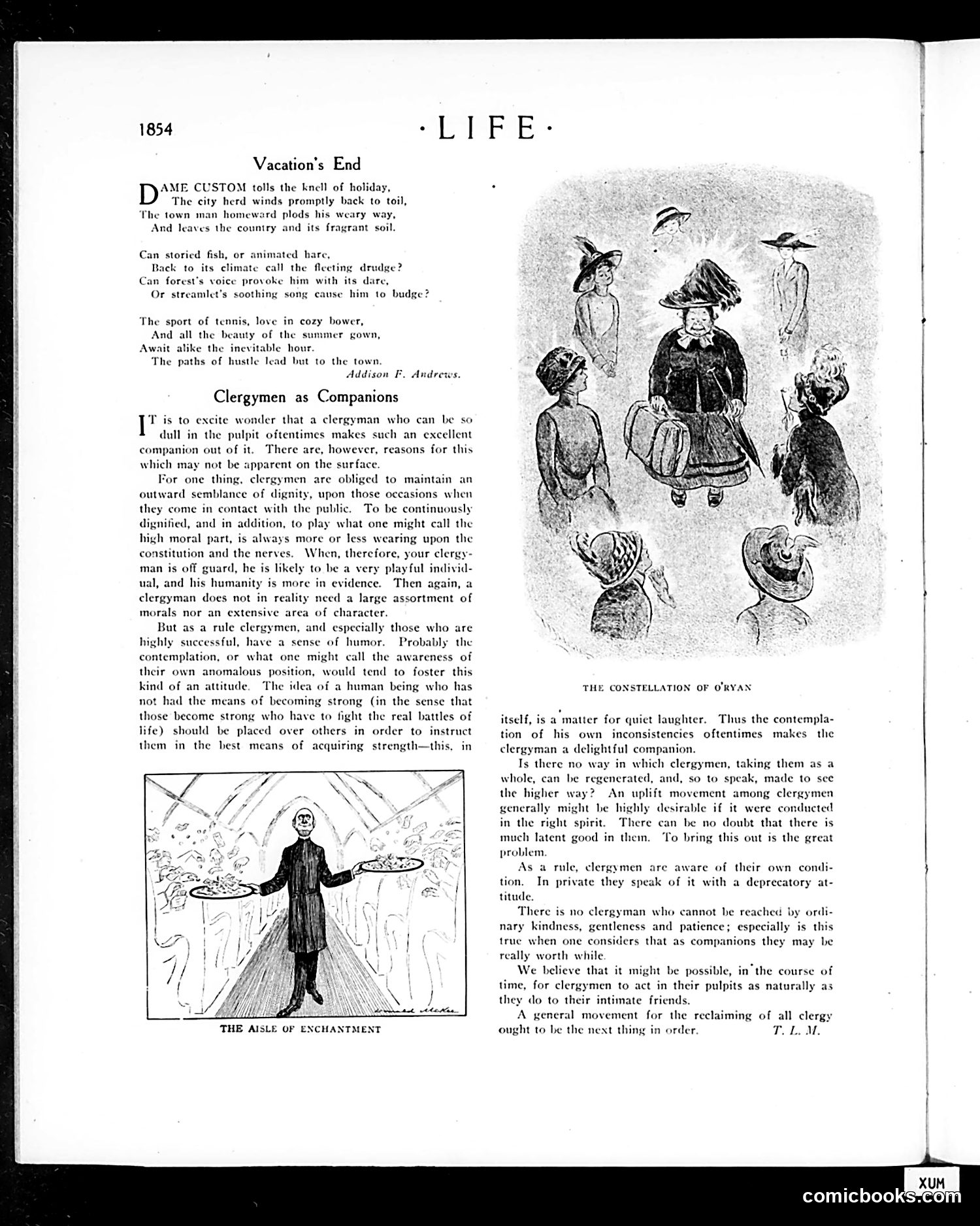
This page contains two distinct pieces of 1854 satirical content: **"Vacation's End"** is a melancholic poem about workers reluctantly returning from summer holidays to urban labor, lamenting nature's lost pleasures. **"Clergymen as Companions"** is a satirical essay mocking clergy. The author argues that while clergymen are dull in pulpits, they're delightful socially—because maintaining constant moral dignity is exhausting, so they're playful "off guard." The satire cuts deeper: the essay suggests clergy lack real moral strength (never having fought life's actual battles) yet presume to instruct others in ethics. This hypocrisy itself becomes a source of their humor. The author ironically advocates "regenerating" clergy through kindness, implying they desperately need moral improvement. The two illustrations—"The Aisle of Enchantment" (a priest blessing) and "The Constellation of O'Ryan" (unclear figure)—likely accompany or reinforce these satirical themes about clergy pretension, though their specific references are unclear without additional context.
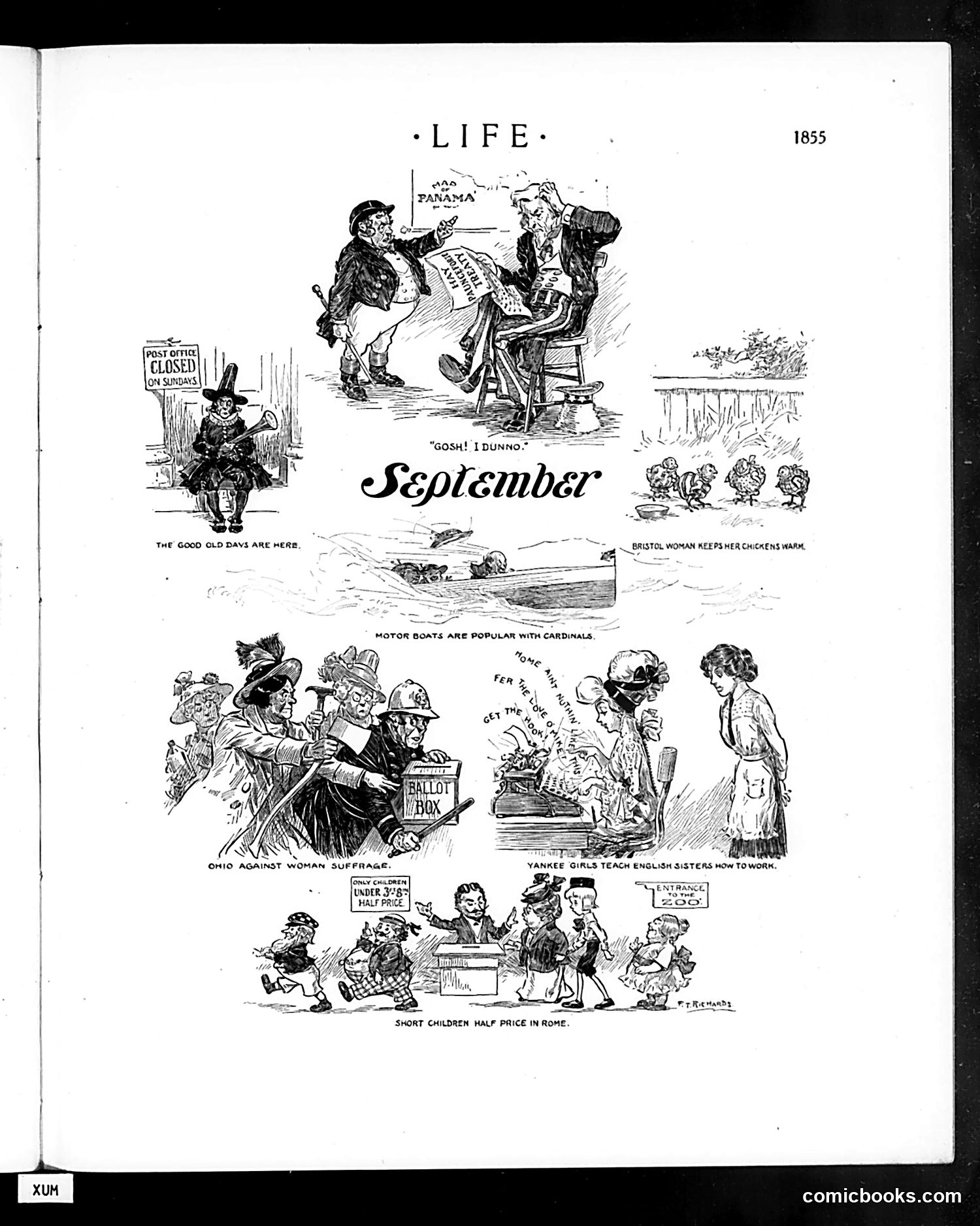
This is a satirical compilation mocking contemporary political and social issues. The top cartoon depicts "Gosh! I Dunno"—likely referencing political uncertainty or evasiveness. "The Good Old Days Are Here" appears ironic commentary on nostalgia. "Ohio Against Woman Suffrage" shows opposition to women's voting rights, a heated 1855 debate. "Motor Boats Are Popular with Cardinals" satirizes the Catholic Church adopting modern technology. Other vignettes mock British eccentricities ("Bristol Woman Keeps Her Chickens Warm") and Italian pricing practices ("Short Children Half Price in Rome")—likely exaggerating foreign customs for American readers' amusement. The "Post Office Closed" and ballot box imagery suggest election-related commentary. Overall, the page uses caricature and visual humor to critique political debates, women's rights opposition, and international stereotypes typical of mid-19th-century American satire.
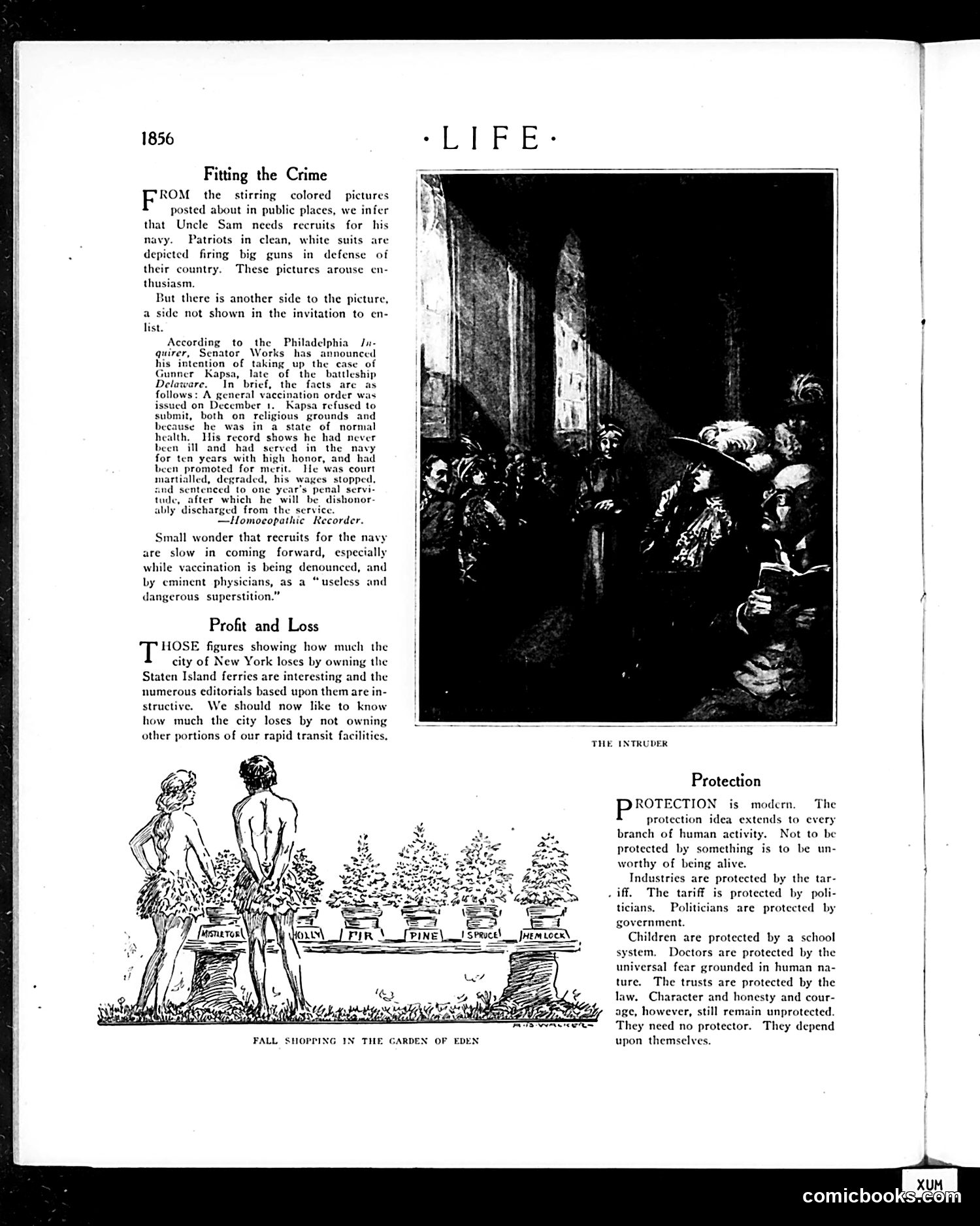
This page contains three satirical pieces: **"Fitting the Crime"** criticizes Navy recruitment propaganda. The text contrasts stirring patriotic recruitment posters (showing clean sailors firing guns) with the actual treatment of service members. It cites the case of Gunner Kapsa, a ten-year veteran forcibly vaccinated against his religious objections, then court-martialed, degraded, and dishonorably discharged for refusing. The satire exposes how the Navy's harsh discipline and involuntary medical procedures contradict the heroic image presented in recruitment materials—explaining why recruitment is slow. **"Profit and Loss"** briefly critiques New York City's financial management of public transit, noting losses from the Staten Island ferries while questioning losses from other facilities the city doesn't own. **"Protection"** argues ironically that modern society protects everything—industries (tariffs), politicians (government), children (schools), doctors (fear)—except character, honesty, and courage, which "need no protector." The accompanying cartoon of Adam and Eve appears to reference this ironic point about human virtue.
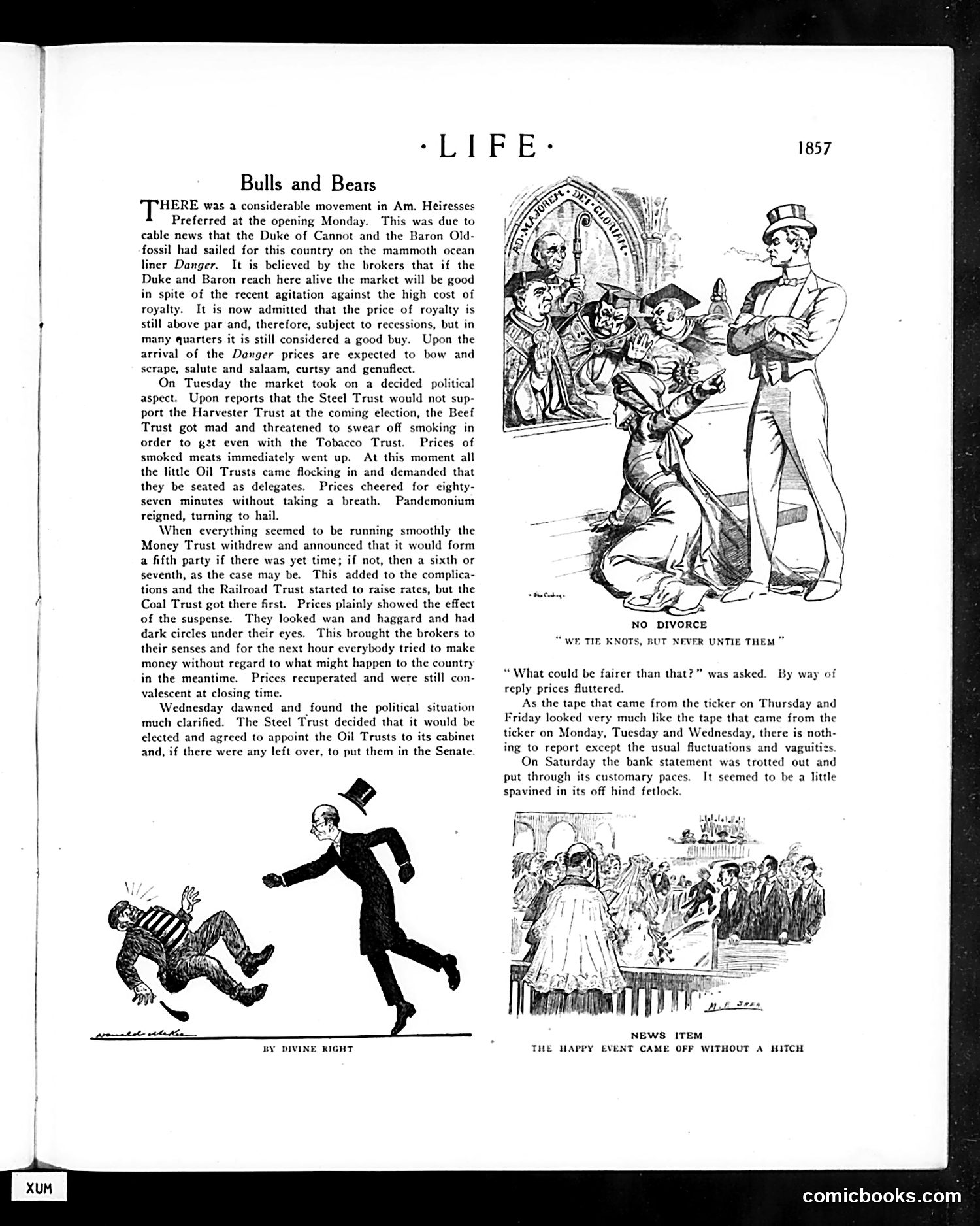
This page satirizes the stock market and American social anxieties of the Gilded Age through absurdist financial allegory. **"Bulls and Bears"** mockingly describes market speculation through personified "trusts" (monopolistic corporations) as competing political factions—Steel Trust, Beef Trust, Tobacco Trust, Oil Trusts, Money Trust, Railroad Trust, Coal Trust—each scheming for dominance like candidates. The joke: the stock market operates on pure gossip and irrational sentiment (European nobility arriving causes excitement), not fundamentals. **The cartoons** reinforce this chaos: "By Divine Right" shows a top-hatted figure kicking a prone businessman—depicting arbitrary market forces. "No Divorce" depicts marriage as permanent entanglement, paralleling how investors become trapped in market positions. **Social context**: The text mocks wealthy Americans' obsession with marrying European aristocracy and ridicules the era's unchecked corporate power, where trusts manipulated prices and political outcomes. The "high cost of royalty" jab suggests contempt for this social climbing during an era of growing anti-trust sentiment.
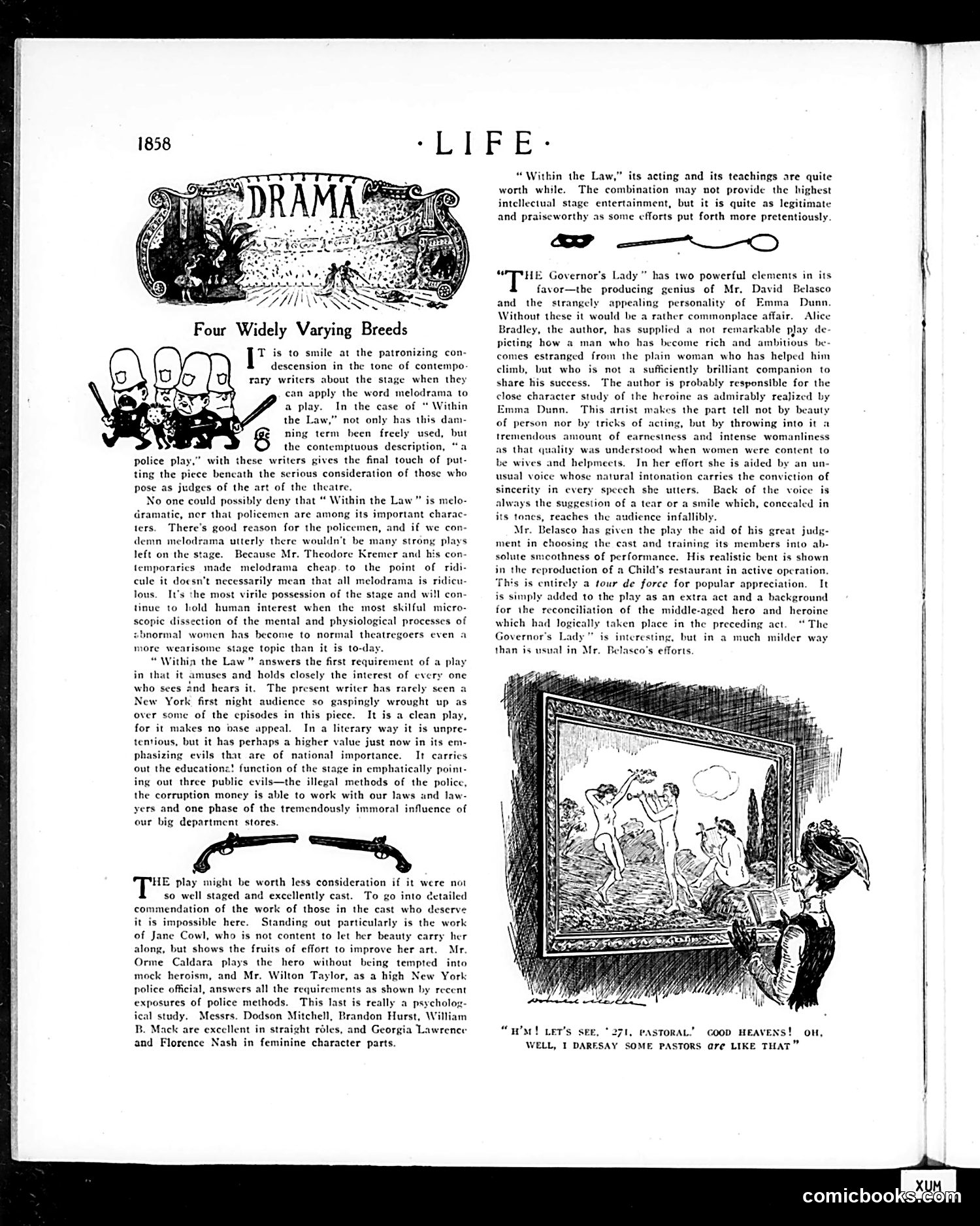
This page reviews two theatrical productions with contrasting artistic merit. **"Within the Law"** is defended against critical dismissal as mere "melodrama" or "police play." The reviewer argues the play succeeds because it (1) genuinely engages audiences, (2) addresses real social problems—illegal police tactics, corruption, and department store exploitation—and (3) features strong performances, particularly Jane Cowl's serious acting effort and Wilton Taylor's psychological portrayal of a corrupt police official. **"The Governor's Lady,"** produced by David Belasco with Emma Dunn, is deemed less substantial. Though well-acted, it relies heavily on its star's personality and Belasco's production genius. The plot—a self-made man abandoning his plain wife for a more sophisticated companion—is described as unremarkable and conventional. The implicit critique: popular entertainment gains legitimacy when it educates audiences about genuine social injustices, not merely through spectacle or star power.
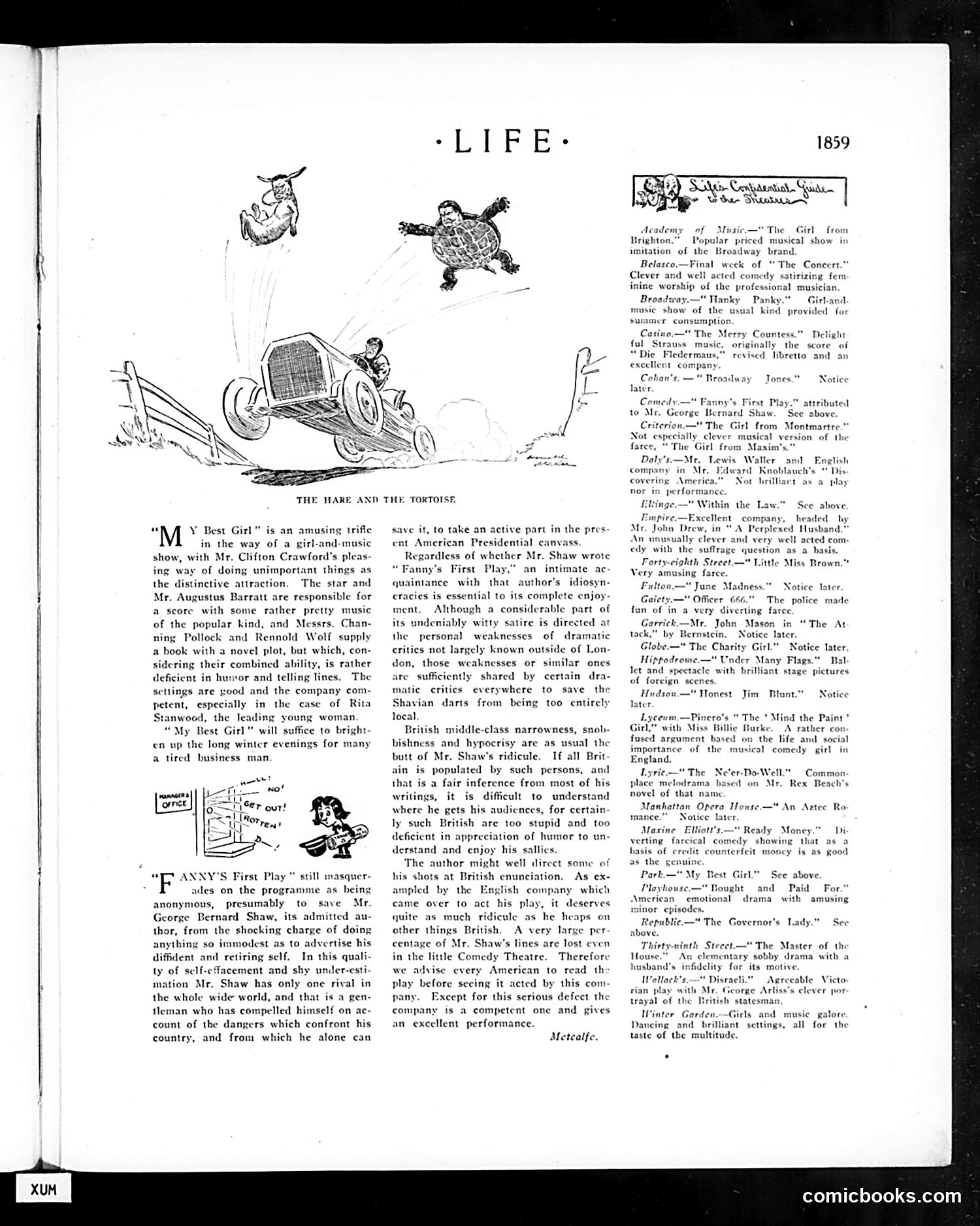
This page contains theater reviews and a whimsical cartoon titled "The Hare and the Tortoise" (showing figures in a racing vehicle). The main satirical content targets George Bernard Shaw's play "Fanny's First Play." The reviewer notes Shaw's famous pretense of anonymity for the play, then compares him sarcastically to someone else claiming modesty while actively involved in the current American Presidential campaign (appears to reference Theodore Roosevelt, though not named). The satire's core: Shaw viciously mocks British middle-class stupidity and hypocrisy in his writing, yet—the critic jokes—Britain must be populated entirely by such people if his plays get audiences. How could such "stupid" people appreciate his wit? The review also critiques the English company's terrible enunciation, making Shaw's clever lines inaudible to American audiences, recommending readers study the script beforehand.
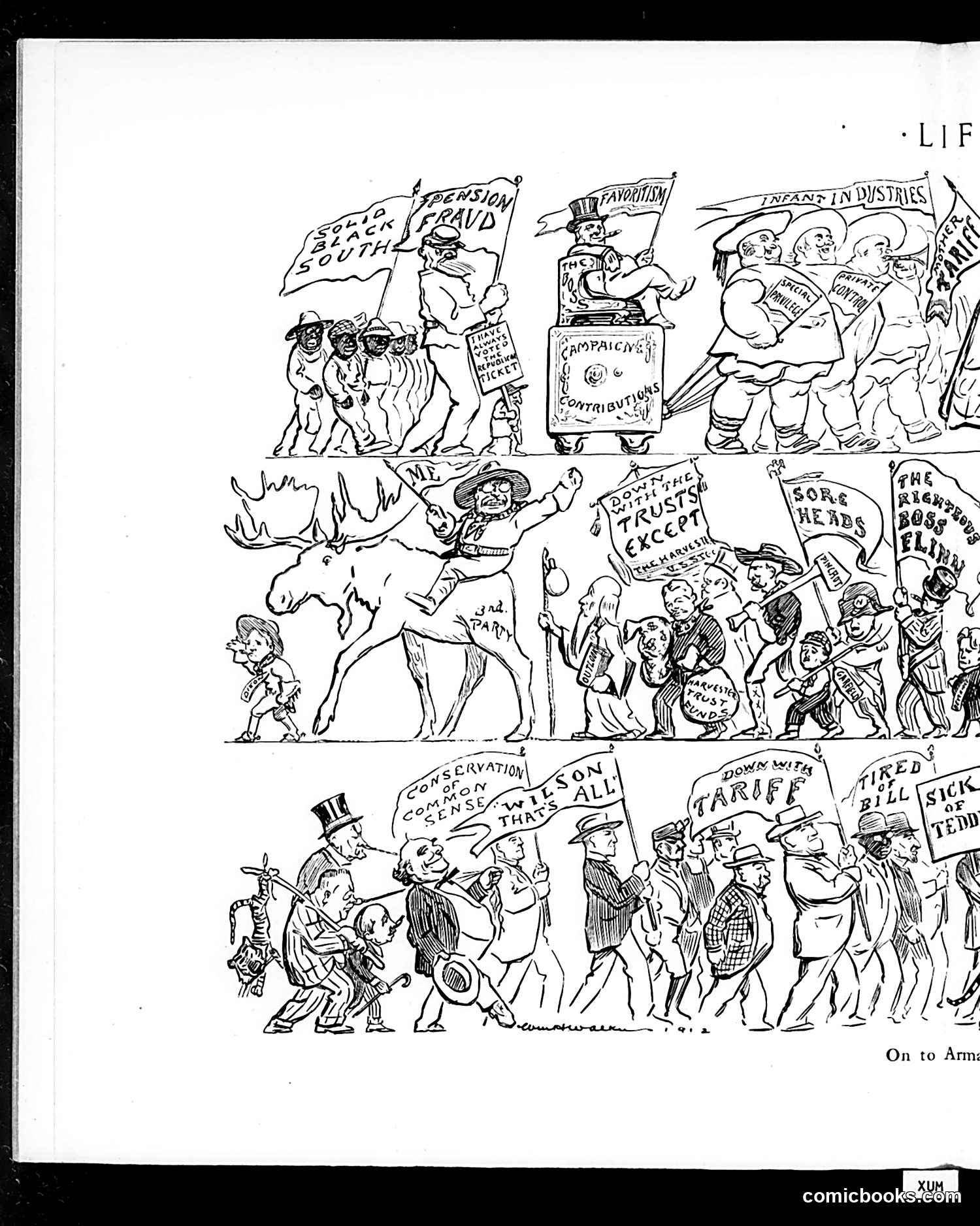
This appears to be a multi-panel satirical cartoon depicting various political interest groups and their agendas. The top panels show figures carrying flags and banners labeled with causes like "Pension Fraud," "Favoritism," and "Graft." The middle section features a large donkey (the Democratic Party symbol) surrounded by competing groups with signs reading "Sore Heads" and "The Biggest Bluff." The bottom panel shows a procession of figures holding banners about "Conservation," "Common Sense," "Down with Tariff," and other political positions, marching together. The cartoon satirizes the chaotic coalition of interests within a political party—here likely Democrats—showing how disparate groups with conflicting agendas claim to represent the same party. The donkey imagery reinforces this critique of party disunity. The text caption "On to Arm[ageddon]" suggests the cartoon portrays intra-party conflict as destructive.
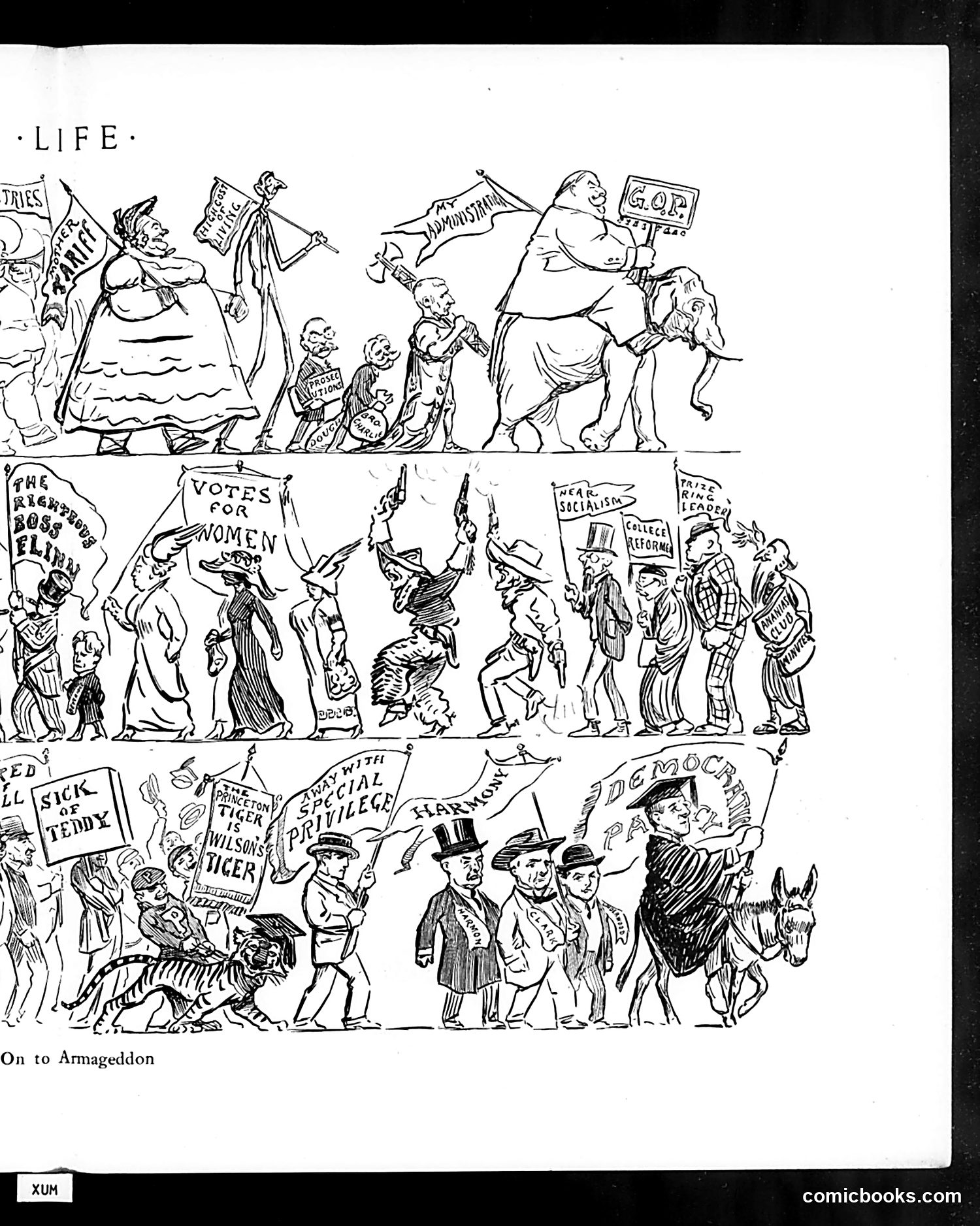
This three-panel political cartoon satirizes early-20th-century social movements and their perceived consequences. The top panel shows aristocratic figures representing established order. The middle panel depicts protesters carrying signs including "VOTES FOR WOMEN" and other reform demands, suggesting labor, socialist, and suffrage movements. The bottom panel shows these movements leading to chaos—depicted as armed conflict and democratic collapse (the donkey labeled "Democracy" suggests political disorder). The cartoon's title "On to Armageddon" frames progressive reforms as apocalyptic threats to civilization. This reflects conservative anxieties about women's suffrage, labor organizing, and socialist politics of the era. The satire mocks such reactionary fears by presenting social reform movements as inevitably producing civilizational collapse—though Life's stance (endorsing or mocking these fears) remains unclear from the image alone.
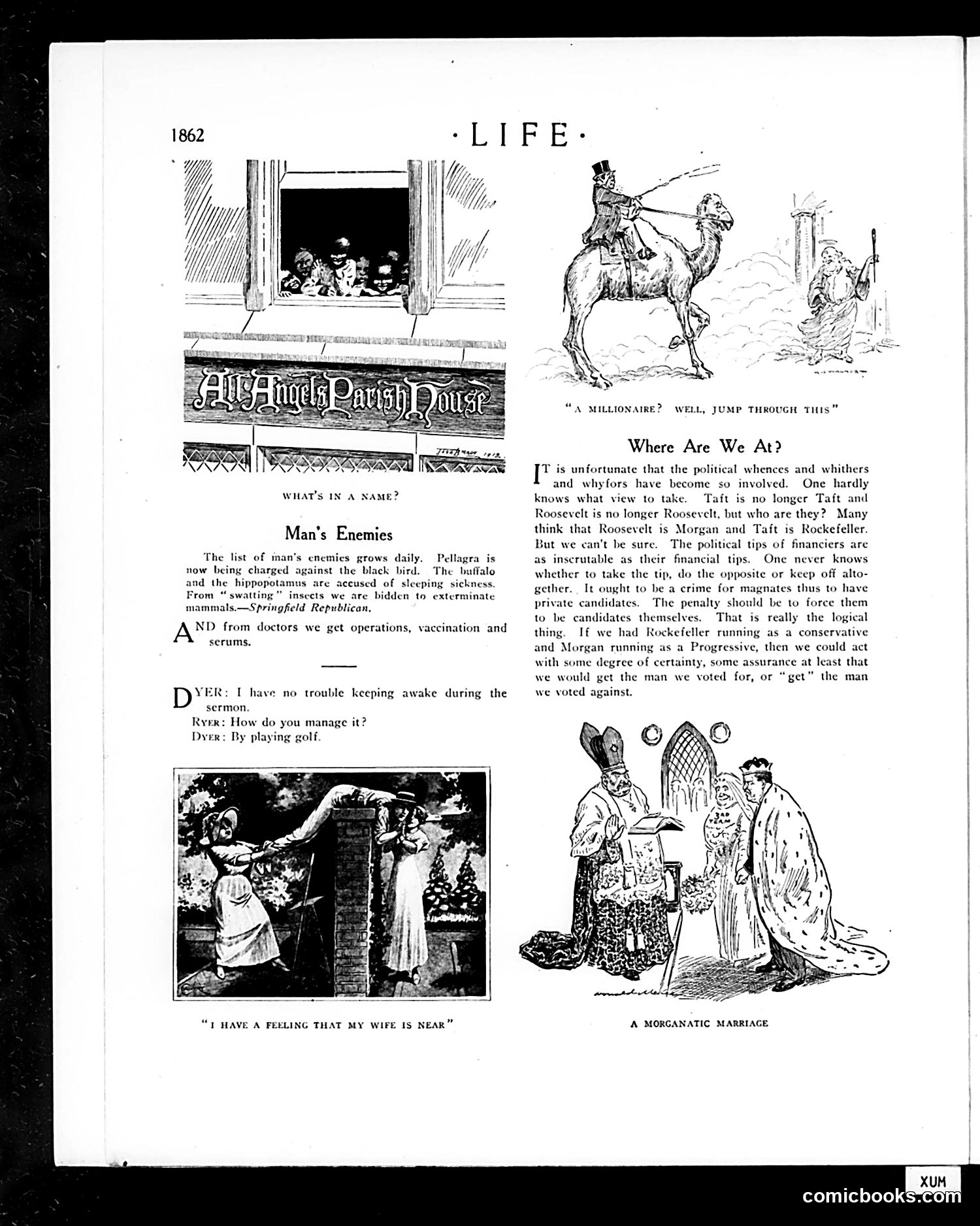
This page satirizes the 1912 U.S. presidential election chaos. The main article "Where Are We At?" mocks voter confusion over whether candidates represent themselves or wealthy industrialists. It suggests Roosevelt is associated with J.P. Morgan and Taft with Rockefeller—implying financiers secretly control politics. The cartoon "A Morganatic Marriage" plays on this: a "morganatic marriage" (unequal union) depicts religious/political figures uniting Morgan and Rockefeller's interests, visualizing the corrupt alliance between big money and candidates. Other items mock modern anxieties (disease, medical treatments) and include a gag about a pastor who stays awake by thinking about golf. The overall message: voters cannot trust elections when wealthy magnates secretly control both parties' candidates.
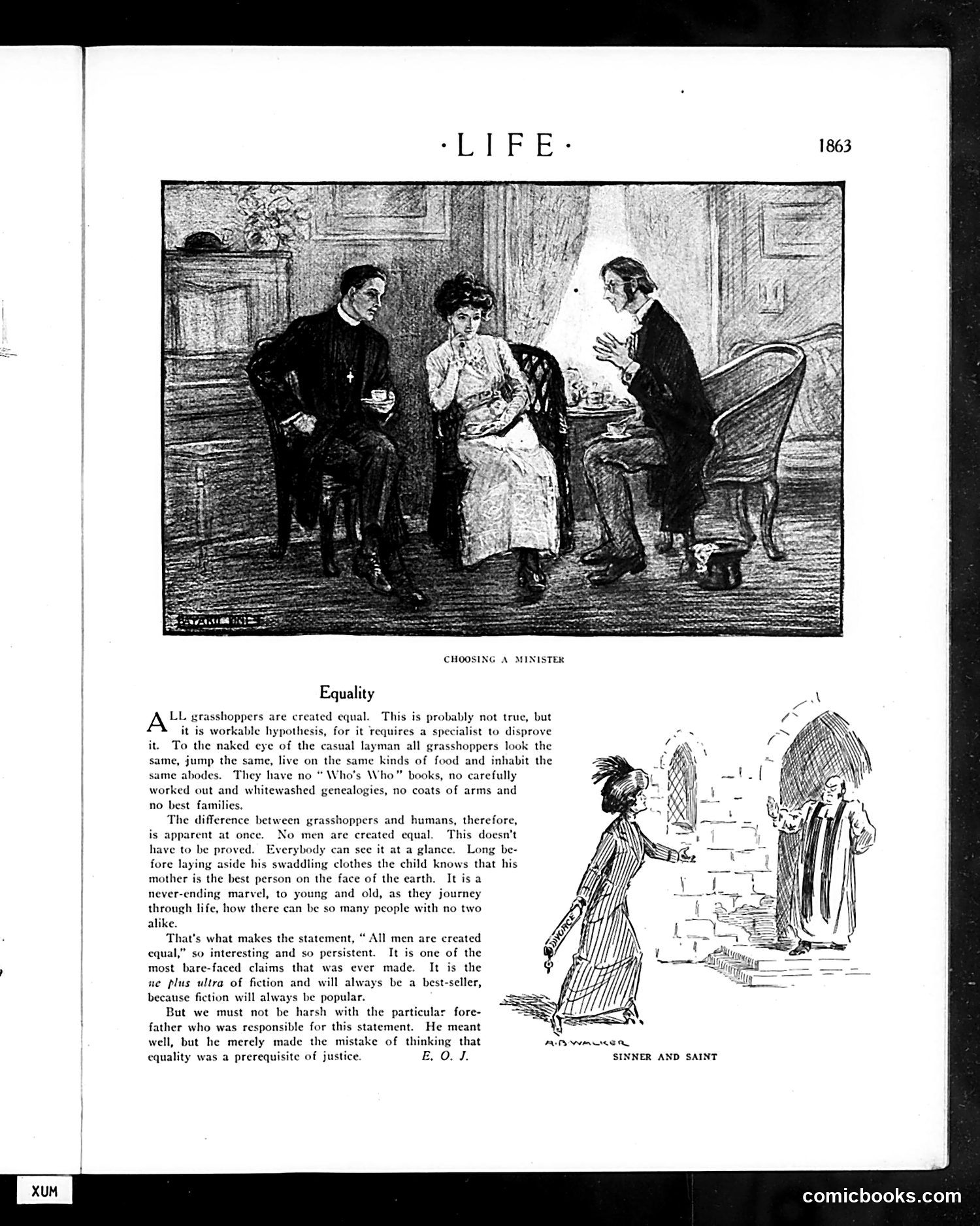
**Top Illustration ("Choosing a Minister"):** Shows three men in formal dress with a woman in the center—apparently depicting a selection process for a clergyman. The satirical point is unclear from the image alone, but likely comments on patronage or nepotism in religious appointments. **Essay ("Equality"):** A sardonic piece by E.O.J. that mocks the Declaration of Independence's claim that "all men are created equal." The author argues this is obviously false—visible at a glance in human society (unlike grasshoppers, who genuinely appear identical). The essay credits the "forefather" who wrote the statement with good intentions but poor logic, suggesting he confused equality with justice. **Context:** Published during the Civil War (1863), this appears to satirize idealistic American founding principles as naive fiction, while implying actual human inequality is observable fact. The piece takes a cynical stance on egalitarian rhetoric common in the era. **Bottom Illustration ("Sinner and Saint"):** Two figures at what appears to be a doorway or gate—likely depicting moral contrast, though specific meaning is unclear.
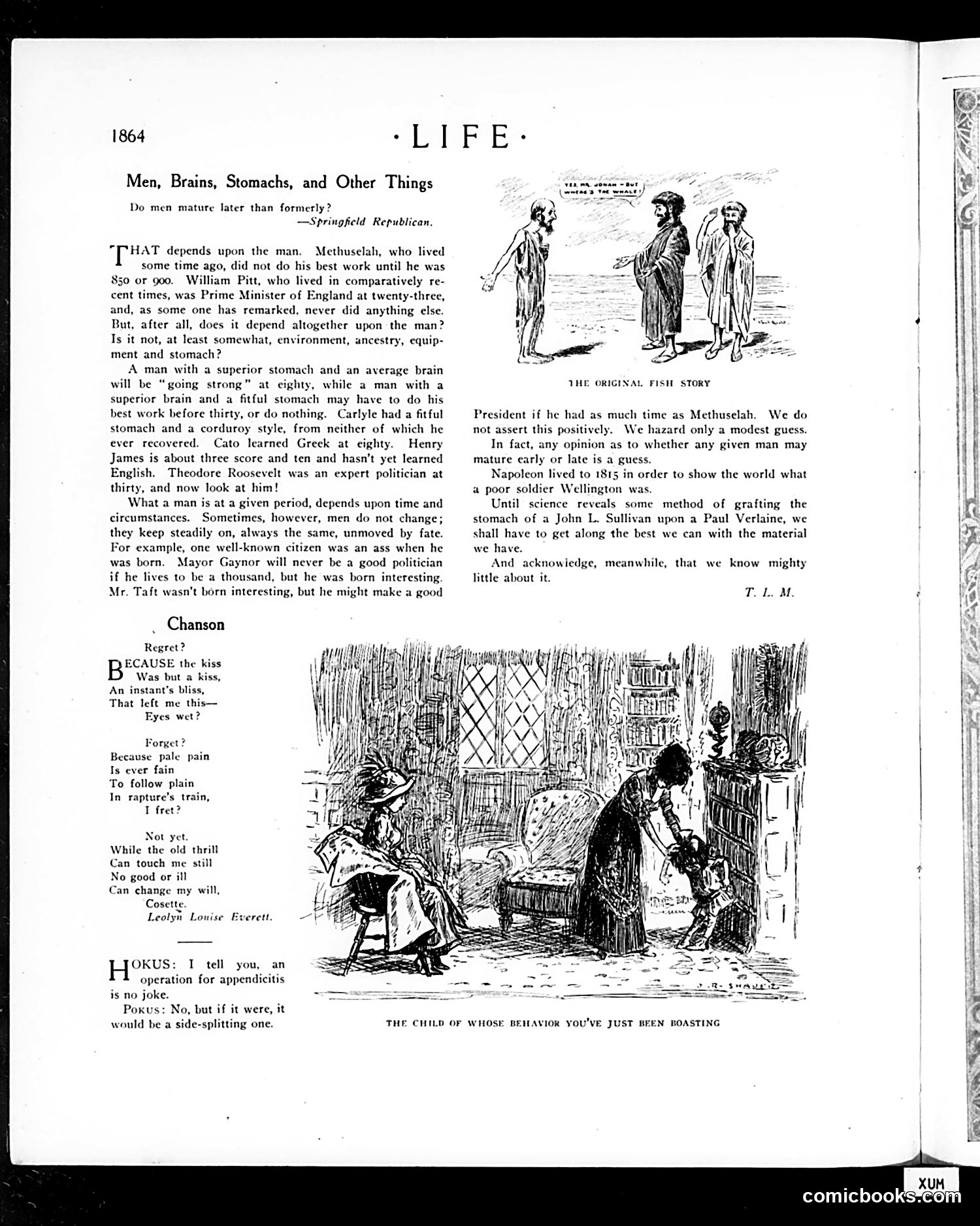
This page contains satirical commentary on human maturation and potential. The main article humorously argues that whether men mature early or late depends less on inherent ability than on their physical constitution—specifically, their stomachs. It references historical and contemporary figures: Methuselah (biblical longevity), William Pitt (precocious British Prime Minister), Theodore Roosevelt, Mayor Gaynor, and President Taft—using them as examples of how circumstance and physiology shape achievement. The cartoons illustrate this theme: "The Original Fish Story" depicts adults telling tall tales, while "The Child of Whose Behavior You've Just Been Boasting" shows an exasperated mother with a misbehaving child, satirizing parental self-deception. A song and joke about appendicitis surgery complete the page. The satire's core message: stop crediting genius alone; consider digestive health.
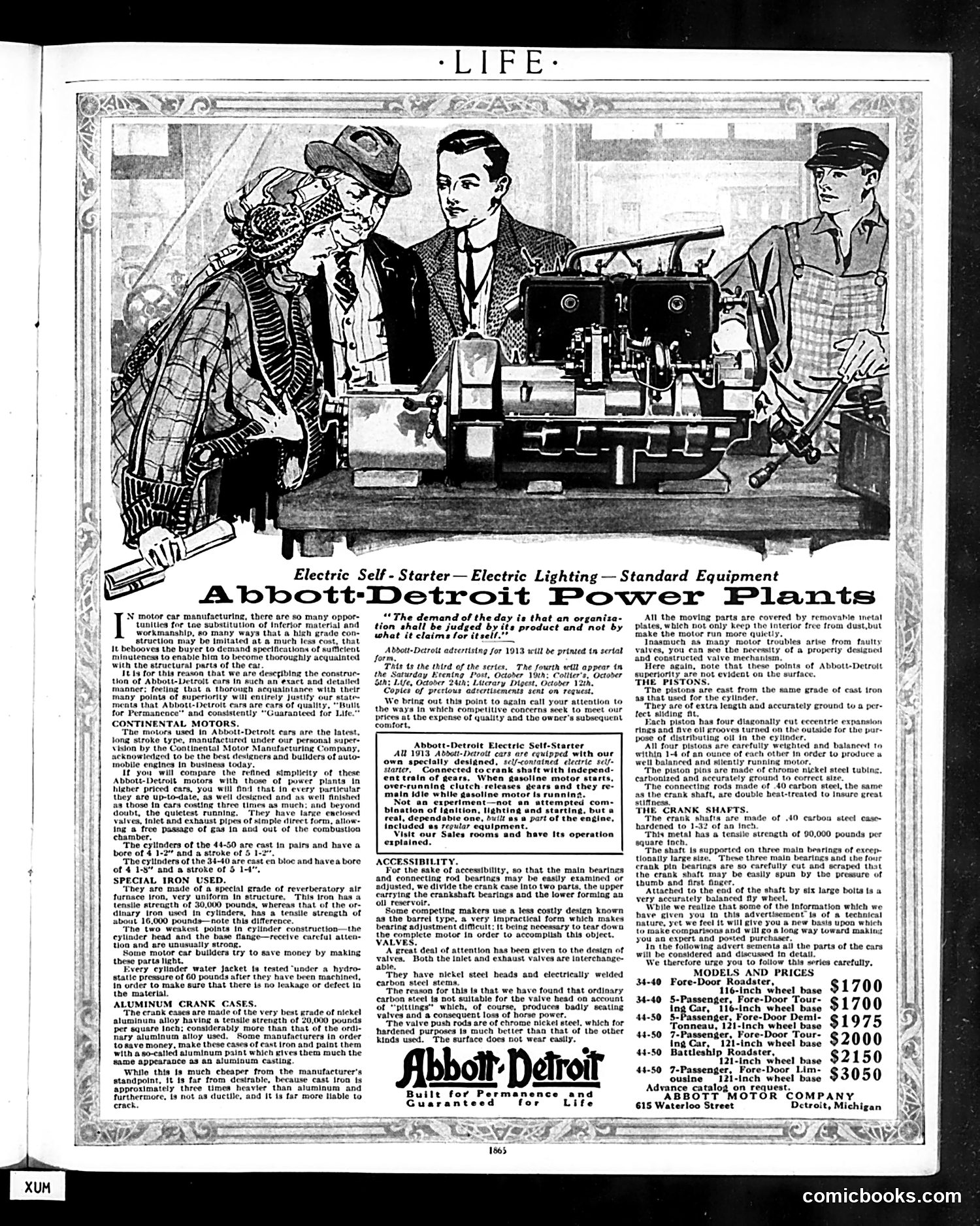
This page is **primarily a full-page automobile advertisement**, not a political cartoon. It promotes Abbott-Detroit automobiles manufactured in Detroit, Michigan. The illustration shows four men examining an Abbott-Detroit engine, emphasizing the car's technical superiority. The accompanying text extensively details the vehicle's construction—Continental Motors engines, special iron cylinders, aluminum alloy crank cases, and other mechanical specifications—to convince buyers of quality craftsmanship. The satirical element is subtle: the ad mocks competitors who cut corners by using cheaper materials (like painted cast iron disguised to look like aluminum) while charging premium prices. The phrase "Built for Permanence and Guaranteed for Life" represents the manufacturer's confidence claim against inferior rivals. This reflects early 1910s automotive market competition, when manufacturing standards weren't uniform and buyers needed detailed technical information to distinguish quality cars from cheaper imitations.
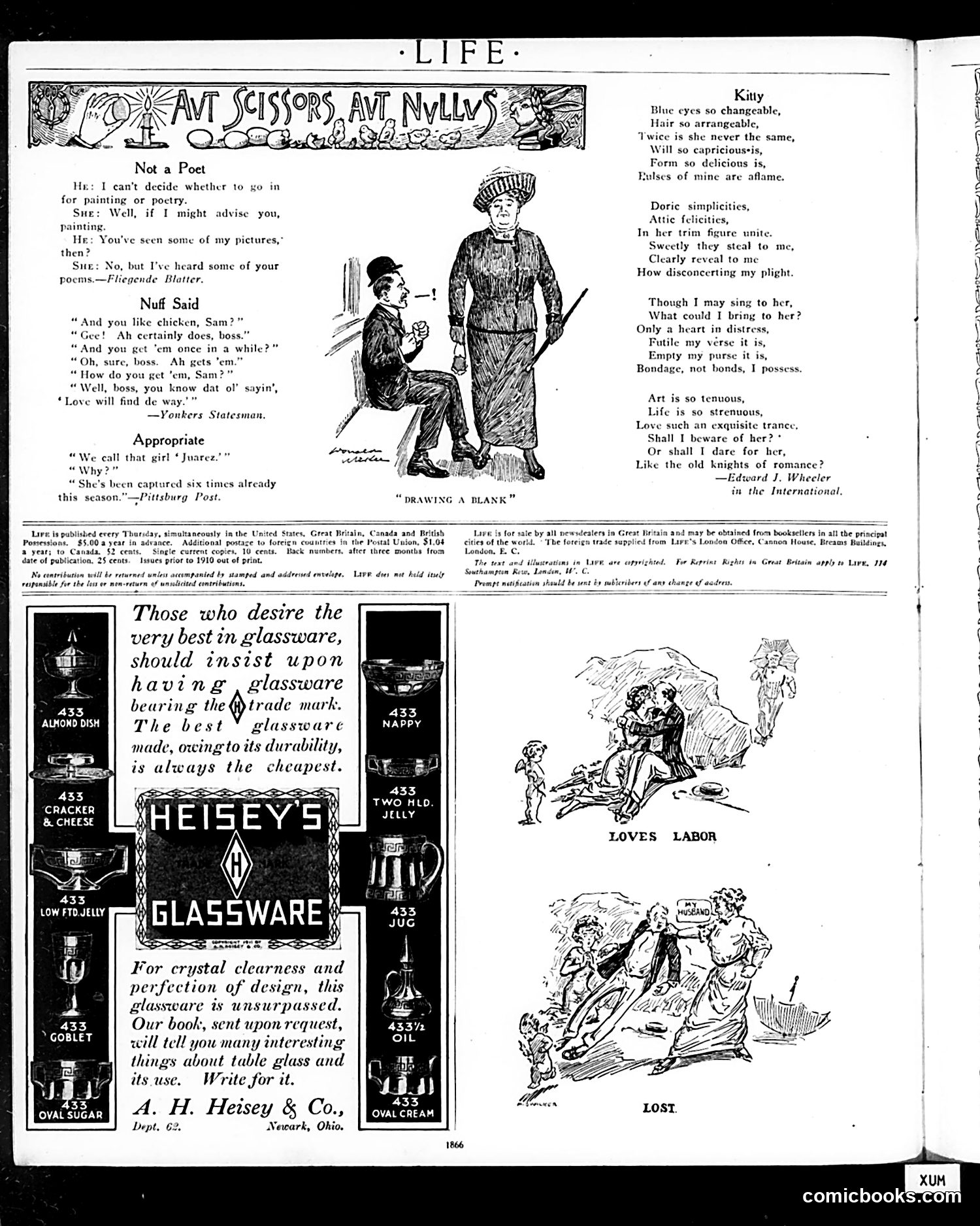
This page contains **humor and light satire** rather than political commentary. The main content includes: **"Not a Poet"** – A dialogue joke where a man can't decide between painting or poetry. When his friend suggests painting, the friend admits she's never seen his pictures but has *heard* his poems—implying his poetry is terrible. The humor rests on this backhanded insult. **"Nuff Said"** – A racist dialect joke featuring "Sam," an African American character using stereotypical speech patterns. The punchline involves a play on "love will find the way," suggesting he obtains chicken through unspecified (likely theft or poaching) means. **"Appropriate"** – A brief joke calling a girl "Juarez" (referencing the Mexican border city), noting she's been "captured six times already this season"—a dating/conquest joke. The page also includes **Heisey glassware advertisements** and poetry about romantic love ("Kitty," "Art is so tenuous"). **For modern readers:** The racist content, particularly the dialect humor, reflects period attitudes. The romantic and dating humor remains somewhat recognizable, though dated in tone.
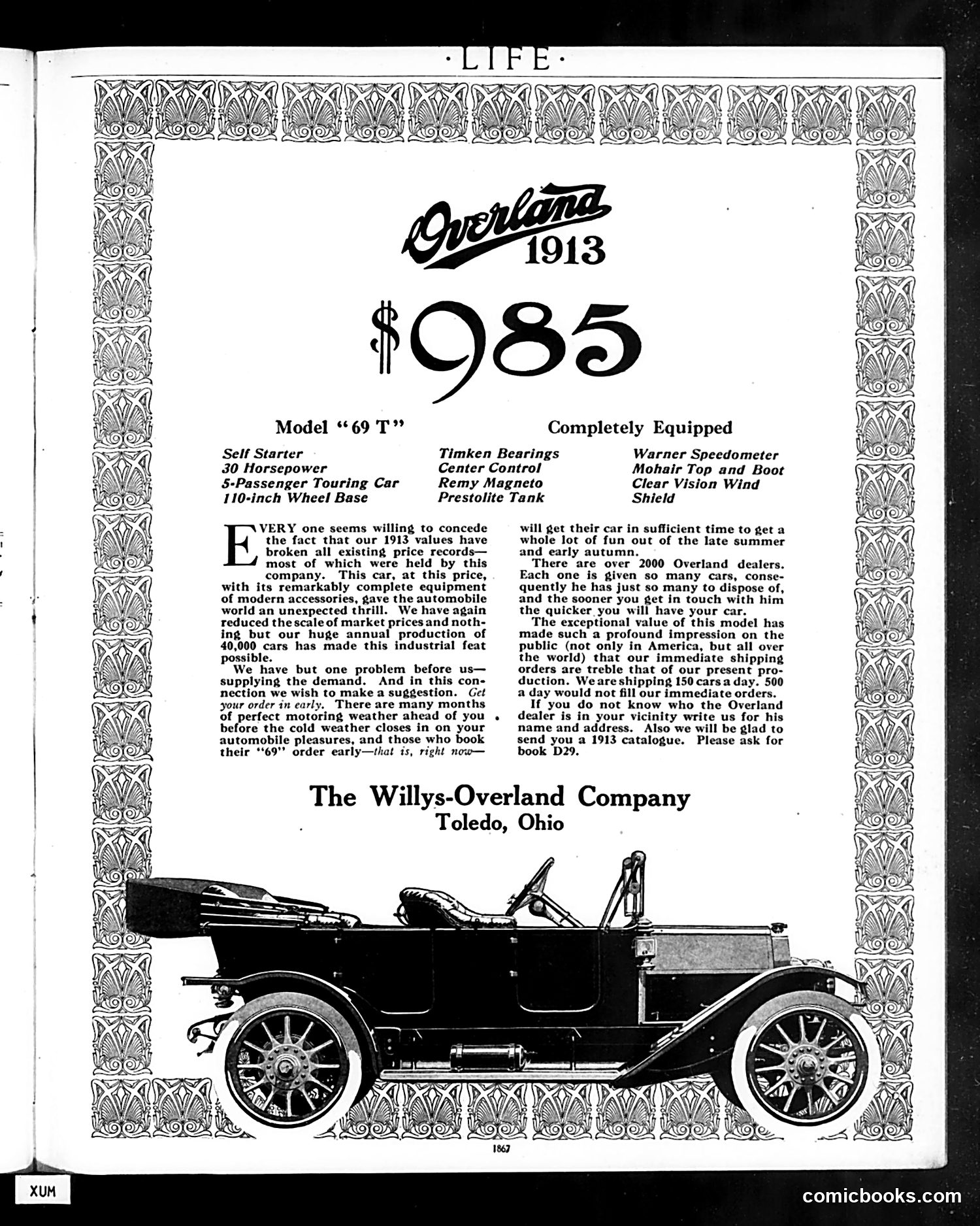
This is **not a cartoon or satire**—it's a full-page automobile advertisement for the Willys-Overland Company's 1913 Model "69 T" priced at $985. The ad emphasizes the car's exceptional value: it claims to have broken existing price records while offering modern features (self-starter, Timken bearings, speedometer, etc.). The copy stresses unprecedented demand—production of 40,000 cars annually, shipping 150 daily, with orders tripling current output. The rhetorical strategy appeals to urgency: customers should "order in early" because dealers have limited inventory and cold weather approaches. The ad also mentions 2,000+ dealers nationwide, suggesting broad availability. For modern readers: this represents early automotive mass-production marketing, emphasizing affordability, reliability, and scarcity-driven demand—techniques still used today. The $985 price (roughly $30,000 in 2024 dollars) positioned this as accessible middle-class transportation during the automobile's rapid adoption era.
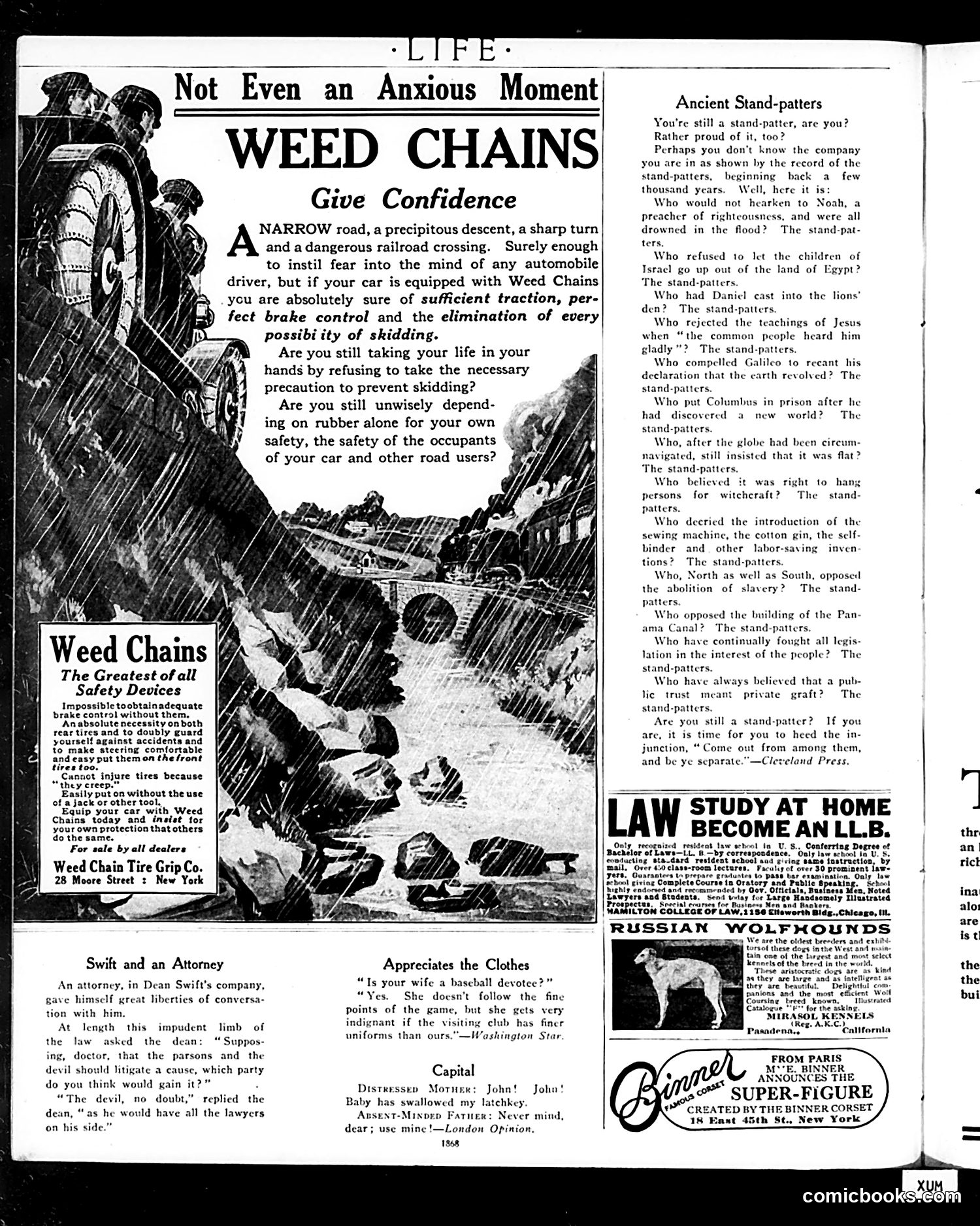
This Life magazine page combines product advertising with political commentary. **Main Advertisement**: The large "Weed Chains" ad promotes tire chains as essential safety devices for automobiles navigating dangerous roads. The dramatic illustration shows a car on a precipitous mountain road, emphasizing the anxiety drivers faced before modern safety equipment. **Political Satire**: The "Ancient Stand-Patters" piece mocks conservatives who resist progress. It catalogs historical figures and groups who opposed change—from those who rejected Noah to those who opposed abolition, the Panama Canal, and labor-saving inventions. The piece equates "stand-patters" (conservatives) with historical obstructionists, sarcastically suggesting they've always been on the wrong side of progress. It ends by urging readers to abandon such reactionary positions. **Context**: This reflects early 20th-century Progressive Era debates about modernization, technological advancement, and social reform—presenting resistance to change as foolish and morally wrong.
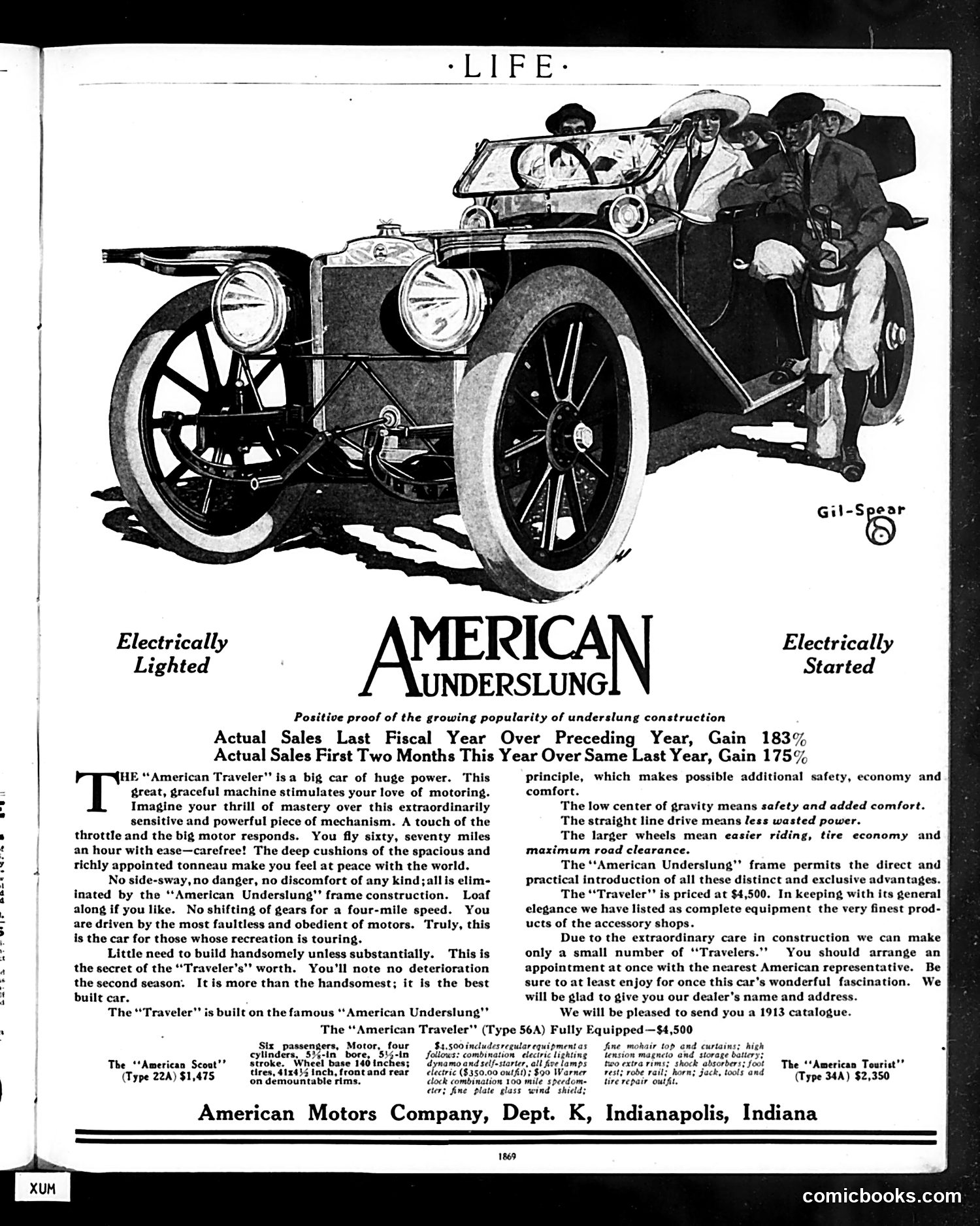
This is **not a cartoon or satire—it's a straightforward automobile advertisement** from Life magazine (early 1910s). The page promotes the "American Underslung" automobile, highlighting three models: the Traveler ($4,500), Scout ($1,475), and Tourist ($2,350). The illustration depicts well-dressed passengers enjoying the car's features. The ad emphasizes technical innovations of the era: electric lighting and electric starting (then novel luxuries), a low center of gravity for safety, and straight-line drive mechanics. Sales figures (183% and 175% gains) are cited as proof of market success. The humor—if any—lies in the breathless, effusive marketing language typical of early automotive advertising, which treats car ownership as a thrilling lifestyle achievement. Terms like "love of motoring" and "wonderful fascination" reflect period attitudes toward automobiles as rare, prestigious machines rather than everyday transportation. This is primarily **commercial content**, not editorial satire.
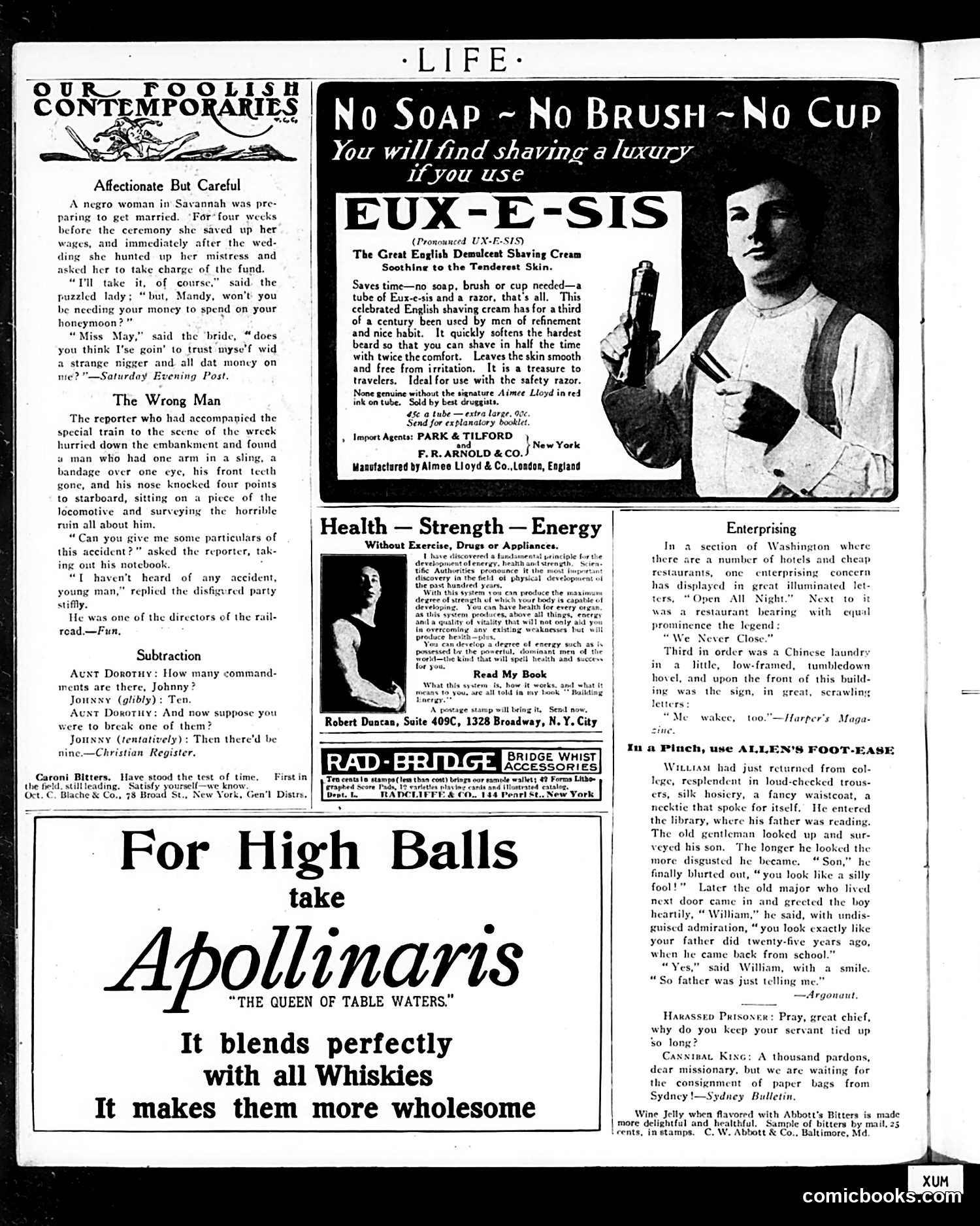
This page from *Life* magazine (a satirical publication) contains mostly **advertisements and humor columns**, not political cartoons. The notable content includes: **"Affectionate But Careless"** — A racist dialect humor piece (typical of early 20th-century *Life*) depicting an African American woman in Savannah who asks her white employer to safeguard her honeymoon savings, not trusting her new husband with money. **"The Wrong Man"** — A joke about a train wreck where a severely injured man claims ignorance of any accident, revealing he's a railroad director. **"Subtraction"** — A brief joke about logical consequences. **William anecdote** — A humorous story contrasting how William's father and a neighbor react to his appearance—the father finds him ridiculous, the neighbor sees him as resembling his younger self, which William reveals his father had just told him. The remainder is **product advertising** (shaving cream, water, dining products), which dominated *Life* magazine's revenue. No significant political satire appears on this page.
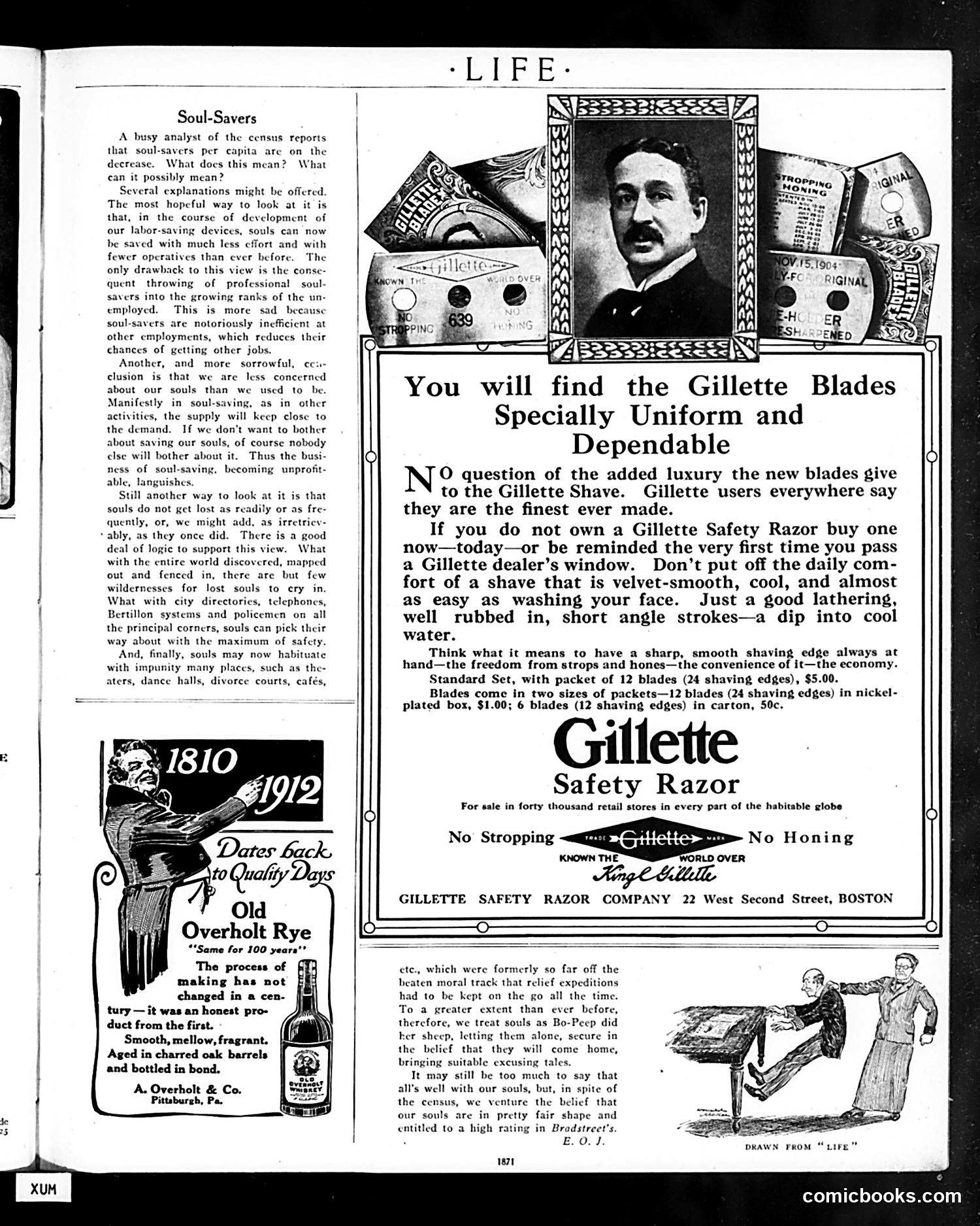
This satirical essay jokes about census data showing fewer "soul-savers" per capita. The author humorously explores possible explanations for the decline in professional religious workers and moral reformers. The satire mocks both the decline itself and modern society's changing morality. It suggests three possibilities: (1) labor-saving devices have made soul-saving more efficient, ironically leaving workers unemployed; (2) people care less about spiritual salvation than before; or (3) souls are safer now because the entire world is "discovered, mapped out and fenced in"—there's nowhere for souls to get lost. The final point is particularly pointed: modern conveniences like city directories, telephones, and police mean people can navigate morally risky places (theaters, dance halls, divorce courts, cafés) with less spiritual danger. The essay concludes wryly that souls are doing fine despite the census, using a business metaphor ("high rating in Bradstreet's"). This reflects early 20th-century anxieties about secularization and modernity's challenge to traditional religious authority.
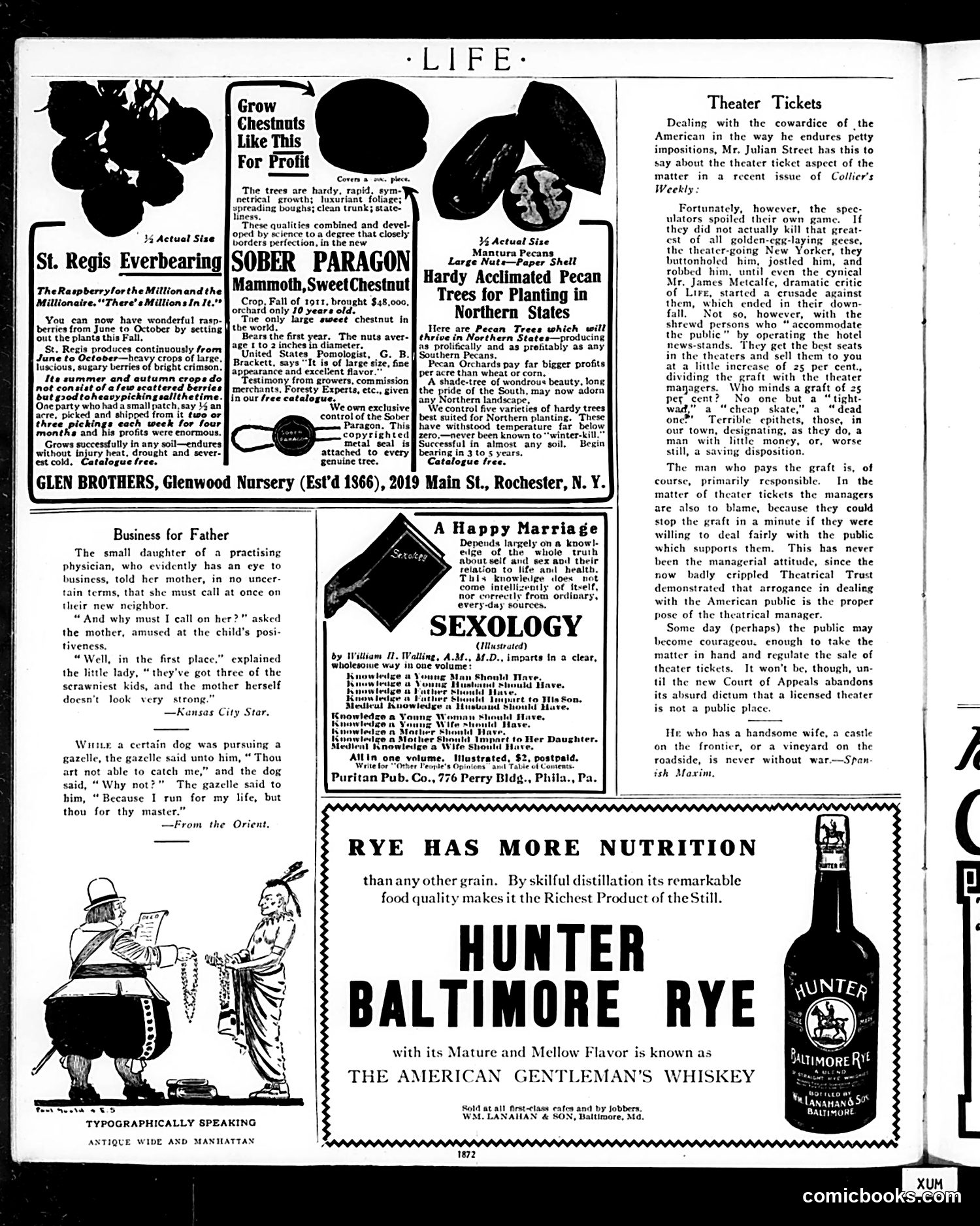
This page is primarily **advertising** for nursery products, self-help books, and whiskey, with brief humorous anecdotes rather than political cartoons. The main satirical content appears in two short stories: "Business for Father" jokes about a doctor's daughter's mercenary thinking—she wants her mother to visit a neighbor specifically because their malnourished children and sickly mother represent potential medical business. The second anecdote mocks a dog chasing a gazelle; when the dog asks why it can't catch the prey, the gazelle quips it must be "for thy master"—a cynical observation about servants pursuing goals for their employers rather than themselves. The illustrated cartoon shows a figure at a table labeled "TYPOGRAPHICALLY SPEAKING" with classical references, though its specific meaning is unclear without more context. The bulk of the page promotes fruit trees, berries, and a book on sexual health ("Sexology"), reflecting early 1900s American commercial interests in agricultural profit and Victorian-era anxieties about sex education.
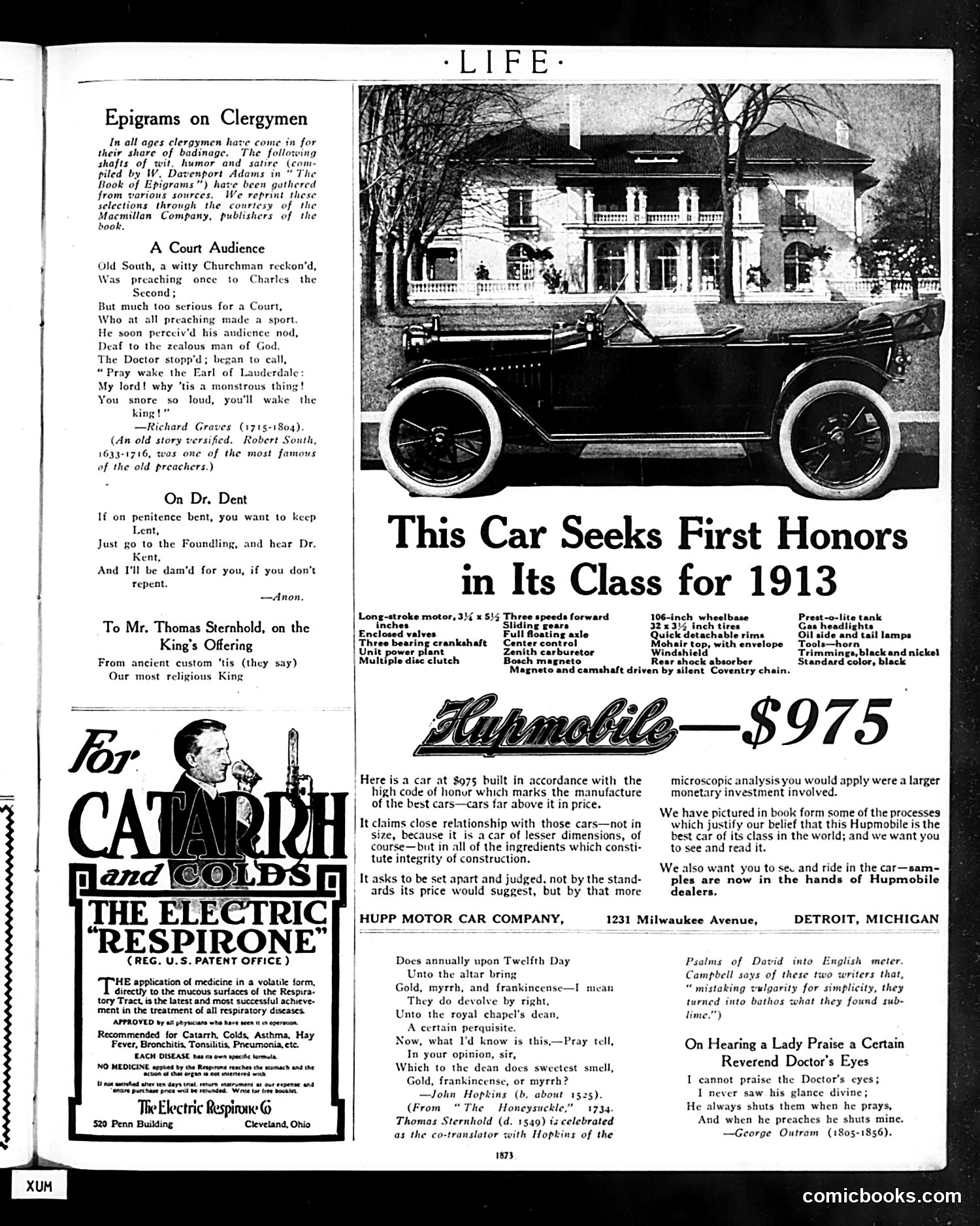
This page mixes **historical satirical poetry about clergy** with **early automobile advertising**. The left side reprints witty 18th-century epigrams mocking clergymen—a common target of satire across eras. One jokes about a preacher whose sermon was so boring that a nobleman fell asleep in church; another puns on a clergyman's name (Dr. "Dent" / penitence). These were genteel jabs at clergy hypocrisy and tedium, reflecting an era when religious figures were fair game for humor magazines. The right side advertises the **1913 Hupmobile automobile** at $975—positioning it as a quality vehicle competing with more expensive cars. The ad emphasizes engineering integrity and invites readers to inspect the car themselves, reflecting early 1900s consumer confidence-building. The juxtaposition is incidental: *Life* was simply a magazine combining humor, social commentary, and advertising without thematic connection between sections. Modern readers might find the clergy jokes quaint while the car ad reads as period marketing.
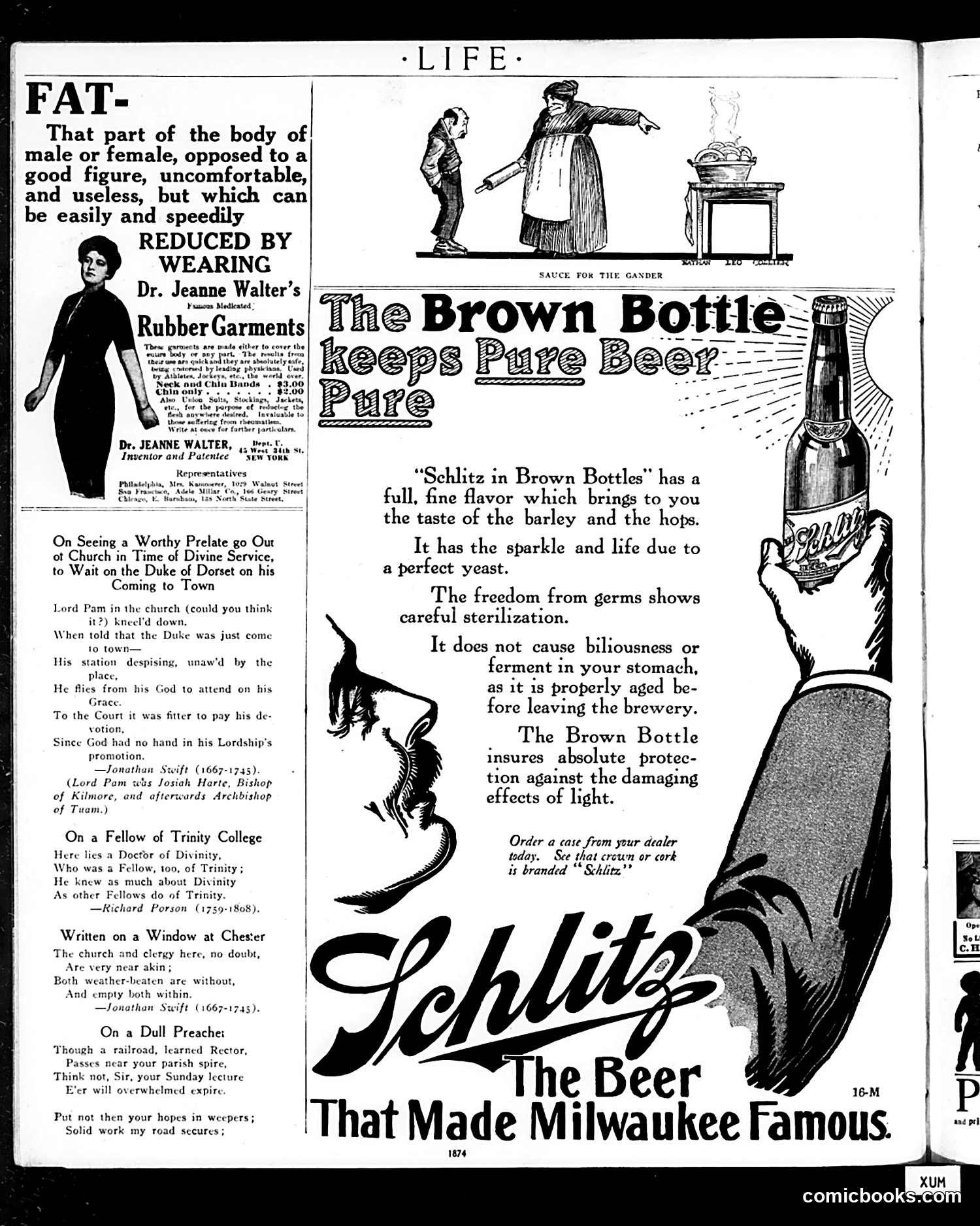
This page mixes satirical literary quotations with period advertising. The left column features 18th-century verses by Jonathan Swift and Richard Porson mocking clergy and religious hypocrisy—bishops abandoning church duties for secular power, divinity scholars ignorant of theology, and ineffectual preachers. The humor relies on intellectual satire typical of *Life* magazine's educated readership. The top depicts a domestic scene labeled "Sauce for the Gander"—likely illustrating marital discord or comeuppance, referencing the proverb "sauce for the goose is sauce for the gander" (equal treatment). The dominant right-side advertisement promotes Schlitz beer in brown bottles, emphasizing sterilization, purity, and protection from light damage—marketing appeals reflecting early 20th-century concerns about food safety and hygiene. The "Milwaukee Famous" tagline references Schlitz's Wisconsin brewery dominance. The left advertisement for Dr. Jeanne Walter's rubber corsets promises to reduce body fat through compression garments—reflecting contemporary (and problematic) beauty standards and the era's dubious medical device marketing.
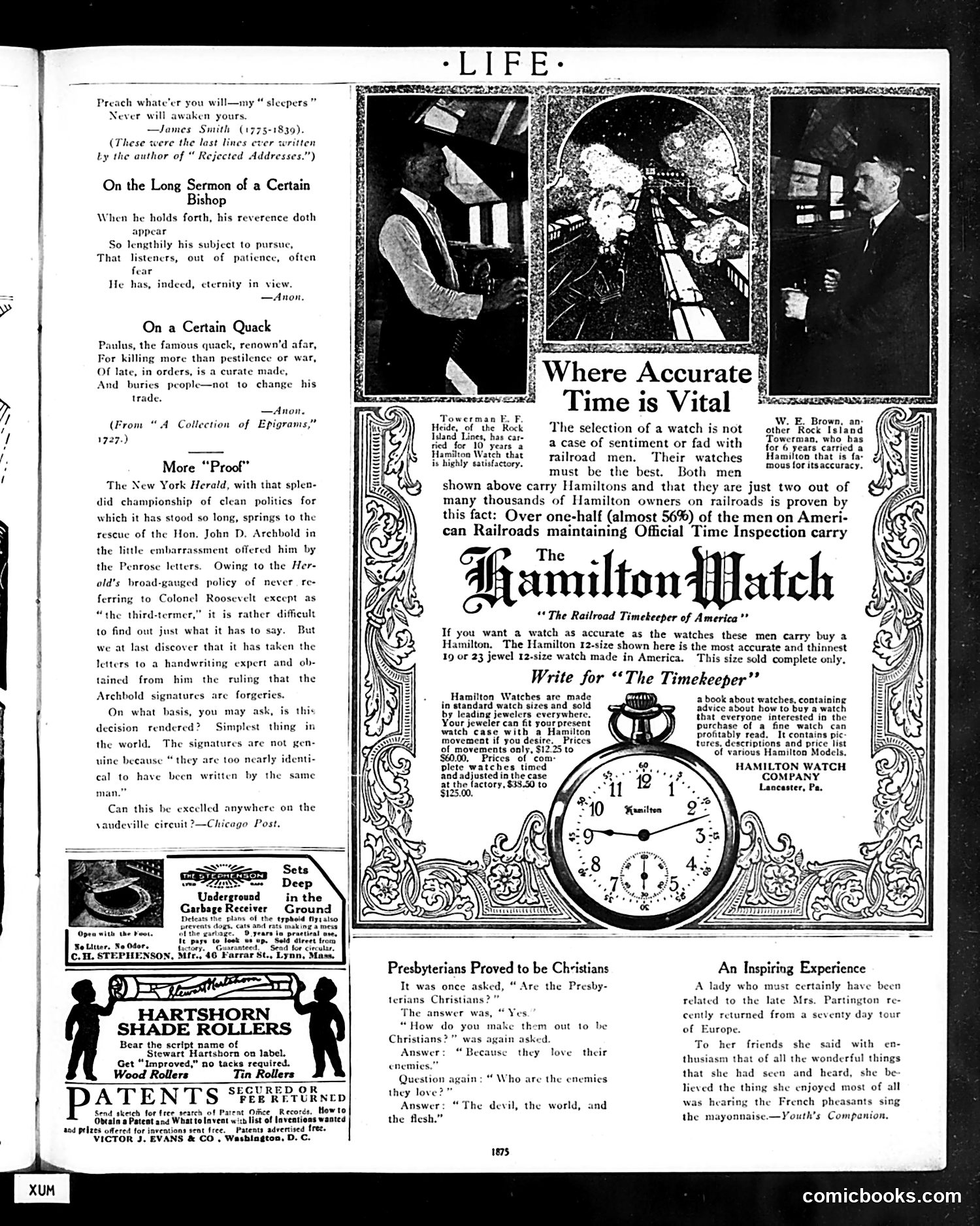
This page is primarily **advertising** for Hamilton watches, with decorative period poetry and satirical commentary filling the margins. The main advertisement features two railroad workers (a towerman and another employee) who carry Hamilton watches. The copy emphasizes that over half of American railroad men maintaining Official Time Inspection use Hamiltons, positioning the brand as "The Railroad Timekeeper of America." This reflects the early 20th-century industrial context where precise timekeeping was literally a safety and operational necessity for railroads. The surrounding text consists of brief satirical verses mocking religious figures: a bishop who preaches interminably (suggesting listeners fear he believes in eternal sermons), and a quack doctor-turned-curate whose ironic "trade" of burying people continues unchanged. A small article titled "More 'Proof'" critiques the *New York Herald's* defense of John D. Archbold against forgery accusations by a handwriting expert, sarcastically noting the expert's circular logic: signatures are forged because they're "too nearly identical"—absurd reasoning the Post compares to vaudeville. The page reflects period concerns: industrial reliability, religious hypocrisy, and journalistic corruption.
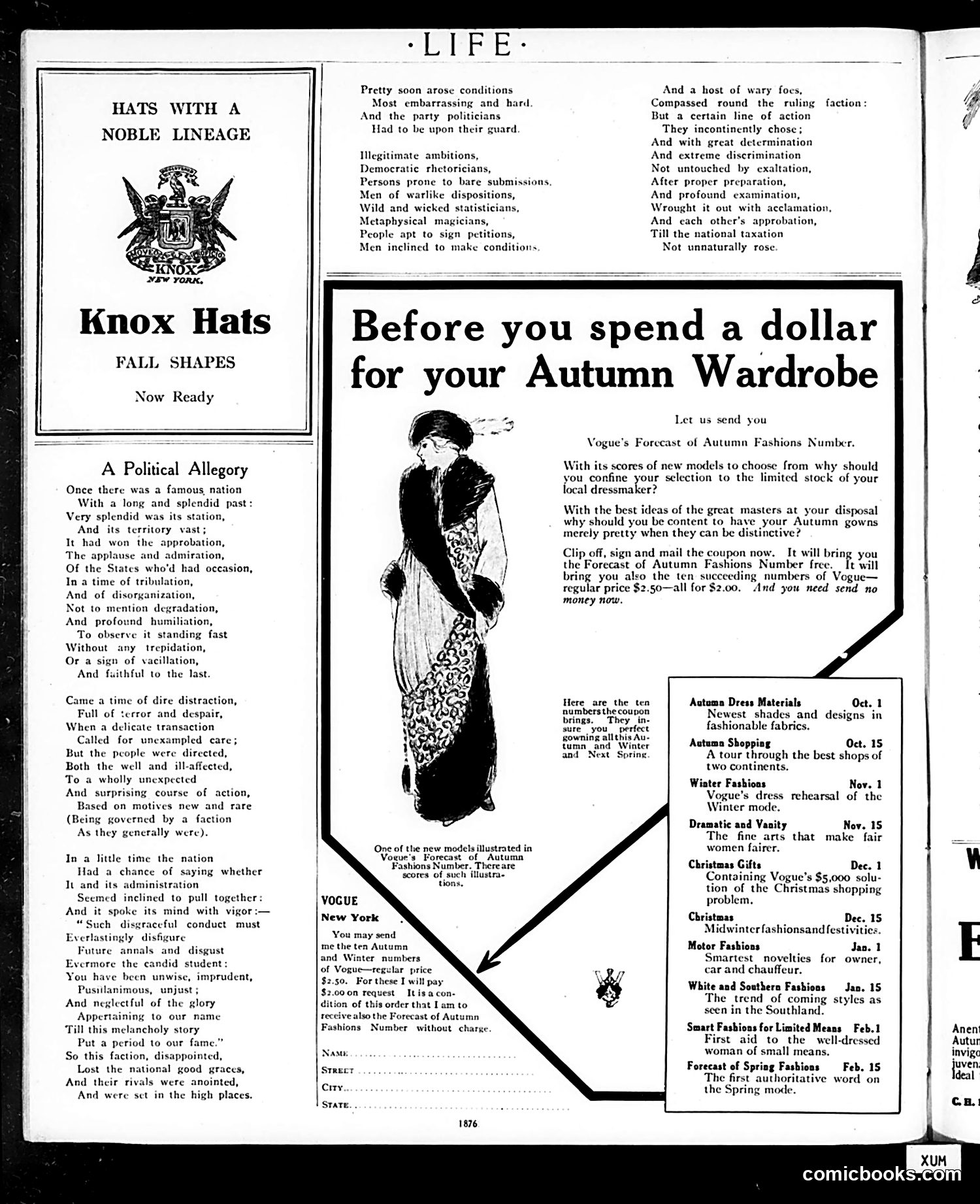
This satirical poem allegorizes recent American political events. A "famous nation" (the United States) with a "splendid past" faces a crisis requiring careful handling. The people vote to reject the governing faction for their mismanagement, installing rivals in power. However, the new administration immediately encounters serious problems: "embarrassing and hard" conditions arise, including opposition from "Democratic rhetoricians," "wild and wicked statisticians," and various troublemakers. Despite their efforts—described in grandiose language—they ultimately raise "national taxation." The satire targets a specific administration's failures and unpopular tax increases. Without the publication date visible, the exact political moment is unclear, but the poem mocks how newly elected officials inherit problems and resort to taxation despite campaign promises or good intentions. The mock-heroic language ("with great determination / And extreme discrimination") undercuts their actual incompetence. The page is primarily a Vogue fashion advertisement; the political poem serves as filler content typical of *Life* magazine's satirical format.
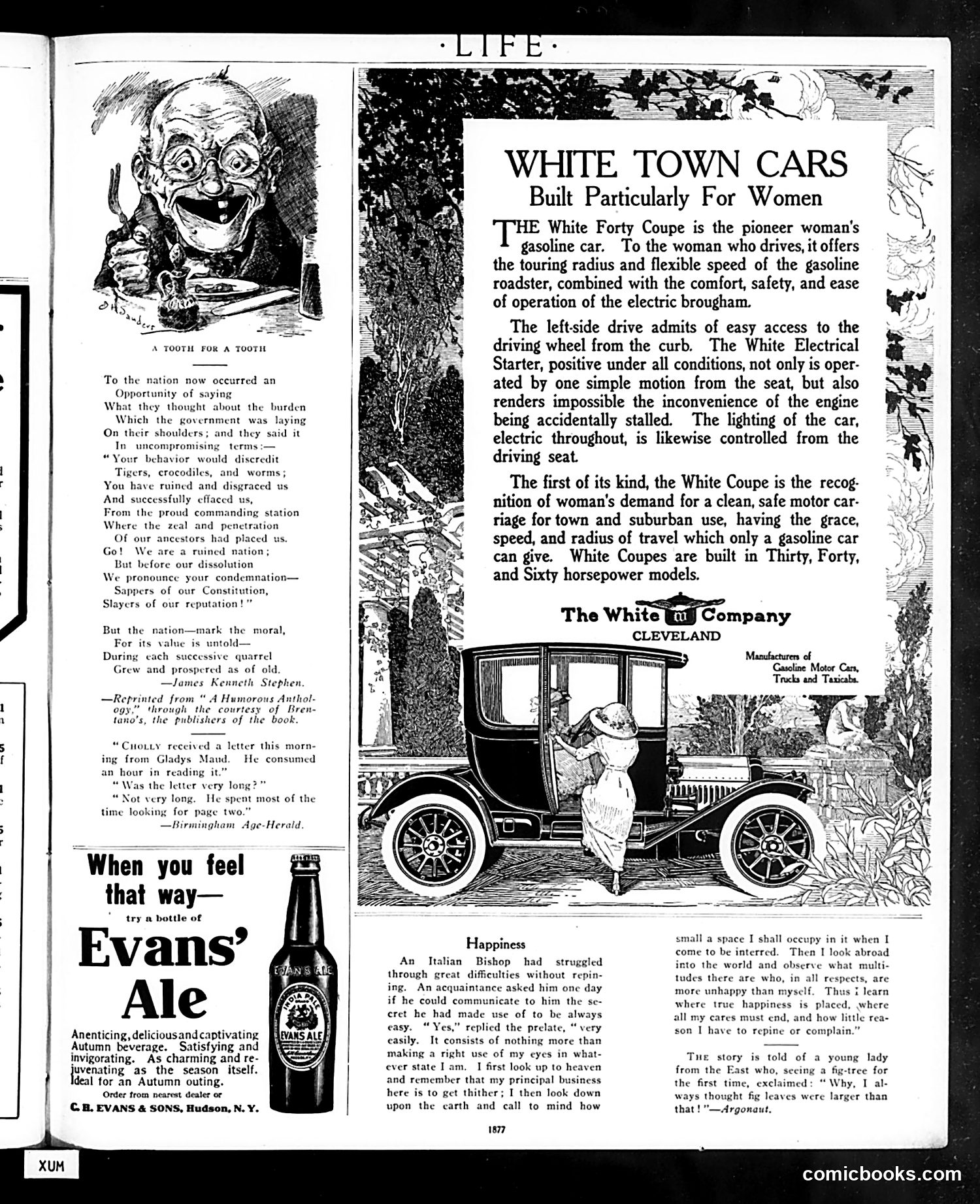
The cartoon depicts a caricatured figure (likely representing the U.S. government) receiving criticism from the nation. The accompanying poem is a scathing rebuke: citizens accuse their government of ruining the country, disgracing the nation, and betraying the legacy of their ancestors—calling them "Sappers of our Constitution, Slayers of our reputation!" The satire's ironic point appears in the final stanza: despite this harsh condemnation, "the nation...Grew and prospered as of old." The message suggests that America's strength and success persist *despite* government failures, implying that the nation's fundamental resilience transcends governmental incompetence. The specific political grievance isn't entirely clear from the text alone, but the general thrust critiques what the author viewed as destructive government policies or leadership. This was typical of Life magazine's role as a vehicle for political commentary in the early 20th century.
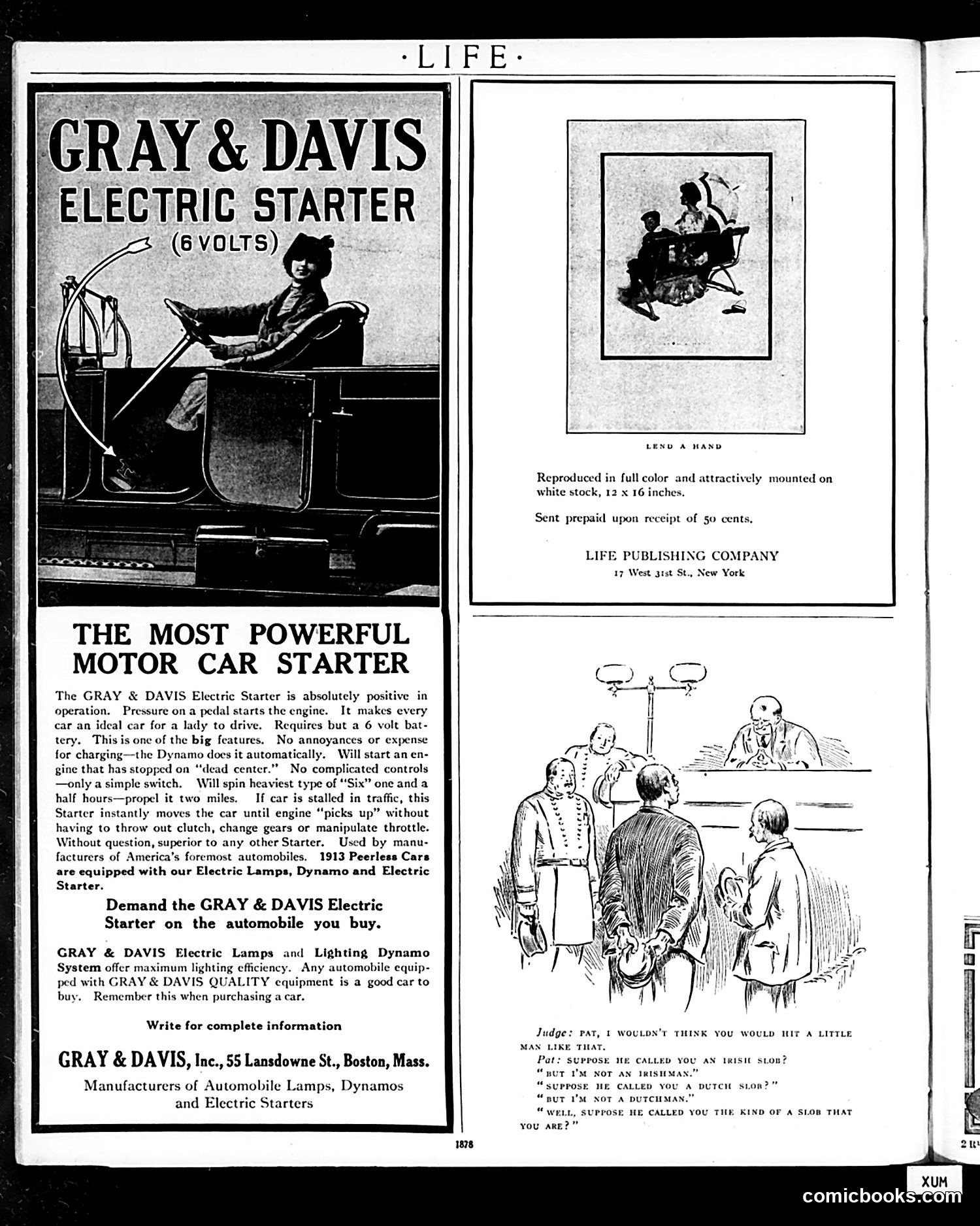
This page combines a 1913 automobile advertisement with a satirical cartoon about ethnic stereotyping. **The Advertisement (left):** Gray & Davis markets an electric car starter, emphasizing it makes driving accessible to women—a progressive feature for the era, though the ad's framing reveals gender assumptions of the period. **The Cartoon (right):** Titled "Lend a Hand," it depicts what appears to be an employment or social interaction scene. The dialogue satirizes ethnic prejudice: a man is offended at being called various slurs (Irish, Dutch/German, and "slob"). The judge or authority figure questions the man's own identity and character, suggesting the cartoon mocks how people hurl ethnic insults while being equally offensive themselves. The satire targets casual bigotry and name-calling prevalent in early 20th-century America, where Irish, German, and other immigrant groups faced discrimination. By showing someone indignant at being stereotyped while embodying similar flaws, the cartoon critiques hypocrisy in ethnic prejudice.
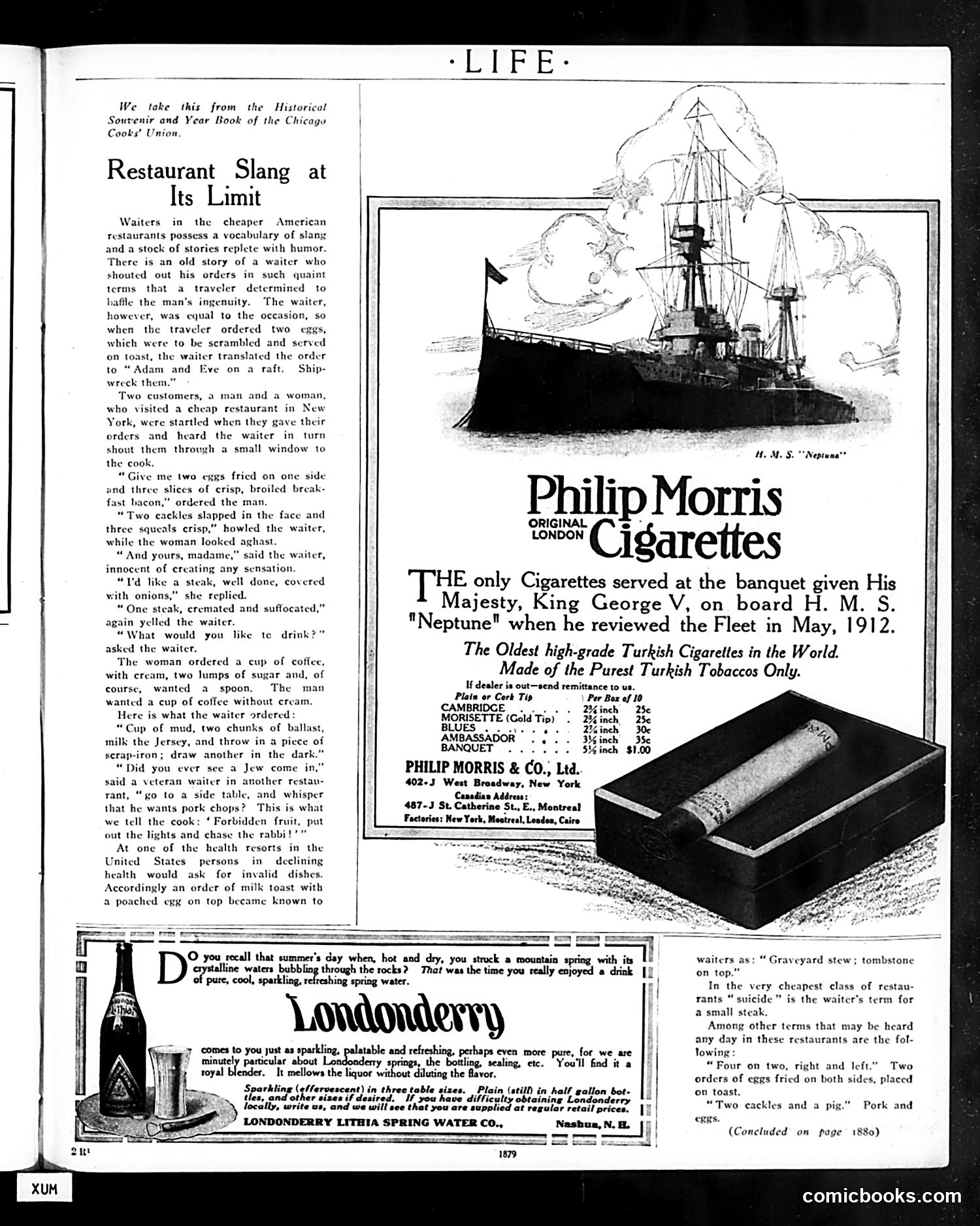
This page satirizes the colorful coded language waiters in cheap American restaurants used to shout orders to cooks. The humor derives from deliberately crude or absurdist translations of customer requests: "Adam and Eve on a raft" (eggs on toast), "two cackles slapped in the face" (fried eggs), "cup of mud" (coffee), and "cremated and suffocated" (well-done steak with onions). The article presents this working-class verbal culture as both inventive and intentionally bewildering to customers. One anecdote describes a waiter outwitting a traveler trying to stump him with complex orders—establishing the waiter's linguistic ingenuity as a source of pride. The satire gently mocks both the waiters' elaborate slang and the customers' bewilderment, while also documenting authentic restaurant-worker culture from the *Chicago Cooks' Union* historical record. It's simultaneously affectionate and condescending toward this vernacular world.
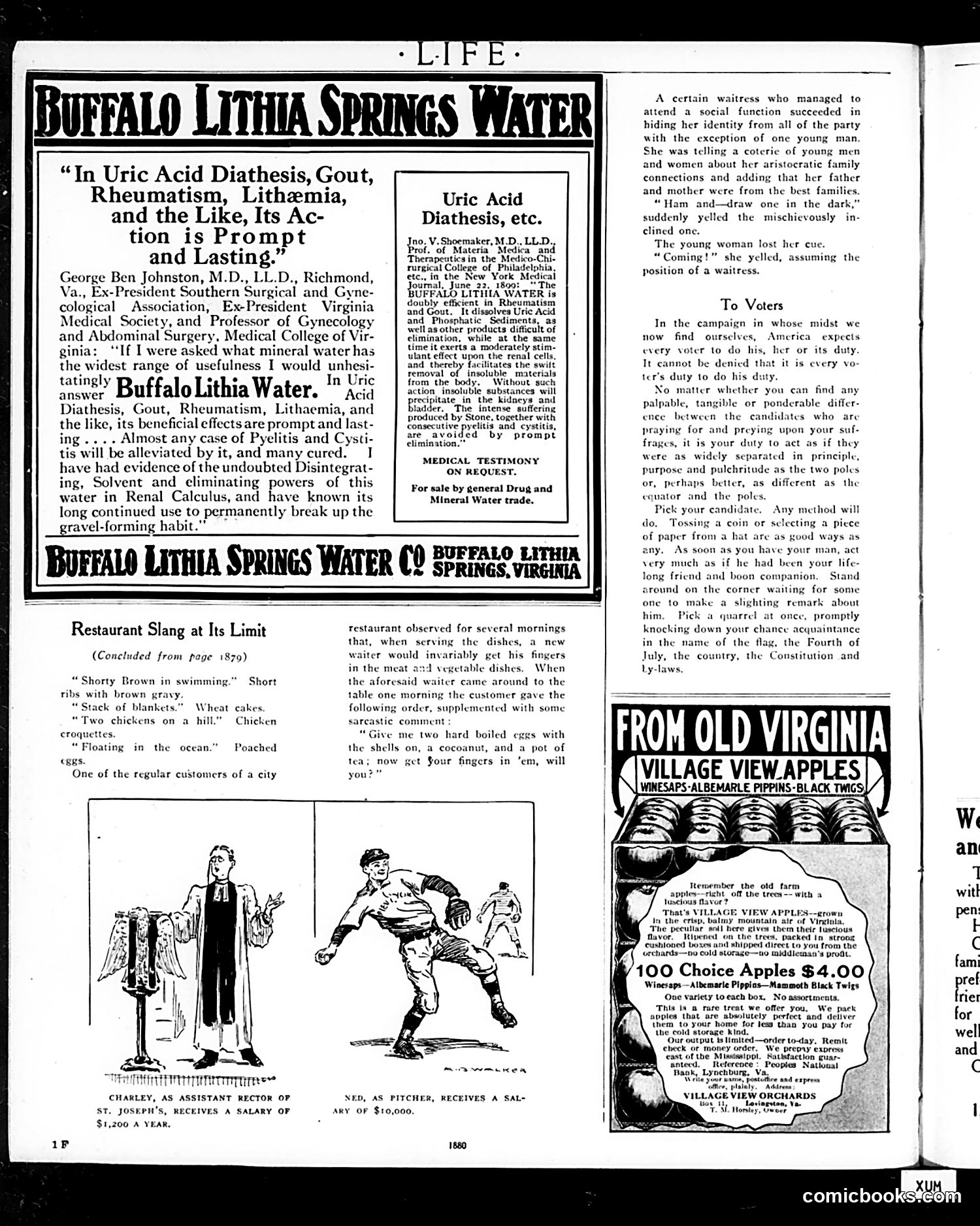
This page contains **two distinct satirical pieces**: ## The Waitress Story (top right) A humorous anecdote mocking social pretension. A waitress attending a party claims aristocratic family connections to impress guests. When she brags about her "best families" background, a young man who recognizes her from the restaurant calls out the restaurant order "Ham and—draw one in the dark," exposing her true occupation. She automatically responds as a waitress would, revealing her deception. The satire targets class pretense and the inability to escape one's actual social station. ## "To Voters" (center right) Political satire on the 1900 election. The piece sardonically advises voters that since candidates are indistinguishable, voting methods are irrelevant—"tossing a coin" works as well as deliberation. It mocks voter apathy and the equivalence of opposing candidates, suggesting Americans treat elections casually despite their civic importance. Both pieces use humor to critique American social and political behavior.
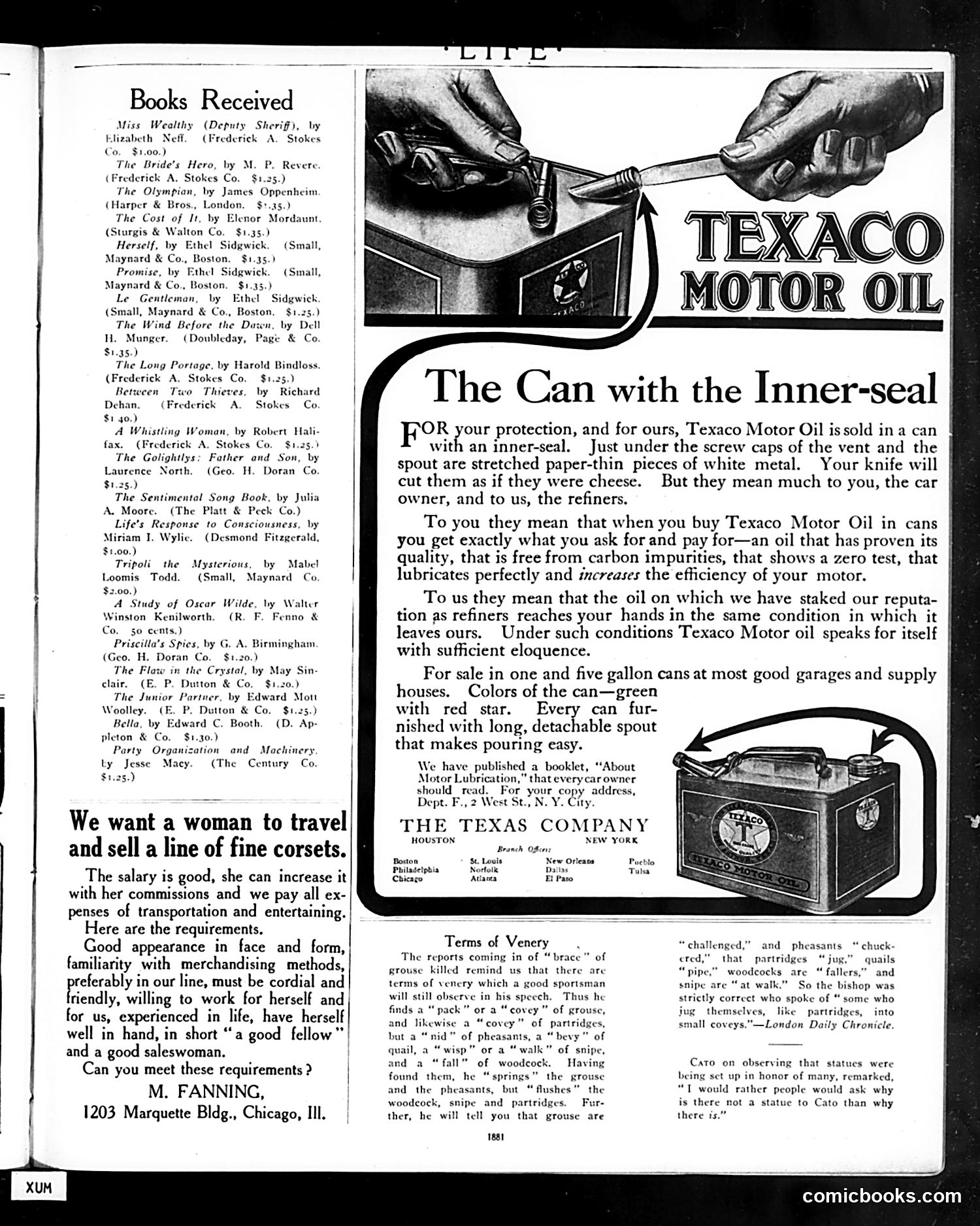
This page contains book reviews, classified advertising, and commercial advertisements typical of early 20th-century Life magazine—not political cartoons or satire. The **"Books Received"** section lists recently published novels, mostly from established publishers of the era. The **employment advertisement** from M. Fanning seeks a woman to travel selling corsets—notable for explicitly listing requirements like "good appearance" and being "a good fellow," reflecting period attitudes toward women workers as needing particular social graces alongside sales ability. The dominant feature is a **Texaco Motor Oil advertisement** emphasizing the product's "inner-seal" can design, which supposedly protects oil quality and purity during sale and use. The ad uses technical claims (carbon-free, zero-test results) to build consumer confidence. A brief **"Terms of Venery"** column discusses hunting terminology. These were common educational features in Life magazine, teaching readers specialized vocabulary from various pursuits. The page reflects early 1900s commercial culture and consumer marketing rather than political commentary.
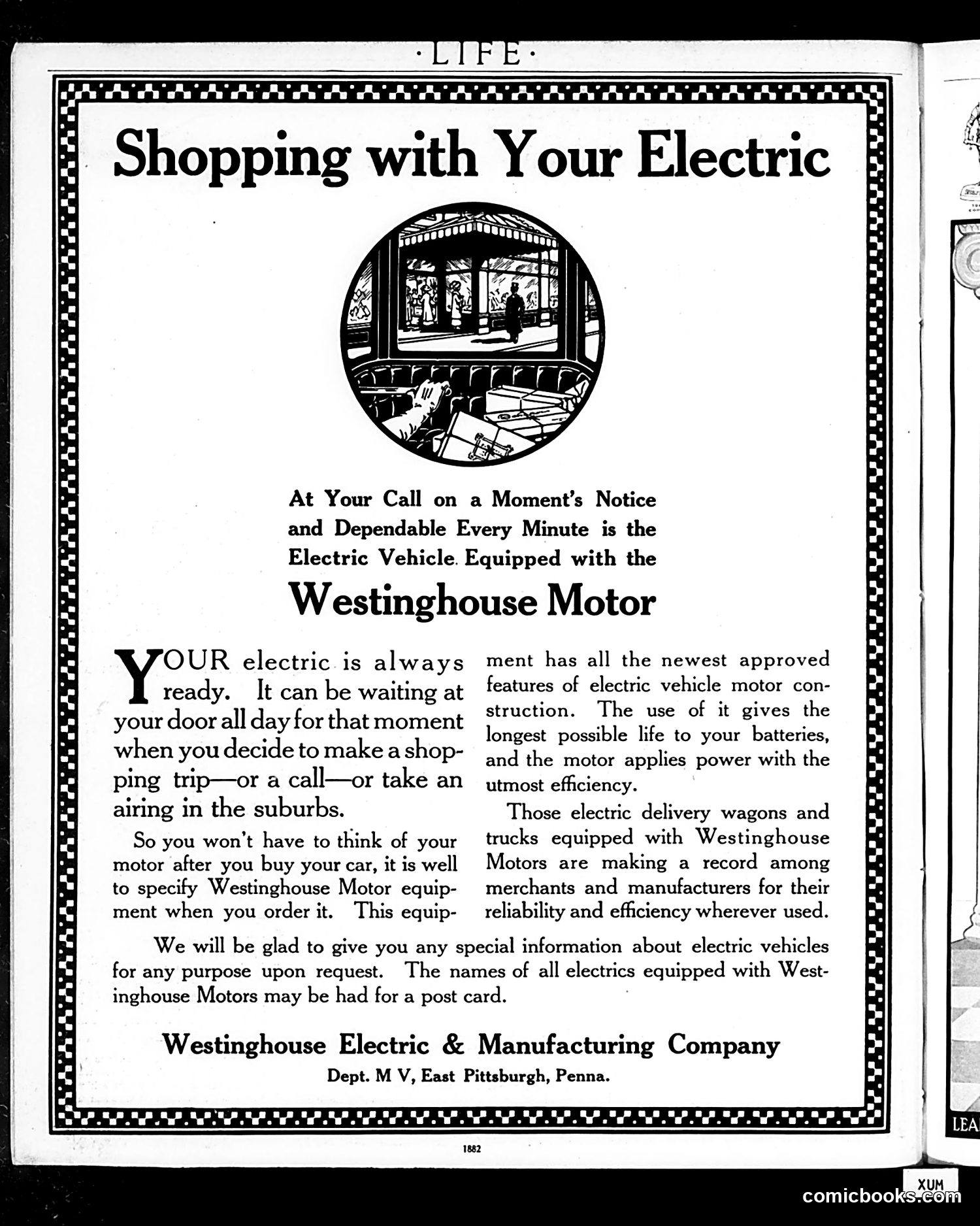
This is a **Westinghouse advertisement**, not satire or political commentary. The page promotes electric vehicles equipped with Westinghouse motors to early 20th-century consumers—primarily women, based on the shopping focus. The circular illustration shows a well-dressed woman in an electric car outside a storefront, depicting the vehicle's practical convenience for shopping trips and suburban outings. The ad's pitch emphasizes reliability ("always ready"), ease of use (no engine maintenance required), and efficiency for both personal and commercial delivery use. The historical context: this represents the brief era (roughly 1900-1920) when electric vehicles competed seriously with gasoline cars, particularly appealing to affluent women who preferred their quietness and simplicity over the cranking and noise of gas engines. By the 1920s, mass-produced affordable gasoline cars had won this competition. This is a genuine period advertisement reflecting real market conditions, not satire.
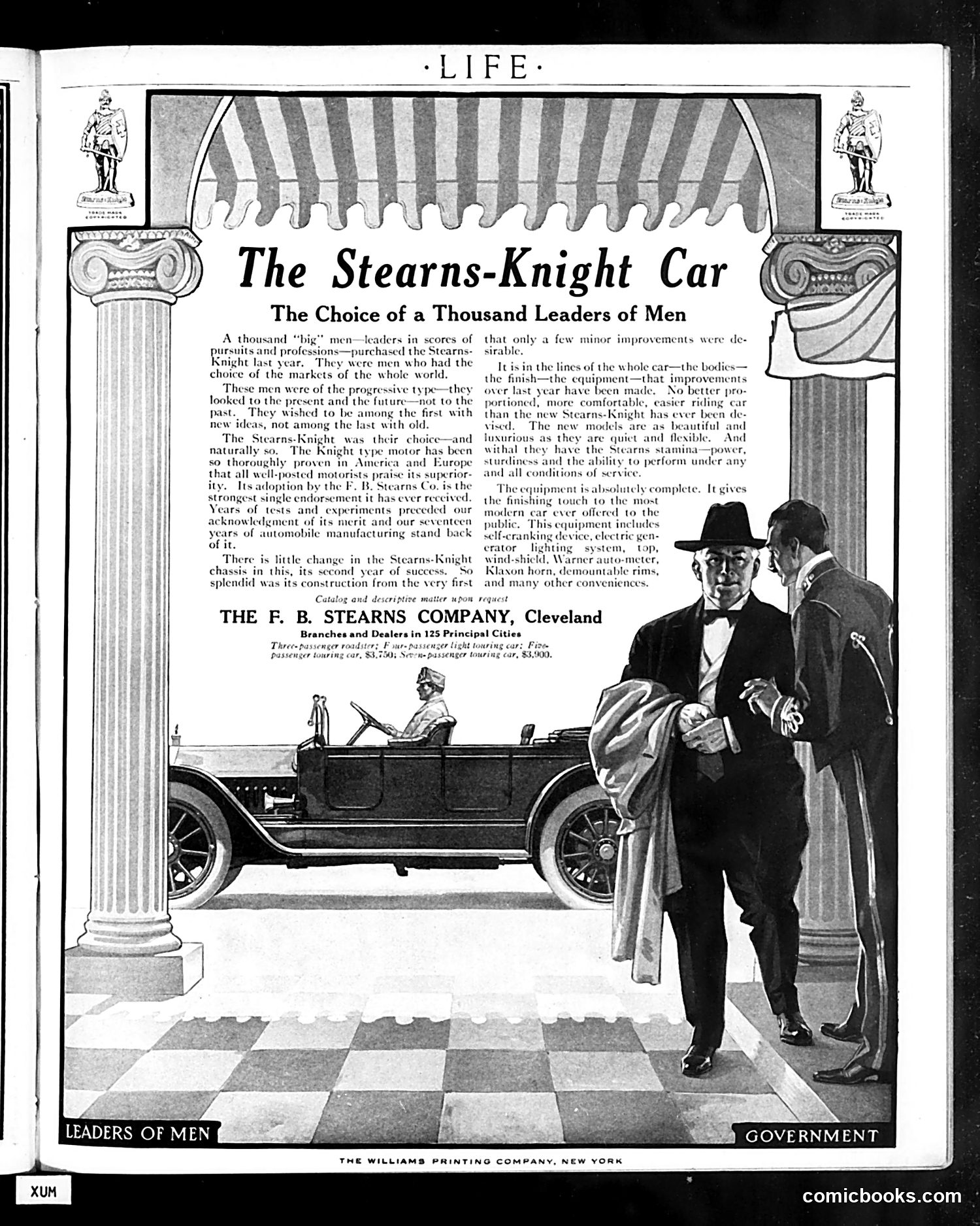
This is primarily **an advertisement, not a political cartoon**. The page promotes the Stearns-Knight automobile through Life magazine. The illustration depicts two well-dressed men in formal attire (top hats, overcoats) examining a Stearns-Knight car parked beneath a classical column. The image implies wealth and leadership—the "thousand leaders of men" referenced in the headline. **The sales pitch**: The ad claims that successful businessmen and professionals worldwide chose this car, positioning it as the choice of the progressive, forward-thinking elite. The "Knight" motor is presented as thoroughly tested and endorsed by the F.B. Stearns Company. **Historical context**: This appears to be early 20th-century automotive advertising, when cars were luxury goods for the wealthy. The classical architecture and gentlemen's formal dress signal exclusivity and high social status. **The satire/humor is minimal**—this is straightforward luxury marketing disguised within Life's satirical format, appealing to readers' aspirations for success and modern progress.
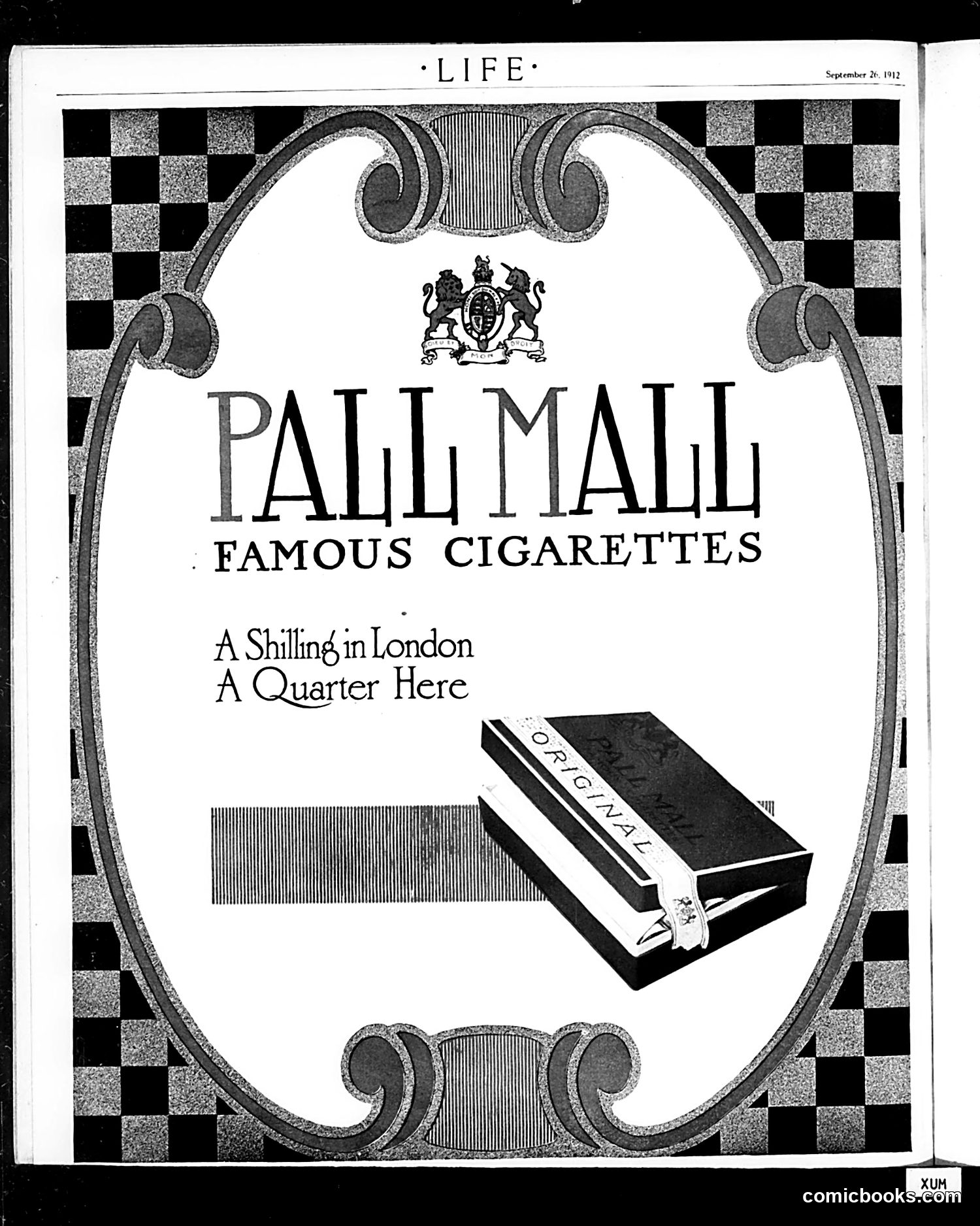
This is a **full-page advertisement** for Pall Mall cigarettes, not a political cartoon or satirical content. The ad emphasizes price comparison between markets: "A Shilling in London / A Quarter Here," suggesting Pall Mall cigarettes cost one shilling in London and a quarter (25 cents) in America—positioning them as affordable luxury goods. The design features an ornate oval frame with a checkerboard border and decorative scrollwork, containing a coat of arms at the top and an image of a Pall Mall cigarette package. The elegant presentation appeals to consumer aspirations of the era. Published September 20, 1912 in *Life* magazine, this reflects early-20th-century advertising focused on transatlantic commerce and pricing strategies.