
Life, 1912-09-26 · page 18 of 48
Life — September 26, 1912 — page 18: what you’re looking at
What you’re looking at
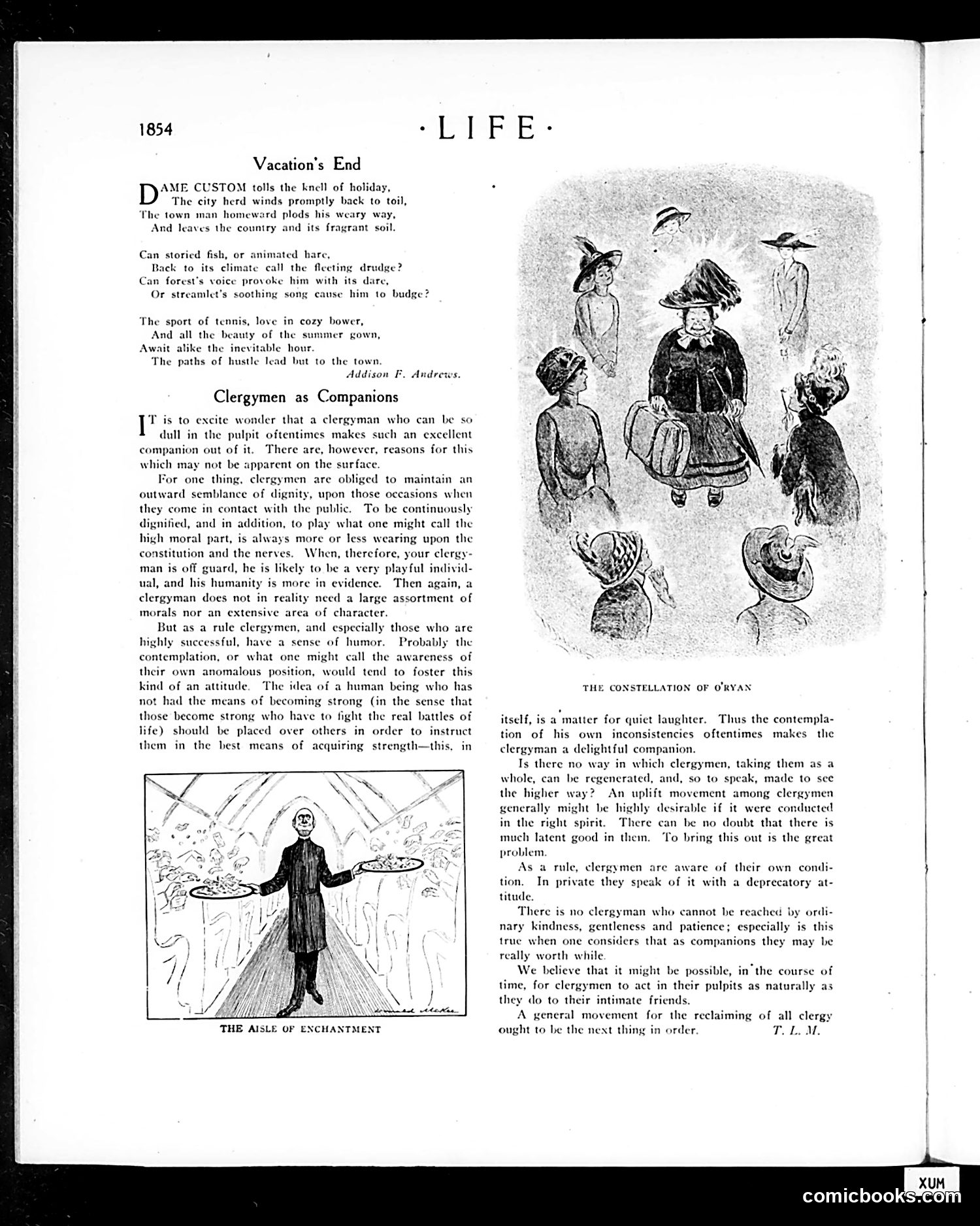
This page contains two distinct pieces of 1854 satirical content: **"Vacation's End"** is a melancholic poem about workers reluctantly returning from summer holidays to urban labor, lamenting nature's lost pleasures. **"Clergymen as Companions"** is a satirical essay mocking clergy. The author argues that while clergymen are dull in pulpits, they're delightful socially—because maintaining constant moral dignity is exhausting, so they're playful "off guard." The satire cuts deeper: the essay suggests clergy lack real moral strength (never having fought life's actual battles) yet presume to instruct others in ethics. This hypocrisy itself becomes a source of their humor. The author ironically advocates "regenerating" clergy through kindness, implying they desperately need moral improvement. The two illustrations—"The Aisle of Enchantment" (a priest blessing) and "The Constellation of O'Ryan" (unclear figure)—likely accompany or reinforce these satirical themes about clergy pretension, though their specific references are unclear without additional context.
📄 Transcribed text from this page (OCR, searchable)
Machine-transcribed from the original scan — historical spelling and the odd misread are preserved.
1854 Vacation’s End AME CUSTOM tolls the knell of holiday, The city herd winds promptly back to toil, The town man homeward plods his weary way, And leaves the country and its fragrant soil. Can storied fish, or animated har Back to its climate call the flecting drudg Can forest’s voice provoke him with its dare, Or streamlet’s soothing song cause him to budge? The sport of tennis, love in cozy bower, And all the beauty of the summer gown, Await alike the The paths of hustle lead but to the town. Addison F. Andrews. evitable hour. Clergymen as Companions |" is to excite wonder that a clergyman who can be so dull in the pulpit oftentimes makes such an excellent companion out of it. There are, however, reasons for this which may not be apparent on the surface. For one thing, clergymen are obliged to maintain an outward semblance of dignity, upon those occasions when they come in contact with the public. To be continuously dignified, and in addition, to play what one might call the high moral part, is always more or less wearing upon the constitution and the nerves. When, therefore, your clergy- man is off guard, he is likely to be a very playful individ- ual, and his humanity is more in evidence. Then again, a clergyman does not in reality need a large assortment of morals nor an extensive area of character. But as a rule clergymen, and especially those who are highly successful, have a sense of humor. Probably the contemplation, or what one might call the awareness of their own anomalous position, would tend to foster this kind of an attitude. The idea of a human being who has not had the means of becoming strong (in the sense that those become strong who have to fight the real battles of life) should be placed over others in order to instruct them in the best means of acquiring strength—this, in THE AISLE OF ENCHANTMENT THE CONSTELLATION OF O'RYAN itself, is a’matter for quict laughter. Thus the contempla- tion of his own inconsistencies oftentimes makes the clergyman a delightful companion. Is there no way in which clergymen, taking them as a whole, can be regenerated, and, so to speak, made to see the higher way? An uplift movement among clergymen generally might be highly desirable if it. were conducted in the right spirit. There can be no doubt that there is much latent good in them. ‘To bring this out is the great problem. As a rule, clergymen are aware of their own condi- tion. In private they speak of it with a deprecatory at- titude. There is no clergyman who cannot be reached by ordi- nary kindness, gentleness and patience; especially is this true when one considers that as companions they may be really worth while We believe that it might be possible, in’the course of time, for clergymen to act in their pulpits as naturally a they do to their intimate friends. general movement for the reclaiming of all clergy ought to be the next thing in order. T. L.M. comicbookean