
Life, 1912-09-26 · page 41 of 48
Life — September 26, 1912 — page 41: what you’re looking at
What you’re looking at
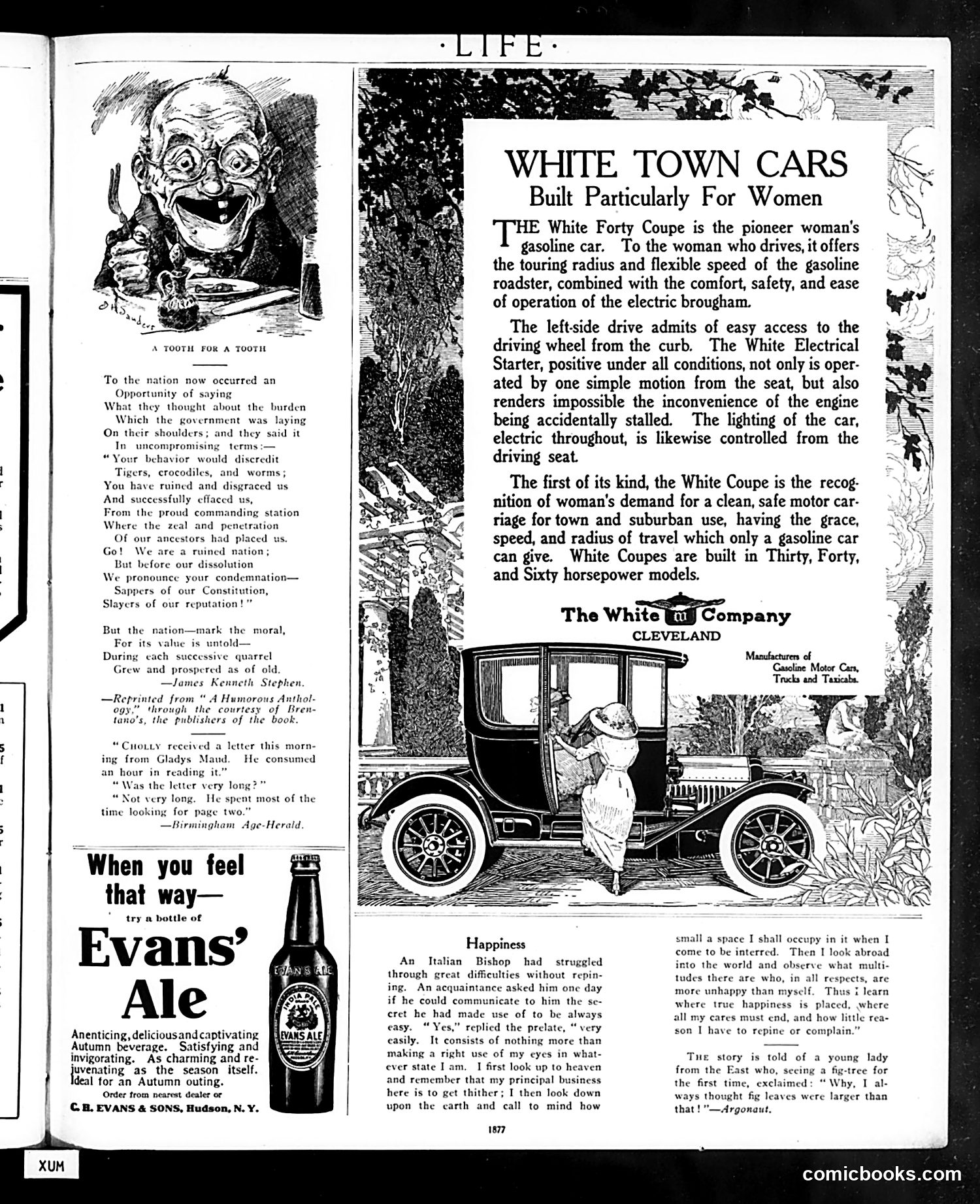
The cartoon depicts a caricatured figure (likely representing the U.S. government) receiving criticism from the nation. The accompanying poem is a scathing rebuke: citizens accuse their government of ruining the country, disgracing the nation, and betraying the legacy of their ancestors—calling them "Sappers of our Constitution, Slayers of our reputation!" The satire's ironic point appears in the final stanza: despite this harsh condemnation, "the nation...Grew and prospered as of old." The message suggests that America's strength and success persist *despite* government failures, implying that the nation's fundamental resilience transcends governmental incompetence. The specific political grievance isn't entirely clear from the text alone, but the general thrust critiques what the author viewed as destructive government policies or leadership. This was typical of Life magazine's role as a vehicle for political commentary in the early 20th century.
📄 Transcribed text from this page (OCR, searchable)
Machine-transcribed from the original scan — historical spelling and the odd misread are preserved.
A TOOTM FOR A TOOTH To the nation now occurred an Opportunity of saying What they thought about the burden Which the government: was laying On their shoulders; and they said it In uncompromising terms:— “Your behavior would discredit Tigers, crocodiles, and worms; You have ruined and disgraced us And successfully effaced us, From the proud commanding station Where the zeal and penetration Of our ancestors had placed us. Go! We are a ruined nation; But before our dissolution We pronounce your condemnation— Sappers of our Constitution, Slayers of our reputation!" But the nation—mark the moral, For its value is untold— During each successive quarrel Grew and prospered as of old. —James Kenneth Ste; WHITE TOWN CARS Built Particularly For Women T= White Forty Coupe is the pioneer woman's gasoline car. To the woman who drives, it offers the touring radius and flexible speed of the gasoline roadster, combined with the comfort, safety, and ease of operation of the electric brougham. The left-side drive admits of easy access to the driving wheel from the curb. The White Electrical Starter, positive under all conditions, not only is oper- ated by one simple motion from the seat, but also renders impossible the inconvenience of the engine being accidentally stalled. The lighting of the car, electric throughout, is likewise controlled from the driving seat. The first of its kind, the White Coupe is the recog. nition of woman's demand for a clean, safe motor car- riage for town and suburban use, having the grace, speed, and radius of travel which only a gasoline car can give. White Coupes are built in Thirty, Forty, and Sixty horsepower models. The White ow Company —Reprinted from “ A Humorous Anthol- ogy,” through the courtesy of Bren- tano’s, the publishers of the book. “Cnoity received a letter this morn- ing from Gladys Maud. He consumed an hour in reading it.” “Was the letter very lon “Not very long. He spent most of the time looking for page two.” —Birmingham Age-Herald. “When you feel that way— try a bottle of Evans’ Ale Anenticing, deliciousand captivating Autumn beverage. Satisfying and invigorating. As charming and re- juvenating as the season itself. deal for an Autumn outing. Order from nearest dealer or GB. EVANS & SONS, Hudson, N. Y. Happiness An Italian Bishop had struggled through great difficulties without repin- ing. An acquaintance asked him one day if he could communicate to him the se~ cret he had made use of to be always easy. “Yes,” replied the prelate, “ very casily. It consists of nothing more than making a right use of my eyes in what- ever state Tam. I first look up to he and remember that my principal business here is to get thither; I then look down upon the carth and call to mind how 1877 small a space I shall occupy in it when I come to be interred. Then I look abroad into the world and observe what multi- tudes there are who, in all respects, are more unhappy than myself. Thus i learn where true happiness is placed, where all my cares must end, and how little rea- son I have to repine or complain.” Tune story is told of a young lady from the East who, seeing a fig-tree for the first time, exclaimed: “Why, I al- ways thought fig leaves were larger than that !""—Argonaut. comicbooks.com