
Life, 1912-09-26 · page 6 of 48
Life — September 26, 1912 — page 6: what you’re looking at
What you’re looking at
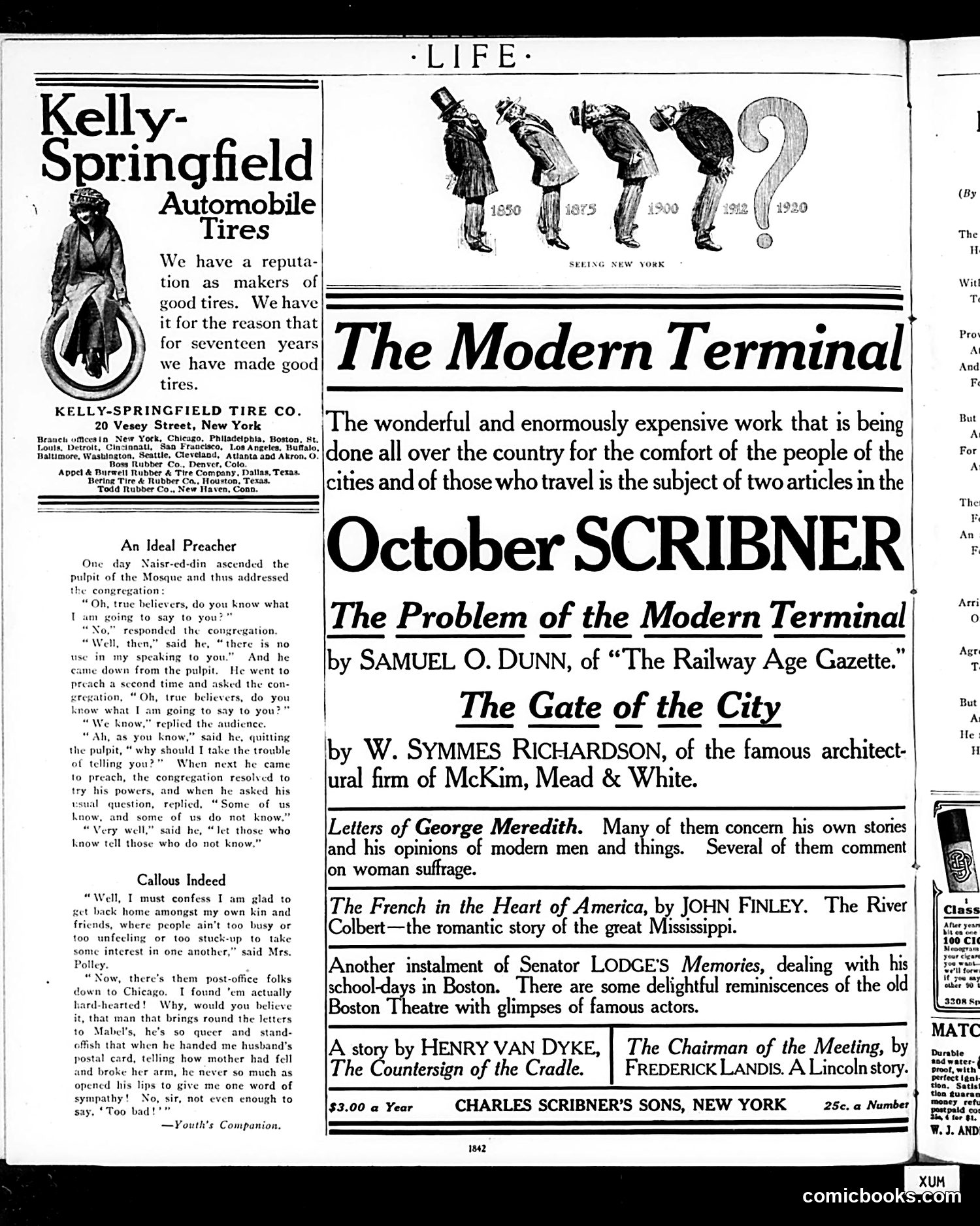
The top center cartoon depicts four figures bowing progressively lower across the decades (1850, 1875, 1900, 1912), followed by a question mark. Titled "SEEING NEW YORK," this satirizes changing fashion and posture in New York City over roughly 60 years. The joke appears to be that visitors' bowing posture—whether from deference, fatigue, or simply changing fashion—has become increasingly exaggerated. The final question mark suggests uncertainty about what comes next, perhaps mocking the rapid pace of urban change or the absurdity of fashion evolution. The page is otherwise dominated by advertisements (Kelly-Springfield tires) and promotional content for the October *Scribner's* magazine issue, making this a typical early 1900s magazine layout mixing editorial and commercial content.
📄 Transcribed text from this page (OCR, searchable)
Machine-transcribed from the original scan — historical spelling and the odd misread are preserved.
Kelly- Springfield Automobile Tires We have a reputa- tion as makers of good tires. We have it for the reason that for seventeen years we have made good tires. ay Tad; KELLY-SPRINGFIELD TIRE CO. 20 Vesey Street, New York Branel omces in New York, Chicago. Philadelphia, Boston, St. Louls, Detroit, Cincinaatl, San Francisco, Los Angeles, Buftalo, Baltimore, Washington, Seattle, Cleveland, Atianta and Akron, O- Boss Rubber Co.. Denver, Colo. Appel & Burwell Rubber & Tire Company, Dallas, Texas. Bering Tire & Rubber Co,, Houston, Texas. ‘Todd Rubber Co., New Haven, Conn. An Ideal Preacher One day Naisr-ed-din ascended the pulpit of the ne and thus addressed the congreg: “Oh, true believers, do you know what | Tam going to say to you?” ; responded the congregation. “Well, then,” said he, “there is no use in my speaking to you.” And he came down from the pulpit. He went to preach a sccond time and asked the con- i Dh, true believers, do you n going to say to you?” A audience. “Ah, as you know,” said he, quitting the pulpit, “why should I take the trouble of telling you?” When next he came to preach, the congregation resolved to try his powers, and when he asked his usual question, replied, “Some of us Know, and some of us do not know.” “Very well," said he, “Jet those who know tell those who do not know.” “We kn Callous Indeed “Well, I must confess I am glad to get back home amongst my own kin and friends, where people ain't too busy or too unfeeling of too stuck-up to take some interest in one another,” said Mrs. Polley. “Now, there's them post-office folks down to Chicago, I found ‘em actually hard-hearted! Why, would you believe it, th: in that brings round the letters to Mabel’s, he's so qucer and stand- offish that when he handed me husband's postal card, telling how mother had fell and broke her arm, he never so much as opened his lips to give me one word of sympathy! No, sir, not even enough to say, ‘Too bad! Youth's Companion. > The Modern Terminal The wonderful and enormously expensive work that is being done all over the country for the comfort of the people of the | cities and of those who travel is the subject of two articles in the October SCRIBNER The Problem of the Modern Terminal by SAMUEL O. DUNN, of “The Railway Age Gazette.” The Gate of the City lby W. SYMMES RICHARDSON, of the famous architect- ural firm of McKim, Mead & White. Letters of George Meredith. Many of them concem his own stories land his opinions of modem men and things. Several of them comment o lon woman suffrage. L The French in the Heart of America, by JOHN FINLEY. The River Colbert—the romantic story of the great Mississippi. | Another instalment of Senator LODGE’S Memories, dealing with his school-days in Boston. There are some delightful reminiscences of the old heatre with glimpses of famous actors. Boston A story by HENRY VAN DYKE, | The Chairman of the Meeting, by | The Coutnteniin of the Cradle. FREDERICK Lanois. A Lincoln story. $3.00 a Year CHARLES SCRIBNER’S SONS, NEW YORK 25c. a Number 1842