
A complete issue · 44 pages · 1912
Life — September 19, 1912
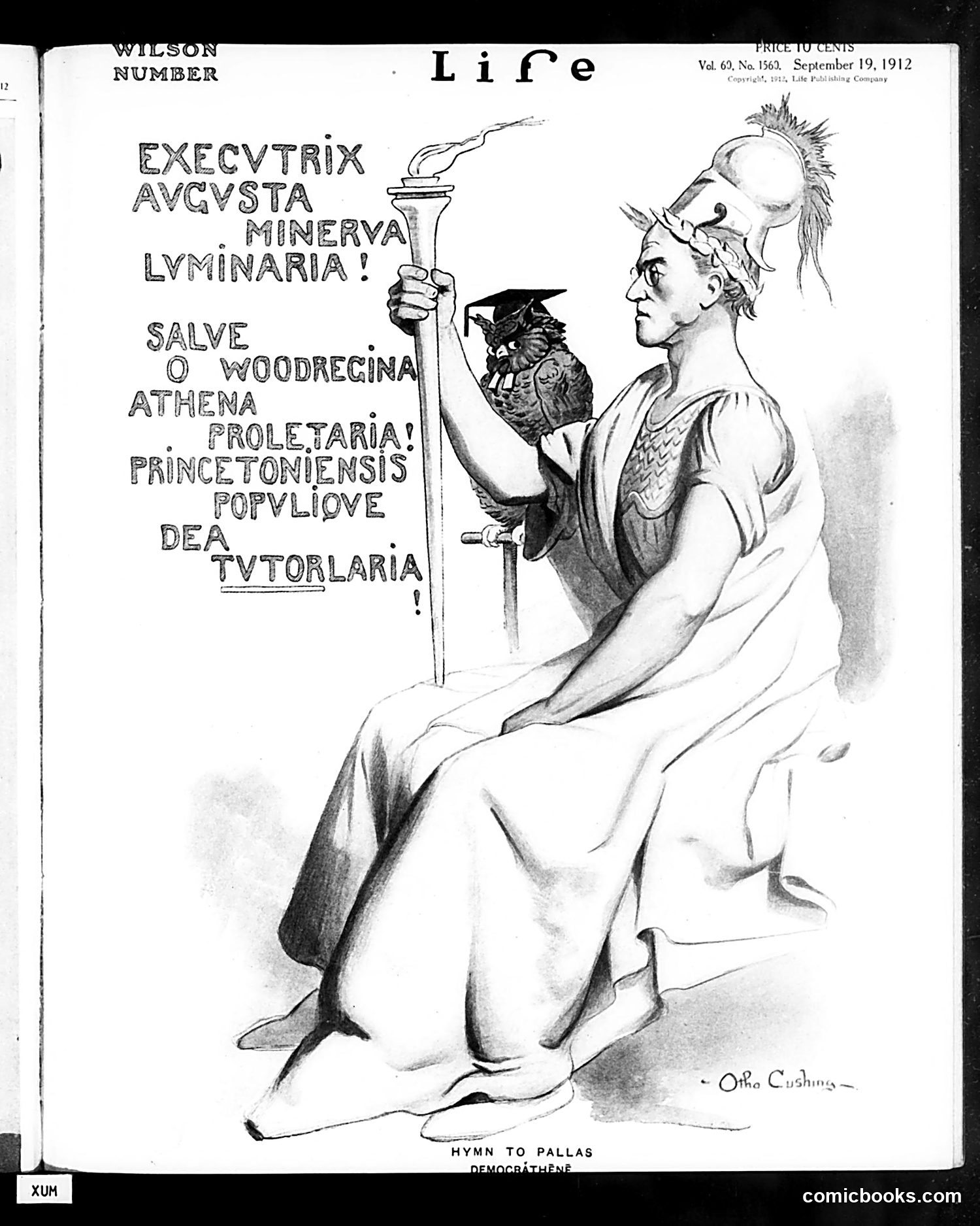
This political cartoon depicts a classical female figure (representing Athena/Wisdom) holding a torch and an owl, addressing Princeton University's leadership in Latin. The Latin text invokes classical ideals of enlightened governance and education. The satire likely references Princeton's president Woodrow Wilson, who was elected New Jersey governor in 1910 and became a presidential candidate in 1912. The cartoon appears to critique Wilson or Princeton's direction during this period, using classical imagery to ironically contrast idealized democratic principles with contemporary political realities. The "Hymn to Pallas Democrathene" subtitle reinforces the classical framework, suggesting commentary on American democracy's philosophical foundations versus actual practice. Without additional context, the specific target of criticism remains unclear.
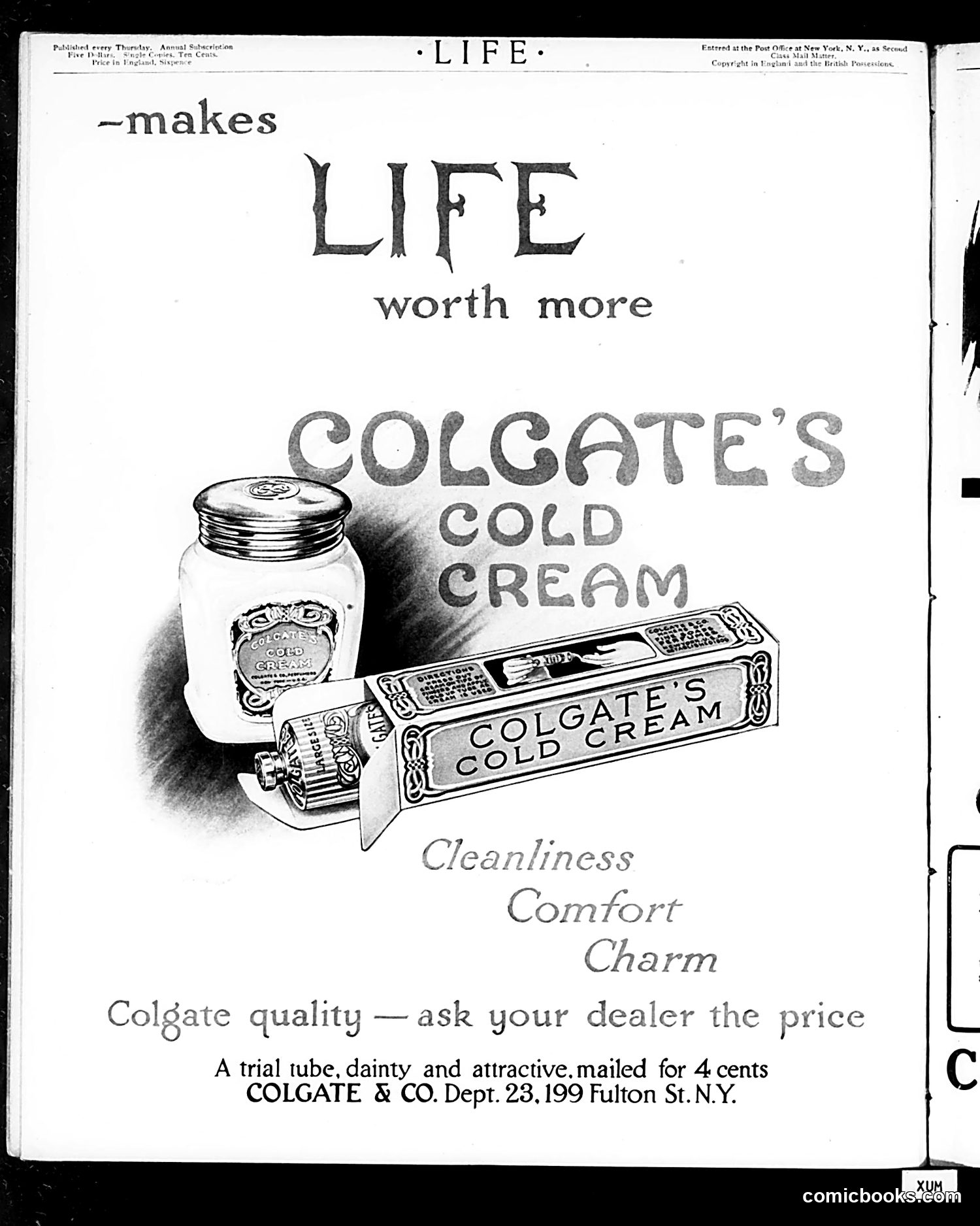
This page is **primarily an advertisement**, not a cartoon or satirical content. It's a Colgate's Cold Cream advertisement from Life magazine, promoting the product's benefits for "Cleanliness, Comfort, Charm." The ad uses the common early 20th-century marketing approach of claiming that a beauty/personal care product "makes LIFE worth more"—a hyperbolic pitch suggesting the cream significantly improves one's quality of life. The visual shows a jar and tube of the product. There is **no political satire or social commentary** present. This is straightforward commercial messaging typical of the era, where beauty products were marketed with broad lifestyle claims. A modern reader would recognize this as an exaggerated advertising pitch that would likely face regulatory scrutiny today.
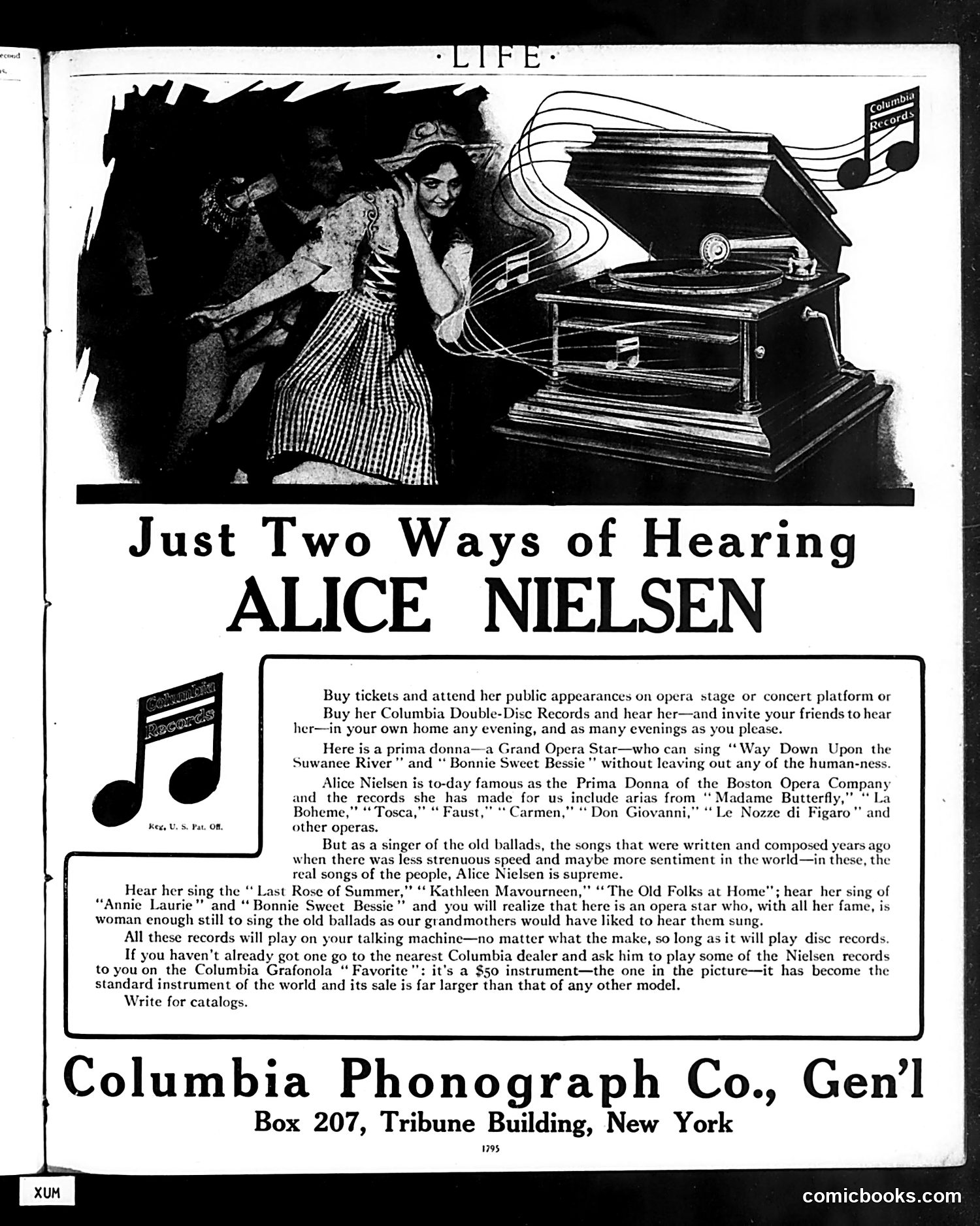
This is a **Columbia Records advertisement** for opera singer Alice Nielsen, not satirical content. The page promotes two ways to hear her performances: attending live opera/concert appearances or purchasing Columbia phonograph records to play at home. The ad emphasizes Nielsen's prominence as prima donna of the Boston Opera Company and her recordings of famous operatic arias ("Carmen," "Faust," "Don Giovanni," etc.). It also highlights her ability to sing traditional ballads like "Bonnie Sweet Bessie" and "Last Rose of Summer" with emotional authenticity. The advertisement's real pitch: Columbia's "Favorite" phonograph model is positioned as a superior home listening device, encouraging readers to visit dealers to hear Nielsen's records demonstrated on the equipment before purchasing.
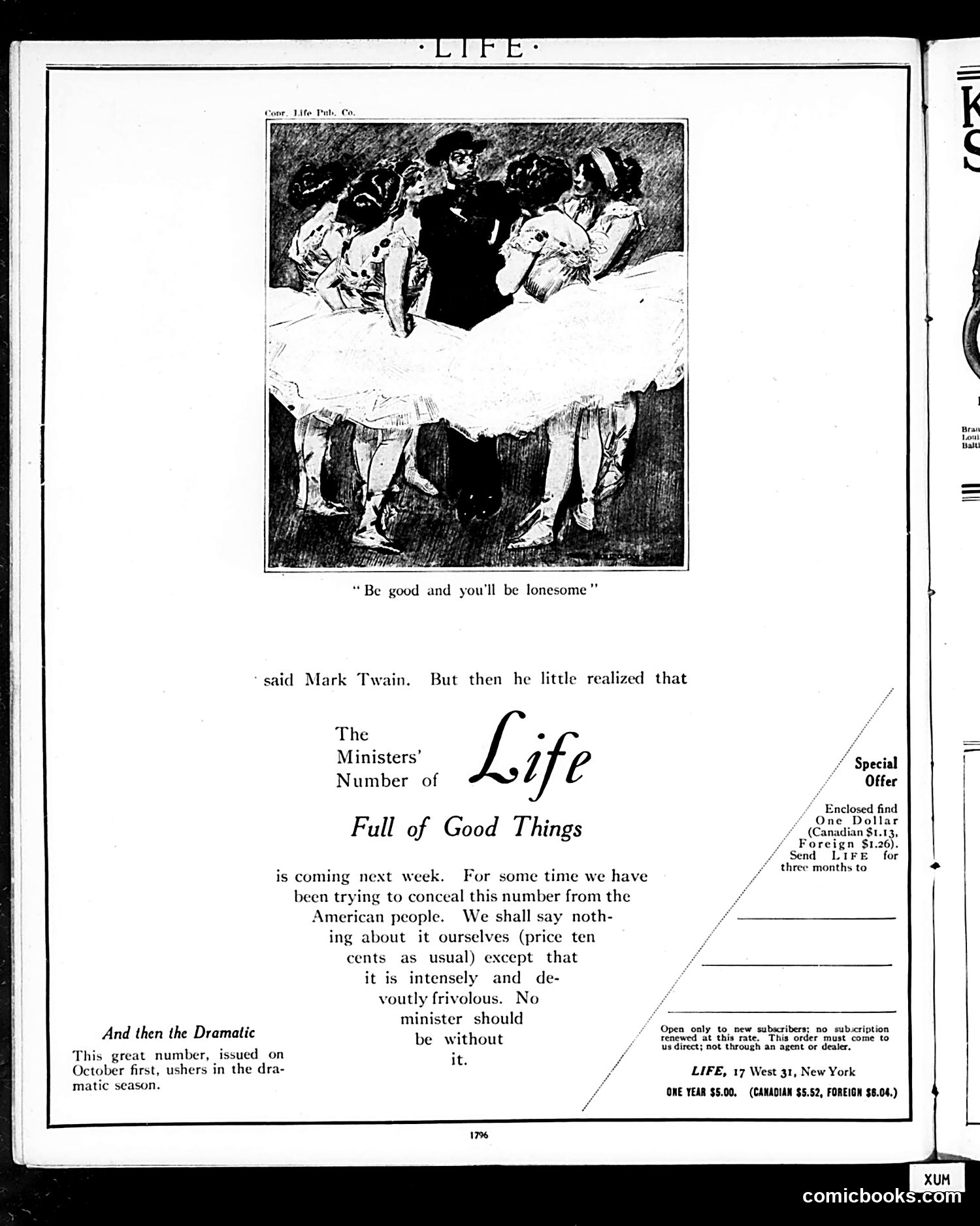
The page features a satirical illustration and advertisement for *Life* magazine's upcoming "Ministers' Number." The cartoon depicts a group of people (appearing to be clergy or ministers based on context) gathered around a table, with the caption "Be good and you'll be lonesome"—attributed to Mark Twain. The image humorously suggests that virtue isolates people socially. The text below promotes an upcoming special issue devoted to ministers, describing it as "Full of Good Things" and "intensely and devoutly frivolous." The satire appears to mock both ministerial pomposity and the magazine's playful irreverence toward religious authority—suggesting that a magazine issue about ministers would paradoxically be frivolous rather than serious. This reflects *Life*'s reputation as a publication that satirized American institutions, including the clergy.
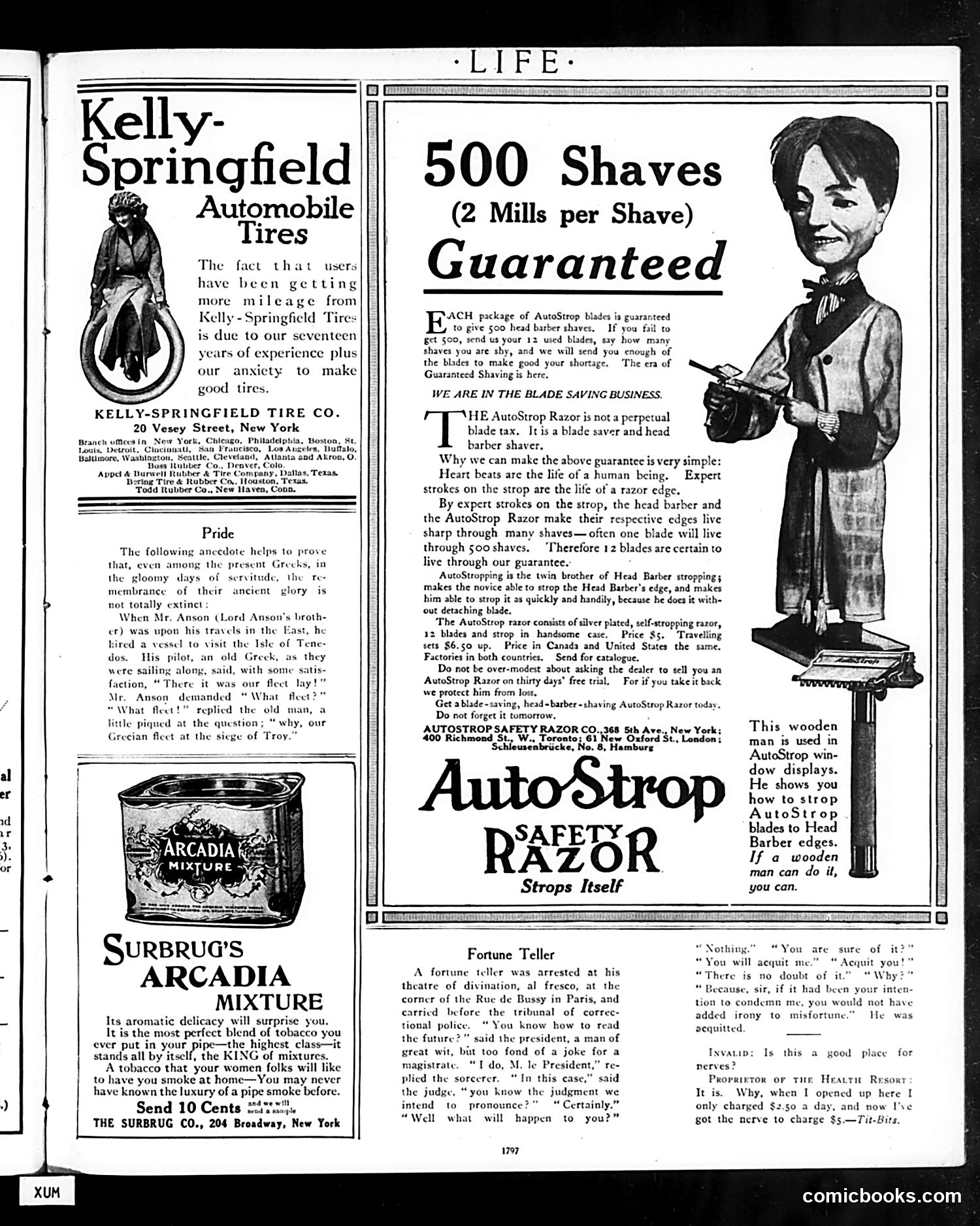
This page is primarily **advertising**, not satire or political commentary. It contains four distinct ads: 1. **Kelly-Springfield Automobile Tires** — emphasizes durability from 17 years of experience 2. **AutoStop Safety Razor** — the central ad, featuring a smiling woman demonstrating how the razor "strops itself," guaranteeing 500 shaves at 2 mills each 3. **Surbrug's Arcadia Mixture** tobacco — marketed as luxury pipe tobacco preferred by women 4. **Fortune Teller** — a brief humorous anecdote about a fortune teller arrested in Paris There are no political cartoons or identifiable caricatures. The content reflects early 20th-century consumer advertising and includes period-appropriate gender stereotypes (women being marketed tobacco and razors). The page primarily showcases commercial products typical of *Life* magazine's revenue model.
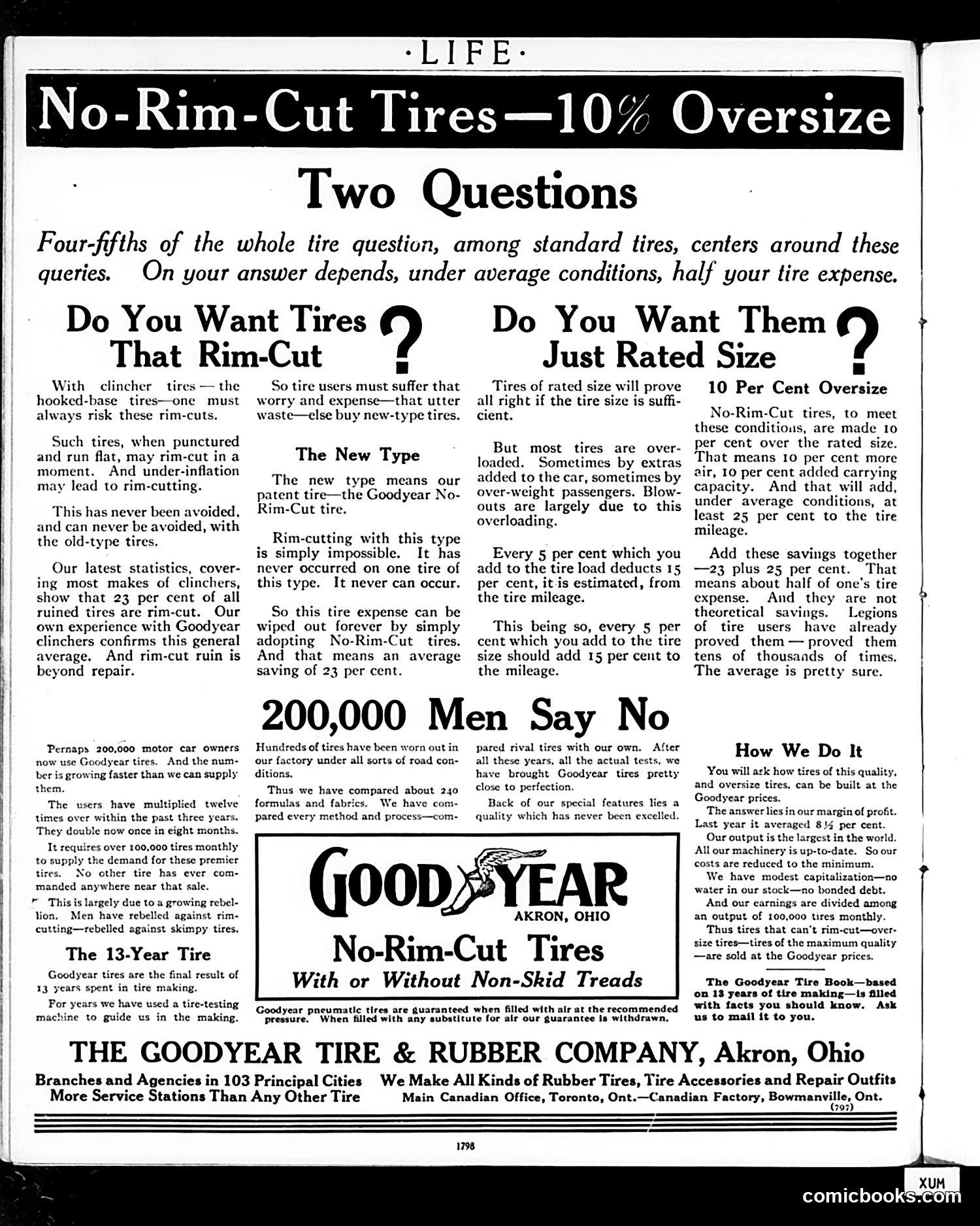
This is **not a political cartoon or satire** — it's a straightforward **advertisement for Goodyear No-Rim-Cut tires** from around the 1920s-1930s. The page presents two marketing questions addressing consumer concerns: 1. **"Do You Want Tires That Rim-Cut?"** — argues against cheaper tires prone to damage 2. **"Do You Want Them Just Rated Size?"** — promotes Goodyear's oversized tires (10% larger) as more durable The ad emphasizes that Goodyear's innovation prevents rim-cutting (a common tire failure), claims 200,000 satisfied customers, and promises cost savings through longer tire life. The "13-Year Tire" reference boasts durability from their manufacturing process. This is purely commercial messaging, not satire — typical of early automotive advertising emphasizing technical superiority and reliability.
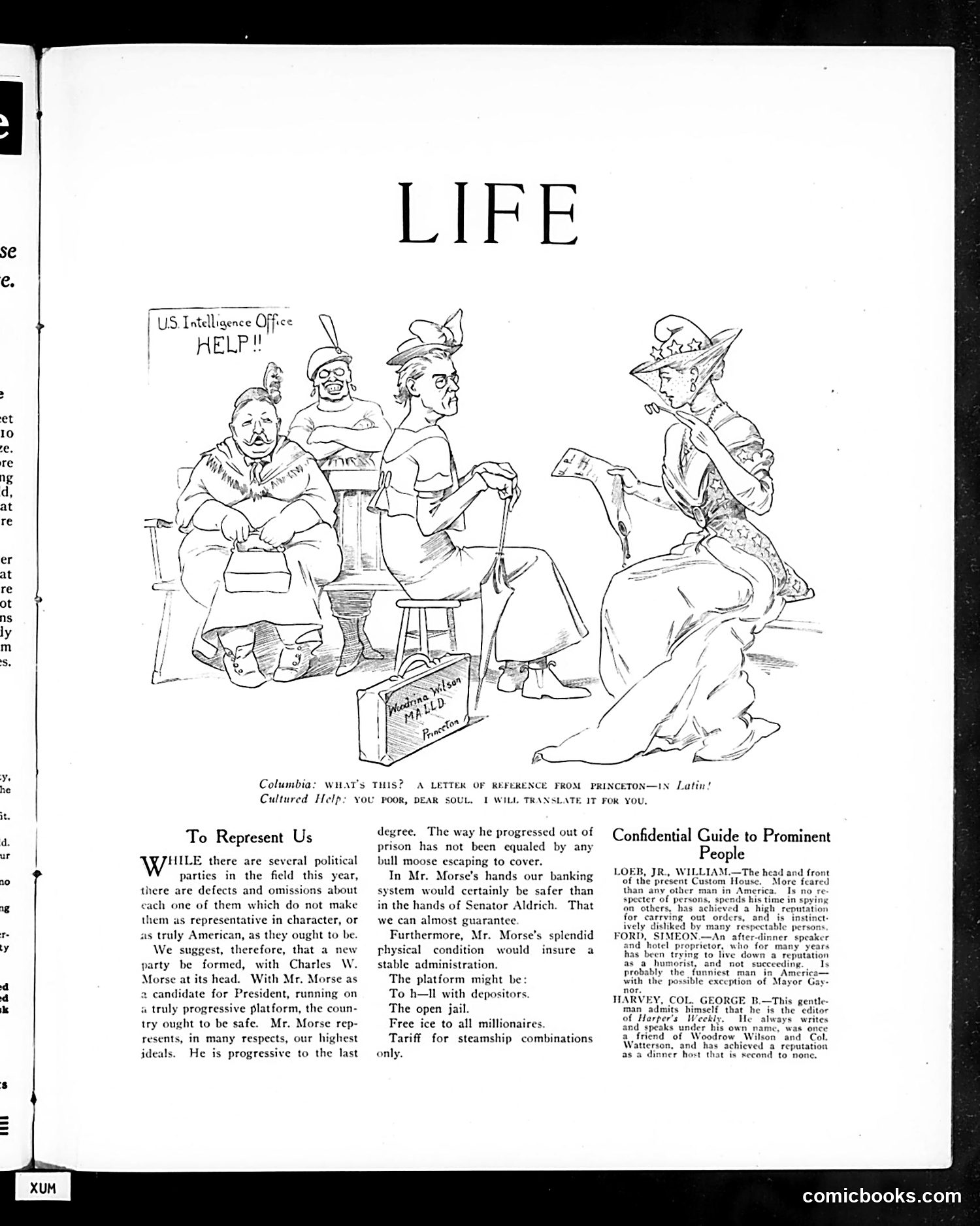
This cartoon satirizes American political chaos through the metaphor of someone seeking help from the "US Intelligence Office." The three figures on the left (appearing distressed and caricatured) represent domestic political parties in disarray, while the figure on the right—labeled with military regalia and appearing confident—represents an authoritarian or militaristic alternative. The caption references "Columbia" (personification of America) receiving "a letter of reference from Princeton—in Latin," suggesting absurdist solutions to political dysfunction. The accompanying article "To Represent Us" proposes Charles Morse as a presidential candidate, satirizing how Americans might turn to a strongman figure when traditional parties fail. The piece mockingly suggests Morse's "splendid physical condition" and progressive credentials would make him suitable leadership, while listing deliberately ridiculous platform planks.
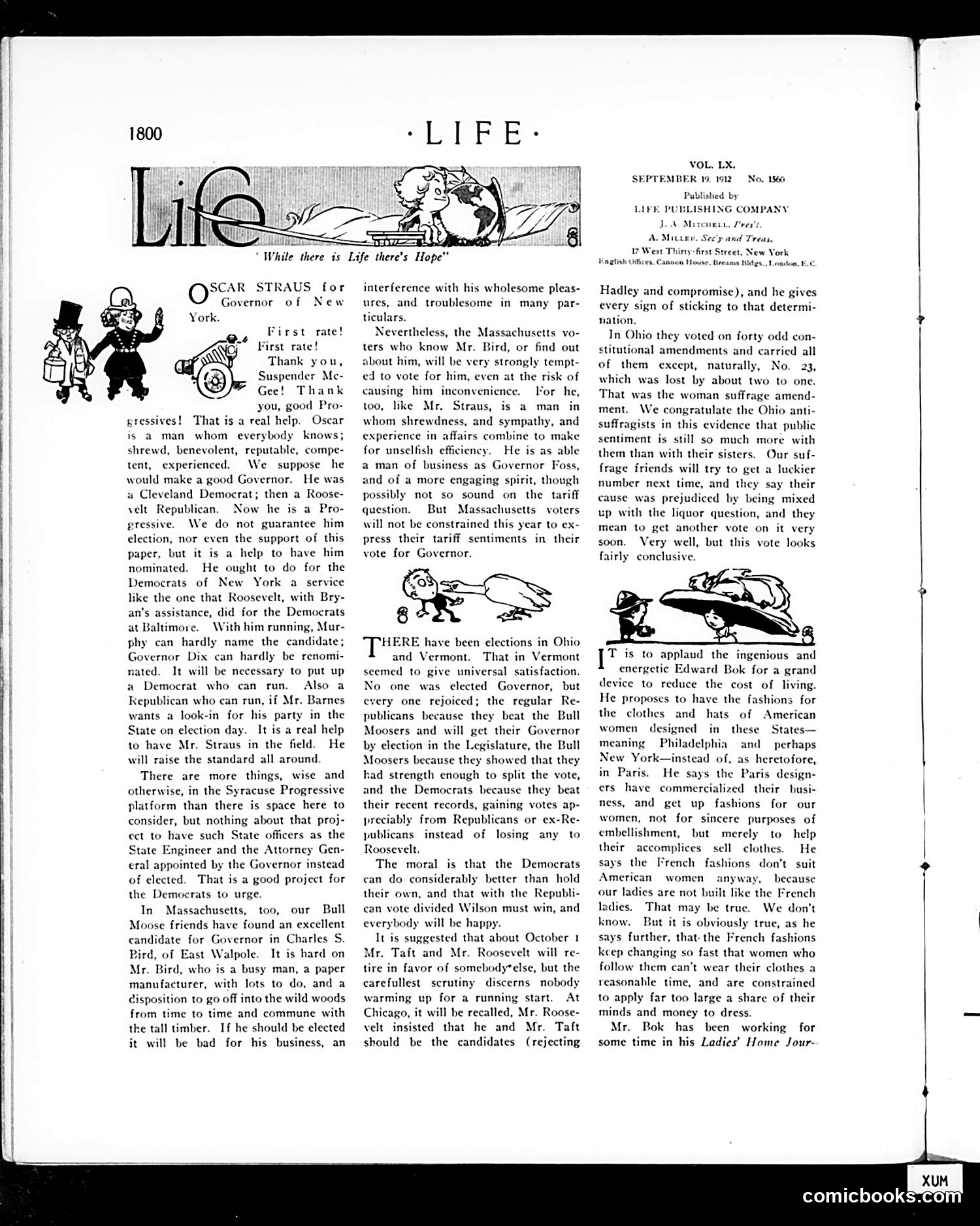
This page criticizes Oscar Straus as a candidate for New York Governor. The text argues Straus, though "shrewd, benevolent, reputable," lacks executive experience—unlike Roosevelt or a true businessman like Charles S. Bird of East Walpole, whom Life endorses instead. The small cartoons show figures in comedic poses, likely depicting political candidates or their supporters. The article mentions concurrent elections in Ohio and Vermont, praising their results, then shifts to praising Edward Bok's fashion reform efforts for American women. The overall tone is satirical commentary on 1912 election politics, endorsing practical businessmen over politicians Life deemed insufficiently experienced for high office.
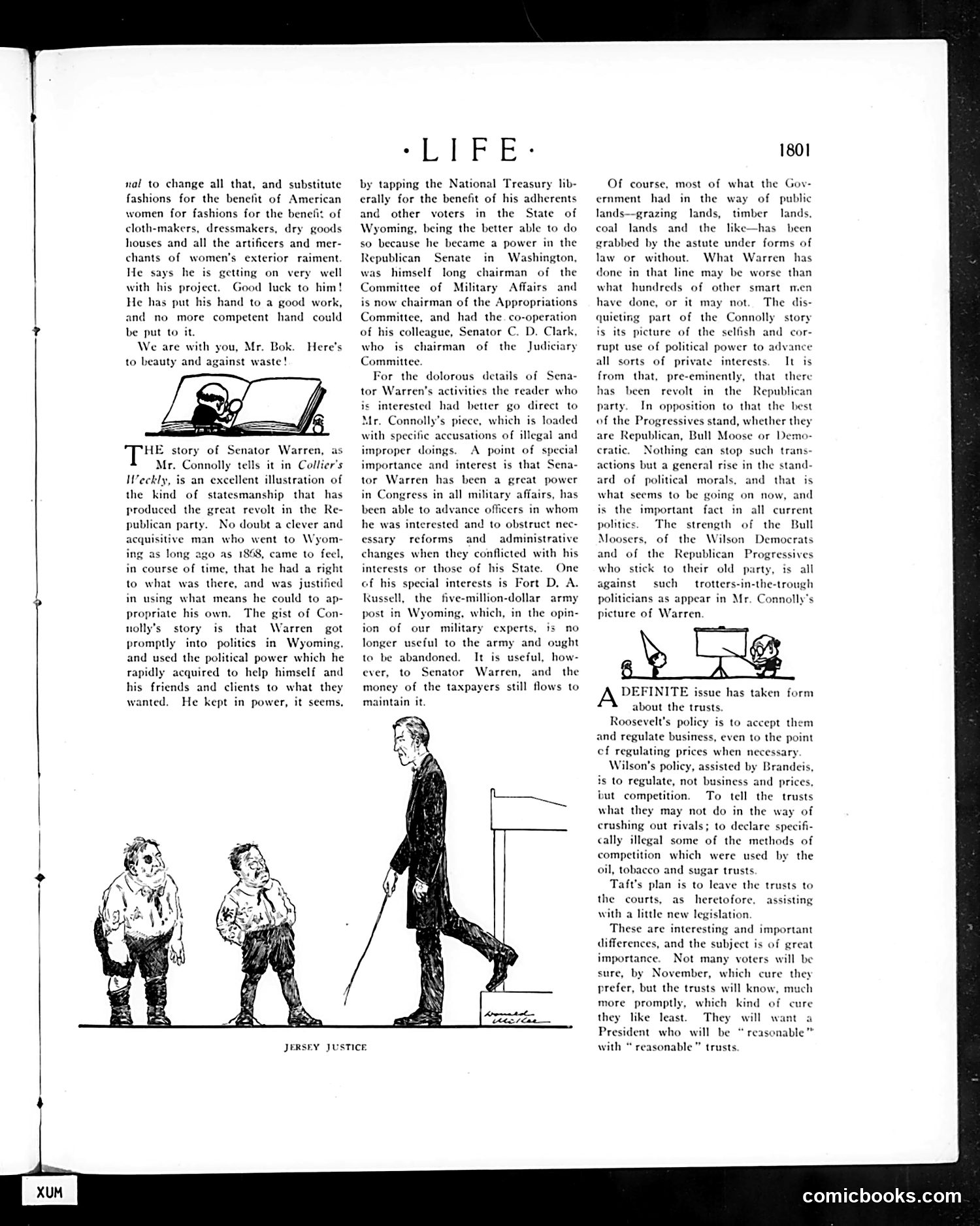
This 1901 *Life* magazine page criticizes Senator Warren's political power in Wyoming. The cartoon titled "Jersey Justice" depicts a tall figure (Warren) standing over two smaller figures labeled as representing common citizens or workers, visually emphasizing the power imbalance. The accompanying article details Warren's influence—his control of military affairs committees, his ability to advance officers, and his use of political power to benefit private interests, particularly Fort D.A. Russell in Wyoming. The satire suggests Warren exploited his position to enrich himself and allies while claiming to serve public interest. The cartoon's title invokes "justice" ironically: the composition shows Warren towering over ordinary people, suggesting justice is perverted when politicians prioritize personal gain over constituents' welfare.
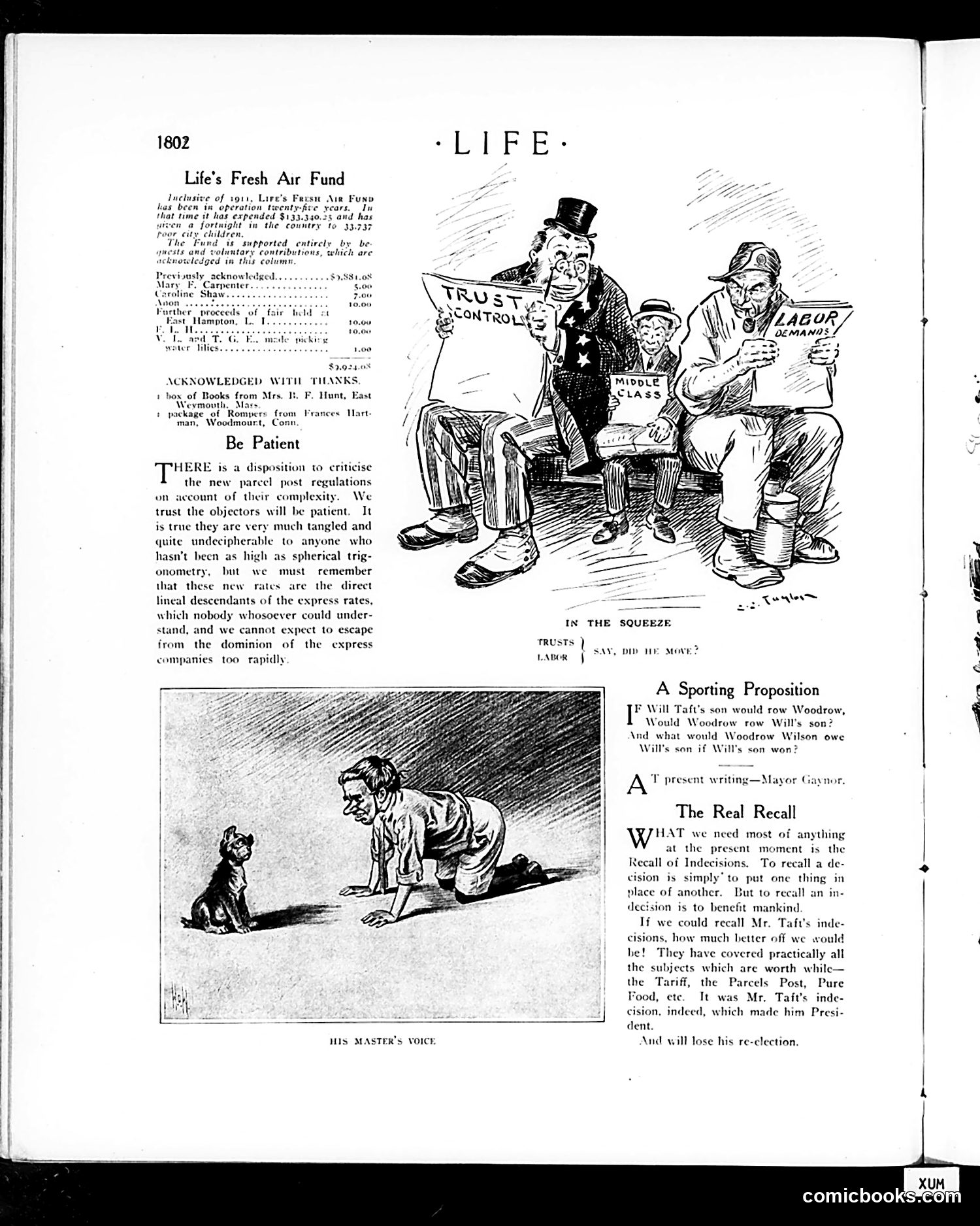
The main cartoon "In the Squeeze" depicts three figures labeled "TRUST," "CONTROL," and "LABOR" pressuring a small "MIDDLE CLASS" man caught between them. This satirizes the economic tension of the era where the middle class felt squeezed by monopolistic trusts, government regulation, and labor demands. Below, "His Master's Voice" shows a dog listening to a man on all fours—likely mocking political subservience or loss of dignity. The text pieces reference postal rate regulations and criticize President Taft's policies, suggesting he would lose re-election. "A Sporting Proposition" and "The Real Recall" discuss Taft's indecision and the recall movement, indicating this is from the 1912 election period when progressive Republicans challenged Taft's leadership.
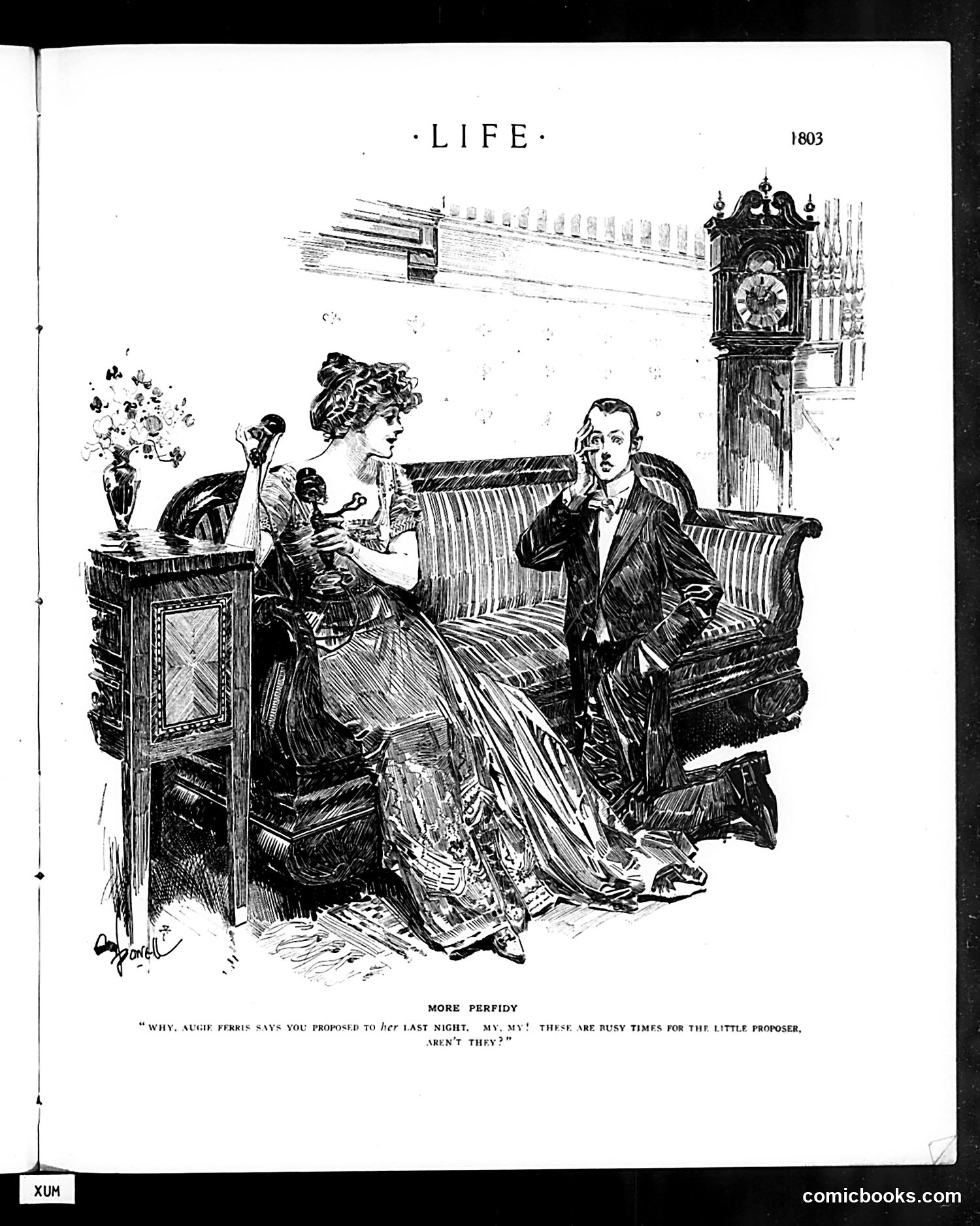
This cartoon depicts a drawing room scene where a woman confronts a man about a marriage proposal. The caption reads: "Why, Augie Ferris says you proposed to her last night, my my! These are busy times for the little proposer, aren't they?" The satire targets a man (presumably "Augie Ferris" or the man being addressed) who appears to be a serial proposer—making multiple marriage proposals to different women, perhaps casually or insincerely. The woman's sardonic tone ("busy times for the little proposer") mocks his apparent habit of proposing without commitment. The ornate Victorian furnishings and fashionable woman's dress establish this as upper-class social satire, criticizing frivolous courtship behavior and masculine duplicity in romantic matters.
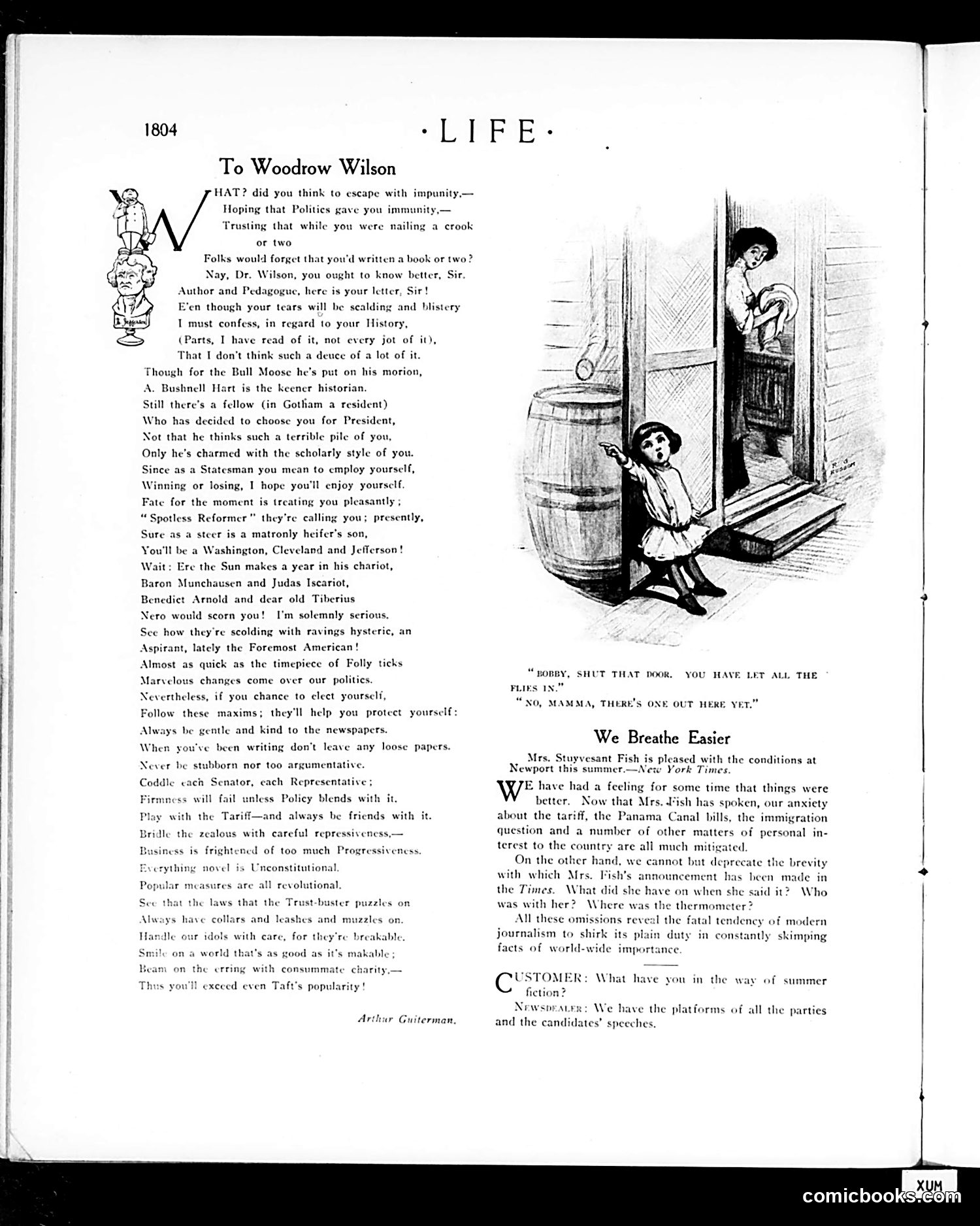
This page contains a satirical poem by Arthur Guiterman addressed to Woodrow Wilson, likely written during the 1904 presidential campaign. The poem mocks Wilson's scholarly pretensions and warns him about entering politics, referencing various political figures (the "Bull Moose," figures like Benedict Arnold and Judas Iscariot as cautionary examples). The accompanying illustration depicts two children peering through a doorway at barrels, with dialogue: "Sorry, shut that door. You have let all the flies in." / "No, mamma, there's one out here yet." This cartoon likely satirizes political corruption or unwanted political figures—the "flies" represent undesirable politicians or parties attempting to enter the political arena. The page also begins an article titled "We Breathe Easier," critiquing Mrs. Fish's newspaper announcements about contemporary issues (tariffs, Panama Canal).
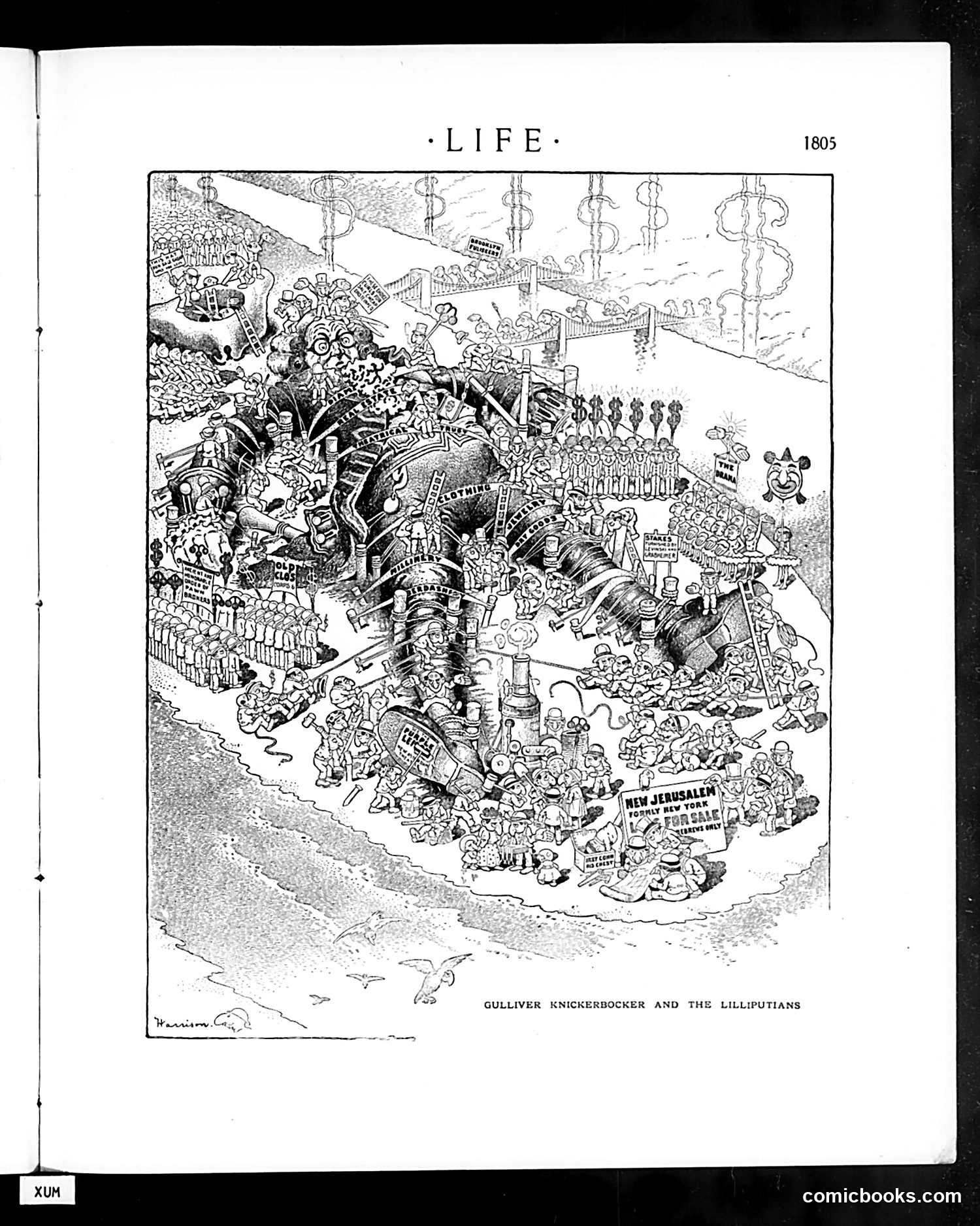
This 1895 *Life* magazine cartoon depicts a chaotic scene titled "Gulliver Knickerbocker and the Lilliputians." The illustration references Jonathan Swift's *Gulliver's Travels*, transplanting that satire into an American urban context. A giant figure (Gulliver Knickerbocker—a personification of New York City using the Dutch colonial name) towers over a landscape swarming with tiny people and commercial enterprises. Visible signage includes "New Jerusalem For Sale," suggesting real estate speculation. The dollar signs floating overhead emphasize themes of commerce and greed dominating urban life. The satire compares turn-of-the-century New York's rapid development and financial speculation to Swift's tale of a giant among diminutive people, critiquing the era's rampant commercialism and urban growth.
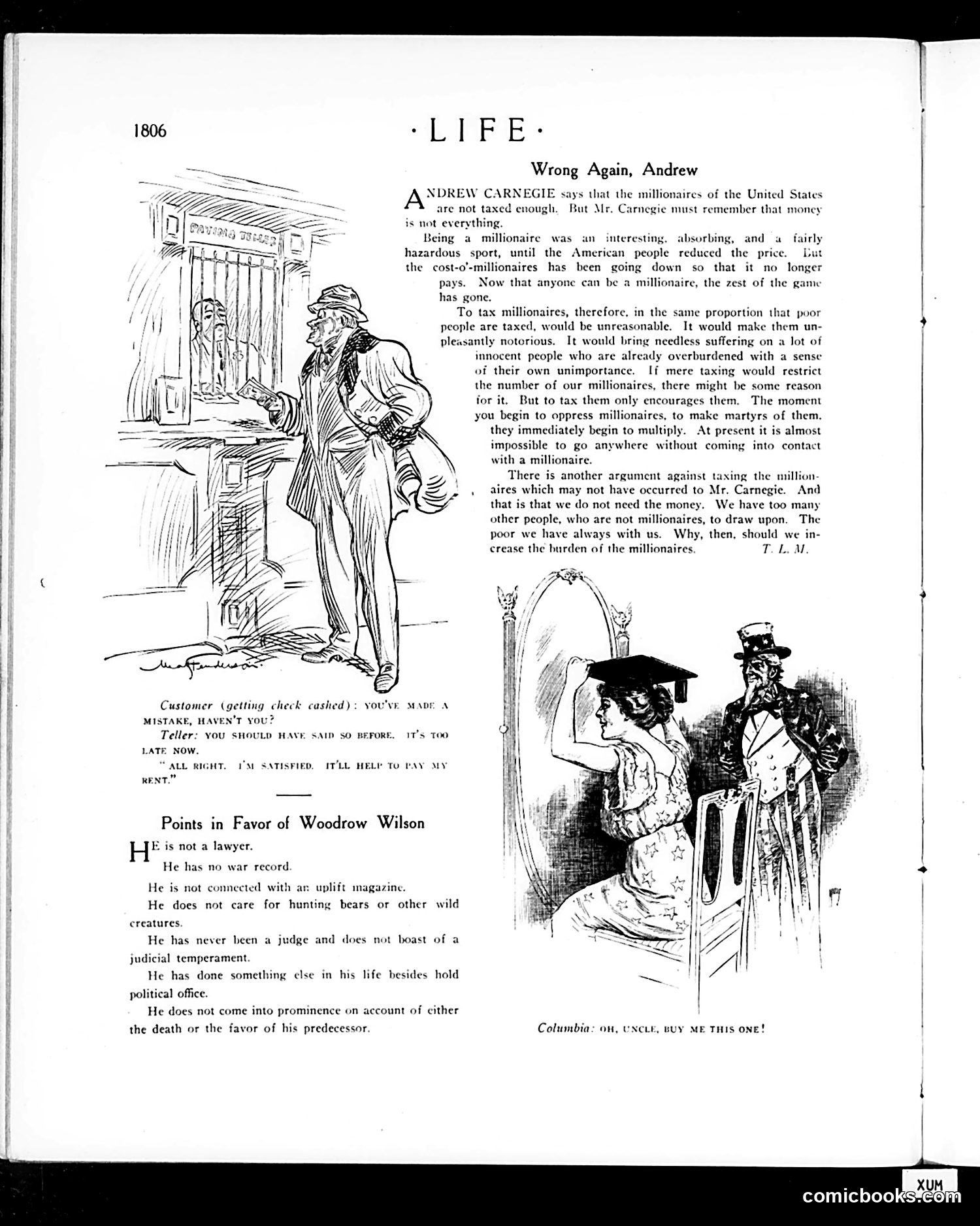
**Top Article: "Wrong Again, Andrew"** This critiques Andrew Carnegie's opposition to taxing millionaires. The author argues Carnegie is wrong that the wealthy shouldn't be taxed proportionally to the poor. The piece sarcastically notes that taxing millionaires would discourage them from multiplying—presenting this as absurd, since millionaires are already everywhere and tiresome to encounter. **Bottom Section: "Points in Favor of Woodrow Wilson"** This lists Wilson's advantages as a candidate, emphasizing his lack of political baggage: he's not a lawyer, has no war record, isn't connected to magazines, and hasn't been a judge. The implication is ironic—these "points" actually highlight his inexperience, suggesting the satirist favors his outsider status. **Cartoons:** The illustrations appear to accompany these satirical political arguments, though their specific details are difficult to parse without clearer visibility.
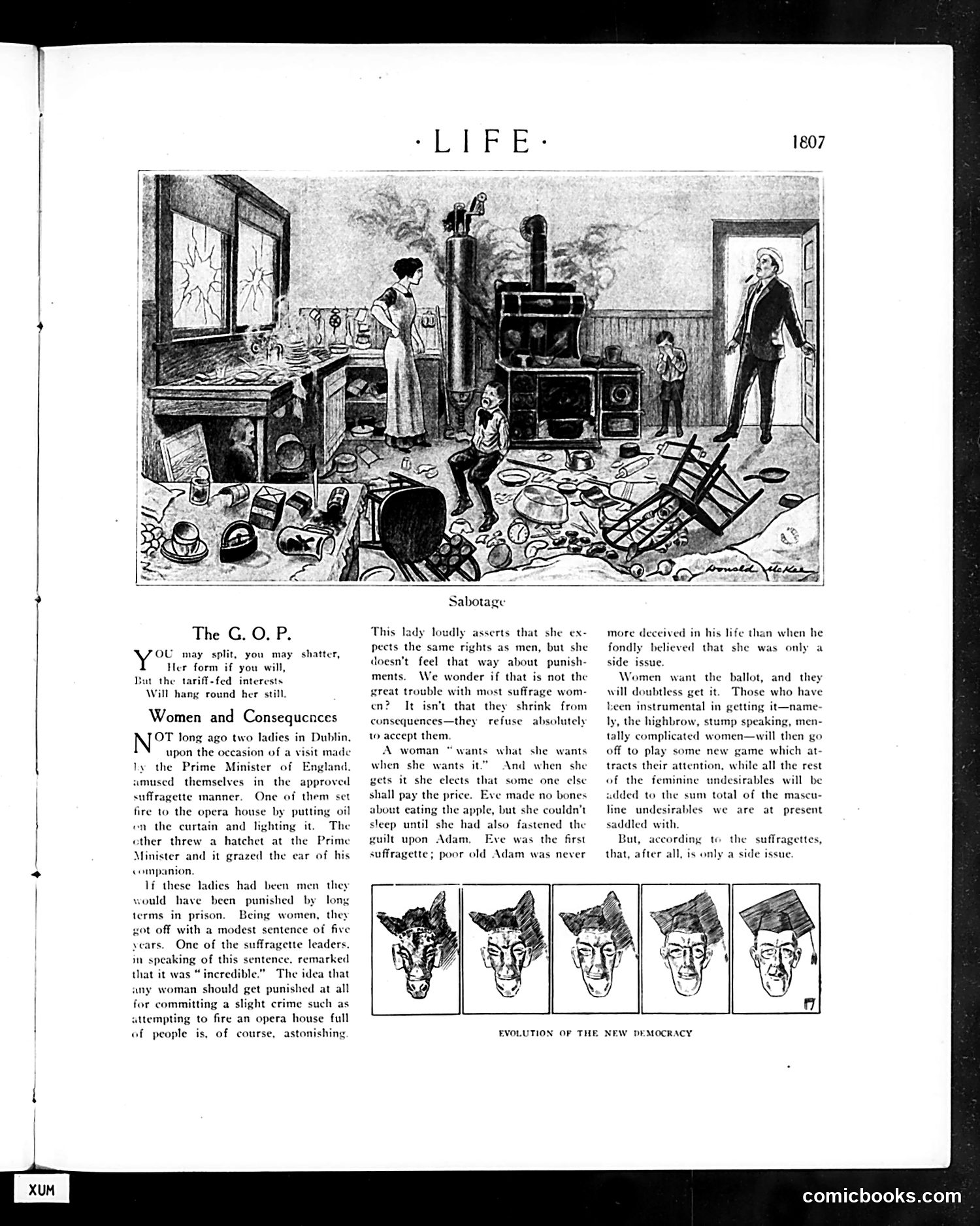
This page contains two distinct satirical pieces: **"The G.O.P."** (top): A brief poem mocking the Republican Party's inability to escape the influence of tariff-protected industrial interests, regardless of internal divisions. **"Women and Consequences"** (main article): A lengthy anti-suffrage polemic using recent British suffragette violence as its hook. The article references actual incidents—arson at an opera house and an axe attack on the British Prime Minister's companion—allegedly committed by suffragettes in Dublin. The author's central argument: women demanding voting rights refuse to accept equal *punishment* for crimes, expecting leniency based on gender. The piece sarcastically dismisses suffragettes as self-centered elites ("highbrow, stump speaking, mentally complicated women") who, once obtaining the ballot, will abandon the cause, leaving ordinary women as collateral damage to society. The "Evolution of the New Democracy" cartoon (bottom) appears to show progressive distortion of a face—likely satirizing how democracy itself becomes corrupted or absurd. The tone throughout is deeply misogynistic by modern standards, but represents mainstream editorial opinion of the era.
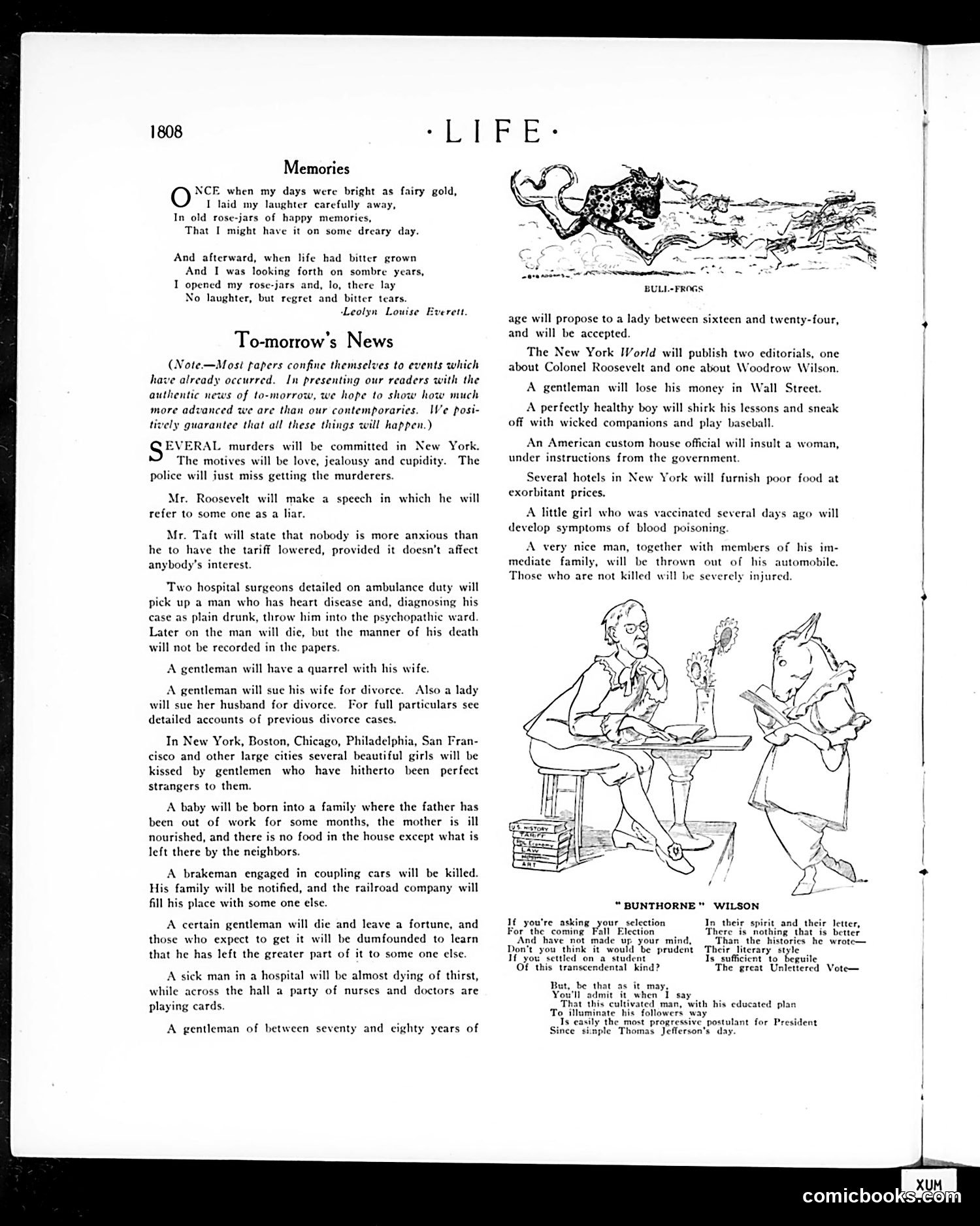
This 1908 *Life* magazine page satirizes predictable news cycles and political figures through two pieces: **"To-morrow's News"** is satirical commentary mocking newspapers' formulaic coverage. It lists absurdly mundane "predictions"—murders motivated by love/jealousy, tariff disputes, hospital mix-ups, divorces, railway deaths, hotels overcharging—implying that American journalism merely recycles the same stories endlessly rather than reporting genuinely novel events. The satire suggests newspapers are predictable and shallow. **"Bunthorne Wilson"** (right cartoon) references Woodrow Wilson, a Princeton intellectual preparing for the 1908 presidential race. The caricature mocks him as an overly educated, pretentious "transcendental" academic unsuited for practical politics. The verse sarcastically praises his "educated plan" and "progressive" candidacy while doubting whether intellectual credentials translate to effective leadership. The cartoon suggests contemporary skepticism about Wilson's suitability for high office based on his academic background rather than political experience.
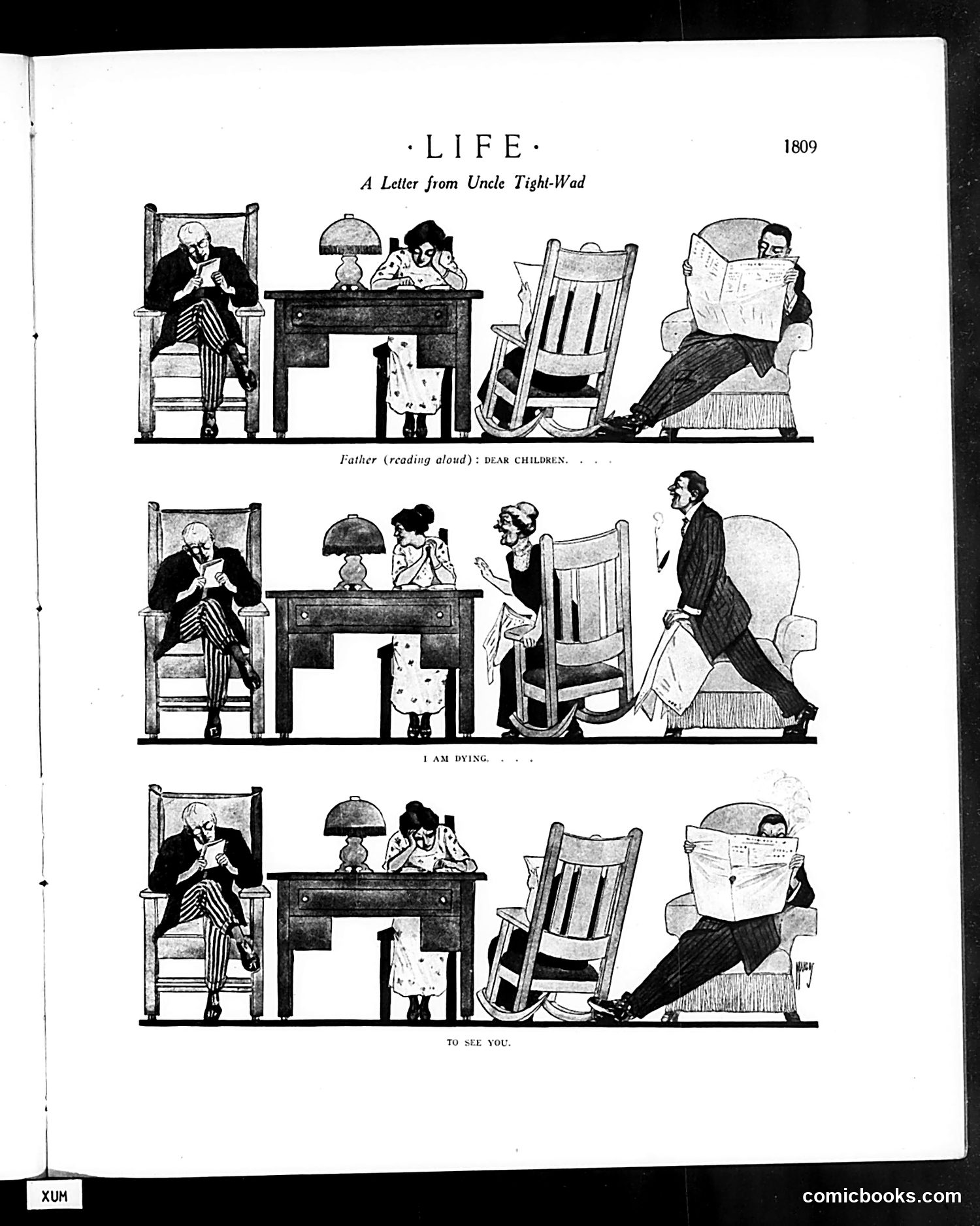
This three-panel comic satirizes a miserly relative's visit. In the first panel, "Father" reads aloud a letter from "Uncle Tight-Wad" to the children. The second panel shows the uncle's arrival ("I AM DYING"), depicting him as gaunt and skeletal, suggesting financial desperation or stinginess has wasted him away. The final panel reveals the joke ("TO SEE YOU")—the uncle visits claiming he's "dying" to see his relatives, but his skeletal appearance and the setup implies darker meaning about his actual condition or motivations. The humor targets both the uncle's miserliness (his name) and the false sentiment of the letter. The comic plays on audience expectations: readers anticipate a touching family reunion, but instead find thinly-veiled satire about greed and insincerity among relatives.
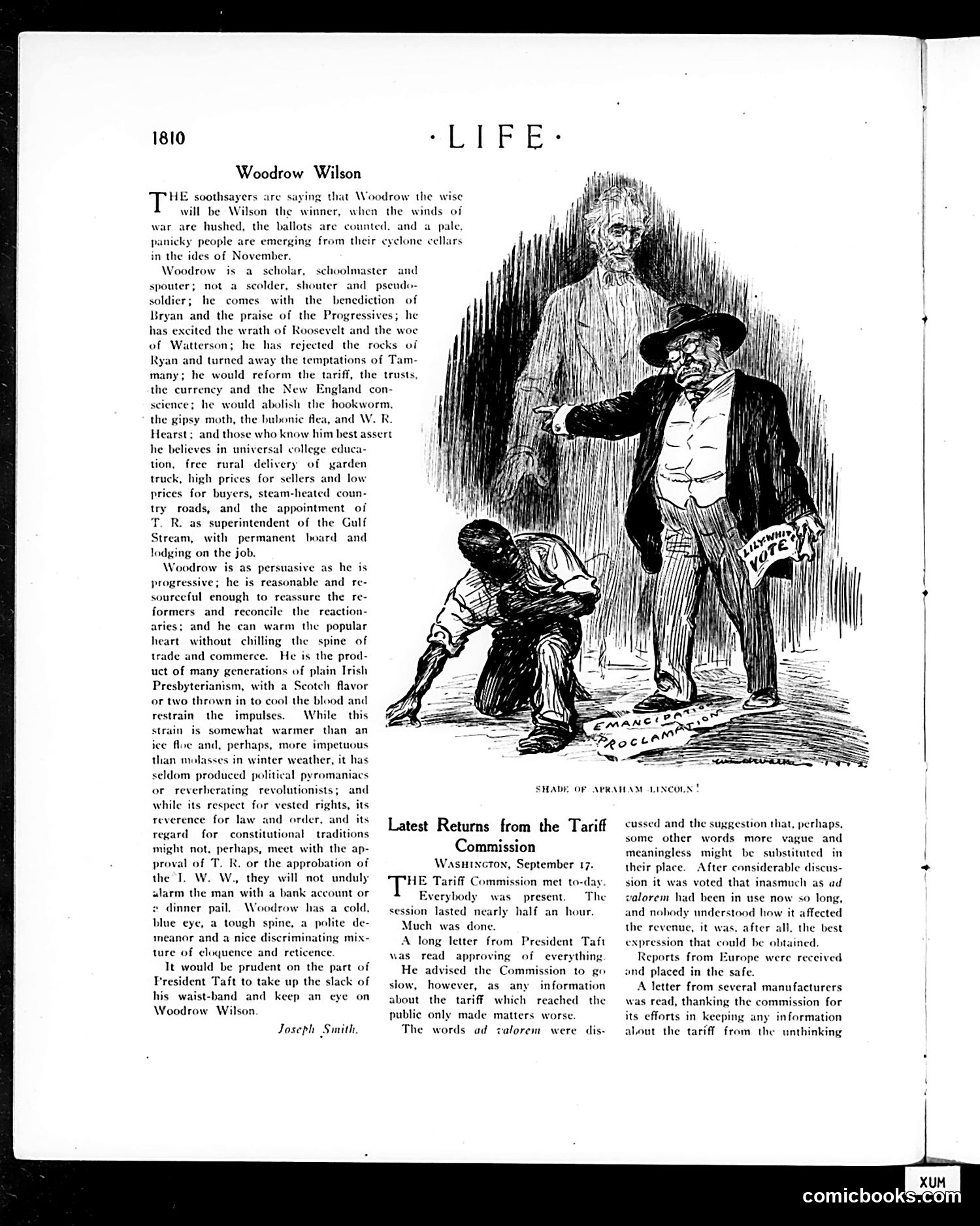
**The Wilson Cartoon:** The top illustration shows Wilson (identified as "Shade of Abraham Lincoln") as a progressive reformer. The text presents him sarcastically as the ideal candidate—educated, reasonable, and reform-minded on tariffs, trusts, and currency. However, the absurd final detail ("appointment of T.R. as superintendent of the Gulf Stream") signals the satire's point: Wilson's platform is so comprehensive and contradictory that it's almost meaningless. The cartoonist mocks both Wilson's ambitions and voters' unrealistic expectations. **The Tariff Commission Cartoon:** This section satirizes government ineffectiveness. The Commission meets, accomplishes nothing concrete, deliberately avoids informing the public about tariff policy, and votes to keep confusing terminology ("ad valorem") simply because people are already used to not understanding it. The joke: the Commission exists to obscure rather than clarify economic policy. Both pieces critique political overreach and bureaucratic dysfunction during the 1910 election season.
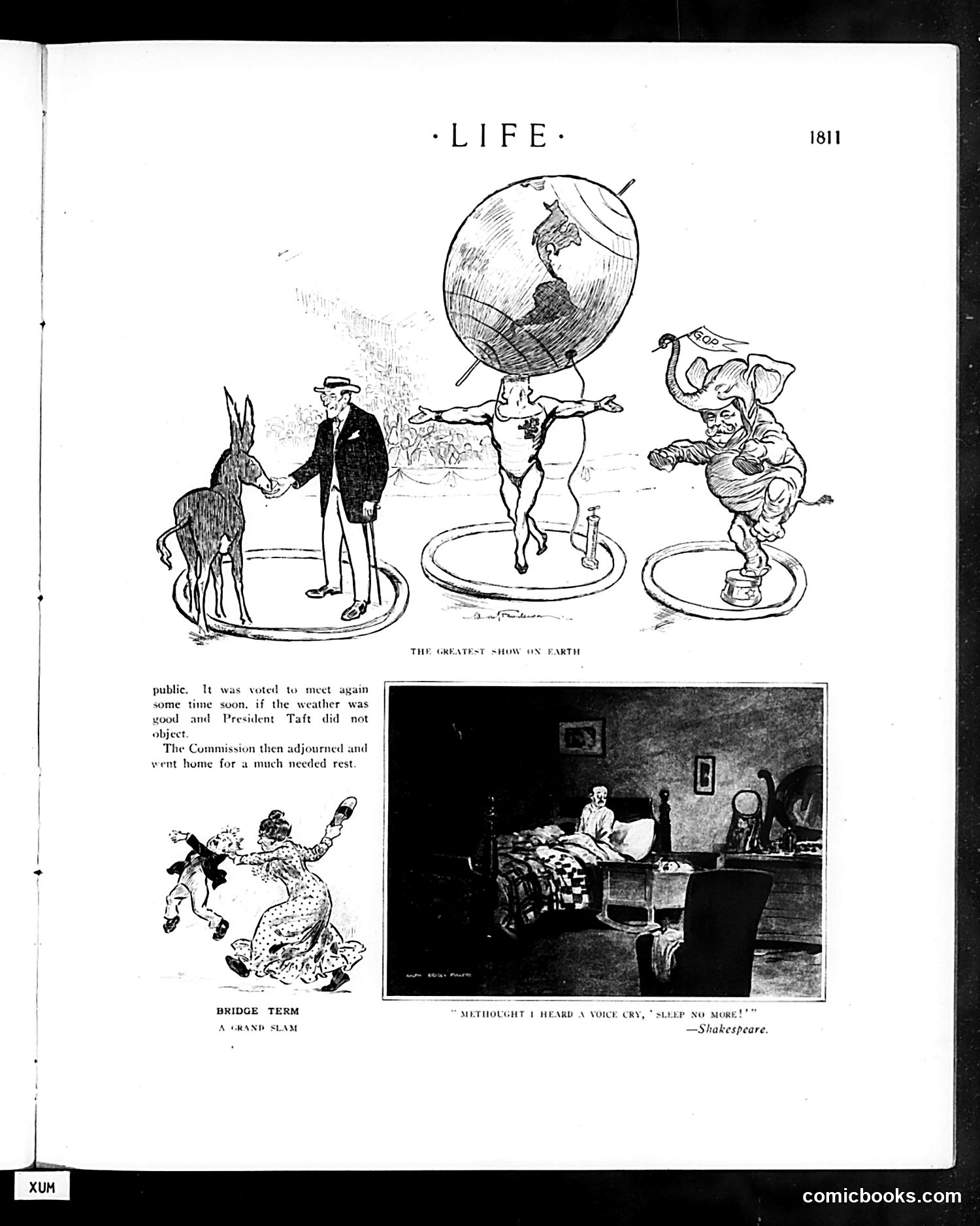
The top cartoon, titled "The Greatest Show on Earth," depicts three circus performers balancing globes and performing acts. This satirizes a commission (likely government-related) meeting about President Taft, mocking their proceedings as theatrical spectacle rather than serious governance. The caption references an adjournment and going "home for a much needed rest," suggesting the commission's work was trivial or performative. The lower cartoon, "Bridge Term: A Grand Slam," shows two figures in a exaggerated dance or struggle, using bridge-game terminology to comment on political maneuvering or conflict—possibly related to Taft administration disputes. The Shakespeare quote about hearing "Sleep no more!" appears to accompany a photograph suggesting anxiety or troubled conscience, likely criticizing government inaction or failed promises. Overall, the page satirizes political theater and governmental ineffectiveness under President Taft.
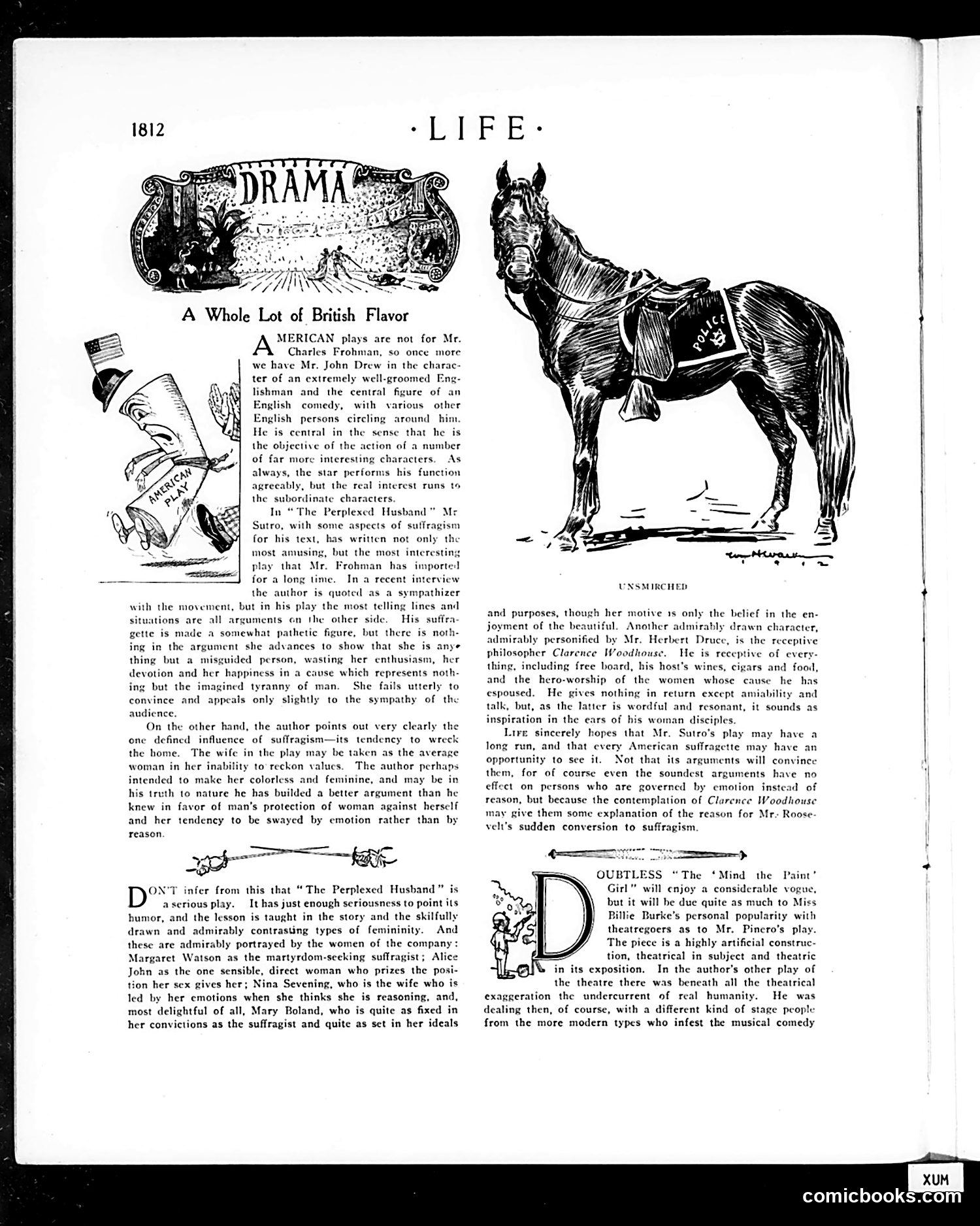
This page reviews the play "The Perplexed Husband," starring English actor John Drew in a comedic role. The critic praises the supporting female cast—including Margaret Watson as a suffragist and Mary Boland—while critiquing the play's anti-suffrage argument. **The satire's point**: The review reveals the play's hypocrisy. While author Alfred Sutro claims sympathy for women's suffrage, the play actually argues *against* it, portraying the suffragist wife as emotionally irrational and destructive to her marriage. The critic sardonically hopes American suffragettes see it—not because it will convince them, but because understanding its philosophy ("Clarence Woodhouse," a parasitic philosopher) might explain President Theodore Roosevelt's "sudden conversion to suffragism." **Context**: This reflects 1912 pre-suffrage debate. The magazine lampoons anti-suffrage arguments that characterized voting women as emotional and illogical, while portraying male philosophical detachment as superior.
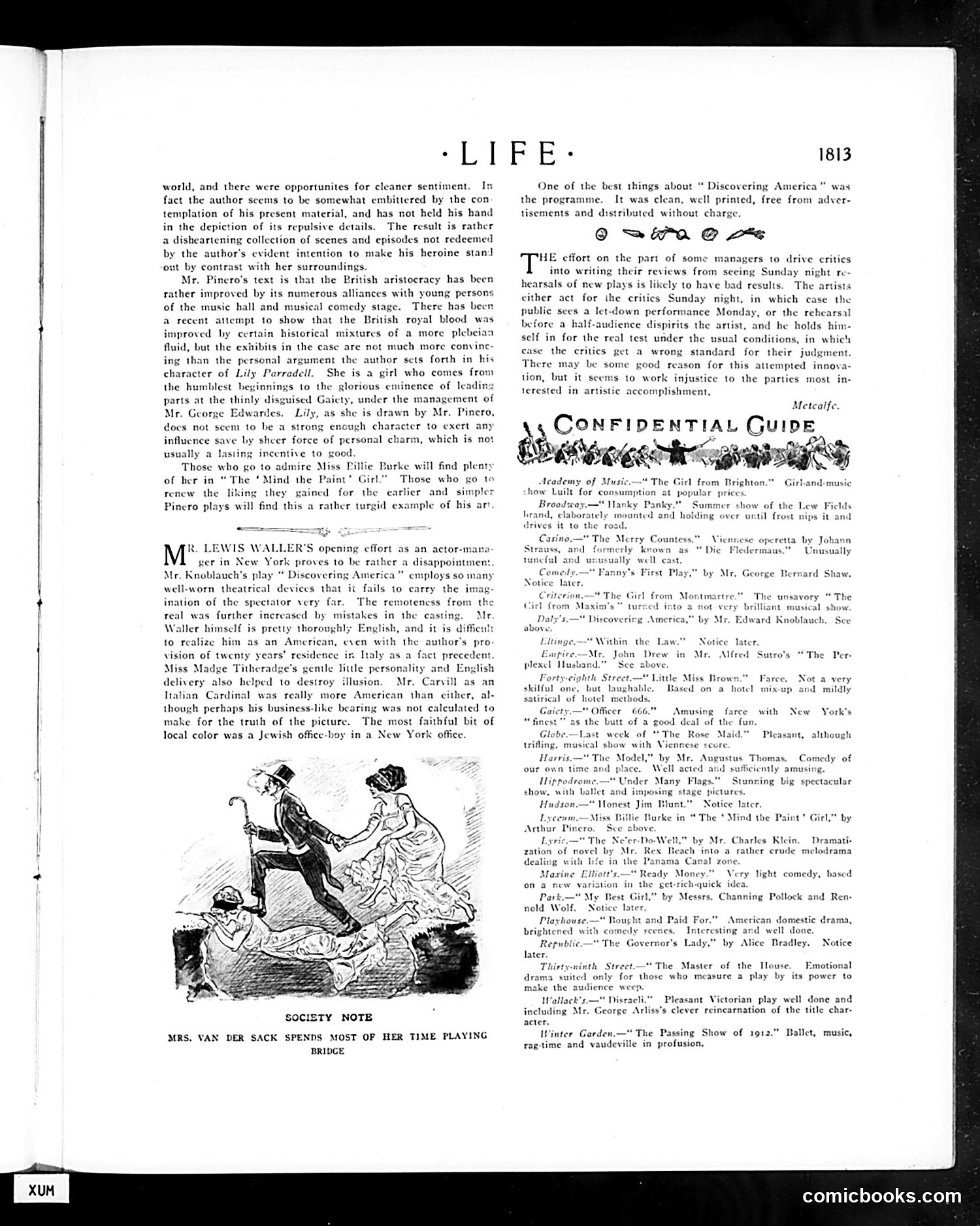
This page from Life magazine contains a society note with accompanying illustration rather than a political cartoon. The drawing depicts two figures in what appears to be a romantic or social encounter—a man in formal dress (top hat visible) and a woman in period clothing, depicted in a sketch style typical of early 20th-century satirical magazines. The accompanying society note sarcastically comments: "MRS. VAN DER SACK SPENDS MOST OF HER TIME PLAYING BRIDGE"—likely a joke about wealthy society women's leisure activities and social priorities. The bulk of the page consists of theater reviews critiquing contemporary plays and performances, including commentary on acting quality, casting choices, and theatrical authenticity. The satire targets actors' accents and miscasting (an English actor playing American roles, an Italian actor's unconvincing performance), reflecting period concerns about theatrical realism and professional standards in early 1900s American theater.
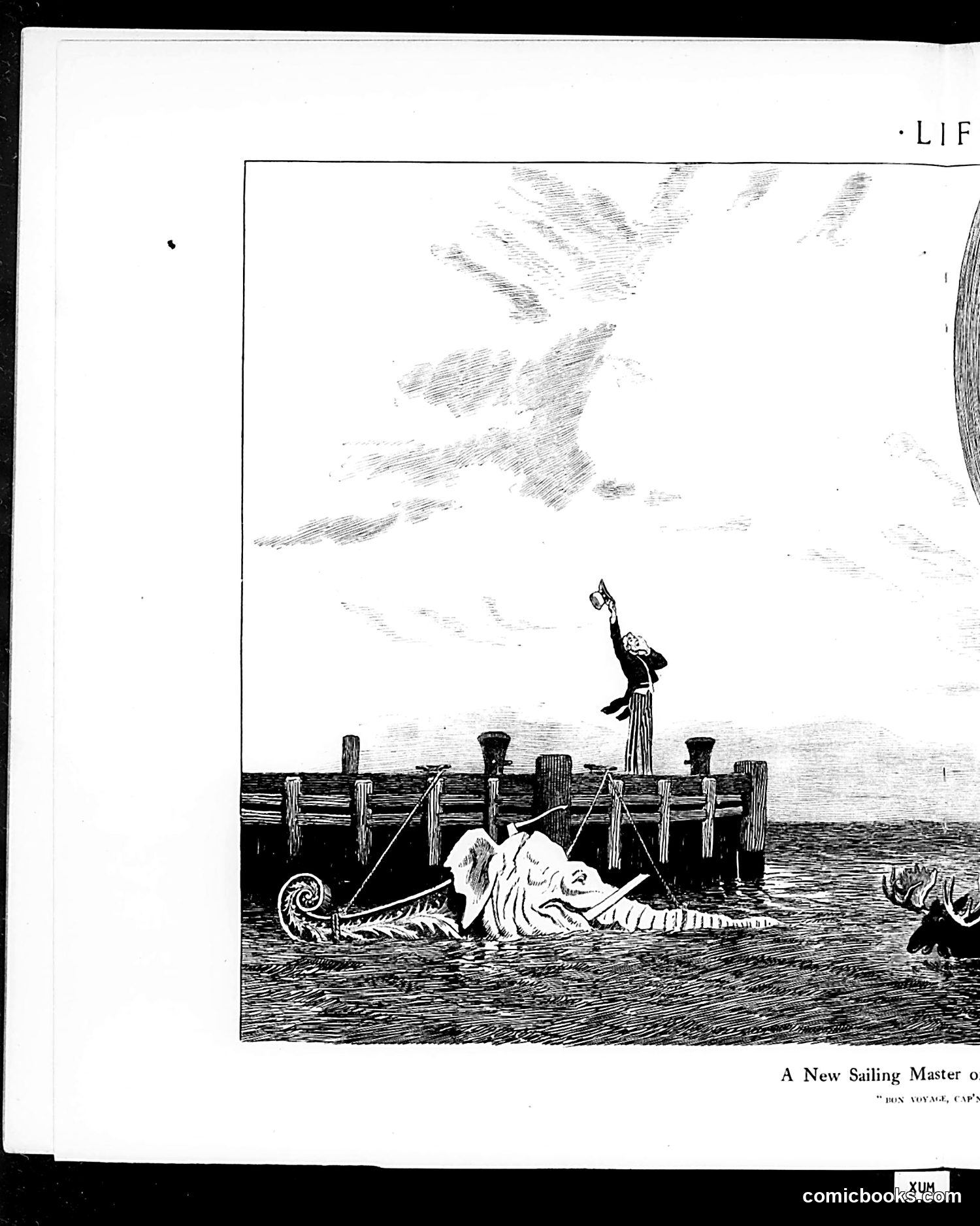
This satirical cartoon depicts a large tiger lying dead or dying in the water beside a wooden dock. A figure stands triumphantly on the dock with arm raised, appearing to claim victory over the beast. The caption reads "A New Sailing Master" with partial text suggesting "BON VOYAGE, CAPT[AIN]." The tiger likely represents a dangerous threat or adversary, while the "sailing master" figure appears to be celebrating having overcome it. Without clearer dating or additional context from Life magazine's publication date, the specific political or military reference remains unclear—it could reference colonial conflicts, maritime dangers, or a contemporary political figure portrayed metaphorically. The imagery suggests themes of conquest or triumph over a formidable enemy.
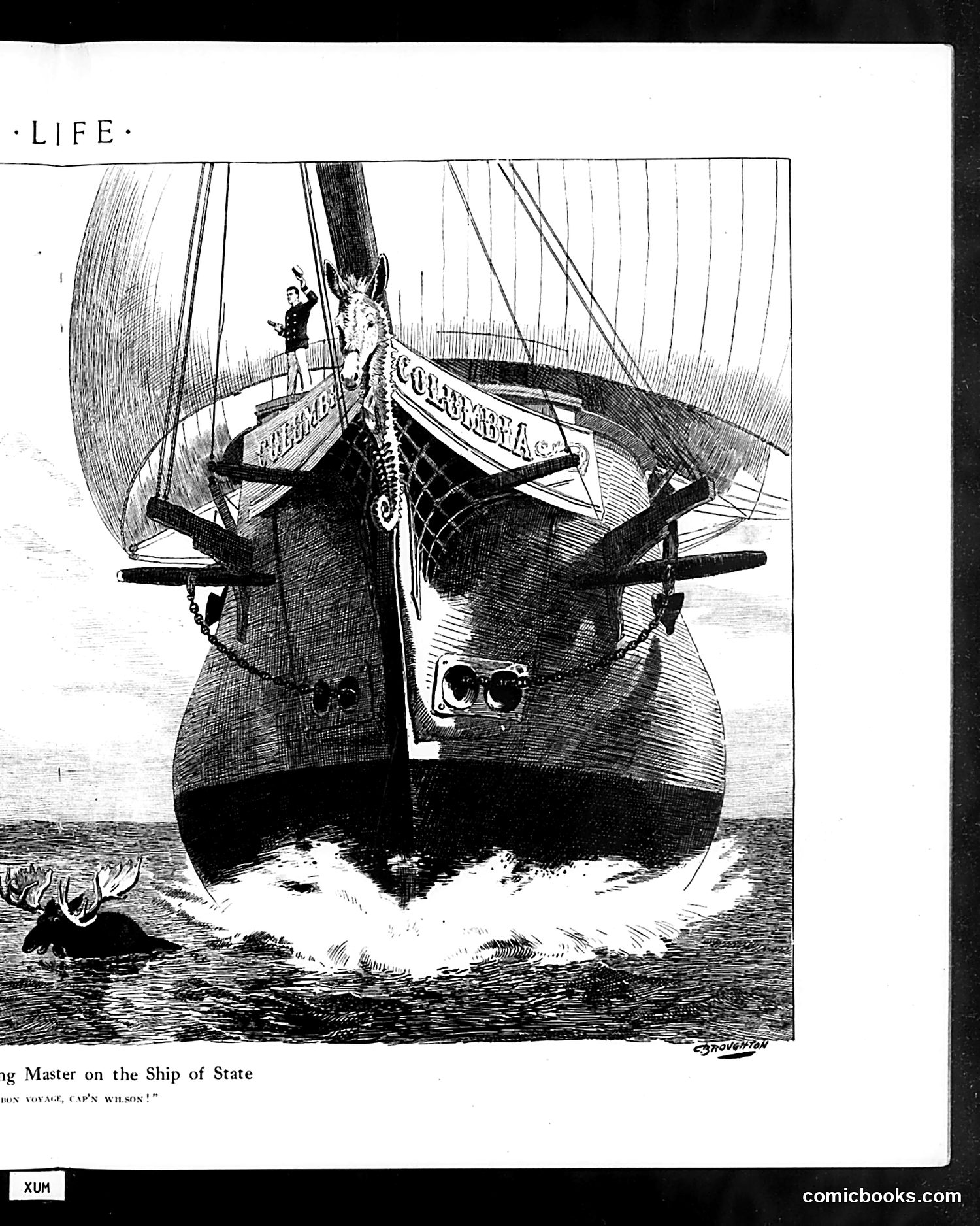
This is a satirical cartoon titled "Master on the Ship of State" depicting a ship labeled "Columbia" (representing the United States). The caption references "Captain Wilson," clearly alluding to President Woodrow Wilson. The cartoon shows the ship in rough waters with a small figure on deck, suggesting Wilson struggling to command the nation during turbulent times—likely referring to World War I or its aftermath (given Life magazine's early 20th-century date). The "Ship of State" is a classical metaphor for government navigation through crises. The satire critiques Wilson's leadership during this period of national challenge, questioning whether he maintains proper control of the vessel/nation amid stormy conditions. The hand-drawn style and dramatic composition emphasize the precariousness of his position.
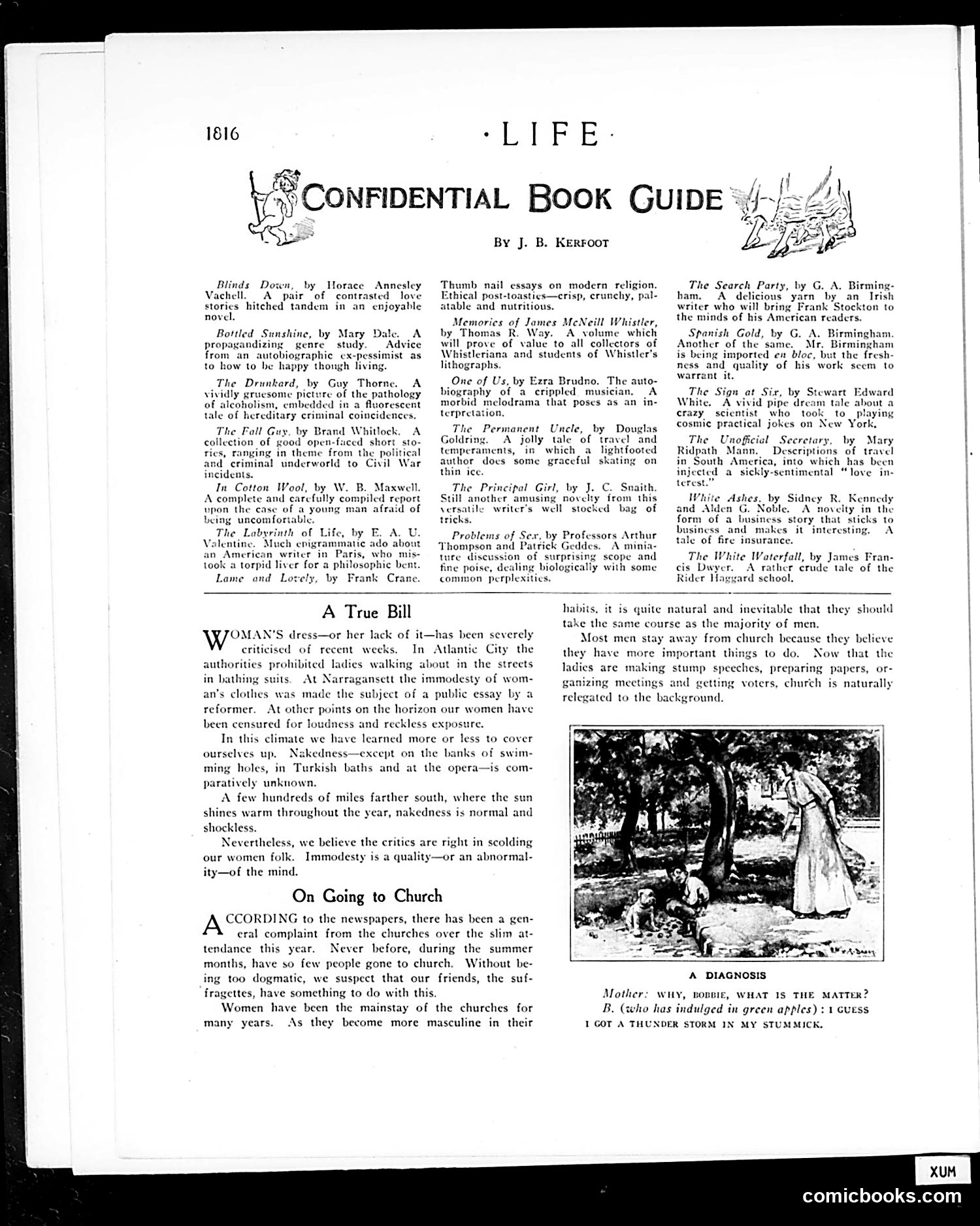
This page contains two satirical pieces on contemporary American social behavior. **"A True Bill"** addresses women's bathing attire and public modesty. Recent weeks saw authorities in Atlantic City and Narragansett prohibiting or criticizing women's bathing suits as immodest. The piece argues that while nakedness is normal in warm climates, American critics are "right in scolding" women—framing immodesty as a moral/mental quality rather than mere exposure. This reflects 1916 anxieties about changing women's fashion and public behavior. **"A Diagnosis"** (accompanying the illustration) humorously depicts a mother scolding a child who "indulged in green apples" and caught a stomach ailment. The joke appears to be simple domestic/medical humor rather than political satire. The page primarily functions as a book review section ("Confidential Book Guide") alongside these lighter editorial commentaries on manners and morality.
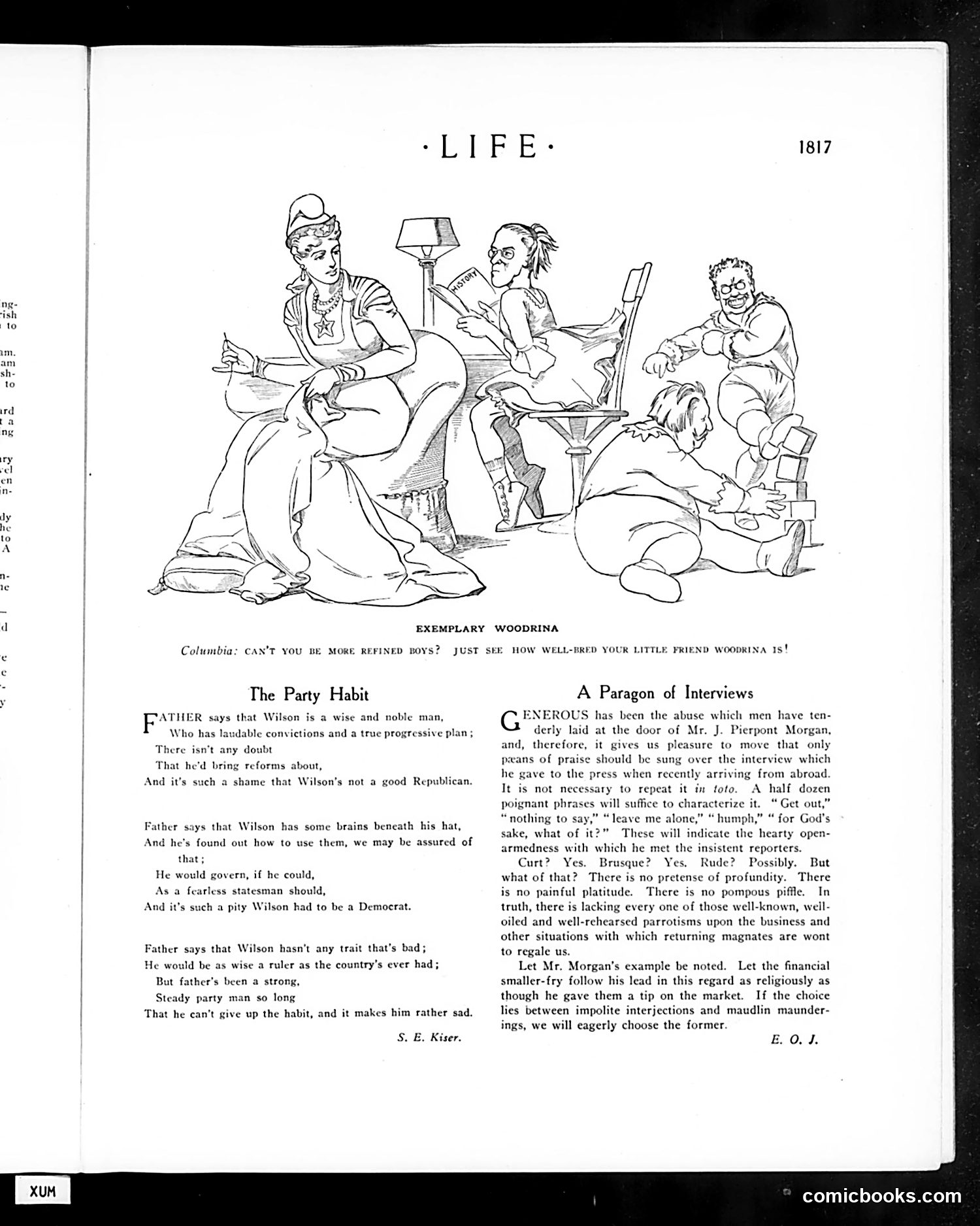
**Top Cartoon ("Exemplary Woodrina"):** Columbia (personification of America) compliments a refined female figure ("Woodrina," likely representing Woodrow Wilson) on her manners, while crude male characters behave badly. This mocks Republicans who admire Wilson's progressive policies yet refuse to vote for him solely because he's a Democrat—prioritizing party loyalty over merit. **"The Party Habit" (poem by S.E. Kiser):** Reinforces this theme. A father acknowledges Wilson possesses wisdom, reform vision, and good qualities, but remains unable to support him due to lifelong Republican allegiance. The satire targets rigid partisanship that prevents voters from backing qualified candidates across party lines. **"A Paragon of Interviews" (by E.O.J.):** Praises J.P. Morgan's curt, dismissive behavior toward press interviews, contrasting favorably with typical wealthy magnates' verbose self-promotion. The satire ironically celebrates Morgan's rudeness as refreshingly honest compared to typical corporate platitudes.
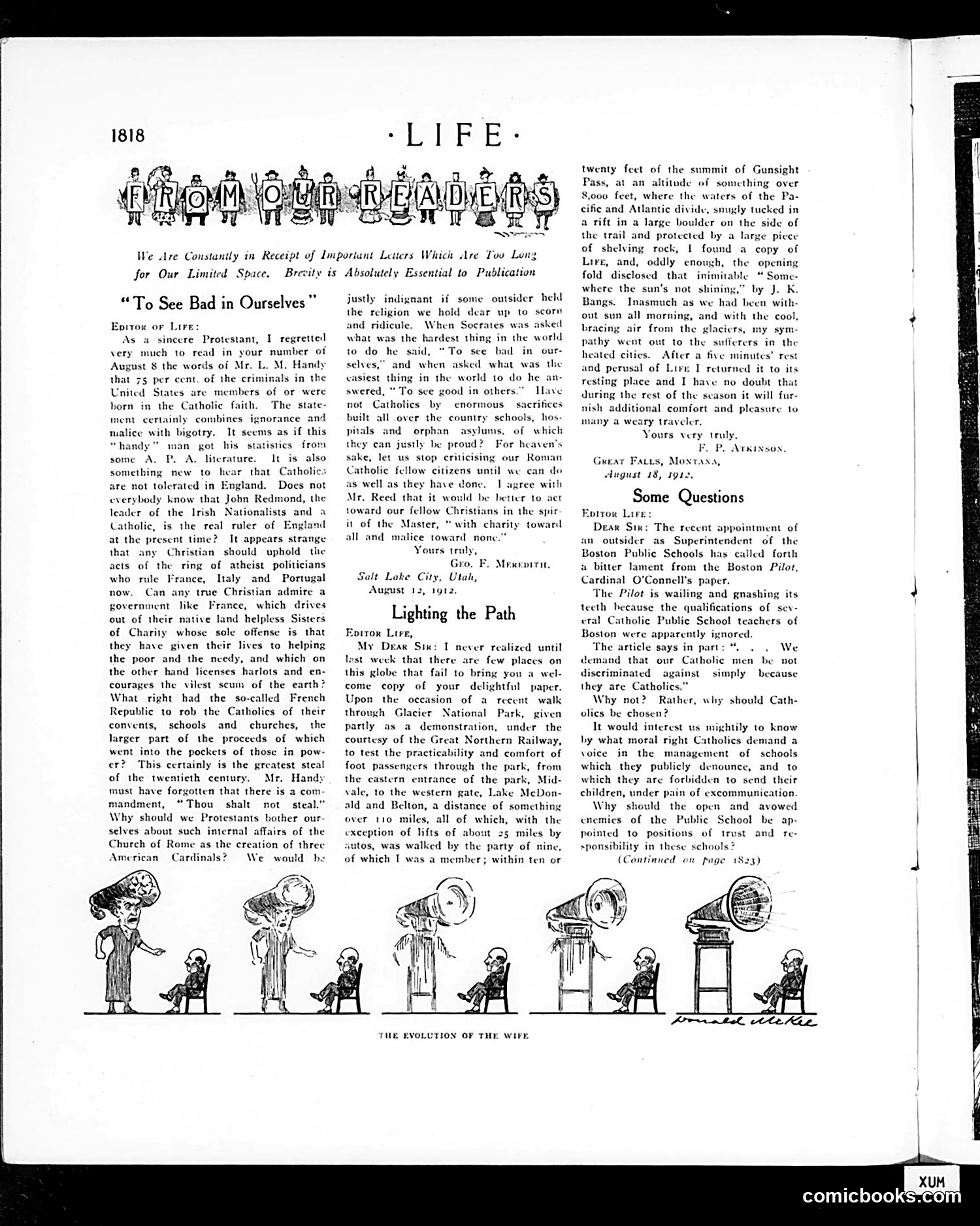
This page contains three letters to the editor addressing religious and social issues of 1912. **"To See Bad in Ourselves"** responds to an earlier article claiming 75% of U.S. criminals were Catholic. The letter defends Catholics, citing John Redmond (Irish Nationalist leader) and criticizing Protestant France for expelling Catholic religious orders and confiscating church property. The writer argues Protestants shouldn't criticize Catholic internal affairs. **"Lighting the Path"** describes a hiking trip through Glacier National Park where the author discovered a copy of *Life* magazine tucked in a remote mountain pass—a humorous testament to the magazine's wide circulation. **The cartoon** at bottom, titled "The Evolution of the Wife," shows five sequential domestic scenes depicting a woman's changing relationship with a man over time, progressing from attentive care to apparent indifference or dominance. It's satirical commentary on marriage dynamics. The page reflects early 20th-century Protestant-Catholic tensions and gender role humor typical of the era.
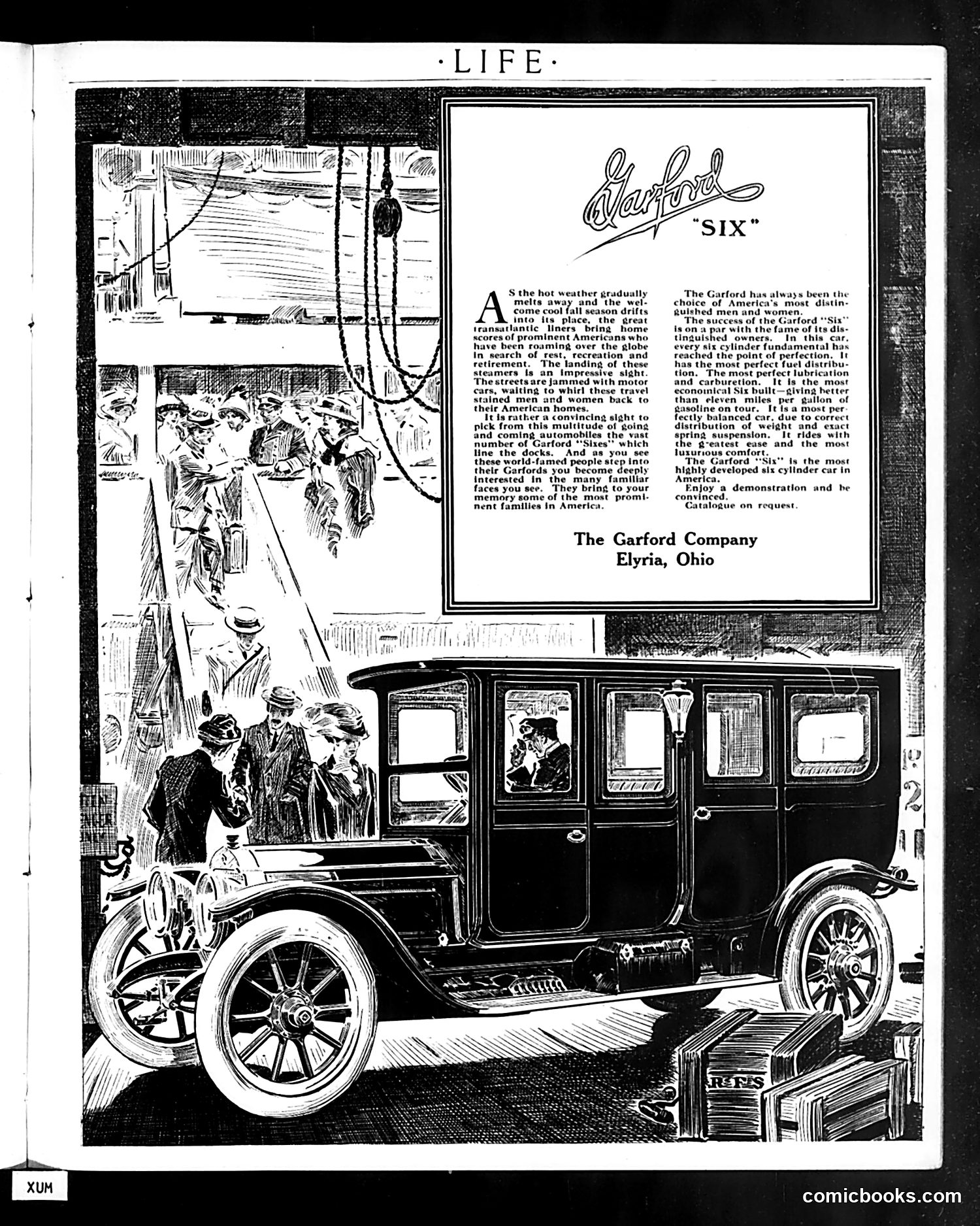
This is primarily a **car advertisement**, not political satire. The Garford Company uses an illustration showing wealthy Americans returning from European travel, arriving by ship and being transported in Garford automobiles from the docks. The appeal is **aspirational**: the ad claims that America's "most distinguished men and women" and "prominent families" choose the Garford "Six" (six-cylinder model). By showing the car ferrying the wealthy and well-traveled, the advertisement suggests that owning a Garford signals refined taste and social status. The imagery depicts the 1910s-era leisure class—Americans wealthy enough to take transatlantic vacations—creating an implicit promise that buyers can align themselves with this elevated social circle through automobile purchase. This reflects early automotive advertising's strategy of linking car ownership to class aspiration, before mass production made cars commonplace.
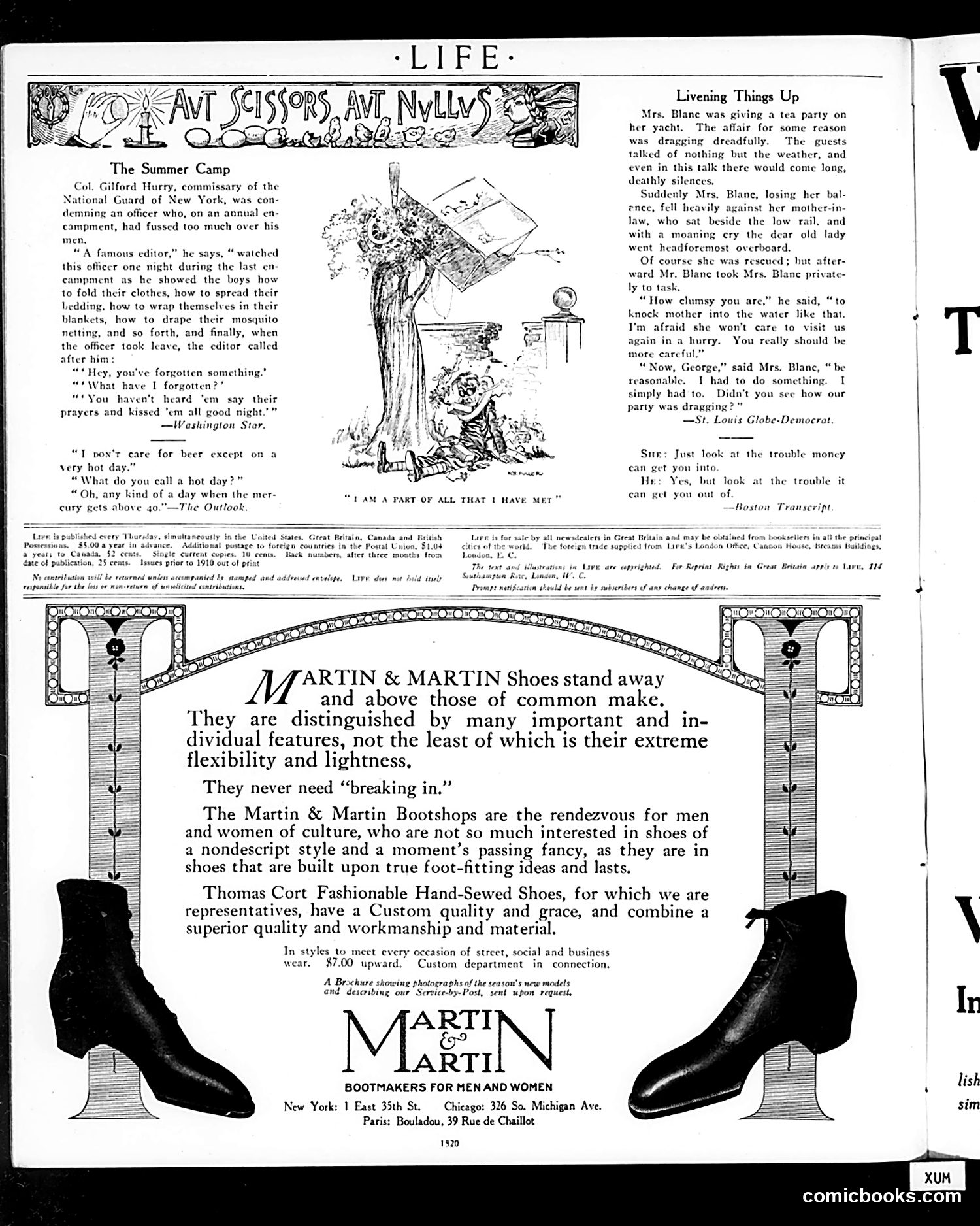
This page contains three separate humorous anecdotes satirizing upper-class social life and gender dynamics: **"Livening Things Up"** mocks wealthy yacht-party culture. Mrs. Blane's tea party is so tediously boring that she deliberately (or accidentally—the text is ambiguous) knocks her mother-in-law overboard to create excitement. The joke satirizes the desperation of high-society hostesses and the vapid conversations that plague such gatherings. **"The Summer Camp"** ridicules an overly attentive military officer who fusses excessively over soldiers' comfort and hygiene. A disapproving editor jokes that the officer forgot to tuck the men in like children, mocking what he sees as excessive coddling. **The remaining brief jokes** offer wordplay about beer and money—generic humor with no specific satire. The page is primarily advertising: **Martin & Martin Shoes** dominates the lower half, promoting their flexibility and quality craftsmanship to cultured customers. The cartoons reflect Life's satirical focus on American upper-class pretension and social conventions—common targets for the magazine's humor.
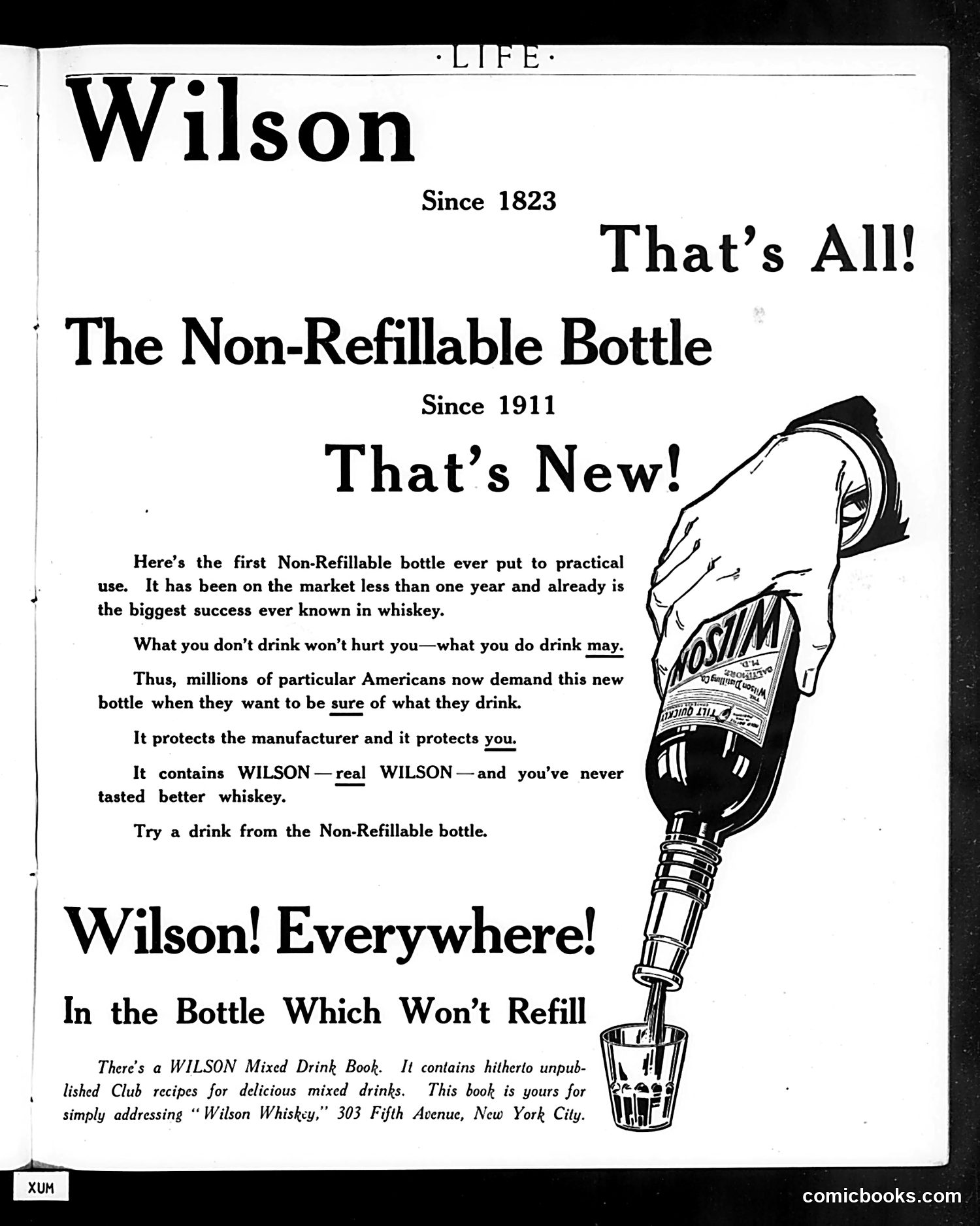
This is a **whiskey advertisement**, not satire or editorial cartoon. It promotes Wilson brand whiskey and its innovation: the non-refillable bottle (introduced 1911). The ad's appeal targets consumers concerned about product authenticity and safety. The tagline "What you don't drink won't hurt you—what you do drink may" uses dark humor to suggest that refillable bottles enabled adulteration or tampering, making non-refillable bottles a consumer protection. The illustration shows whiskey being poured from a sealed bottle into a glass—emphasizing the bottle's integrity and the purity guarantee. For modern readers: this reflects early 20th-century anxieties about food/beverage safety before FDA regulations. The non-refillable bottle was genuinely marketed as a quality assurance innovation, positioning Wilson as protecting both manufacturer reputation and consumer health.
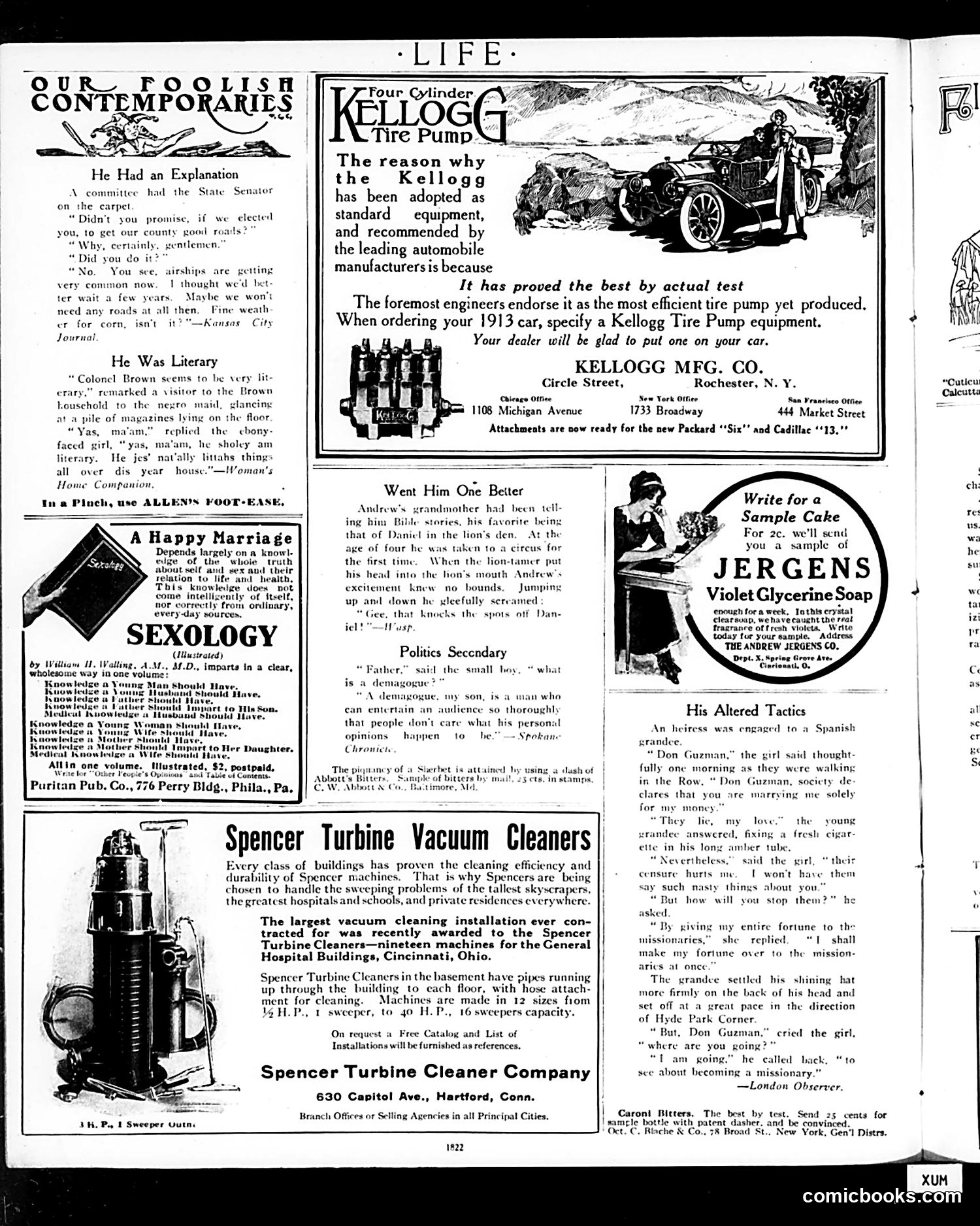
This page is primarily **advertising with light satirical content** typical of early-20th-century magazines. The visible cartoon items are brief: 1. **"He Had an Explanation"**: A politician promises county improvements if elected, then admits he didn't deliver—blamed on airships being "common now" so the promised roads aren't needed. The satire mocks politicians who make excuses for broken campaign promises. 2. **"He Was Literary"**: A play on the word "littering." A visitor praises a Black household servant for being "literary," and the maid responds he's "litahs things all over dis year house"—a dialect-comedy misunderstanding where "littering" (scattered objects) is confused with literary education. This reflects period racist humor stereotypes. The bulk of the page features advertisements for tire pumps, vacuum cleaners, soap, and a "Sexology" book—representative commercial content filling space. Brief ancillary stories like "Went Him One Better" and "Politics Secondary" fill remaining space with mild domestic or observational humor.
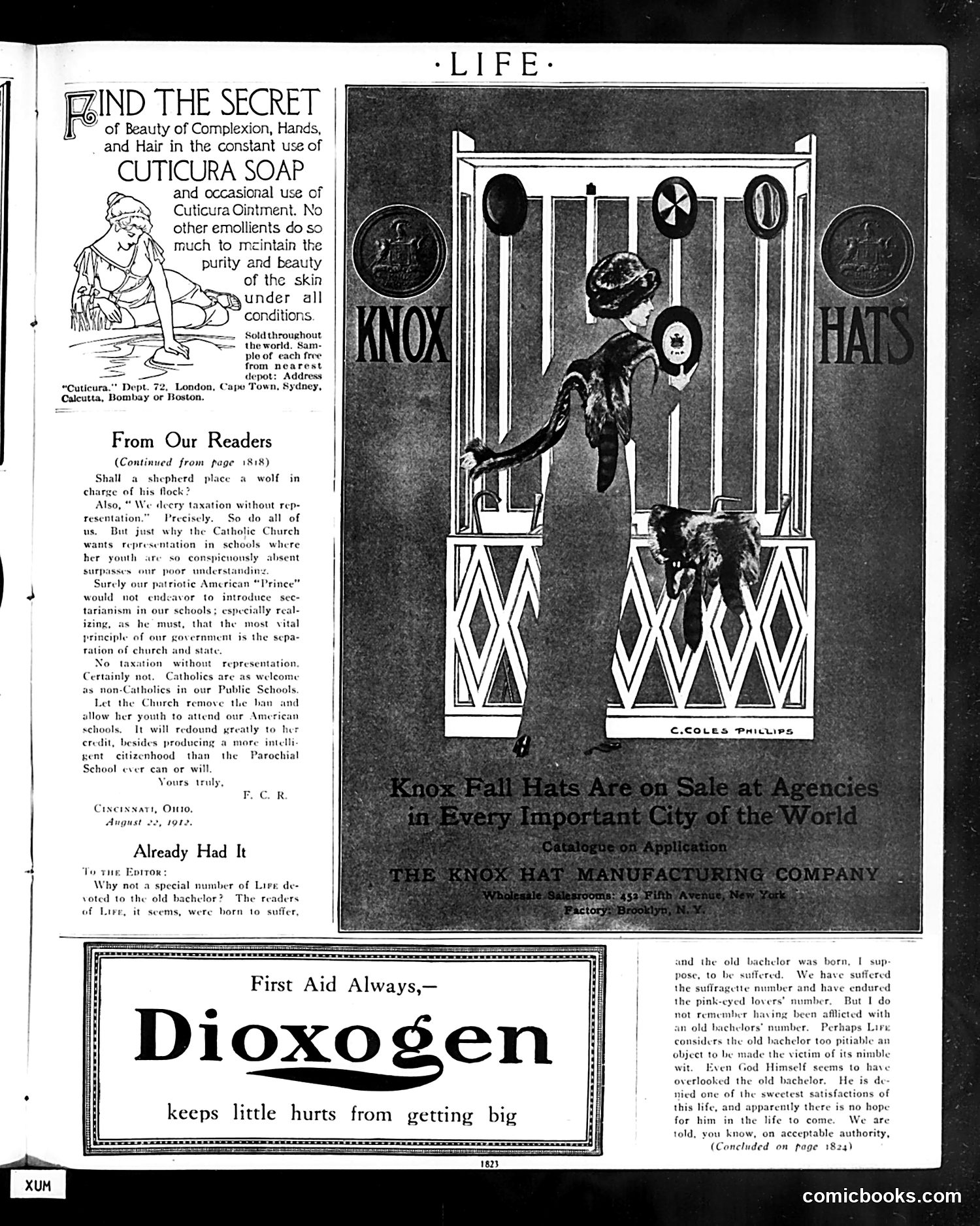
This page is primarily **advertising and reader letters**, not political satire. The main content includes: 1. **Cuticura Soap ad** (left): A beauty product advertisement with classical imagery, typical early 1900s marketing. 2. **Knox Hats advertisement** (center): A large illustration showing a woman selecting hats from display stands, with the text "Knox Fall Hats Are on Sale at Agencies in Every Important City of the World." This is straightforward commercial advertising for a hat manufacturer. 3. **Reader Letters section** (bottom): Contains two letters—one discussing Catholic Church representation in schools (a church-state separation debate), and another humorously proposing a "special number" devoted to old bachelors as a satirical subject. 4. **Dioxogen ad** (bottom): A first-aid product advertisement with the slogan "keeps little hurts from getting big." The page is essentially a **mixed advertising and letters section**, not a political cartoon page. Any satire is limited to the reader letters' tongue-in-cheek tone about bachelors.
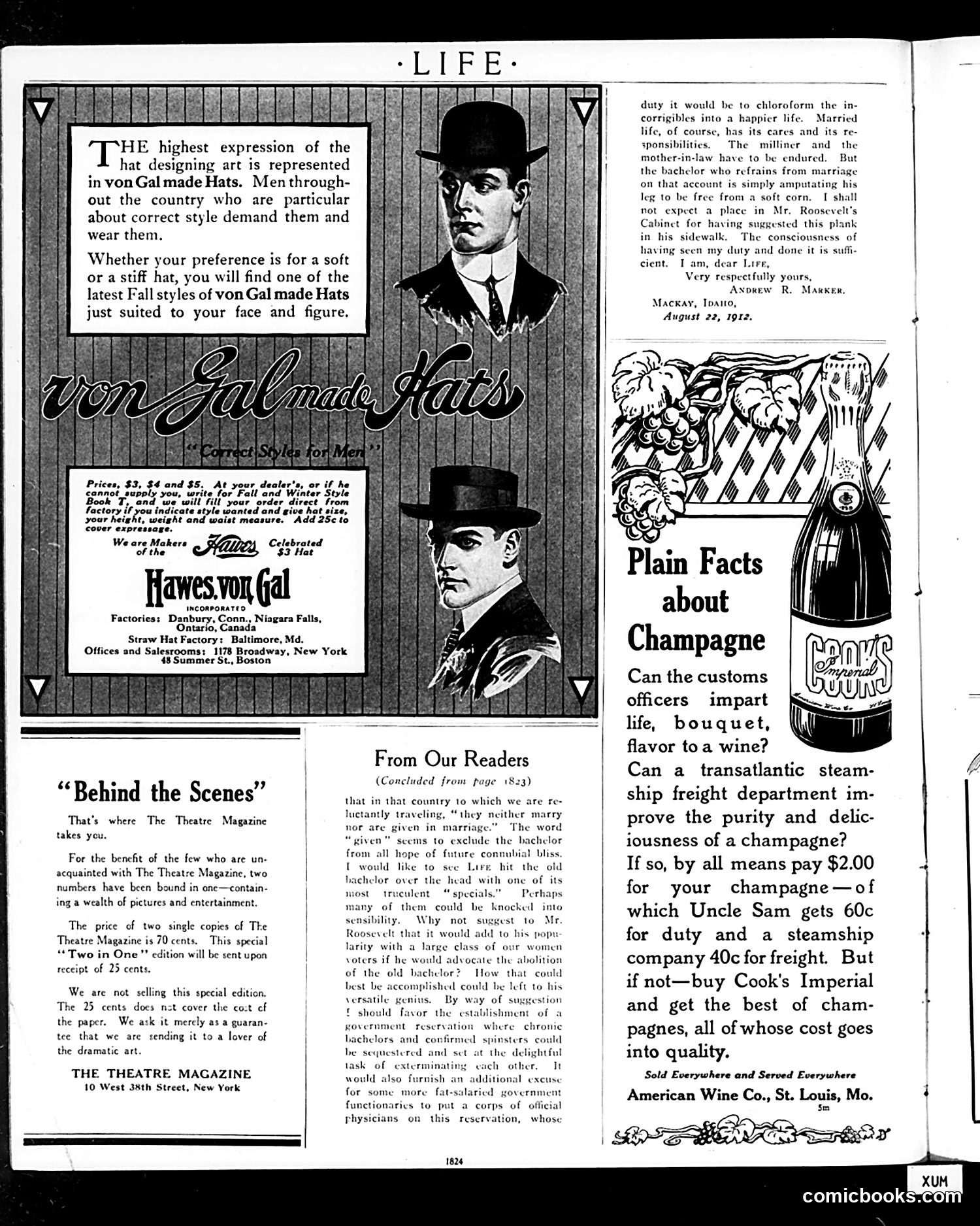
This page from Life (circa 1912, based on the August 22 letter) contains primarily **advertisements and reader correspondence**, not political cartoons. ## Key Content: **Von Galmade Hats ad**: Standard fashion advertisement showing two men in formal hats, emphasizing style and fit. **Reader's Letter**: A satirical proposal from Andrew R. Marker suggesting Theodore Roosevelt should advocate abolishing bachelorhood. The writer humorously proposes a "government reservation" where bachelors and spinsters would be confined and "set at the delightful task of exterminating each other"—dark humor mocking both chronic bachelors and government bureaucracy. This references Roosevelt's era progressive politics and government expansion. **Cook's Imperial Champagne ad**: A consumer-advocacy pitch arguing that tariffs ($2.00 duty on imported champagne) make American wine a smarter buy, with the humor that the cost actually goes to quality rather than taxes. The page reflects early 20th-century American attitudes toward bachelorhood, marriage, and consumer economics, with light satire through advertising and reader wit rather than visual cartoons.
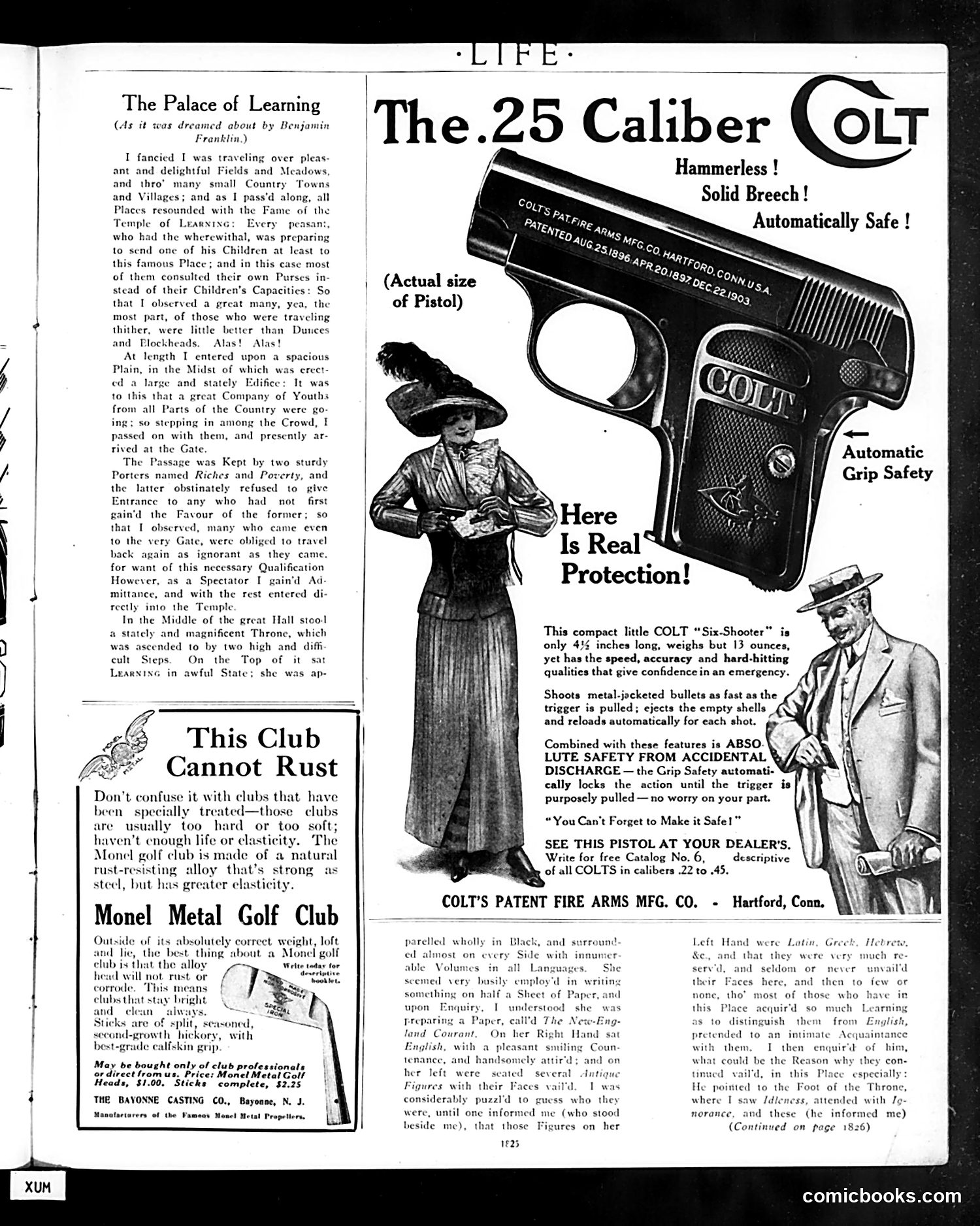
This page contains **two distinct items**: a serialized story called "The Palace of Learning" (left column) and a **Colt firearm advertisement** (right side). The advertisement is the dominant content—a period gun ad promoting the Colt .25 caliber pistol as compact, safe, and practical for self-defense. It features illustrated figures (a woman and a man) and emphasizes the weapon's "automatic grip safety" as protection against accidental discharge. The left column continues a fictional narrative about traveling through pleasant countryside and visiting a "Temple of Learning" where youth from various regions gather. It's literary content, not satirical commentary. This page represents **commercial Life magazine content**: mixing serialized fiction with period advertising, typical of early 20th-century publications. There is no political cartoon or satire present.
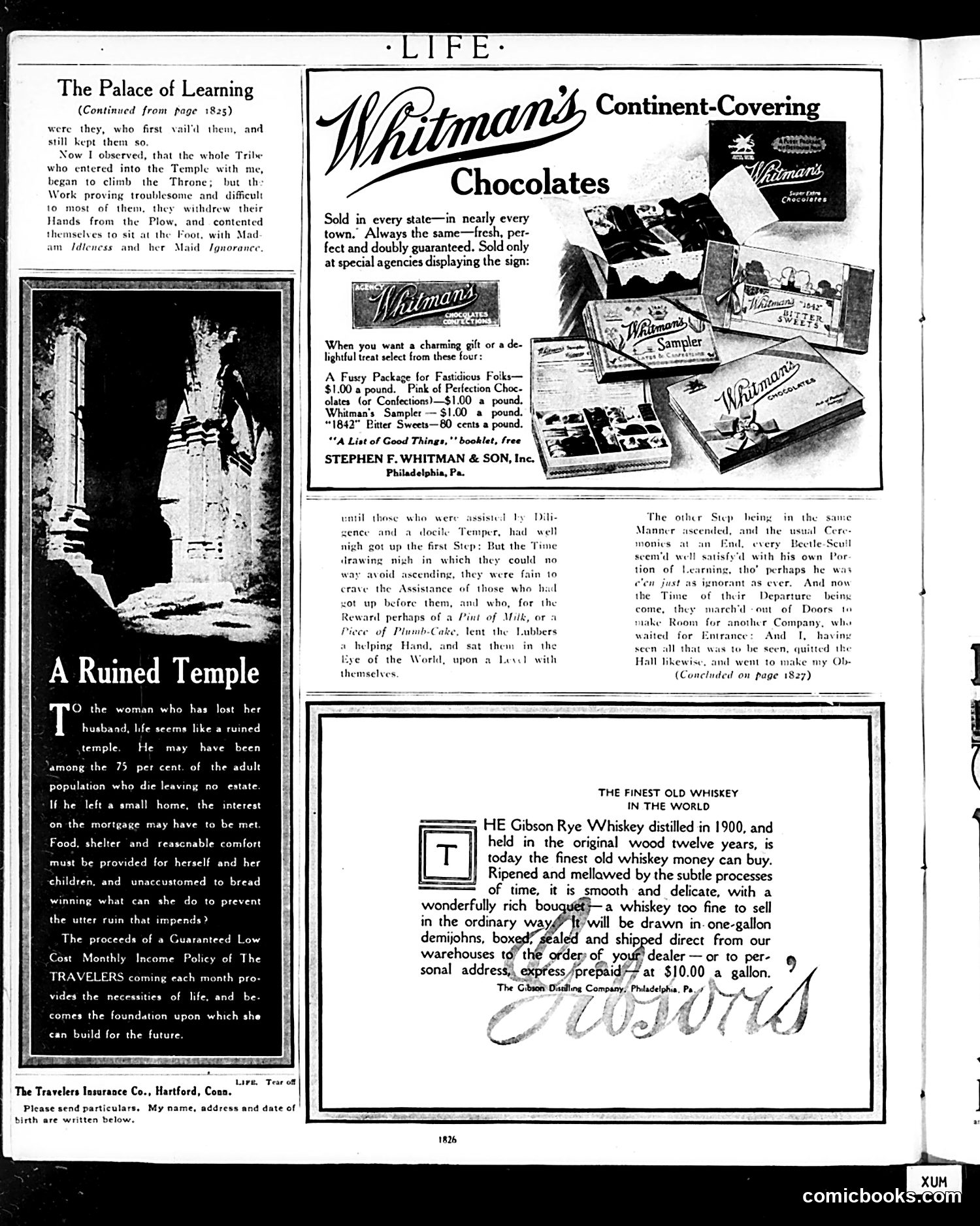
This page contains a multi-part satirical narrative (continued from earlier). The main text describes an allegorical journey through a "Temple" of Learning, where visitors attempt to climb toward knowledge but many fail, aided only by "Idleness and her Maid Ignorance." The satire mocks lazy students who abandon intellectual effort, seeking shortcuts or remaining at the bottom. The illustration shows a robed figure ascending stone steps in a classical temple setting—visualizing the difficult climb toward education. The surrounding advertisements (Whitman's Chocolates, Gibson Rye Whiskey, and Travelers Insurance) are typical period commercial content, unrelated to the satire. A secondary article, "A Ruined Temple," uses temple imagery differently—comparing a widow's plight after losing her husband to a ruined structure, advocating for life insurance protection. The satire's main point: genuine learning requires sustained effort; most people lack discipline and settle for ignorance.
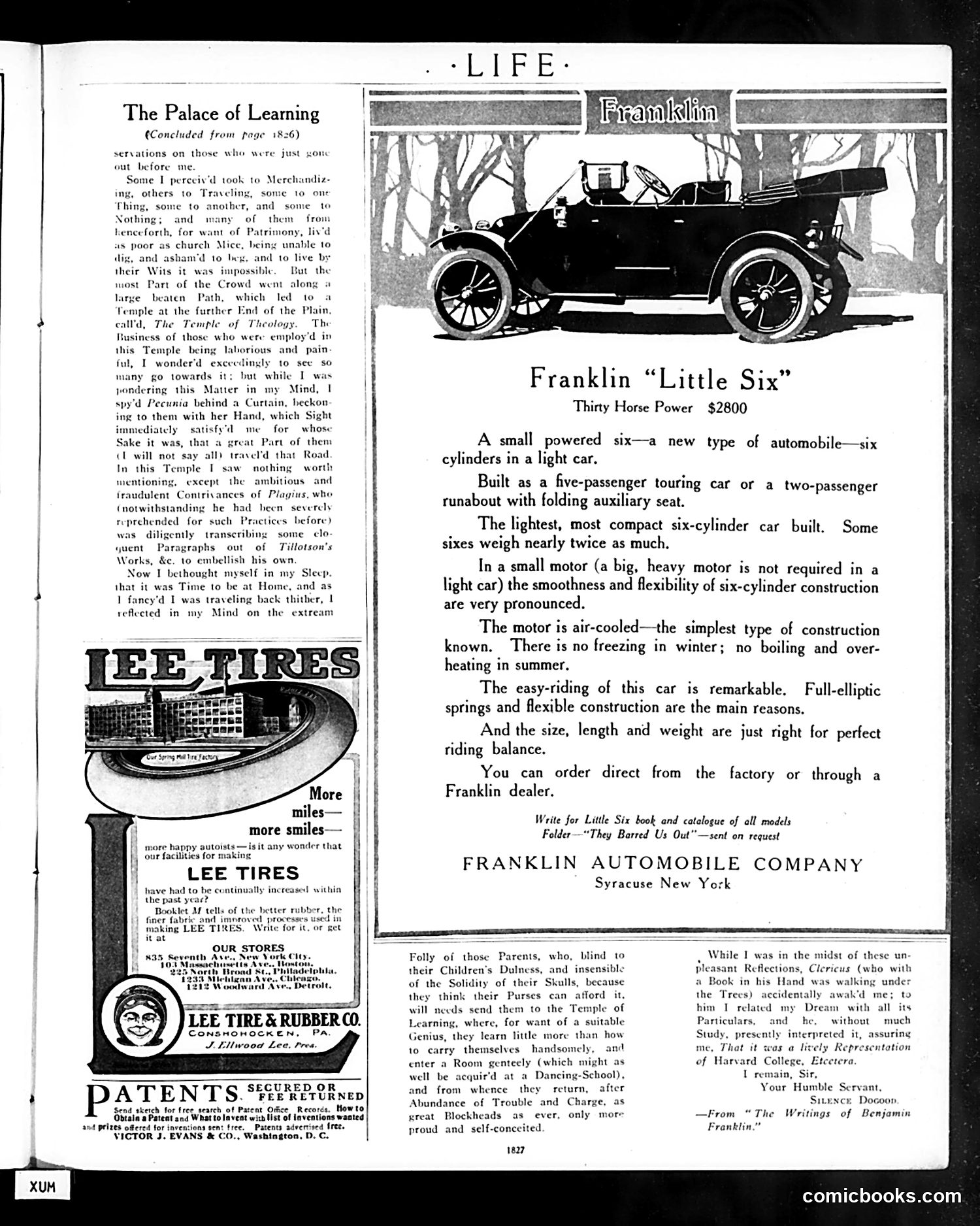
This page presents a satirical 18th-century allegorical narrative (likely by Benjamin Franklin, based on the attribution at bottom) mocking contemporary education and social pretension. **The satire:** The text describes a "Temple of Theology" where people pursue learning for profit ("Pecunia"—personified Money—beckons them). The passage ridicules: 1. **Plagiarism in academia**: A figure named "Plagius" shamelessly copies eloquent passages from Tillotson's Works to enhance his own reputation despite past punishment. 2. **Wealthy but unintelligent parents** who pay for their dull children's education solely to teach them superficial social graces (proper carriage, genteel room-entry), producing "great Blockheads" who become "proud and self-conceited." The satire argues that education without genuine aptitude creates arrogant mediocrity, while scholarly dishonesty goes unpunished. It's a critique of education as status-signaling rather than intellectual development. The **advertisements** (Lee Tires, Franklin automobile, patents) are incidental commercial content typical of Life magazine.
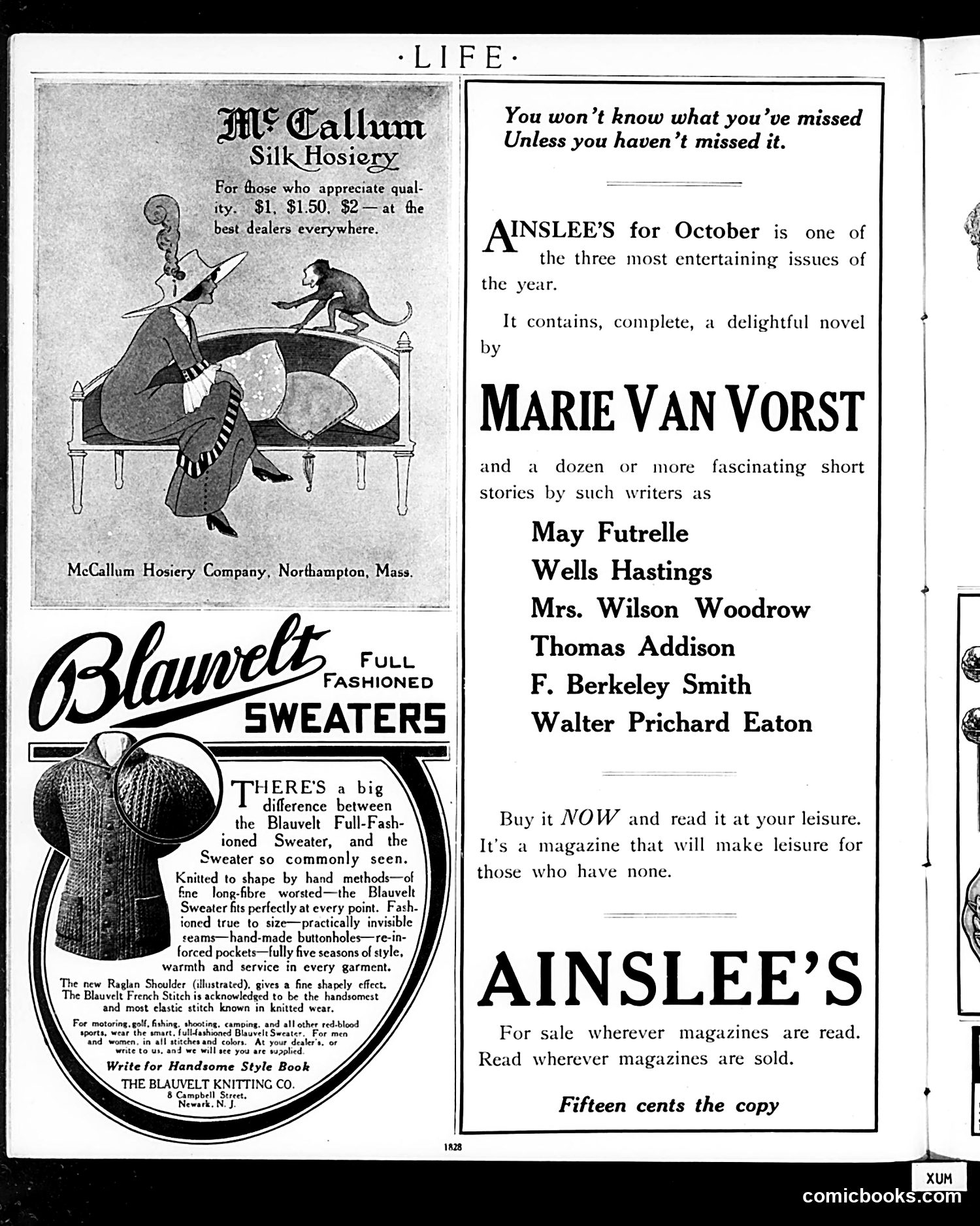
This page is primarily **advertising**, not political satire. It contains three product advertisements from the early 20th century: 1. **McCallum Silk Hosiery** (top left): Features a whimsical illustration of a woman in a chair being dressed by a monkey—a playful, absurdist image meant to catch attention and suggest elegance and quality. 2. **Blauvelt Full-Fashioned Sweaters** (bottom left): Emphasizes hand-crafted construction, quality materials, and durability across multiple seasons—targeting affluent consumers who valued craftsmanship. 3. **Ainslee's Magazine** (right): Promotes the October issue, highlighting a novel by Marie Van Vorst and short stories by established writers. The tagline "You won't know what you've missed / Unless you haven't missed it" is clever wordplay designed to create FOMO (fear of missing out). The page reflects early 1900s consumer culture, emphasizing quality, luxury, and leisure reading for the middle and upper classes.
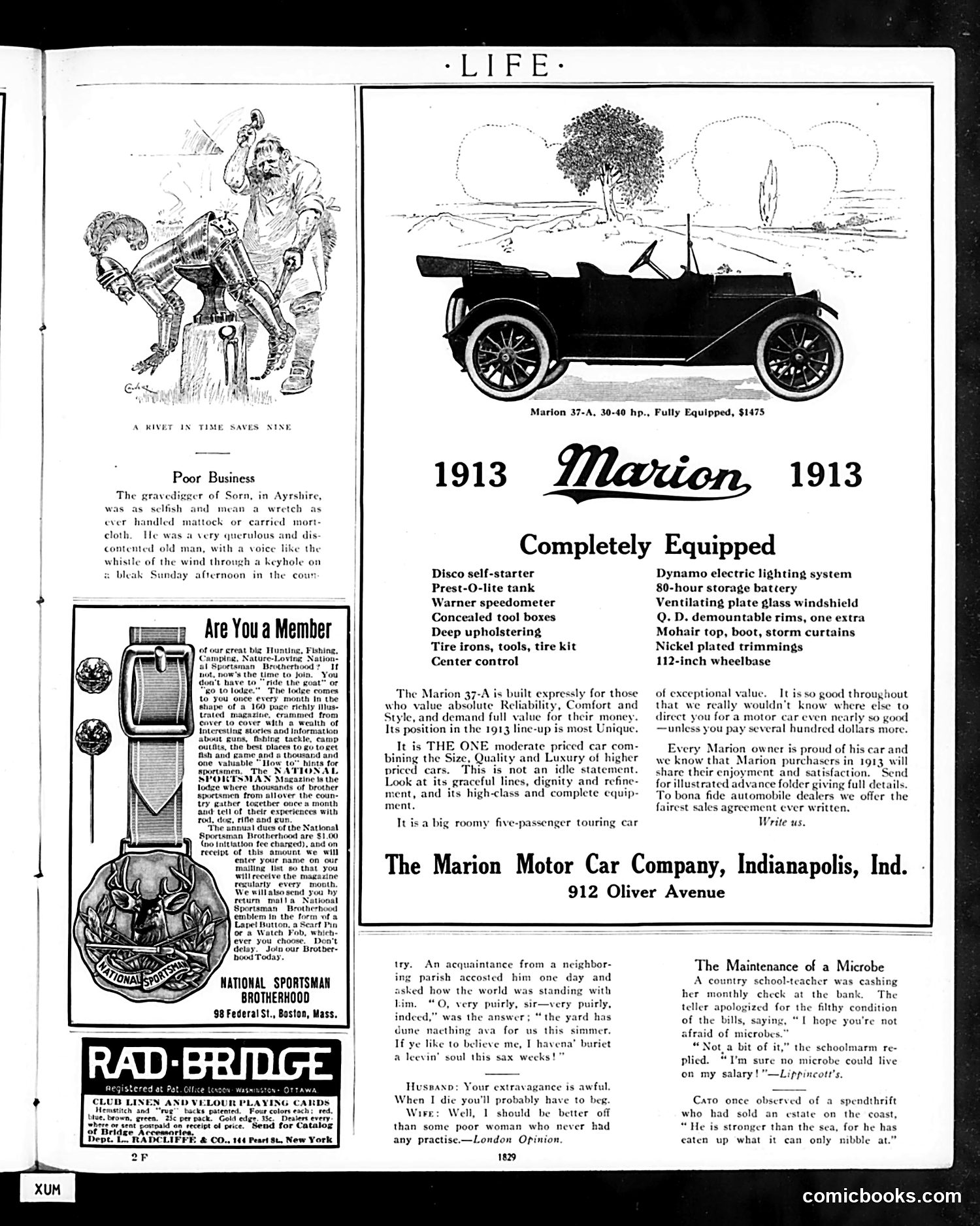
This page from *Life* magazine (1913) is primarily **advertising**, with minor satirical content. The main cartoon, "A Rivet in Time Saves Nine," depicts a gravedigger from Scotland—a querulous old man—illustrating the saying that prevention (a timely rivet) prevents disaster (nine burials). It's a visual pun on the proverb "a stitch in time saves nine." The rest of the page contains ads for a **Marion automobile** ($1,475, fully equipped), a National Sportsman magazine subscription, and playing cards. These reflect 1913 consumer goods aimed at middle-class men. The humor pieces (anecdotes about a wife's extravagance, a schoolteacher's poverty wages) use period comedy tropes—nagging spouses and underpaid professionals—common to early 20th-century magazines. No specific political satire is evident; the page reflects advertising-driven magazine content typical of the era.
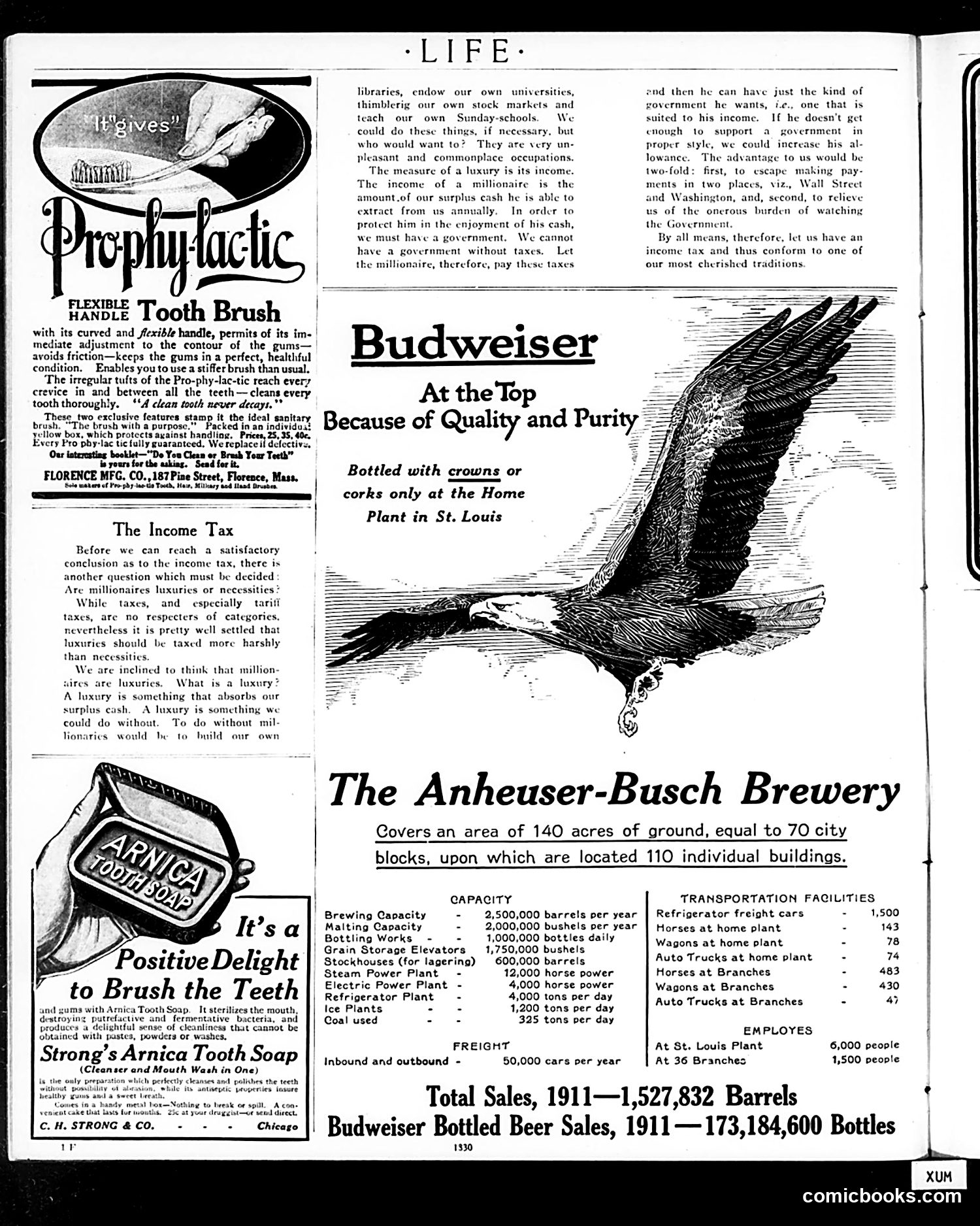
This page mixes political satire with commercial advertising, typical of *Life* magazine's format. **The Satire:** The main editorial content satirizes wealthy millionaires, arguing they should be taxed heavily as "luxuries" rather than "necessities." The author proposes a provocative solution: let millionaires *themselves* fund government through income taxes, relieving ordinary citizens of tax burden. The satire's point is that the wealthy extract surplus wealth from the public annually anyway—so why not formalize this as taxation? It's a tongue-in-cheek argument that millionaires are essentially maintained by society and should therefore pay for it. **The Advertisements:** The page includes typical early-1900s product ads (toothbrushes, tooth soap) alongside a massive advertisement for Anheuser-Busch Brewery, showcasing its scale and capacity with specific statistics. This juxtaposition—luxury goods marketed alongside working-class beer production—ironically frames different definitions of "luxury" discussed in the editorial. The date appears to be 1912 based on "1330" at page bottom.
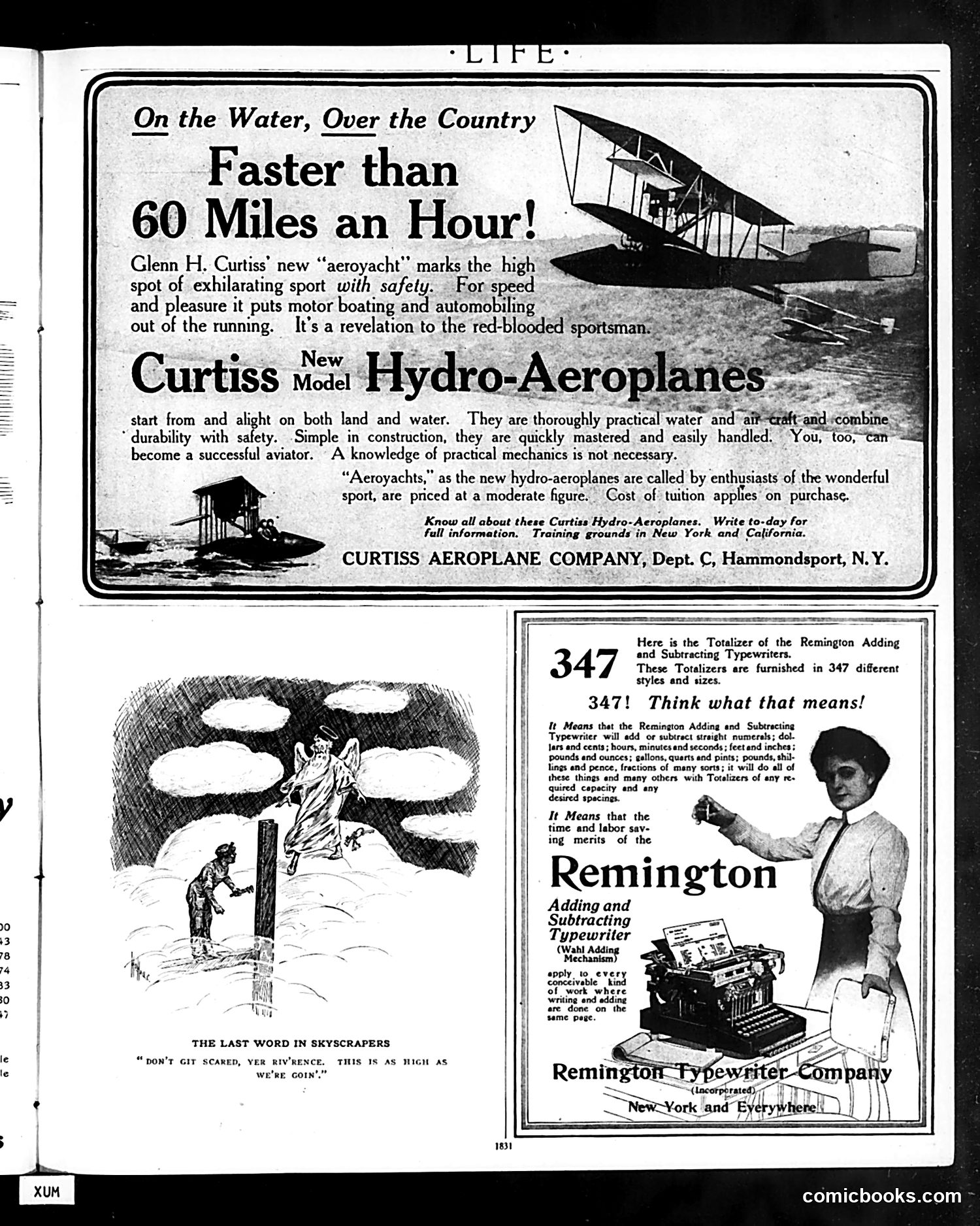
This page consists primarily of three advertisements from the early 1910s, not political satire. **Top:** Glenn Curtiss advertises his "aeroyacht"—a hybrid hydroaeroplane combining boat and aircraft capabilities, capable of speeds exceeding 60 mph. The ad targets wealthy sportsmen, emphasizing safety and accessibility ("no knowledge of practical mechanics necessary"). **Middle-left:** A small cartoon titled "The Last Word in Skyscrapers" shows a figure at extreme height, with dialogue mocking fear of tall buildings—period humor about skyscraper anxiety. **Right:** Remington Typewriter promotes an adding/subtracting model with 347 different configurations. The "347" serves as the hook—emphasizing customization for diverse accounting and clerical tasks. These ads reflect early-20th-century fascination with technological innovation (aviation, electromechanical calculation) marketed to business professionals and leisure enthusiasts. The content is commercial rather than satirical.
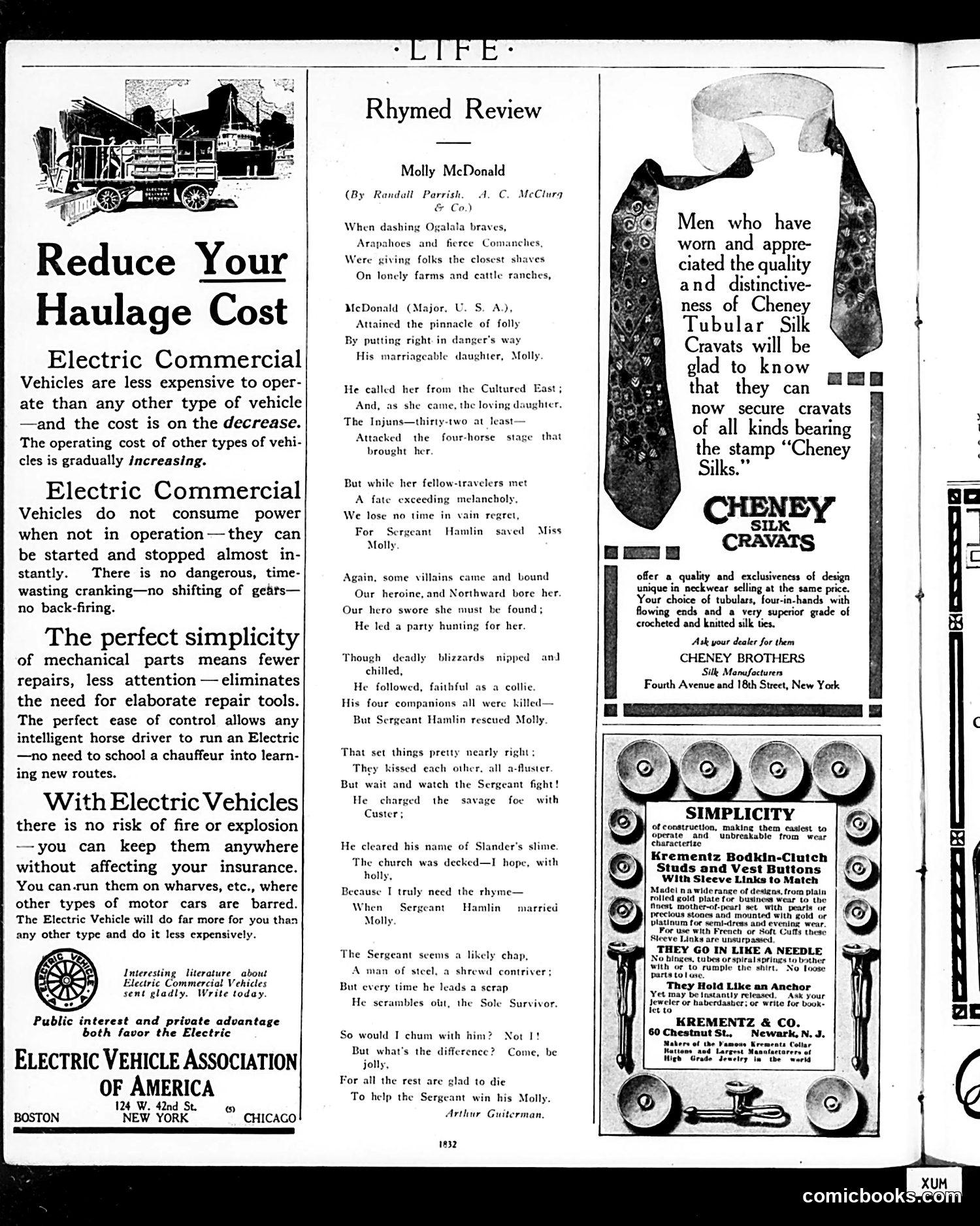
This page is primarily **advertising with a literary review**. The "Rhymed Review" by Arthur Guiterman summarizes a Western novel about a Major McDonald who endangers his daughter Molly by bringing her to the frontier during Indian conflicts. Sergeant Hamlin repeatedly rescues her from attacks by Native Americans and villains, eventually marrying her. The satire lies in Guiterman's final verses: he mocks Hamlin as a "Sole Survivor" whose companions consistently die protecting him, questioning why anyone would befriend such a man despite his heroic reputation. It's gentle mockery of melodramatic Western fiction tropes. The page also features advertisements for **electric commercial vehicles** (emphasizing their safety and economy), **Cheney silk neckwear**, and **Krementz cufflinks**—typical early 20th-century luxury goods advertising.
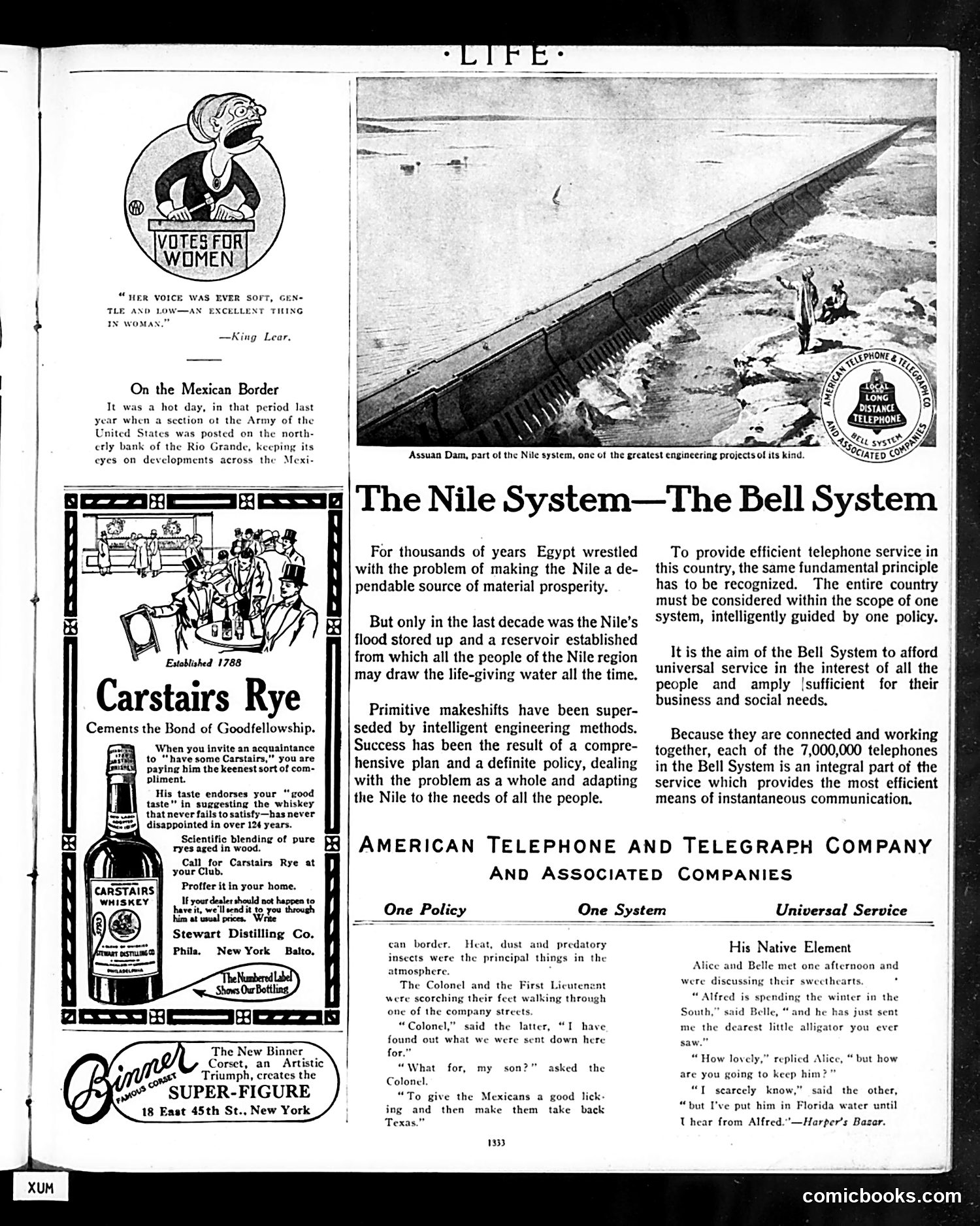
This page mixes advertising with editorial content reflecting early 20th-century American concerns. **"On the Mexican Border"** is a brief anecdote about U.S. Army troops stationed at the Rio Grande during a period of Mexican-American tensions (likely referencing the Mexican Revolution era). The joke is mild: soldiers sent to intimidate Mexico are actually just dealing with heat and insects, with one officer joking their real purpose is to "give the Mexicans a good licking" and reclaim Texas—a absurdist exaggeration of American bluster. **"The Nile System—The Bell System"** is corporate propaganda comparing Egypt's Aswan Dam engineering achievement to Bell Telephone's integrated national network. Both represent systems requiring "one policy" and comprehensive planning to serve entire populations efficiently. The advertisements (Carstairs Rye whiskey, Binney corsets) and the "His Native Element" domestic humor about keeping a sweetheart occupied are typical period filler, unremarkable by modern standards.
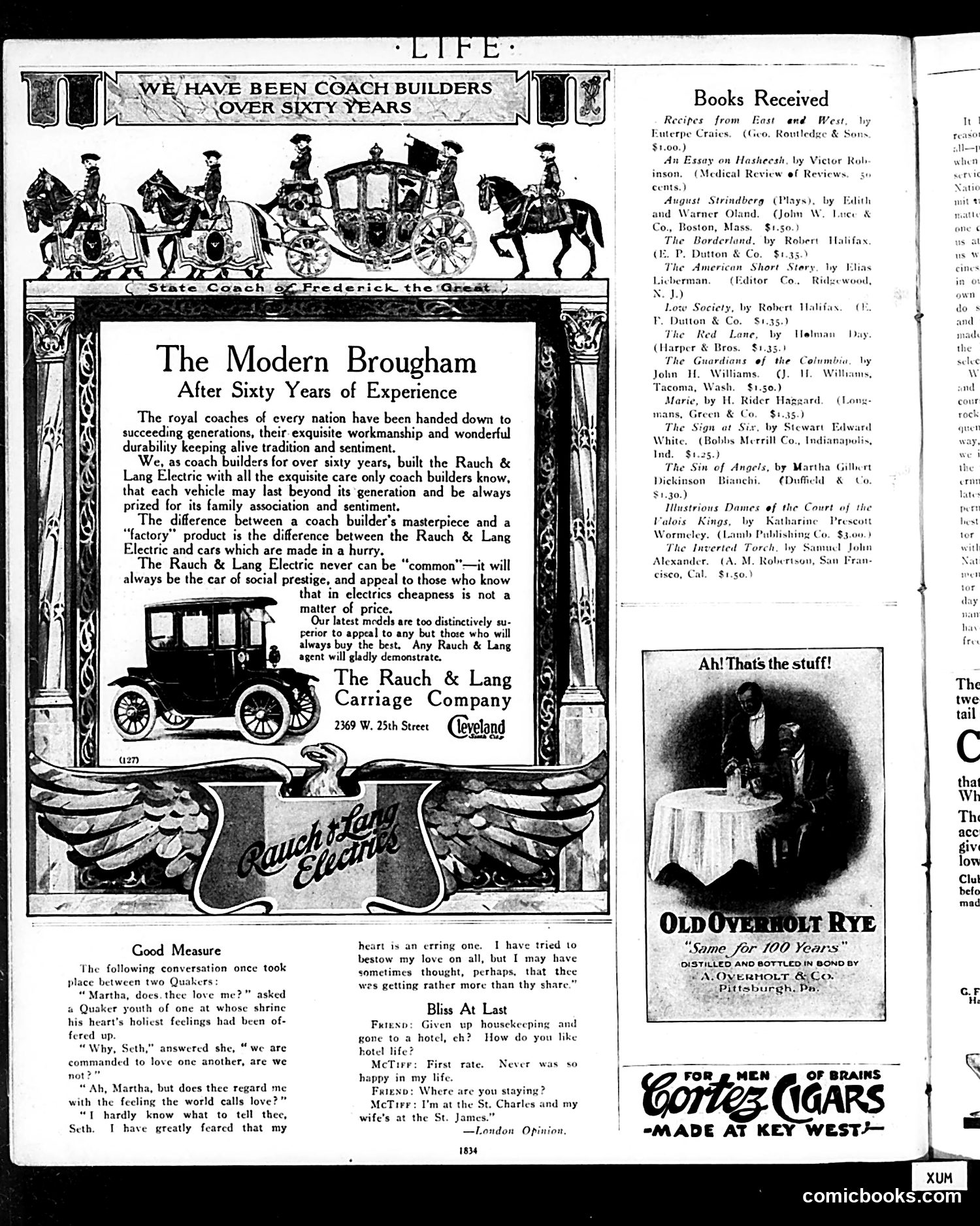
This page is primarily **advertising**, not political satire. The dominant content is a full-page advertisement for the **Rauch & Lang Carriage Company** of Cleveland, promoting their "Modern Brougham" electric automobile after "sixty years" of coach-building experience. The ad emphasizes that despite their shift to automobiles, Rauch & Lang maintain the craftsmanship and prestige of traditional coach-building. It positions electric cars as vehicles of "social prestige" that appeal to the wealthy—not cheap "factory products." The page also includes: - A **"Books Received"** section listing recent publications - A brief **humorous dialogue** about Quaker courtship ("Bliss At Last") - Advertisements for **Old Overholt Rye whiskey** and **Cortez Cigars** There are **no political cartoons** on this page. The imagery consists entirely of decorative period engravings (historical coaches, a Rauch & Lang automobile) and product advertisements typical of *Life* magazine's revenue model circa the 1910s.
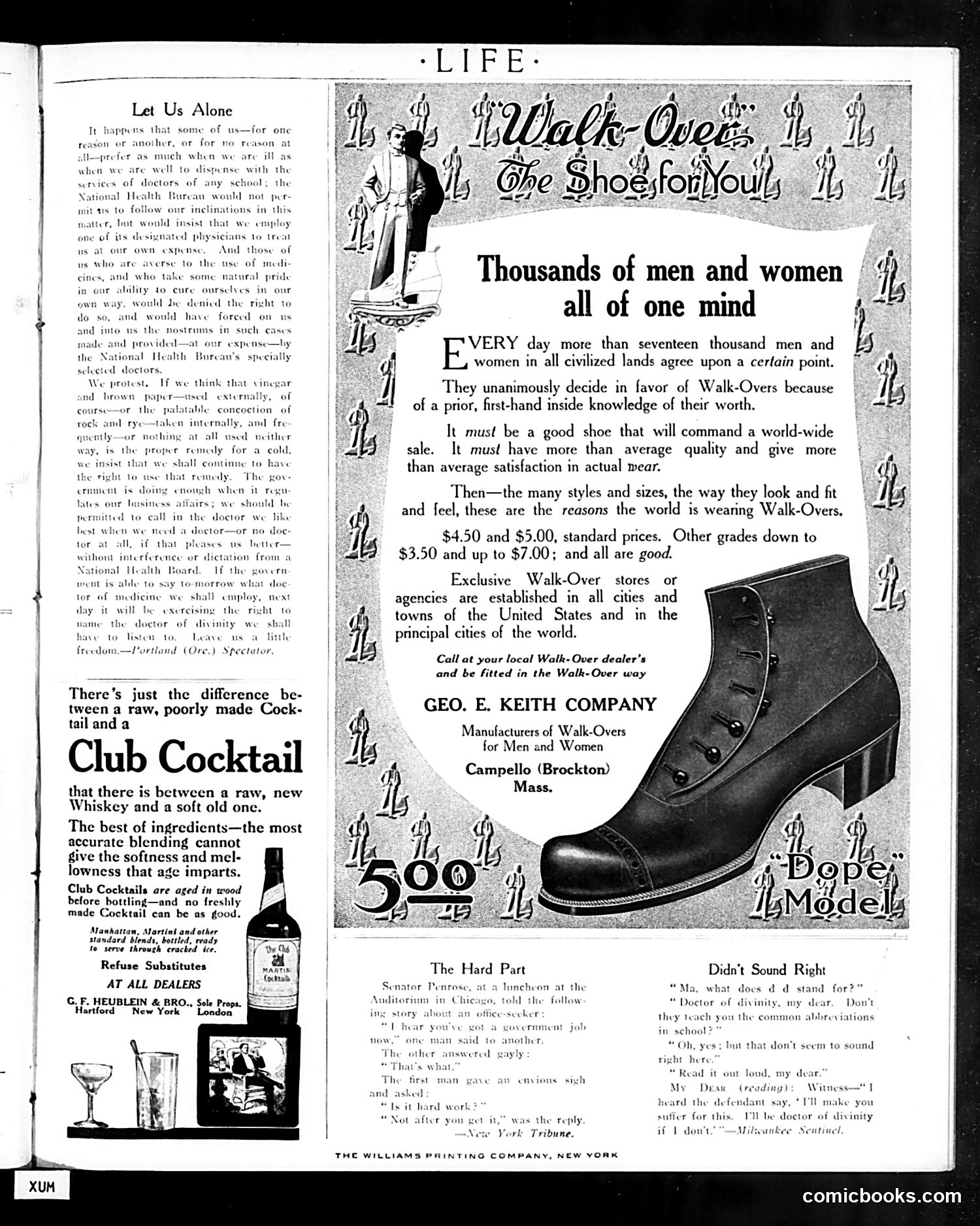
This page consists primarily of **advertisements rather than satirical cartoons**. The dominant feature is a full-page ad for **Walk-Over shoes** (manufactured by Geo. E. Keith Company in Brockton, Mass.), claiming that "seventeen thousand men and women in all civilized lands" unanimously prefer them for their quality and variety of styles. Below that are two smaller ads: one for **Club Cocktail** whiskey, emphasizing that aging in wood gives superior smoothness compared to freshly made cocktails, and another for **Heublein & Bro.** spirits. The page also includes a brief humorous anecdote titled "Didn't Sound Right" about someone mishearing "D.D." (Doctor of Divinity) as "D.D." in another context. There are no significant political cartoons or satirical commentary visible on this page—it's primarily commercial advertising typical of early 20th-century Life magazine content.
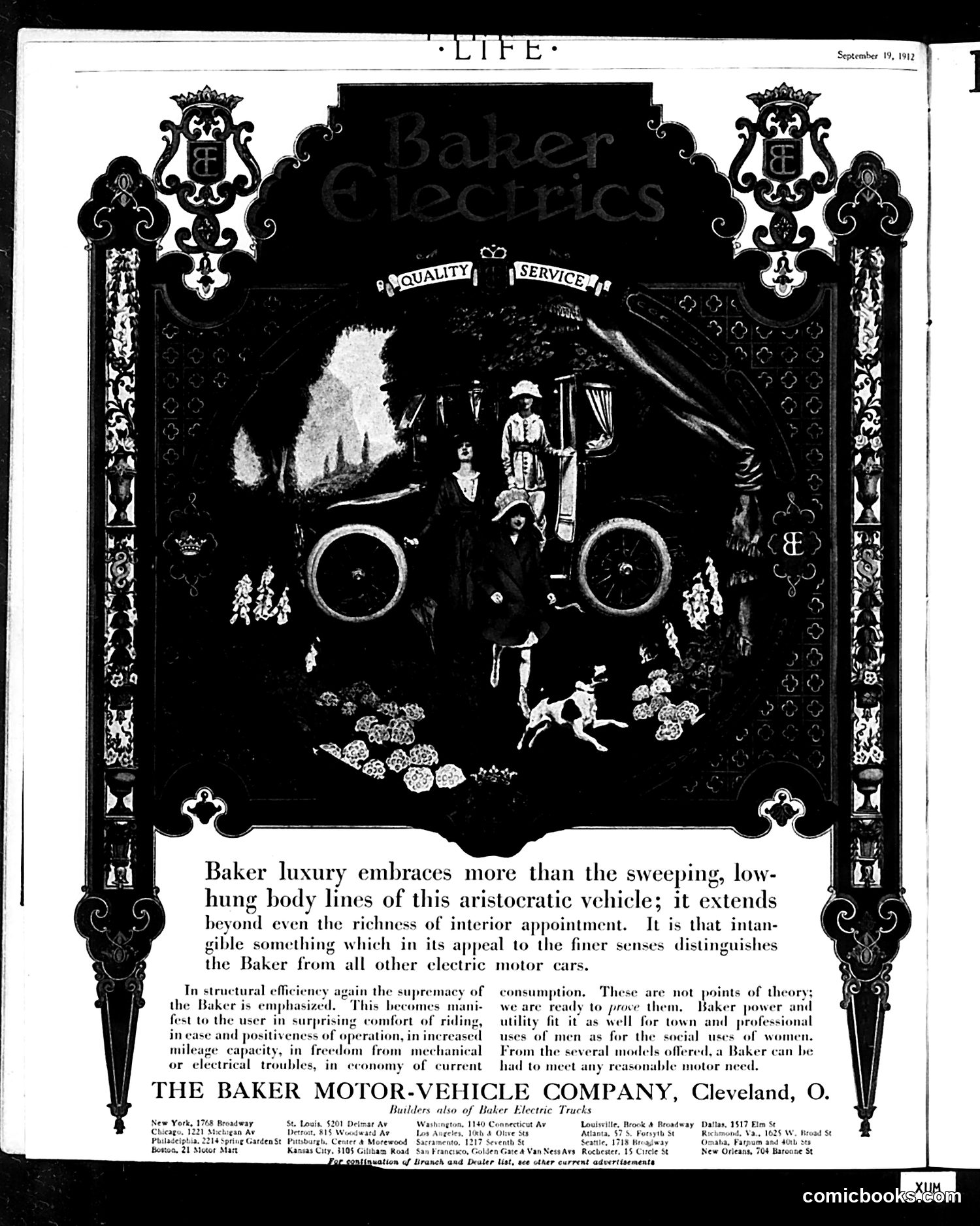
This is primarily a **luxury automobile advertisement**, not political satire. The page promotes the Baker Motor-Vehicle Company's electric car, dated September 19, 1912. The ornate illustration depicts an elegant woman in period dress being driven in a Baker electric vehicle through a pastoral landscape. The imagery emphasizes luxury and refinement—aristocratic styling, low body lines, and fine interior appointments. The accompanying text argues that Baker cars appeal to "the finer senses" and distinguishes itself through structural efficiency and reliability. It claims Baker vehicles suit both professional/commercial uses and social occasions for women. **Context for modern readers:** This reflects the 1912 market moment when electric automobiles competed seriously with gasoline cars, particularly appealing to wealthy, status-conscious buyers. The gendered marketing (emphasizing a woman driver) reflects period assumptions about who purchased luxury vehicles. Electric cars were seen as refined, quiet, and safe—the opposite of loud, dangerous gasoline engines. This is advertisement-as-content, not editorial commentary.