
Life, 1912-09-19 · page 9 of 44
Life — September 19, 1912 — page 9: what you’re looking at
What you’re looking at
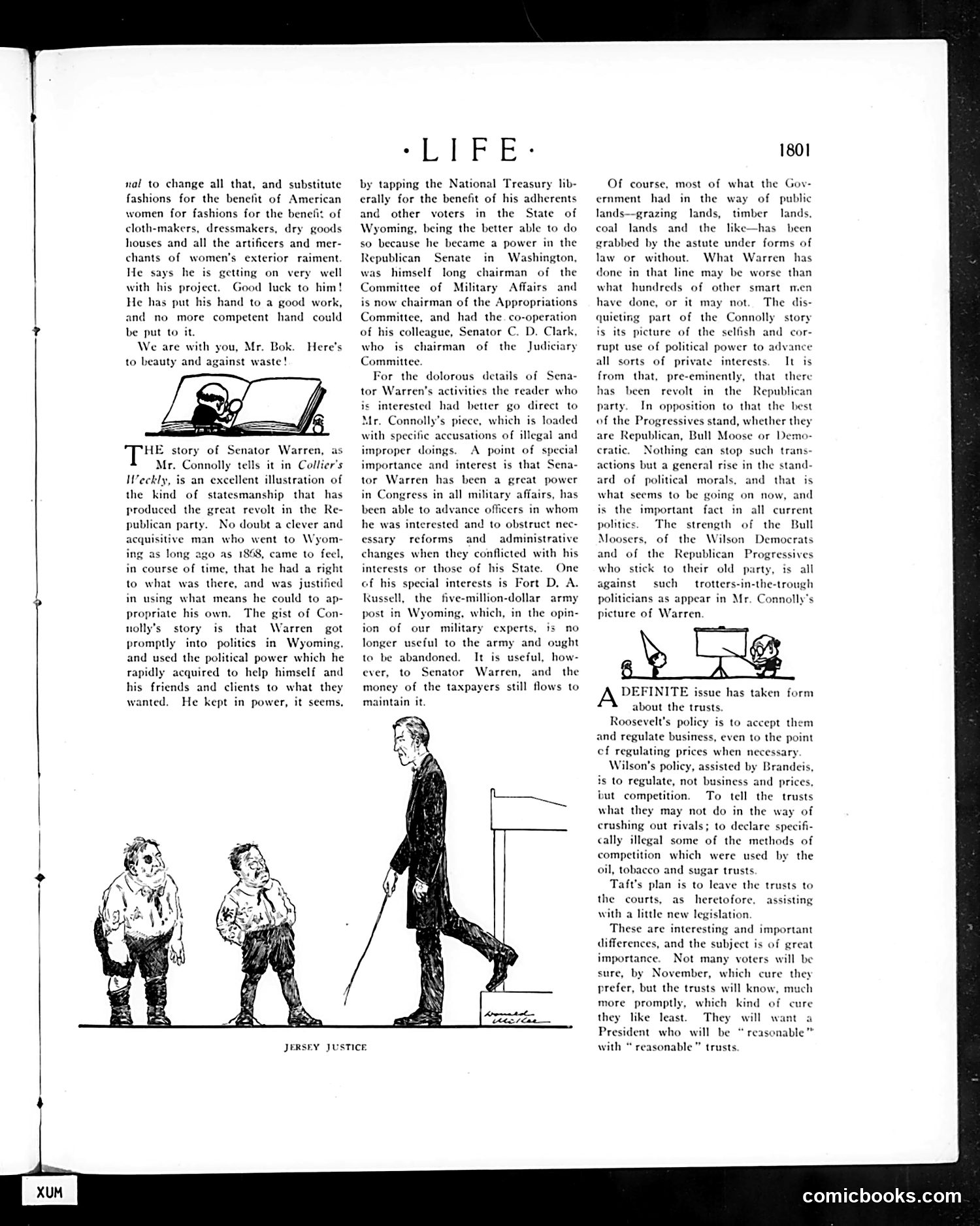
This 1901 *Life* magazine page criticizes Senator Warren's political power in Wyoming. The cartoon titled "Jersey Justice" depicts a tall figure (Warren) standing over two smaller figures labeled as representing common citizens or workers, visually emphasizing the power imbalance. The accompanying article details Warren's influence—his control of military affairs committees, his ability to advance officers, and his use of political power to benefit private interests, particularly Fort D.A. Russell in Wyoming. The satire suggests Warren exploited his position to enrich himself and allies while claiming to serve public interest. The cartoon's title invokes "justice" ironically: the composition shows Warren towering over ordinary people, suggesting justice is perverted when politicians prioritize personal gain over constituents' welfare.
📄 Transcribed text from this page (OCR, searchable)
Machine-transcribed from the original scan — historical spelling and the odd misread are preserved.
nal to change all that, and substitute fashions for the benefit of American women for fashions for the benefit of cloth-makers, dressmakers, dry goods houses and all the artificers and mer- chants of women’s exterior raiment. He says he is getting on very well with his project. Good luck to him! He has put his hand to a good work, and no more competent hand could be put to it. We are with you, Mr. Bok. to beauty and against waste! Here's HE story of Senator Warren, Mr. Connolly tells it in Collier's Weekly, is an excellent illustration of the kind of statesmanship that has produced the great revolt in the Re- publican party. No doubt a clever and acquisitive man who went to Wyom- ing as long ago as 1868, came to feel, in course of time, that he had a right to what was there, and was justified in using what means he could to ap- propriate his own. The gist of Con- nolly’s story is that Warren got promptly into politics in Wyoming, and used the political power which he rapidly acquired to help himself and his friends and clients to what they wanted. He kept in power, it seems, "LIFE: by tapping the National Treasury lib- crally for the benefit of his adherents and other voters in the State of Wyoming, being the better able to do so because he became a power in the Republican Senate in Washington, was himself long chairman of the Committee of Military Affairs and is now chairman of the Appropriations Committee, and had the. co-operation of his colleague, Senator C. D. Clark, who is chairman of the Judiciary Committee. For the dolorous details of Sena tor Warren's activities the reader who is interested had better go direct to Mr. Connolly’s piece, which is loaded with specific accusations of illegal and improper doings. A point of special importance and interest is that Sena- tor Warren has been a great power in Congress in all military affairs, has been able to advance officers in whom he was interested and to obstruct nec- essary reforms and administrative changes when they conflicted with his interests or those of his State. One of his special interests is Fort D, A. the five-million-dollar army post in Wyoming, which, in the opin- ion of our military experts, is no longer useful to the army and ought to be abandoned. It is useful, how- ever, to Senator Warren, and the money of the taxpayers still flows to maintain it, Kussell, JERSEY JUSTICE 1801 Of course, most of what the Gov- ernment had in the way of public lands—grazing lands, timber coal lands and the like—has been grabbed by the astute under forms of law or without. What Warren has done in that line may be worse than what hundreds of other smart men have done, or it may not. The dis- quicting part of the Connolly story is its picture of the selfish and cor- rupt use of political power to advance all sorts of private interests. It is from that, pre-eminently, that there has been revolt in the Republican party. In opposition to that the best of the Progressives stand, whether they are Republican, Bull Moose or De: cratic. Nothing can stop such trans- actions but a general rise in the stand- ard of political morals, and that is what seems to be going on now, and lands. nO- is the important fact in all current politics. ‘The strength the Bull Moosers, of the Wilson Democrats and of the Republican Progressives who stick to their old party, is all against trotters-in-the-trough politicians as appear in Mr. Connolly's picture of Warren. such APE FINITE issue has taken form about the trusts. Roosevelt's policy is to accept them and regulate business, even to the point cf regulating prices when necessary Wilson's policy, assisted by Brandeis, is to regulate, not business and prices, but competition. To tell the trusts what they may not do in the way of crushing out rivals; to declare specifi- cally illegal some of the methods of competition which were used by the oil, tobacco and sugar trusts. Taft's plan is to leave the trusts to the courts, as heretofore, with a little new legislation These are interesting and important differences, and the subject is of great importance. Not many voters will be sure, by November, which cure they prefer, but the trusts will know, much more promptly, which kind of cure they like least. They will want a President who will be “ reasonable with “ reasonable” trusts. assisting comicbooks.com