
Life, 1912-09-19 · page 20 of 44
Life — September 19, 1912 — page 20: what you’re looking at
What you’re looking at
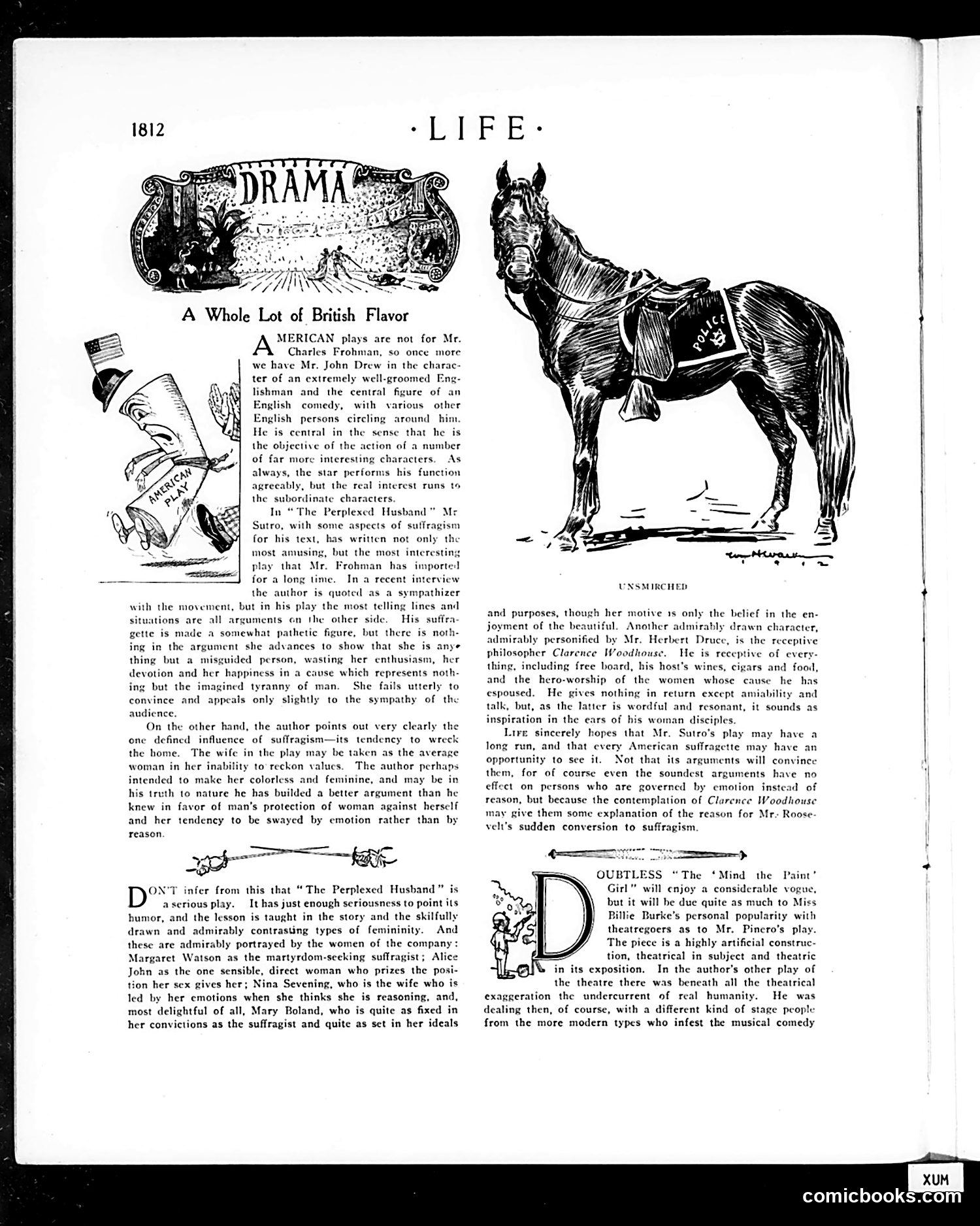
This page reviews the play "The Perplexed Husband," starring English actor John Drew in a comedic role. The critic praises the supporting female cast—including Margaret Watson as a suffragist and Mary Boland—while critiquing the play's anti-suffrage argument. **The satire's point**: The review reveals the play's hypocrisy. While author Alfred Sutro claims sympathy for women's suffrage, the play actually argues *against* it, portraying the suffragist wife as emotionally irrational and destructive to her marriage. The critic sardonically hopes American suffragettes see it—not because it will convince them, but because understanding its philosophy ("Clarence Woodhouse," a parasitic philosopher) might explain President Theodore Roosevelt's "sudden conversion to suffragism." **Context**: This reflects 1912 pre-suffrage debate. The magazine lampoons anti-suffrage arguments that characterized voting women as emotional and illogical, while portraying male philosophical detachment as superior.
📄 Transcribed text from this page (OCR, searchable)
Machine-transcribed from the original scan — historical spelling and the odd misread are preserved.
A Whole Lot of British Flavor MERICAN plays are not for Mr. Charles Frohman, so once more we have Mr. John Drew in the charac- ter of an extremely well-groomed Eng- lishman and the central figure of an English comedy, with various other English persons circling around him. He is central in the sense that he is the objective of the action of a number of far more interesting characters. As always, the star performs his function agreeably, but the real interest runs to the subordinate characters. In “The Perplexed Husband" Mr Sutro, with some aspects of suffrag’ for his text, has written not only the most amusing, but the most interesting play that Mr. Frohman has importe:l for a long time. In a recent interview the author is quoted as a sympathizer with the movement, but in his play the most telling lines and situations are all arguments on the other side. His. sufira gette is made a somewhat pathetic figure, but there is noth- ing in the argument she advances to show that she is anye thing but a misguided person, wasting her enthusiasm, her devotion and her happiness in a cause which represents noth- ing but the imagined tyranny of man. She fails utterly to convince and appeals only slightly to the sympathy of the audience On the other hand, the author points out very clearly the one defined influence of suffragism—its tendency to wreck the home. The wife in the play may be taken as the average woman in her inability to: reckon values. The author perhaps intended to make her colorless and feminine, and may be in his truth to nature he has builded a better argument than he knew in favor of man’s protection of won inst herself and her tendency to be swayed by emotion rather than by reason m ON'T infer from this that “The Perplexed Husband” is D ascrious play. It has just enough seriousness to point its humor, and the lesson is taught in the story and the skilfully drawn and admirably contrasting types of femininity. And these are admirably portrayed by the women of the company : Margaret Watson as the martyrdom-sceking suffragist ; Alice John as the one sensible, direct woman who prizes the pos tion her sex gives her; Nina Sevening, who is the wife who is led by her emotions when she thinks she is reasoning, and, most delightful of all, Mary Boland, who is quite as fixed in her convictions as the suffragist and quite as set in her ideals UNSMIRCHED and purposes, though her motive 1s only the belief in the en- joyment of the beautiful. Another admirably drawn character, admirably personified by Mr. Herbert Druce, is the receptive philosopher Clarence Woodhouse. He is receptive of every- thing, including free board, his host's wines, cigars and foo, and the hero-worship of the women whose cause he has espoused. He gives nothing in return except amiability and talk, but, as the latter is wordful and resonant, it sounds as inspiration in the ears of his woman disciples Lire sincerely hopes that Me. Sutro’s play may have a long run, and that every American suffragette may have an opportunity to see it. Not that its arguments will convince them, for of course even the soundest arguments have no effeet_ on persons who are governed by emotion instead of reason, but because the contemplation of Clarence Woodhouse may give them some explanation of the reason for Mr- Roose velt’s sudden conversion to suffragism I ee OUBTLESS “The ‘Mind the Paint’ Girl” will enjoy a considerable vogue, but it will he due quite as much to Miss Billie Burke's personal popularity with theatregoers as to Mr. Pincro’s play. The piece is a highly artificial construc- tion, theatrical in subject and theatric in its exposition. In the author's other play of the theatre there was beneath all the theatrical exaggeration the undercurrent of real humanity. He was dealing then, of course, with a different kind of stage peop from the more modern types who infest the musical comedy comicbook $.co