
Life, 1912-09-19 · page 21 of 44
Life — September 19, 1912 — page 21: what you’re looking at
What you’re looking at
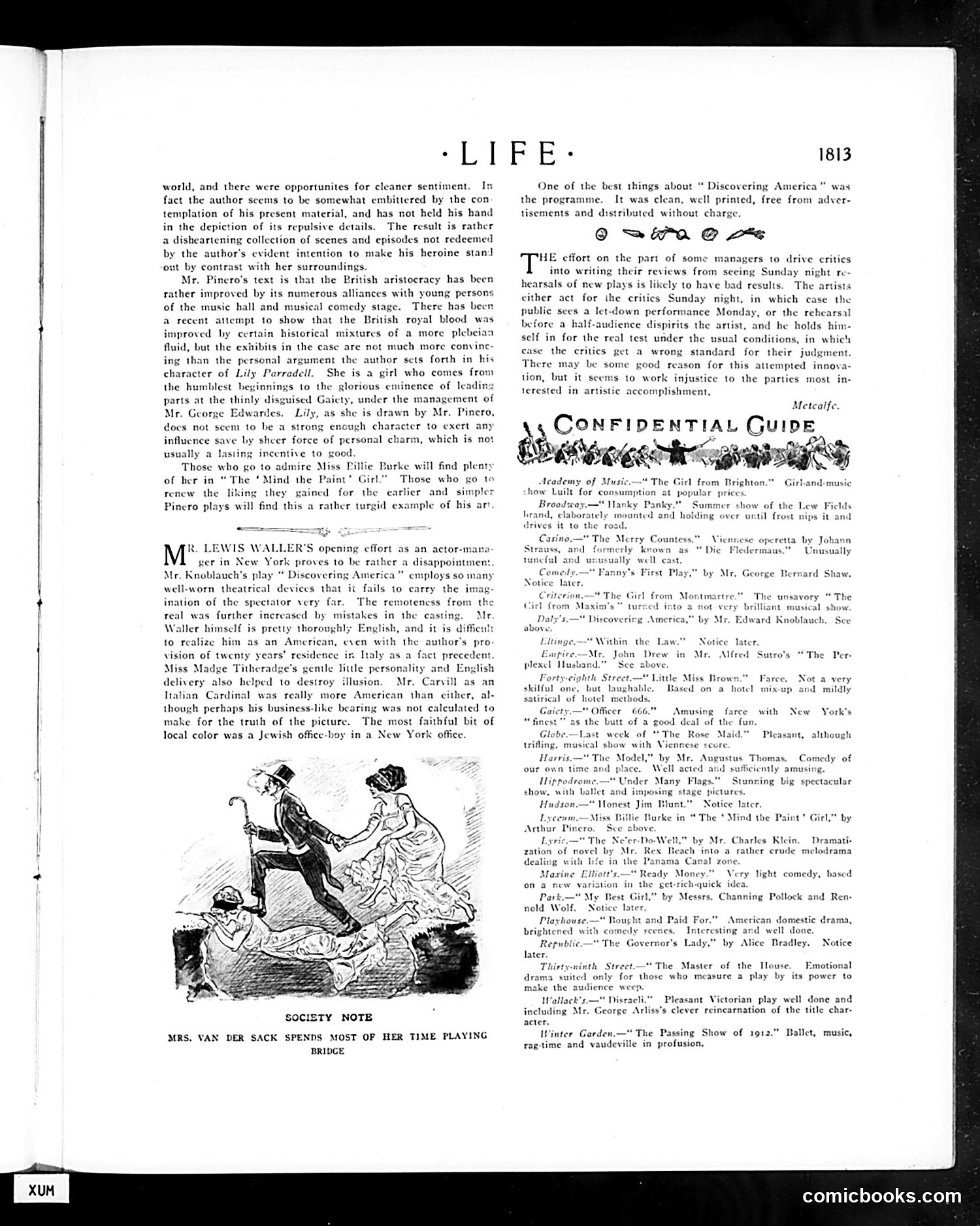
This page from Life magazine contains a society note with accompanying illustration rather than a political cartoon. The drawing depicts two figures in what appears to be a romantic or social encounter—a man in formal dress (top hat visible) and a woman in period clothing, depicted in a sketch style typical of early 20th-century satirical magazines. The accompanying society note sarcastically comments: "MRS. VAN DER SACK SPENDS MOST OF HER TIME PLAYING BRIDGE"—likely a joke about wealthy society women's leisure activities and social priorities. The bulk of the page consists of theater reviews critiquing contemporary plays and performances, including commentary on acting quality, casting choices, and theatrical authenticity. The satire targets actors' accents and miscasting (an English actor playing American roles, an Italian actor's unconvincing performance), reflecting period concerns about theatrical realism and professional standards in early 1900s American theater.
📄 Transcribed text from this page (OCR, searchable)
Machine-transcribed from the original scan — historical spelling and the odd misread are preserved.
LIFE: 1813 world, and there were opportunites for cleaner sentiment. In fact the author scems to be somewhat embittered by the con templation of his present material, and has not held his band in the depiction of its repulsive de The result is rather a disheartening collection of scenes and episodes not redeemed by the author's evident intention to make his heroine stand out by contrast with her surroundings. Mr. Pincro’s text is that the British aristocracy has been rather improved by its numerous alliances with young persons of the music hall and musical comedy stage. There has beer a recent attempt to show that the British royal blood was improved by certain historical mixtures of a more plebeiaa fluid, but the exhibits in the case are not much more convine ing than the personal argument the author sets forth in his aracter of Lily Parradell. She is a girl who comes from the humblest beginnings to the glorious eminence of leadir parts at the thinly disguised Gaiety, under the management of Mr. George Edwardes. Lily, as she is drawn by Mr. Pinero, docs not scem to be a strong enough character to exert any influence save by shcer force of personal charm, which is not cl usually a lasting incentive to good. Those who go to admire Miss Pillie Burke will find plent of her in “The ‘Mind the Paint’ Girl.’ Those who go 10 renew the liking they gained for the earlier and_ simp! Pinero plays will find this a rather turgid example of his art M* LEWIS WALLER’S opening effort as an actor-mans ger in New York proves to be rather Mr. Knoblauch’s play “ Discovering Ame 1 disappointinen: employs so many well-worn theatrical devices that it fails to carry the in ination of the spectator very far. The remoteness from th real was further increased by kes in the casting. Mr Waller himself is pretty thoroughly English, and it is diffien to realize him as an American, even with the author's pro vision of twenty years’ residence in Italy as a Miss Madge Titheradg d English delivery also helped to destroy illusion. Mr. Carvill as an Halian Cardinal was really more American than cither, al- though perhaps his business-like bearing was not calculated to make for the truth of the picture. The most faithful bit of local color was a Jewish office-boy in a New York office. fact precedent gentle little personali SOCIETY NOTE MRS. VAN DER SACK SPENDS MOST OF HER TIME PLAYING BRIDGE, One of the best things about “ Discovering America” was the programme. It was clean, well printed, free from adver- tisements and distributed without charge. 0 =A @ 2*s HE effort on the part of some managers to drive critics into writing their reviews from seeing Sunday night re- hearsals of new plays is likely to have bad results. The artists cither act for the crit night, in which case the public sees a let-down performance Monday, or the rehearsal before a half-audience dispirits the artist, and he holds him- self in for the real test under the usual conditions, in which case the critics get a wrong standard for their judgment. There may be some good reason for this attempted innova tion, but it seems to work injustice to the parties most in- terested in s Sunda tistic accomplishment, Metcalfe. \ CONFIDENTIAL Guipbe Academy of 3 1 from Brighton.” Girl-and-music sic. how Luilt for consump popular prices Broad: “Hanky Panky.” S show of the Lew Fields brand, elaborately mounted and ho over until frost nips it and drives it to the road Casino. ; “The Merry Countess.” Viennese operetta by Joh Strauss, nerly known as “ Die jedermaus."” Unusually tuneful and unusually well cast, Comedy " by Mr. George Notice Criterio tmartre.” The unsavory “ The irl fro! ‘ot very brilliant musical show Daly’: above Eltinge.—" W the Law." Notice later. Empire-—Mr, John Drew in Mr. Alfred Sutro’s “The Pers plexcl Husband.” “See above —"* Discovering America,” by Mr. Edward Knoblauch, Sce Fo th Strect.—* Little Miss Brown, Not a very skilful one, but laughable. Based on a hotel mix-up and mildly satirical of hotel method Gaicty.—" Officer 666." Amusing farce with New York's “finest? as the butt of a good deal of the Globe.—Last week of “The Rose Maid.” Pleasant, although trifling, musical show with Viennese vcore. he Mode el,” by Mr. Augustus Thomas, Comedy of d place, Well acted ai —"Under Many Flags. ng stage pictures Hudson.— t Jim Blunt." Noti Lycoum.— Miss Billie Rurke in “ The * Mind the Paint’ Gi 1 Pinero. Sce above Lyrie.—" The Ne‘er-Do-Well.” by Mr. Charles Ki zation of novel by Mr. Rex Bea dealing with life in the Pan: ie Elliott's. —" RK in th J sufficiently amus inning big spectacular ter, 1" by Ar Dramati- melodrama into a rather crude get-rich-quick id comedy, based Ww variation — My Rest Girl,” neld Wolf. Notice later, Playhouse.—" Trough bright by Messrs. Channing Pollock and Ren- and Paid For." American domestic drama, Interesting and well done. Republic. * by Alice Bradley. Notice later. Thirty-ninth The Master of the House. Emotional dr: suited ¢ who measure a play by its power to ake the audience weep. Wallack's.—" Diss: Pleasant Victorian play well done and including Mr. George Arliss’s clever reincarnation of the title char- acte q ter Garden.—" The Passing Show of 191 rag-time and vaudeville in profusion, Ballet, music, comicbooks.com