
A complete issue · 40 pages · 1911
Life — December 14, 1911
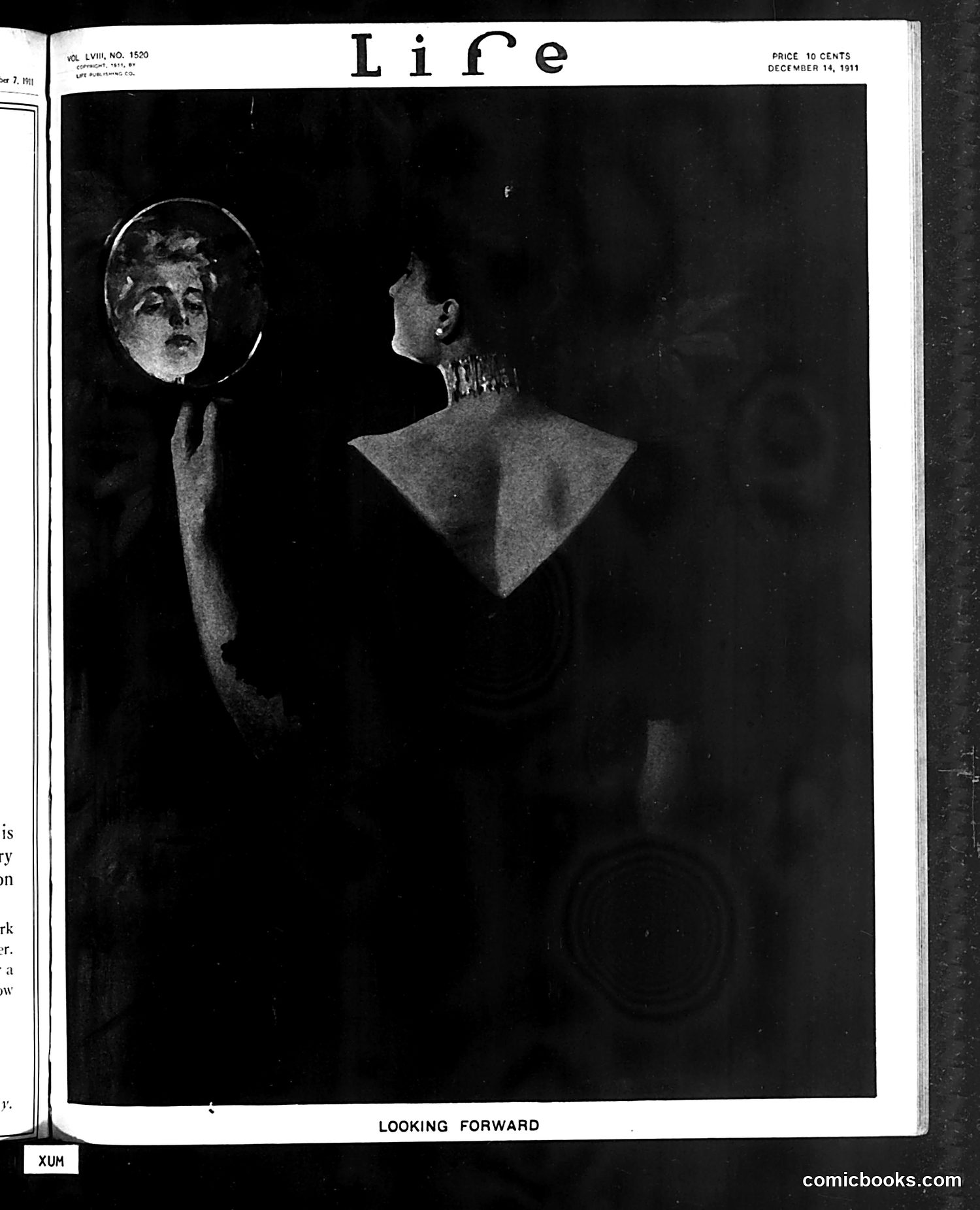
This illustration depicts a woman examining her reflection in a mirror, but seeing an older, aged version of herself. The satirical point appears to be about female vanity and anxiety regarding aging—a common theme in early 20th-century humor. The woman's present-day appearance contrasts sharply with the wrinkled, worn face reflected back at her, suggesting either literal fortune-telling or metaphorical commentary on women's preoccupation with youth and beauty. The title "Looking Forward" reinforces this temporal dimension, playing on dual meanings: literally gazing ahead into a mirror, and figuratively considering an unflattering future. This reflects period attitudes about women, aging, and societal beauty standards that Life magazine frequently satirized.
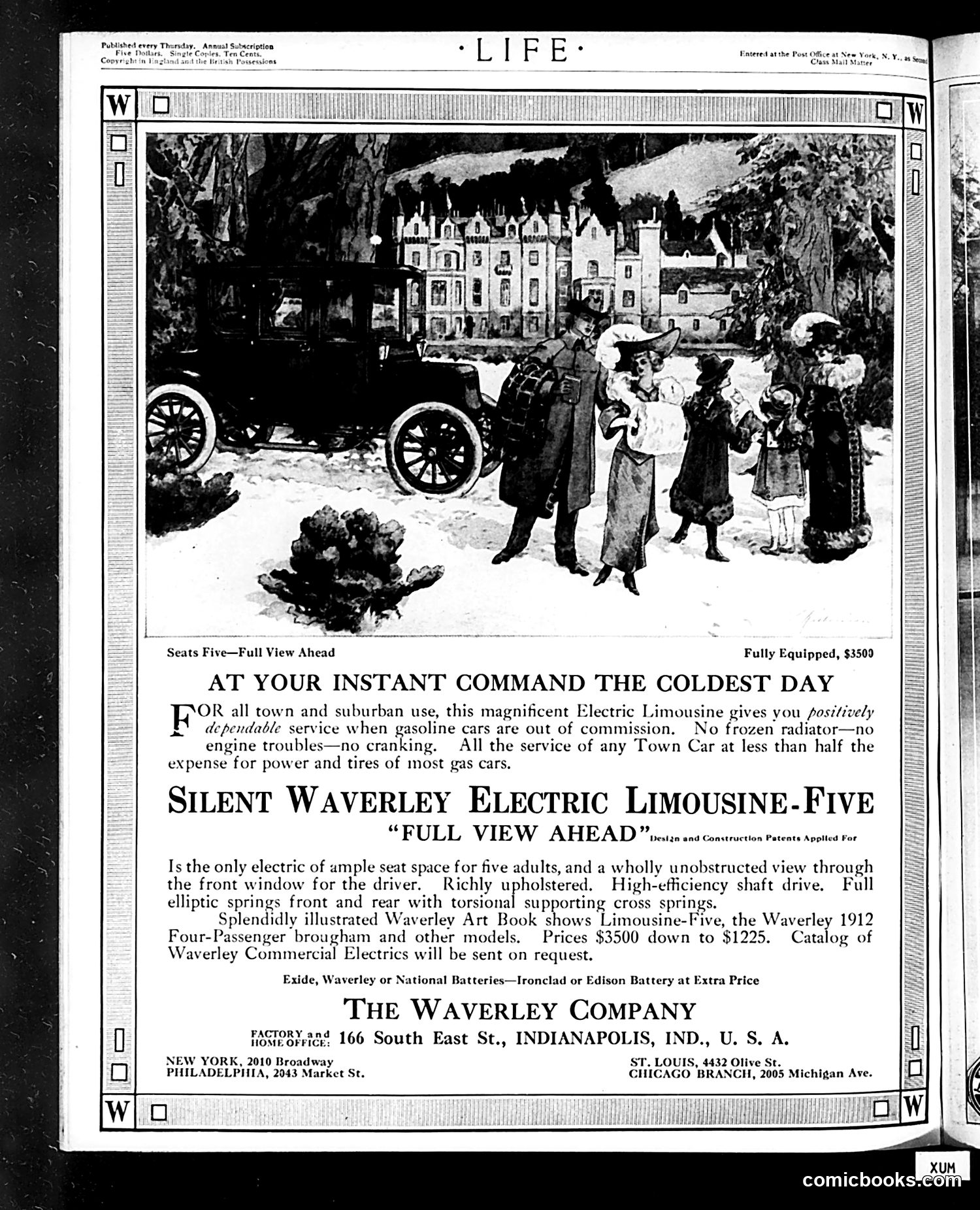
This is **not a cartoon or satire page** — it's a straightforward advertisement for the Silent Waverley Electric Limousine-Five, an early electric automobile manufactured by The Waverley Company of Indianapolis. The image shows a winter scene with a well-dressed chauffeur and passengers beside the vehicle parked near an elegant mansion. The advertisement emphasizes practical advantages: electric cars required no hand-cranking, wouldn't freeze in cold weather (unlike gasoline engines), and cost less to operate than gas cars. The ad targets affluent town and suburban residents, promoting the vehicle's reliability, comfort ("ample seat space for five adults"), and superior visibility. Prices ranged from $1,225 to $3,500. This represents early automotive marketing before gasoline vehicles became dominant.
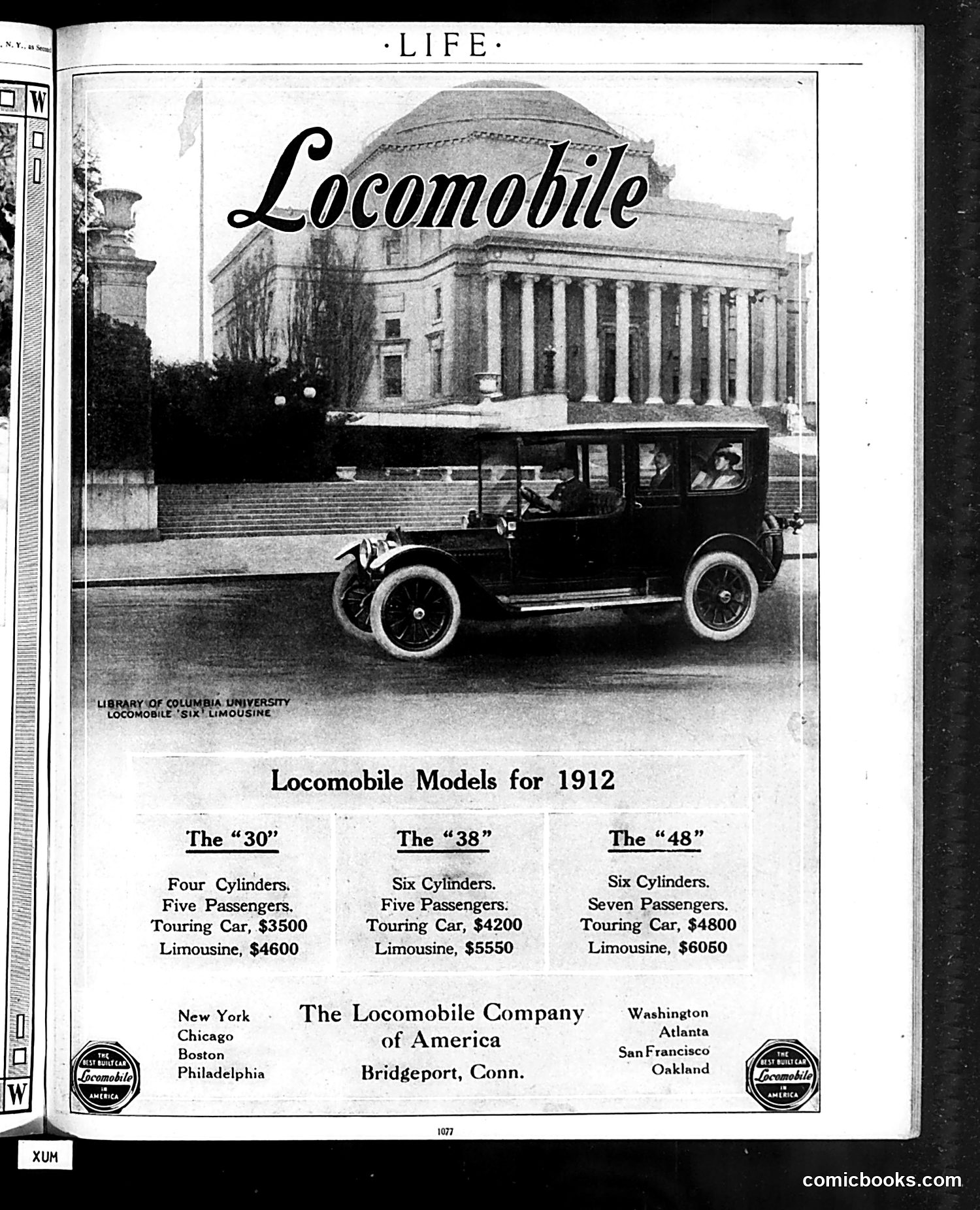
This page is **primarily an advertisement**, not satire or political commentary. It promotes three Locomobile automobile models for 1912: the "30," "38," and "48," differentiated by cylinder count and passenger capacity, with prices ranging from $3,500 to $6,050. The advertisement features a photograph of a Locomobile "Six" limousine positioned before an impressive neoclassical building (likely a museum or government structure), suggesting luxury and respectability. The imagery associates the vehicle with affluence and institutional prominence—typical of early automotive advertising targeting wealthy buyers. This represents typical early-20th-century *Life* magazine content: high-end product advertising aimed at the magazine's affluent readership, rather than editorial satire.
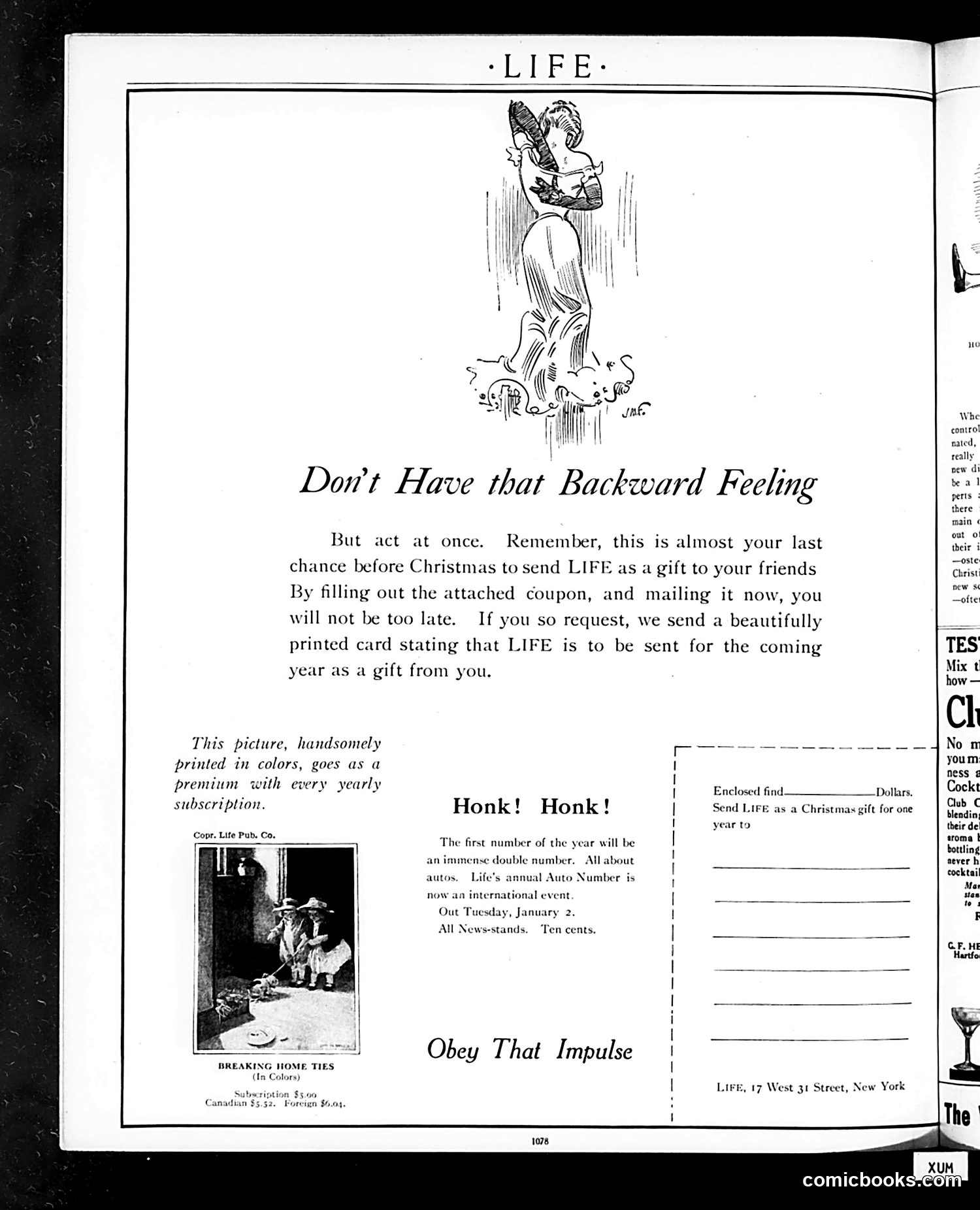
This page is primarily **advertising for Life magazine subscriptions**, not political satire. The top cartoon shows a figure standing on a pedestal, captioned "Don't Have that Backward Feeling"—a humorous appeal encouraging readers to subscribe as Christmas gifts rather than procrastinating. Below is a separate image labeled "Breaking Home Ties (In Color)," advertising that Life prints premium colored pictures as subscription bonuses. The "Honk! Honk!" section announces Life's annual Auto Number, publishing January 2, positioning it as an international automotive event. The right side contains a subscription coupon for mailing in. This is **vintage magazine self-promotion** rather than political commentary—using humor and FOMO ("almost your last chance before Christmas") to drive holiday gift subscriptions.
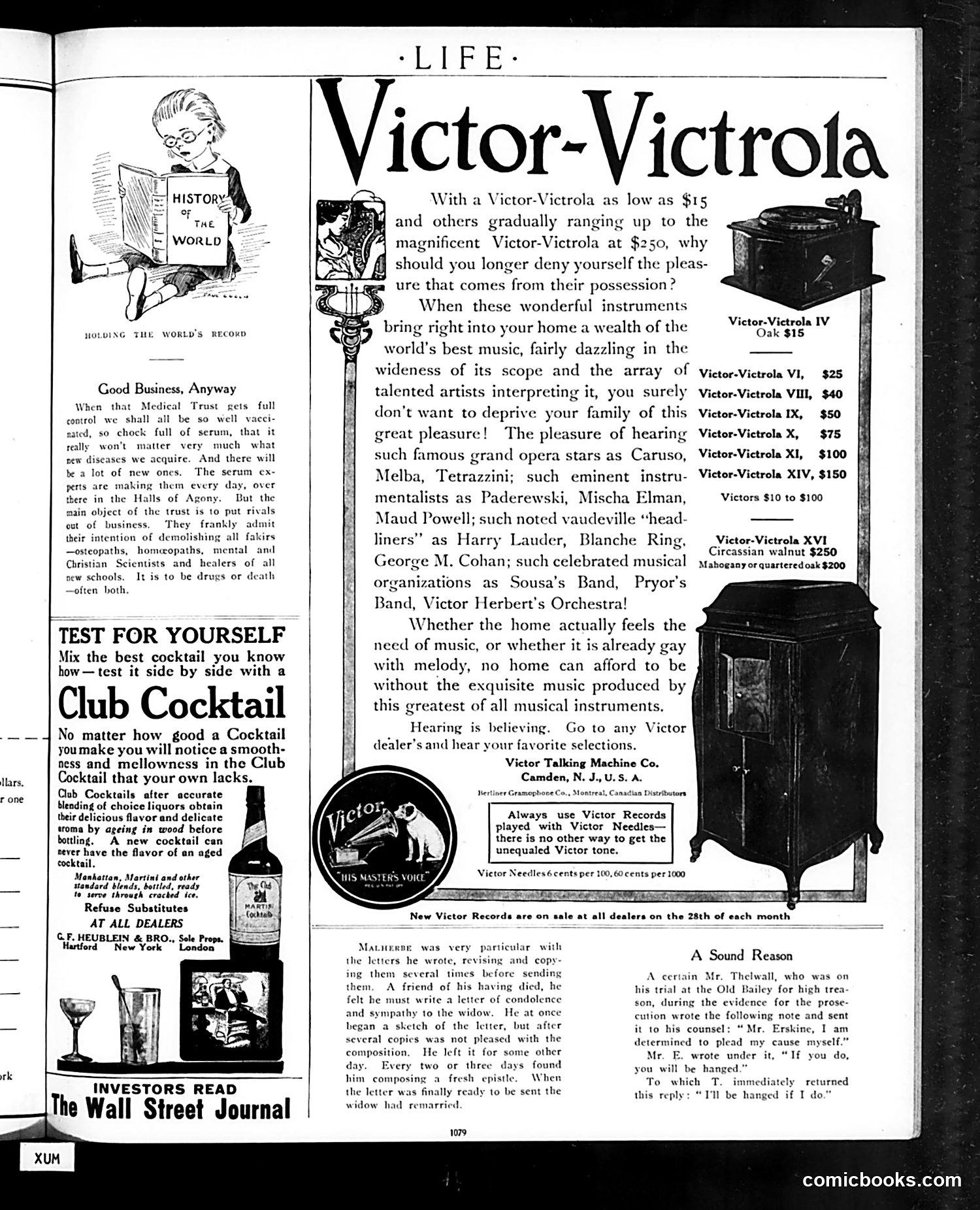
This page is **primarily advertising** for Victor-Victrola phonographs, not political satire. The small cartoon in the upper left ("Holding the World's Record") shows a child reading a "History of the World" book while sitting on what appears to be a stack of records—a gentle visual pun suggesting phonograph records as a form of cultural knowledge or entertainment dominance. The main content celebrates the Victrola's ability to bring famous opera singers (Caruso, Melba) and orchestras into homes at various price points ($15-$250). The advertising emphasizes music as an essential home luxury. The remaining left-side content advertises Club Cocktails and The Wall Street Journal—unrelated products typical of magazine advertising from this era. There is no significant political commentary on this page.
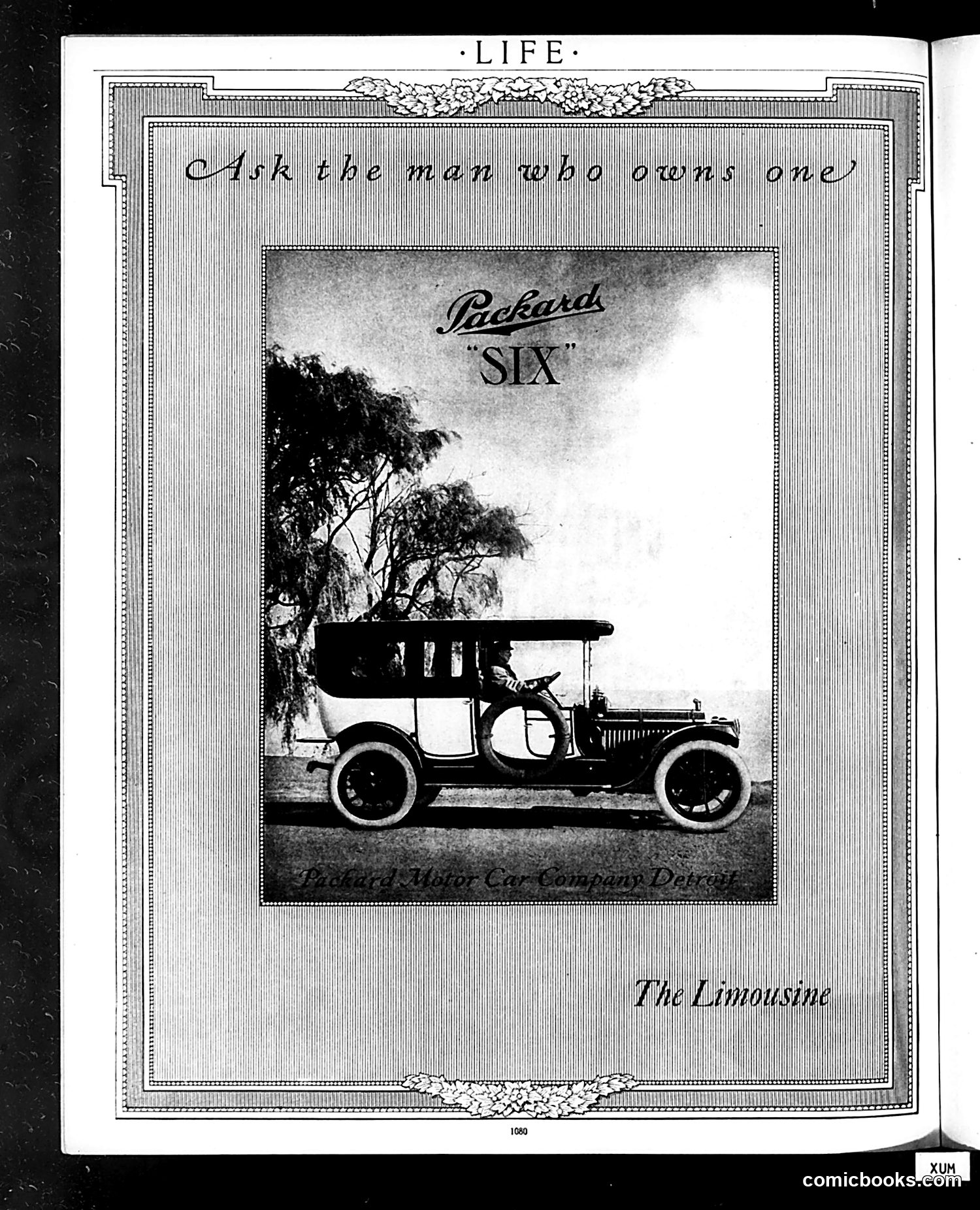
This is primarily a **Packard automobile advertisement** from Life magazine, not a political cartoon. The ad headline reads "Ask the man who owns one," a famous Packard slogan from the early 1900s. The image shows a Packard "Six" automobile in limousine configuration, photographed against a stylized tree. The caption credits the "Packard Motor Car Company, Detroit." The satire is subtle: by appearing in Life (known for humor and social commentary), this earnest luxury car advertisement becomes humorous through juxtaposition. The aspirational messaging—suggesting one should ask satisfied owners—implicitly mocks the pretension of luxury car marketing to the magazine's satirical readership. This represents early automotive advertising targeting wealthy consumers during the pre-Model T luxury car market.
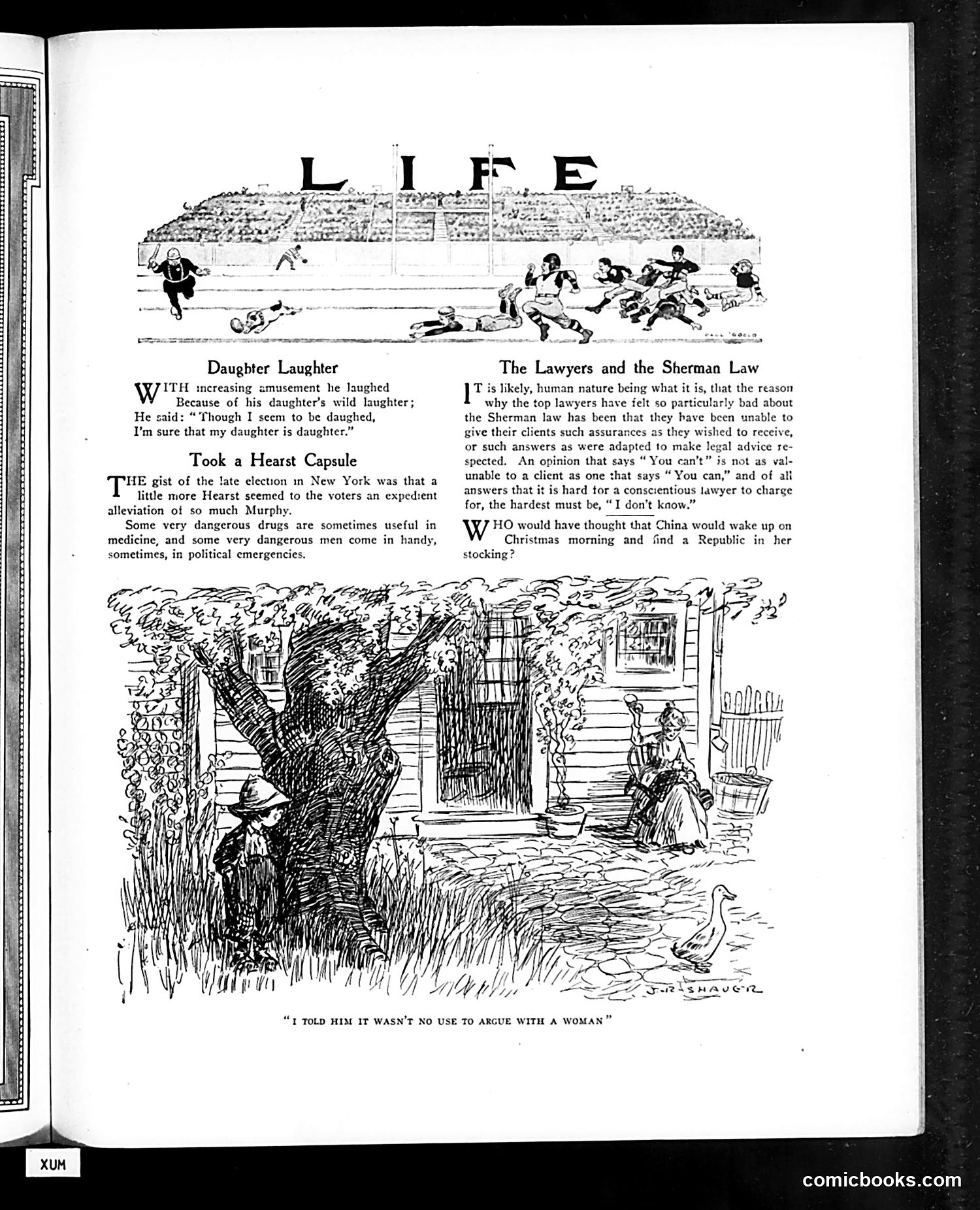
This page contains three satirical pieces: 1. **"Daughter Laughter"**: A brief joke about a man amused by his daughter's wild laughter, establishing her as an uninhibited character. 2. **"Took a Heart Capsule"**: Commentary on the 1920s New York election, noting that "Heart" capsules (apparently a medicinal product) were sometimes useful for political emergencies—a veiled reference to political expedience or desperate remedies. 3. **"The Lawyers and the Sherman Law"**: Satirizes lawyers' inability to give clients definitive legal advice regarding the Sherman Antitrust Act, mocking their tendency toward uncertainty with phrases like "I don't know." The large illustration depicts a domestic scene where a man hides behind a tree while a woman stands on a porch, captioned "I TOLD HIM IT WASN'T TO USE TO ARGUE WITH A WOMAN"—satirizing gender relations and the futility of arguing with women, a common joke trope of the era.
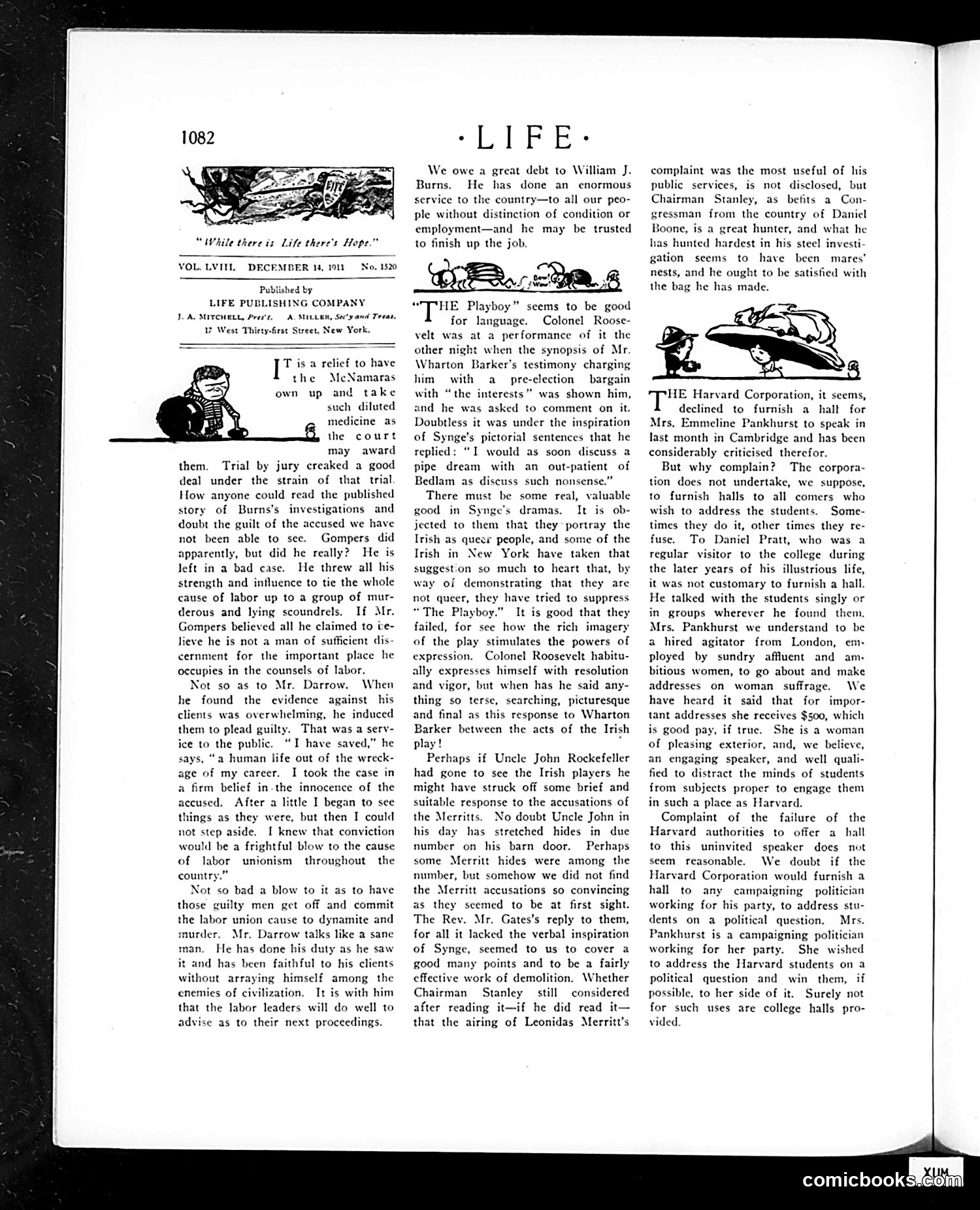
This page contains editorial commentary rather than political cartoons. The text discusses several topics: 1. **William J. Burns** - praised for his investigative work and service to the country, though criticized for his role in a labor case involving accused murderers. 2. **"The Playboy"** - a theatrical performance featuring Colonel Roosevelt's testimony about pre-election dealings with newspaper interests, apparently mocking his responses. 3. **Harvard Corporation controversy** - criticism of the university for hiring Mrs. Emmeline Pankhurst, a British suffragist, to speak despite controversy. The text suggests some Harvard officials wanted to avoid addressing students on political matters like women's suffrage. The page reflects Progressive Era debates about labor, politics, and women's rights activism.
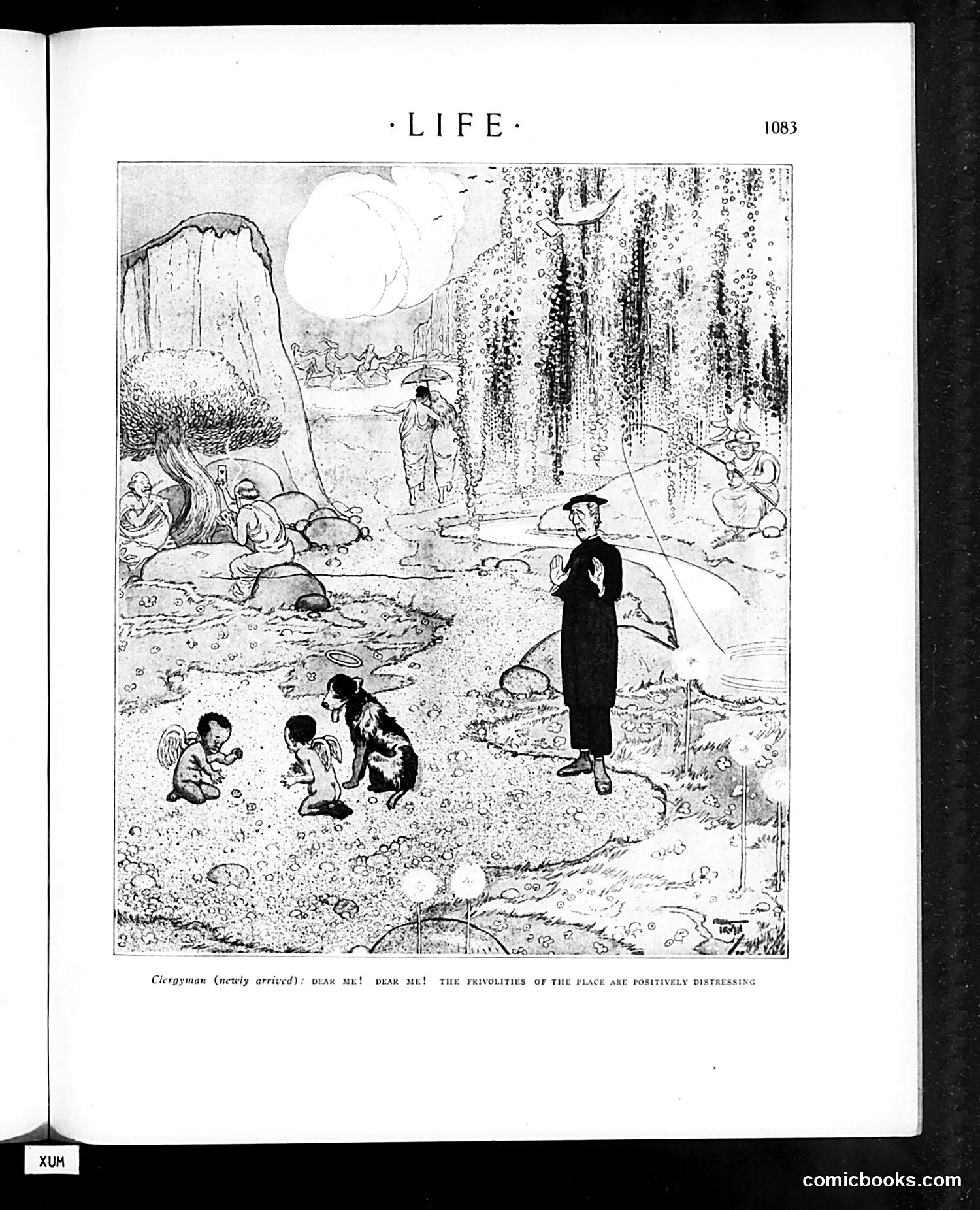
This is a single cartoon from *Life* magazine (page 1083) showing a camping scene. A well-dressed woman in black stands holding a parasol, surrounded by other campers engaged in outdoor activities—fishing, sitting by fires, and relaxing in tents. The caption reads: "Clergyman (newly arrived): 'DEAR ME! DEAR ME! THE FRIVOLITIES OF THE PLACE ARE POSITIVELY DISTRESSING.'" The satire mocks a prudish clergyman shocked by the casual, secular leisure activities of campers. The humor derives from the contrast between his moral disapproval of innocent camping pursuits and the actual innocence of the scene. It critiques religious figures who find moral corruption in ordinary recreation and worldly pleasures—a common *Life* magazine theme satirizing excessive religious prudishness in early 20th-century America.
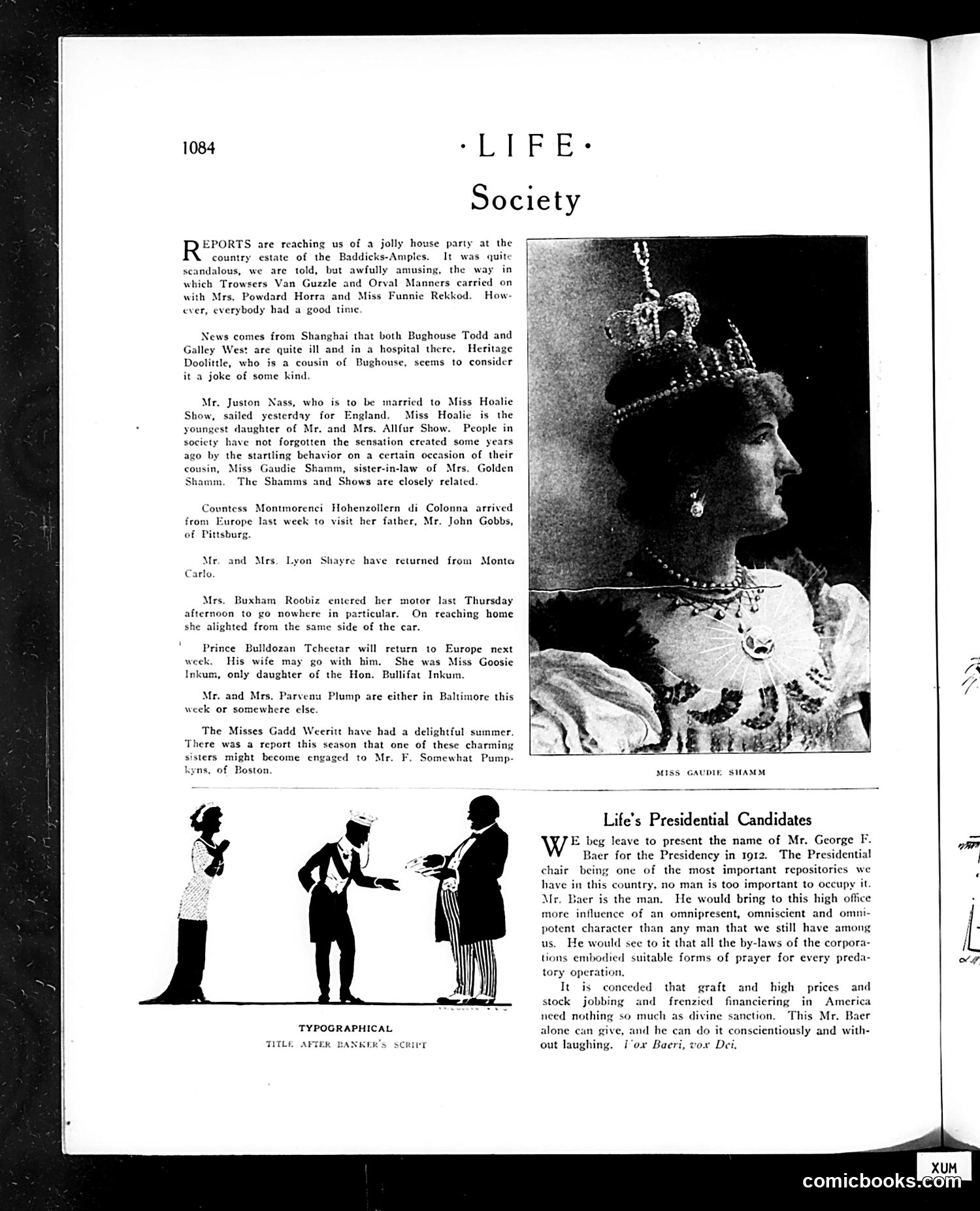
**Society Gossip Section:** The upper portion is standard society reporting—updates on wealthy individuals' movements, engagements, and social activities (house parties, hospitalizations, European travel). It includes a photograph of "Miss Gaudie Shamm," identifying her as someone of social note. **Political Cartoon:** The lower section presents "Life's Presidential Candidates," proposing Mr. George F. Baer for the 1912 presidency. The accompanying silhouette cartoon (titled "Typographical Title After Banker's Script") depicts three figures in what appears to be a satirical commentary on corporate influence or financial corruption in politics. The text sarcastically suggests Baer could solve America's problems through "divine sanction," mocking the notion that wealthy businessmen are suited to govern. The Latin phrase "Vox Baeri, vox Dei" (Baer's voice is God's voice) emphasizes the satire.
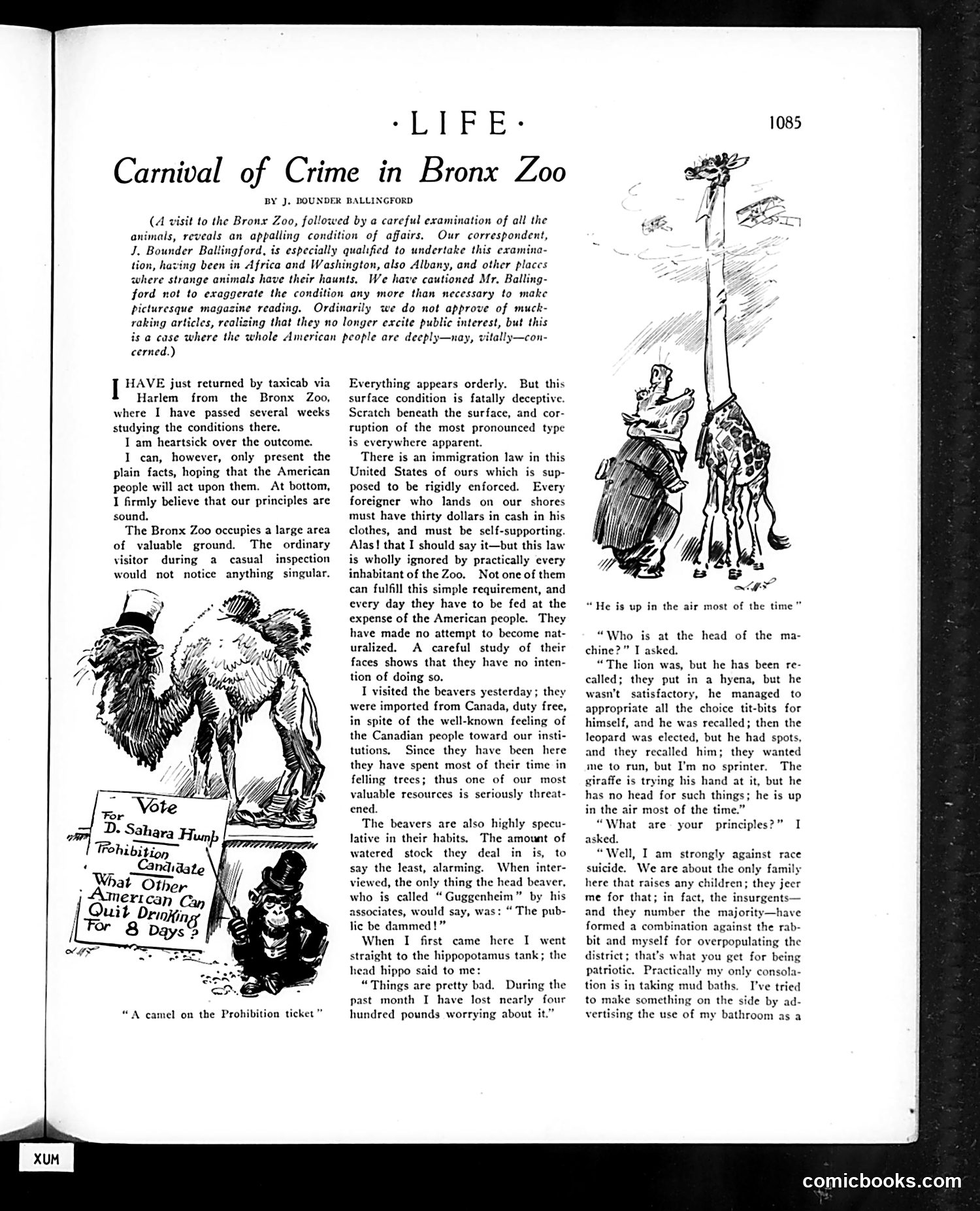
This satirical article by J. Bounder Ballingford criticizes conditions at the Bronx Zoo, exposing corruption beneath orderly appearances. The cartoons illustrate specific abuses: one shows a camel labeled "A camel on the Prohibition ticket," referencing how zoo animals were allegedly exploited for illegal purposes during Prohibition era. Another depicts zoo staff neglecting animals while promoting a "Vote for Sahara Stump, Prohibition Candidate"—suggesting administrative corruption and hypocrisy. The text reveals that foreign workers at the zoo violated immigration laws (required to have $30 cash) and weren't naturalized, while animals suffered neglect. The author details specific animal abuse, including a hippopotamus losing 400 pounds from poor care. The satire exposes how public institutions masked systemic corruption and animal cruelty.
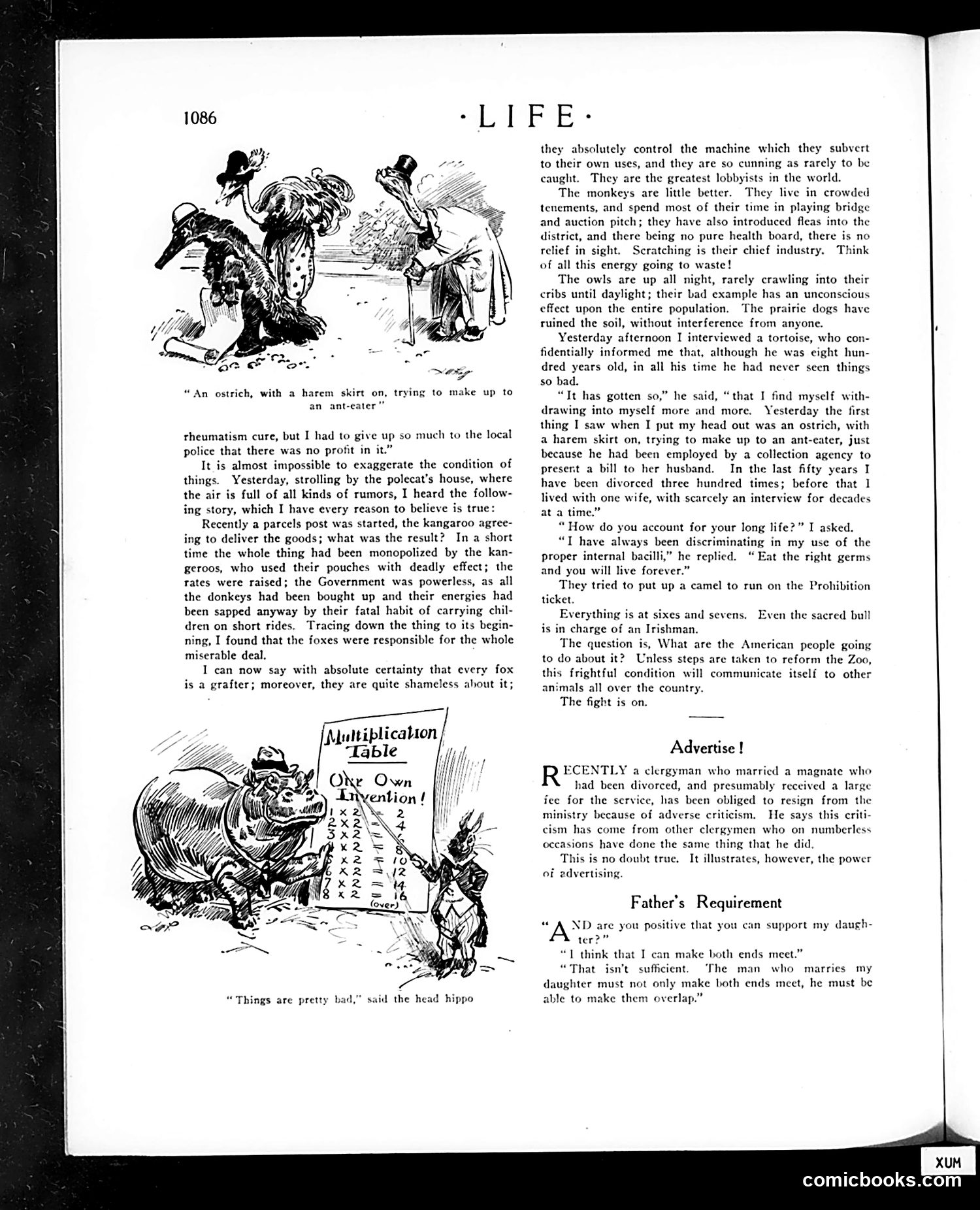
This page contains satirical commentary on American social issues rather than political cartoons. The main text discusses animal pest problems—foxes killing livestock, monkeys in captivity causing disruption, and prairie dogs damaging soil. The author argues these creatures are "the greatest lobbyists in the world," using this metaphor to suggest animals inadvertently expose human mismanagement and neglect. The accompanying illustrations show an ostrich in a "harem skirt" (likely referencing 1920s fashion) attempting a health cure, and a hippopotamus with a multiplication table. The "Advertise!" and "Father's Requirement" sections at bottom are brief satirical pieces on advertising's persuasive power and marriage expectations—typical light social commentary for Life magazine's humorous approach to contemporary issues.
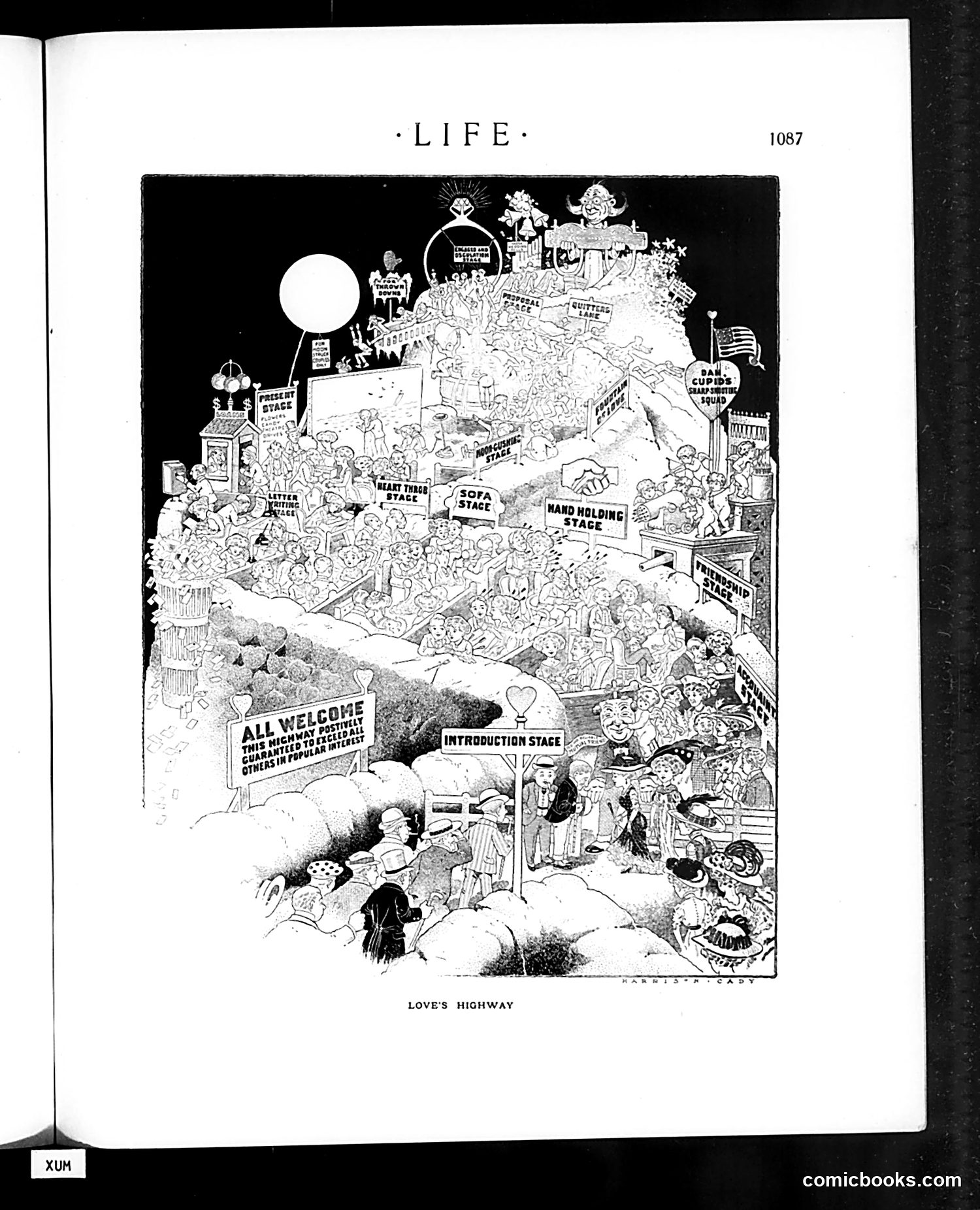
This is a satirical cartoon titled "Love's Highway" depicting a chaotic carnival or fair scene. The illustration shows numerous stages labeled for different romantic scenarios: "Introduction Stage," "Hand Holding Stage," "Sofa Stage," "Giant Teddy Stage," and others arranged like an amusement park map. The cartoon satirizes the ritualized progression of courtship and romantic relationships in the 1920s-30s era, treating dating like a structured journey with distinct "stations." Large crowds of people navigate through this landscape, suggesting the commercialization and public spectacle of modern romance. The "All Welcome" sign and various carnival-like attractions mock how romance has become standardized and entertainment-driven rather than spontaneous. The overall message appears to critique how contemporary society has mechanized intimate human connection into predictable, staged experiences.
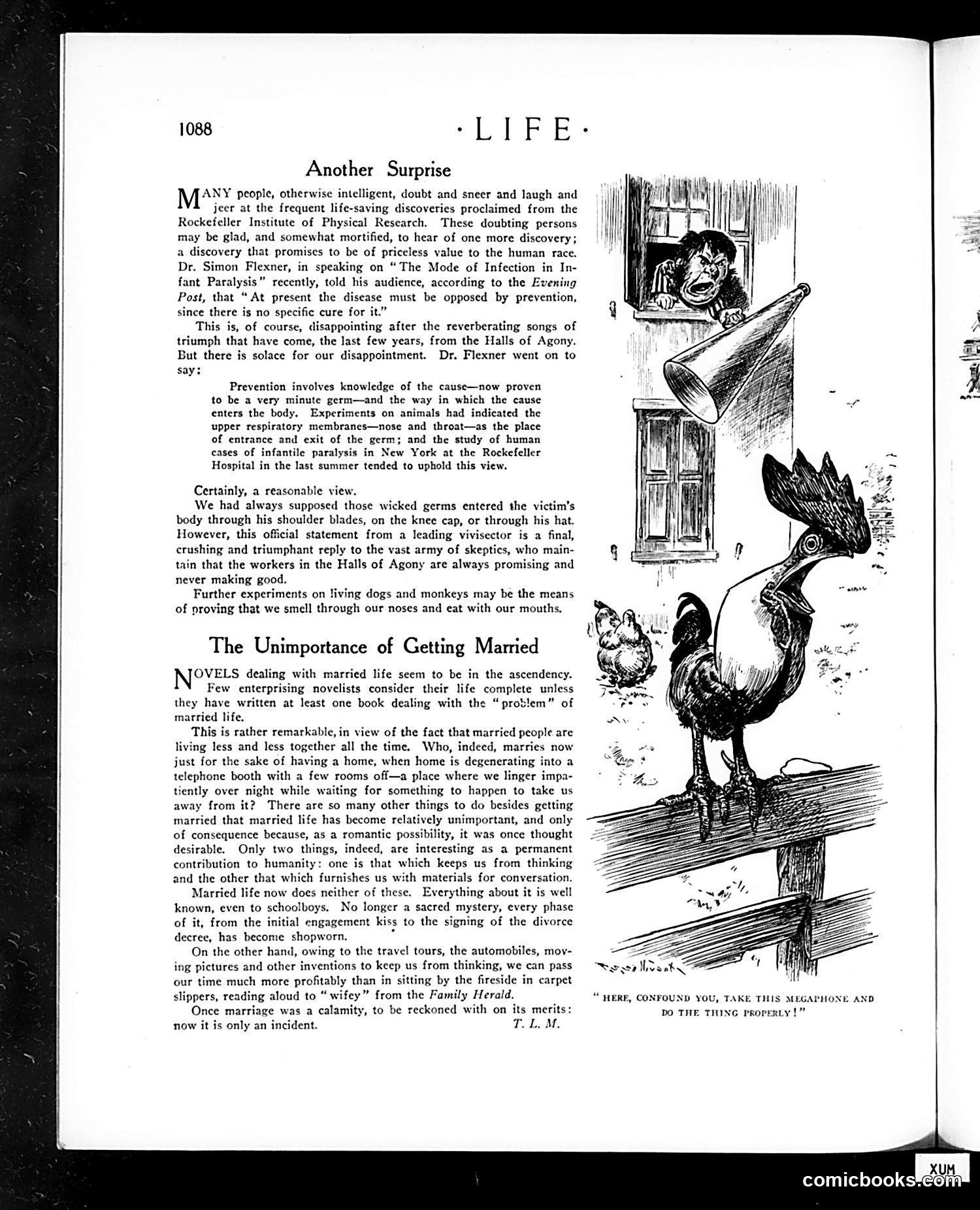
This page contains two articles with one accompanying illustration. **"Another Surprise"** discusses Dr. Simon Flexner's research on infantile paralysis (polio) prevention at the Rockefeller Institute, countering skeptics who doubt the value of such medical discoveries. **"The Unimportance of Getting Married"** satirizes how modern novels obsess over marital problems despite marriage becoming increasingly mundane. The piece argues married life is now dull—mere cohabitation rather than romantic adventure—and that automobiles and other distractions make marriage relatively unimportant to contemporary existence. **The illustration** shows a rooster on a fence post receiving a telephone call, with text reading "Here, confound you, take this megaphone and do the thing properly!" This appears to be a humorous commentary on communication or performing duties, though its specific satirical target is unclear from context alone.
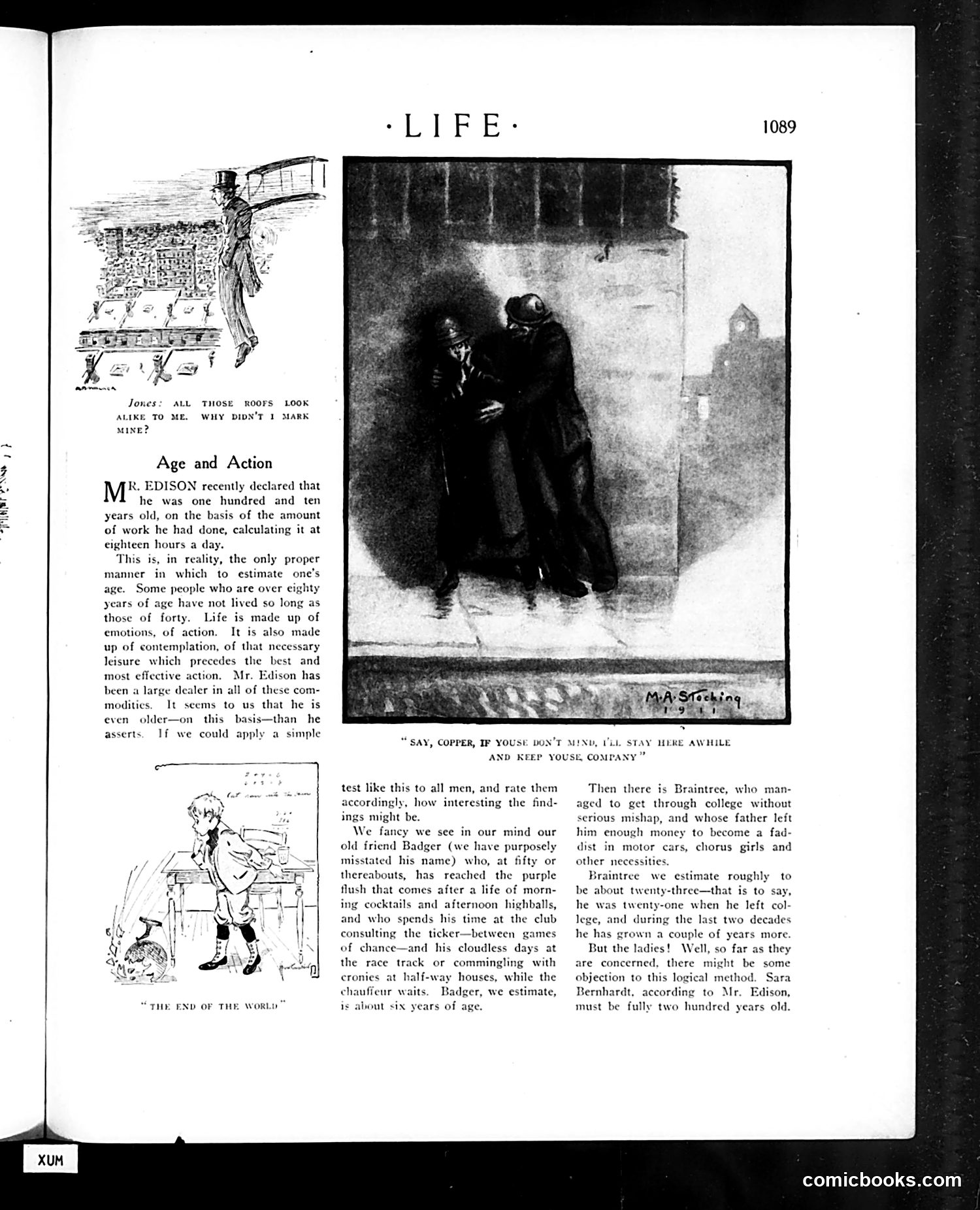
This page satirizes Edison's claim that age should be measured by productive work rather than years lived. The article proposes a humorous metric: rating people's "true age" based on their activity level and life experience. The satire targets idle wealthy men through caricatured types: "Badger," a fifty-year-old living a life of cocktails, gambling, and clubbing—rated as only six years old because he accomplishes nothing. "Braintree," a college graduate who wastes his inherited fortune on cars and chorus girls, rates as roughly twenty-three despite being older. The final joke notes that actress Sarah Bernhardt, by Edison's standard of constant activity and work, would be "fully two hundred years old"—implying her legendary career and vitality make her effectively ageless. The cartoons above mock similar themes of frivolous upper-class life ("The End of the World") and the blind, disconnected wealthy observer. The satire criticizes leisure-class idleness versus productive achievement.
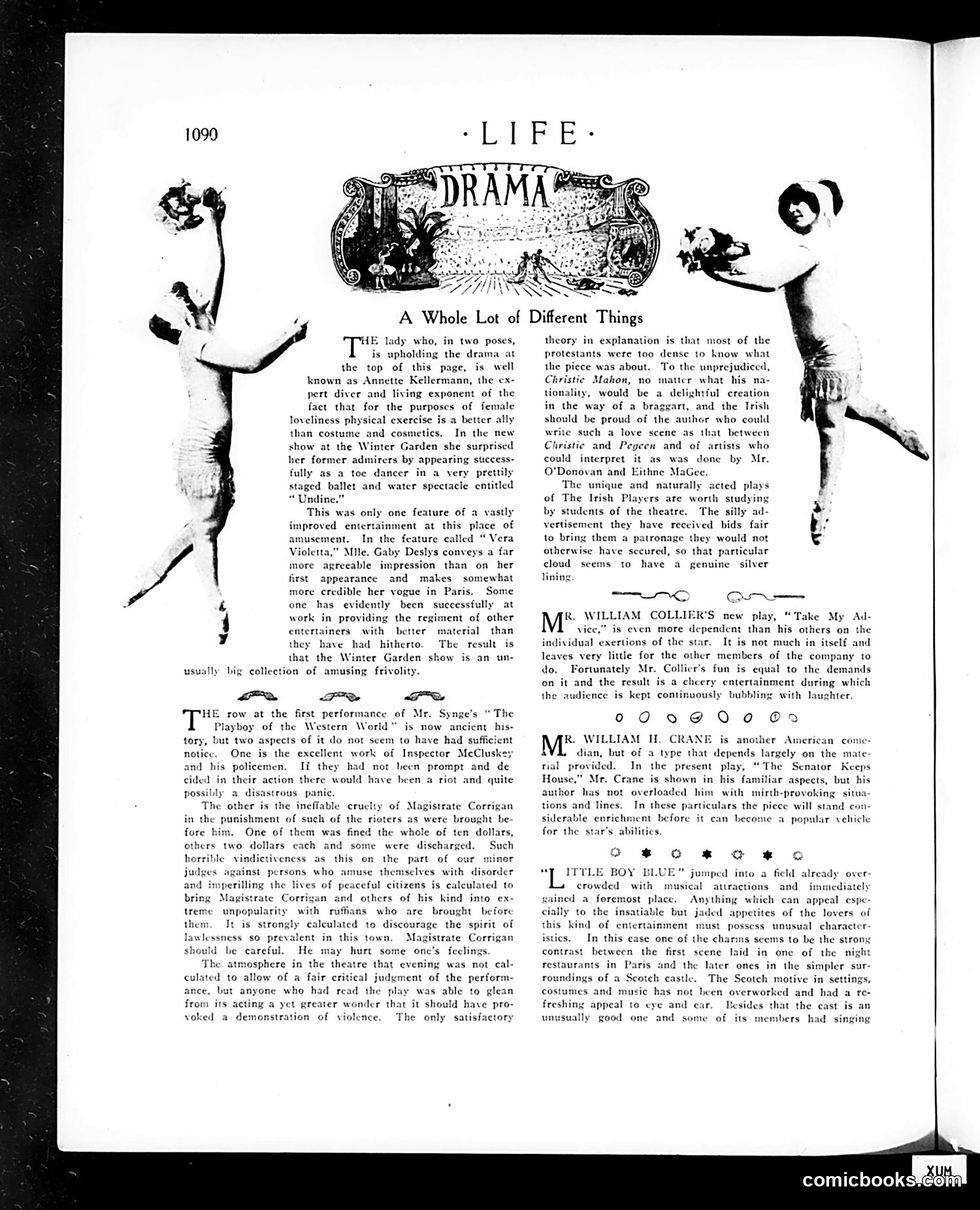
This page reviews theatrical productions from early 1900s New York. The top features **Annette Kellermann**, a famous diver and swimmer portrayed in two poses, who appeared in a ballet-water spectacle called "Undine" at the Winter Garden Theatre. The text praises her as evidence that physical fitness enhances female beauty more than cosmetics alone. The page also discusses **J.M. Synge's "Playboy of the Western World,"** which caused a riot at its premiere (likely Dublin, 1907). The critic defends the play against protesters, suggesting they didn't understand it, and criticizes the lenient sentences given to rioters by Magistrate Corrigan—only $10 for one offender, $2 for others. The piece endorses The Irish Players' production quality while noting the scandal ironically boosted their popularity. Reviews of plays by **William Collier** and **William H. Crane** are mentioned as additional entertainment recommendations.
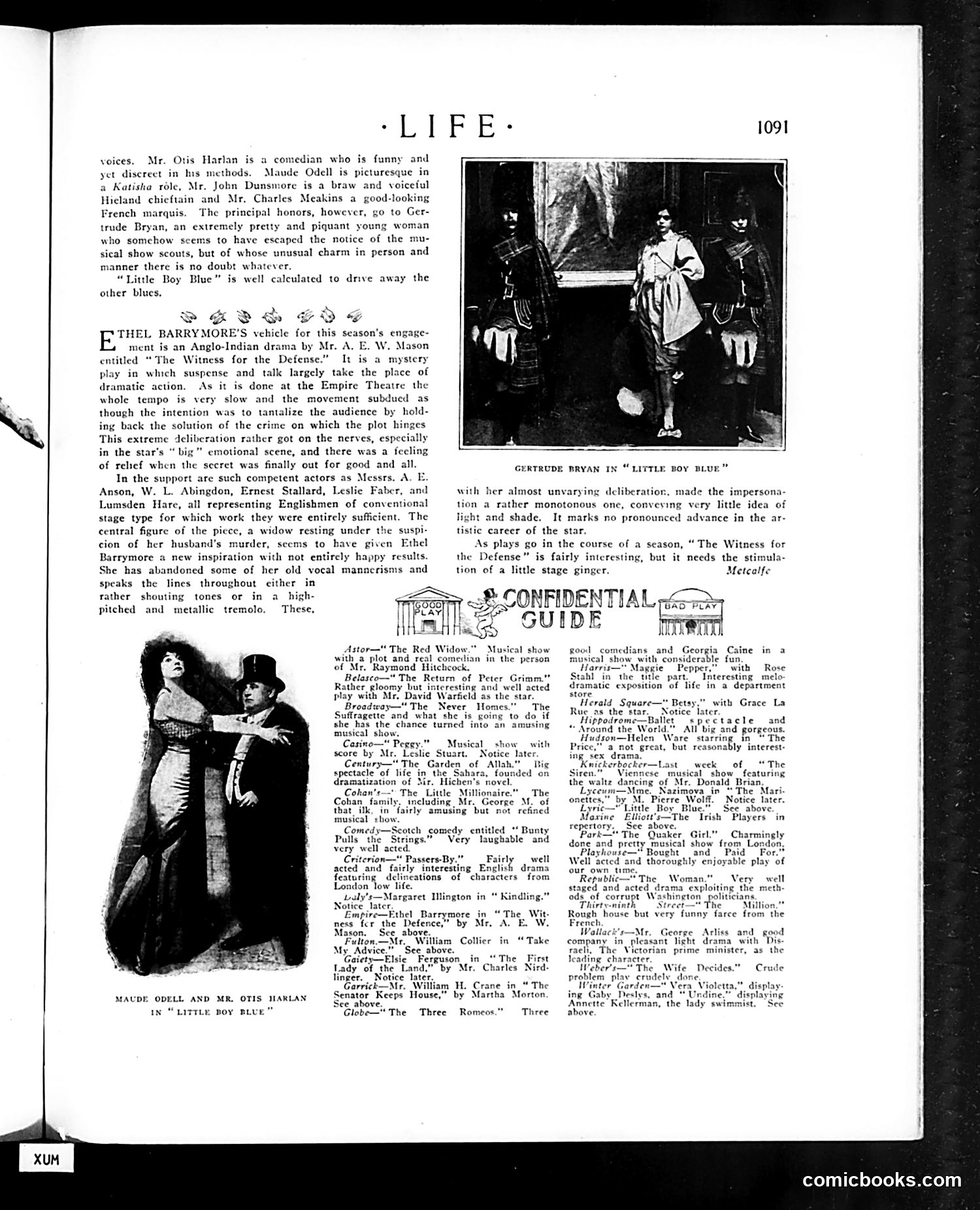
This page contains theater reviews from Life magazine's "Confidential Guide" section, focusing on Broadway productions. The two photographs show performers from "Little Boy Blue" — Gertrude Bryan (top) and Maude Odell with Otis Harlan (bottom). The reviews are straightforward theatrical criticism rather than political satire. The text praises Bryan as an "extremely pretty and piquant young woman" who deserves recognition despite escaping "the notice of the musical show scouts." The review of Ethel Barrymore's "The Witness for the Defence" is mixed, criticizing her delivery as "monotonous" with "shouting tones" and "metallic tremolo," suggesting her performance lacks nuance. The "Confidential Guide" section briefly summarizes other Broadway offerings, mixing musical comedies with dramas. This appears to be straightforward entertainment journalism rather than satirical content — a typical theater column from the era aimed at affluent readers interested in New York stage productions.
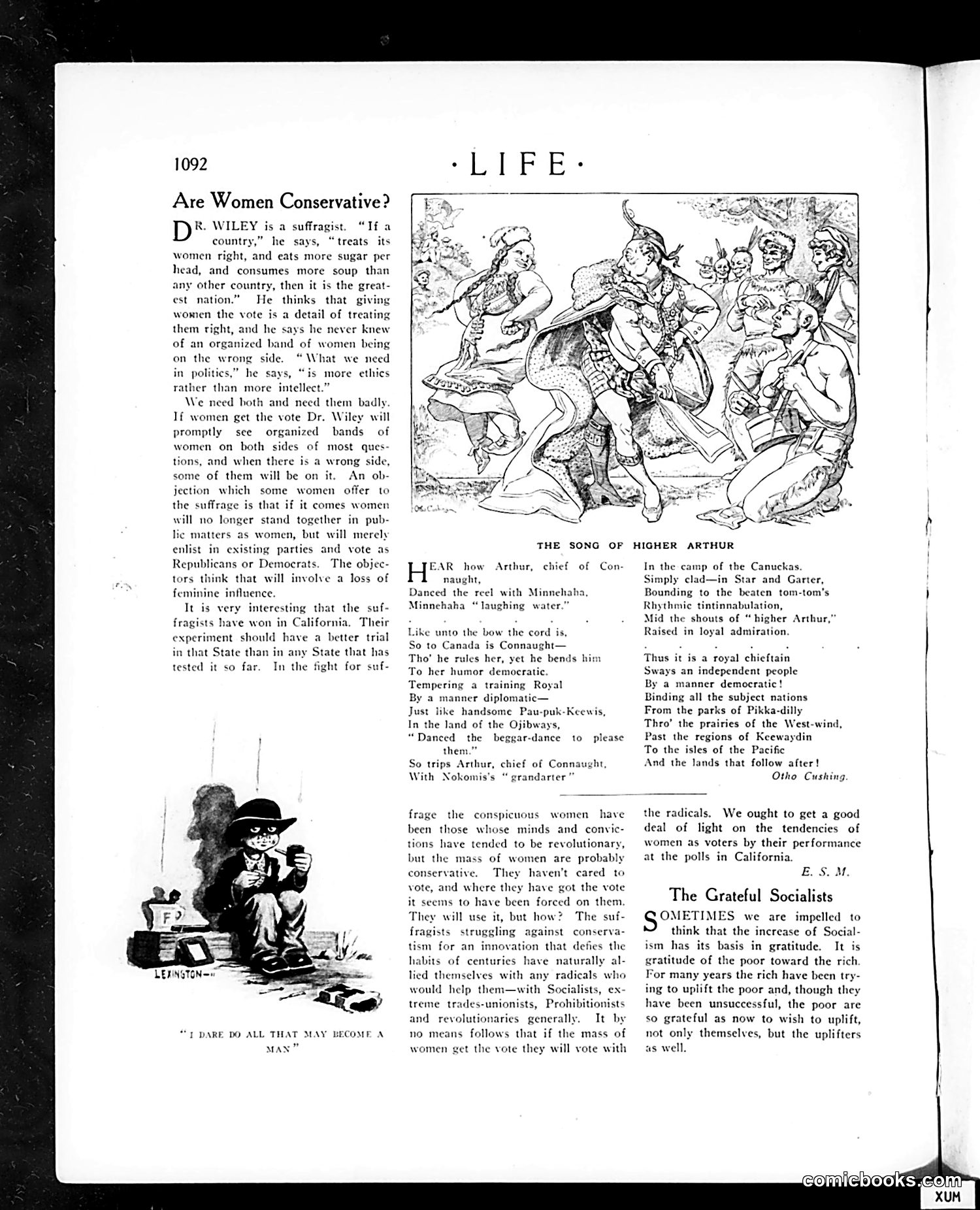
This page contains political commentary on women's suffrage circa the early 1910s (Life published during this era). **Main Article - "Are Women Conservative?"** The piece argues against Dr. Wiley's suffragist assumption that women voters will automatically align with progressive causes. The author contends that while vocal suffrage *advocates* tend to be radicals and revolutionaries, most women are actually *conservative* and won't necessarily vote left-wing. The piece cites California's recent suffrage passage as a test case. The cartoon at left (captioned "I dare do all that may become a man") appears to mock overly idealistic suffrage rhetoric. **"Song of Higher Arthur"** The illustrated poem is a satirical comparison: just as Arthur (likely the Duke of Connaught, British royal) rules Canada through charm and diplomacy rather than force, so women will naturally govern through feminine influence rather than radical means. **"The Grateful Socialists"** A brief satirical jab suggesting Socialists' gratitude toward the wealthy for "uplift" efforts is so strong they now want to reciprocate by uplifting the rich. The overall tone suggests Life's skepticism toward both naive suffrage idealism *and* radical politics.
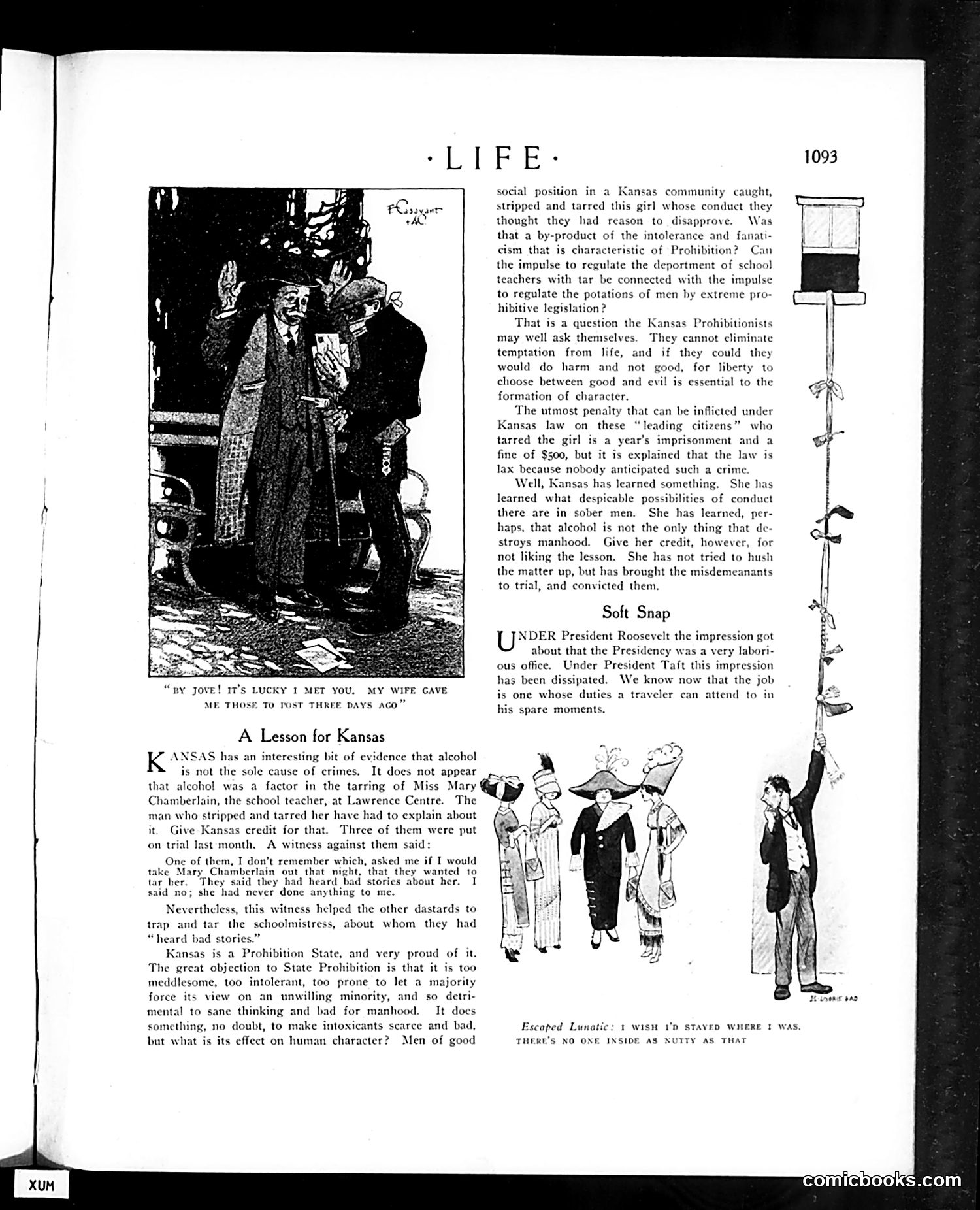
**Main Article: "A Lesson for Kansas"** This article critiques the 1911 tarring and feathering of Mary Chamberlain, a schoolteacher at Lawrence Centre, Kansas. "Respectable" community members stripped and tarred her for alleged moral misconduct. The piece argues this vigilante violence reveals Prohibition's dangerous intolerance: Kansas's effort to legislate morality through alcohol bans correlates with mob enforcement of social conformity. The article mordantly notes the perpetrators received only token punishment ($500 fines, one year imprisonment maximum), yet ironically credits Kansas for prosecuting them at all and learning that "sober men" commit despicable acts—undermining prohibitionists' claim that alcohol alone causes immorality. **"Soft Snap" Section** A brief jab at President Taft, claiming his administration made the presidency seem effortless compared to Roosevelt's characterization of it as laborious. The cartoon's specific meaning is unclear without seeing accompanying images. **Side cartoon:** Appears unrelated political commentary about an escaped lunatic.
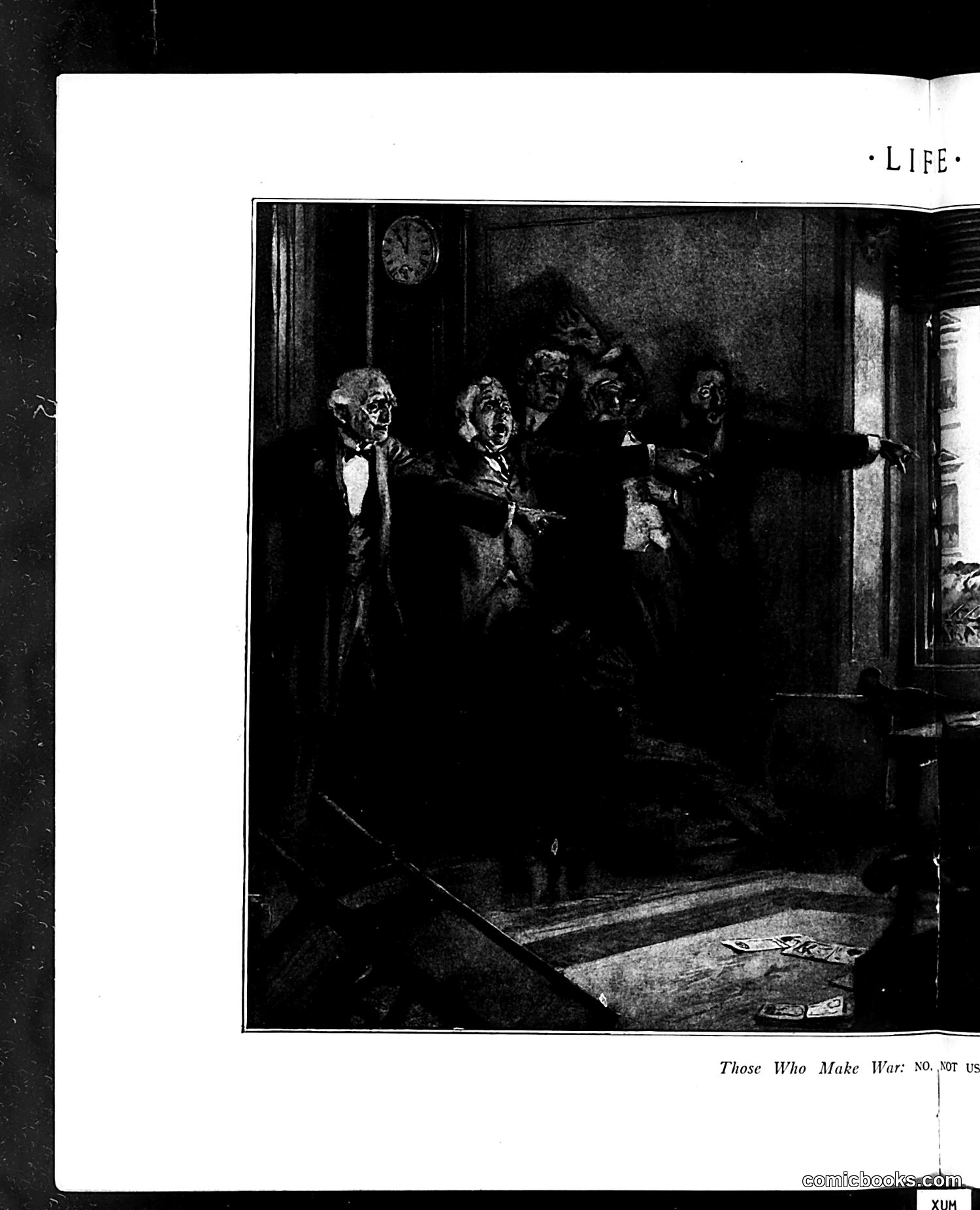
This satirical illustration depicts what appears to be wealthy or elite figures in formal dress gathered in an interior setting, likely representing government officials, industrialists, or politicians. The caption "Those Who Make War: NO, NOT US" conveys bitter irony—suggesting these powerful decision-makers authorize military conflicts while distancing themselves from actual warfare's consequences. The dark, shadowy rendering emphasizes the secretive nature of war-planning away from public view. The figures' formal attire and indoor setting contrast sharply with the brutal realities of combat, highlighting hypocrisy: those who declare war rarely fight it themselves. This reflects early-20th-century *Life* magazine's satirical critique of power structures and the disconnect between ruling classes and common soldiers bearing war's costs.
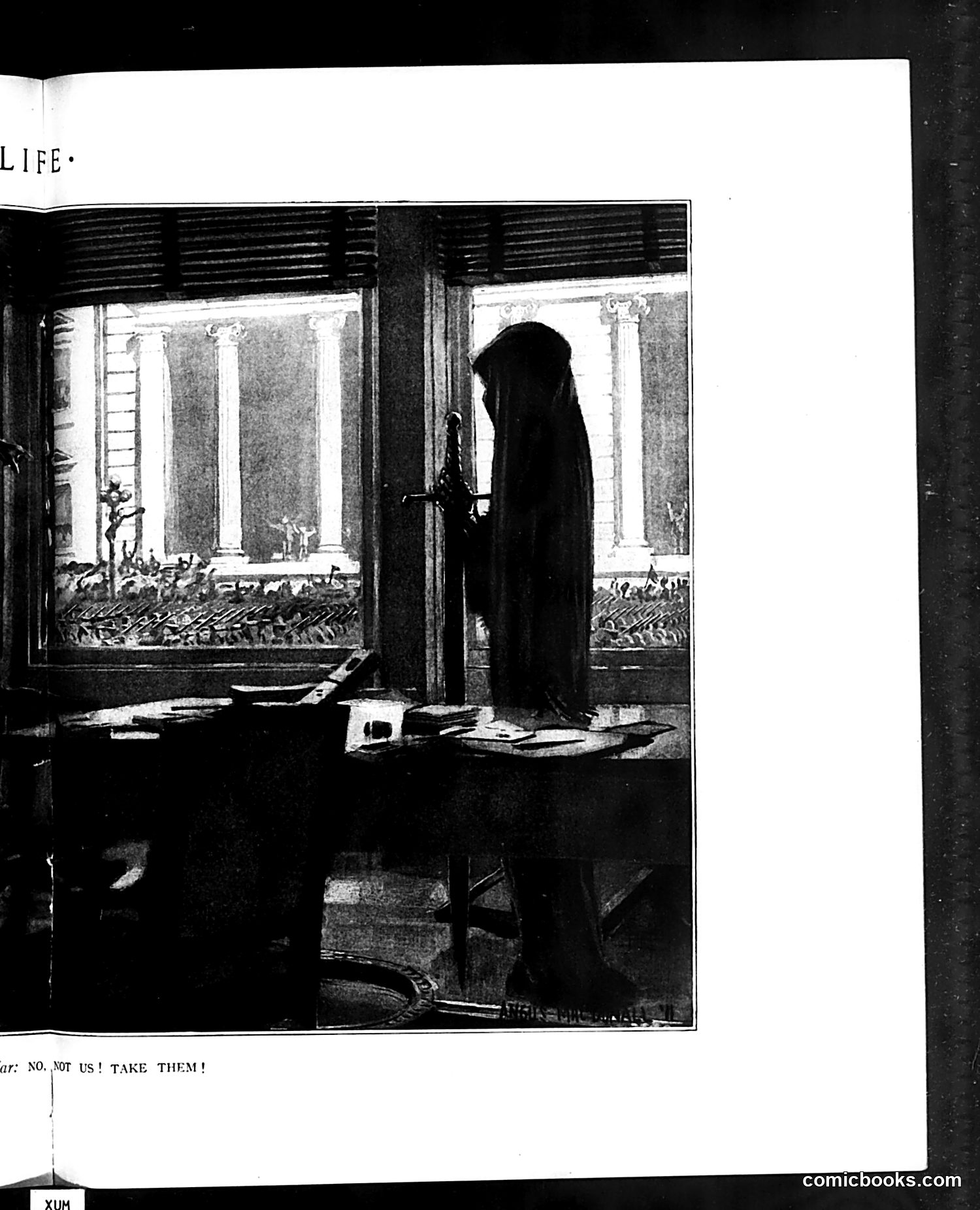
This appears to be a dramatic illustration from *Life* magazine showing a robed figure (silhouetted in black) standing at a window, gesturing toward classical columns visible outside. The partial caption reads "NO, NOT US! TAKE THEM!" The image likely depicts a commentary on wealth, privilege, or social responsibility—the figure appears to be deflecting danger or hardship away from themselves toward others (represented by the classical architecture/establishment beyond the window). The robed figure's posture suggests refusal or rejection. Without the full caption or publication date, the specific historical reference is unclear. However, the satire appears to critique self-preservation at others' expense, possibly during a period of social unrest, war, or economic crisis. The classical setting may symbolize traditional institutions or the privileged class.
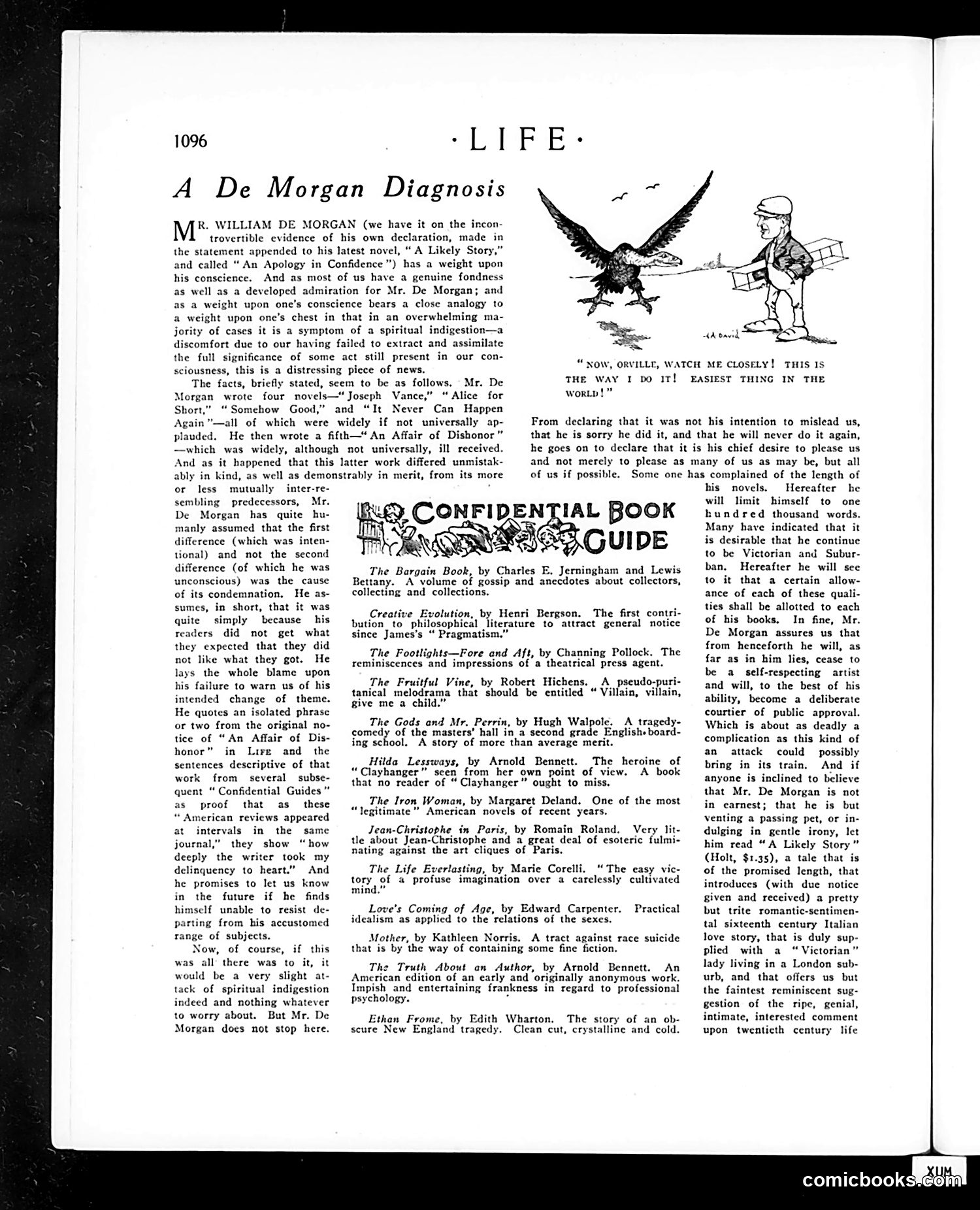
This page critiques novelist William De Morgan's self-justification in his latest work, "A Likely Story." De Morgan claims his previous novel, "An Affair of Dishonor," failed because readers didn't expect the thematic change—not because the book was inferior. The accompanying cartoon satirizes his excuse: it shows a man (De Morgan) with a bird landing on his chest, captioned "NOW, ORVILLE, WATCH ME CLOSELY! THIS IS THE WAY I DO IT! EASIEST THING IN THE WORLD!" The satire suggests De Morgan is performing intellectual gymnastics to avoid acknowledging his book's actual artistic failure. Rather than admitting the work was genuinely worse, he blames reader expectations—a self-serving diagnosis of his "spiritual indigestion" (his guilty conscience). The cartoon implies his explanation is as absurd and unconvincing as the magical feat he's claiming to perform.
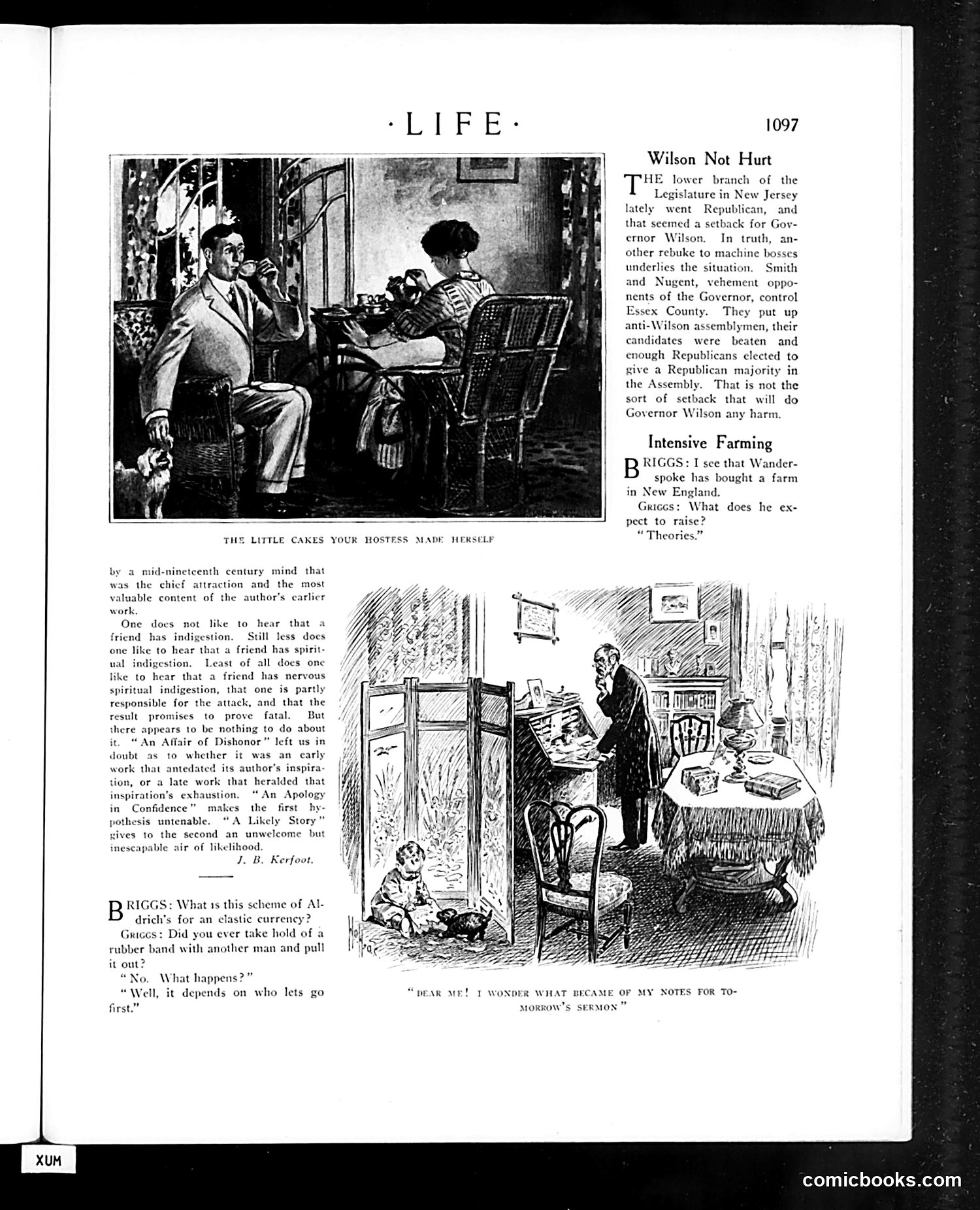
**Political Content ("Wilson Not Hurt"):** Governor Wilson of New Jersey faced what appeared to be a setback when the state legislature's lower house went Republican. However, the article argues this wasn't actually harmful to Wilson. The real story: machine politicians Smith and Nugent, who opposed Wilson, had put up anti-Wilson candidates. Those candidates lost, and enough Republicans were elected instead—meaning Wilson benefited from a rebuke to political machine bosses, not a personal defeat. **Social Satire (Bottom Section):** Two brief jokes appear. The "Intensive Farming" exchange mocks a wealthy man (Wanderspoke) who bought a New England farm expecting to raise "theories"—satirizing impractical idealism. The "Aldrich" joke about elastic currency uses a rubber-band metaphor to suggest financial schemes depend on who "lets go first"—implying instability or manipulation. **Visual Content:** Two illustrations accompany the text, depicting domestic interior scenes typical of Life's period humor.
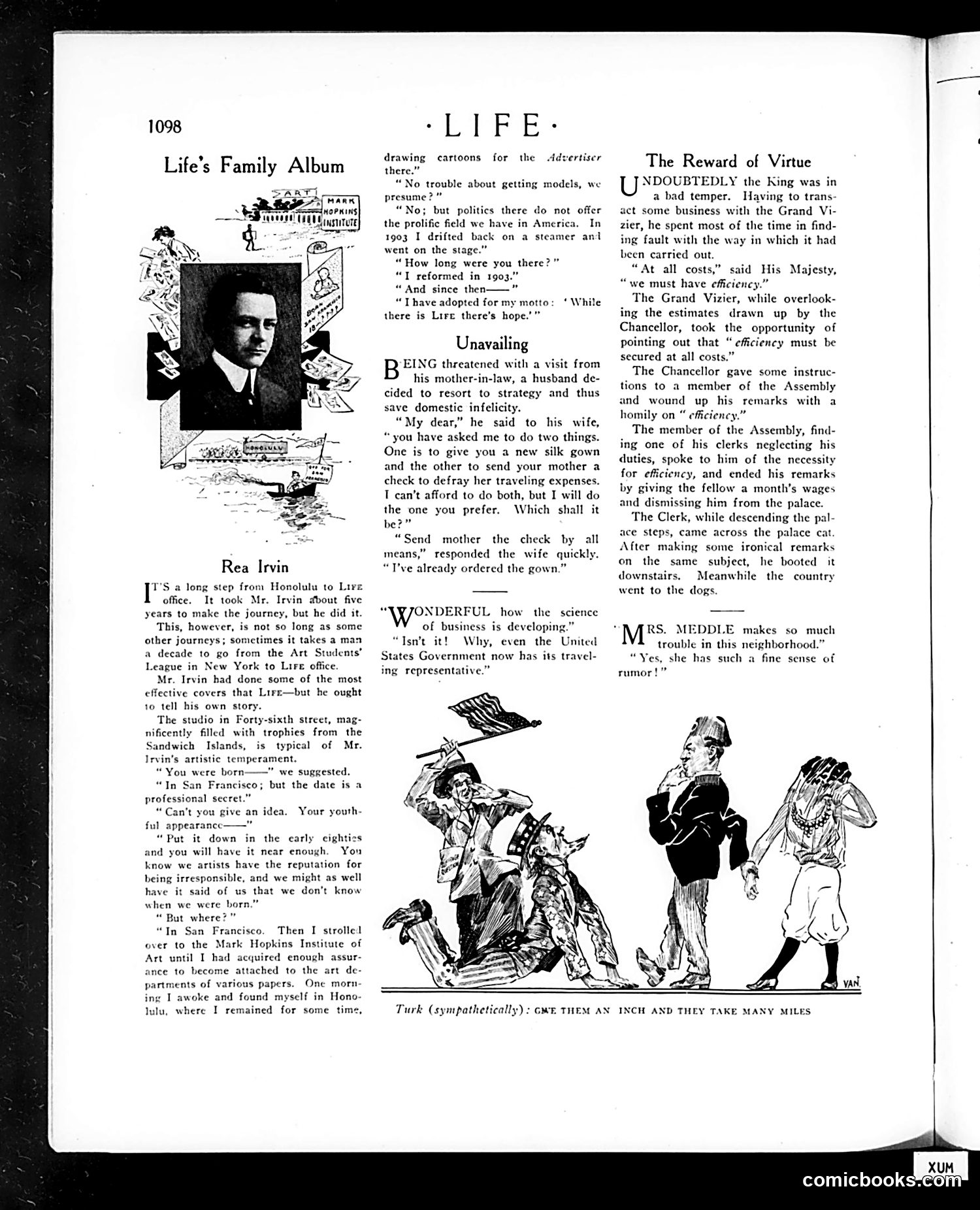
This page from Life magazine features several satirical pieces typical of early 20th-century American humor: **"Rea Irvin" Profile**: A biographical sketch of the artist/cartoonist Rea Irvin, who worked for Life. The text humorously describes his unconventional career path from San Francisco through Hawaii and back, adopting the motto "While there is Life there's hope." **"Unavailing"**: A domestic humor joke where a husband cleverly manipulates his wife by offering to choose between buying her a silk gown OR paying for her mother's travel expenses. She chooses the check, but he's outwitted—she's already ordered the gown anyway. **"The Reward of Virtue"**: A satirical cascade showing how bureaucratic obsession with "efficiency" filters downward, ultimately reaching absurdity when a clerk—having received these efficiency lectures—kicks the palace cat, causing the "country [to go] to the dogs." **Bottom cartoon**: Titled "Turk," depicting Turkish figures, with the caption suggesting small concessions lead to larger demands—likely referencing contemporary geopolitical tensions regarding Ottoman territorial losses. The page reflects Life's signature style: witty domestic satire and political commentary through visual humor.
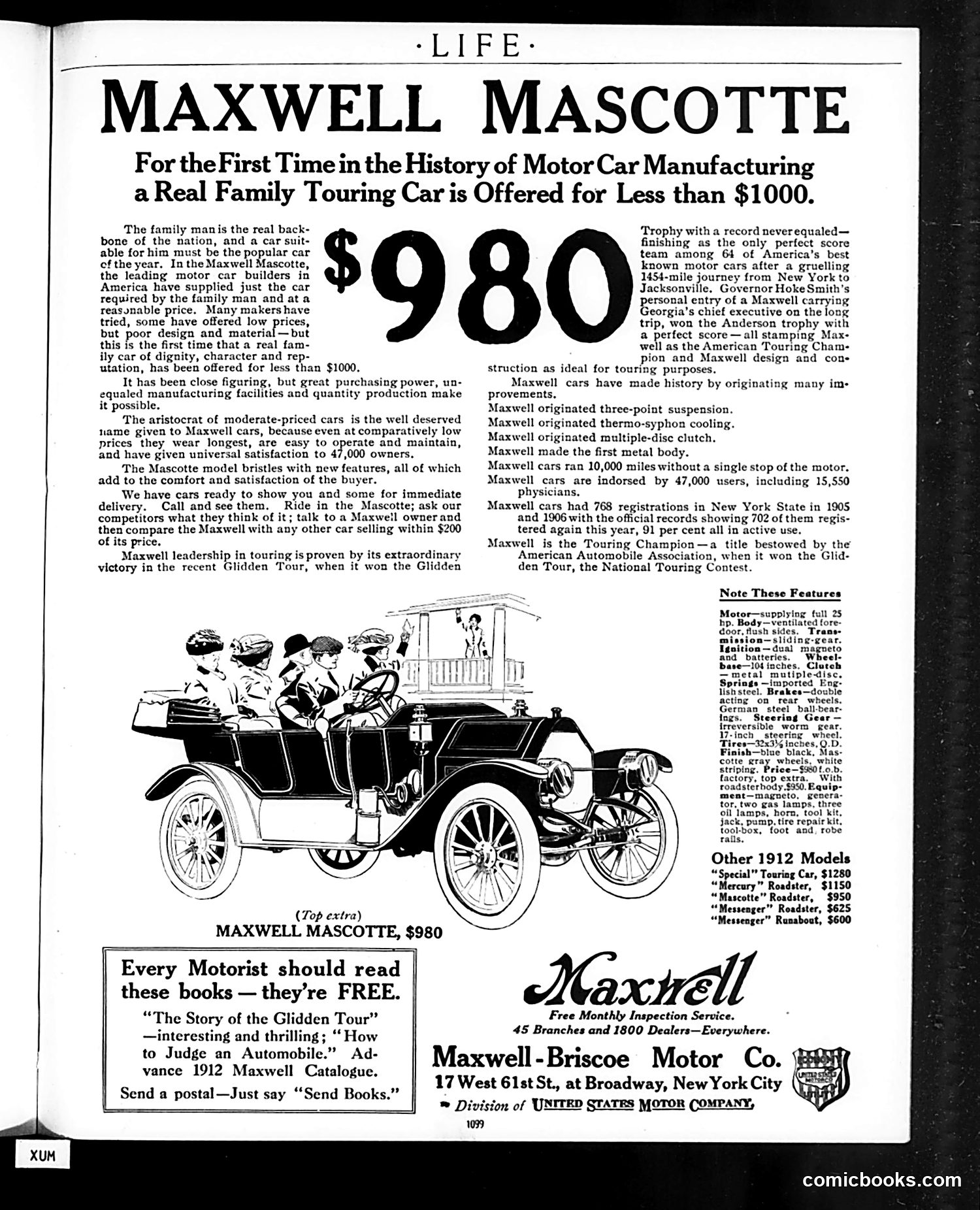
This is primarily a **car advertisement**, not satire or a political cartoon. It announces the Maxwell Mascotte automobile, priced at $980—noteworthy as the first "real family car" offered under $1,000 in American motor manufacturing history. The advertisement emphasizes practical family appeal ("the family man is the real backbone of the nation") and establishes credibility through the car's victory in the **Glidden Tour**, a grueling 1,454-mile reliability race involving 64 American cars. The text notes Governor Hoke Smith's personal entry won with a "perfect score." The illustration shows the open-air touring car with a cheerful family of passengers, reinforcing the "family touring car" marketing angle. Technical specifications and endorsements (47,000 owners, 15,550 physicians) build consumer confidence. This reflects early 1900s automotive marketing strategy: emphasizing durability, affordability, and patriotic values to position cars as accessible to middle-class American families rather than just wealthy elites.
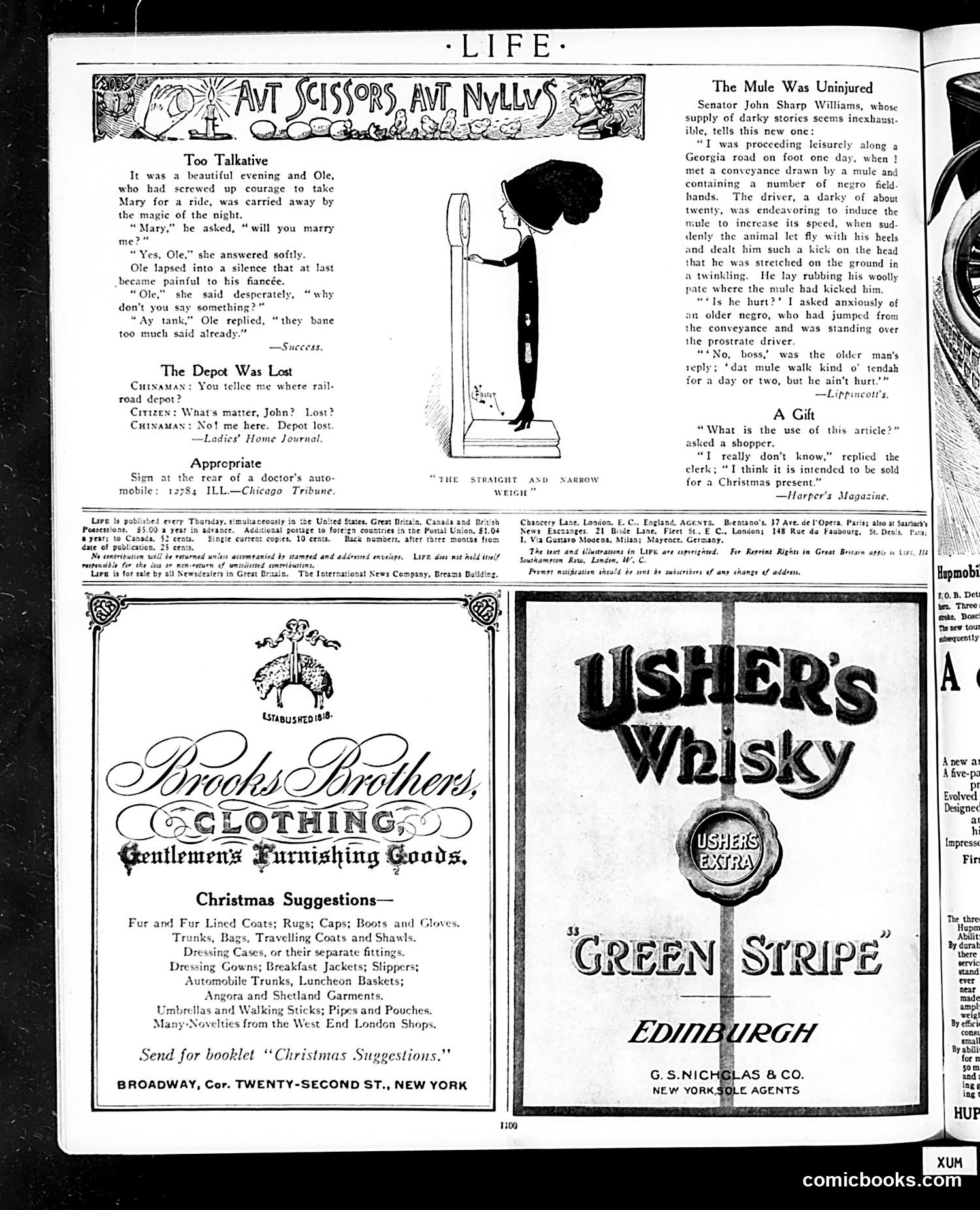
This page contains three brief humorous stories typical of early 20th-century American humor magazines: **"Too Talkative"** satirizes a taciturn Scandinavian suitor (Ole) who, after his fiancée complains he never talks, responds that too much has already been said—mocking both his silence and ethnic stereotype. **"The Depot Was Lost"** plays on a Chinaman's broken English, where his statement that "Depot lost" is misunderstood as him being lost, when he means the depot itself is missing—ethnic humor based on language barriers. **"The Mule Was Uninjured"** presents Senator John Sharp Williams recounting a story where a mule kicks a Black driver unconscious, yet an older Black man claims the *mule* is merely "tendah" (tender) and will recover—the joke relies on minstrel-style dialect and inverts sympathy toward the animal over the injured man. The remainder consists of period advertisements for Brooks Brothers clothing and Usher's whisky. All humor depends on ethnic stereotypes common to the era.
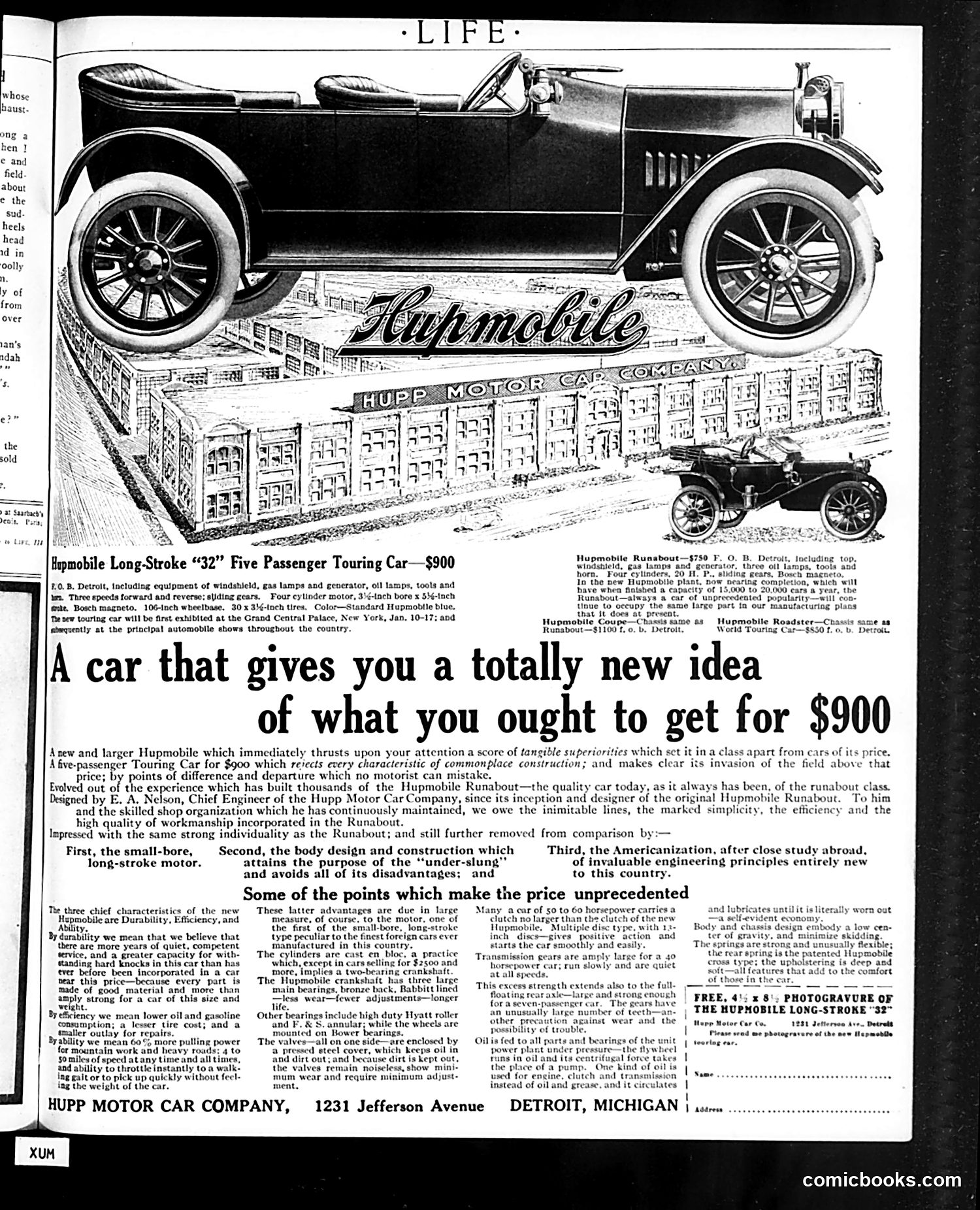
This is primarily a **car advertisement**, not political satire. It promotes the Hupmobile Long-Stroke "32" touring car at $900—positioned as an exceptional value offering luxury features typically found in more expensive vehicles. The ad emphasizes the car's engineering innovations: a small-bore, long-stroke motor; distinctive body design; and American manufacturing principles adapted from European cars. It appeals to buyers by arguing they're getting "a totally new idea of what you ought to get for $900"—implying competitors offer less for similar prices. The small illustration of a competing car in the lower right appears comparative, suggesting the Hupmobile's superiority in design and engineering. The page includes a coupon for a photogravure of the vehicle, a common early-20th-century marketing technique. This reflects the era's booming automobile industry and manufacturers' competition through technological innovation rather than price-cutting.
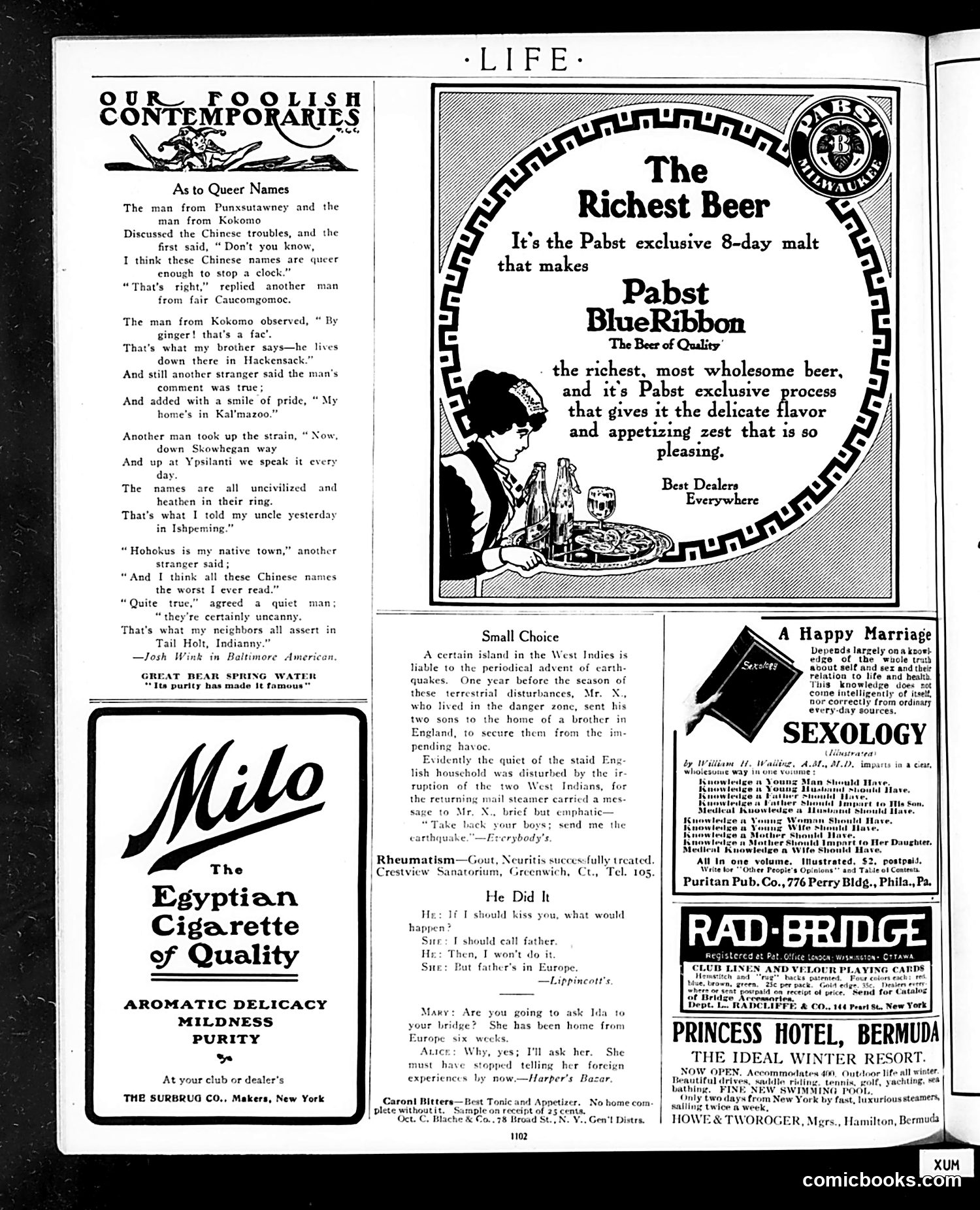
This satirical piece mocks Americans who criticize Chinese names as "queer" and "uncivilized," while themselves hailing from absurdly named American towns: Punxsutawney, Kokomo, Caucomgomoc, Hackensack, Kalamazoo, Skowhegan, Ypsilanti, Ishpeming, Hohokus, and Tail Holt. The joke is ironic: the characters ridicule foreign names as strange while representing equally unusual American place names—many derived from Native American languages. Life's satirists expose the hypocrisy and ethnocentrism of Americans who judge other cultures' nomenclature while ignoring the peculiarity of their own geography. This reflects early 20th-century debates about immigration and cultural prejudice, using humor to critique xenophobic attitudes masking as reasonable criticism.
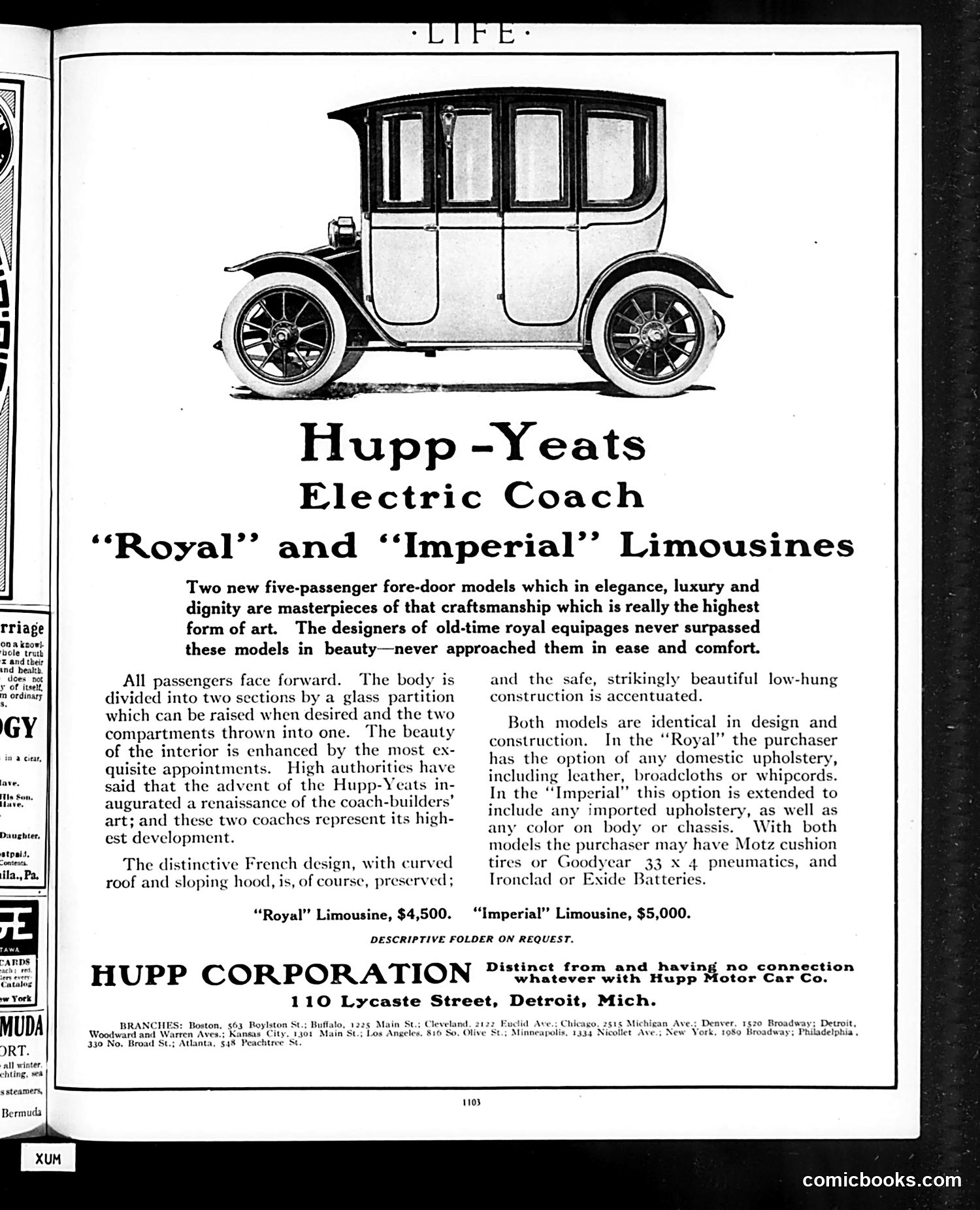
This is **not a cartoon or satire**—it's a straightforward automobile advertisement from *Life* magazine's advertising section. The Hupp Corporation promotes two electric coach models: the "Royal" and "Imperial" limousines, priced at $4,500 and $5,000 respectively. The ad emphasizes luxury features typical of early 1900s marketing: French design, elegant interiors, glass partitions dividing passenger sections, and customizable upholstery options (domestic or imported). The language reflects period attitudes toward automobiles as status symbols, comparing them favorably to "old-time royal equipages" to appeal to wealthy buyers. The detailed specifications (tire options, battery types) suggest this targets affluent consumers interested in premium electric vehicles—then a viable alternative to gasoline cars. There is no political satire or social commentary visible here; it's purely commercial advertising for the Hupp Corporation's Detroit-based electric automobile line.
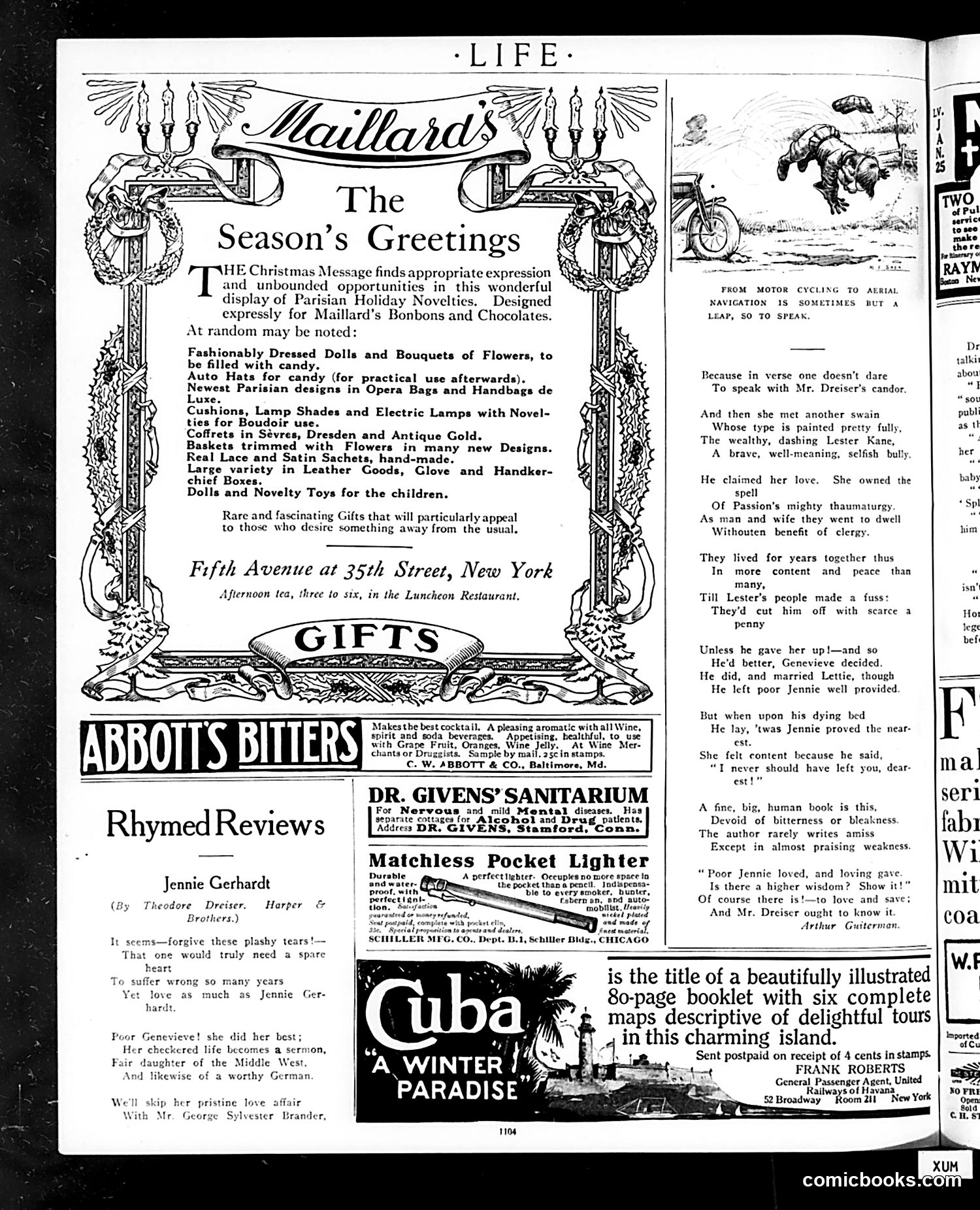
This page is primarily **advertising and book review**, not political satire. The dominant content is a **Maillard's luxury gift advertisement** (top half) promoting Parisian holiday novelties—dolls, hats, lamps, and chocolates—at their Fifth Avenue location. Below is a **"Rhymed Review"** of Theodore Dreiser's novel *Jennie Gerhardt*. The verse summary describes the plot: a poor woman loves a wealthy man (Lester Kane) who leaves her when pressured by his family, marries another woman (Lettie), but on his deathbed reveals his enduring affection for Jennie. Critic Arthur Guiterman critiques Dreiser's apparent message that love without marriage is acceptable, arguing instead that "love and save" (love *and* preserve through marriage) is morally superior. The page also contains assorted advertisements for Abbott's Bitters, Dr. Givens' Sanitarium, a pocket lighter, and a Cuba travel booklet. **No political cartoons appear on this page.** It reflects period attitudes about morality, class, and literary merit rather than political commentary.
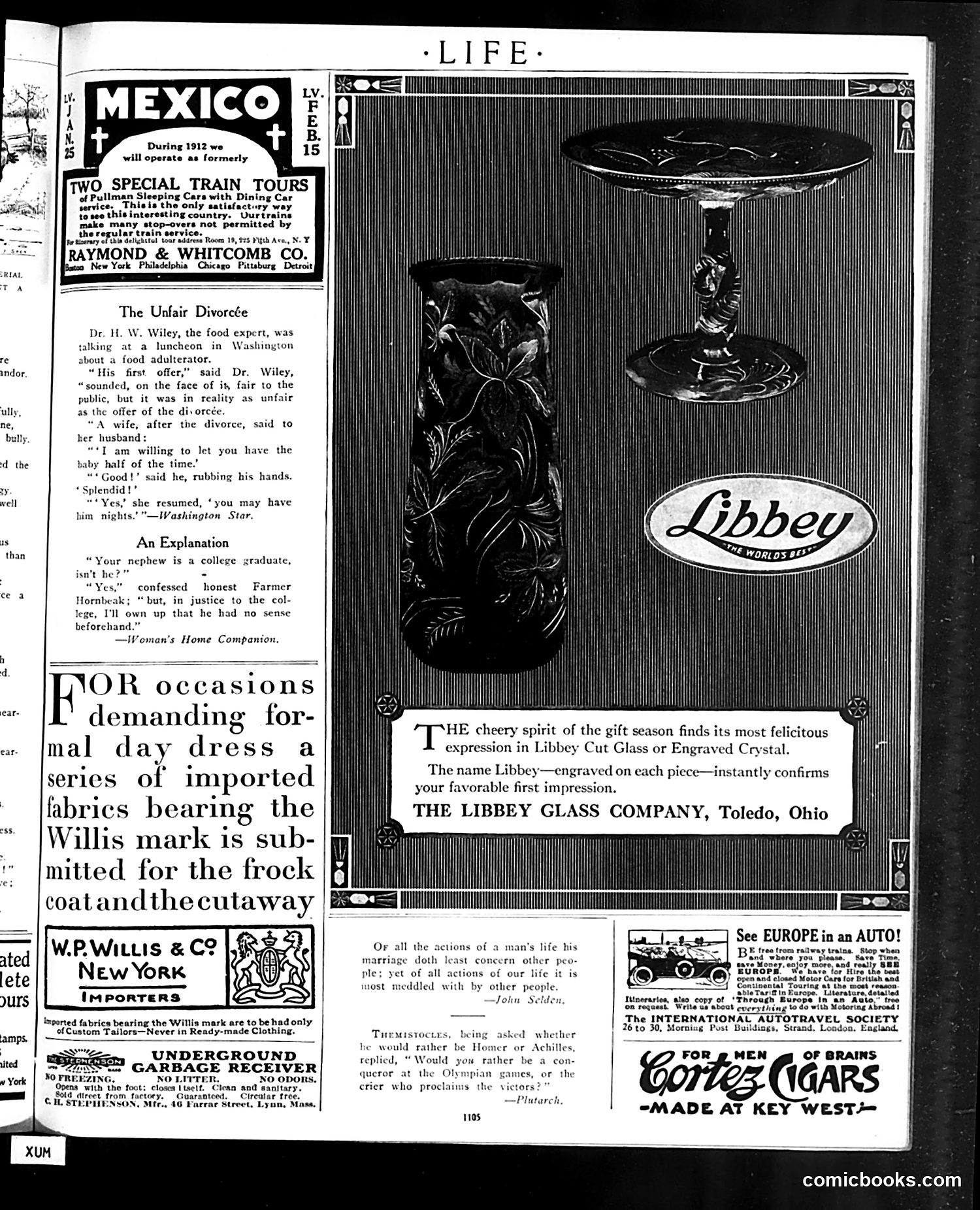
This page is primarily **advertisements and brief humor items** rather than political cartoons. The main content includes: 1. **"The Unfair Divorcée"** — A brief anecdote where Dr. H.W. Wiley (a real food safety expert) compares an unfair business offer to a divorcing woman's settlement proposal: she'll let her ex-husband have "the baby half the time" but he can have "the nights." The joke plays on the unfairness of the arrangement being presented as generous. 2. **"An Explanation"** — A farm humor piece where a farmer admits his college-educated nephew is foolish, quipping the college "gave up" on him before graduation. The bulk of the page contains **period advertisements** for travel tours, formal fabrics, Libbey glassware, European auto tours, and Key West cigars. There is **no significant political satire** on this page—it's a standard Life magazine issue mixing light humor with commercial ads typical of 1912 publications.
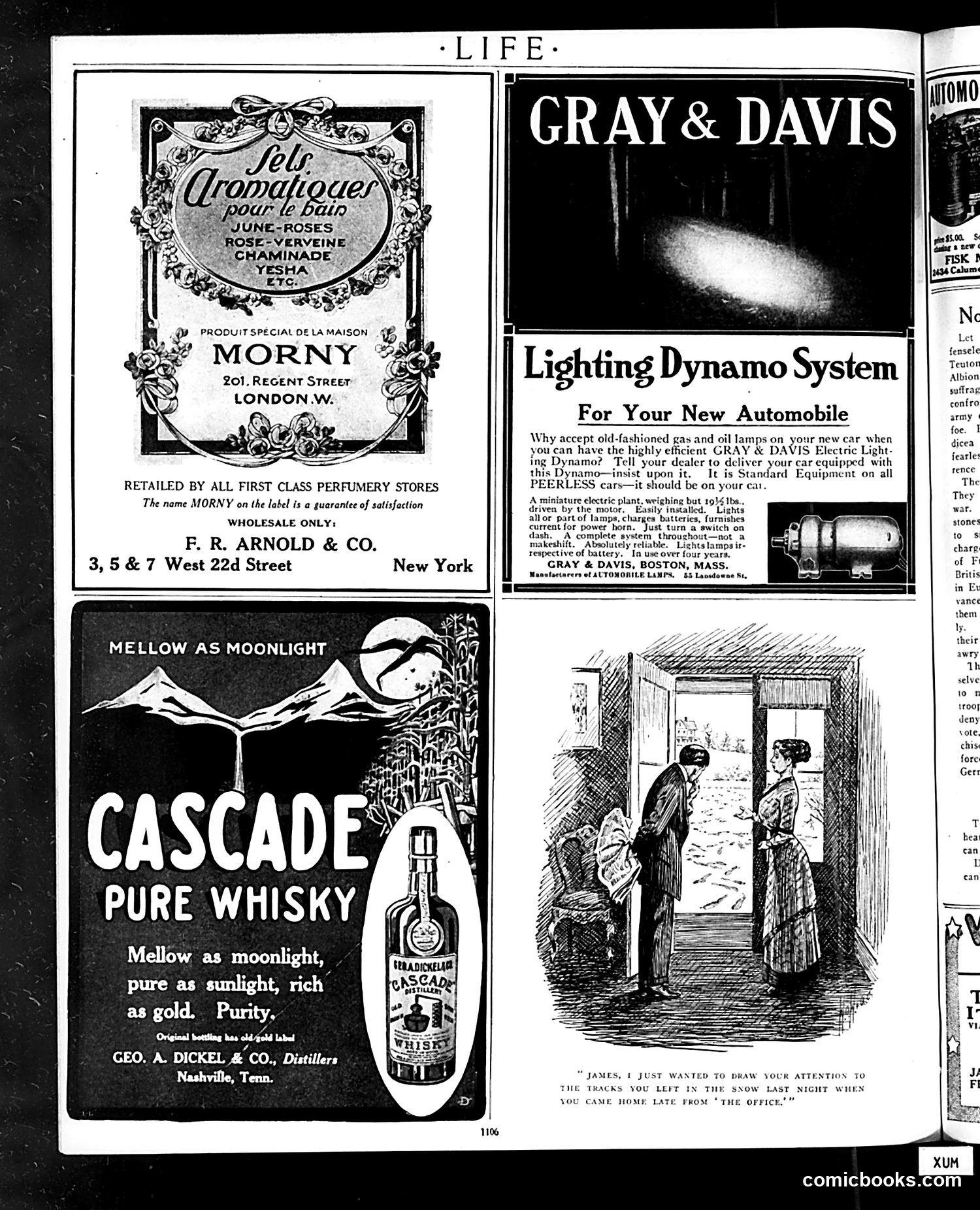
This page consists primarily of **advertisements**, not political satire. The ads promote luxury goods typical of early 1900s consumer culture: 1. **Morny Perfume** (top left): A French bath fragrance sold through high-end perfumery stores, marketed as a status symbol. 2. **Gray & Davis Lighting Dynamo** (top right): An automobile electrical system advertisement emphasizing modern technology—electric lights as superior to "old-fashioned gas and oil lamps." 3. **Cascade Whisky** (bottom left): A Tennessee whiskey ad using poetic language ("mellow as moonlight, pure as sunlight"). 4. **Domestic cartoon** (bottom right): A humorous domestic scene where a wife confronts her husband about late-night activities, using telltale snow footprints as evidence—a joke about infidelity or suspicious behavior rather than political commentary. The page reflects turn-of-the-century advertising priorities: luxury imports, new technology, and domestic humor.
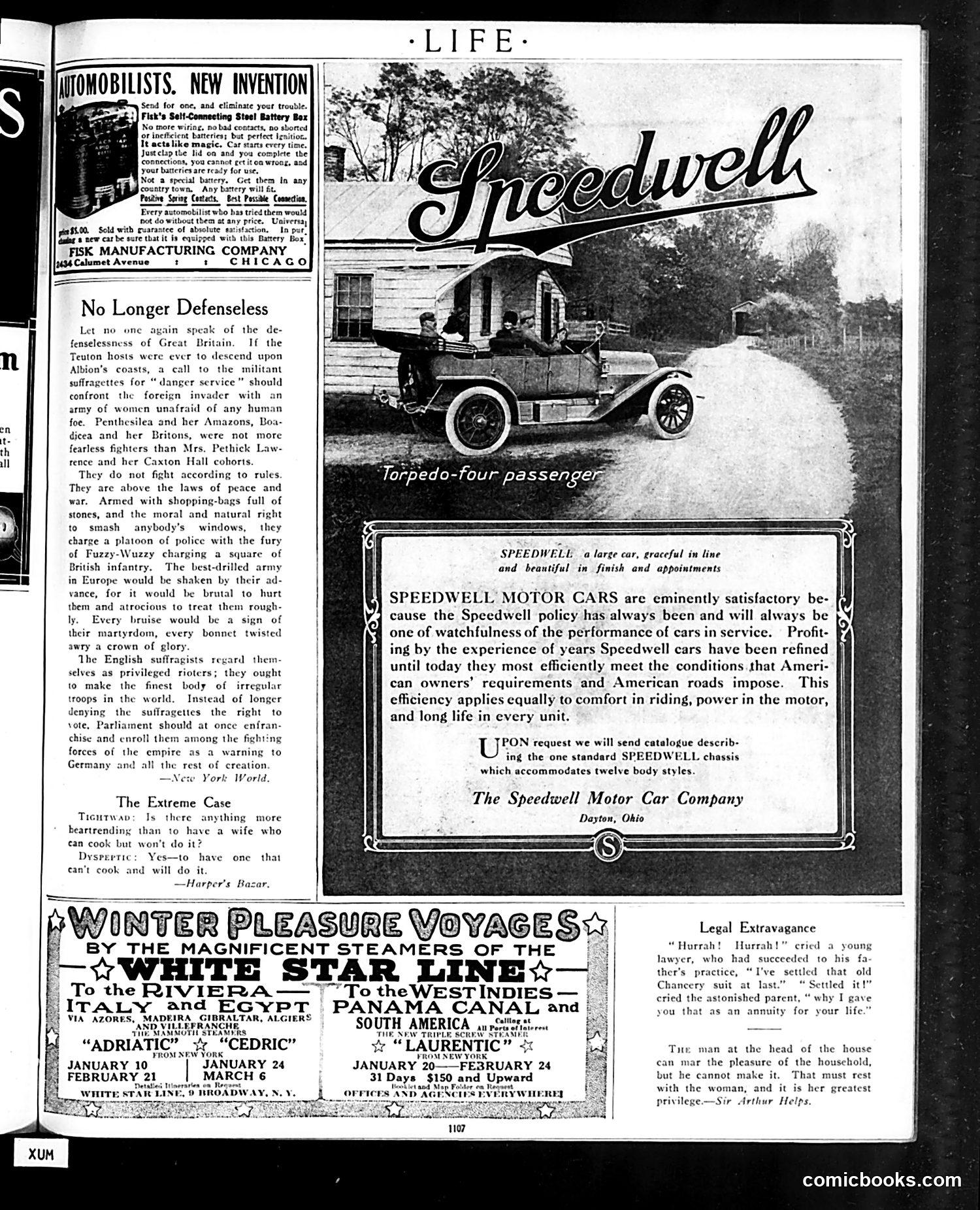
This page contains mostly **advertisements and light humor** rather than political cartoons requiring historical context. The notable satirical content is "No Longer Defenseless," which mocks **British suffragettes** (women's voting rights activists). The piece sarcastically suggests that militant suffragettes like Mrs. Pethick Lawrence—known for window-smashing and confrontational tactics—could serve as Britain's military defense against German invasion. The satire works by inverting the suffragettes' actual status: they faced arrest and ridicule, yet the piece pretends their "fury" and disregard for rules would terrify enemy armies. It's mockery disguised as praise, criticizing both suffragettes' methods and the notion that property destruction constitutes legitimate protest. The page also includes automobile and steamship advertisements typical of the era, plus a brief joke about a lawyer profiting endlessly from a single case. The overall tone reflects early-20th-century skepticism toward women's suffrage activism.
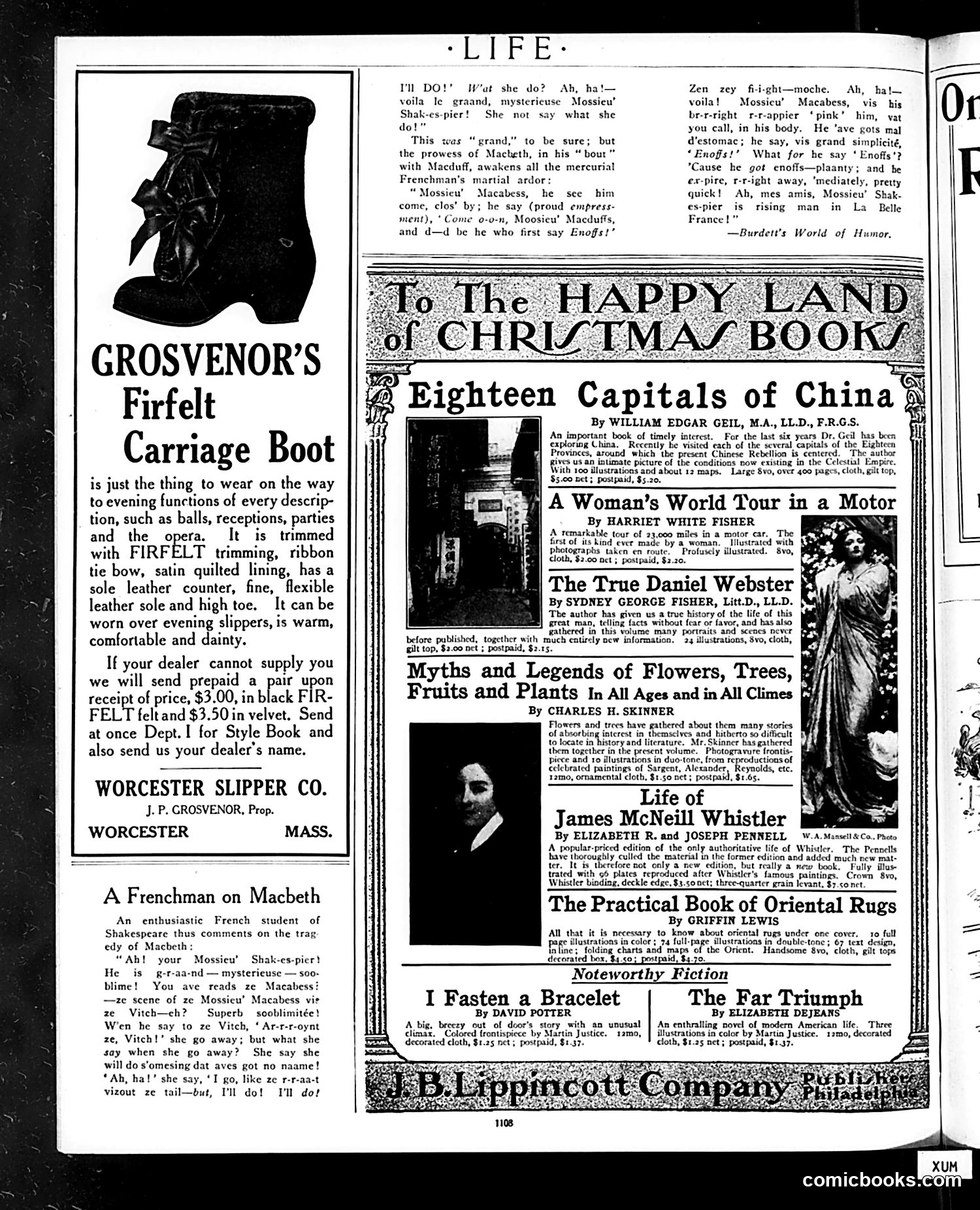
This page is **primarily advertising for Christmas books**, published by J.B. Lippincott Company. The substantive editorial content is minimal. The one notable cartoon piece is "A Frenchman on Macbeth"—a comedic sketch where an enthusiastic French theater-goer describes watching *Macbeth*, likely a recent stage production. The humor relies on **stereotypical French accent representation** (written phonetically: "Mossieu'," "br-r-right," "r-r-appier") and the Frenchman's animated response to the violence—particularly Macbeth's stabbing of Macduff. The joke plays on the contrast between Shakespeare's literary grandeur and the Frenchman's focus on the spectacular physical action. His comment that Macbeth "is rising man in La Belle France" suggests the piece gently mocks European enthusiasm for Shakespeare while poking fun at exaggerated French theatrical mannerisms. The rest of the page consists of book advertisements for titles on China, travel, Daniel Webster biography, flowers/plants, and Whistler—typical 1900s-era gift book fare.
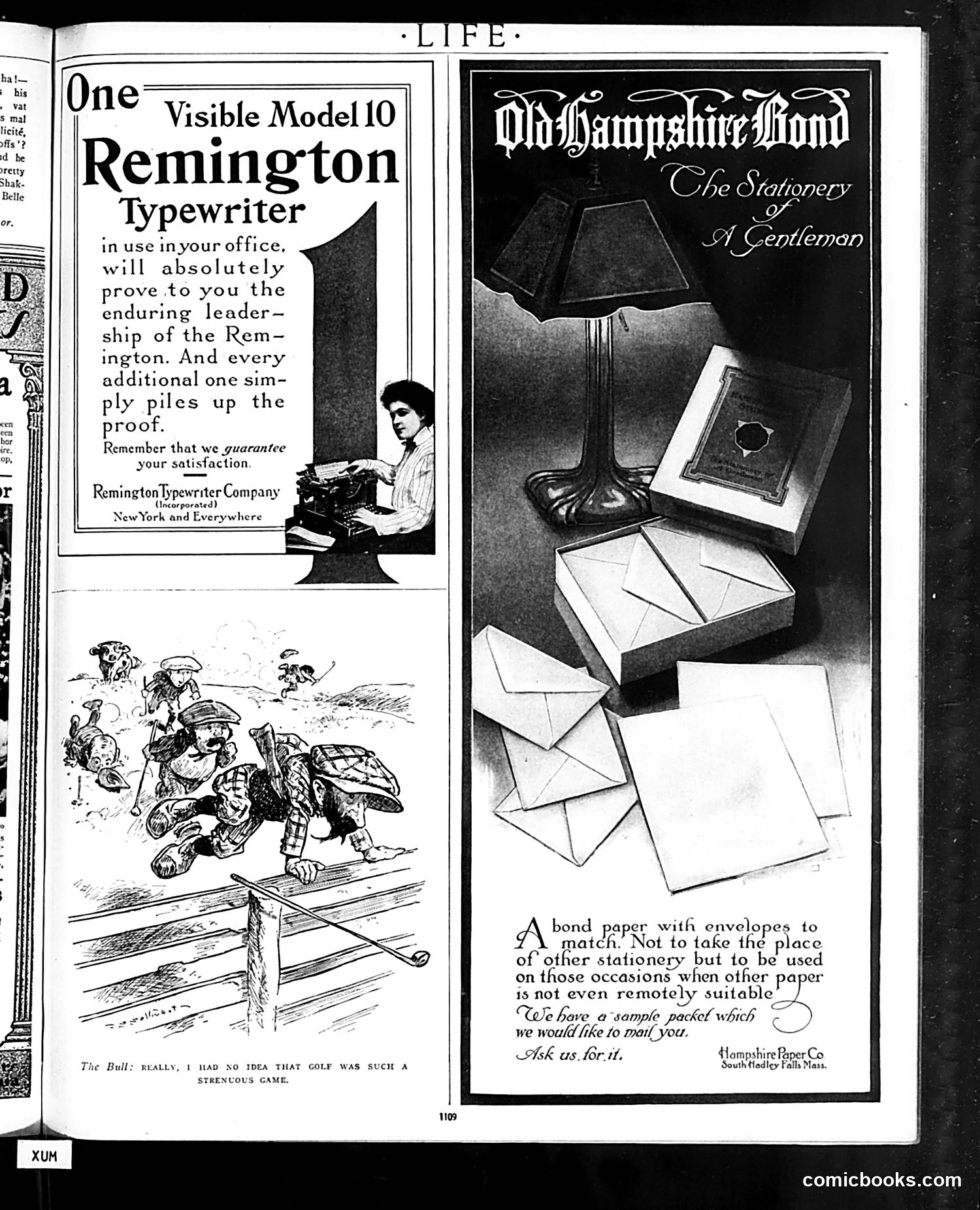
This page contains two advertisements rather than political satire. **Left side:** A Remington Typewriter ad featuring a woman at a typewriter. The copy emphasizes the machine's "enduring leadership" and uses the phrase "every additional one simply piles up the proof"—a competitive business appeal to office managers. Below is an unrelated cartoon showing a golfer encountering difficulty, with the caption "Really, I had no idea that golf was such a strenuous game," depicting physical comedy about golf's unexpected demands. **Right side:** An advertisement for Hampshire Bond stationery. It shows elegant writing paper and envelopes styled as luxury goods, positioned for gentlemen's correspondence. The ad emphasizes this is specialized stationery "for those occasions when other paper is not even remotely suitable"—a status appeal to distinguish refined gentlemen's writing. Neither contains political commentary. This is a standard magazine advertising page from the early 20th century, with one unrelated humorous cartoon filler.
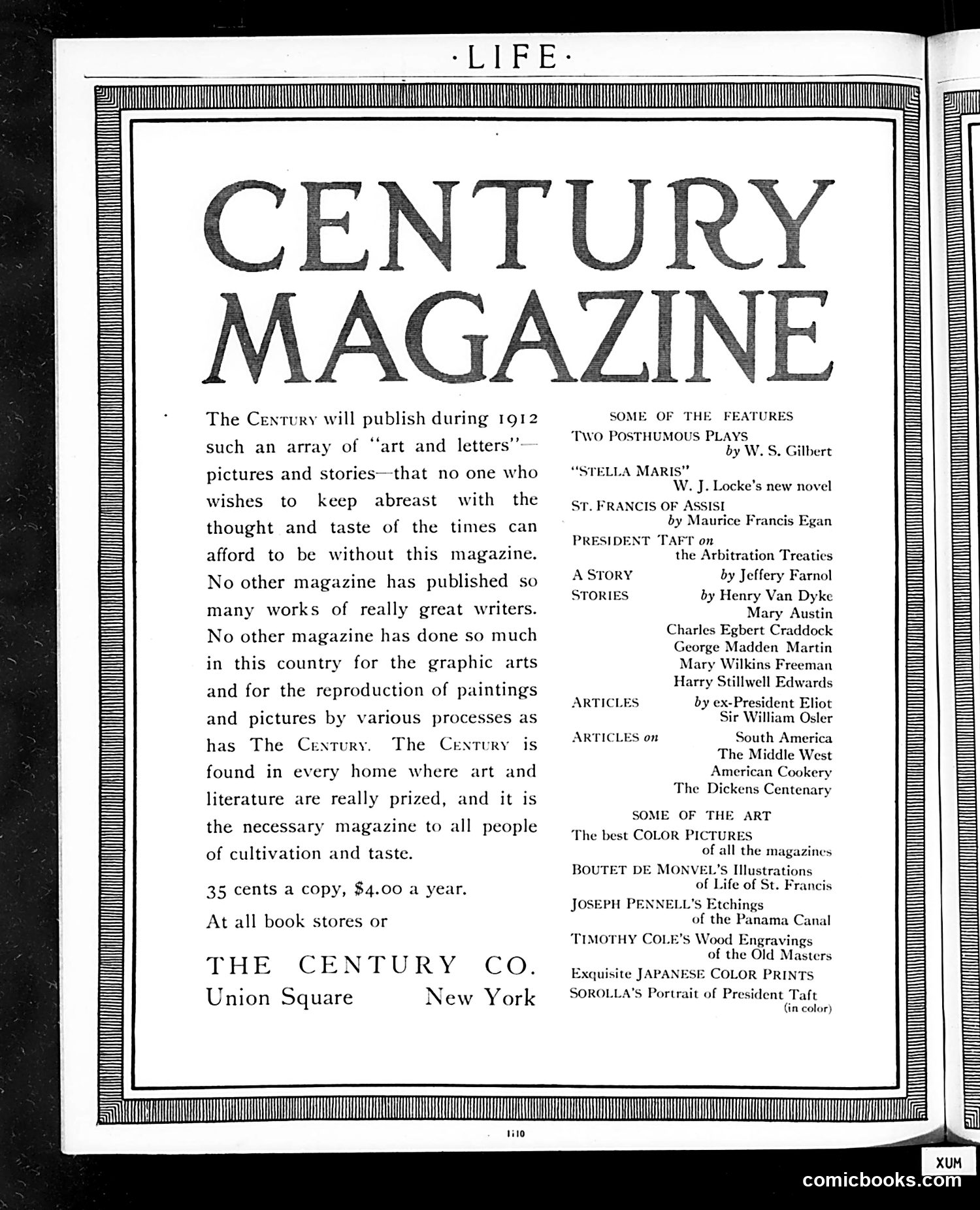
This is a full-page advertisement for *Century Magazine*, not a political cartoon. It promotes the magazine's 1912 content to appeal to educated, affluent readers. The ad emphasizes *Century's* prestige by listing prominent contributors: ex-President Eliot, President Taft (writing on arbitration treaties), and acclaimed writers like Henry Van Dyke and Mary Austin. It highlights high-quality art reproduction—a key selling point—featuring Japanese color prints, etchings of the Panama Canal, and paintings by Old Masters. The language ("cultivation and taste," "people of cultivation") targets an elite audience. At 35 cents per copy ($4/year), it positioned itself as a luxury magazine for the culturally refined. The ad essentially argues *Century* is the necessary publication for anyone claiming intellectual sophistication—a direct appeal to status-conscious readers of the era.
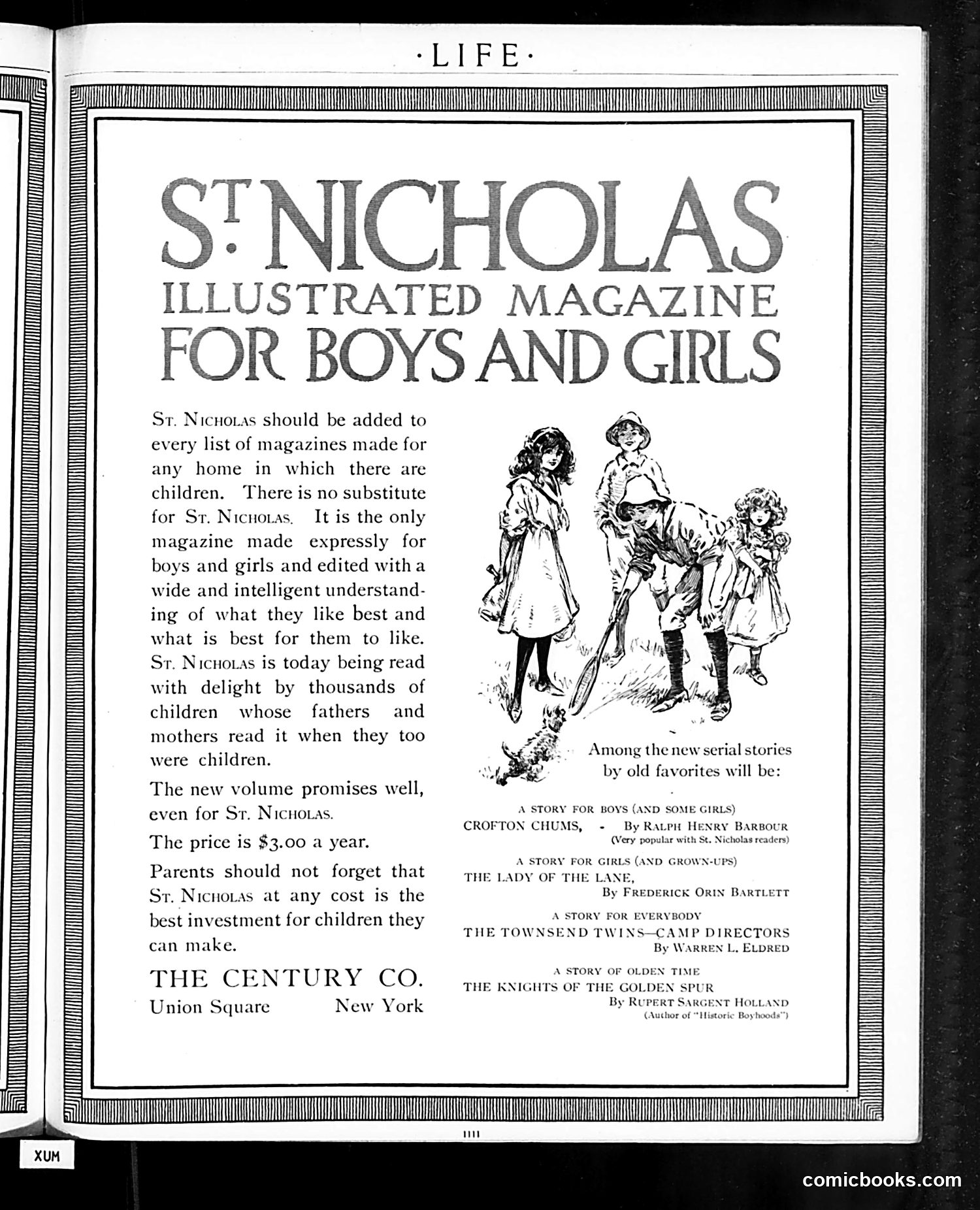
This is a **full-page advertisement**, not a cartoon or satirical piece. It promotes *St. Nicholas* magazine for children, published by The Century Co. in New York. The illustration shows children engaged in outdoor activities (appearing to explore or play), reinforcing the magazine's appeal to young readers. The ad emphasizes that *St. Nicholas* is the **only magazine expressly edited for boys and girls**, positioning it as essential for any home with children. Key selling points include the $3.00 annual price, the endorsement that parents themselves read it as children (establishing generational continuity), and listings of upcoming serial stories by established authors. The message is explicitly didactic: parents should view this subscription as a worthwhile "investment" in their children's proper moral and intellectual development—a common Victorian-era argument for quality children's literature. There is **no satire or political commentary** visible here—merely straightforward period advertising emphasizing values parents of that era prioritized: tradition, quality literature, and wholesome content.
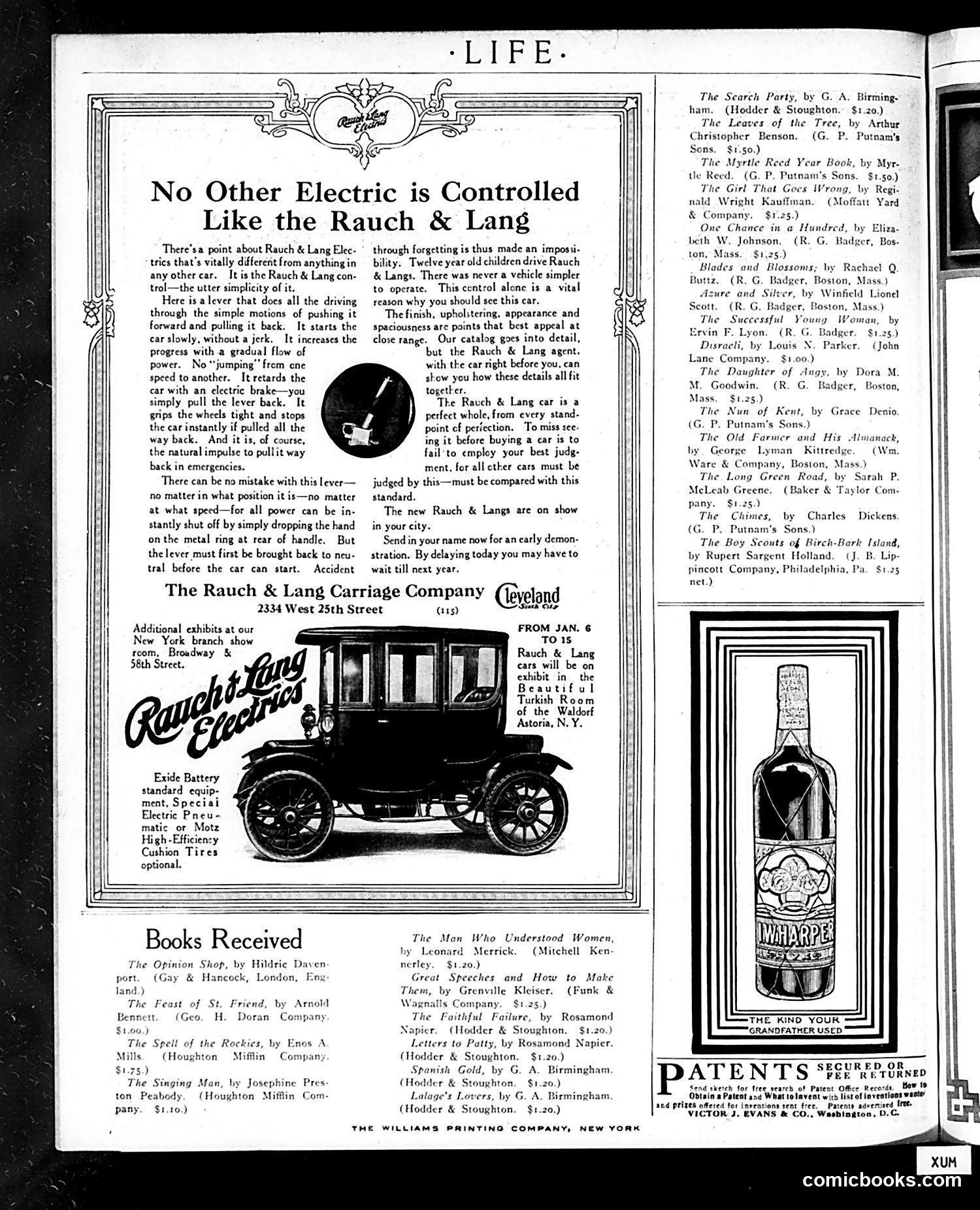
This page is **primarily an advertisement** for the Rauch & Lang electric automobile, a Cleveland-based manufacturer. There are no political cartoons or satirical content visible. The ad promotes the car's key innovation: a single lever control system that handles acceleration, braking, and stopping through simple forward/backward motions. The marketing emphasizes safety and simplicity—notably claiming that even "twelve year old children" can operate it safely, which speaks to early-1900s attitudes about vehicle design. The right column lists newly published books, a common LIFE magazine feature. The Rauch & Lang company notes their cars will be exhibited at the Waldorf Astoria hotel in New York from January 6-15, suggesting this is a dated advertisement from that period. The page reflects the era when electric vehicles competed seriously with gasoline cars before ultimately losing market dominance.
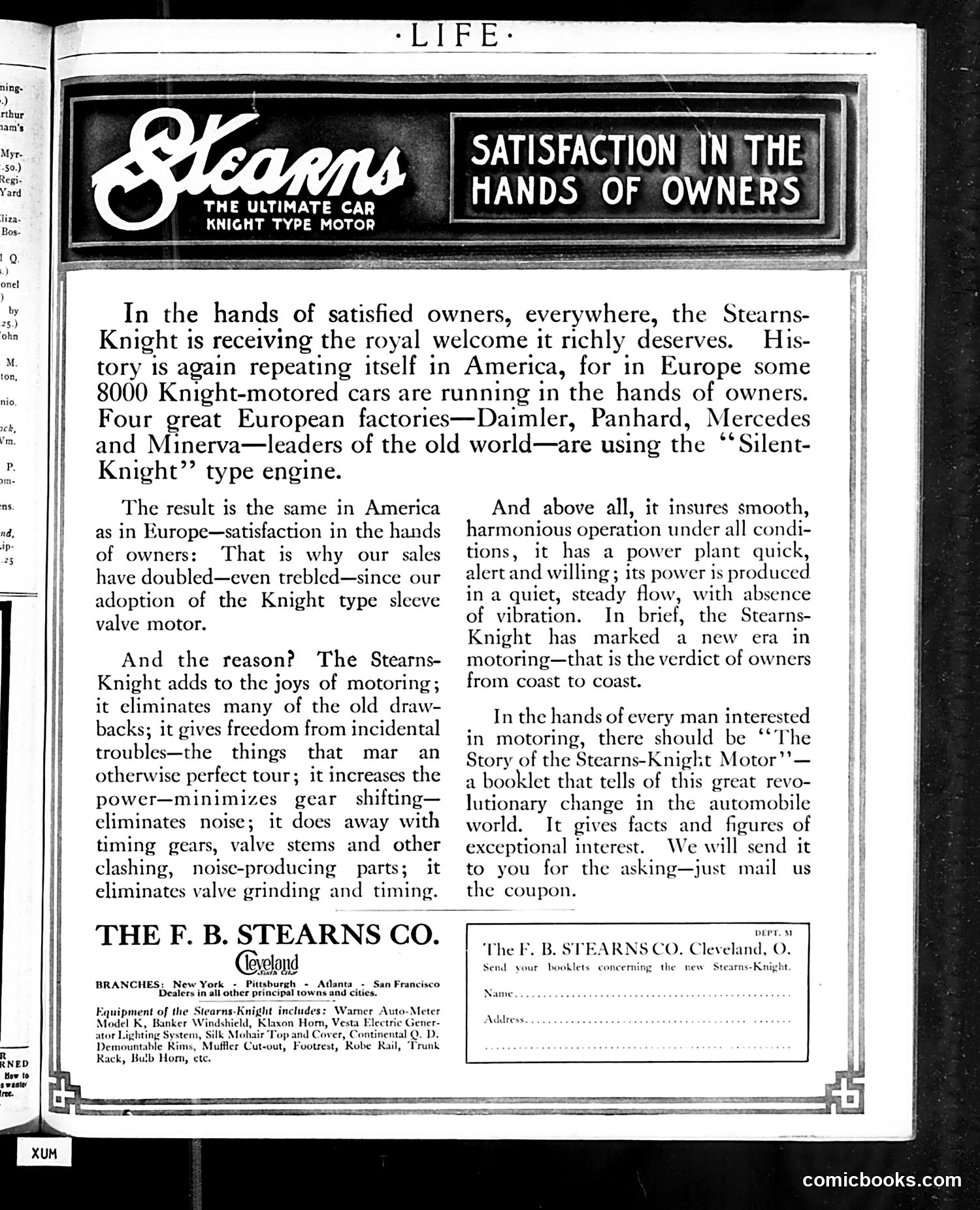
This is a **full-page automobile advertisement**, not satirical content. It promotes the Stearns-Knight car and its "Silent-Knight" sleeve-valve motor engine. The ad makes technical claims: the Knight motor allegedly reduces noise, eliminates gear-shifting troubles, and provides smoother operation than competing engines. It appeals to authority by noting that European luxury manufacturers (Daimler, Panhard, Mercedes, Minerva) use the same engine technology, and that 8,000 Knight-motored cars operate successfully in Europe. The "satire" label on *Life* magazine reflects the publication's general irreverent tone, but **this specific page contains straightforward marketing copy**, not political satire or jokes. The humor, if any, lies in the earnest, hyperbolic sales language typical of early 20th-century advertising ("royal welcome it richly deserves"). There are no identifiable caricatures or political figures. This is commercial advertising appearing in a satirical magazine's pages.
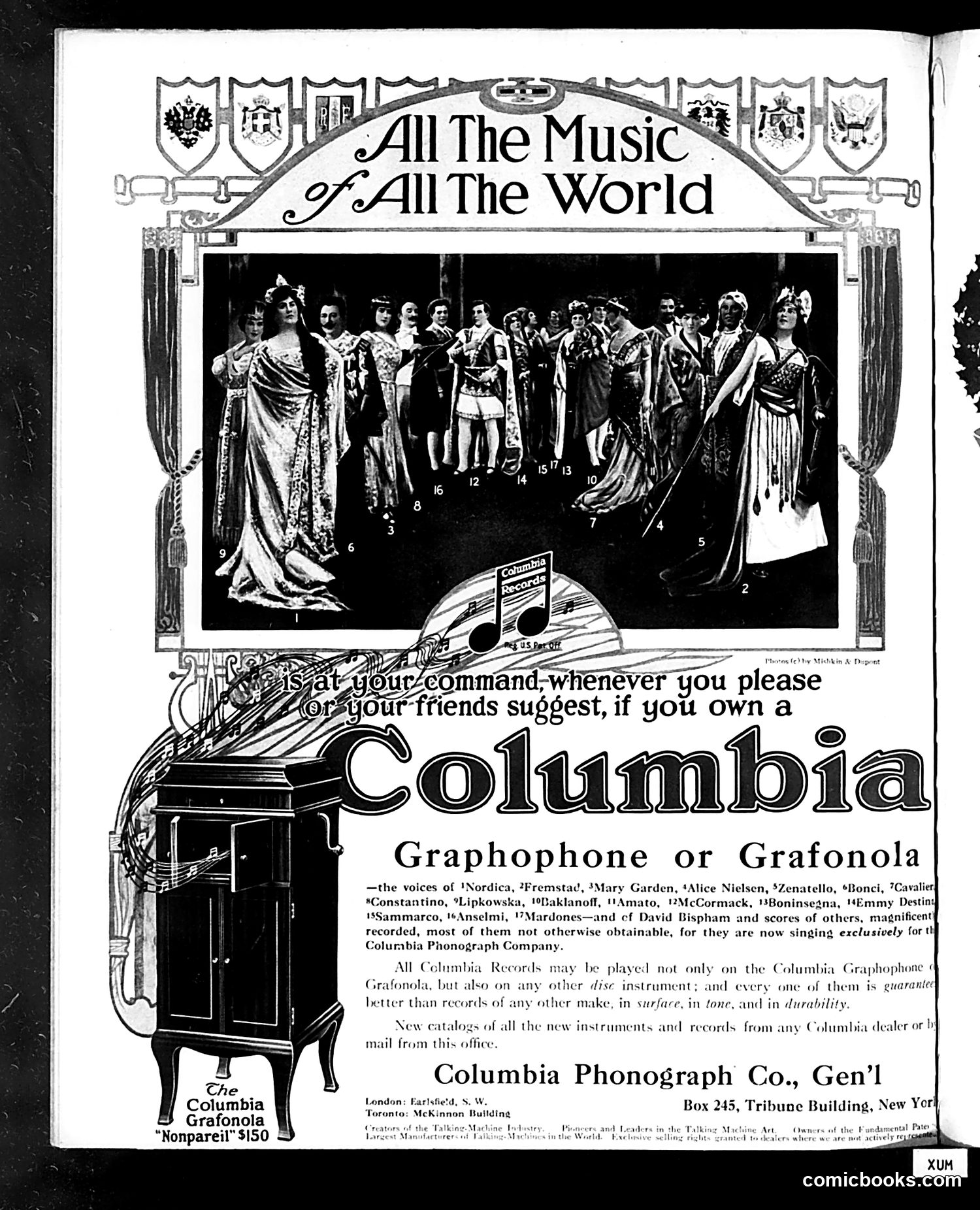
This is a **Columbia Phonograph Company advertisement**, not a satirical cartoon. The page shows a theatrical scene featuring numbered cast members in elaborate operatic costumes (appearing to be from a classical opera production). The advertisement's purpose is straightforward: to promote the Columbia Graphophone and Grafonola record players by listing famous opera singers—names like Nordica, Fremstad, Mary Garden, and Caruso (likely among "scores of others")—who recorded *exclusively* for Columbia Records. The emphasis on "exclusively" and the claim that these recordings are "not otherwise obtainable" was the key selling point. The text assures buyers that Columbia records play on any disc machine and are superior in quality ("surface, tone, and durability"). This was a premium product advertisement targeting wealthy consumers interested in classical music during the early phonograph era. There is no satire or political commentary visible here—it's purely commercial messaging.