
Life, 1911-12-14 · page 8 of 40
Life — December 14, 1911 — page 8: what you’re looking at
What you’re looking at
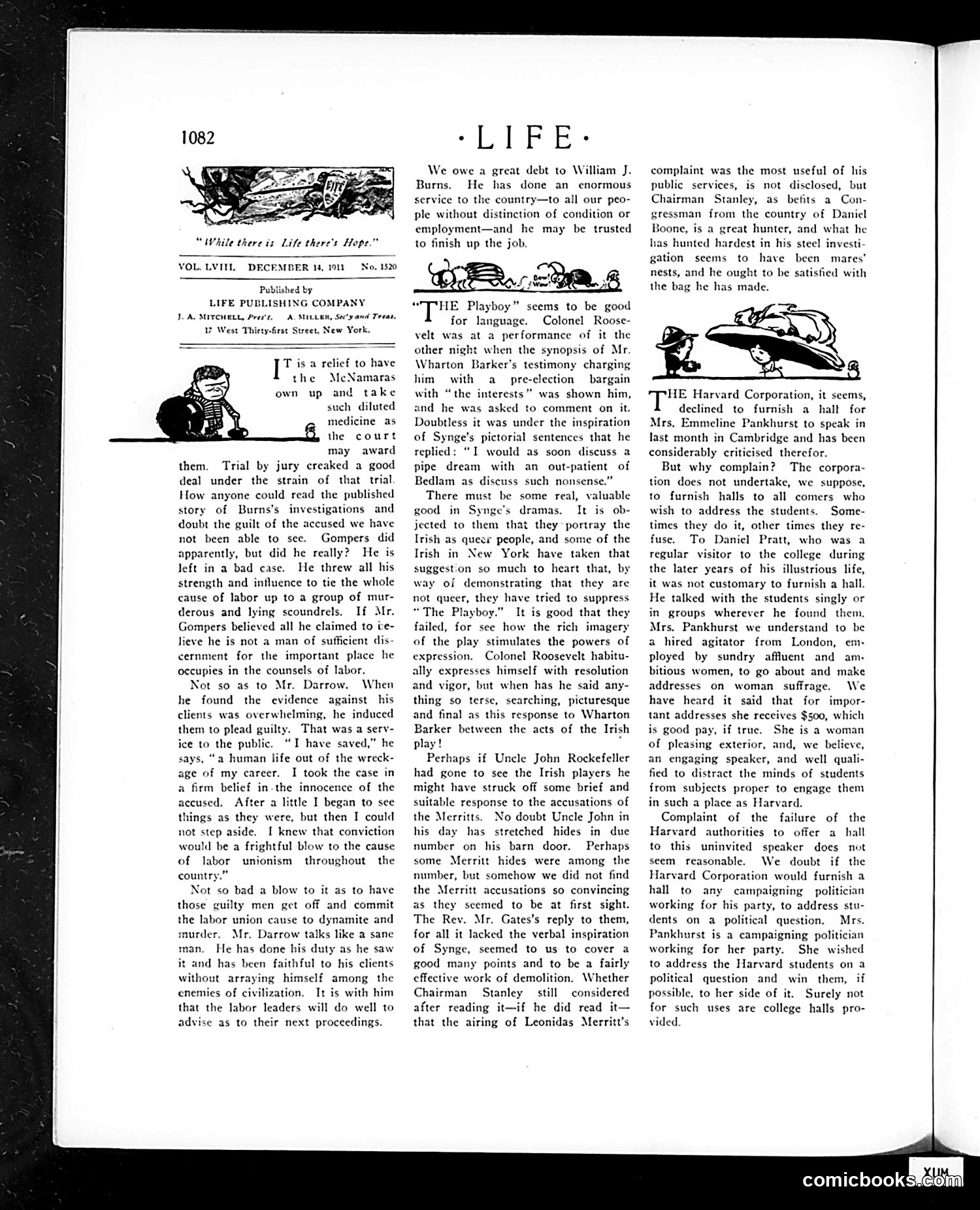
This page contains editorial commentary rather than political cartoons. The text discusses several topics: 1. **William J. Burns** - praised for his investigative work and service to the country, though criticized for his role in a labor case involving accused murderers. 2. **"The Playboy"** - a theatrical performance featuring Colonel Roosevelt's testimony about pre-election dealings with newspaper interests, apparently mocking his responses. 3. **Harvard Corporation controversy** - criticism of the university for hiring Mrs. Emmeline Pankhurst, a British suffragist, to speak despite controversy. The text suggests some Harvard officials wanted to avoid addressing students on political matters like women's suffrage. The page reflects Progressive Era debates about labor, politics, and women's rights activism.
📄 Transcribed text from this page (OCR, searchable)
Machine-transcribed from the original scan — historical spelling and the odd misread are preserved.
“While there is Life there's Hope.” VOL. LVIIL, DECEMBER 14, 1911 No. 1520 Published by LIFE PUBLISHING COMPANY JA. MITCHELL, Prove, A SILLER, 17 West Thirty-first Street, New York. ce'y and Treas, T is a relief to have the MeNamaras up and take such diluted medicine as the court may award them. Trial by jury creaked a good deal under the strain of that trial How anyone could read the published story of Burns’s investigations and doubt the guilt of the accused we have not been able to see. Gompers did apparently, but did he really? He is left in a bad case. He threw all his strength and influence to tie the whole cause of labor up to a group of mur- derous and lying scoundrels. If Mr. Gompers believed all he claimed to be- lieve he is not a man of sufficient dis- cernment for the important place he occupies in the counsels of labor. Not so as to Mr. Darrow. When he found the evidence against his clients was overwhelming, he induced them to plead guilty. That was a serv- ice to the public. “I have saved,” he says, “a human life out of the wreck- age of my career. I took the case in a firm belief in-the innocence of the accused. After a little I began to see things as they were, but then I could not step aside. I knew that conviction would be a frightful blow to the cause of labor unionism throughout the own Not so bad a blow to it as to have those guilty men get off and commit the labor union cause to dynamite and murder. Mr. Darrow talks like a sane man. He has done his duty as he saw it and has been faithful to his clients without arraying himself among the enemies of civilization. It is with him that the labor leaders will do well to advise as to their next proceedings. ‘LIPE- We owe a great debt to William J. Burns. He has done an enormous service to the country—to all our peo- ple without distinction of condition or employment—and he may be trusted to finish up the job. i! HE Playboy” seems to be good for language. Colonel Roose- velt was at a performance of it the other night when the synopsis of Mr. Wharton Barker's testimony charging him with a pre-election bargain with “the interests” was shown him, and he was asked to comment on it. Doubtless it was under the inspiration of Synge’s pictorial sentences that he replied: “I would as soon discuss a pipe dream with an out-patient of Bedlam as discuss such nonsense.” There must be some real, valuable good in Synge’s dramas. It is ob- jected to them that they portray the Irish as queer people, and some of the Irish in New York have taken that suggestion so much to heart that, by way of demonstrating that they are not queer, they have tried to suppress “The Playboy.” It is good that they failed, for see how the rich imagery of the play stimulates the powers of expression. Colonel Roosevelt habitu- ally expresses himself with resolution and vigor, but when has he said any- thing so terse, searching, picturesque and final as this response to Wharton Barker between the acts of the Irish play! . Perhaps if Uncle John Rockefeller had gone to see the Irish players he might have struck off some brief and suitable response to the accusations of the Merritts. No doubt Uncle John in his day has stretched hides in due number on his barn door. Perhaps some Merritt hides were among the number, but somehow we did not find the Merritt accusations so convincing as they scemed to be at first sight. The Rev. Mr. Gates’s reply to them, for all it lacked the verbal inspiration of Synge, seemed to us to cover a good many points and to be a fairly effective work of demolition. Whether Chairman Stanley still considered after reading it—if he did read it— that the airing of Leonidas Merritt's complaint was the most useful of his public services, is not disclosed, but Chairman Stanley, as befits a Con- gressman from the country of Daniel Boone, is a great hunter, and what he has hunted hardest in his steel investi gation seems to have been mares’ nests, and he ought to be satisfied with the bag he has made. HE Harvard Corporation, it seems, declined to furnish a halt for Mrs. Emmeline Pankhurst to speak in last month in Cambridge and has been considerably criticised therefor. But why complain? The corpora- tion does not undertake, we suppose, to furnish halls to all comers who wish to address the students. Some- times they do it, other times they re- fuse. To Daniel Pratt, who was a visitor to the college during the later years of his illustrious life, it was not customary to furnish a hall. He talked with the students singly or in groups wherever he found them. Mrs. Pankhurst we understand to be a hired agitator from London, em- ployed by sundry affluent and am. bitious women, to go about and make addresses on woman suffrage. We have heard it said that for impor- tant addresses she receives $500, which is good pay, if true. She is a woman of pleasing exterior, and, we believe an engaging speaker, and well quali- fied to distract the minds of students from subjects proper to engage them in such a place as Harvard. Complaint of the failure of the Harvard authorities to offer a_ hall to this uninvited speaker does not seem reasonable. We doubt if the Harvard Corporation would furnish a hall to any campaigning politician working for his party, to address stu- dents on a political question. Mrs. Pankhurst is a campaigning politician working for her party. She wished to address the Harvard students on a political question and win them, if possible, to her side of it. Surely not for such uses are college halls pro- vided. comicbookMen 5