
Life, 1911-12-14 · page 18 of 40
Life — December 14, 1911 — page 18: what you’re looking at
What you’re looking at
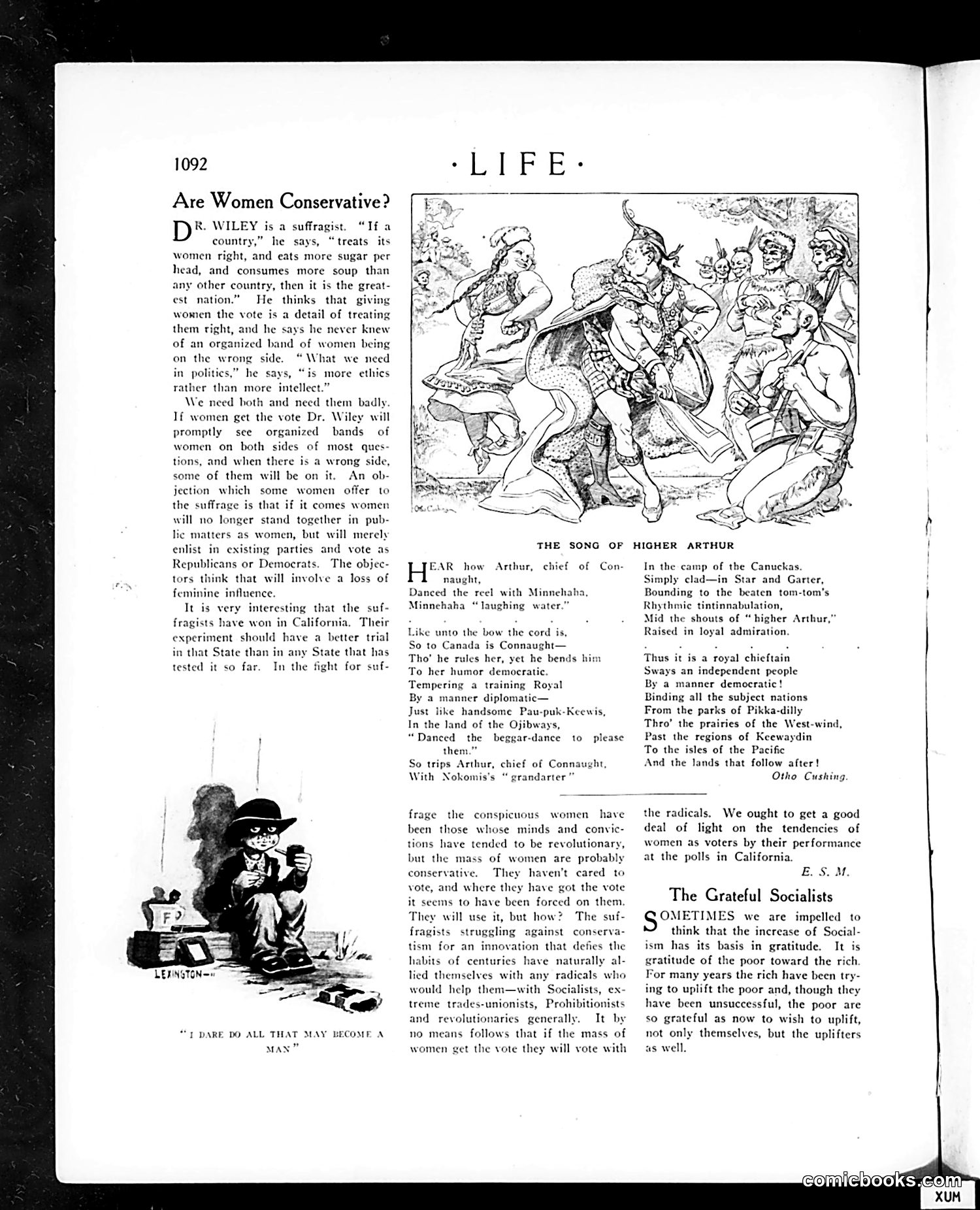
This page contains political commentary on women's suffrage circa the early 1910s (Life published during this era). **Main Article - "Are Women Conservative?"** The piece argues against Dr. Wiley's suffragist assumption that women voters will automatically align with progressive causes. The author contends that while vocal suffrage *advocates* tend to be radicals and revolutionaries, most women are actually *conservative* and won't necessarily vote left-wing. The piece cites California's recent suffrage passage as a test case. The cartoon at left (captioned "I dare do all that may become a man") appears to mock overly idealistic suffrage rhetoric. **"Song of Higher Arthur"** The illustrated poem is a satirical comparison: just as Arthur (likely the Duke of Connaught, British royal) rules Canada through charm and diplomacy rather than force, so women will naturally govern through feminine influence rather than radical means. **"The Grateful Socialists"** A brief satirical jab suggesting Socialists' gratitude toward the wealthy for "uplift" efforts is so strong they now want to reciprocate by uplifting the rich. The overall tone suggests Life's skepticism toward both naive suffrage idealism *and* radical politics.
📄 Transcribed text from this page (OCR, searchable)
Machine-transcribed from the original scan — historical spelling and the odd misread are preserved.
1092 Are Women Conservative? D*® WILEY is a suffragist. “If a country,” he says, “treats its women right, and eats more sugar per head, and consumes more soup than any other country, then it is the great- est nation.” He thinks that giving women the vote is a detail of treating them right, and he says he never knew of an organized band of women being on the wrong side. “What we need in polities,” he says, “is more ethics rather than more intellect.” We need both and need them badly. If women get the vote Dr. Wiley will promptly see organized bands of women on both sides of most ques- tions, and when there is a wrong side, some of them will be on it. An ob- jection which some women offer to the suffrage is that if it comes women will no longer stand together in pub- lic matters women, but will merely enlist in existing parties and vote as Republicans or Democrats. The objec- tors think that will involve a loss of feminine influence. It is very interesting that the suf- fragists have won in California. Their experiment should have a better trial in that State than in any State that has tested it so far. In the fight for suf- DARE DO ALL THAT MAY MAN” BECOME A THE SONG OF EAR naught, Danced the reel with Minnehaha, Minnehaha “laughing water.” how Arthur, chief of Con- Like unto the bow the cord is, So to Canada is Connaught— Tho’ he rules her, yet he bends him To her humor den peratic. Tempering a training Royal By a manner diplomatic— Just like handsome Pau-puk-Keewis, In the land of the Ojibways, “Danced the beggar-dance to them.” So trips Arthur, chief of Connaught, please With Nokomis’s “ grandarter” frage the conspicuous women have been those whose minds and convic- tions have tended to be revolutionary, but the mass of women are probably conservative. They haven't cared to vote, and where they have got the vote it seems to have been forced on them, They will use it, but how? The suf- fragists struggling against conserva- tism for an innovation that defies the habits of centuries have naturally al- lied themselves with any radicals who would help them—with Socialists, ex- treme trades-unionists, Prohibitioni and revolutionaries generally. It by no means follows that if the mass of women get the vote they will vote with HIGHER ARTHUR In the camp of the Canuckas. Simply clad—in Star and Garter, Bounding to the beaten tom-tom's Rhythmic tintinnabulation, Mid the shouts of “higher Arthu Raised in loyal admiration. Thus it is a royal chieftain Sways an independent people By a manner democratic! Binding all the subject nations From the parks of Pikka-dilly Thro’ the prairies of the West-wind, Past the regions of Kee To the isles of the Pacific And the lands that follow after! Otho Cushing. aydin the radicals. We ought to get a good deal of light on the tendencies of women as voters by their performance at the polls in California. ES. BM The Grateful Socialists OMETIMES we are impelled to think that the increase of Social- ism has its basis in gratitude. It is gratitude of the poor toward the rich. For many years the rich have been try- ing to uplift the poor and, though they have been unsuccessful, the poor are so grateful as now to wish to uplift, not only themselves, but the uplifters as well.