
Life, 1911-12-14 · page 22 of 40
Life — December 14, 1911 — page 22: what you’re looking at
What you’re looking at
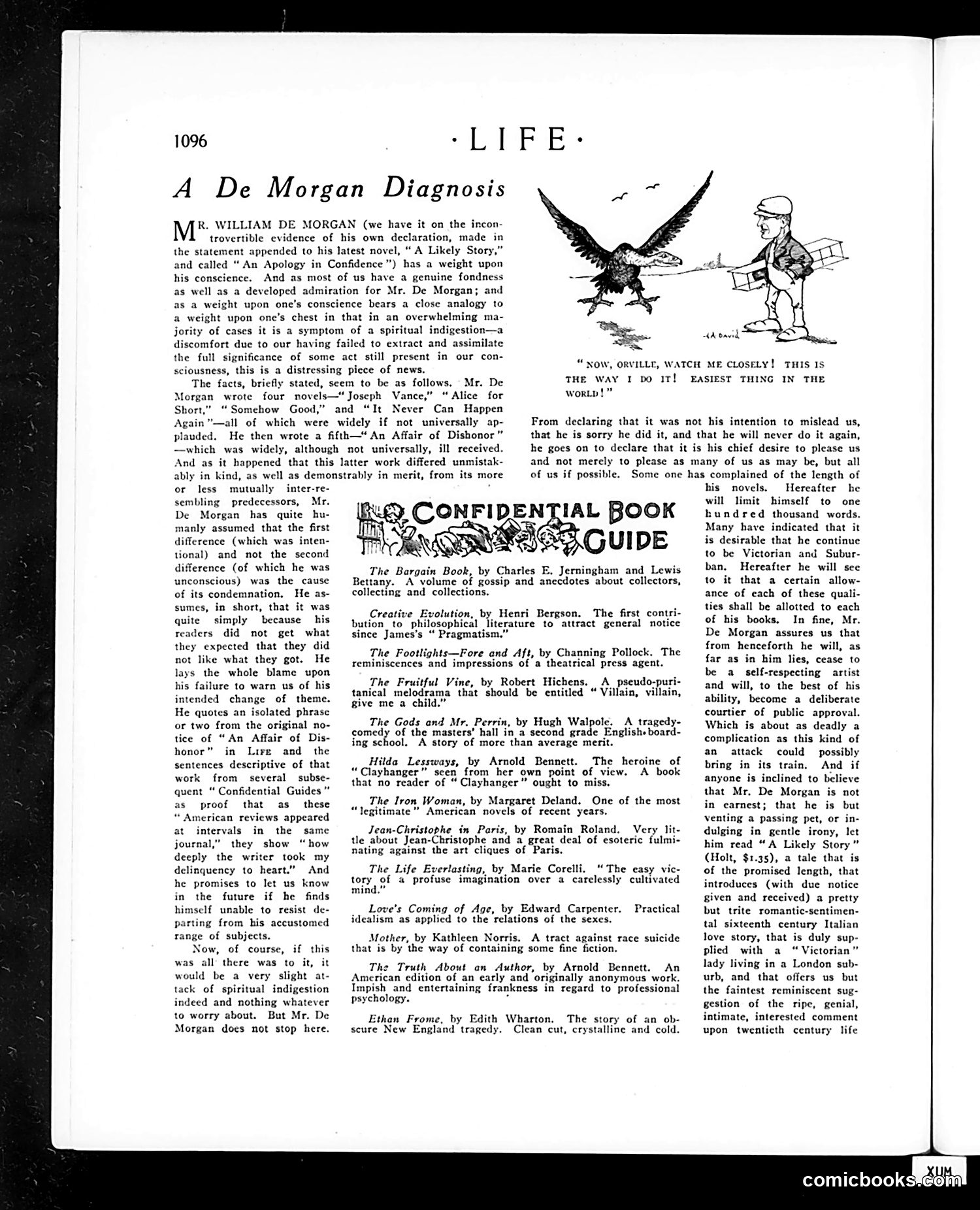
This page critiques novelist William De Morgan's self-justification in his latest work, "A Likely Story." De Morgan claims his previous novel, "An Affair of Dishonor," failed because readers didn't expect the thematic change—not because the book was inferior. The accompanying cartoon satirizes his excuse: it shows a man (De Morgan) with a bird landing on his chest, captioned "NOW, ORVILLE, WATCH ME CLOSELY! THIS IS THE WAY I DO IT! EASIEST THING IN THE WORLD!" The satire suggests De Morgan is performing intellectual gymnastics to avoid acknowledging his book's actual artistic failure. Rather than admitting the work was genuinely worse, he blames reader expectations—a self-serving diagnosis of his "spiritual indigestion" (his guilty conscience). The cartoon implies his explanation is as absurd and unconvincing as the magical feat he's claiming to perform.
📄 Transcribed text from this page (OCR, searchable)
Machine-transcribed from the original scan — historical spelling and the odd misread are preserved.
1096 LIF Es A De Morgan Diagnosis R. WILLIAM DE MORGAN (we have it on the incon- trovertible evidence of his own declaration, made in the statement appended to his latest novel, “A Likely Story,” and called “An Apology in Confidence”) has a weight upon his conscience. And as most of us have a genuine fondness as well as a developed admiration for Mr. De Morgan; and as a weight upon one’s conscience bears a close analogy to a weight upon one’s chest in that in an overwhelming ma- jority of cases it is a symptom of a spiritual indigestion—a discomfort due to our having failed to extract and assimilate the full significance of some act still present in our con- sciousness, this is a distressing piece of news. The facts, briefly stated, seem to be as follows. four novels—" Joseph Vance,” “Alice for and “Tt Again "—all of which were widely if not universally ap- He then wrote a fifth—‘An Affair of Dishonor” —which was widely, although not universally, ill received. And as it happened that this latter work differed unmistak- ably in kind, as well as demonstrably in merit, from its more Morgan Short, wrote Somehow Good,’ plauded. or less mutually inter-re- sembling predecessors, Mr. De Morgan has quite hu- manly assumed that the first difference (which was inten- tional) and not the second difference (of which he was unconscious) was the cause of its condemnation. He as- sumes, in short, that it was quite simply because _ his readers did not get what they expected that they did not like what they got. He lays the whole blame upon failure to warn us of his intended change of theme. He quotes an isolated phra: or two from the original no- tice of “An Affair of Dis- honor” in Lire and the sentences descriptive of that work from several subse- quent “ Confidential Guides ” as proof that as these “American reviews appeared at intervals in the same journal,” they show “how deeply the writer took my delinquency to heart.” And he promises to let us know in the future if he finds himself unable to resist de- parting from his accustomed range of subjects. Now, of course, if this was all’ there was to it, it would be a very slight at- tack of spiritual indigestion indeed and nothing whatever to worry about. But Mr. De Morgan does not stop here. THE WAY I bo IT! Wwortp!”" Mr. De ever Can Happen of us if possible. CONFIDENTIAL BOOK SBN 3IG3. GUIDE The Bargain Book, by Charles E. Jerningham and Lewis Bettany. A volume of gossip and anecdotes about collectors, collecting and collections. Creative Evolution, by Henri Bergson. The first contri- bution to philosophical literature to attract general notice since James's “ Pragmatism.” The Footlights—Fore and Aft, by Channing Pollock. The reminiscences and impressions ofa theatrical press agent. The Fruitful Vine, by Robert Hichens. A. pseudo-puri- tanical melodrama that should be entitled “ Villain, villain, give me a child.” The Gods and Mr. Perrin, by Hugh Walpole, A tragedy- comedy of the masters’ hall in a second grade English- board- ing school. A story of more than average merit. Hilda Lessways, by Arnold Bennett. “Clayhanger” scen from her own point of view. that no reader of “ Clayhanger” ought to miss. The heroine of A book The Iron Woman, by Margaret Deland. One of the most “legitimate” American novels of recent years. Jean-Christophe in Paris, by Romain Roland. Very lit- tle about Jean-Christophe and a great deal of esoteric fulmi- nating against the art cliques of Paris. The Life Everlasting, by Marie Corelli. “The easy vic- tory of a profuse imagination over a carelessly cultivated mind.” Love's Coming of Age, by Edward Carpenter. Practical idealism as applicd to the relations of the sexes. Mother, by Kathleen Norris, A tract against race suicide that is by the way of containing some fine fiction. The Truth About an Author, by Arnold Bennett. An American edition of an early and ‘originally anonymous work. Impish and entertaining frankness in regard to professional psychology. . Ethan Frome, by Edith Wharton. The story of an ob- scure New England tragedy. Clean cut, crystalline and cold. OW, ORVILLE, WATCH ME CLOSELY! EASIEST THING IN THE THIS 1S From declaring that it was not his intention to mislead us, that he is sorry he did it, and that he will never do it again, he goes on to declare that it is his chief desire to please us and not merely to please as many of us as may be, but all Some one has complained of the length of his novels, Hereafter he will limit himself to one hundred thousand words. Many have indicated that it is desirable that he continue to be Victorian and Subur- ban. Hereafter he will see to it that a certain alloy ance of cach of these quali- ties shall be allotted to each of his books, In fine, Mr. De Morgan assures us that from henceforth he will, as far as in him lies, cease to be a self-respecting artist and will, to the best of his ability, become a deliberate courtier of public approval. Which is about as deadly a complication as this kind of an attack could _ possibly bring in its train. And if anyone is inclined to bel that Mr. De Morgan is not in earnest; that he is but venting a passing pet, or in- dulging in gentle irony, let him read “A Likely Story” (Holt, $1.35), a tale that is of the promised length, that introduces (with due notice given and received) a pretty but trite romantic-sentimen- tal sixteenth century Italian love story, that is duly sup- plied with a “ Victorian” lady living in a London sub- urb, and that offers us but the faintest reminiscent sug- gestion of the ripe, genial, intimate, interested comment upon twentieth century life comicbookeort