
A complete issue · 40 pages · 1911
Life — November 30, 1911
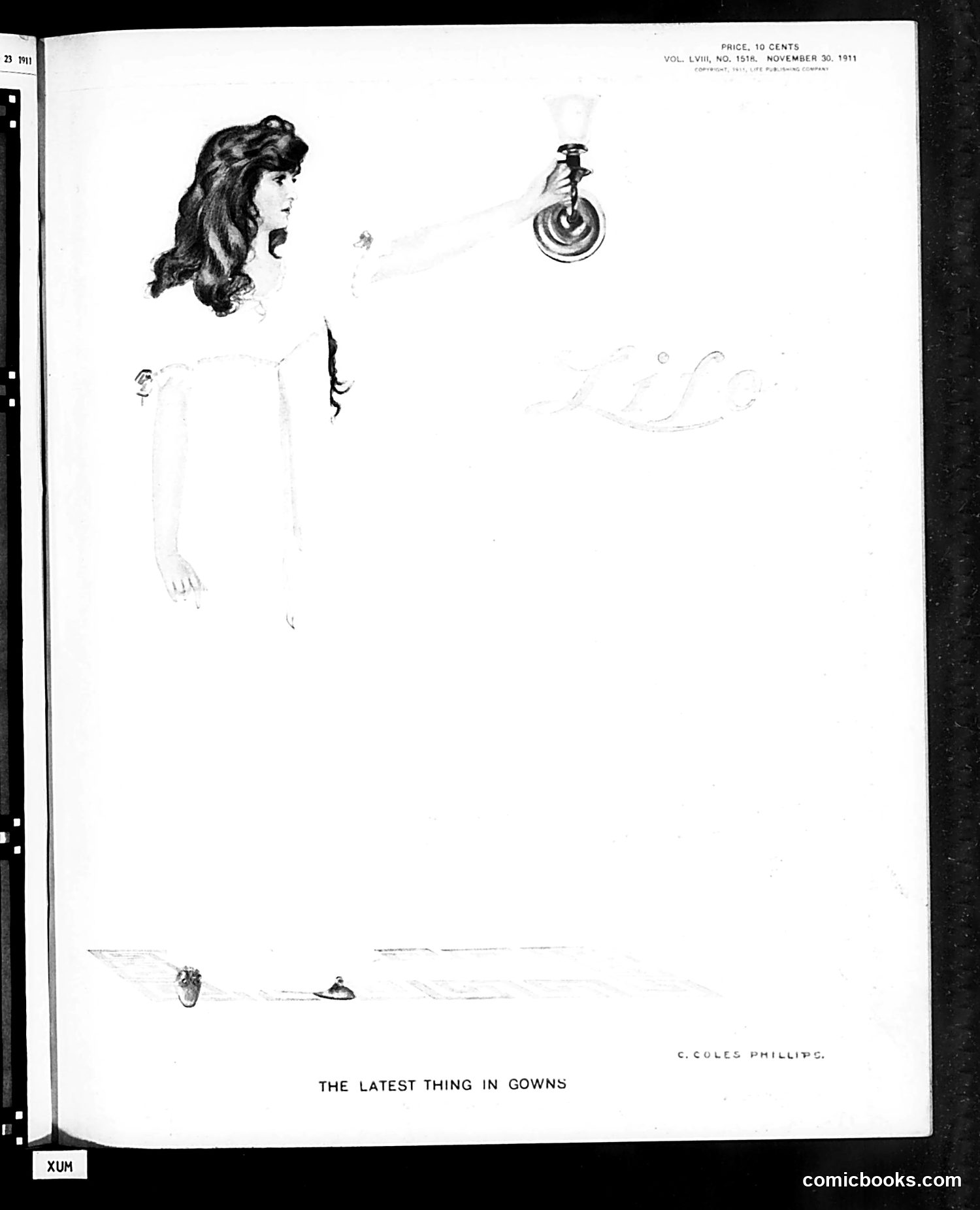
This page from *Life* magazine (November 30, 1911) is titled "The Latest Thing in Gowns" and presents a fashion satire by artist C. Coles Phillips. The cartoon depicts a minimalist fashion sketch—a woman's head and basic garment outline—accompanied by floating design elements (a small decorative pin or brooch at top, sketch lines, and minimal detail at bottom). The satire appears to target the fashion industry's increasingly abstract and minimal approaches to depicting women's clothing in this era. By reducing the "gown" to its barest essentials—essentially just a head and vague outline—Phillips mocks either the impracticality of current fashion trends or the tendency of fashion illustrations to suggest rather than show garments. The joke relies on the growing modernist influence in early 1910s design and fashion illustration.
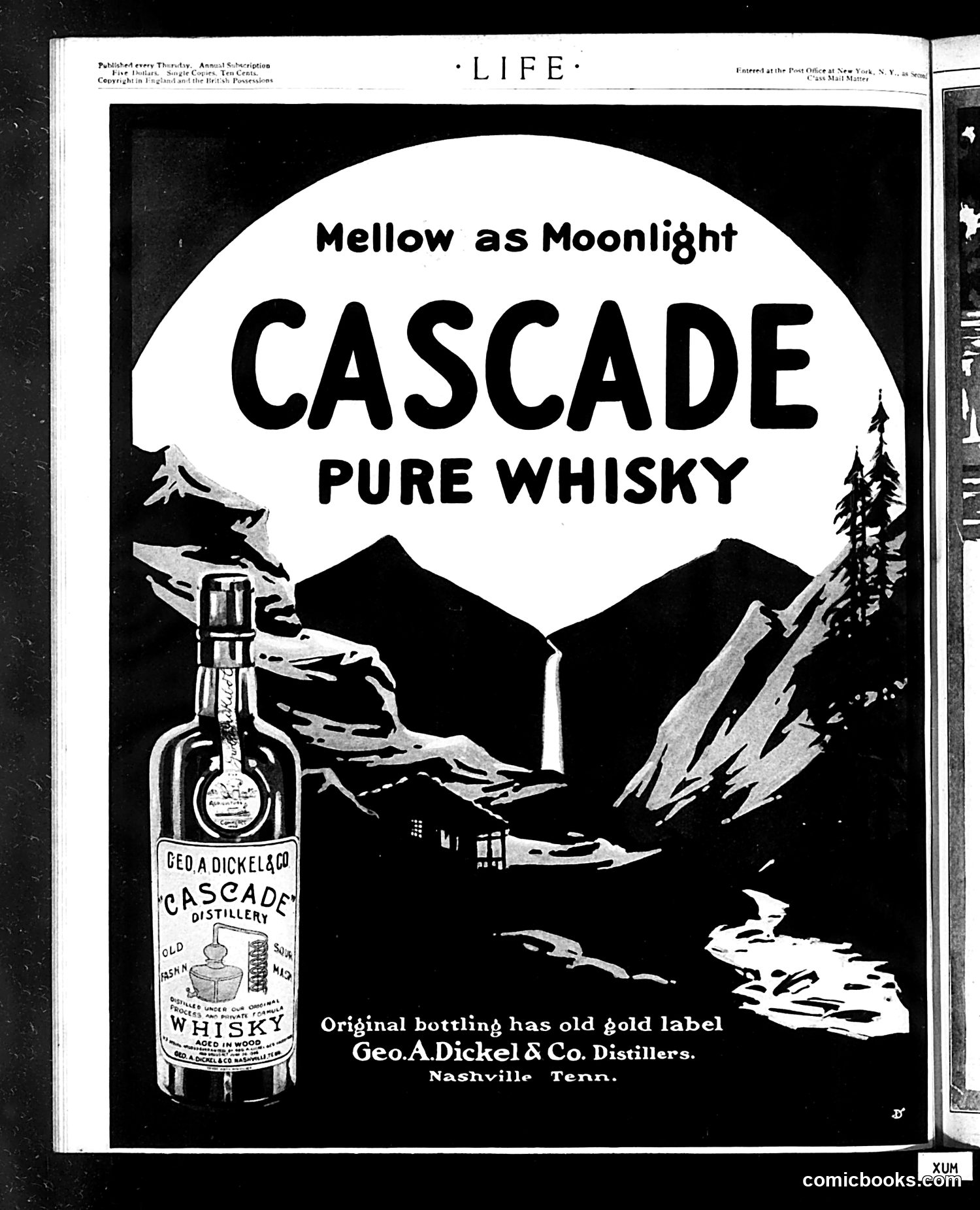
This page is a **whisky advertisement**, not political satire. It promotes Cascade Pure Whisky, manufactured by Geo. A. Dickel & Co. Distillers of Nashville, Tennessee. The ad uses atmospheric imagery—a moonlit mountain landscape with a cabin, trees, and rushing water—to evoke the natural, rustic origins of the product. The tagline "Mellow as Moonlight" emphasizes smoothness and quality. The bottle itself is prominently displayed on the left side. The text notes this represents the "original bottling" with an "old gold label," suggesting heritage and authenticity—marketing appeals common to whisky advertising of this era. There is no political commentary or satire present on this page.
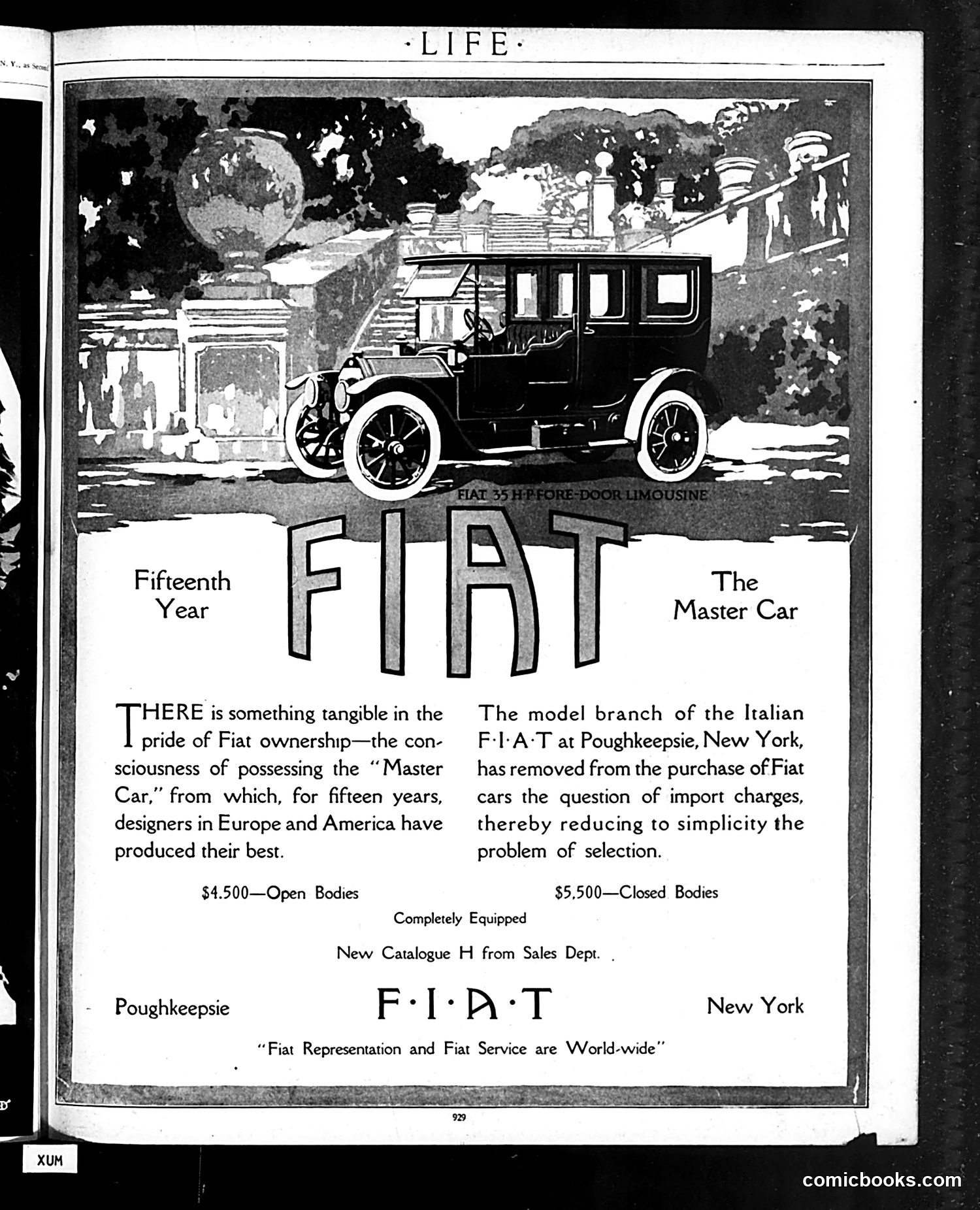
This page is primarily **advertising, not satire**. It's a Fiat automobile advertisement from *Life* magazine's early automotive era. The ad promotes the Fiat 35 H.P. Fore-Door Limousine as "The Master Car" of the fifteenth year (of Fiat's production). The text emphasizes that Fiat ownership conveys pride and that European designers have used Fiat as their template for fifteen years. A key selling point: Fiat's model branch in Poughkeepsie, New York manufactured cars domestically, eliminating import duties and simplifying purchasing decisions for American buyers. Prices ranged from $4,500 (open bodies) to $5,500 (closed bodies). The elegant illustration depicts the vehicle in a classical garden setting, suggesting luxury and prestige positioning.
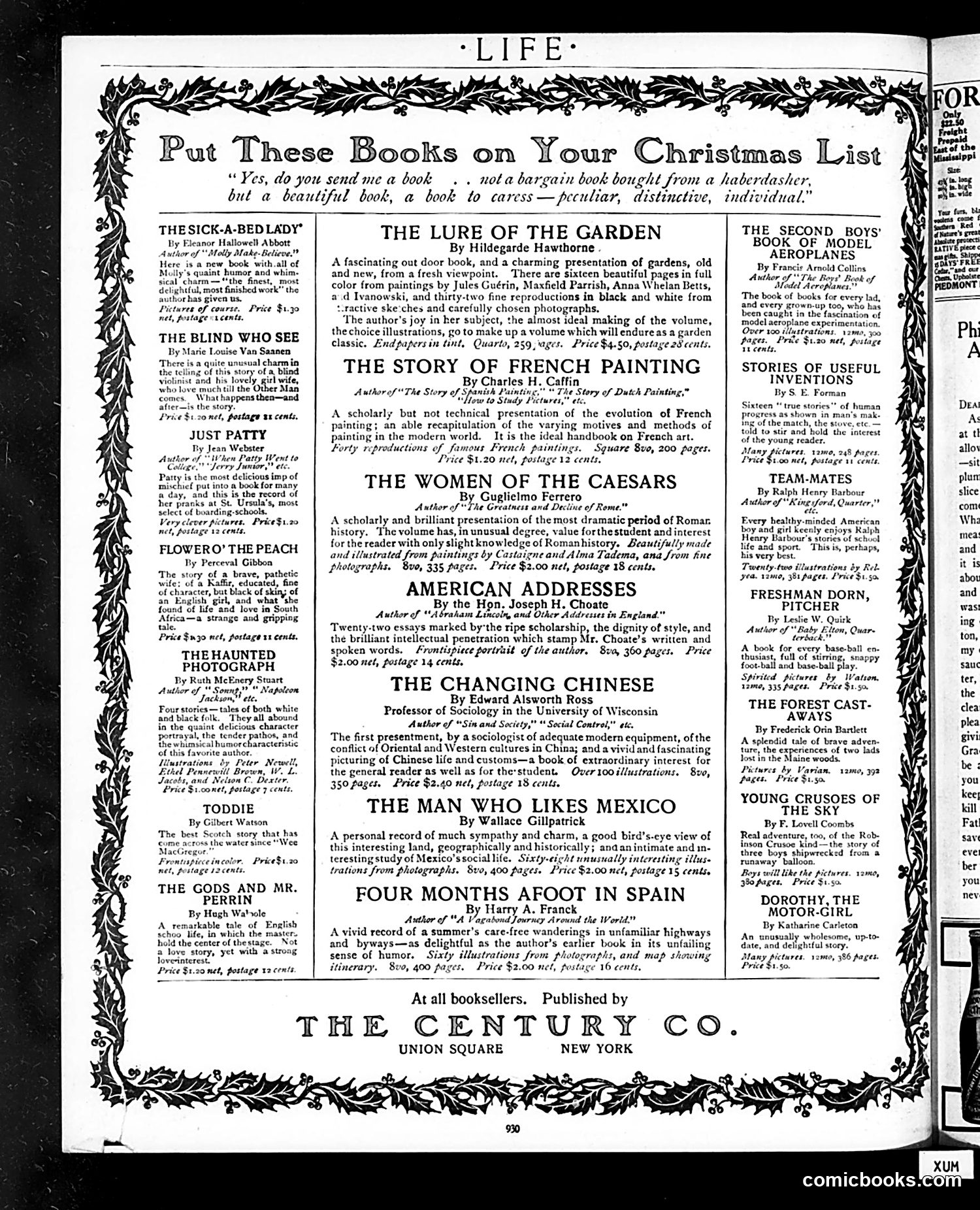
This is not a political cartoon page but rather a **book advertisement section** from Life magazine. The page is titled "Put These Books on Your Christmas List" and features approximately 20 book recommendations from The Century Company publisher, arranged in columns. The books cover diverse subjects including gardening, art history, painting techniques, biography, travel narratives, and fiction. Notable titles include "The Lure of the Garden," "The Story of French Painting," and "Four Months Afoot in Spain." Rather than satire or political commentary, this represents early 20th-century publishing promotion, offering gift suggestions to Life's educated, affluent readership. The decorative holly border reinforces the Christmas holiday theme.
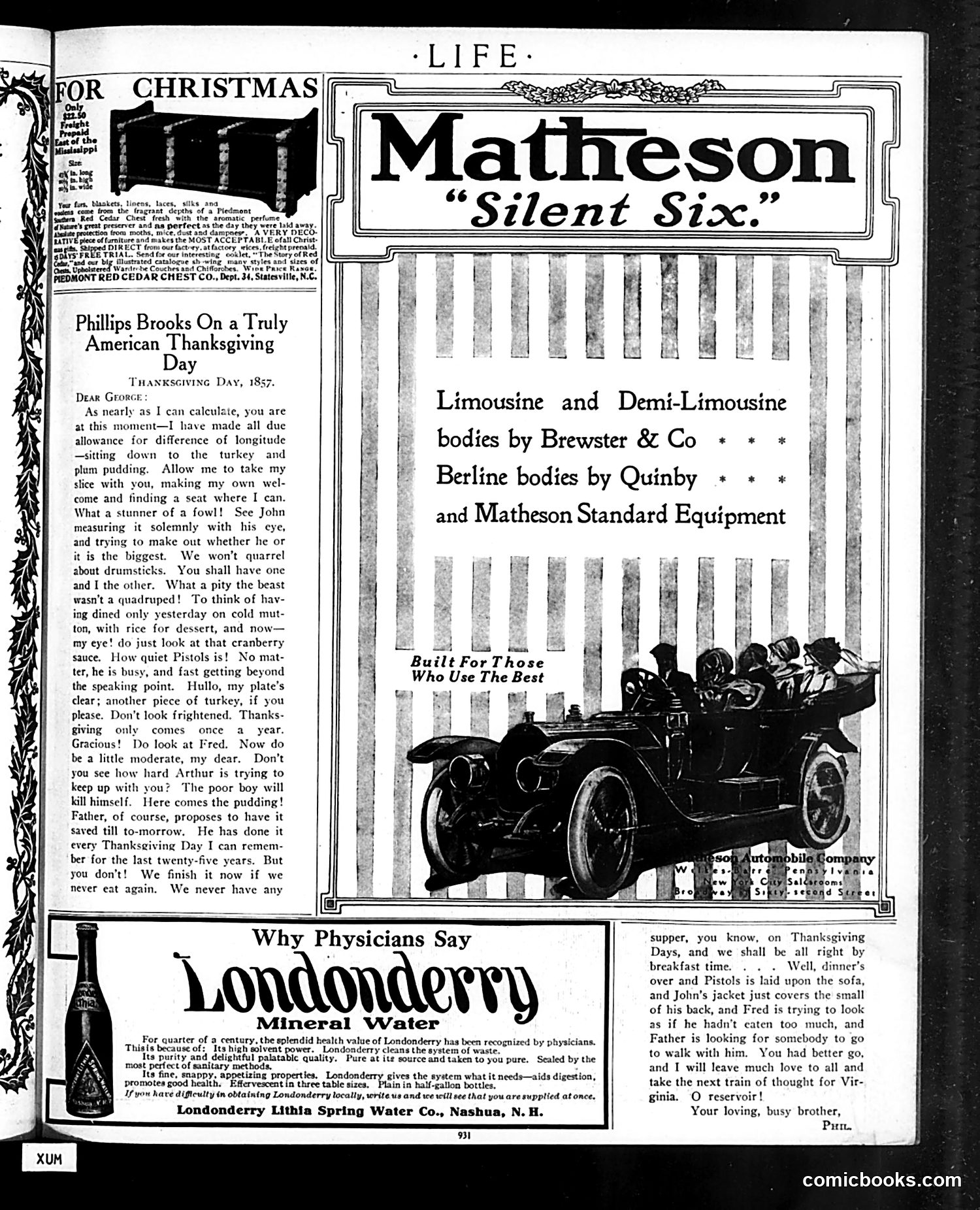
This page is primarily **advertising** rather than political cartoons. The main content includes: 1. **Matheson "Silent Six" automobile ad** - featuring a limousine with Brewster & Co. and Quinby bodies, marketed as "Built For Those Who Use The Best" 2. **"Phillips Brooks On a Truly American Thanksgiving Day"** - a personal letter dated 1857 from what appears to be a historical figure, humorously describing preparing turkey and discussing family dinner dynamics, including complaints about drumsticks and overeating 3. **Londonderry Mineral Water ad** - promoting health benefits endorsed by physicians The Thanksgiving letter provides gentle period humor about family gatherings and food rather than political satire. No identifiable political figures or contemporary events are referenced on this page.
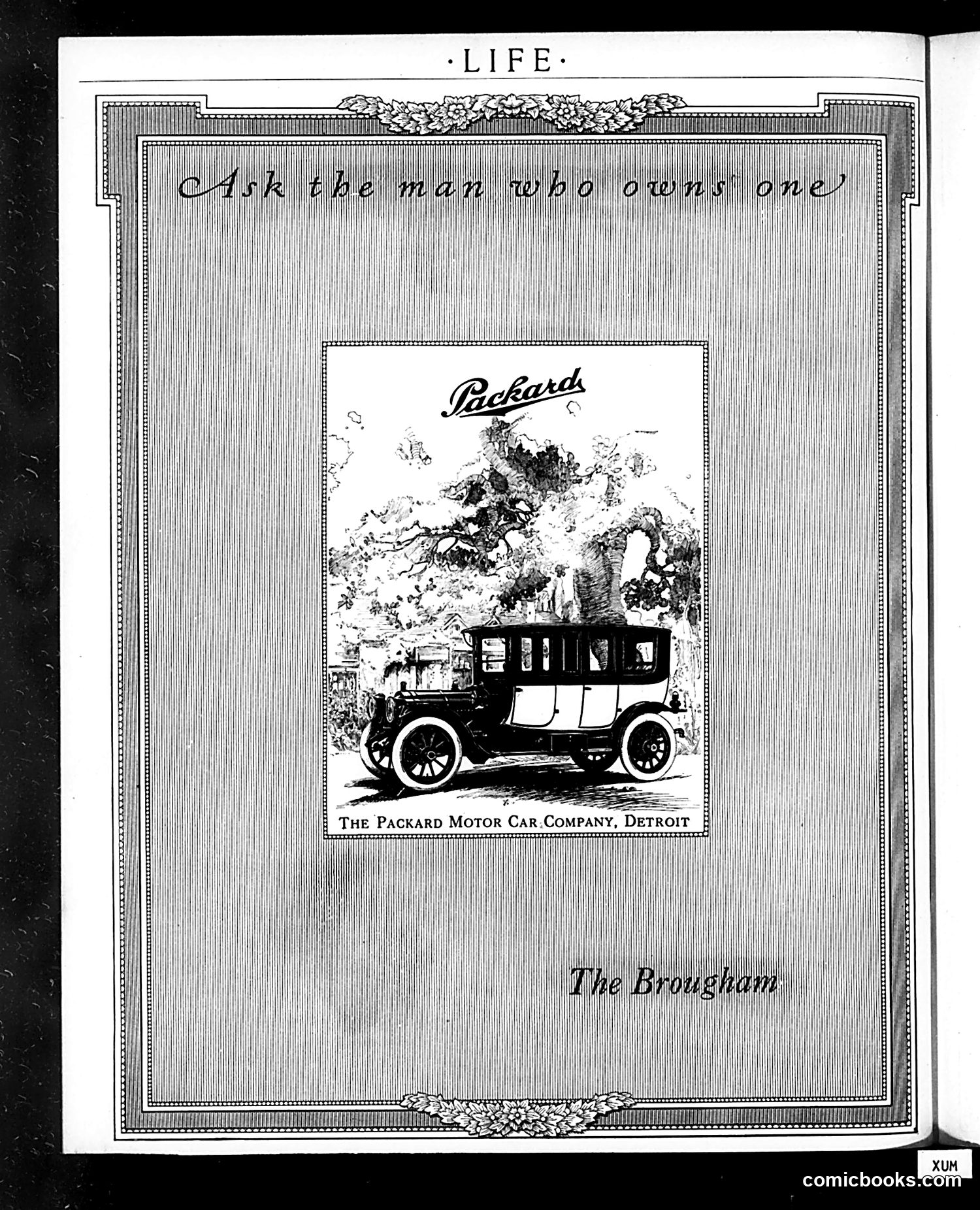
This page is primarily a **Packard automobile advertisement**, not political satire. The ad features "The Brougham," a Packard Motor Car model made by the Detroit-based company. The top text reads "Ask the man who owns one"—Packard's famous advertising slogan from this era, implying customer satisfaction and reliability. The illustration shows an early 1900s touring car with passengers against a decorative background. The ornate border and "Life" magazine header indicate this ran in the satirical publication, but the content itself is straightforward commercial advertising. There is no apparent political commentary or social satire on this particular page—it's simply a high-end automobile advertisement targeting wealthy readers of Life magazine.
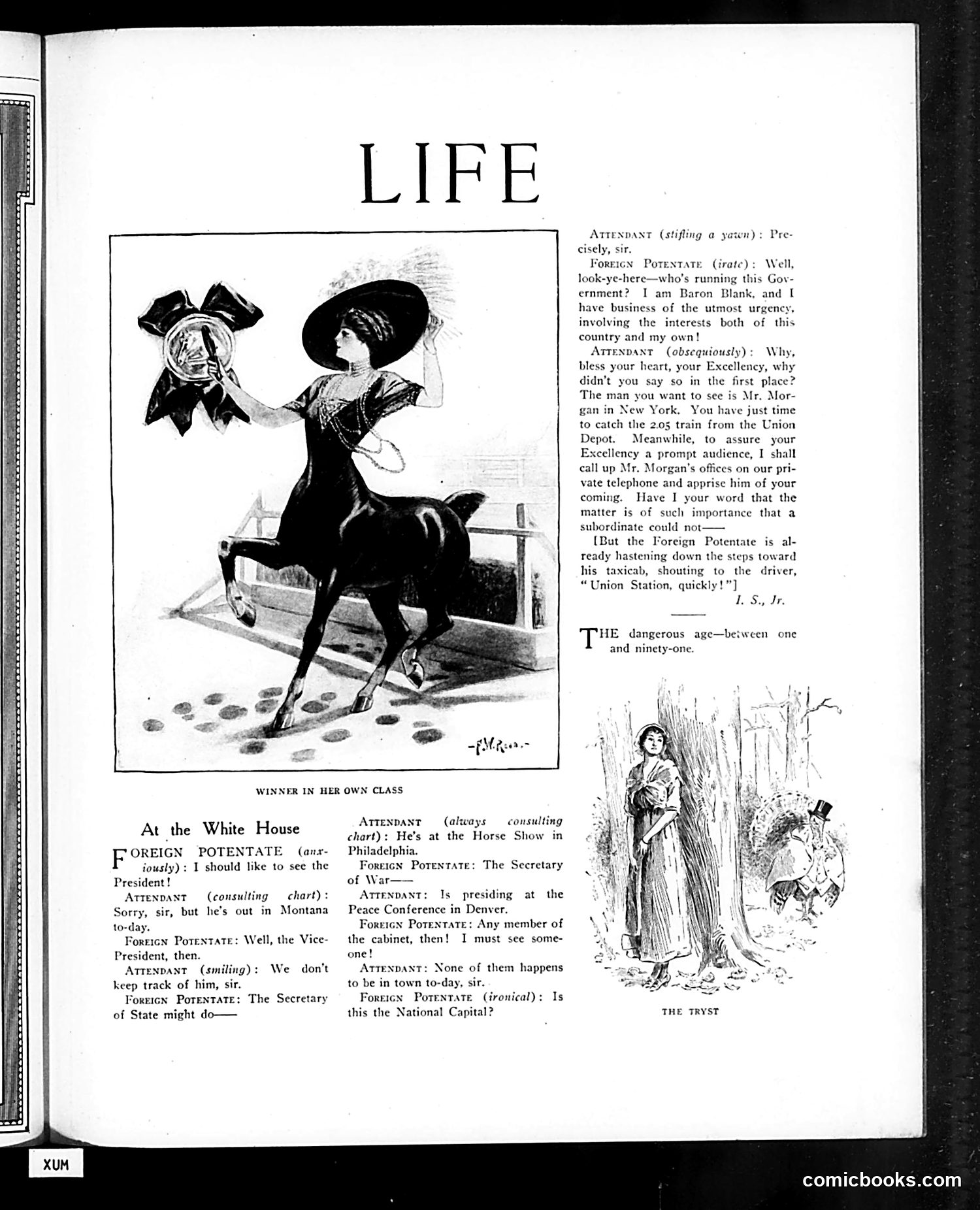
This page contains two separate comedic sketches satirizing American government and social pretension. **"Winner in Her Own Class"** shows a woman on horseback labeled "Foreign Potentate" (a visiting dignitary), competing in what appears to be a show-jumping event. The satire mocks how the U.S. government scrambles to accommodate foreign visitors—an attendant mentions calling Mr. Morgan's office and catching trains to impress the visiting official. The joke suggests America treats foreign dignitaries with excessive deference while ignoring domestic concerns. **"At the White House"** depicts bureaucratic confusion, with an attendant unable to locate the President, Vice President, or any cabinet members to meet a visiting foreign official. The satire critiques governmental disorganization and unavailability during important diplomatic occasions. Both pieces mock American political priorities and administrative inefficiency.
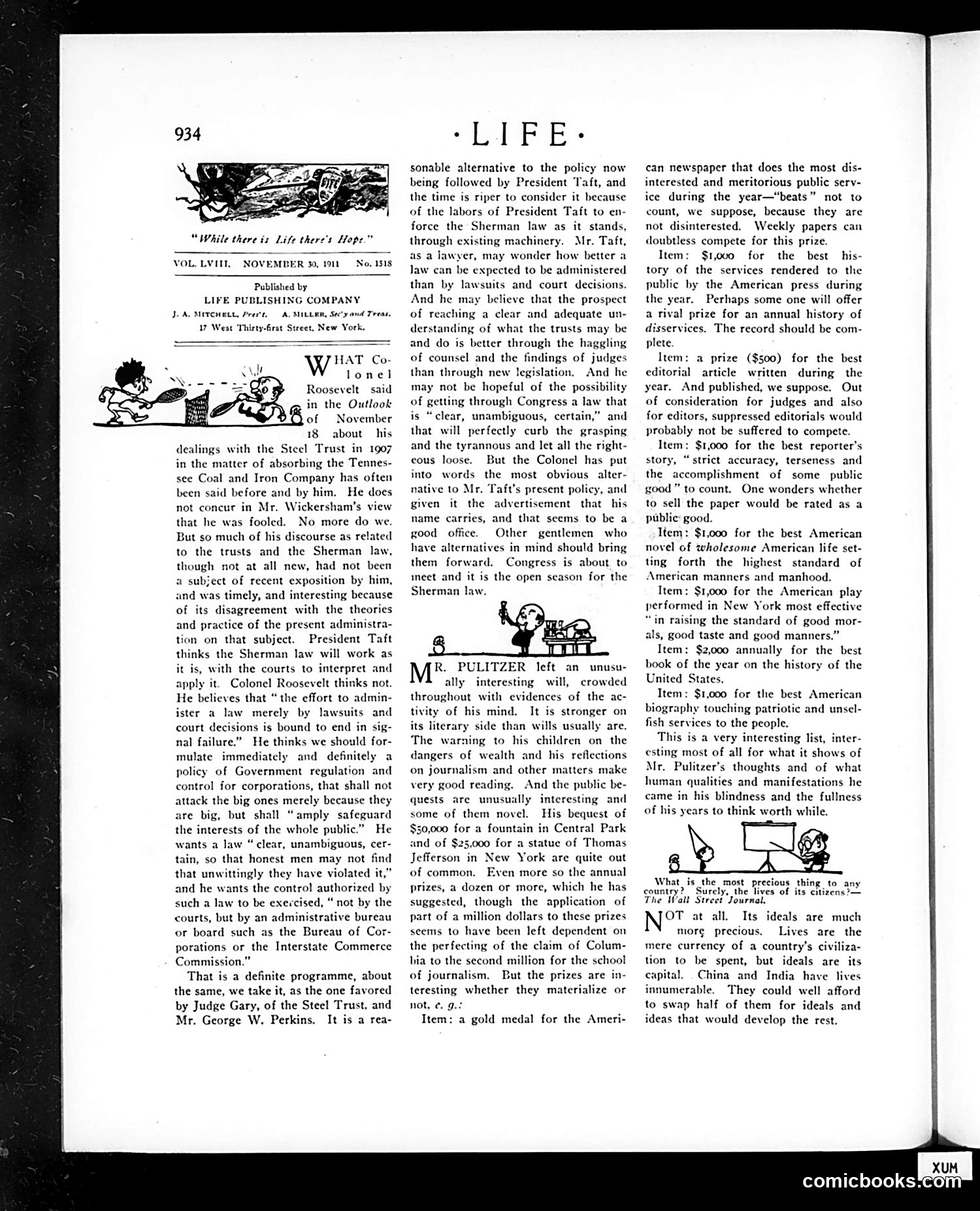
This page discusses Colonel Roosevelt's views on the Sherman Antitrust Law and trust regulation. The text contrasts Roosevelt's approach with President Taft's policy, suggesting Roosevelt favors administrative action over lawsuits and court decisions to control corporate trusts. The cartoon depicts **Mr. Pulitzer** (identifiable by the caption), described as having an "unusually interesting will" that is "stronger on its thrifty side than wills usually are." The satire references Pulitzer's substantial bequests—$500,000 for a fountain and $25,000 for a Thomas Jefferson statue—highlighting the contrast between his wealth and the prizes he established for journalism and literature. The broader context involves debates over how government should regulate large corporations during the Progressive Era.
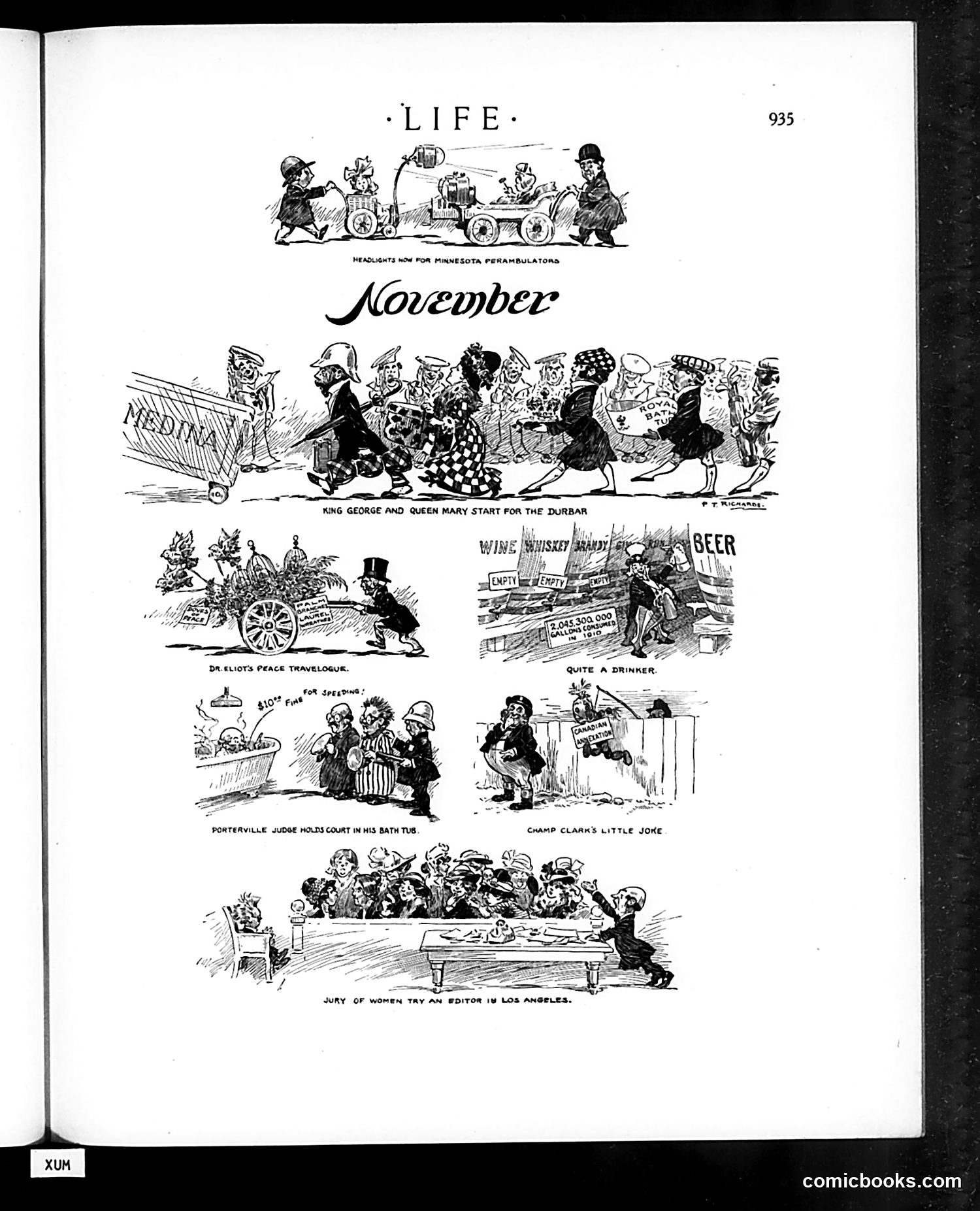
This page presents seven satirical cartoon vignettes commenting on November 1920s events and figures. The cartoons include: 1. "Headquarters Now for Minnesota Perambulators" - appears to reference Minnesota politics 2. "King George and Queen Mary Start for the Durbar" - British royalty's travel plans 3. "Dr. Eliot's Peace Travelogue" - likely Harvard president Charles Eliot's peace advocacy 4. "Quite a Drinker" - Prohibition-era commentary showing alcohol smuggling 5. "Ponterville Judge Holds Court in His Bath Tub" - judicial humor 6. "Champ Clark's Little Joke" - former House Speaker Champ Clark 7. "Jury of Women Try an Editor in Los Angeles" - women's expanded legal participation The cartoons employ exaggerated caricature and situational humor to satirize contemporary political figures, legal developments, and social changes of the period, particularly Prohibition and women's evolving civic roles.
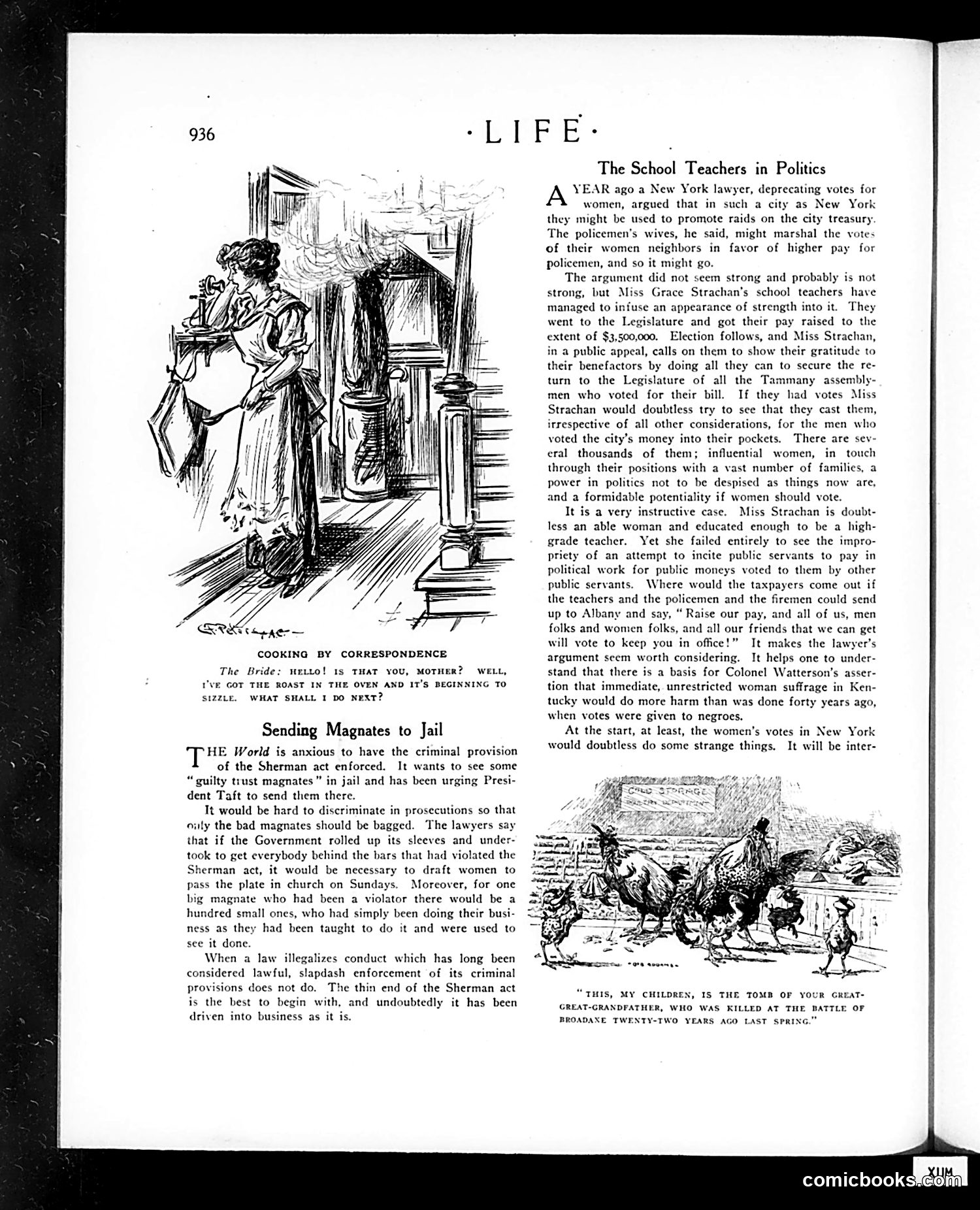
This satirical piece critiques Miss Grace Strachan's effort to lobby the New York legislature for a $1.5 million pay raise for teachers. The cartoon (top left) shows a woman apparently cooking or preparing something at a stove—illustrating the caption's joke about women being manipulated through domestic labor ("cooking by correspondence"). The article mocks Strachan for failing to recognize the impropriety of using public servants (policemen, firemen) to lobby elected officials with taxpayer money. The author argues this political maneuver—however well-intentioned—represents dangerous precedent: if organized groups can deploy public employees to influence legislation, democratic accountability becomes compromised. The cartoon at bottom right appears unrelated, depicting a historical battlefield scene with the caption about a great-great-grandfather killed at Brandywine.
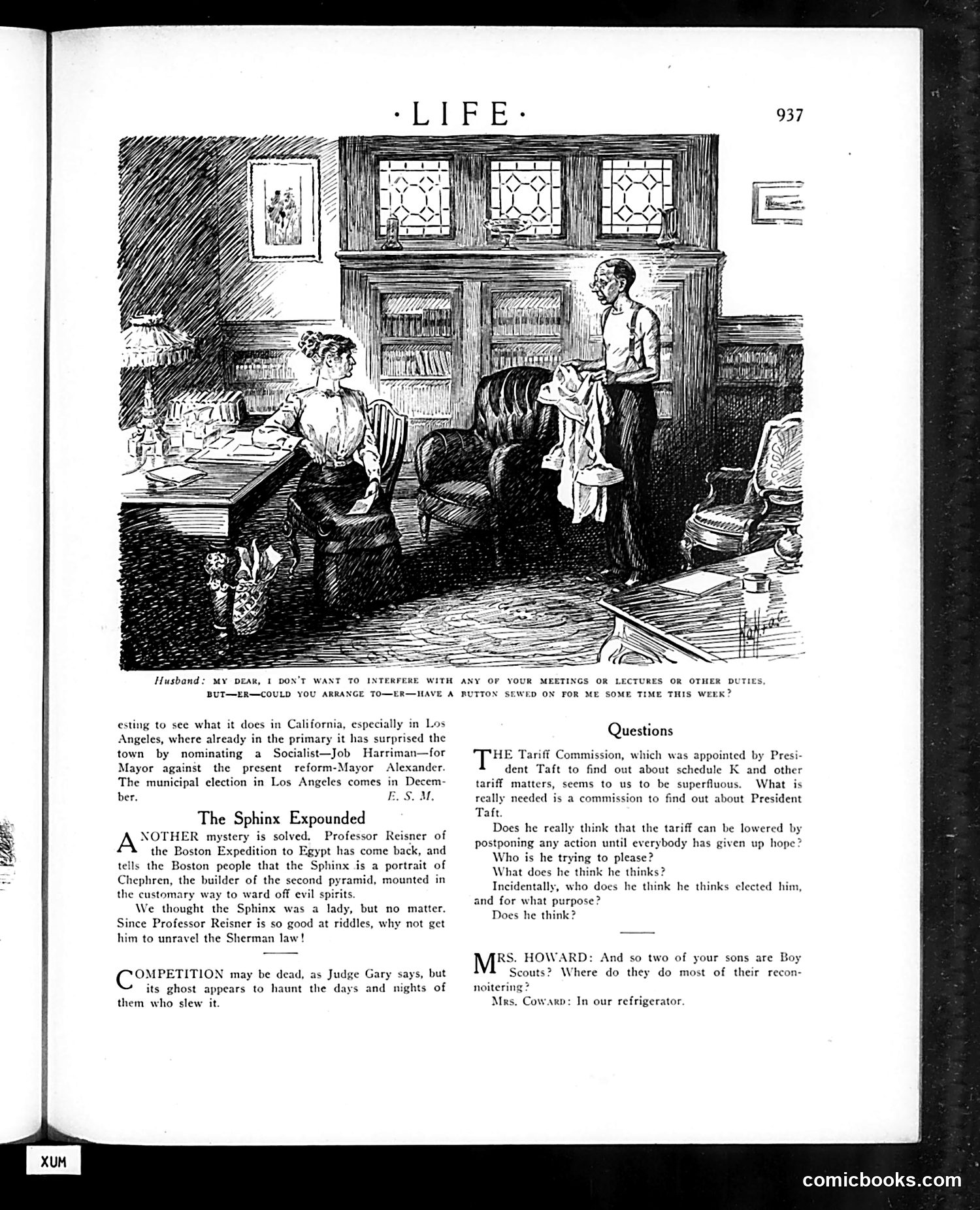
The cartoon depicts a domestic scene where a husband asks his wife to have a button sewn on—a mundane request framed as negotiation. The humor lies in the wife's apparent refusal or delay, with the husband offering to "arrange" time for this simple task, suggesting she's too busy with meetings or lectures to manage basic domestic duties. This satirizes early 20th-century tensions over women's expanding roles. As women increasingly engaged in civic activities, education, and reform movements, traditional domestic responsibilities became points of household friction. The cartoon mocks both the husband's inability to sew and the wife's prioritization of public activities over domestic service—reflecting anxieties about changing gender roles during the Progressive Era.
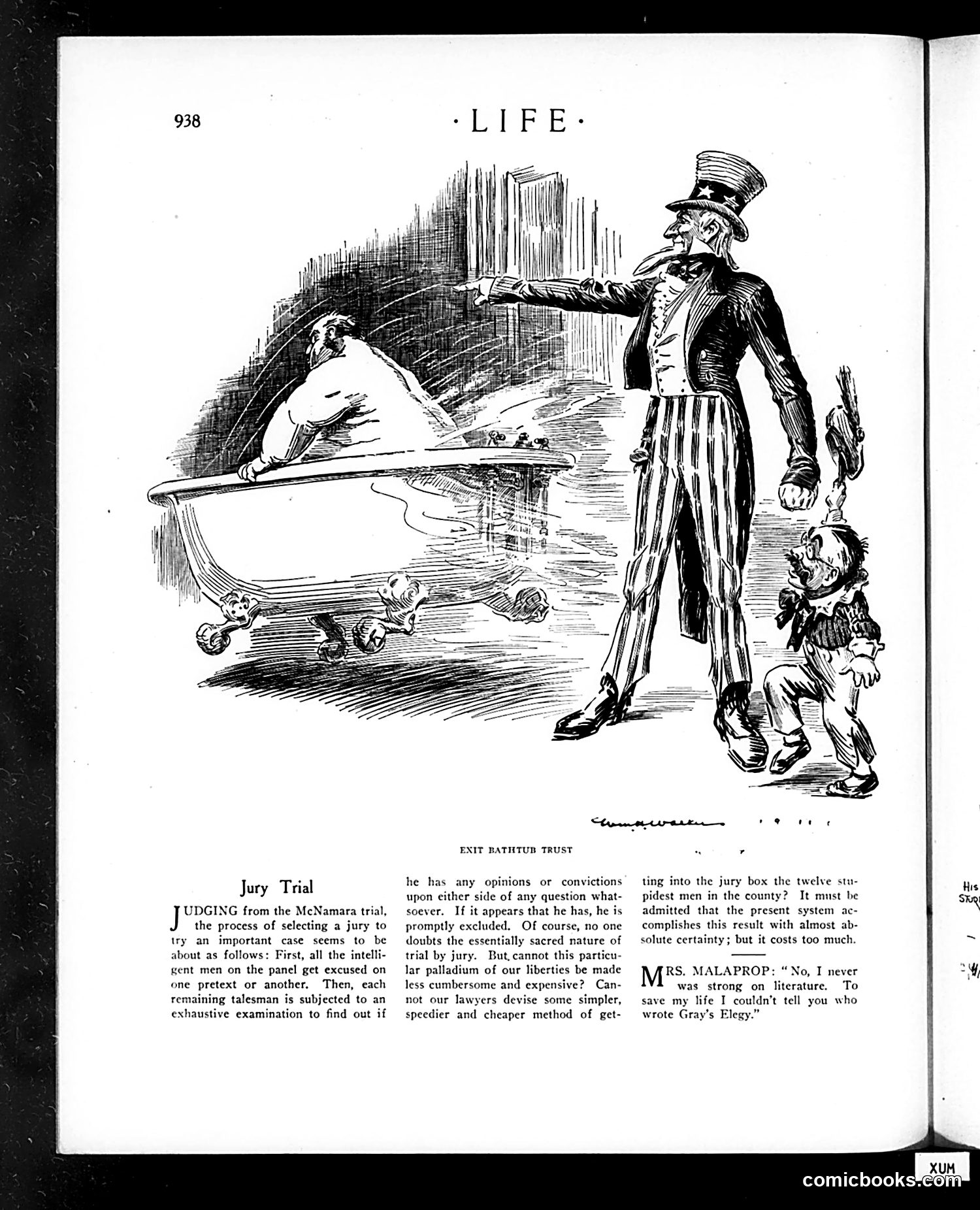
This cartoon satirizes the jury selection process in what appears to be a high-profile trial (the text references the "McNamara trial"). The tall figure in Uncle Sam-style clothing points dismissively at a bathtub, while a small child looks on. The "bathtub trust" likely refers to unsafe bathtub manufacturing or design—a contemporary consumer safety scandal. The satire critiques how jury selection systematically excludes intelligent, opinionated citizens, leaving only the most naive or uninformed ("the twelve stupidest men in the county," as the text notes). The bathtub becomes a symbol of how poorly-informed juries fail to protect public safety, making them tools rather than guardians of justice.
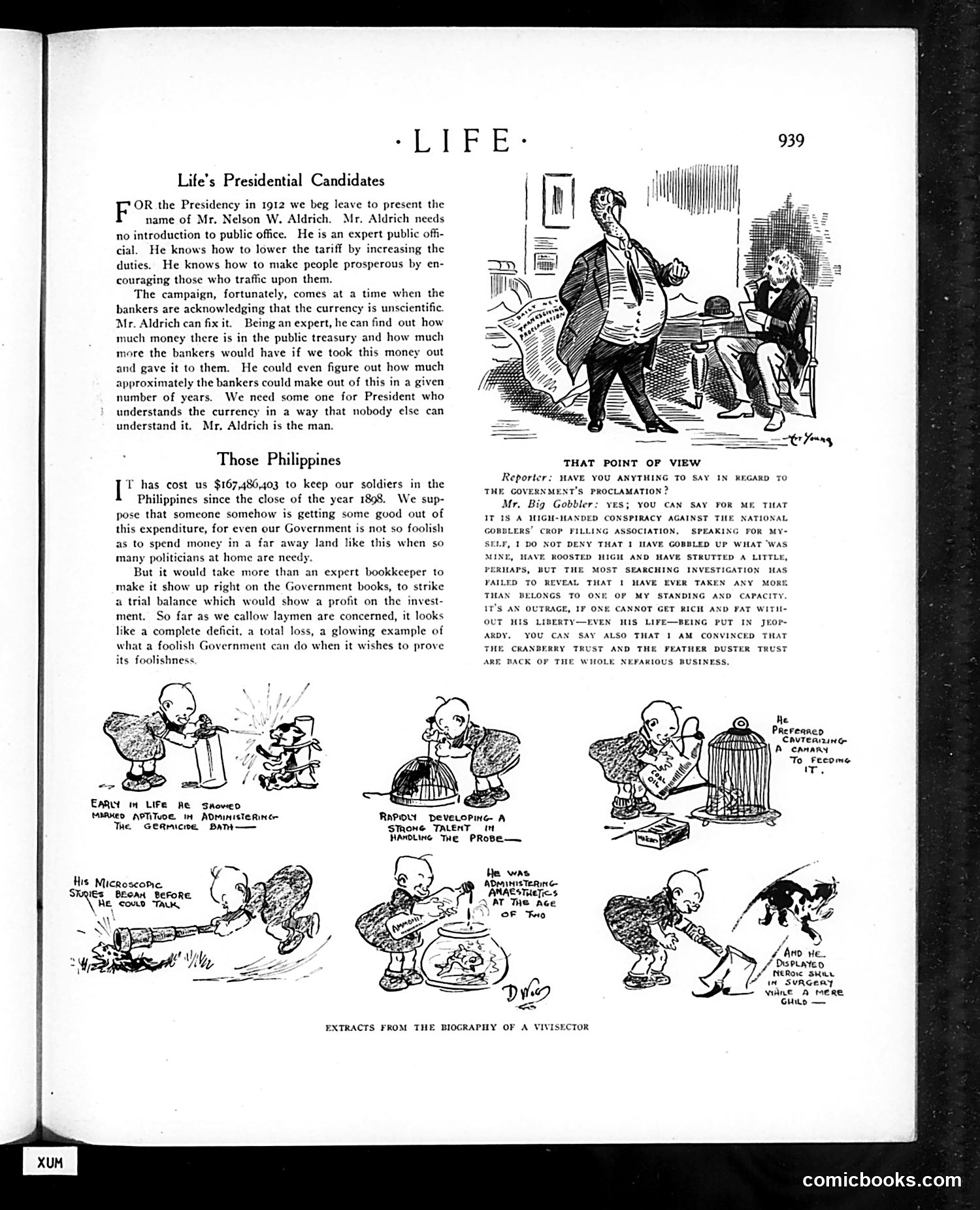
This 1912 political satire promotes Nelson W. Aldrich as a presidential candidate. The text praises his expertise in tariffs and currency—issues vital to bankers and economists. The top cartoon depicts Aldrich meeting with what appears to be a banker or financier, suggesting his close ties to wealthy interests. The bottom section, "Extracts from the Biography of a Vivivisector," uses dark humor to satirize Aldrich's character through a series of crude cartoons showing a baby-like figure engaged in increasingly disturbing behavior—from harming animals to conducting experiments. The term "vivivisector" (one who dissects living things) is a caustic metaphor for someone willing to harm others for gain, implying Aldrich ruthlessly pursued financial and political power regardless of consequences.
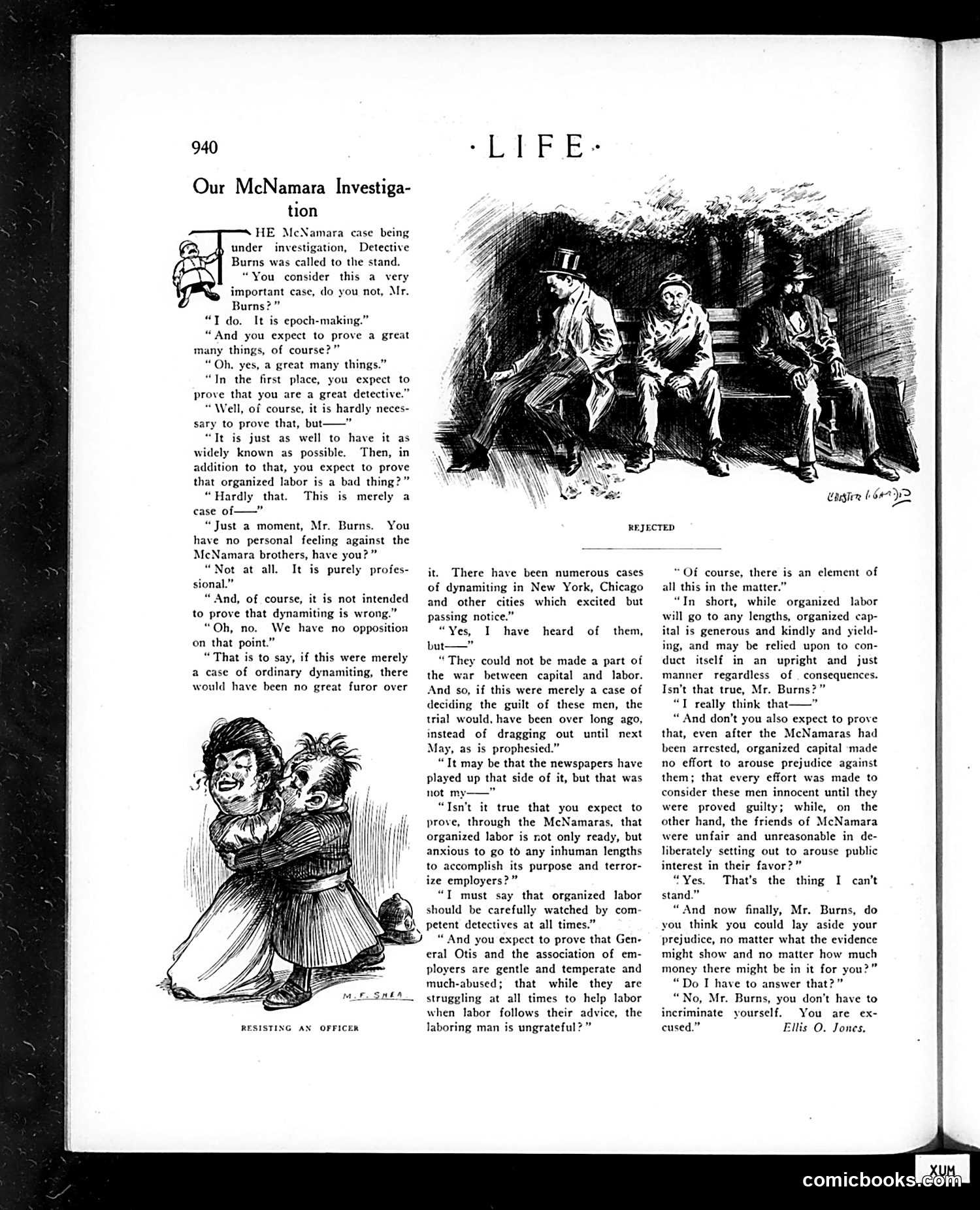
This page satirizes a legal proceeding involving the McNamara brothers. The text shows Detective Burns being questioned about whether he can prove organized labor committed dynamiting and terrorism. The dialogue mocks Burns's inflated expectations—he claims he'll prove labor is "bad," that it resorts to violence, and that it's "ungrateful" despite capital's benevolence. The cartoon titled "RESISTING AN OFFICER" (lower left) depicts someone violently resisting arrest, likely commentary on labor unrest. The satire targets both Burns's bias against organized labor and the broader debate over who bears responsibility for industrial violence. Life suggests Burns enters the investigation prejudiced, and that proving the McNamaras guilty won't settle fundamental labor-capital conflicts.
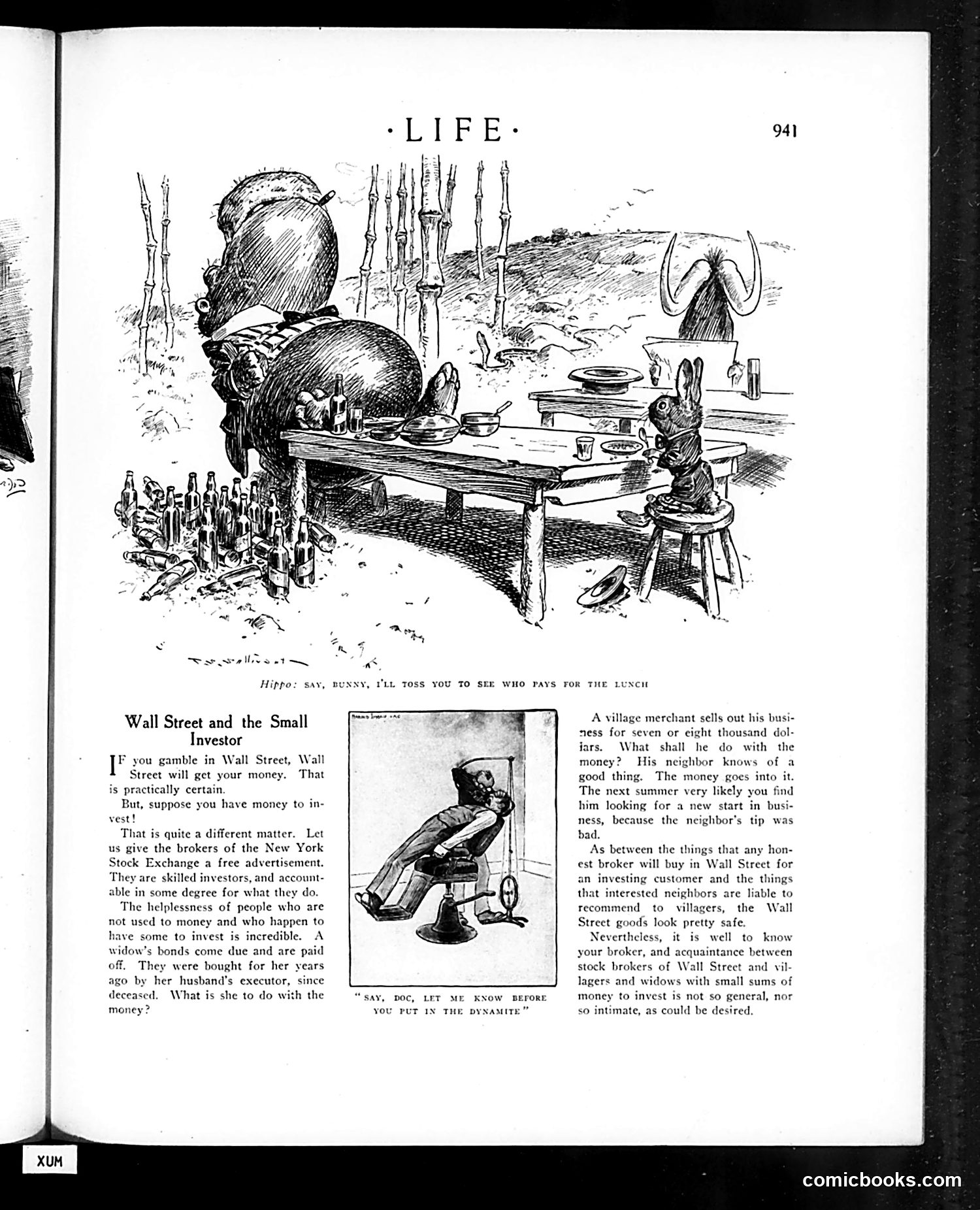
This satirical piece uses two cartoons to critique investment practices. The top cartoon shows animals at a dining table—likely representing foolish investors—gambling over who pays for lunch, suggesting casual financial recklessness. The bottom illustration depicts a man in a chair being pitched a dubious "dynamite" investment tip, captioned to warn investors before committing funds. The accompanying article argues that while professional Wall Street brokers are "skilled investors," ordinary people—widows managing inherited bonds, village merchants with sudden capital—are vulnerable to bad advice. The satire's point: unsophisticated investors lack connections to trustworthy brokers and instead rely on well-meaning but ignorant neighbors' tips, leading to financial losses. The piece advocates for better access between small investors and legitimate Wall Street firms, not because Wall Street is altruistic, but because its regulated brokers are preferable to amateur "tips."
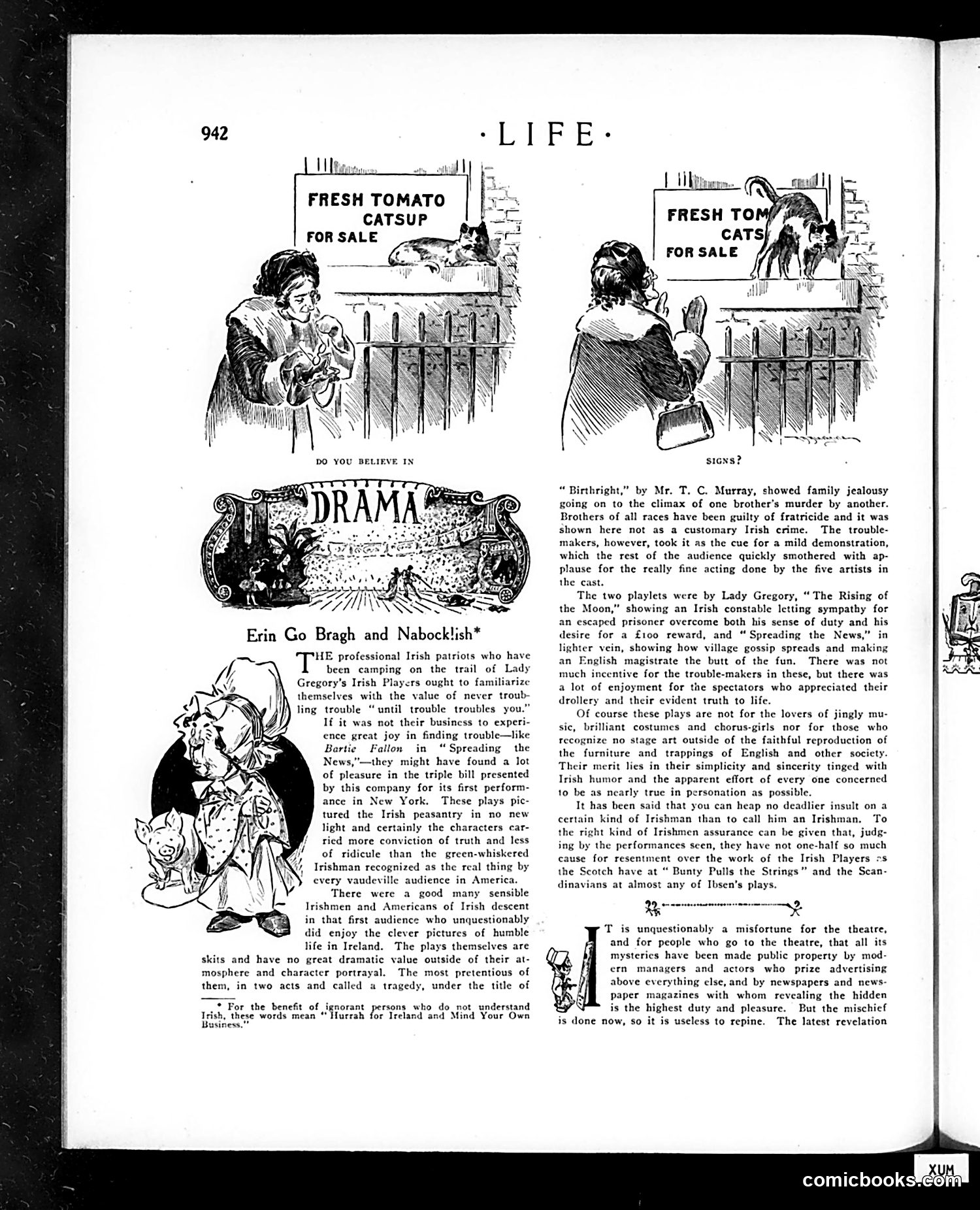
The top cartoons satirize misread signs: a woman sees "Fresh Tomato Catsup for Sale" but reads it as "Cats for Sale" (visual pun on poor eyesight or distraction). The humor is wordplay—the absurdity of selling cats like condiments. The main article reviews Lady Gregory's Irish Players' New York debut. It defends the theatrical troupe against Irish-American protesters who objected to the plays' portrayal of Irish peasant life. The reviewer argues the plays show authentic, humble Irish characters with "conviction of truth"—not the stereotypical "green-whiskered Irishman" of American vaudeville. The piece explains that some Irish-Americans found "Birthright" (depicting fratricide) offensive, but the audience applauded the "fine acting." The reviewer suggests such protesters are overly sensitive, claiming the plays deserve appreciation for their "simplicity and sincerity tinged with Irish humor." **Context**: This reflects early 1900s tensions between Irish immigrants' self-image and artistic representation—complaints that theater reinforced ethnic stereotypes.
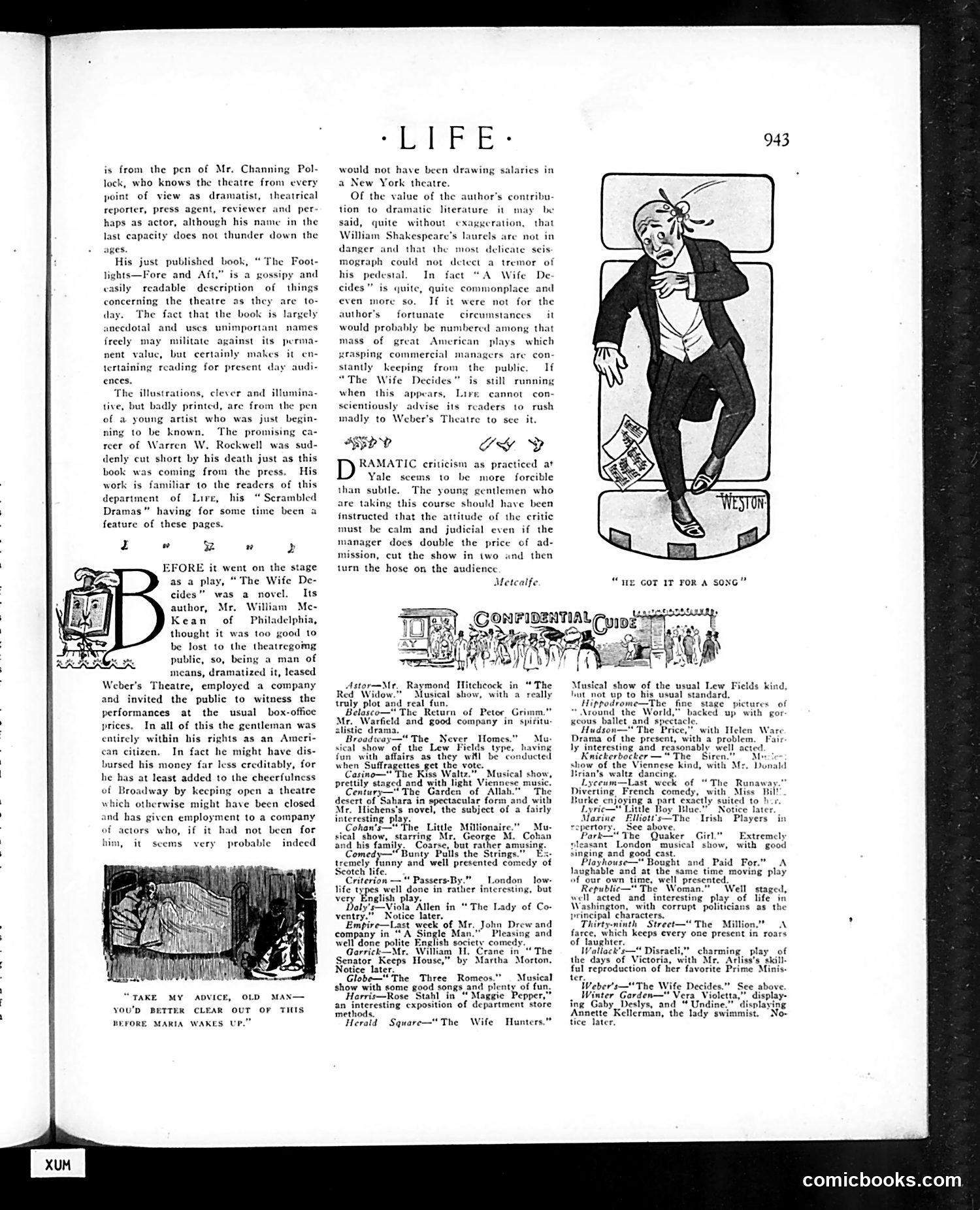
This page from Life magazine (likely early 1900s) contains theatrical criticism and gossip. The main cartoons mock two theatrical situations: **Upper cartoon**: Shows a man ("Weston," labeled "HE GOT IT FOR A SONG") being kicked out by his wife "Maria," illustrating the satirical review of the play "The Wife Decides." The joke is that the play's plot—a domestic squabble—is so trivial and commonplace that even its own defense (the author spent money supporting Broadway) doesn't justify seeing it. **Lower cartoon**: Captioned "TAKE MY ADVICE, OLD MAN—YOU'D BETTER CLEAR OUT OF THIS BEFORE MARIA WAKES UP," reinforces the marital-trouble theme, mocking the play's uninspired domestic drama. The text criticizes both the play's mediocrity (comparing unfavorably to Shakespeare) and Yale's overly harsh dramatic criticism. The page primarily serves as entertainment-industry commentary for Life's sophisticated urban readership, using domestic conflict as satirical fodder.
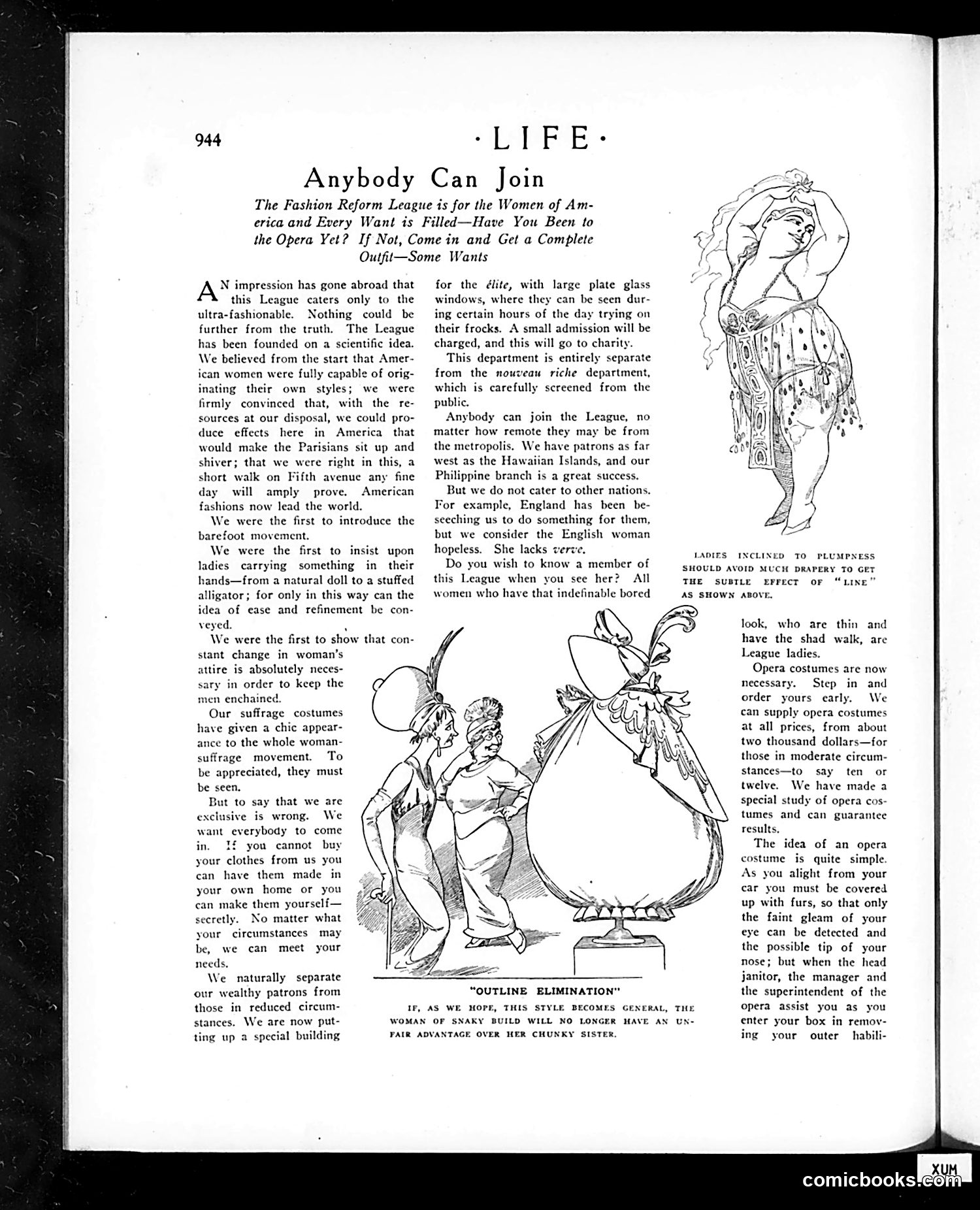
This Life magazine piece satirizes the Fashion Reform League, a real organization promoting American fashion independence from Paris. The satire mocks the League's contradictory claims of democratic inclusivity while maintaining strict class hierarchies. The text claims "anybody can join" yet describes elaborate segregation: a separate building for the wealthy elite with viewing windows, entirely screened from the "nouveau riche department." The absurdist humor peaks in costume advice—women must be completely covered in furs at the opera "so that only the faint gleam of your eye can be detected," rendering the expensive costume invisible. The cartoons illustrate the fashionable silhouettes the League promotes: exaggerated "outline elimination" for plump women and the thin, slouched posture deemed desirable. The satire targets both pretentious American fashion nationalism and the arbitrary, constantly-changing standards imposed on women—all presented with deadpan sincerity that exposes the League's fundamental hypocrisy.
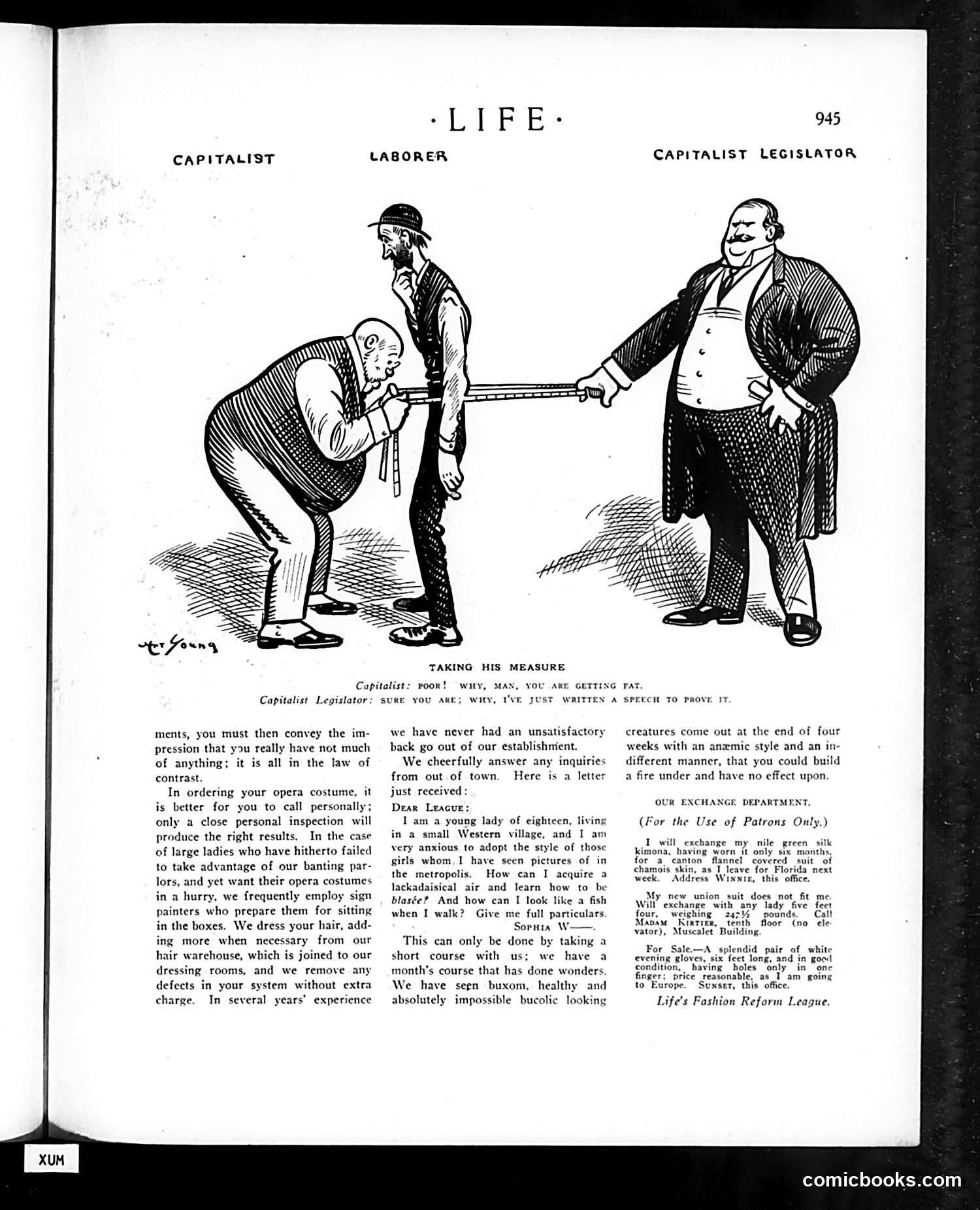
This cartoon satirizes class inequality and political hypocrisy during the Industrial Age. The image depicts three figures: a thin, impoverished **Laborer** being measured by a **Capitalist** (bent over, examining him), while a rotund **Capitalist Legislator** watches approvingly. The caption's bitter joke: the Capitalist says the Laborer is "getting fat," while the Legislator boasts he's "just written a speech to prove it"—suggesting politicians fabricate false justifications for economic conditions benefiting the wealthy. The satire targets how legislation serves capitalist interests rather than workers' welfare. By claiming the laborer is "getting fat" (prospering), the legislator provides propaganda cover for exploitative practices. The visual contrast—skinny worker, bloated politician—underscores the irony. This reflects turn-of-century labor movement critiques of corrupt politician-capitalist collusion to maintain worker exploitation while claiming everyone benefits.
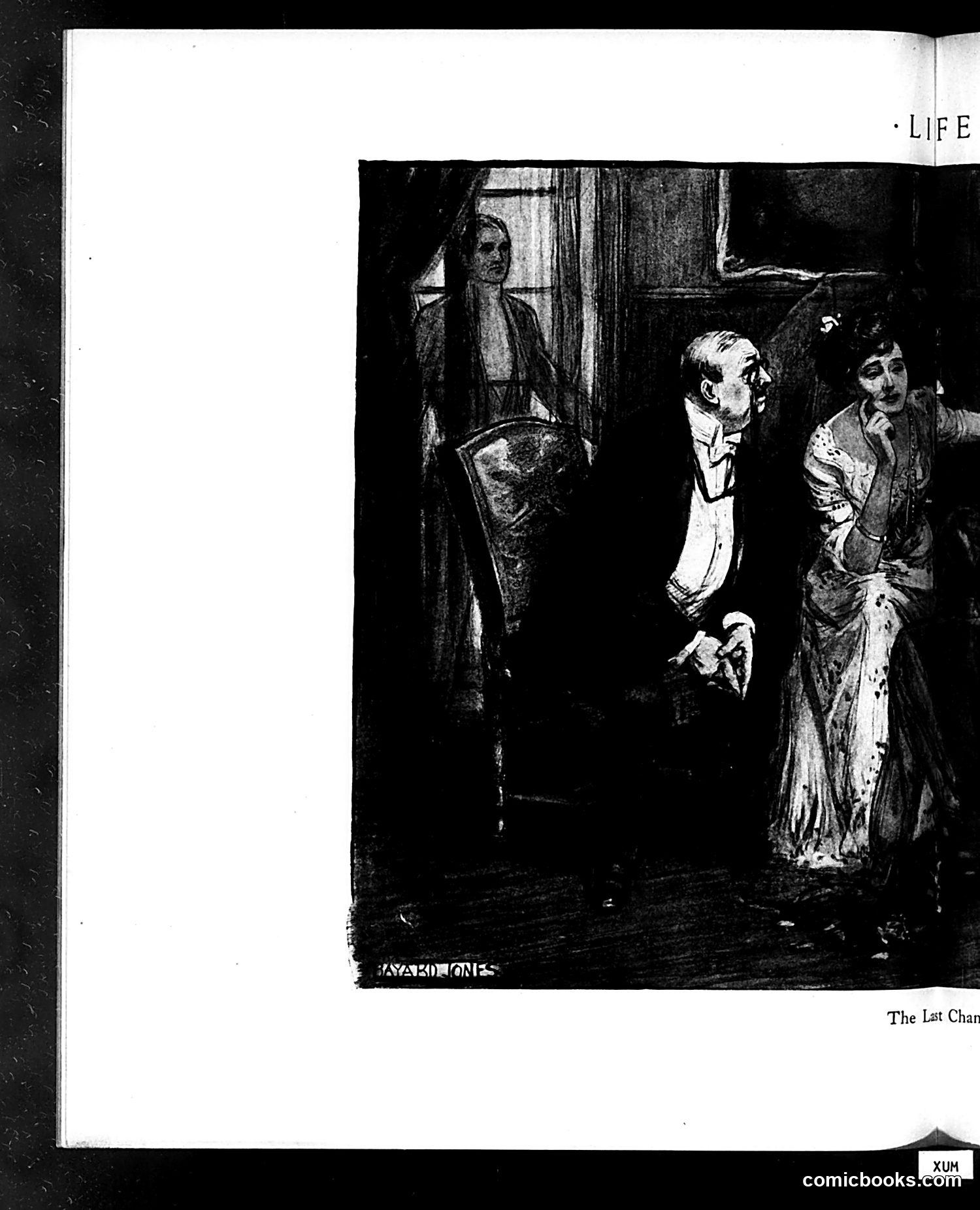
This page from *Life* magazine shows a dark, dramatic illustration labeled "The Last Chan" (text appears incomplete or unclear). The image depicts what appears to be an interior scene with three figures: a man in formal dress (white shirt, dark jacket) who is the apparent focus, a woman on the right in period clothing, and a shadowy figure in the background near a doorway. The incomplete caption and OCR errors make the specific reference unclear. However, the theatrical, noir-like aesthetic and formal dress suggest this may reference a dramatic scene from literature, theater, or current events of the era. Without clearer text or additional context, I cannot definitively identify which "Chan" figure is referenced or what satirical point is being made. The style suggests early-to-mid 20th century satirical commentary, but the exact target remains uncertain from this page alone.
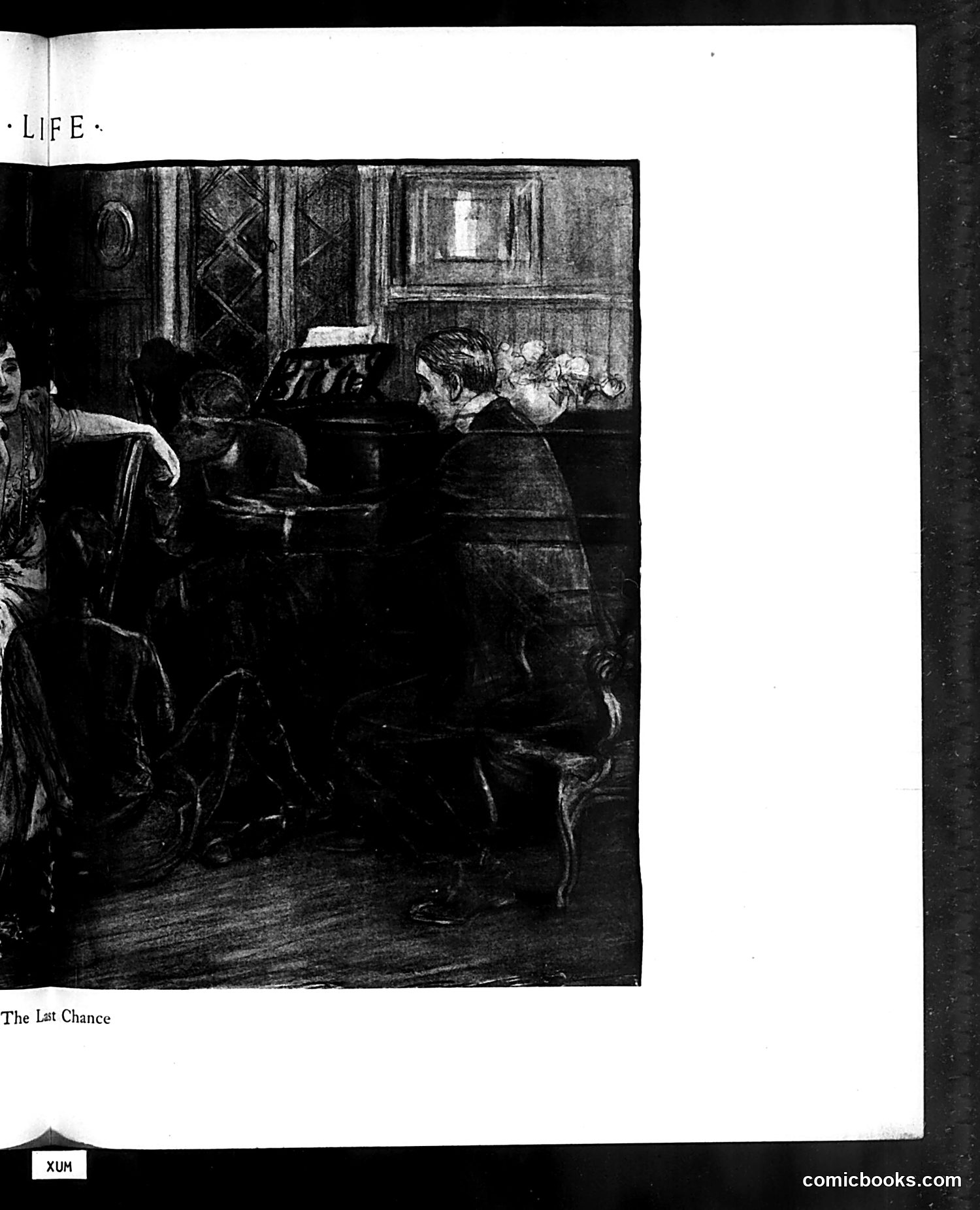
This Life magazine page shows a satirical illustration titled "The Last Chance." The black-and-white drawing depicts what appears to be an interior domestic scene with several figures gathered around a piano. The composition suggests a social gathering or musical performance. Without additional context or clearer identification of the specific figures depicted, the exact political or social commentary remains unclear from the image alone. The title "The Last Chance" implies commentary on some final opportunity or moment—possibly romantic, social, or political in nature—but the specific target of satire cannot be definitively determined from what's visible here. The illustration's style is consistent with early-to-mid 20th century American satirical cartooning.
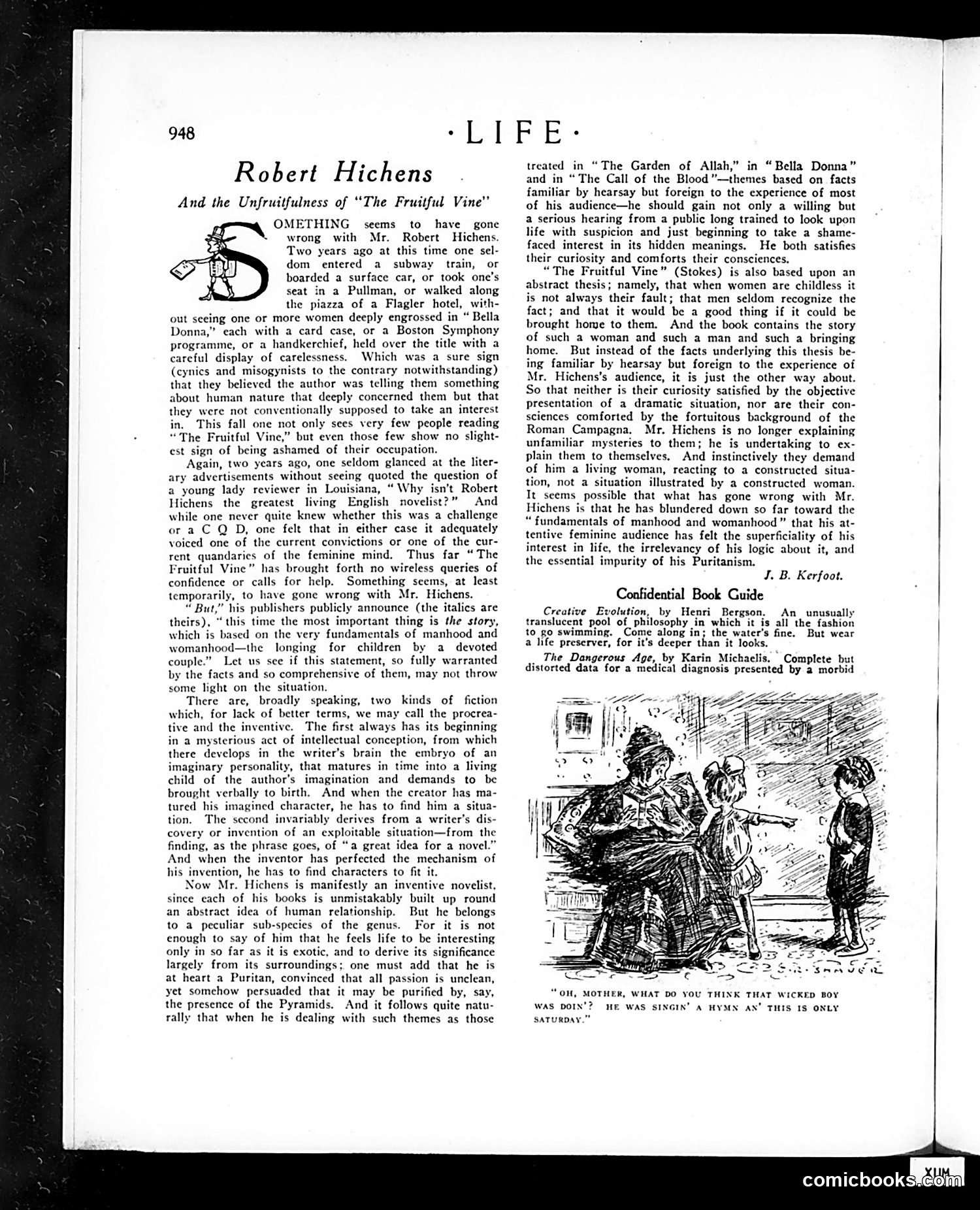
This is a literary essay criticizing novelist Robert Hichens's declining reputation. The piece notes that his earlier novel "Bella Donna" (two years prior) was wildly popular among women readers on public transportation—a status symbol of intellectual engagement. However, his new novel "The Fruitful Vine" has generated no comparable excitement or readership. The essay analyzes Hichens as an "inventive novelist" who builds stories around abstract ideas rather than character development. It argues he's fundamentally a Puritan moralist obsessed with exotic settings (the Pyramids, etc.) who sanitizes passionate themes for his audience. The accompanying illustration shows a domestic scene, likely depicting the novel's central premise about a couple's desire for children—the "fundamentals of manhood and womanhood" his publishers emphasize. The satire suggests Hichens's formula has grown stale.
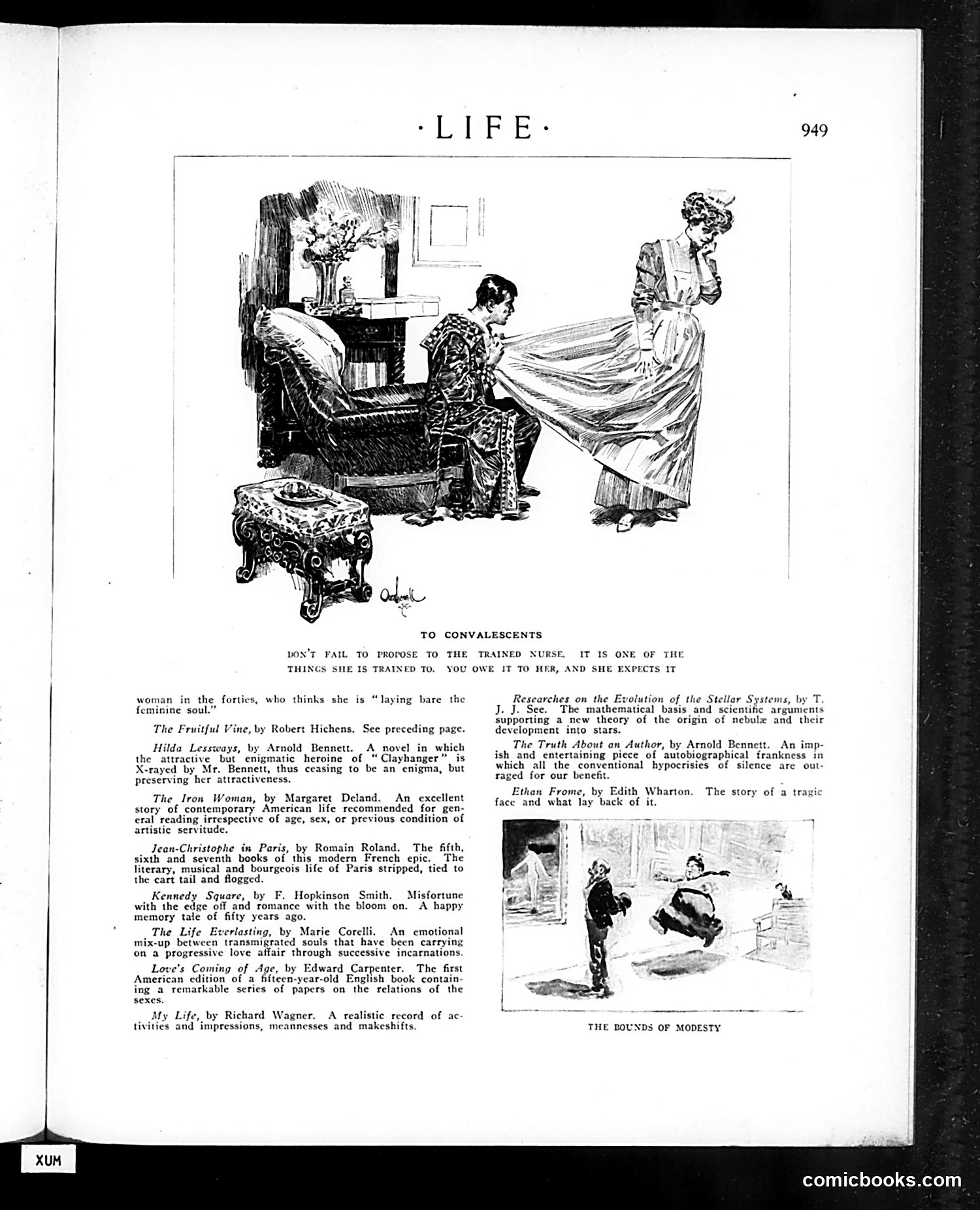
This satirical piece mocks courting conventions among the upper classes. The cartoon shows a young man being urged—by his mother and a trained nurse—to propose to a woman during her convalescence (recovery from illness). The satire targets two social absurdities: First, the expectation that a man should propose to a nurse as repayment for her professional care—treating her trained service as a debt requiring marriage. Second, the artificiality of courtship rituals where vulnerable moments (illness) were exploited as opportunities for romantic advancement. The accompanying caption, "The Bounds of Modesty," suggests irony: the scenario represents a breach of proper restraint. A woman recovering is in no position to refuse, making the proposal inherently manipulative despite claims of propriety. The book reviews below provide context for the page's literary focus on examining romantic and social relationships of the era.
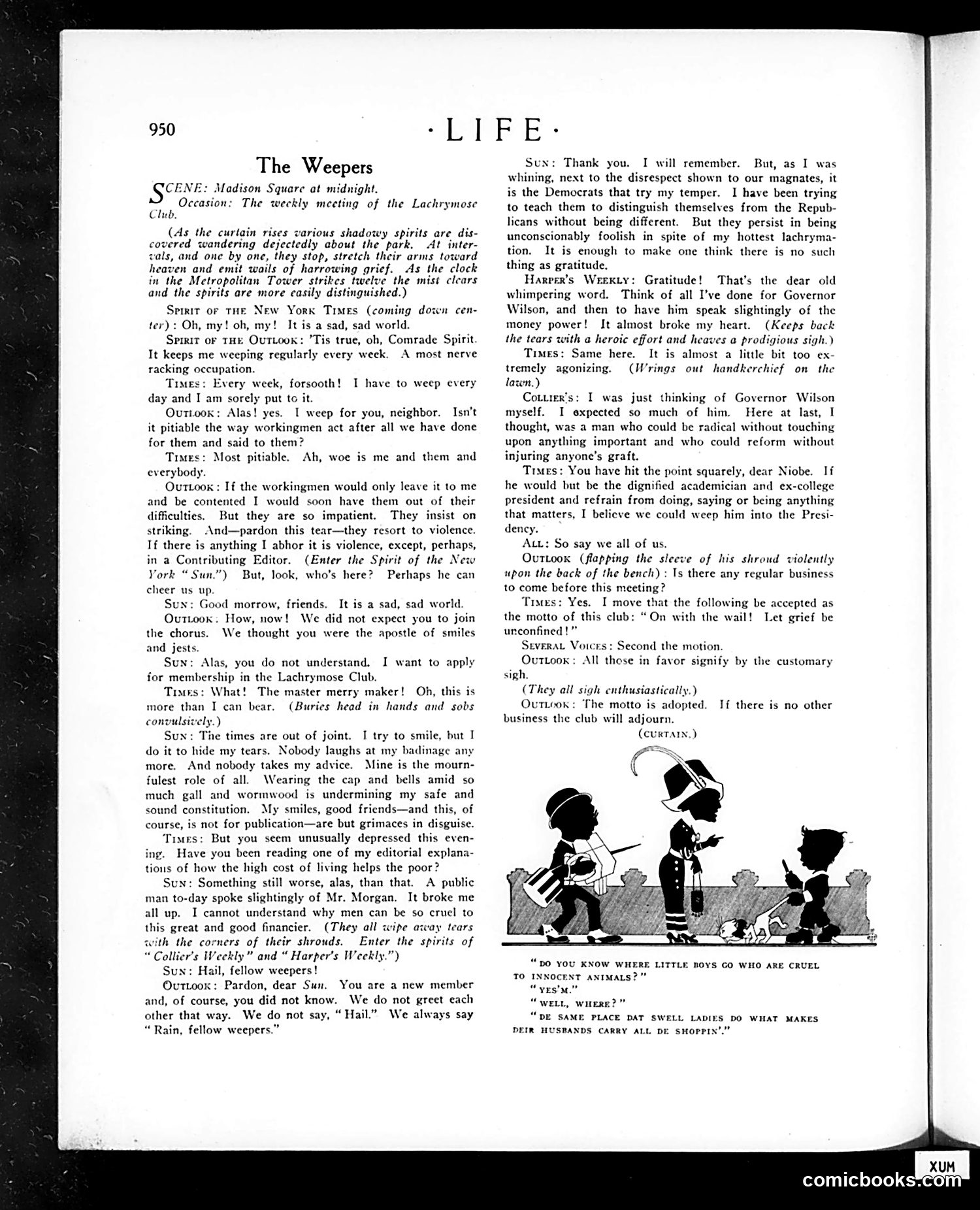
This satirical scene mocks major American publications—the *New York Times*, the *Outlook*, the *Sun*, *Collier's Weekly*, and *Harper's Weekly*—as perpetually self-pitying and maudlin. The joke imagines them as spirits gathering nightly to bewail the world's injustices while actually defending corporate interests and the wealthy. The satire targets their contradictions: they claim moral outrage over workers' suffering while criticizing strikes and labor demands. They pose as reformers yet defend J.P. Morgan and business elites. They bemoan the "high cost of living" while resisting solutions. A key moment mocks *Harper's Weekly* for supporting Governor Wilson yet resenting his criticism of "money power." The cartoon's final punchline—a crude exchange between street urchins about "cruel innocent animals" versus "ladies [who] carry all de shoppin'"—suggests these publications' moralizing disguises hypocrisy about class and gender. Life critiques these journals as sentimental frauds, performing grievance while supporting the status quo.
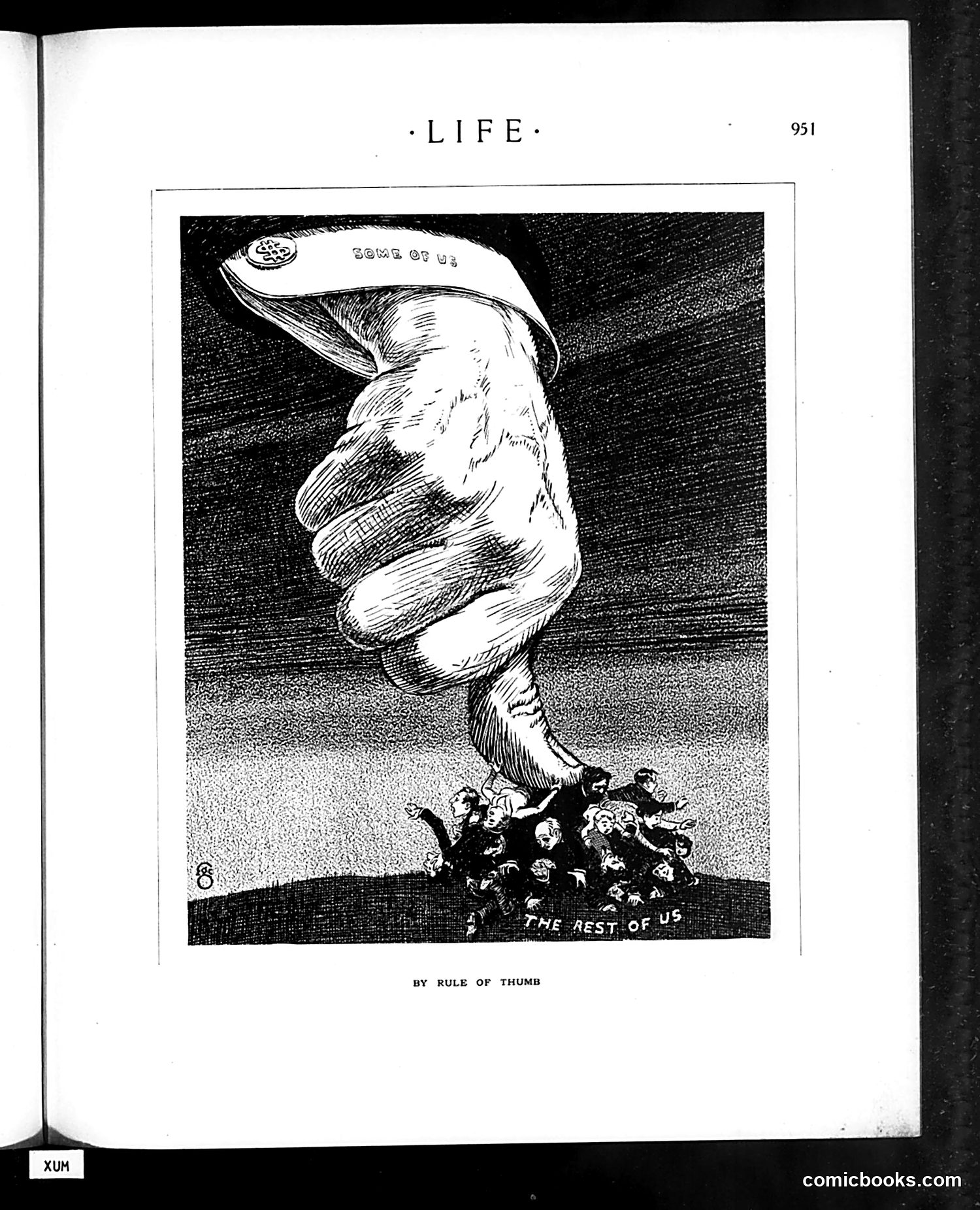
This political cartoon depicts a giant thumb crushing a group of small figures labeled "THE REST OF US." The thumb wears a cap or band marked with text (partially legible as possibly "COME OF US" or similar). The satire criticizes governance "by rule of thumb"—meaning arbitrary, crude decision-making rather than careful deliberation. The enormous thumb represents a powerful authority figure or system making sweeping judgments that harm ordinary people depicted below. Without clearer dating or additional context, the specific political target remains unclear, but the cartoon criticizes authoritarian or tyrannical governance that dismisses the welfare of the general population through casual, heavy-handed rule.
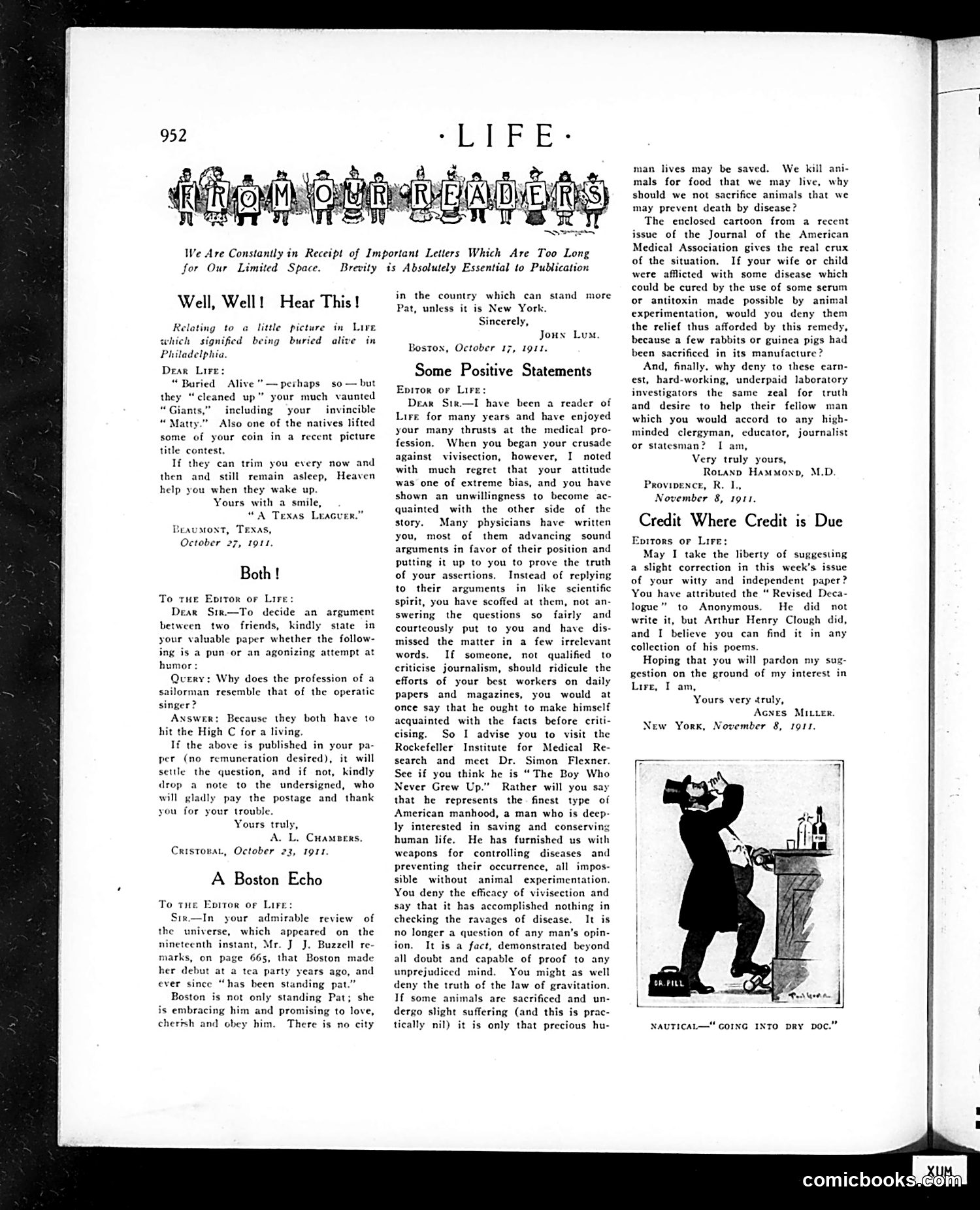
This is primarily a **letters-to-the-editor page** from Life magazine (November 1911), not a political cartoon page. The only illustration is a small nautical cartoon captioned "Going into Dry Doc" (bottom right). The letters reflect early 20th-century debates: 1. **Baseball reference**: A Texas reader mocks Life's coverage of baseball, claiming Philadelphia "cleaned up" Life's praised Giants and player "Matty" (likely Christy Mathewson). 2. **Vivisection debate**: A doctor defends animal experimentation for medical research, criticizing Life's anti-vivisection stance as biased. He references Dr. Simon Flexner of the Rockefeller Institute, arguing animal testing has genuinely advanced disease control—not an opinion but "a fact." 3. **Boston joke**: A playful reference to Boston "standing pat" (maintaining tradition), with wordplay suggesting Boston is clinging to the past. The vivisection letter is most substantive, representing the era's genuine scientific-ethical conflict over animal testing's necessity for medical progress.
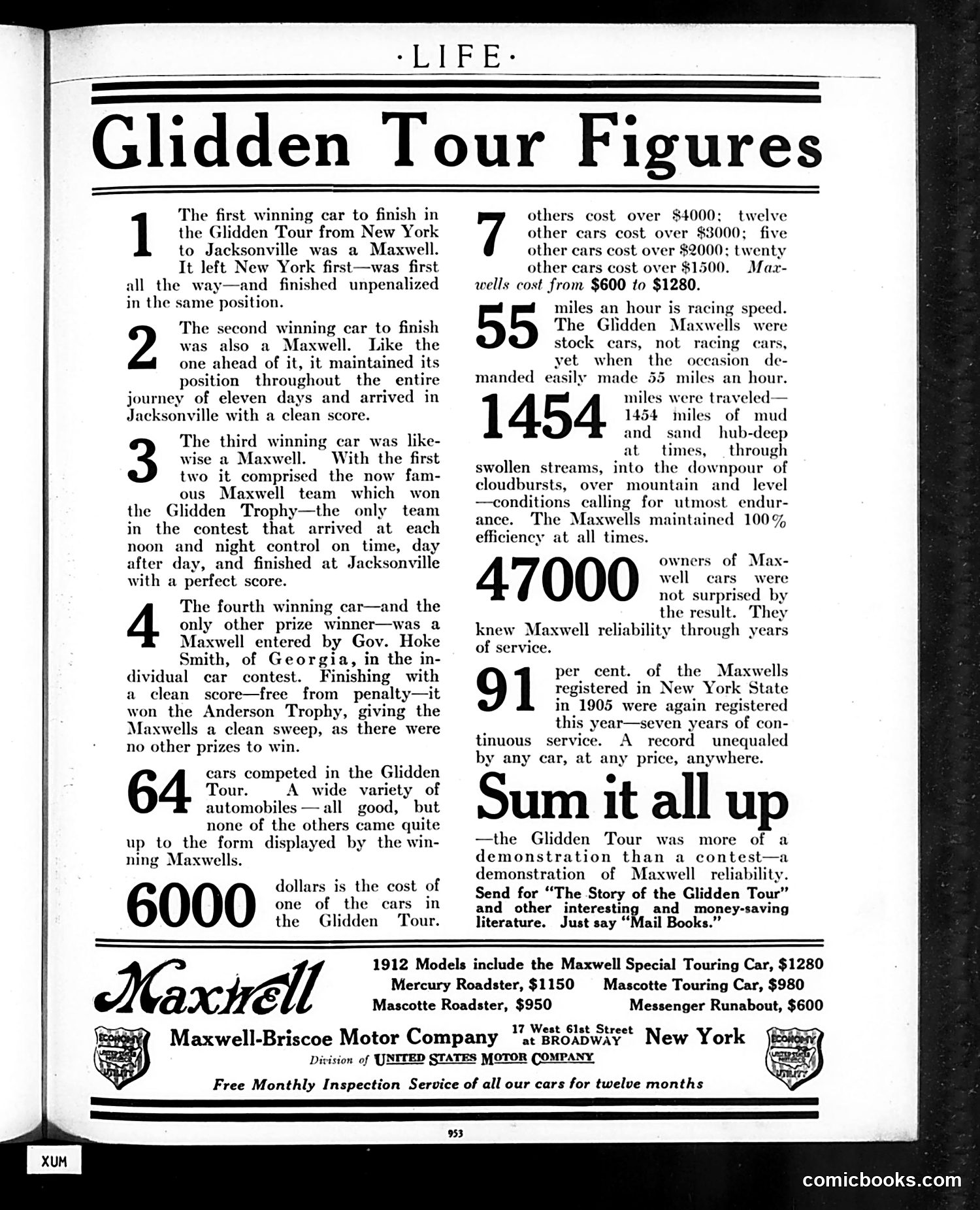
This is not a cartoon or satire—it's a straightforward automobile advertisement masquerading as news reporting. The page presents statistics from the 1912 Glidden Tour, a real cross-country automobile reliability competition from New York to Jacksonville. Maxwell-Briscoe Motor Company uses the tour results to advertise their vehicles' superiority: four of the top finishers were Maxwells, and the company emphasizes reliability metrics (91% of 1905 New York-registered Maxwells still in service, 100% efficiency maintaining 1,454 miles through harsh conditions). The "figures" are literal statistics—costs, speeds, distances—not political caricatures. The advertisement's persuasive strategy conflates a marketing competition victory with objective superiority, promoting Maxwell cars as affordable ($600-$1,280) yet dependable alternatives to more expensive competitors. This represents early 1900s automotive industry advertising, where manufacturers leveraged real sporting events as product endorsements.
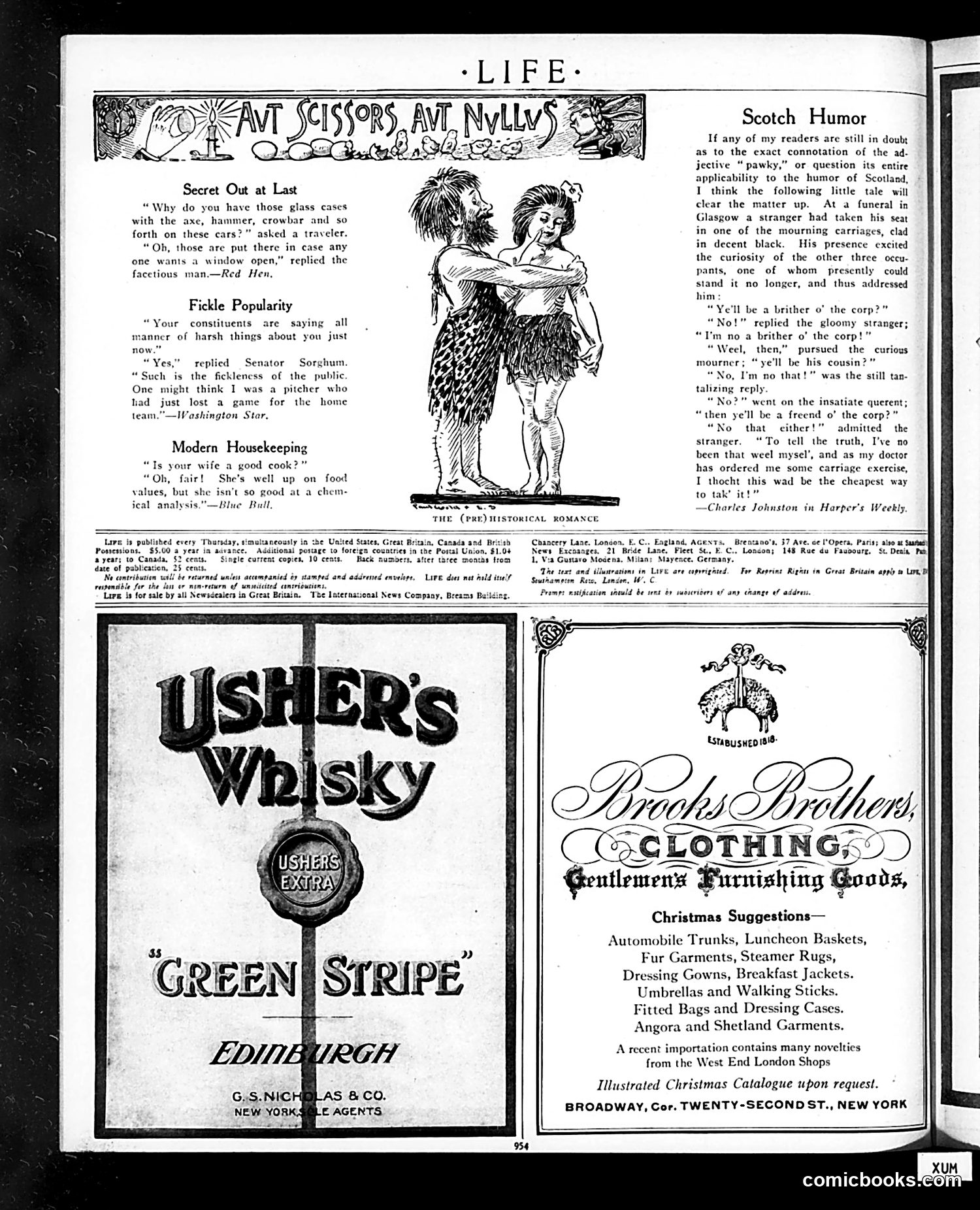
This page contains **humorous anecdotes and advertisements** rather than political cartoons. The main content includes three brief jokes: 1. **"Secret Out at Last"**: A traveler asks why train cars have emergency tools (axes, hammers, crowbars). The conductor jokes they're for passengers wanting to open windows—satirizing both passenger complaints and railway inconvenience. 2. **"Fickle Popularity"**: Senator Sorghum compares public opinion to a baseball pitcher who loses a game, mocking the electorate's inconsistent support. 3. **"Scotch Humor"**: A stranger attends a Glasgow funeral for mysterious reasons. When questioned by other mourners about his relationship to the deceased, he evasively replies he's attending purely for doctor-prescribed carriage exercise—the joke being the dark, matter-of-fact "pawky" (shrewd/sly) Scottish humor. The page also features period advertisements for **Usher's Whisky** and **Brooks Brothers** clothing, typical of early 20th-century Life magazine content.
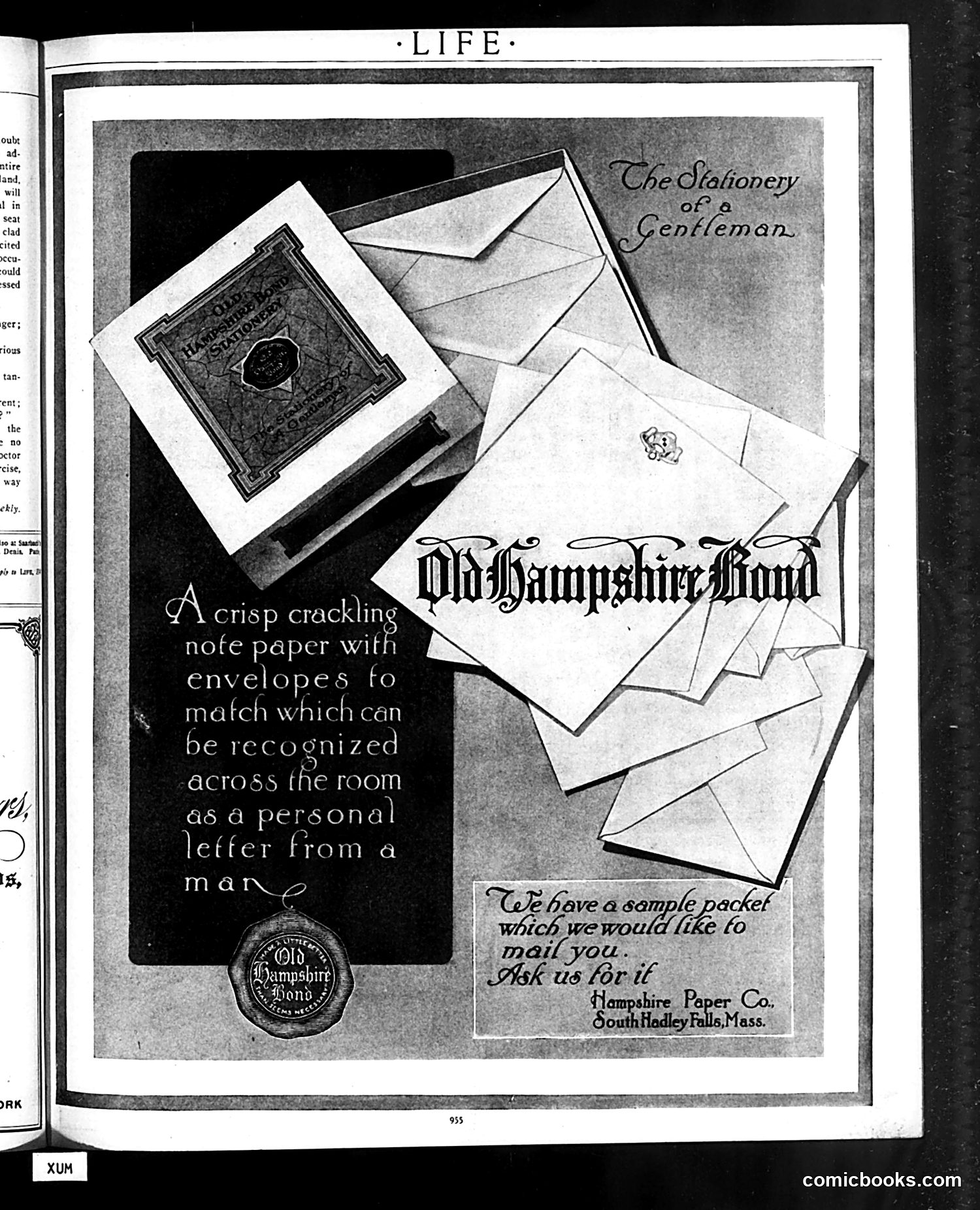
This is primarily a **product advertisement**, not a political cartoon. It promotes "Old Hampshire Bond" stationery from Hampshire Paper Co. (South Hadley Falls, Mass.). The ad uses a genteel marketing angle: the product's distinctive appearance allows recipients to recognize correspondence as genuinely personal mail from a man—implying the stationery signals authenticity and masculine formality. The visual displays elegant envelopes and a decorative box with the company seal. The pitch is nostalgic and class-conscious, appealing to gentlemen concerned with proper correspondence etiquette during the early 20th century. The company offers to mail sample packets to interested customers. There is no satire or political content here—this is straightforward period advertising in *Life* magazine.
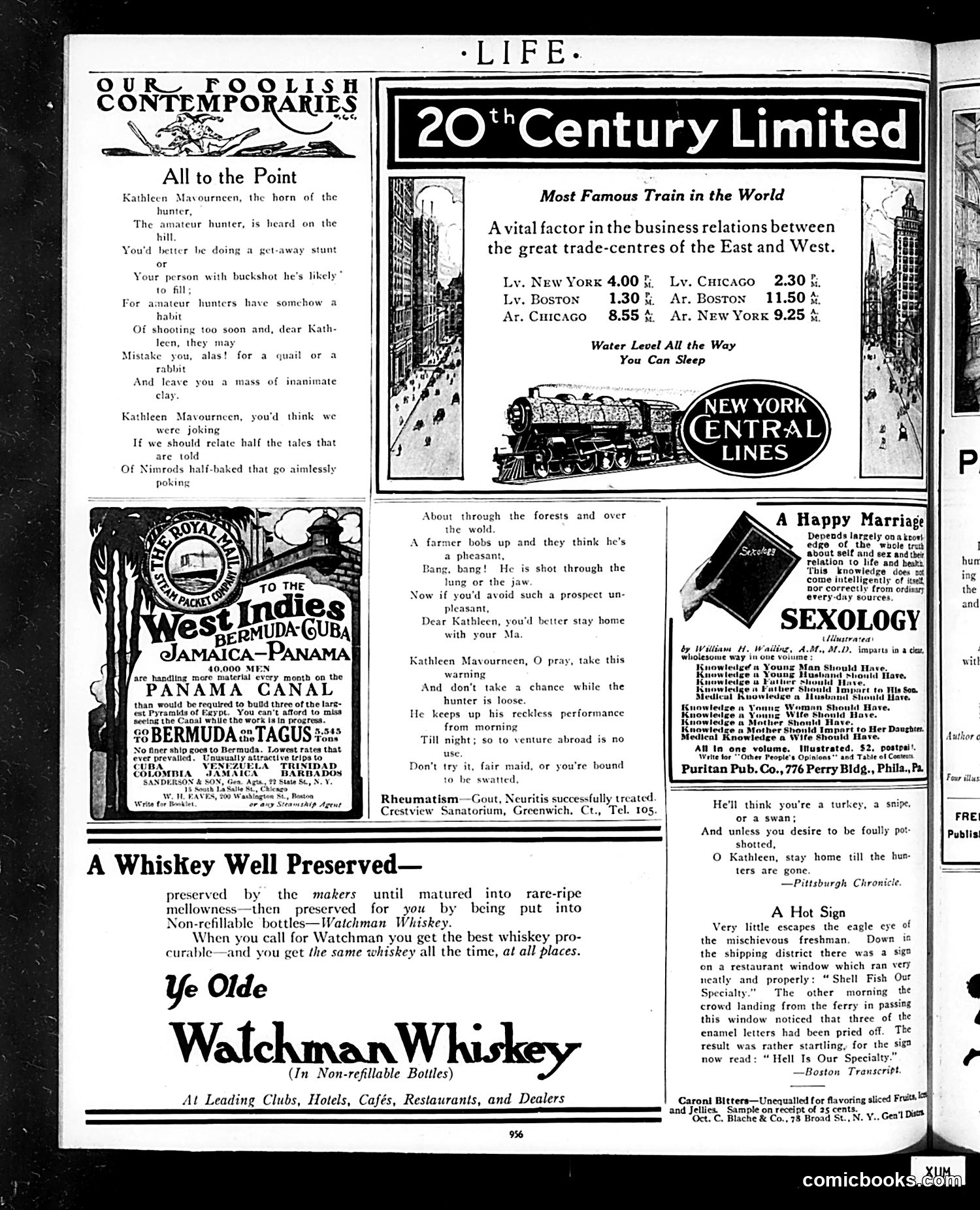
This page is primarily **advertising and light humor** rather than political satire. The main content consists of: **"All to the Point"**: A humorous poem warning a woman named Kathleen about amateur hunters who shoot carelessly and might mistake her for game (quail or rabbit). The joke plays on the incompetence of inexperienced hunters and the danger of venturing outdoors during hunting season. **Supporting ads and items** include: - Railroad advertisements (20th Century Limited, New York Central Lines) - A "Sexology" book advertisement - Whiskey and spirits ads - Shipping line promotions - Small humorous anecdotes ("A Hot Sign" about a restaurant sign altered by removing letters) **The satire is gentle**: Rather than attacking political figures, the humor targets amateur sportsmen and their recklessness. The repeated warnings to "Kathleen" to stay home reflect early 20th-century attitudes about women's safety and domesticity, though presented as comic exaggeration rather than serious commentary. This appears to be a typical Life magazine page from circa 1910s—mixing light verse, advertisements, and brief comic observations about everyday life.
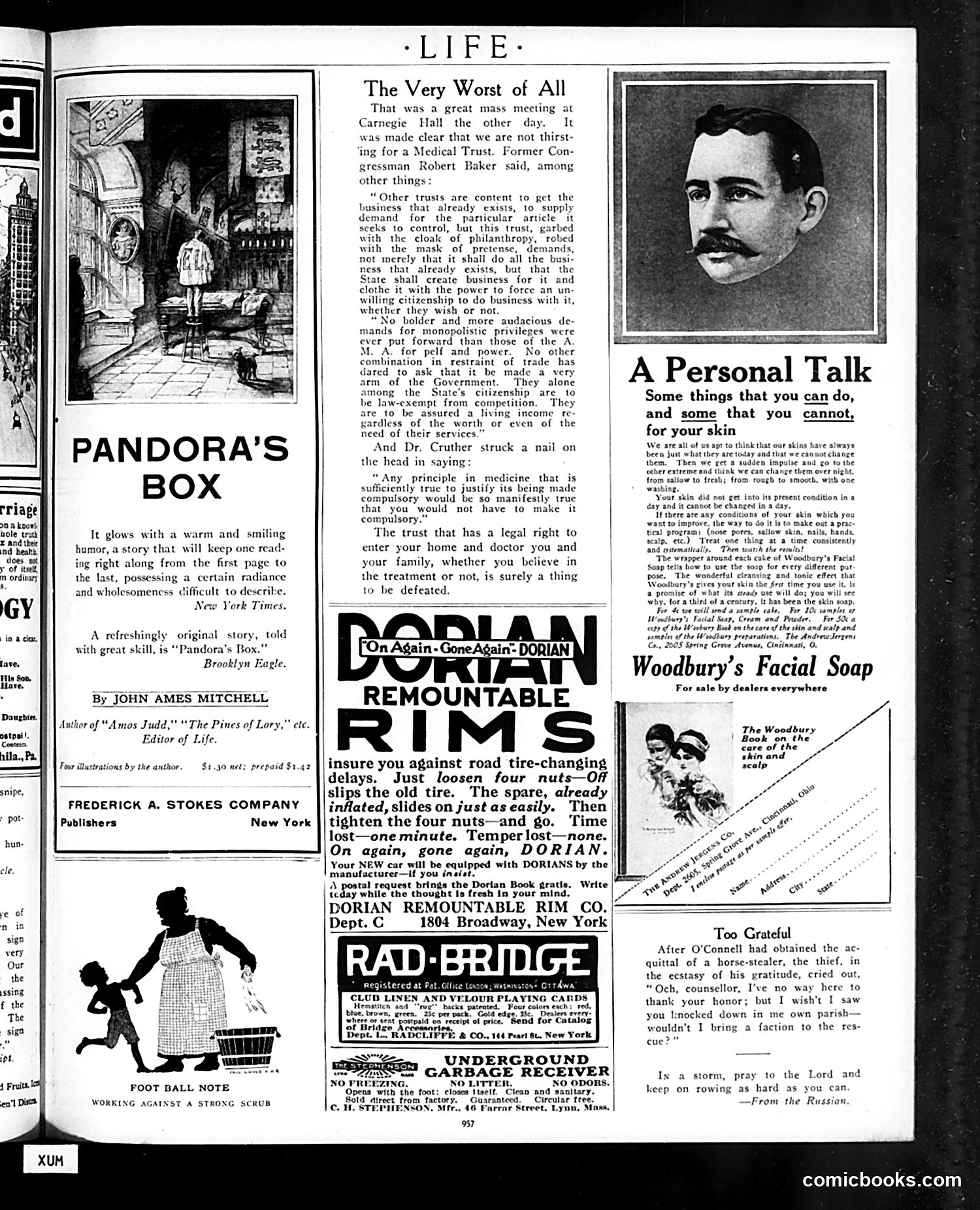
This page from *Life* magazine (a satirical publication) contains several distinct elements: **Main Editorial Content**: "The Very Worst of All" criticizes the American Medical Association as a monopolistic "trust." Former Congressman Robert Baker is quoted attacking the AMA's audacious demands for state-granted power to compel citizens into medical treatment. Dr. Cruther argues that truly valid medical principles wouldn't need to be made compulsory. The piece advocates defeating this "trust." **Context**: This reflects early-20th-century progressive anti-trust sentiment, when monopolistic organizations faced public scrutiny and criticism. **Advertisements**: The page includes typical period ads for Dorian Remountable Rims (automobile tires), playing cards, and Woodbury's Facial Soap—standard consumer goods marketing. **Cartoon**: A small silhouette illustration labeled "Foot Ball Note" depicts a football player, likely satirizing collegiate sports. The editorial stance is clearly reformist, warning against institutional overreach by the medical profession.
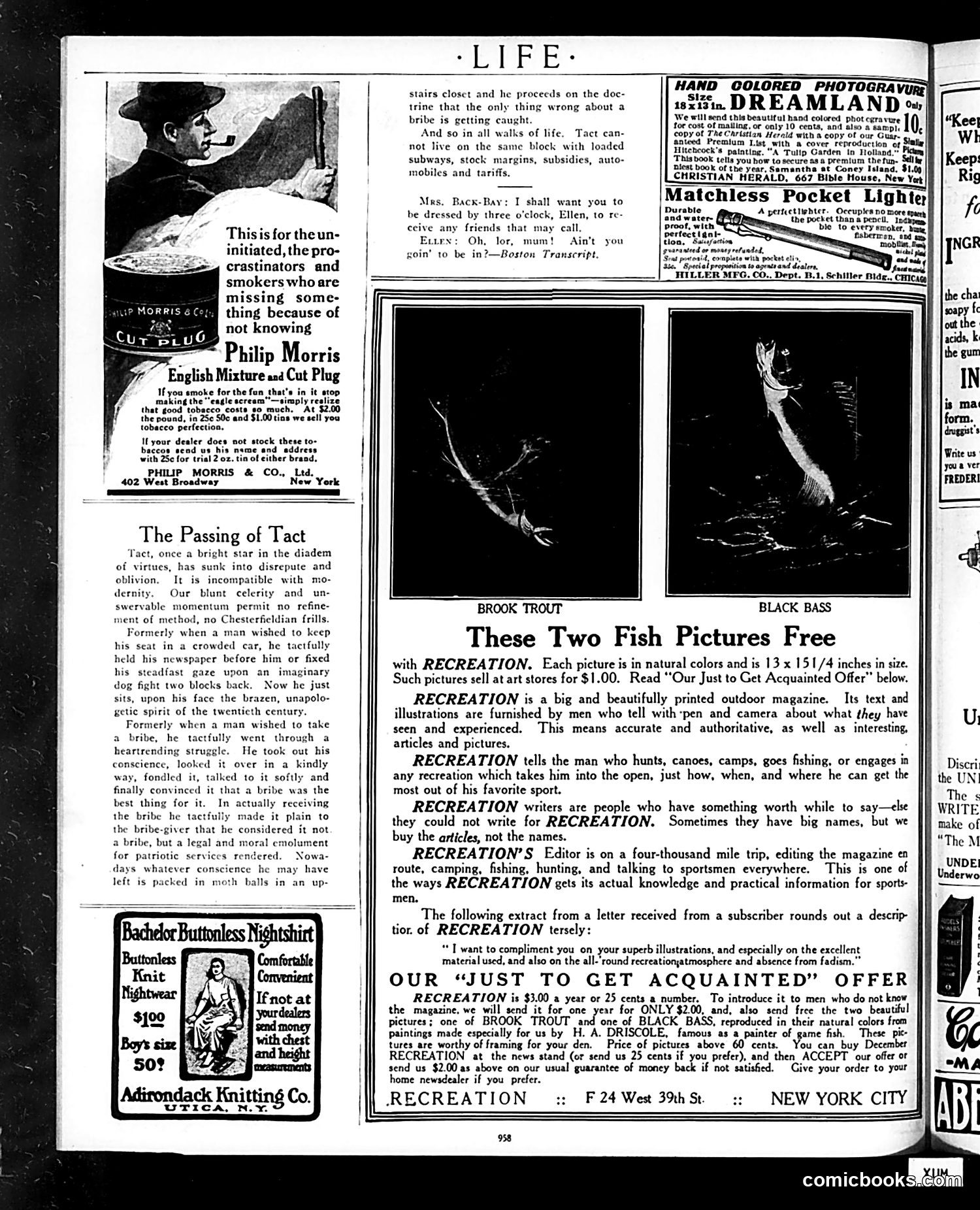
This essay-cartoon criticizes the decline of propriety in modern (early 20th-century) American society. The author argues that "tact"—formerly a valued virtue—has become incompatible with contemporary life's blunt efficiency and speed. The satire uses three examples of traditionally tactful behavior now abandoned: men no longer politely avoid eye contact on crowded streetcars; bribes are accepted without moral pretense or the "conscience-wrestling" of earlier generations; and across all walks of life, people prioritize results over refinement. The accompanying Mrs. Back-Bay/Ellen dialogue humorously illustrates this shift: the servant's blunt "Ain't you goin' to be in?" lacks the diplomatic courtesy expected of household staff in upper-class society. The piece reflects broader anxiety about industrialization, commercialism ("loaded subways, stock margins, subsidies, automobiles and tariffs"), and perceived moral erosion accompanying American modernization—a common LIFE magazine theme satirizing new social rudeness.
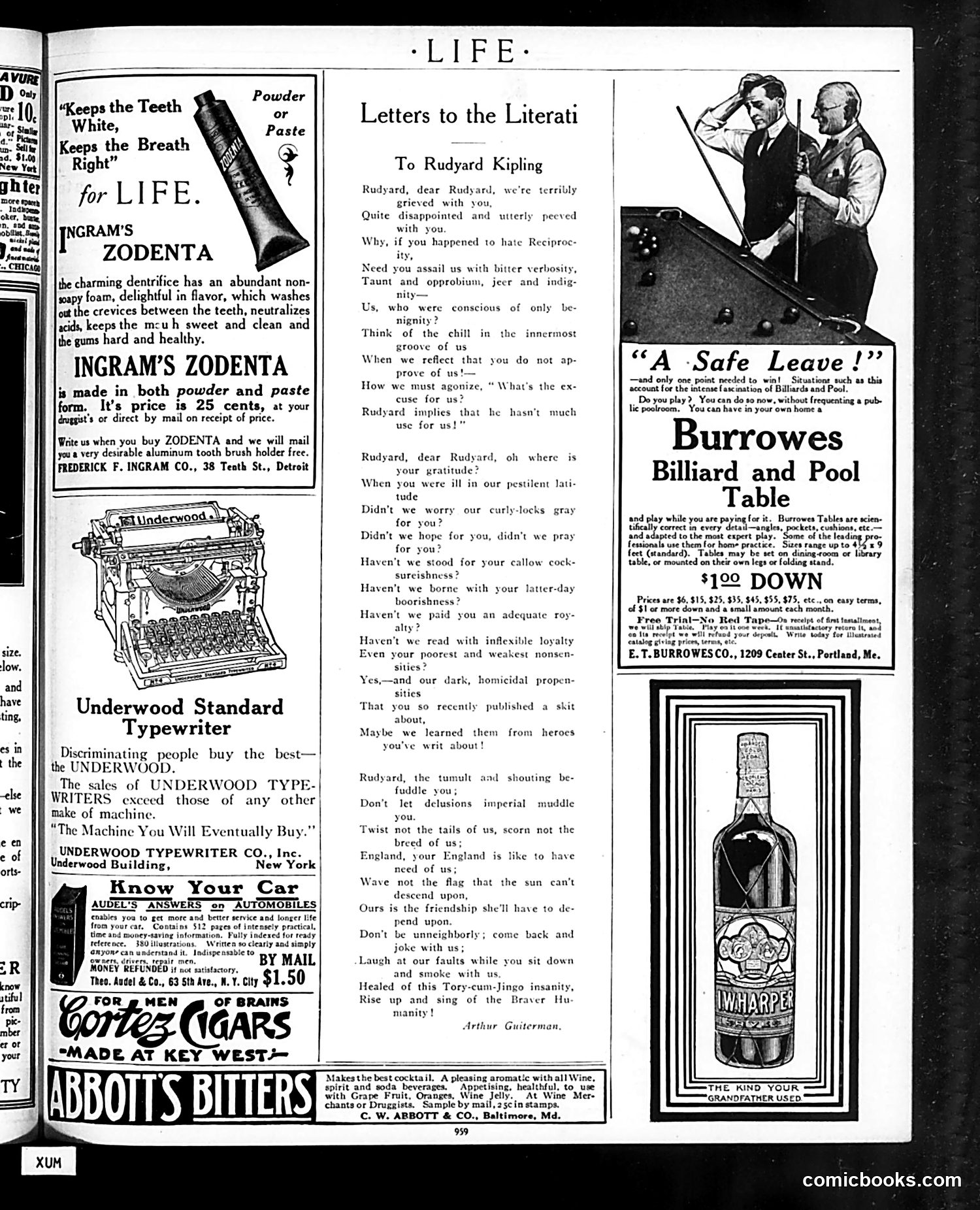
This page features a satirical open letter to author Rudyard Kipling, signed by Arthur Guiterman. The letter playfully chastises Kipling for recent published work perceived as bitter and hostile toward his former admirers. The writer catalogs their loyalty—worrying over him during illness, praying for him, tolerating his "callow cockishness" and "latter-day boorishness"—then accuses him of recently publishing inflammatory material, possibly referencing imperialist or jingoistic writings. The satire cuts both ways: it mocks Kipling's apparent turn toward vitriol while gently ribbing the letter-writers themselves for their self-pitying tone. The closing plea—"Rise up and sing of the Braver Humanity!"—suggests Kipling should return to more noble themes rather than indulging in "Tory-cum-Jingo insanity." The remainder of the page contains period advertisements (typewriters, billiard tables, dental products).
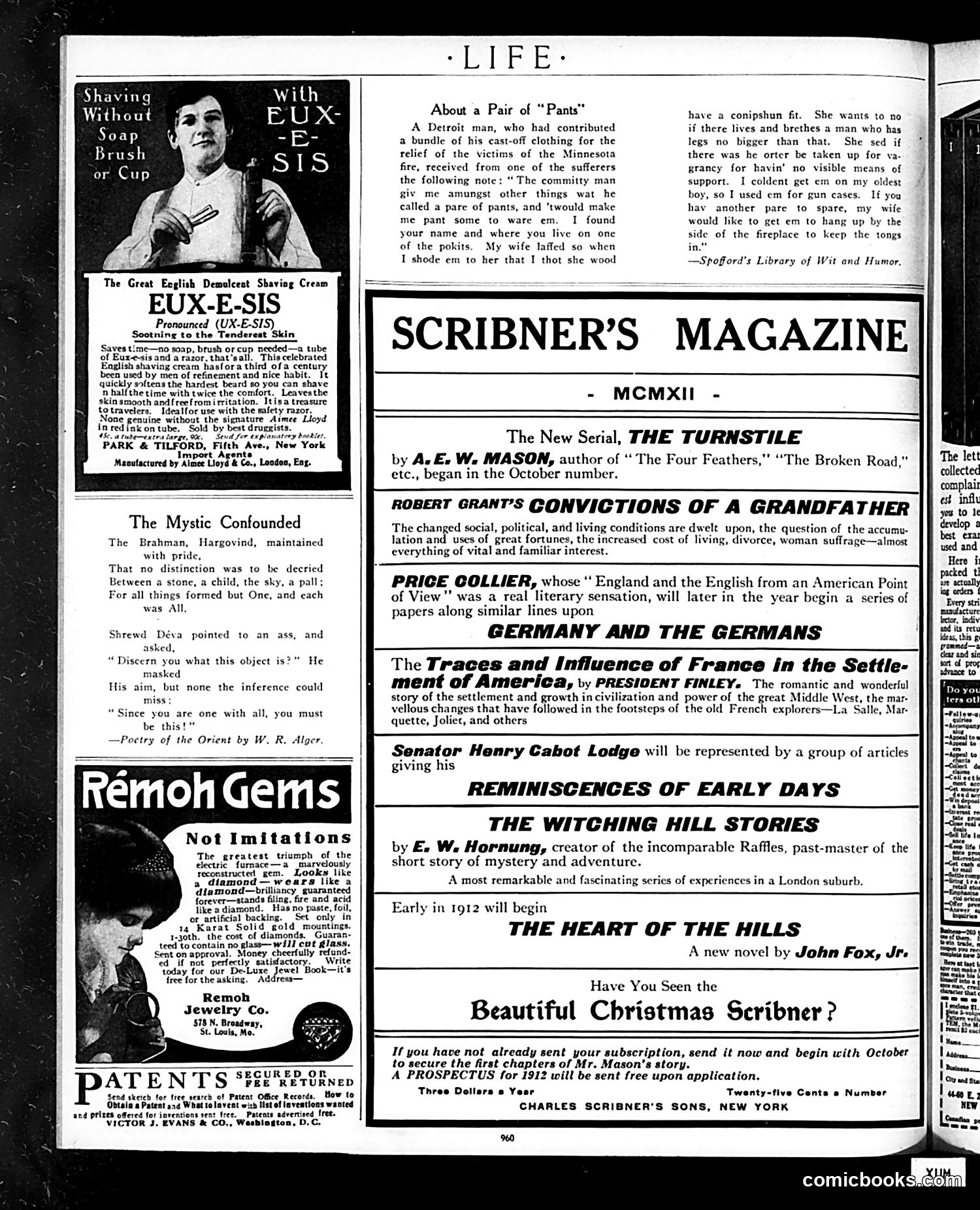
This page is primarily **advertisements and magazine promotion** rather than political satire. The left column contains ads for shaving cream (Eux-e-sis), synthetic gems, and patent services. The only satirical content is a brief humor piece titled "About a Pair of 'Pants'"—a letter from a Minnesota fire relief recipient mocking the donor's extremely small pants. The joke relies on physical comedy: the recipient cannot wear them, his wife laughs at their tiny size, he repurposes them as gun cases, and his wife suggests hanging them decoratively. It's gentle, domestic humor without political edge. The right side announces Scribner's Magazine's upcoming serialized fiction and articles covering contemporary topics: woman suffrage, divorce, living costs, and Franco-German relations. These represent early 1910s progressive concerns but are presented as content announcements, not satirical commentary.
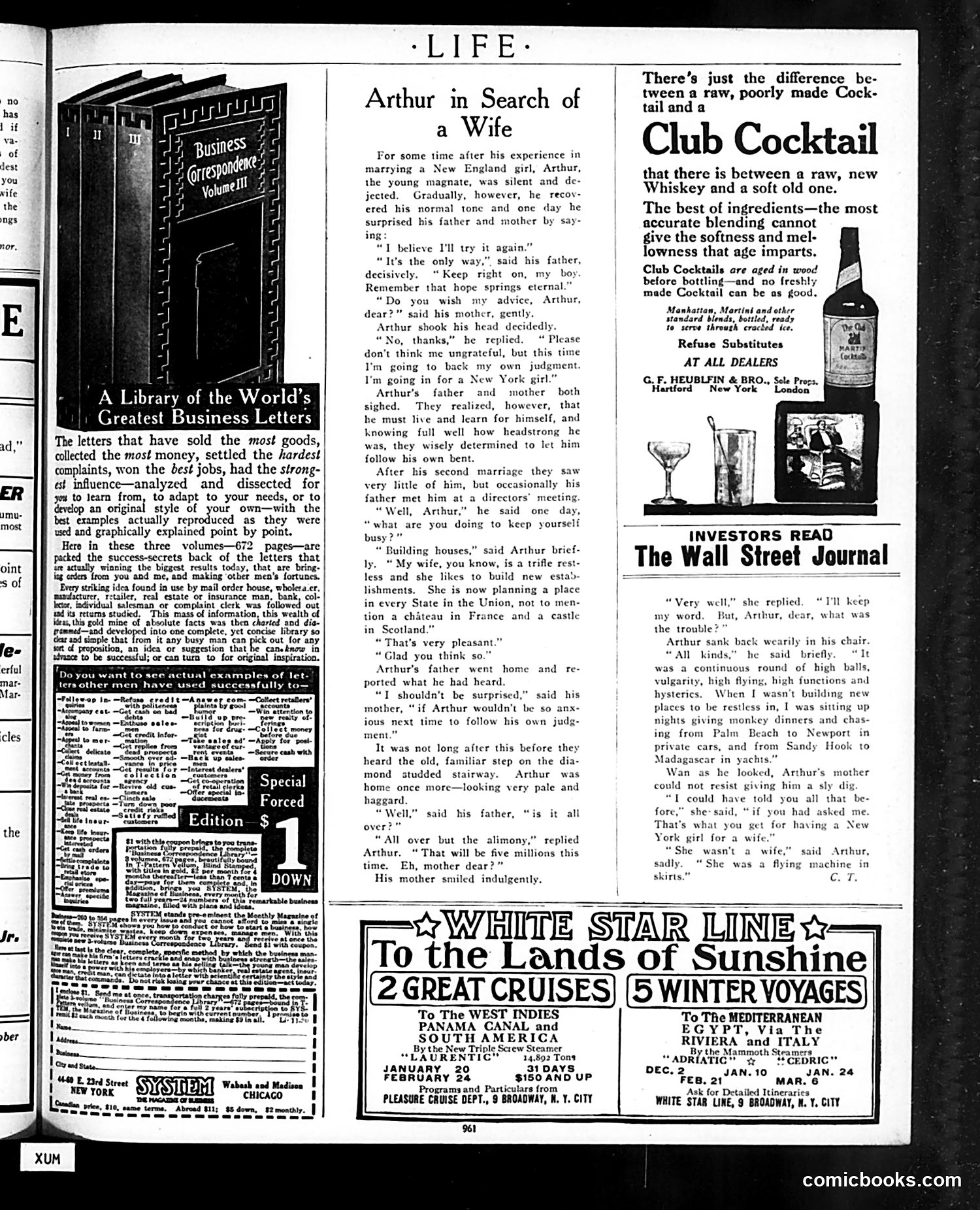
This is a humorous short story (not a cartoon) satirizing wealthy men's marital troubles and alimony. Arthur, a "young magnate," marries twice. After his first marriage to a New England girl fails, his parents encourage him to try again. He insists on choosing independently, marrying a New York woman instead. The joke: his second wife is even *worse*—a spendthrift constantly building estates across America, France, and Scotland. Arthur returns home "pale and haggard," admitting the marriage ended in alimony payments of five million dollars. The satire targets wealthy men's poor judgment in choosing wives and the financial devastation divorce could inflict. It reflects early 20th-century anxieties about women's spending habits and marital instability among the rich.
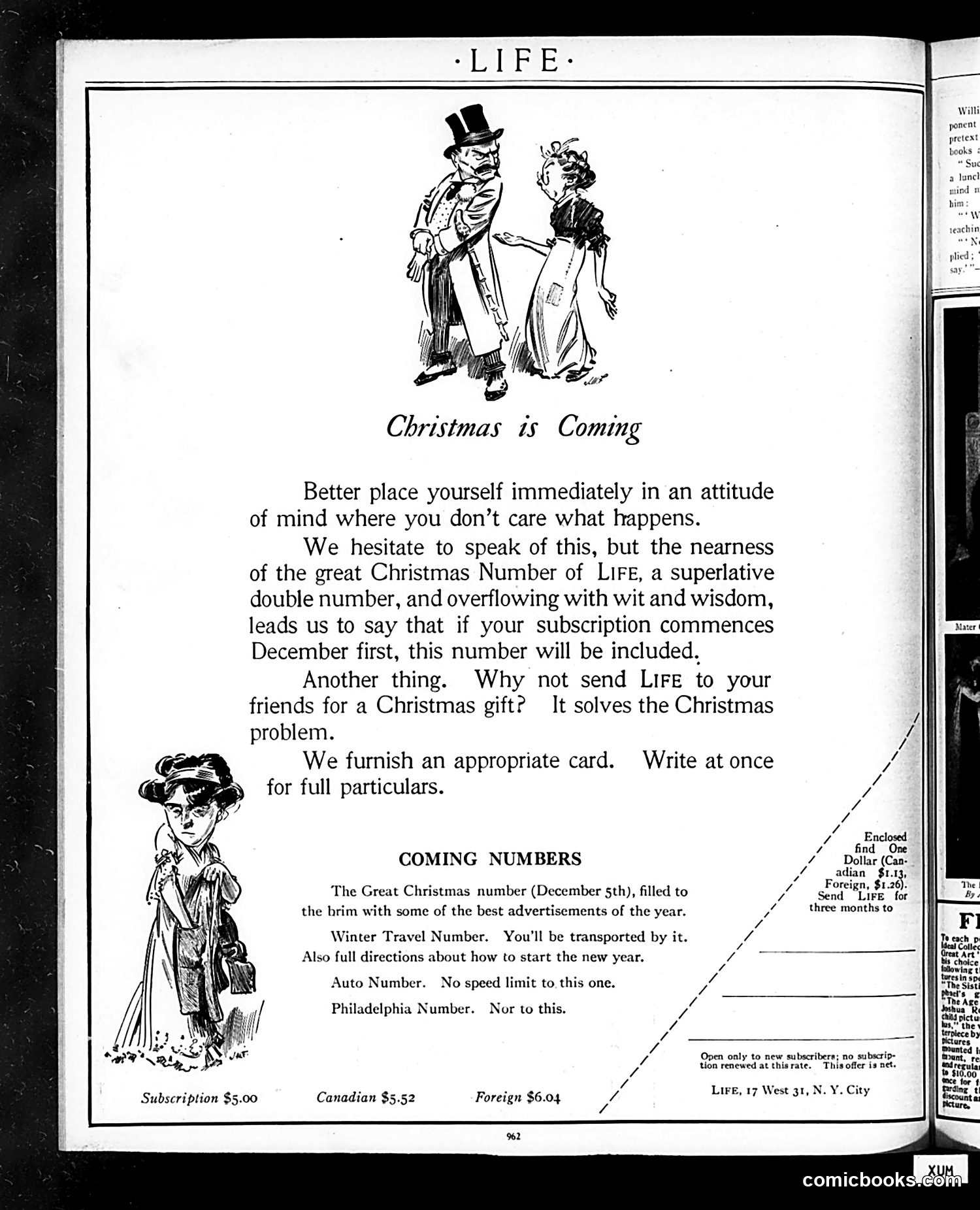
This is primarily a **subscription promotion page**, not political satire. The page advertises Life magazine's upcoming Christmas issue (December 5th) and solicits new subscriptions. The two illustrated figures—a man in a top hat and woman in period dress—represent genteel, upper-class characters typical of Life's satirical humor. Their presence is decorative, establishing the magazine's sophisticated tone. The humor lies in the **opening advice**: "Better place yourself immediately in an attitude of mind where you don't care what happens"—a self-aware joke about the commercial Christmas season's overwhelming stress. Life pitches itself as a gift solution that "solves the Christmas problem." The page promotes upcoming special issues: the Christmas Number (described as "superlative" and "overflowing with wit and wisdom"), a Winter Travel Number, an Auto Number, and a Philadelphia Number. The tone is tongue-in-cheek throughout—"No speed limit to this one" regarding the Auto issue. This reflects early 20th-century magazine culture, when special themed issues were major publishing events.
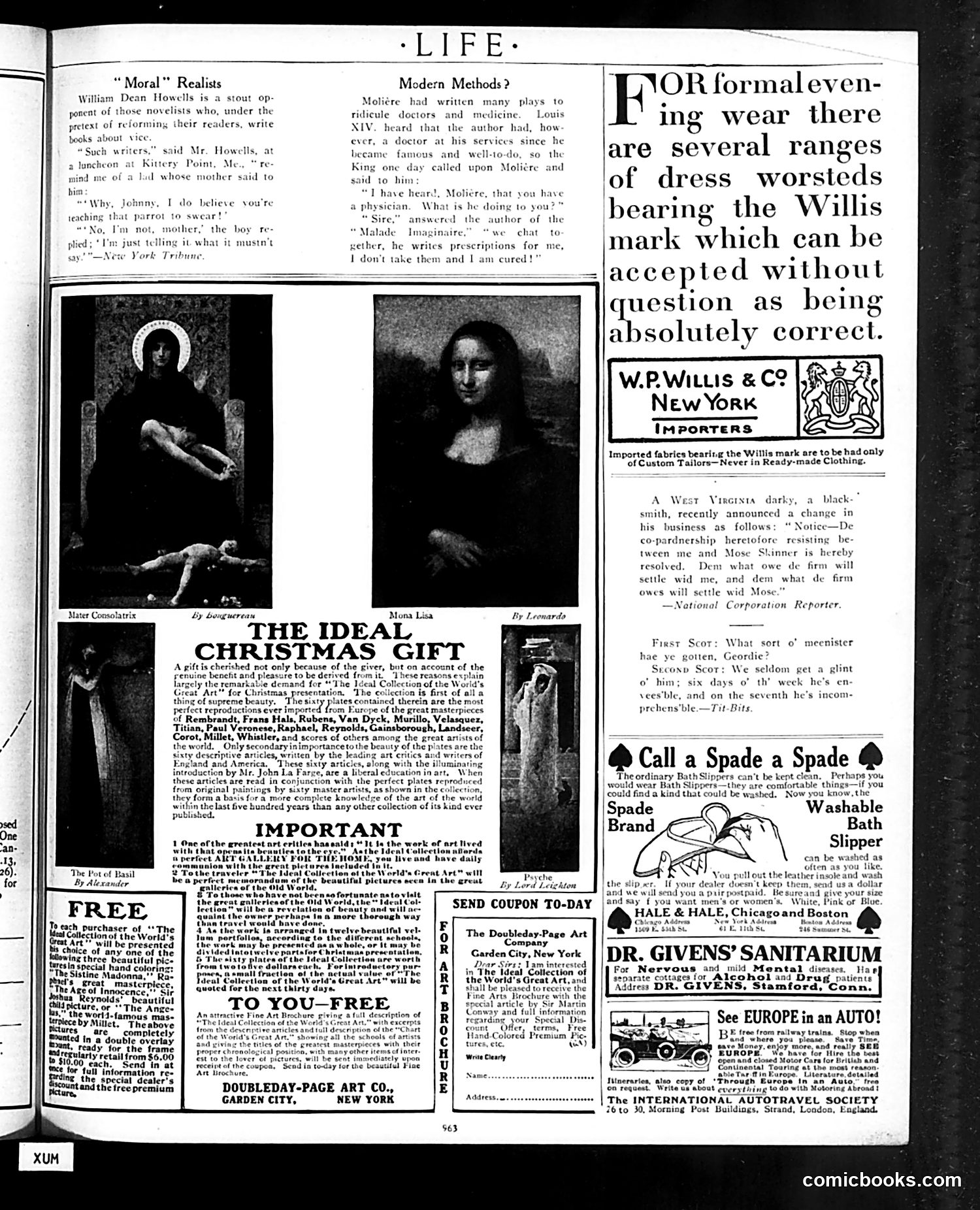
This page primarily contains **advertisements and cultural commentary** rather than political cartoons. The main content includes: **"The Ideal Christmas Gift"** section features reproductions of famous paintings (Mona Lisa, Mater Consolatrix, The Poet of Basil) marketed as an art collection. The text emphasizes cultural refinement through owning reproductions of Old Masters—a common upper-class aspiration of the era. **Opening anecdote** about William Dean Howells references Molière's classical play "The Imaginary Invalid," comparing 19th-century American realism to French dramatic tradition. **Advertisements** dominate: W.P. Willis dress goods, bath slippers, Dr. Givens' sanitarium for alcohol/drug treatment, and European auto tours. **Minor humorous items** include brief jokes about miscreants and a dialectal dialect piece about Appalachian business partnership dissolution. The page reflects early 1900s genteel consumer culture—targeting educated, affluent readers interested in art appreciation, refined goods, and health remedies.
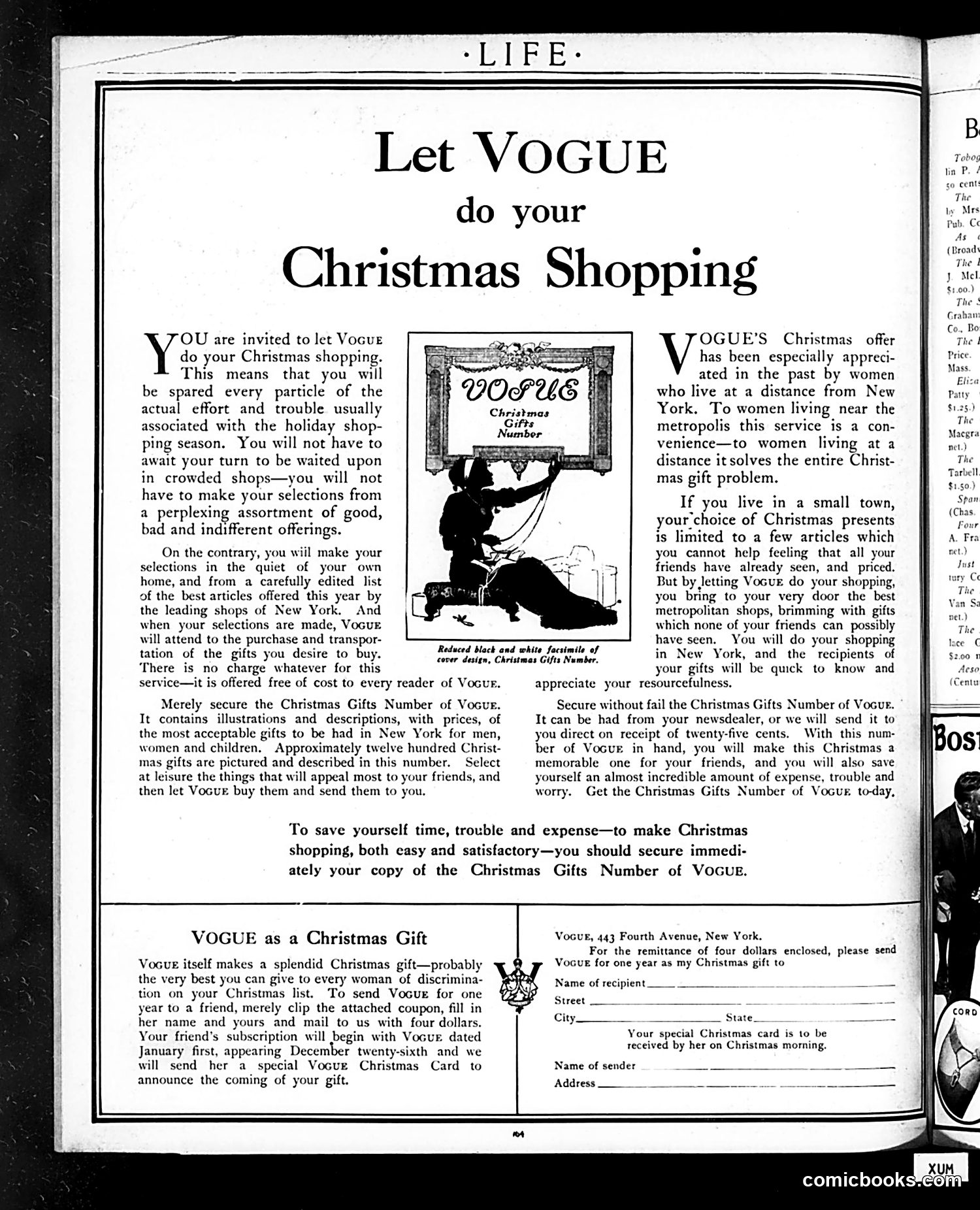
This is primarily a **mail-order advertisement**, not political satire. It promotes Vogue magazine's Christmas gift-shopping service—a convenience offering where busy shoppers (particularly women living far from New York) could browse Vogue's catalog of recommended gifts and have the magazine handle purchasing and delivery. The illustration shows a silhouetted figure reviewing Vogue's "Christmas Gifts Number." The pitch emphasizes **labor-saving** benefits: avoiding crowded holiday stores, making selections at home, and accessing metropolitan shops' curated selections even in small towns. The service costs nothing; customers only paid 25 cents for the catalog. Vogue itself ($4/year subscription) is promoted as an ideal gift for "women of discrimination." This reflects **early 20th-century consumer culture** values: convenience, expertise curation, and mail-order shopping as modern progress—particularly appealing to women excluded from easy retail access or time-constrained by holiday duties.
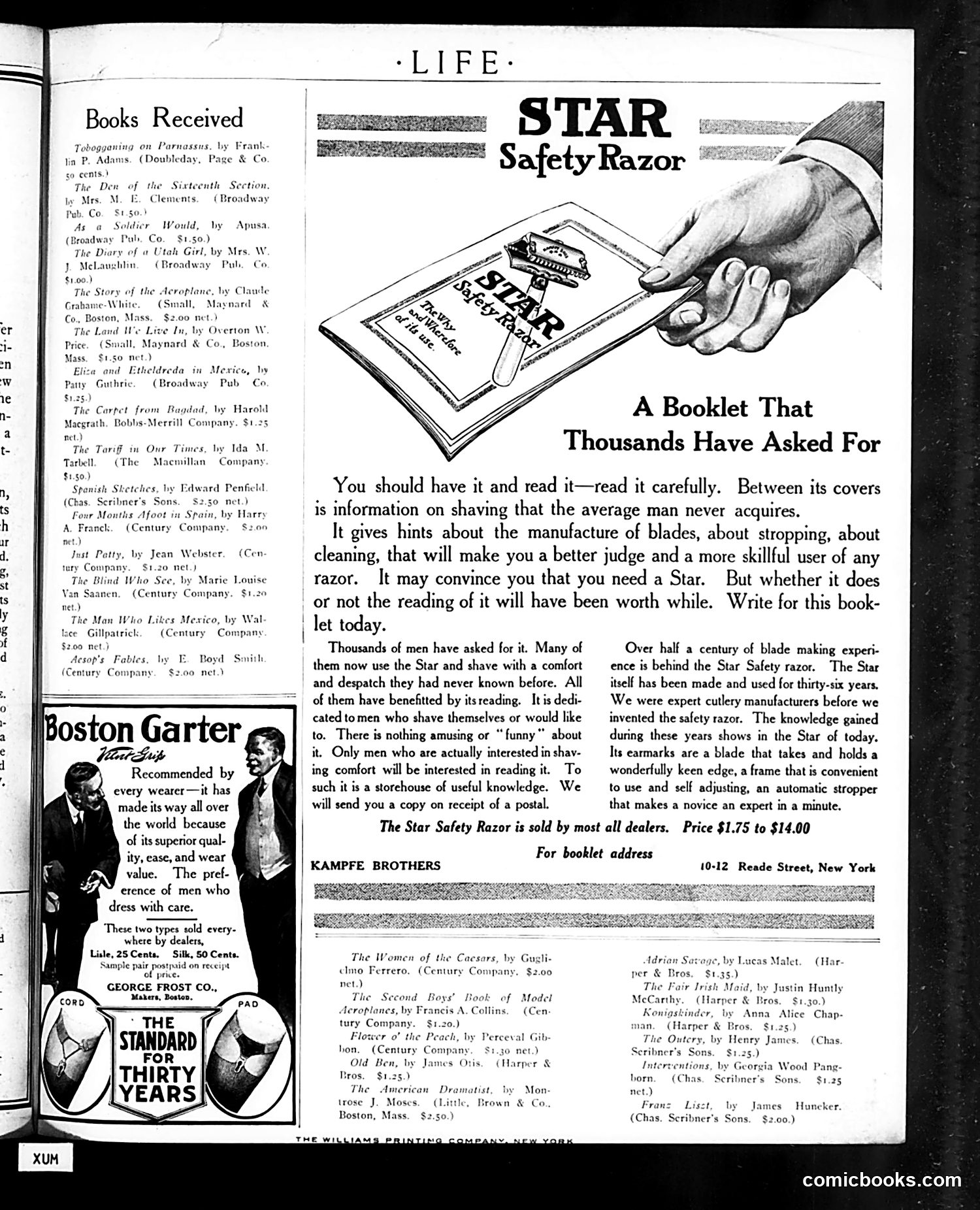
This page is primarily **advertising and book listings**, not satirical content. The left column lists recently published books—a standard "Books Received" section common to literary magazines. The advertisements are straightforward commercial pitches: a Boston Garter hosiery ad (left) and a lengthy Star Safety Razor advertisement (center-right). There are **no political cartoons or satire** on this page. The Boston Garter ad shows two men in period dress endorsing the product's quality; this is conventional product marketing, not caricature or social commentary. The Star Razor ad emphasizes the product's 36-year heritage and technical superiority, appealing to serious male consumers interested in grooming. The page reflects early 20th-century advertising strategy: associating products with expertise, tradition, and practical benefits rather than humor. This is a typical commercial page from *Life*, which balanced satirical content elsewhere in the magazine with revenue-generating advertisements.
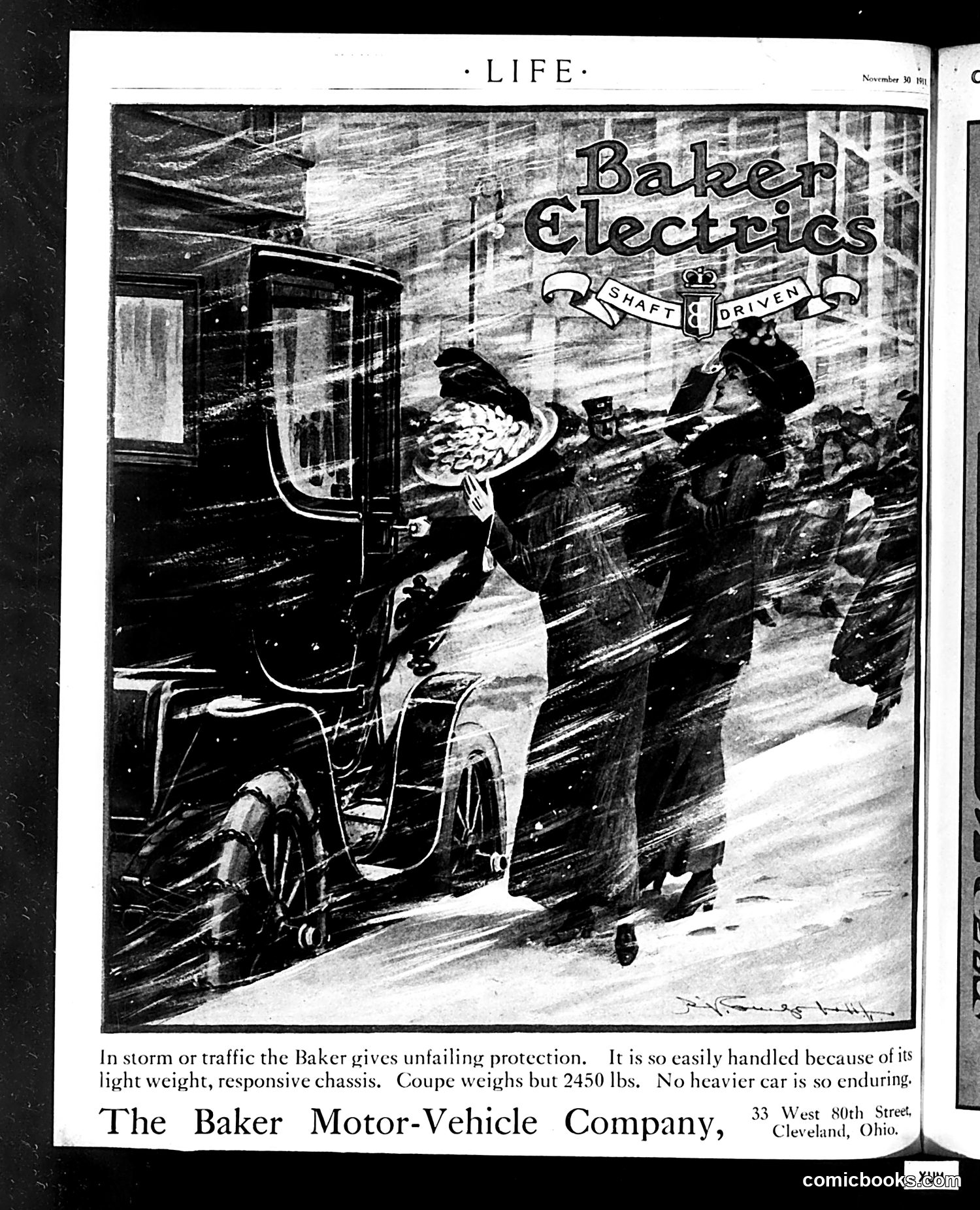
This is a Baker Electrics automobile advertisement, not political satire. The page shows a shaft-driven electric coupe protecting a woman from stormy weather and traffic dangers. The ad emphasizes the vehicle's practical advantages: light weight (2450 lbs), responsive handling, and durability. The imagery appeals to early 1900s consumers by depicting the car as a reliable protector—a significant selling point when automobiles were still novel and travel conditions unpredictable. The Baker Motor-Vehicle Company, based in Cleveland, Ohio, marketed electric cars as safe, manageable alternatives to gasoline vehicles, particularly appealing to women drivers who found them easier to operate than manual-crank gas engines.