
Life, 1911-11-30 · page 26 of 40
Life — November 30, 1911 — page 26: what you’re looking at
What you’re looking at
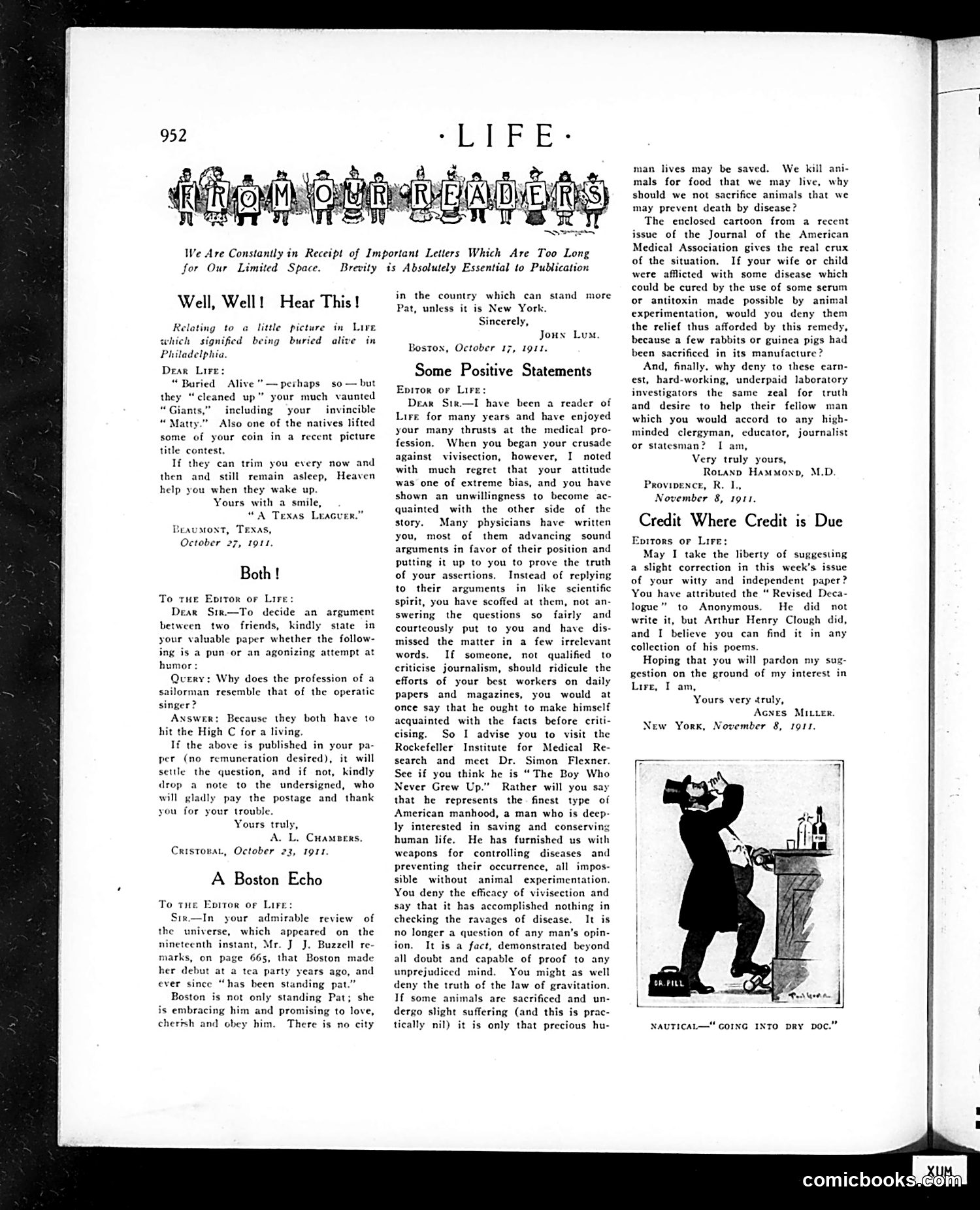
This is primarily a **letters-to-the-editor page** from Life magazine (November 1911), not a political cartoon page. The only illustration is a small nautical cartoon captioned "Going into Dry Doc" (bottom right). The letters reflect early 20th-century debates: 1. **Baseball reference**: A Texas reader mocks Life's coverage of baseball, claiming Philadelphia "cleaned up" Life's praised Giants and player "Matty" (likely Christy Mathewson). 2. **Vivisection debate**: A doctor defends animal experimentation for medical research, criticizing Life's anti-vivisection stance as biased. He references Dr. Simon Flexner of the Rockefeller Institute, arguing animal testing has genuinely advanced disease control—not an opinion but "a fact." 3. **Boston joke**: A playful reference to Boston "standing pat" (maintaining tradition), with wordplay suggesting Boston is clinging to the past. The vivisection letter is most substantive, representing the era's genuine scientific-ethical conflict over animal testing's necessity for medical progress.
📄 Transcribed text from this page (OCR, searchable)
Machine-transcribed from the original scan — historical spelling and the odd misread are preserved.
ena, We Are Constantly in Receipt of Important Letters Which Are Too Long for Our Limited Space. Well, Well! Hear This! Relating to a little picture in Live which signified being buried alive in Philadelphia. Dear Lire “Buried Alive” — perhaps so— but they “cleaned up” your much vaunted “Giants,” including your _ invincible “Matty.” Also one of the natives lifted some of your coin in a recent picture title contest, If they can trim you every now and then and still remain asleep, Heaven help you when they wake up. Yours with a smile, “A Texas Lracver.” AeAUMONT, TEXAS, October 27, 1911. Both! To tHe Epitor oF Lire: Dear decide an argument between two friends, kindly state in your valuable paper whether the follow- ing is a pun or an agonizing attempt at humor: Query: Why does the profession of a sailorman resemble that of the operatic singer? Answer: Because they both have to hit the High C for a living. If the above is published in your pa- per (no red), it will settle the question, and if not, kindly drop a note to the undersigned, who will gladly pay the postage and thank you for your trouble. Yours truly, ALL. Cuampers. Cristowat, October 23, 1911. A Boston Echo To tHe Evitor or Lire: Siz—In your admirable review of the universe, which appeared on the nineteenth instant, Mr. J. J. Buzzell re- marks, on page 665, that Boston made her debut at a tea party years ago, and ever since “has been standing pat Boston is not only standing Pat; she is embracing him and promising to love, cherish and obey him. There is no city Sir.—To remuneration de: Brevity is Absolutely Essential to Publication in the country which can stand Pat, unless it is New York. Sincerely, more Jous Lue. Bostox, October 17, 1911. Some Positive Statements Epitor or Lir Dear Sir—I have been a reader of Lire for many years and have enjoyed your many thrusts at the medical pro- fession. When you began your crusade against vivisection, however, I noted with much regret that your attitude was one of extreme bias, and you have shown an unwillingness to become ac- quainted with the other side of the story. Many physicians have written you, most of them advancing sound arguments in favor of their position and putting it up to you to prove the truth of your assertions. Instead of replying to their arguments in like scientific spirit, you have scoffed at them, not an- swering the questions so fairly and courteously put to you and have dis- missed the matter in a few irrelevant words. If someone, not qu: criticise journalism, should ridicule the efforts of your best workers on daily papers and magazines, you would at once say that he ought to make himself acquainted with the facts before criti- cising. So I advise you to visit the Rockefeller Institute for Medical Re- search and meet Dr. Simon Flexner See if you think he is “The Boy Who Never Grew Up.” Rather will you say that he represents the finest type of American manhood, a man who is decp- ly interested in saving and conserving human life. He has furnished us with weapons for controlling diseases and preventing their occurrence, all impos- sible without animal experimentation. You deny the efficacy of vivisection and say that it has accomplished nothing in checking the ravages of disease. It is no longer a question of any man’s opin- ion, It is a fact, demonstrated beyond all doubt and capable of proof to any unprejudiced mind. You might as well deny the truth of the law of gravitation. If some animals are sacrificed and un- dergo slight suffering (and this is prac- tically nil) it is only that precious hu- man lives may be saved. We kill ani- mals for food that we may live, why should we not sacrifice animals that we may prevent death by disease? The enclosed cartoon from a recent issue of the Journal of the American Medical Association gives the real crux of the situation, If your wife or child were afflicted with some disease which could be cured by the use of some serum or antitoxin made possible by animal experimentation, would you deny them the relief thus afforded by this remedy, because a few rabbits or guinea pigs had been sacrificed in its manufacture? And, finally. why deny to these earn- est, hard-working, underpaid laboratory investigators the same zeal for truth and desire to help their feliow man which you would accord to any high- minded clergyman, educator, journalist or statesman? I am, Very truly yours, Rotaxp Hamoxn, M.D Provipence, R. 1., November 8, 1911. Credit Where Credit is Due Epitors oF Lire: May I take the liberty of suggesting a slight correction in this week's issue of your witty and independent paper? You have attributed the “ Revised Deca- logue” to Anonymous. He did not write it, but Arthur Henry Clough did, and I believe you can find it in any collection of his poems. Hoping that you will pardon my sug- gestion on the ground of my interest in Lirr, I am, Yours very aruly, Acxes Mutter. New York, November 8, 1911. NAUTICAL—" GOING INTO DRY DOC.’ comicbookMeuh