
Life, 1911-11-30 · page 10 of 40
Life — November 30, 1911 — page 10: what you’re looking at
What you’re looking at
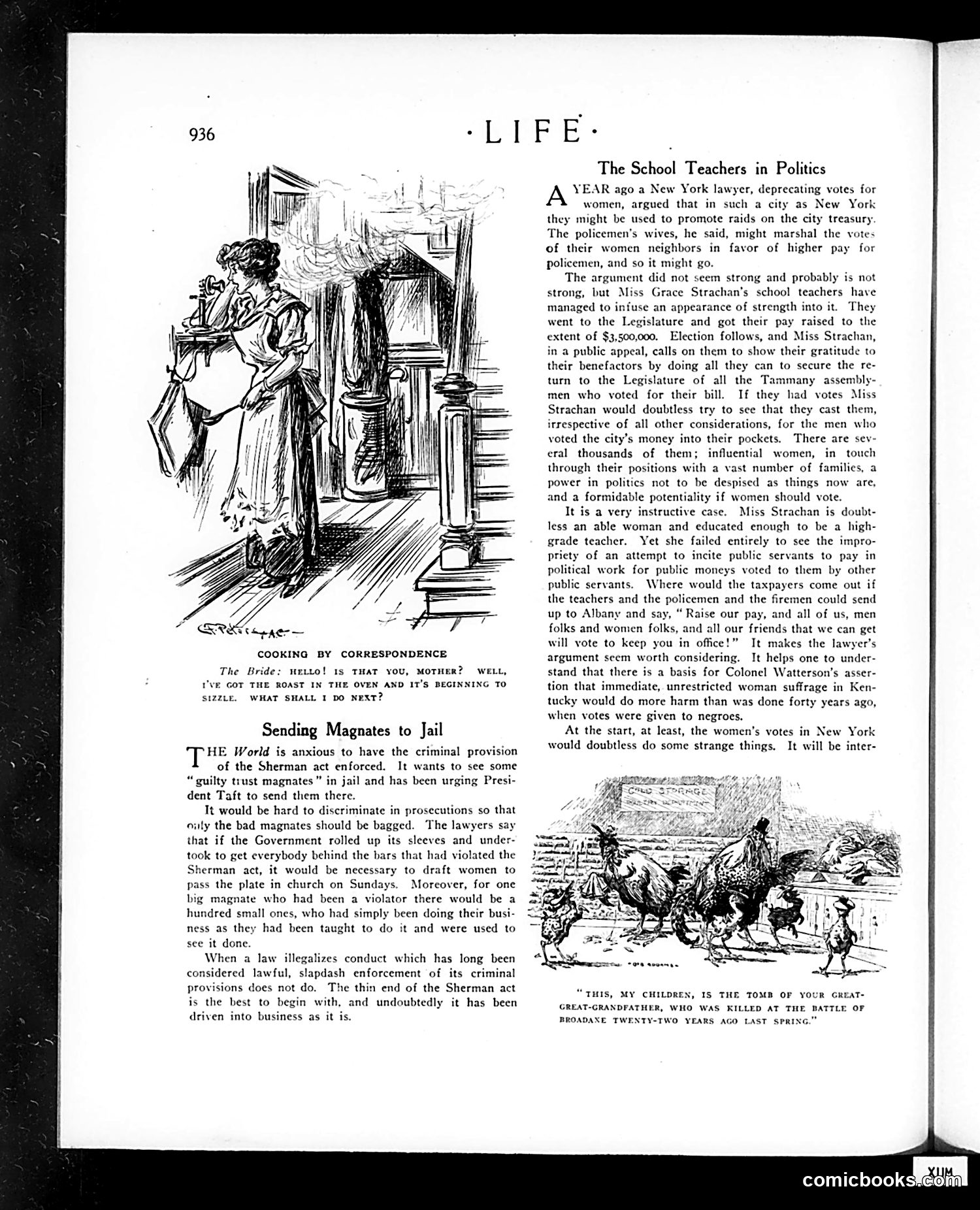
This satirical piece critiques Miss Grace Strachan's effort to lobby the New York legislature for a $1.5 million pay raise for teachers. The cartoon (top left) shows a woman apparently cooking or preparing something at a stove—illustrating the caption's joke about women being manipulated through domestic labor ("cooking by correspondence"). The article mocks Strachan for failing to recognize the impropriety of using public servants (policemen, firemen) to lobby elected officials with taxpayer money. The author argues this political maneuver—however well-intentioned—represents dangerous precedent: if organized groups can deploy public employees to influence legislation, democratic accountability becomes compromised. The cartoon at bottom right appears unrelated, depicting a historical battlefield scene with the caption about a great-great-grandfather killed at Brandywine.
📄 Transcribed text from this page (OCR, searchable)
Machine-transcribed from the original scan — historical spelling and the odd misread are preserved.
-LIFE- The School Teachers in Politics YEAR ago a New York lawyer, deprecating votes for women, argued that in such a city as New York they might be used to promote raids on the city treasury. The policemen’s wives, he said, might marshal the votes of their women neighbors in favor of higher pay for policemen, and so it might go. The argument did not seem strong and probably is not strong, but Miss Grace Strachan’s school teachers have managed to infuse an appearance of strength into it. They went to the Legislature and got their pay raised to the extent of $3,500,000. Election follows, and Miss Strachan, in a public appeal, calls on them to show their gratitude to their benefactors by doing all they can to secure the re- turn to the Legislature of all the Tammany assembly- men who voted for their bill. If they had votes Miss Strachan would doubtless try to see that they cast them, irrespective of all other considerations, for the men who voted the city’s money into their pockets. There are sev- eral thousands of them; influential women, in touch through their positions with a vast number of families, a power in politics not to be despised as things now are, and a formidable potentiality if women should vote. It is a very instructive case. Miss Strachan is doubt- less an able woman and educated enough to be a high- grade teacher. Yet she failed entirely to see the impro- priety of an attempt to incite public servants to pay in political work for public moneys voted to them by other public servants. Where would the taxpayers come out if the teachers and the policemen and the firemen could send up to Albany and say, “ Raise our pay, and all of us, men folks and women folks, and all our friends that we can get will vote to keep you in office!” It makes the lawyer’s argument seem worth considering. It helps one to under- The Bride: we11o! 1s THAT YOU, MOTHER? WELL, stand that there is a basis for Colonel Watterson’s asser- U'VE GOT THE ROAST IN THE OVEN AND IT'S BEGINNING TO tion that immediate, unrestricted woman suffrage in Ken- SUZZLE, WHAT SHALL 1 DO NEXT? tucky would do more harm than was done forty years ago, when votes were given to negroes. Sending Magnates to Jail At the start, at least, the women’s votes in New York would doubtless do some strange things. It will be inter- COOKING BY CORRESPONDENCE HE World is anxious to have the criminal provision of the Sherman act enforced. It wants to see some “ guilty trust magnates” in jail and has been urging Presi- dent Taft to send them there. It would be hard to discriminate in prosecutions so that ouly the bad magnates should be bagged. The lawyers say that if the Government rolled up its sleeves and under- took to get everybody behind the bars that had violated the Sherman act, it would be necessary to draft women to pass the plate in church on Sundays. Moreover, for one big magnate who had been a violator there would be a hundred small ones, who had simply been doing their busi- ness as they had been taught to do it and were used to see it done. When a law illegalizes conduct which has long been considered lawful, slapdash enforcement of its criminal provisions does not do, The thin end of the Sherman act is the best to begin with, and undoubtedly it has been driven into business as it is. “THIS, MY CHILDREN, IS THE TOMB OF YOUR GREAT- GREAT-GRANDPATHER, WHO WAS KILLED AT THE BATTLE OF BROADAXE TWENTY-TWO YEARS AGO LAST SPRING.” comicbookMeorl