
Life, 1911-11-30 · page 22 of 40
Life — November 30, 1911 — page 22: what you’re looking at
What you’re looking at
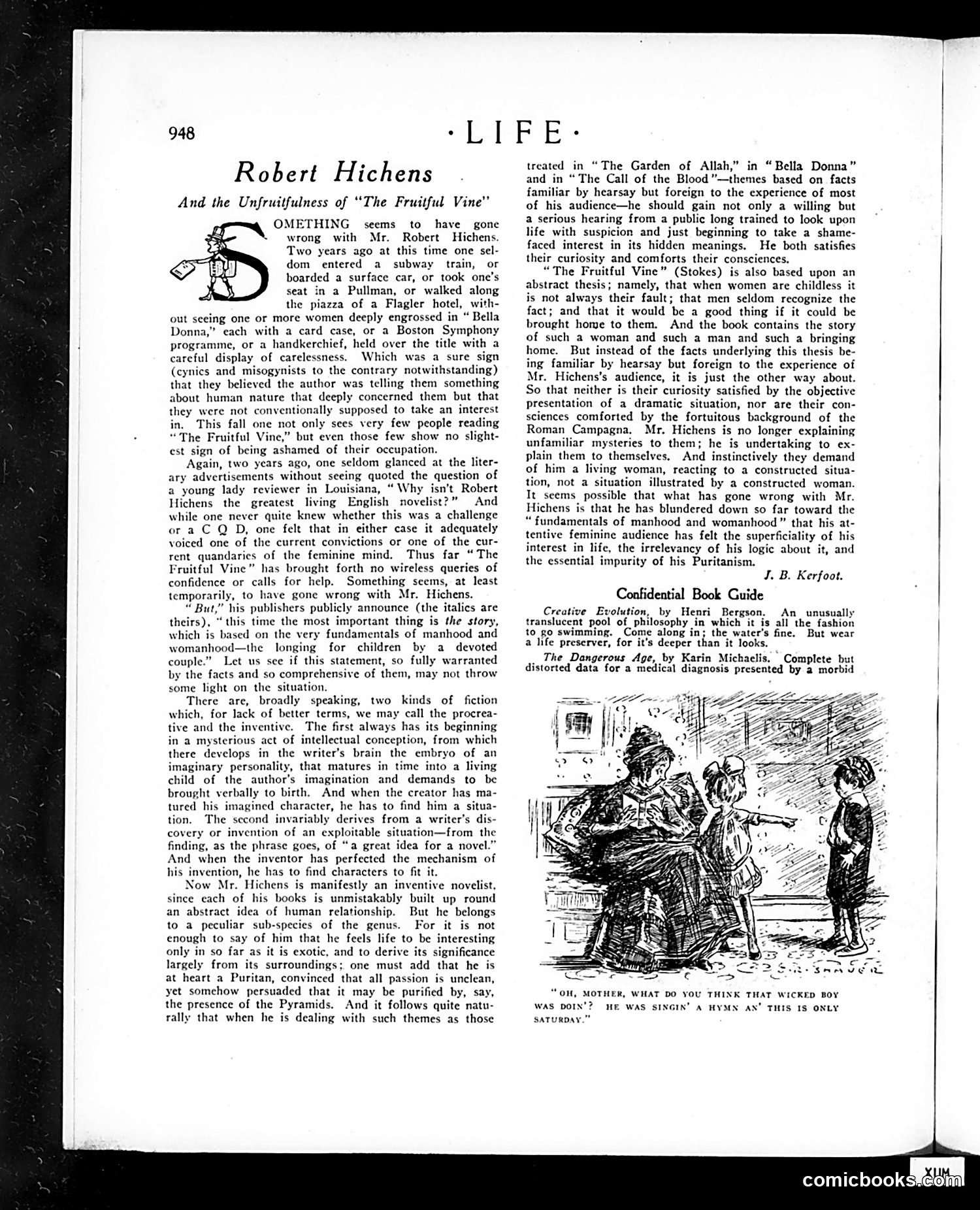
This is a literary essay criticizing novelist Robert Hichens's declining reputation. The piece notes that his earlier novel "Bella Donna" (two years prior) was wildly popular among women readers on public transportation—a status symbol of intellectual engagement. However, his new novel "The Fruitful Vine" has generated no comparable excitement or readership. The essay analyzes Hichens as an "inventive novelist" who builds stories around abstract ideas rather than character development. It argues he's fundamentally a Puritan moralist obsessed with exotic settings (the Pyramids, etc.) who sanitizes passionate themes for his audience. The accompanying illustration shows a domestic scene, likely depicting the novel's central premise about a couple's desire for children—the "fundamentals of manhood and womanhood" his publishers emphasize. The satire suggests Hichens's formula has grown stale.
📄 Transcribed text from this page (OCR, searchable)
Machine-transcribed from the original scan — historical spelling and the odd misread are preserved.
Robert Hichens And the Unfruitfulness of “The Fruitful Vine” OMETHING seems to have gone wrong with Mr. Robert Hichens. Two years ago at this time one sel- dom entered a subway train, or boarded a surface car, or took one’s seat in a Pullman, or walked along the piazza of a Flagler hotel, with- out seeing one or more women deeply engrossed in “ Bella Donna,” each with a card case, or a Boston Symphony programme, or a handkerchief, held over the title with a careful display of carelessness. Which was a sure sign (cynics and misogynists to the contrary notwithstanding) that they believed the author was telling them something about human nature that deeply concerned them but that they were not conventionally supposed to take an interest in. This fall one not only sees very few people reading “The Fruitful Vine,” but even those few show no slight- est sign of being ashamed of their occupation. Again, two years ago, one seldom glanced at the liter- ary advertisements without seeing quoted the question of a young lady reviewer in Louisiana, “ Why isn't Robert Hichens the greatest living English novelist?” And while one never quite knew whether this was a challenge or a C Q D, one felt that in either case it adequately voiced one of the current convictions or one of the cur- rent quandaries of the feminine mind. Thus far “The Fruitful Vine” has brought forth no wireless queries of confidence or calls for help. Something seems, at least temporarily, to have gone wrong with Mr. Hichens. “ But,” his publishers publicly announce (the italics are theirs), “this time the most important thing is the story, which is based on the very fundamentals of manhood and womanhood—the longing for children by a devoted couple.” Let us see if this statement, so fully warranted by the facts and so comprehensive of them, may not throw some light on the situation. There are, broadly speaking, two kinds of fiction which, for lack of better terms, we may call the procrea- tive and the inventive. The first always has its beginning in a mysterious act of intellectual conception, from which there develops in the writer’s brain the embryo of an imaginary personality, that matures in time into a living child of the author's imagination and demands to be brought verbally to birth, And when the creator has ma- tured his imagined character, he has to find him a situa- tion. The sccond invariably derives from a writer’s dis- covery or invention of an exploitable situation—from the finding, as the phrase goes, of “a great idea for a novel.” And when the inventor has perfected the mechanism of his invention, he has to find characters to fit i Now Mr. Hichens is manifestly an inventive novelist, since each of his books is unmistakably built up round an abstract idea of human relationship. But he belongs to a peculiar sub-species of the genus. For it is not enough to say of him that he feels life to be interesting only in so far as it is exotic, and to derive its significance largely from its surroundings; one must add that he is at heart a Puritan, convinced that all passion is unclean, yet somehow persuaded that it may be purified by, say, the presence of the Pyramids. And it follows quite natu- rally that when he is dealing with such themes as those “EEE treated in “The Garden of Allah,” in “Bella Donna” and in “The Call of the Blood ”"—themes based on facts familiar by hearsay but foreign to the experience of most of his audience—he should gain not only a willing but a serious hearing from a public long trained to look upon life with suspicion and just beginning to take a shame- faced interest in its hidden meanings. He both satisfies their curiosity and comforts their consciences. “The Fruitful Vine” (Stokes) is also based upon an abstract thesis; namely, that when women are childless it is not always their fault; that men seldom recognize the fact; and that it would be a good thing if it could be brought home to them. And the book contains the story of such a woman and such a man and such a bringing home. But instead of the facts underlying this thesis be- ing familiar by hearsay but foreign to the experience of Mr. Hichens’s audience, it is just the other way about. So that neither is their curiosity satisfied by the objective presentation of a dramatic situation, nor are their con- sciences comforted by the fortuitous background of the Roman Campagna. Mr. Hichens is no longer explaining unfamiliar mysteries to them; he is undertaking to ex- plain them to themselves. And instinctively they demand of him a living woman, reacting to a constructed situa- tion, not a situation illustrated by a constructed woman. It seems possible that what has gone wrong with Mr. Hichens is that he has blundered down so far toward the “fundamentals of manhood and womanhood” that his at- tentive feminine audience has felt the superficiality of his interest in life, the irrelevancy of his logic about it, and the essential impurity of his Puritanism. J. B. Kerfoot. Confidential Book Guide Creative Evolution, by Henri Bergson. An_ unusually translucent pool of philosophy in which it is all the fashion to go swimming. Come along in; the water's fine. But wear a life preserver, for it's deeper than it looks, . The Dangerous Age, by Karin Michaelis, Complete but distorted data for a medical diagnosis presented by a morbid “OM, MOTHER, WHAT DO YOU THINK THAT WICKED BOY WAS DOI HE WAS SINGIN’ A HYMN AN’ THIS IS ONLY SATURDAY, comicbookMen “1