
Life, 1911-11-30 · page 17 of 40
Life — November 30, 1911 — page 17: what you’re looking at
What you’re looking at
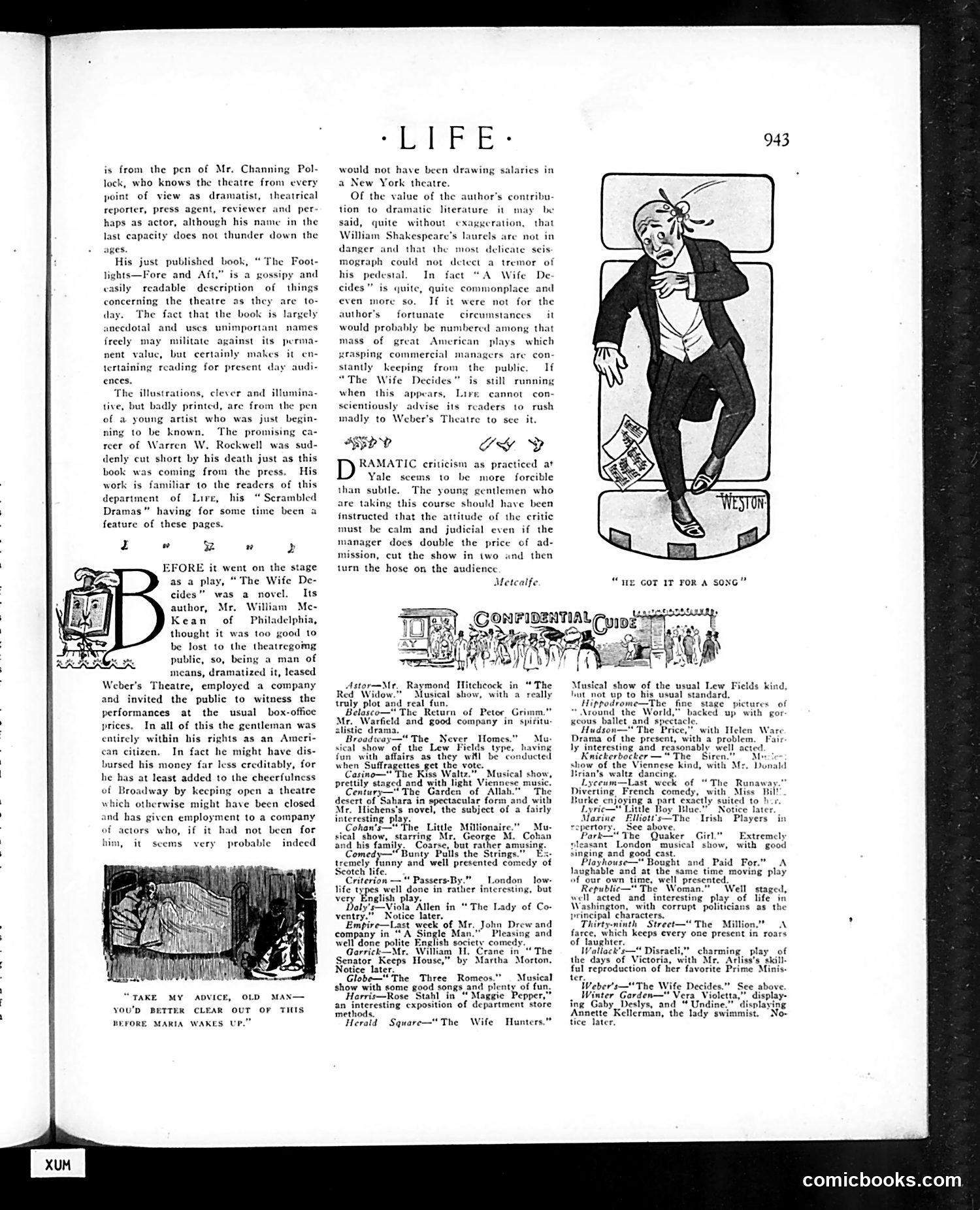
This page from Life magazine (likely early 1900s) contains theatrical criticism and gossip. The main cartoons mock two theatrical situations: **Upper cartoon**: Shows a man ("Weston," labeled "HE GOT IT FOR A SONG") being kicked out by his wife "Maria," illustrating the satirical review of the play "The Wife Decides." The joke is that the play's plot—a domestic squabble—is so trivial and commonplace that even its own defense (the author spent money supporting Broadway) doesn't justify seeing it. **Lower cartoon**: Captioned "TAKE MY ADVICE, OLD MAN—YOU'D BETTER CLEAR OUT OF THIS BEFORE MARIA WAKES UP," reinforces the marital-trouble theme, mocking the play's uninspired domestic drama. The text criticizes both the play's mediocrity (comparing unfavorably to Shakespeare) and Yale's overly harsh dramatic criticism. The page primarily serves as entertainment-industry commentary for Life's sophisticated urban readership, using domestic conflict as satirical fodder.
📄 Transcribed text from this page (OCR, searchable)
Machine-transcribed from the original scan — historical spelling and the odd misread are preserved.
is from the pen of Mr. Channing Pol- lock, who knows the theatre from every point of view as dramatist, theatrical reporter, press agent, reviewer and per haps as actor, although his name in the last capacity does not thunder down the ages. His just published book, “The Foot- lights—Fore and Aft,” is a gossipy and easily readable description of things concerning the theatre as they are to- The fact that the book is largely and uscs unimportant names militate against day anecdotal freely may nent valu; tertaining re ences. The illustrations, clever and illumina- tive, but badly printed, are from the pen of & young artist who was just begin- ning to be known, The promising ca- reer of Warren W. Rockwell was sud- denly cut short by his death just as this book was coming from the press. His work is familiar to the readers of this department of Lire, his “ Scrambled Dramas” having for some time been a feature of these pages. its perma- certainly makes it en ling for present day audi- » B ww » EFORE it went on the stage as a play, “The Wife De- cides" was a novel. Its author, Mr. William Me- Kean. of Philadelphia, thought it was too good to be lost to the theatregomg public, so, being a man of means, dramatized it, leased Weber's Theatre, employed a company and invited the public to witness the performances at the usual box-office prices, In all of this the gentleman was entirely within his rights as an Ameri- can citizen, In fact he might have dis- bursed his money far less creditably, for he has at least added to the cheerfulness of Broadway by kecping open a theatre which otherwise might have been closed nd has given employment to a company of actors who, if it had not been for it scems very probable indeed “TAKE MY ADVICE, OLD MAN— YOu'D BETTER CLEAR OUT OF BEFORE MARIA WAKES UP.” Ts, “LTE - would not have been drawing a New York theatre. Of the value of the author's contribu- tion to dramatic literature it may be said, without exaggeration, that William Shakespeare’s laurels are not in aries in quite danger and that the most delicate seis. mograph could not detect a tremor of his “A Wife De is quite, quite commonplace and If it were not for the fortunate circumstances it would probably be numbered among that mass of great American xrasping commercial managers are con- stantly keeping from the public. If “The Wife Decides” is running when this appears, Lire cannot con- scientiously advise its readers to rush madly to Weber's Theatre to see it. HOV oy Yy RAMATIC criticism as practiced at Yale seems to be more forcible than subtle. The young gentlemen who are taking this course should have been instructed that the attitude of the critic must be calm and judicial even if the manager docs double the price of ad- mission, cut the show in two and then turn the hose on the audience Metcalfe pedestal. In fact cides” even more so. author's plays which Astor==Mr,, Raymond Iitchcock, in Red Widow." Musical show, with a_ real truly plot and real fun. Belasco—" The Return of Peter Grimm Mr. Warfield and good company in spiritu istic drama. Broadway—" The Never Homes.” Mu: sical show of the Lew Fields type, having fun with affairs as they will be conducted when Suffragettes get the vote. Casino—" The Kiss Waltz.” Musical show prettily staged and with light Viennese, mu: Century—"* The Garden of Allah.” The desert of Sahara in spectacular form and with Mr. Hichens's novel, the subject of a fairly interesting play. Cohan’s—" The Little Millionaire.” Mu- ical show, starring Mr, George M. Cohan and his family. Coarse, but rather amusing. Comedy— Bunty Pulls the Strings.” Ex. tremely funny and well presented comedy of Seoteh life. Criterion —" Passers-By.” London low- life types well done in rather interesting, but English play. y's—Viola Allen in “The Lady of Co- ventry.”” Notice later. Empire—Last ohn Drew and company in “A Single Man.” Pleasing and well done polite English society comedy. Garrick—Mr. William II. Crane in“ The Senator Keeps House,” by Martha Morton. Notice later. ‘ Globe—" The Three Romeos.” Musical show with some good songs and plenty of fun; ‘Herris—Rose Stahl in Maggie Pepper,” an interesting exposition of department stote methods. Herald Square—""The Wife Hunters." Gonripzamiat Musical show of the usual Lew Fields kind, int not up to his usual standard, Hippodrome—The fine stage pictures of “Around ‘the World,” backed up with gor xcous ballet and spectacle. Hudson—" The Price,” with Helen V Drama of the present, with a problem. ly interesting and reasonably well acte Knickerbocker —“ The Siren.” Me show of the Viennese kind, with Mz. Donald Krian's waltz dancing. Lyceum—Last week of “The Runaway.” ling. French comedy, with Miss Dil? urke enjoying a part exactly suited to hr Lyric—" Little Hoy Ilue."” Notice later. Maxine Elliott’s—The Irish Players in repertory. See above. Pork—" The Quaker Girl.” pleasant London musical show, Singing and good cast. Playhouse—" Bought and Paid For.” A laughable and at the same time moving play of our own time, well presented. Republic—" The Woman.” — Well staged, well acted and interesting play of life in Washington, with corrupt politicians as the principal characters. Thirty-ninth Street-—“ The Million.” farce, which keeps every one present in roars of laughter. Woallack’s—“ Disraeli,” charming play of the days of Victoria, with Mr. Arliss's skill- ful reproduction of her favorite Prime Minis. ter, Webcr’s—"The Wife Decides. Winter Garden—" Vera Violett ing Gaby Deslys, and “ Undine.’ Annette Kellerman, the lady swimmis tice later. Extremely with good See above. display- lay comicbooks.com.