
Life, 1911-11-30 · page 8 of 40
Life — November 30, 1911 — page 8: what you’re looking at
What you’re looking at
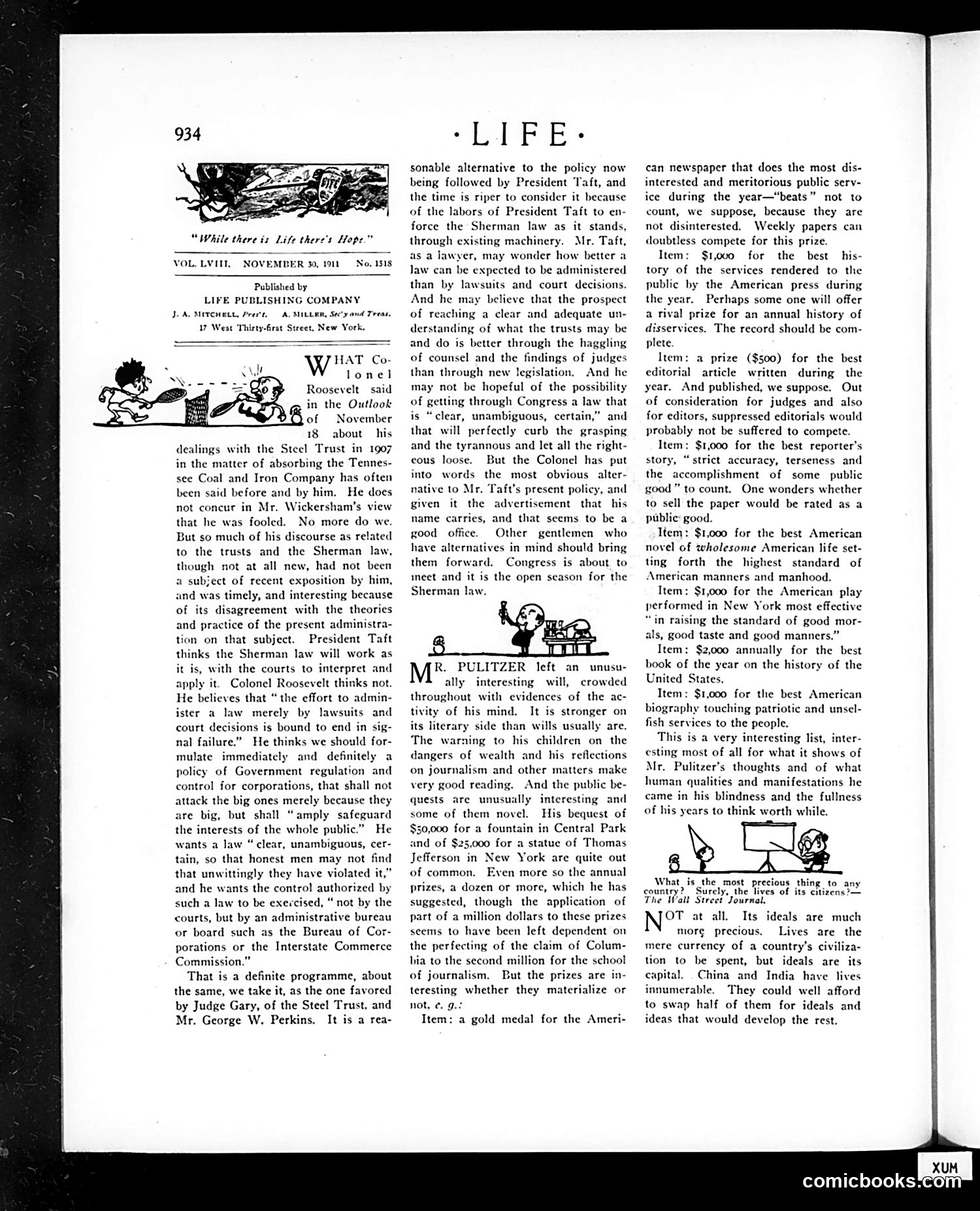
This page discusses Colonel Roosevelt's views on the Sherman Antitrust Law and trust regulation. The text contrasts Roosevelt's approach with President Taft's policy, suggesting Roosevelt favors administrative action over lawsuits and court decisions to control corporate trusts. The cartoon depicts **Mr. Pulitzer** (identifiable by the caption), described as having an "unusually interesting will" that is "stronger on its thrifty side than wills usually are." The satire references Pulitzer's substantial bequests—$500,000 for a fountain and $25,000 for a Thomas Jefferson statue—highlighting the contrast between his wealth and the prizes he established for journalism and literature. The broader context involves debates over how government should regulate large corporations during the Progressive Era.
📄 Transcribed text from this page (OCR, searchable)
Machine-transcribed from the original scan — historical spelling and the odd misread are preserved.
“While there iz Life there's Hope.” VOL. LVM, NOVEMBER 39, 1911 No. 1518 Published by LIFE PUBLISHING COMPANY Jo AL MITCHELL, Pres, AL MILLRR, Sec'y and Treas, ¥7 West Thirty-frst Street, New York. HAT Co- lonel Roosevelt said in the Outlook November 18 about his dealings with the Steel Trust in 1907 in the matter of absorbing the Tennes- see Coal and Iron Company has often been said before and by him. He does not concur in Mr. Wickersham’s view that he was fooled. No more do we. But so much of his discourse as related to the trusts and the Sherman law, though not at all new, had not been a subject of recent exposition by him, and was timely, and interesting because of its disagreement with the theories and practice of the present administra- tion on that subject. President Taft thinks the Sherman law will work as it is, with the courts to interpret and apply it. Colonel Roosevelt thinks not. He believes that “the effort to admin- ister a law merely by lawsuits and court decisions is bound to end in sig- nal failure.” He thinks we should for- mulate immediately and definitely a policy of Government regulation and control for corporations, that shall not attack the big ones merely because they are big, but shall “amply safeguard the interests of the whole public.” He wants a law “clear, unambiguous, cer- tain, so that honest men may not find that unwittingly they have violated it,” and he wants the control authorized by such a law to be exercised, “ not by the courts, but by an administrative bureau or board such as the Bureau of C porations or the Interstate Commerce Commission.” That is a definite programme, about the same, we take it, as the one favored by Judge Gary, of the Steel Trust, and Mr. George W. Perkins. It is a rea- “Ee P'E » sonable alternative to the policy now being followed by President Taft, and the time is riper to consider it because of the labors of President Taft to en- force the Sherman law as it stands, through existing machinery. Mr. Taft, as a lawyer, may wonder how better a law can be expected to be administered than by lawsuits and court decisions. And he may believe that the prospect of reaching a clear and adequate un- derstanding of what the trusts may be and do is better through the haggling of counsel and the findings of judges than through new legislation. And he may not be hopeful of the possibility of getting through Congress a law that is “clear, unambiguous, certain,” and that will perfectly curb the grasping and the tyrannous and let all the right- cous loose. But the Colonel has put into words the most obvious alter- native to Mr, Taft's present policy, and given it the advertisement that his and that seems to be a good office. Other gentlemen who have alternatives in mind should bring them forward. Congress is about to ineet and it is the open season for the Sherman law. name carrie R. PULITZER left an unusu- ally interesting will, crowded throughout with evidences of the ac- tivity of his mind. It is stronger on its literary side than wills usually are. The warning to his children on the dangers of wealth and his reflections on journalism and other matters make very good reading. And the public be- quests are unusually interesting and some of them novel. His bequest of $30,000 for a fountain in Central Park and of $25,000 for a statue of Thomas Jefferson in New York are quite out of common. Even more so the annual prizes, a dozen or more, which he has suggested, though the application of part of a million dollars to these prizes scems to have been left dependent on the perfecting of the claim of Colum- hia to the second million for the school of journalism. But the prizes are in- teresting whether they materialize or not, ¢. g.- Item: a gold medal for the Ameri- can newspaper that does the most di interested and meritorious public serv- ice during the year—“beats” not to count, we suppose, because they are not disinterested. Weekly papers can doubtless compete for this prize. Item: $1,000 for the best his- tory of the services rendered to the public by the American press during the year. Perhaps some one will offer a rival prize for an annual history of disservices. The record should be com- plete. Item: a prize ($500) for the best editorial article written during the year. And published, we suppose. Out of consideration for judges and also for editors, suppressed editorials would probably not be suffered to compete. Item: $1,000 for the best reporter's story, “strict accuracy, terseness and the accomplishment of some public good” to count. One wonders whether to sell the paper would be rated as a public: good. Item: $1,000 for the best American novel of wholesome American life set- ting forth the highest standard of American manners and manhood. Item: $1,000 for the American play performed in New York most effective “in raising the standard of good mor- als, good taste and good manners.” Item: $2,000 annually for the best book of the year on the history of the United States. Item: $1,000 for the best American biography touching patriotic and unsel- fish services to the people. This is a very interesting list, inter- esting most of all for what it shows of Mr. Pulitzer’s thoughts and of what human qualities and manifestations he came in his blindness and the fullness of his years to think worth while. What is the most precious thing to any try? Surely, the lives of its citizens?— Watt Street Journal, OT at all. Its ideals are much morg precious. Lives are the mere currency of a country’s civiliza- tion to be spent, but ideals are its capital. China and India have lives innumerable. They could well afford to swap half of them for ideals and ideas that would develop the rest. comicbooks -CO)