
Life, 1911-11-30 · page 16 of 40
Life — November 30, 1911 — page 16: what you’re looking at
What you’re looking at
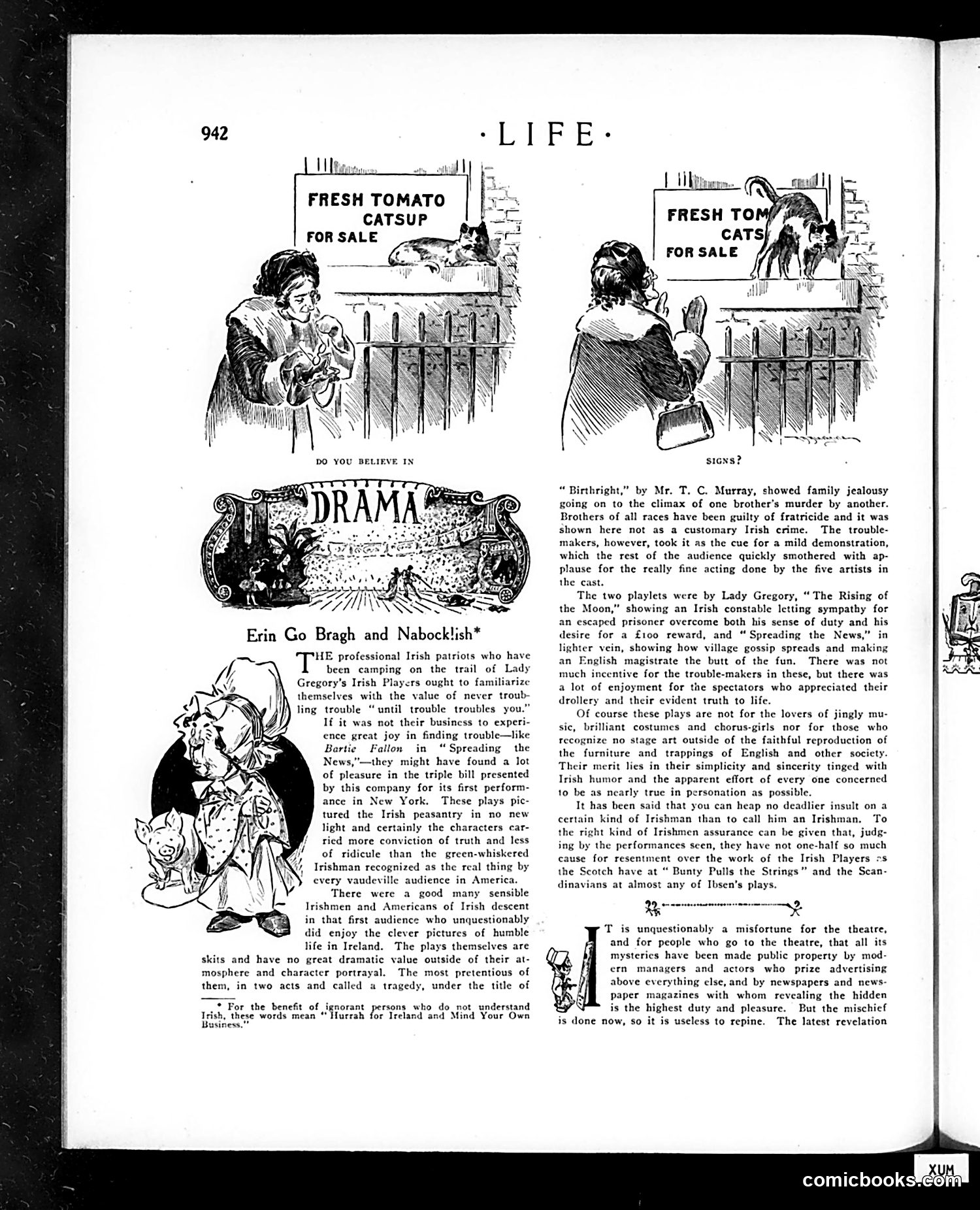
The top cartoons satirize misread signs: a woman sees "Fresh Tomato Catsup for Sale" but reads it as "Cats for Sale" (visual pun on poor eyesight or distraction). The humor is wordplay—the absurdity of selling cats like condiments. The main article reviews Lady Gregory's Irish Players' New York debut. It defends the theatrical troupe against Irish-American protesters who objected to the plays' portrayal of Irish peasant life. The reviewer argues the plays show authentic, humble Irish characters with "conviction of truth"—not the stereotypical "green-whiskered Irishman" of American vaudeville. The piece explains that some Irish-Americans found "Birthright" (depicting fratricide) offensive, but the audience applauded the "fine acting." The reviewer suggests such protesters are overly sensitive, claiming the plays deserve appreciation for their "simplicity and sincerity tinged with Irish humor." **Context**: This reflects early 1900s tensions between Irish immigrants' self-image and artistic representation—complaints that theater reinforced ethnic stereotypes.
📄 Transcribed text from this page (OCR, searchable)
Machine-transcribed from the original scan — historical spelling and the odd misread are preserved.
FRESH TOMATO CATSUP FOR SALE Erin Go Bragh and Nabock!ish* HE professional Irish patriots who have been camping on the trail of Lady Gregory's Irish Players ought to familiarize themselves with the value of never troub- ling trouble “until trouble troubles you.” If it was not their business to experi- ence great joy in finding trouble—like Bartic Fallon in “ Spreading the News,"—they might have found a lot of pleasure in the triple bill presented by this company for its first perform- ance in New York. These plays pic- tured the Irish peasantry in no new light and certainly the characters car- ried more conviction of truth and less of ridicule than the green-whiskered Irishman recognized as the real thing by every vaudeville audience in America. There were a good many sensible Irishmen and Americans of Irish descent in that first audience who unquestionably did enjoy the clever pictures of humble life in Ireland. The plays themselves are skits and have no great dramatic value outside of their at- mosphere and character portrayal. The most pretentious of them, in two acts and called a tragedy, under the title of _* For the benefit of ignorant persons who do not understand Trish, thege words mean ‘Hurrah for Ireland and Mind Your Own usiness. FRESH TO CATS} FOR SALE signs? “ Birthright,” by Mr. T. C. Murray, showed family jealousy going on to the climax of one brother's murder by another. Brothers of all races have been guilty of fratricide and it was shown here not as a customary Irish crime. The trouble- makers, however, took it as the cue for a mild demonstration, which the rest of the audience quickly smothered with ap- plause for the really fine acting done by the five artists in the cast. The two playlets were by Lady Gregory, “The Rising of the Moon,” showing an Irish constable letting sympathy for an escaped prisoner overcome both his sense of duty and his desire for a £100 reward, and “Spreading the News,” i lighter vein, showing how village gossip spreads and making an English magistrate the butt of the fun, There was not much incentive for the trouble-makers in these, but there was a lot of enjoyment for the spectators who appreciated their drollery and their evident truth to life. Of course these plays are not for the lovers of jingly mu- sic, brilliant costumes and chorus-girls nor for those who recognize no stage art outside of the faithful reproduction of the furniture and trappings of English and other society. Their merit lies in their simplicity and sincerity tinged with Irish humor and the apparent effort of every one concerned to be as nearly true in personation as possible. It has been said that you can heap no deadlier insult on a certain kind of Irishman than to call him an Irishman, To the right kind of Irishmen assurance can be given that, judg- ing by the performances scen, they have not one-half so much cause for resentment over the work of the Irish Players 7s the Scotch have at “ Bunty Pulls the Strings” and the Scan- dinavians at almost any of Ibsen's plays. Bape arene 8 T is unquestionably a misfortune for the theatre, and for people who go to the theatre, that all its mysterics have been made public property by mod- ern managers and actors who prize advertising above everything clse, and by newspapers and news- Paper magazines with whom revealing the hidden is the highest duty and pleasure. But the mischief is done now, so it is useless to repine. The latest revelation comicbookMen a