
A complete issue · 44 pages · 1911
Life — November 23, 1911
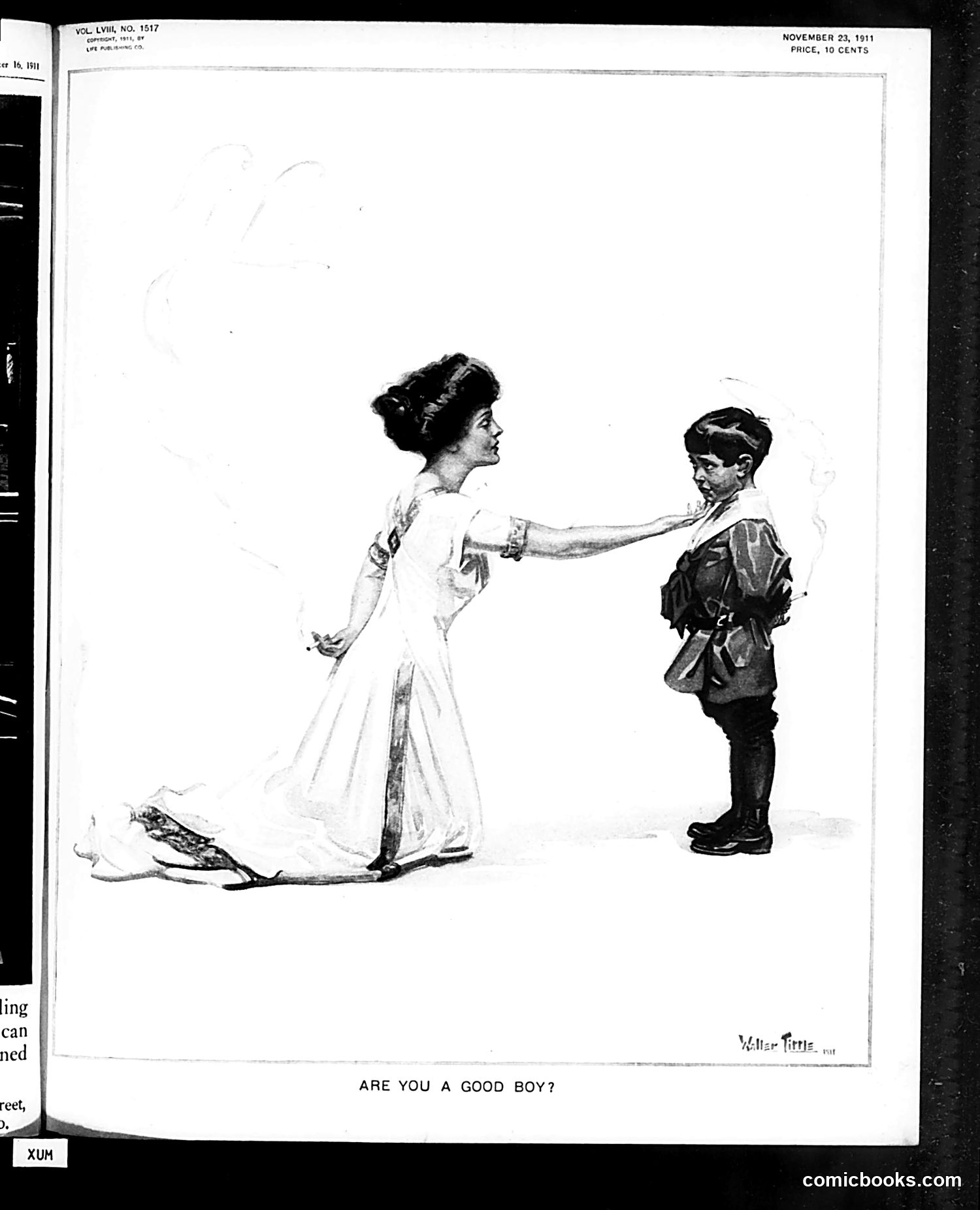
This 1911 *Life* magazine illustration by Wallace Nutting depicts a woman in an elegant white gown addressing a young boy in formal attire. The caption "Are You a Good Boy?" suggests social commentary on child-rearing and behavioral expectations during the Edwardian era. The satire likely mocks contemporary parenting practices and gender dynamics—the woman's commanding posture and the boy's smaller stature emphasize adult authority and childhood subordination. The formal dress of both figures suggests this is about maintaining social propriety and middle-class respectability. Without additional context from the issue, the precise target of satire remains unclear, but it appears to critique conventional attitudes toward childhood obedience and social conditioning in early 20th-century America.
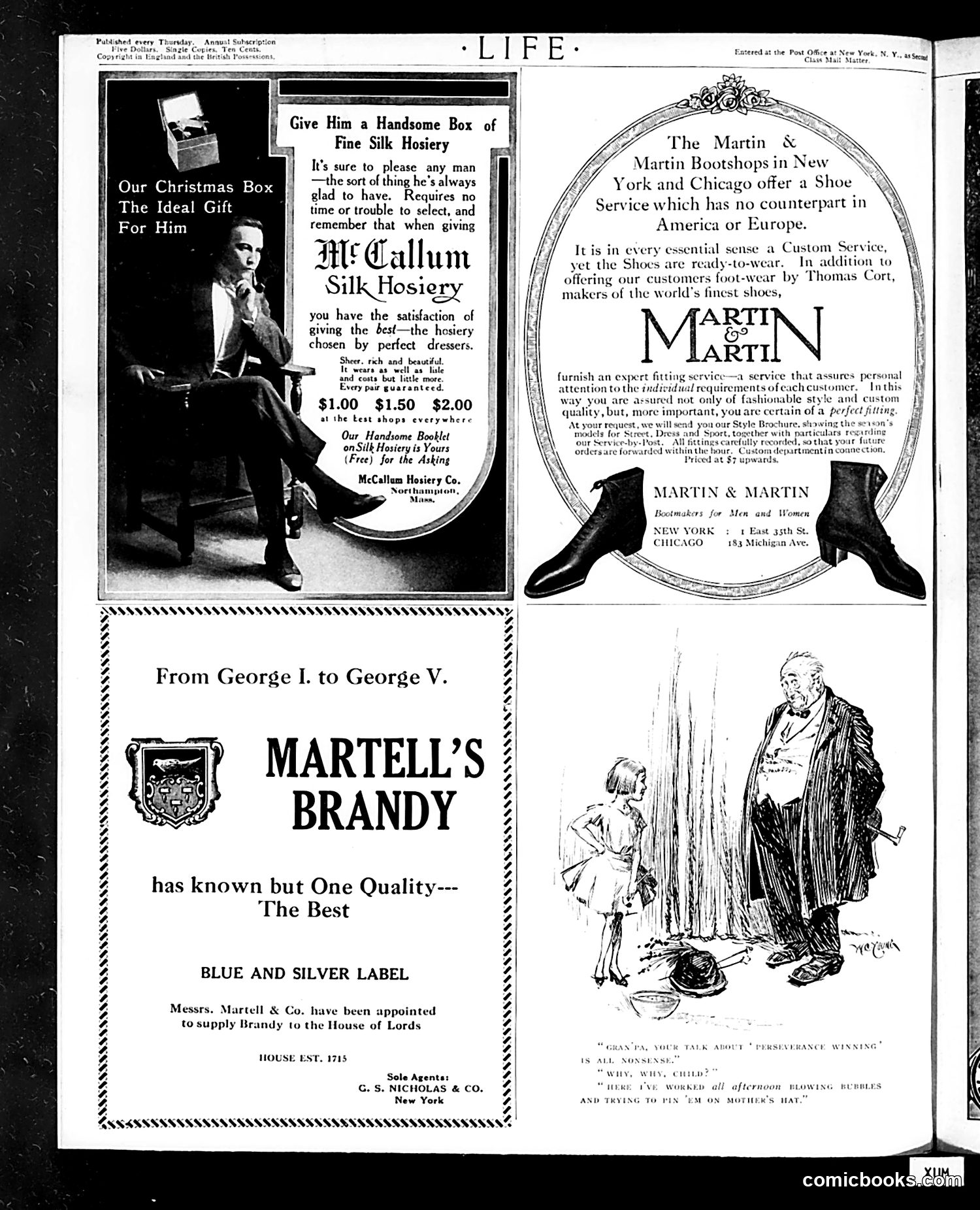
This Life magazine page is primarily **advertising content** rather than satirical editorial material. It features three advertisements: 1. **McCallum Silk Hosiery** - positioned as an ideal Christmas gift for men, priced $1.00-$2.00 2. **Martin & Martin Bootshops** - promoting a shoe fitting service claiming superiority to European competitors 3. **Martell's Brandy** - emphasizing consistent quality across generations (George I to George V, referencing British monarchs) The only cartoon present is a small illustration accompanying the Martell's ad, showing an adult and child, with humorous dialogue about perseverance and bubble-blowing—lighthearted domestic humor unrelated to politics or social satire. This page demonstrates how Life magazine, while known for satire, generated revenue through luxury goods advertising aimed at affluent male readers.
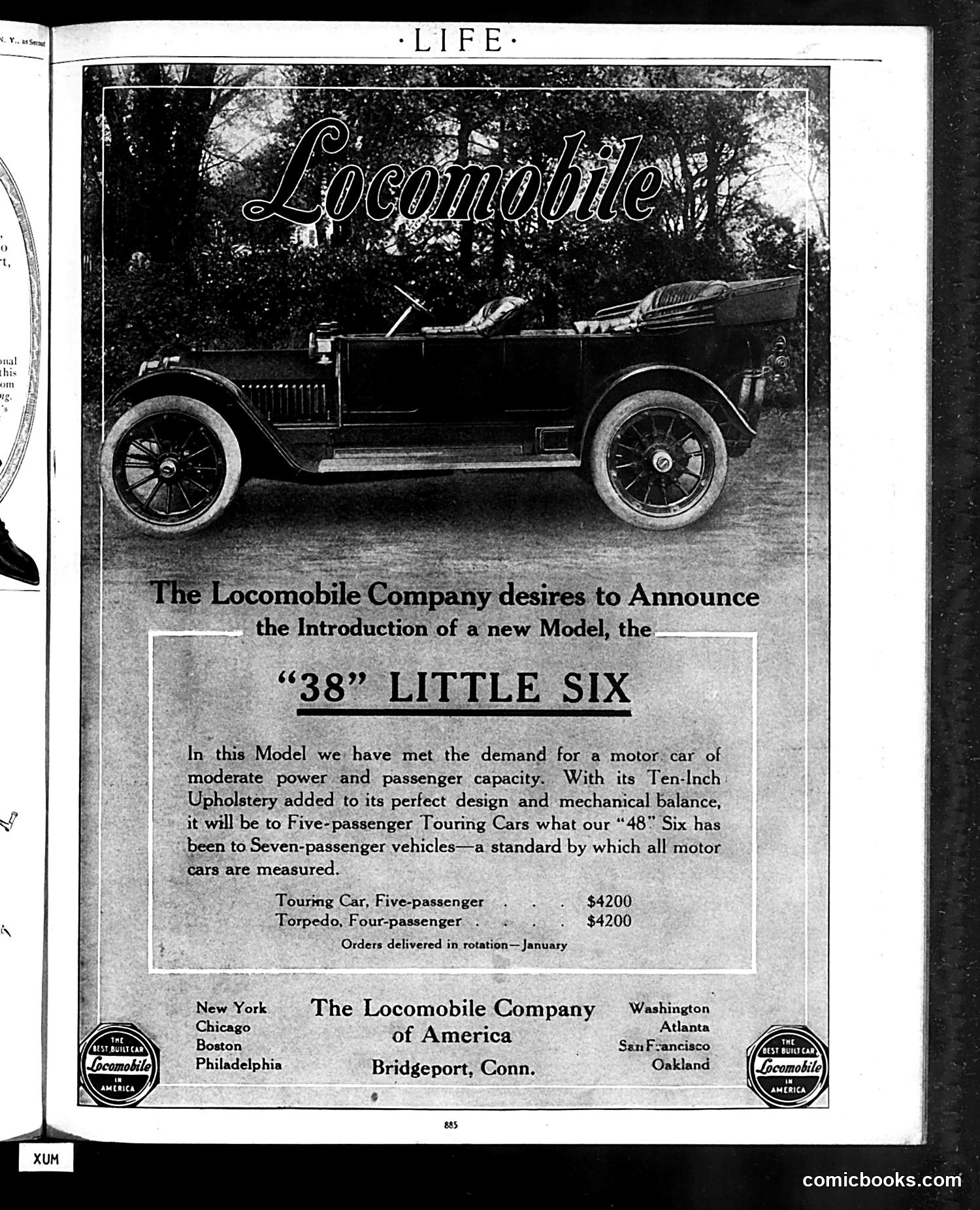
This is primarily an **advertisement, not satirical content**. It's a full-page ad from *Life* magazine for the Locomotile Company of America, announcing their new "38" Little Six automobile model. The ad features a side-view photograph of an open-air touring car and emphasizes the vehicle's practical appeal: moderate power and passenger capacity (five passengers), with quality upholstery. The copy compares it favorably to the company's existing "48" Six model, framing the new car as meeting demand for a more affordable, moderately-sized motor vehicle. Pricing is listed at $4,200 for both the touring car and torpedo models, with delivery promised in January. The company lists multiple locations (New York, Chicago, Boston, Philadelphia, Washington, Atlanta, San Francisco, Oakland), establishing national distribution. This represents early automotive marketing targeting middle-class consumers.
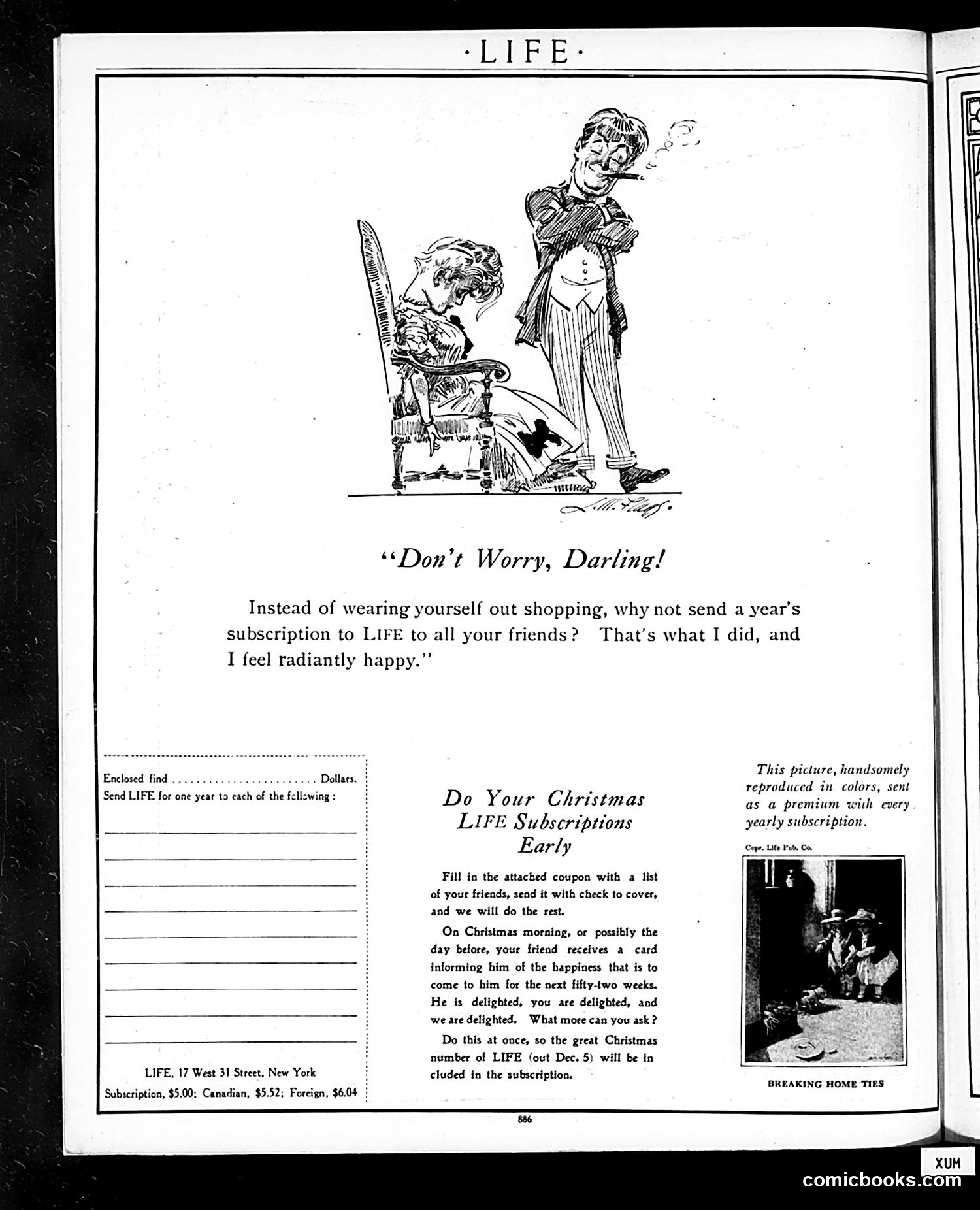
This page is primarily **advertising**, not political satire. It's a LIFE magazine subscription promotion from the early 20th century. The cartoon shows a man presenting an exhausted woman (labeled "Darling") with a gift. The joke: instead of tiring herself with holiday shopping, she should give her friends LIFE magazine subscriptions as Christmas gifts. The man claims he did this and "feel radiantly happy." The advertisement includes a coupon for readers to mail in lists of friends' names and addresses, with LIFE handling the subscription deliveries by Christmas morning. This reflects period attitudes: the "weary shopper" trope (typically depicted as female) and the implication that magazine subscriptions make convenient, appropriate gifts. The pricing ($3.00 domestic; $3.52 Canadian; $6.04 foreign) anchors this to early 1900s economics.
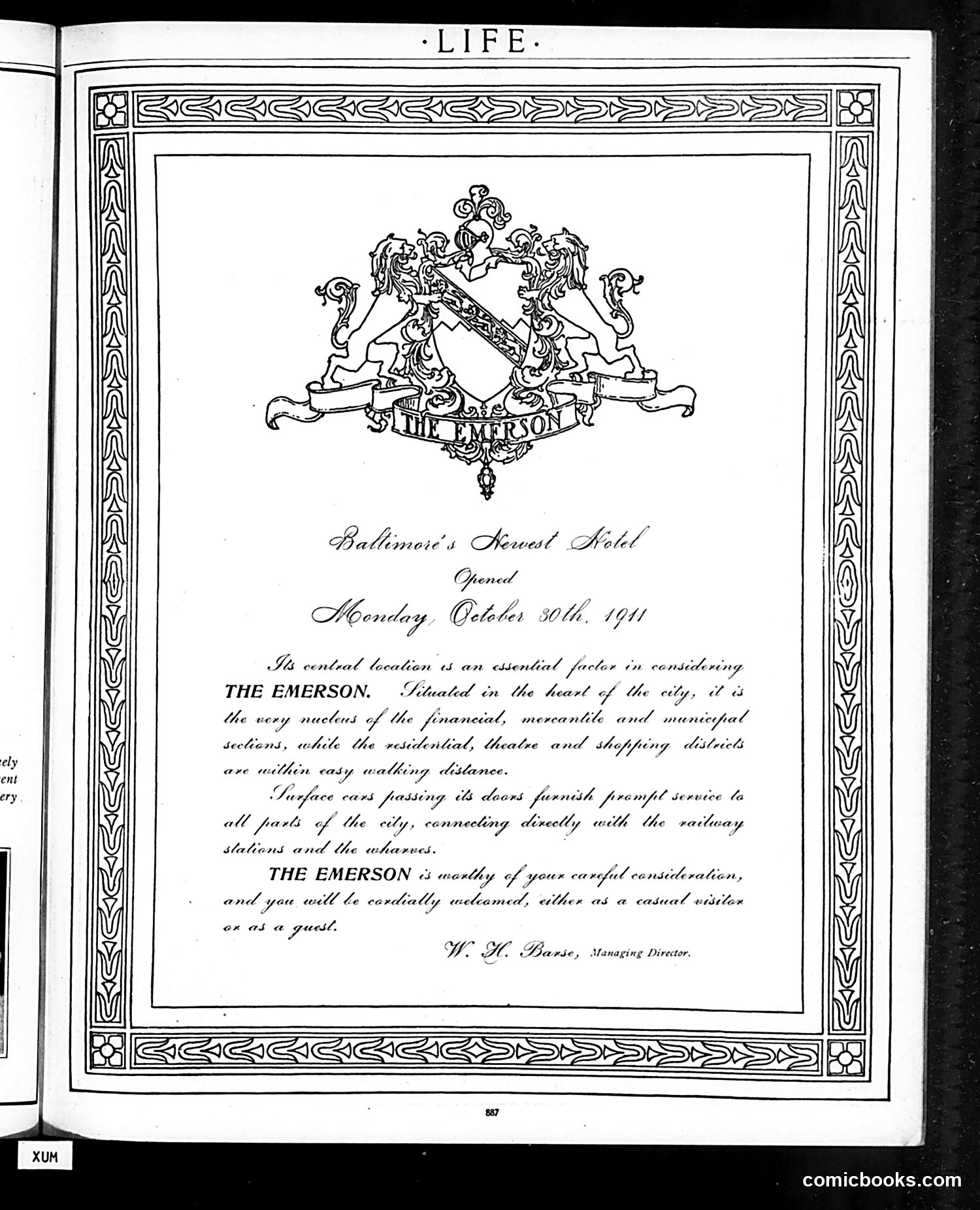
This page is **primarily an advertisement**, not a political cartoon. It promotes the opening of Baltimore's Emerson Hotel on Monday, October 30th, 1911. The ornate heraldic crest at top depicts "THE EMERSON" as the hotel's emblem. The text emphasizes the hotel's prestigious central location in Baltimore's financial, commercial, and cultural districts, highlighting its proximity to shopping, theaters, and railway stations. Managing Director W. H. Barse uses promotional language to position the Emerson as worthy of "careful consideration," welcoming visitors as either casual tourists or guests. The elaborate border and formal typography reflect early 20th-century luxury marketing, presenting the hotel as a prestigious establishment befitting Baltimore's business class.
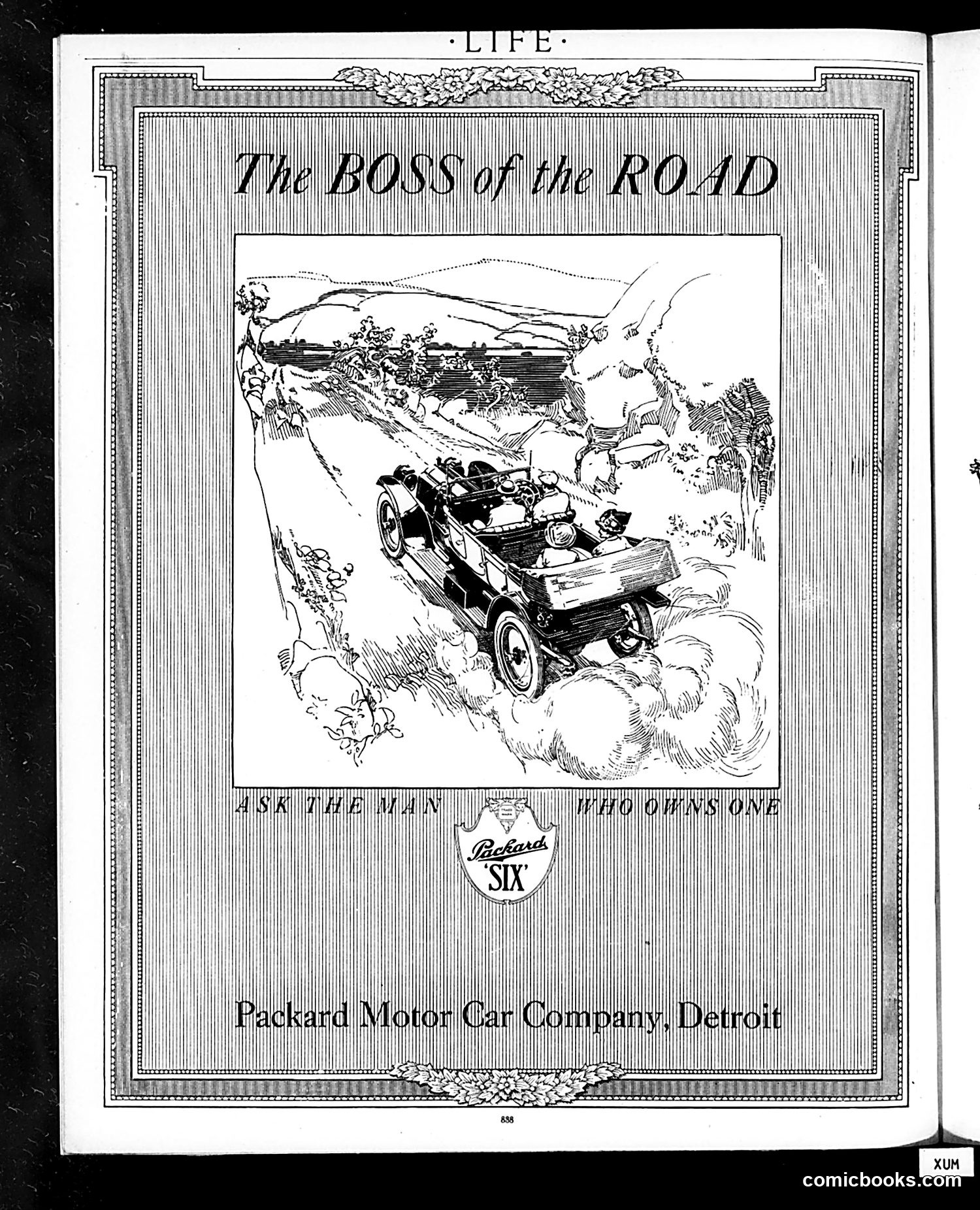
This is a **automobile advertisement**, not political satire. The page promotes the Packard Six motor car from Detroit. The illustration depicts a early 1910s-era automobile driven by a man in formal attire, positioned dominantly on a curved road. Classical cherub figures frame the vehicle, and the tagline reads "ASK THE MAN WHO OWNS ONE." The "boss of the road" phrase is **marketing language** emphasizing the car's superiority and power—the driver literally commands the road. The cherubs and classical styling suggest luxury and prestige. This was a common early automotive advertising strategy: associating cars with control, status, and mastery over the landscape. The Packard Six was a high-end luxury vehicle, and this advertisement targets wealthy consumers.
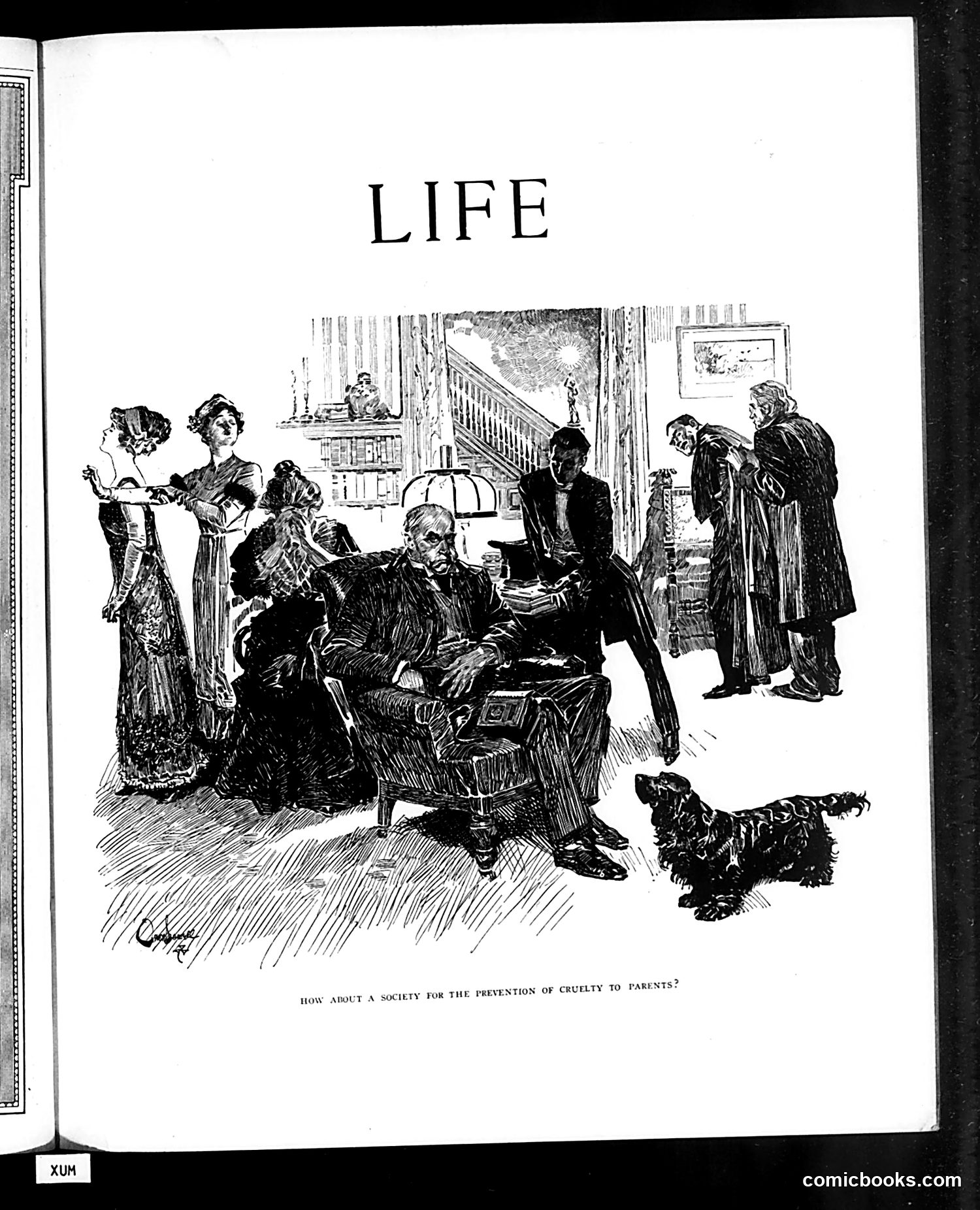
This is a satirical cartoon from *Life* magazine showing a domestic scene with the caption "HOW ABOUT A SOCIETY FOR THE PREVENTION OF CRUELTY TO PARENTS?" The cartoon depicts what appears to be an elderly man (likely a father figure) seated while surrounded by various family members and visitors engaged in activities around him—some appear dismissive or inattentive to his presence. A small dog sits in the foreground. The satire inverts the familiar "Society for the Prevention of Cruelty to Children" (a real organization that existed by this time). Instead, it suggests that parents themselves suffer neglect and disrespect from their own children and family members, implying generational ingratitude or disrespect toward aging parents. The cartoon critiques what the artist saw as a lack of filial duty in contemporary society.
The top cartoon depicts what appears to be a political figure being forcibly removed or ejected—likely referencing "Tammany" (the corrupt Democratic machine controlling New York City politics). The caption mentions Tammany "pitched out of the Assembly" and references freeing the organization from "the fear of Tammany." The text criticizes New York's Democratic establishment, particularly Tammany Hall's influence. It praises recent Republican electoral successes as a rejection of machine politics and corrupt governance. The article distinguishes between honest Democrats and those tied to Tammany's corrupt patronage system of "bosses, office holders, politicians, contractors." The satire targets the persistence of urban political machines despite reform efforts, celebrating their temporary electoral defeat.
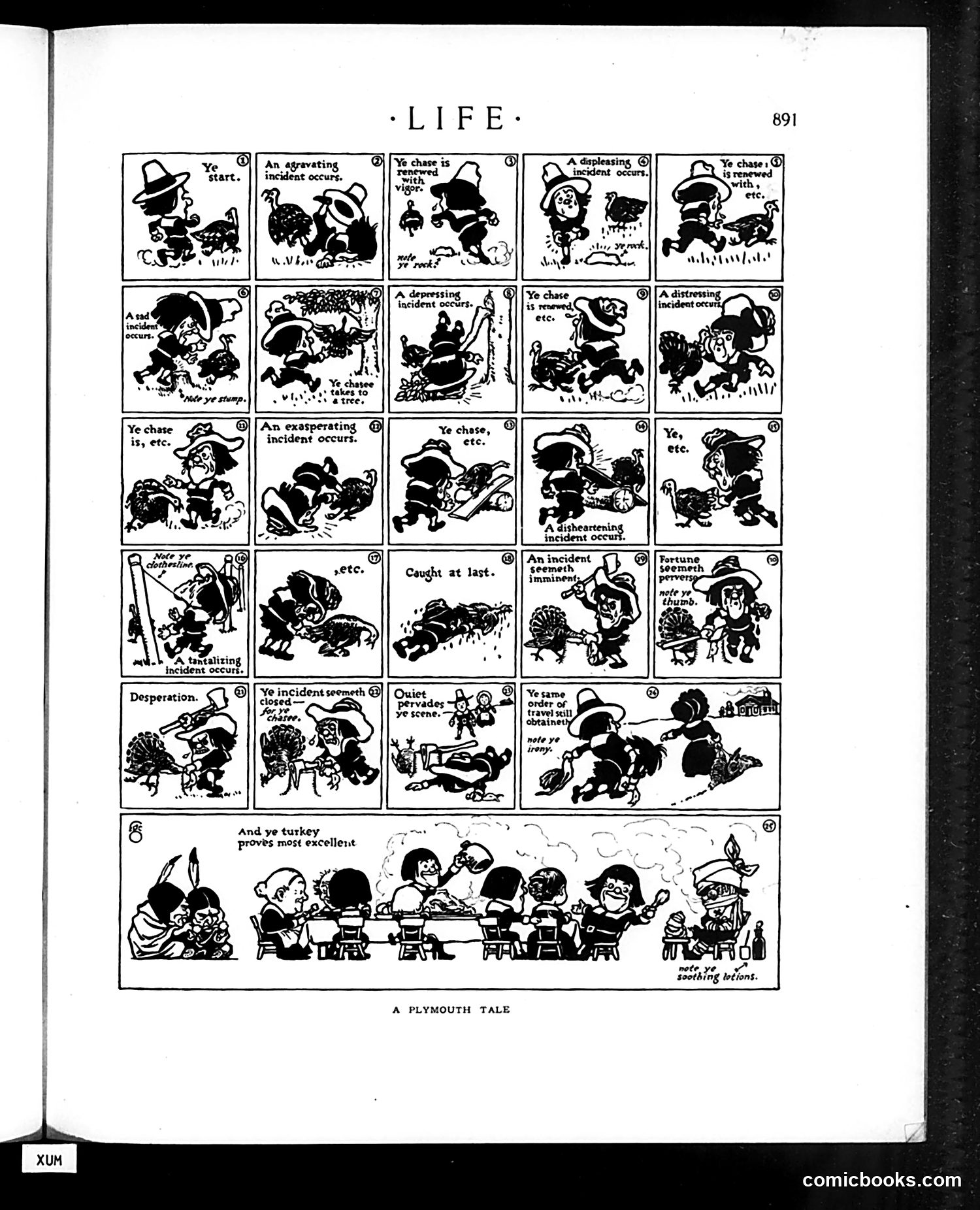
This is a humorous sequential comic strip depicting a chaotic hunting or outdoor adventure. The narrative follows a character (appearing to be a pilgrim or early settler based on the hat style) through a series of increasingly comedic misadventures while chasing what appears to be a turkey. The strip's title "A Plymouth Tale" references Plymouth Colony, the Pilgrims' settlement, connecting the story to Thanksgiving lore. The final panel shows the character successfully presenting a roasted turkey to a dining table full of people, suggesting the comedic journey culminates in the traditional holiday meal. The humor derives from slapstick mishaps and the contrast between the chaotic chase and the civilized feast outcome.
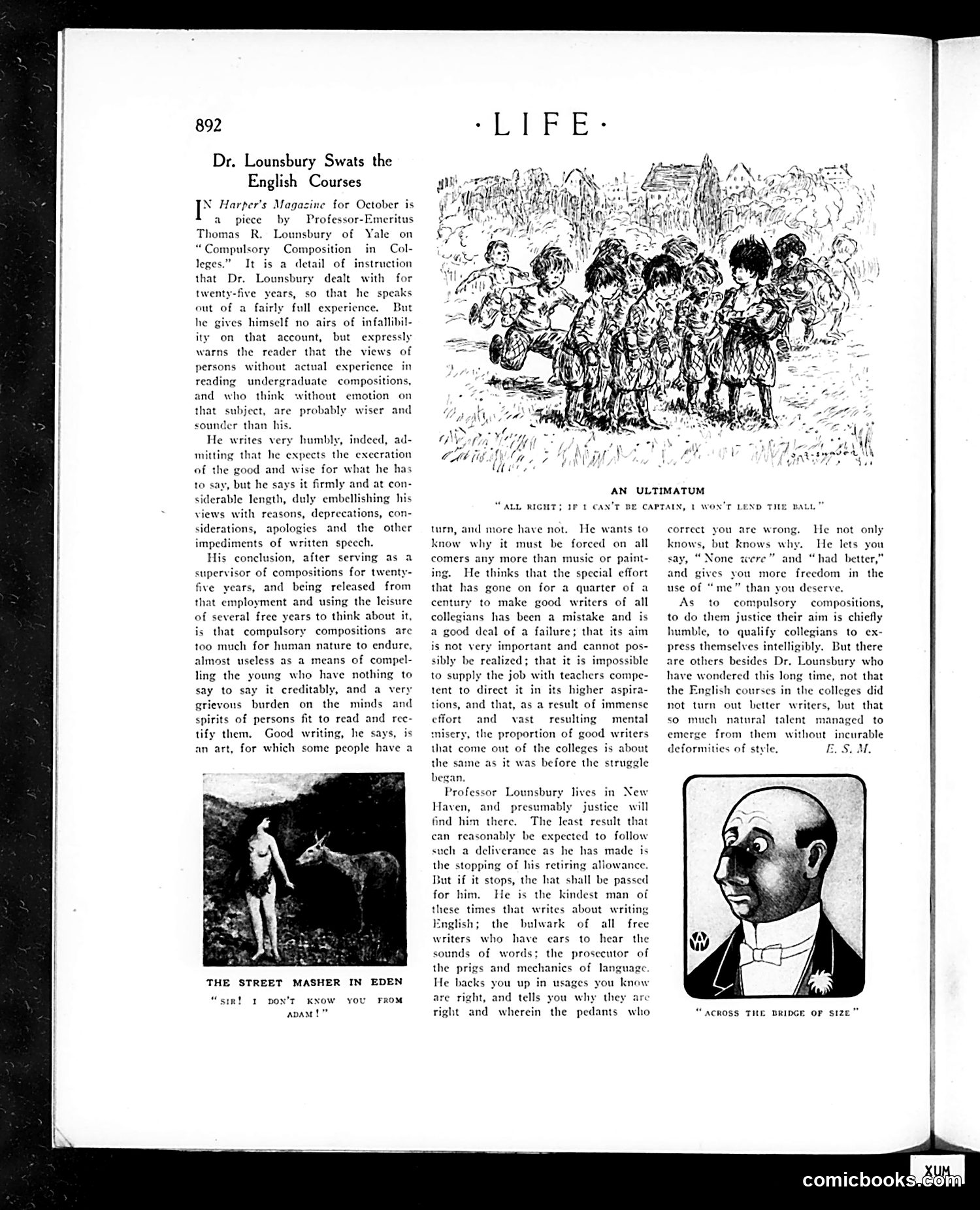
This page discusses **Dr. Thomas R. Lounsbury of Yale**, a literary critic who wrote for Harper's Magazine about university English education. The article critiques his pessimistic views on undergraduate writing composition. The two illustrations appear to be: 1. **"The Street Masher in Eden"** — a sketch showing a man accosting a woman, captioned "Sir! I don't know you from Adam!" This likely satirizes inappropriate social behavior. 2. **"Across the Bridge of Size"** — a caricatured portrait of a bald man in formal dress, presumably Lounsbury himself, used to accompany the critical discussion of his views on English instruction. The page's satire targets Lounsbury's pessimism about teaching writing, arguing his views are overly harsh on both students and composition instruction's potential.
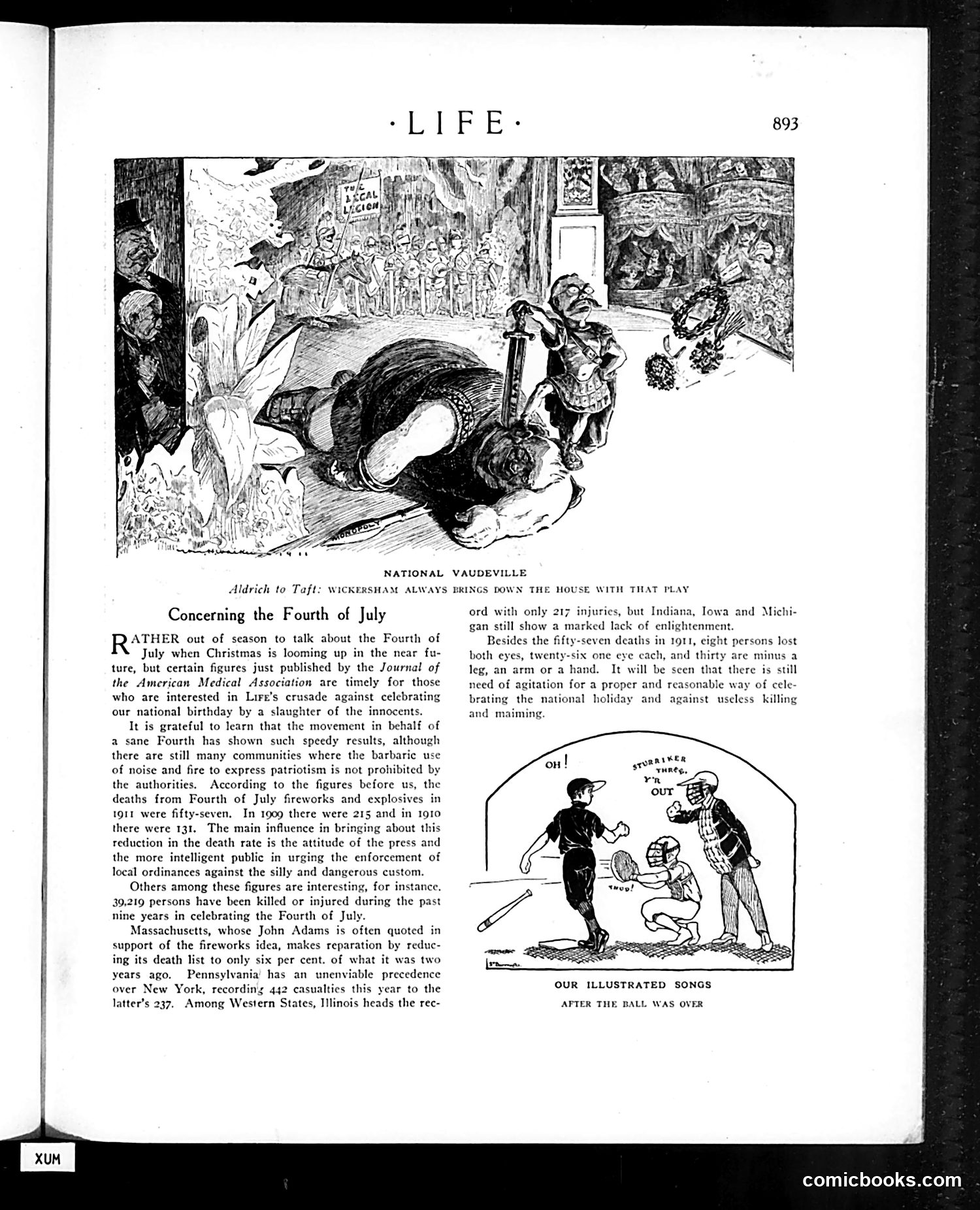
This page contains two elements: a serious editorial and a humorous cartoon. **The Editorial** discusses Fourth of July fireworks safety, noting deaths and injuries from fireworks. It celebrates efforts to reduce casualties—Massachusetts reduced deaths by 51%, Pennsylvania by 41%—crediting press coverage and local ordinances against "the silly and dangerous custom." **The Cartoon** ("Our Illustrated Songs: After the Ball Was Over") depicts a baseball scene. A player swings and appears to have hit another person instead of the ball, shown crouching injured. The joke plays on the song title "After the Ball Was Over"—suggesting literal consequences of a wild swing. It's gentle sports humor, likely satirizing either careless play or overzealous batting.
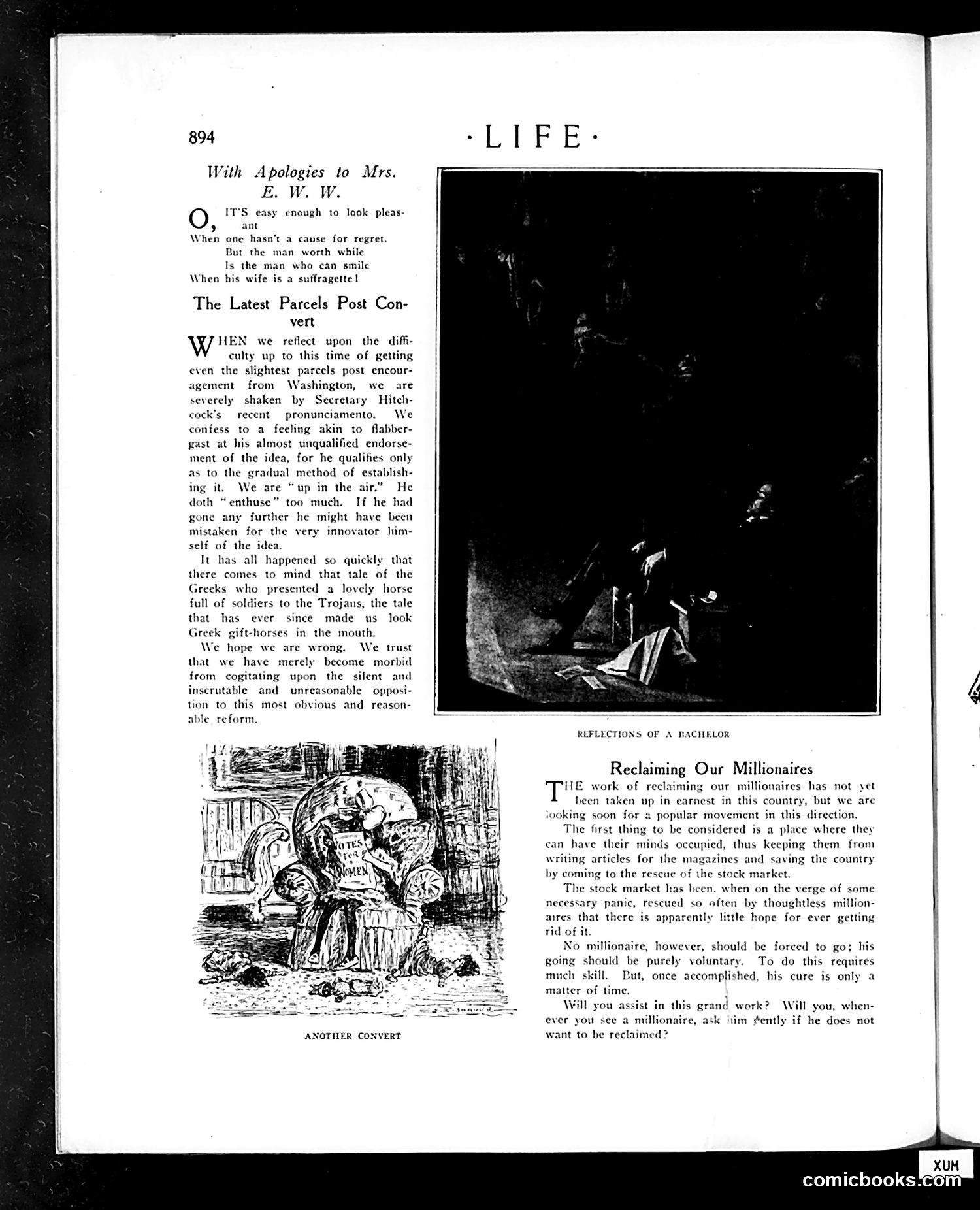
This page contains two distinct cartoons with satirical commentary: **"Another Convert"** (bottom left): A sketch showing a figure being converted, likely religious or ideological conversion, though the specific target is unclear from the image alone. **"Reflections of a Bachelor"** (top right): A photograph or illustration depicting a bachelor in contemplative pose. The text discusses **Secretary Hitchcock's endorsement of parcel post reform**—apparently a significant policy initiative. The article expresses skepticism about his "unqualified endorsement," sarcastically comparing it to the Trojan Horse, suggesting the proposal may have hidden drawbacks despite appearing beneficial. **"Reclaiming Our Millionaires"** (right column): Proposes encouraging wealthy individuals to write magazine articles rather than hoard wealth, framing it as voluntary public service to "rescue" the stock market and national economy. The satire targets Progressive-era concerns about wealth concentration and government reform initiatives.
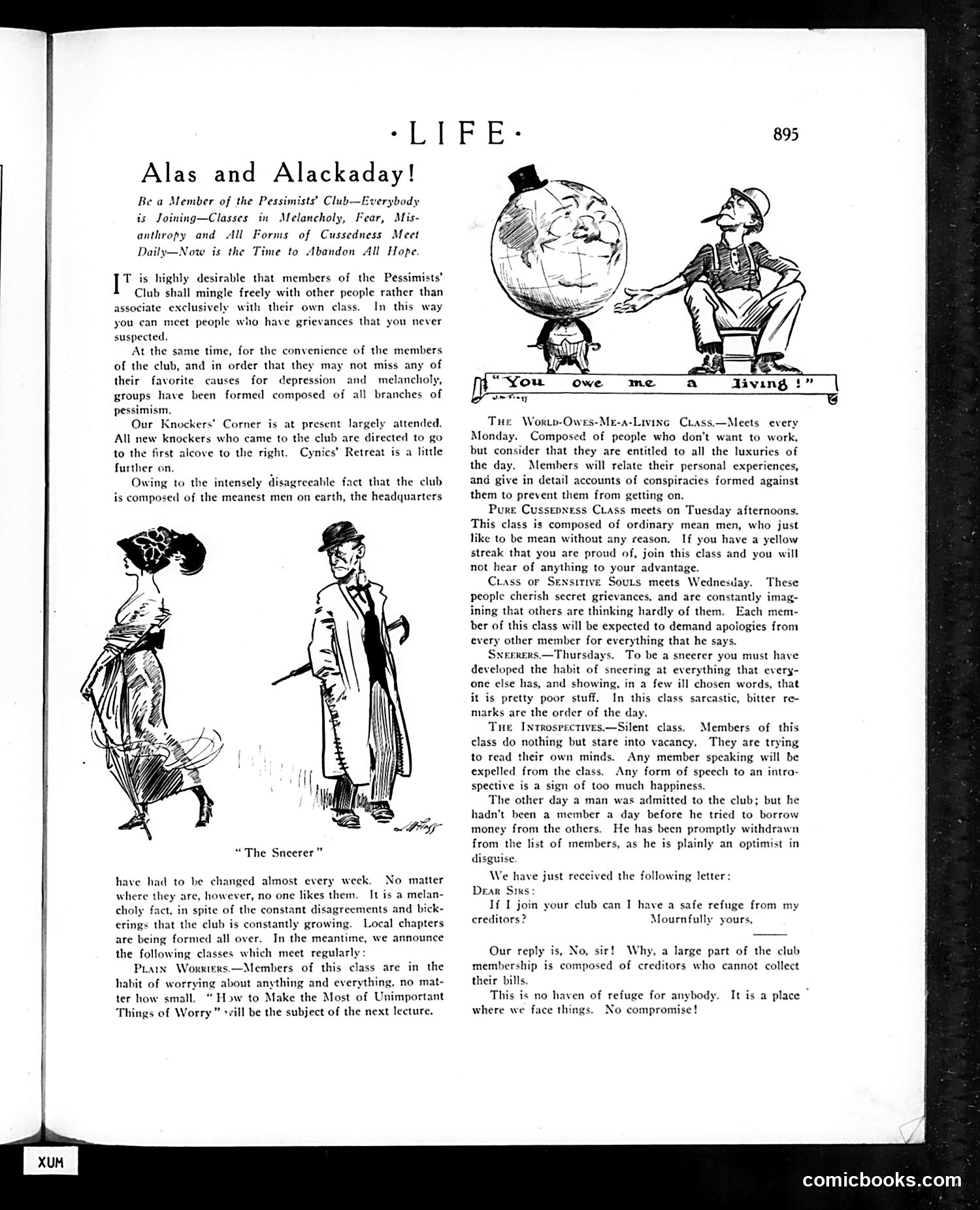
This satirical piece mocks a fictional "Pessimists' Club" whose members are exclusively negative people who socialize only with fellow pessimists. The illustration shows various character types: "The Sorcerer" (a cynical man) and other archetypal pessimists. The satire describes absurd sub-groups within the club—the "World-Owes-Me-a-Living Class," "Pure Cussedness Class," "Sneerers," and "Introspectives"—each embodying exaggerated negative personality traits. The joke is that the club has become so large despite supposedly composed of "the meanest men on earth," and that pessimists are constantly trying to borrow money or avoid paying their bills, making them hypocritical. The satire targets misanthropic social types and the human tendency toward organized complaining.
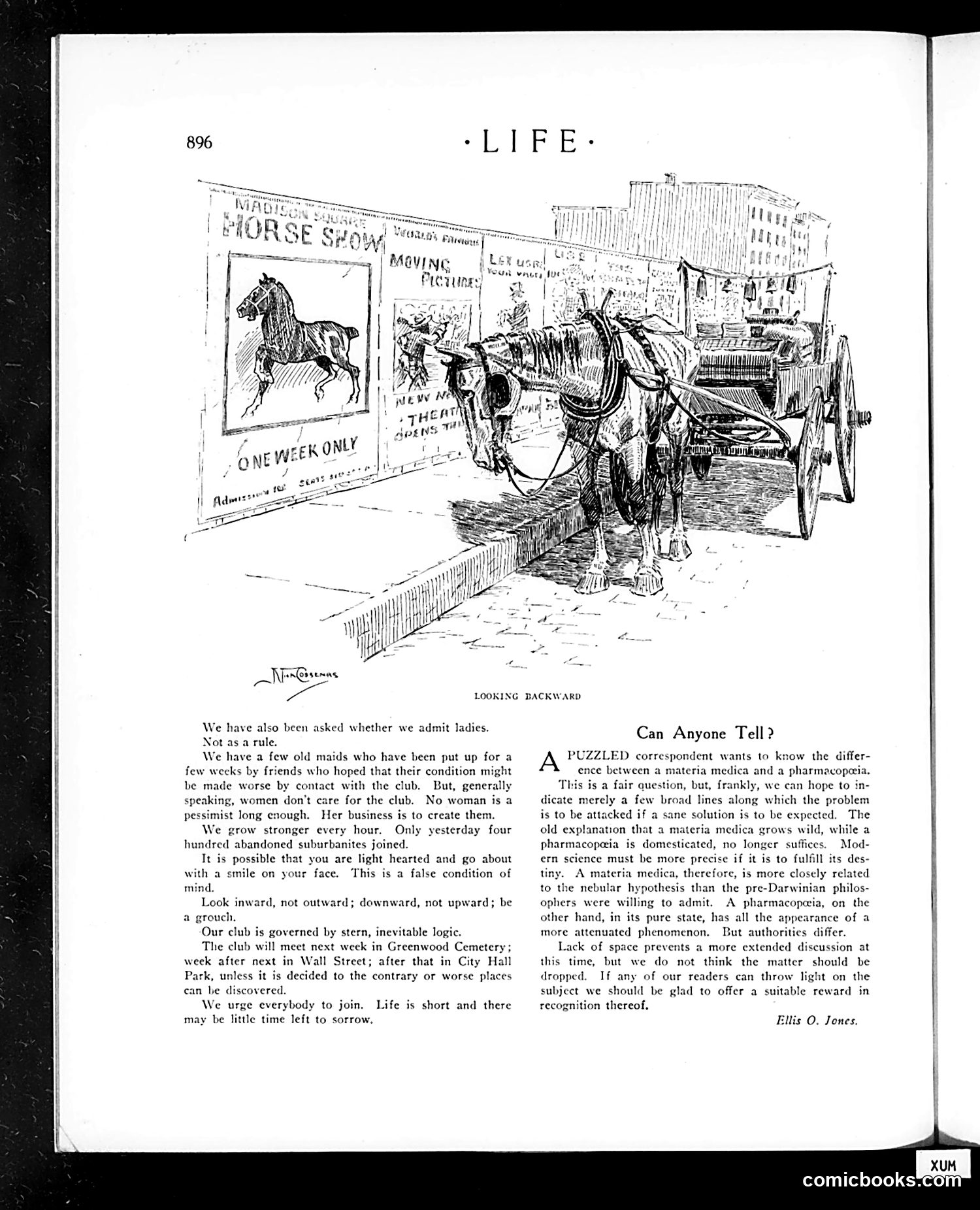
The cartoon depicts a horse-drawn wagon stopping before a storefront advertising a "Horse Show" with "Moving Pictures" and "One Week Only." The image satirizes the contrast between modern entertainment (moving pictures/early cinema) and traditional horse-based transport and spectacles. The accompanying text discusses the magazine's club policies—admitting women, maintaining decorum, and encouraging membership. The text emphasizes social propriety and logic governing the club's operations. The separate article "Can Anyone Tell?" by Ellis O. Jones addresses scientific terminology, specifically distinguishing between "materia medica" and "pharmacopoeia," suggesting readers had confused these medical/pharmaceutical terms. It's a lighthearted educational piece typical of Life's mix of humor and instructional content.
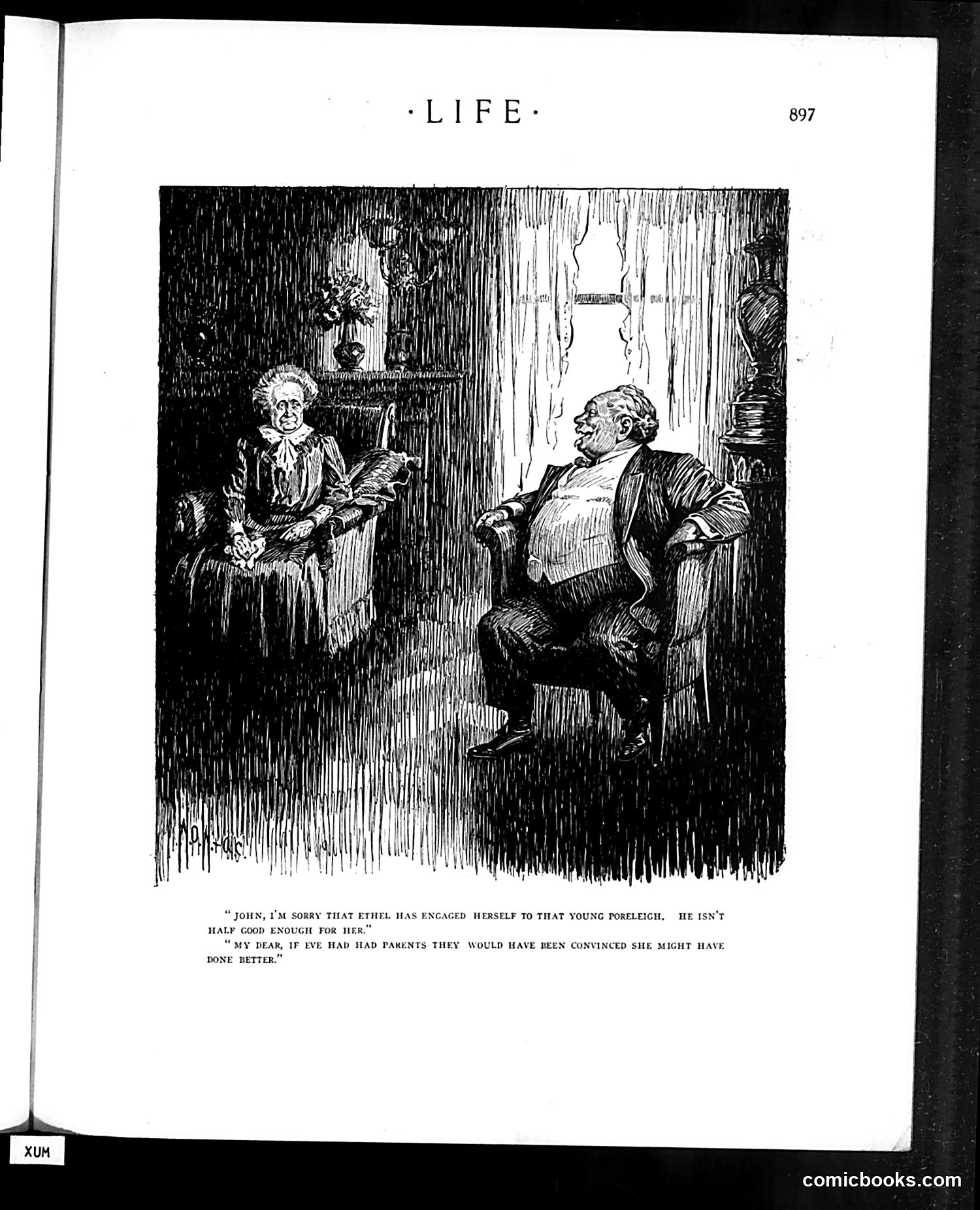
This is a satirical cartoon depicting a domestic conversation between what appears to be an older woman (likely a mother or guardian) and a portly gentleman, presumably discussing a young woman named Ethel's engagement to someone called "Poreleigh." The joke centers on class anxieties: the speaker expresses disappointment that Ethel has engaged herself to this "young foreigner" (the OCR appears to misread "foreigner" as "Poreleigh"), suggesting he's unsuitable—possibly due to his foreign status or lack of breeding. The punchline implies that Ethel's parents would have arranged a better match, referencing the period's practice of parental control over daughters' marriages. The cartoon satirizes Victorian-era concerns about young women making independent romantic choices contrary to family expectations and social propriety.
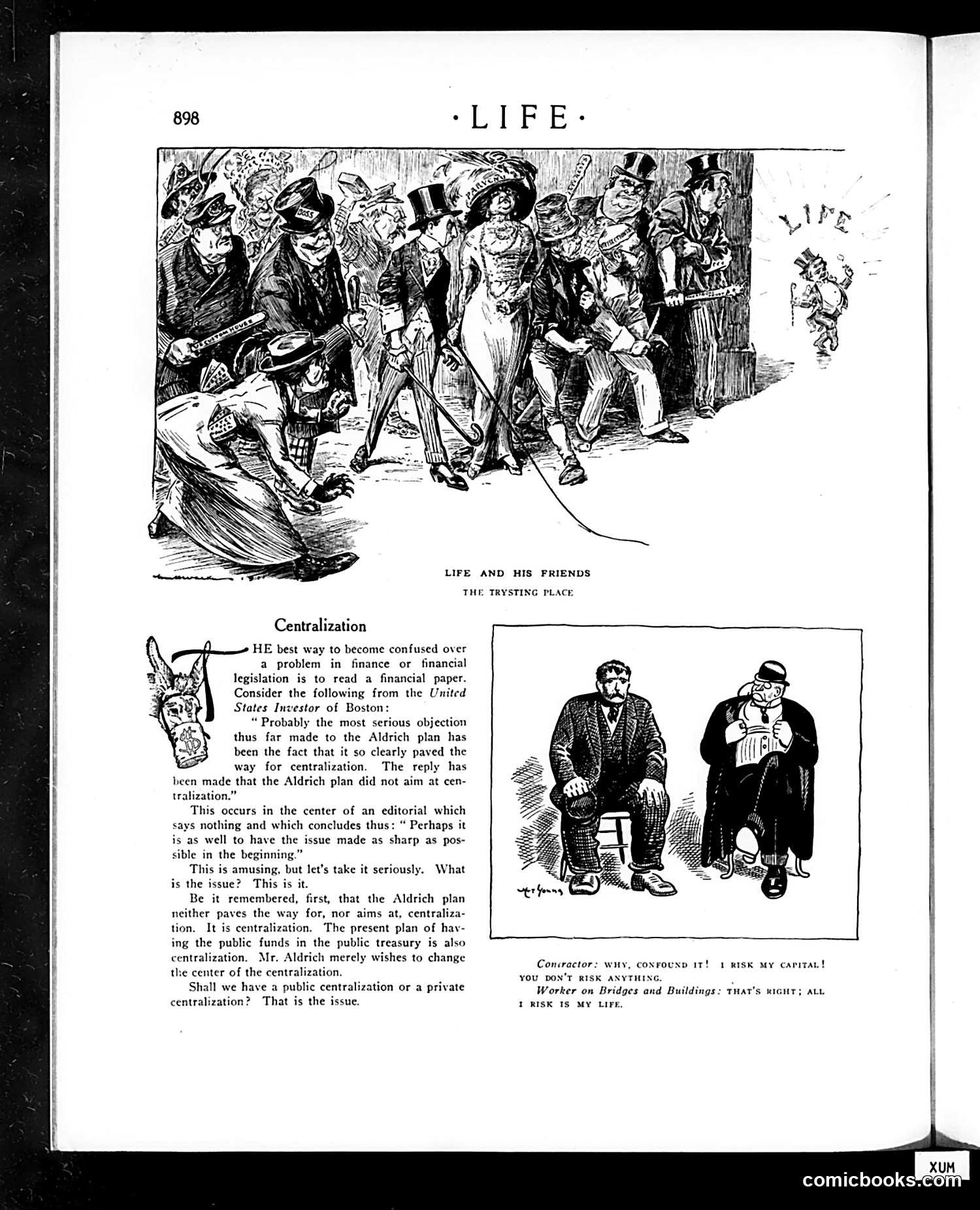
This page critiques the **Aldrich Plan**, a banking reform proposal (likely the 1908 Aldrich-Vreeland Act). The text mocks financial papers for circular, meaningless arguments about whether the plan causes "centralization"—arguing the real issue is *who* controls centralized funds: the government or private banks. The lower cartoon illustrates the hypocrisy. A **Contractor** claims he "risks capital" by objecting to public control of funds, while a **Worker on Bridges and Buildings** points out he risks his *life* doing the actual labor. The satire exposes how financial elites frame banking centralization as dangerous to business while workers bear the actual physical danger—yet have no say in the outcome. The page advocates for **public** over **private** centralization of financial control.
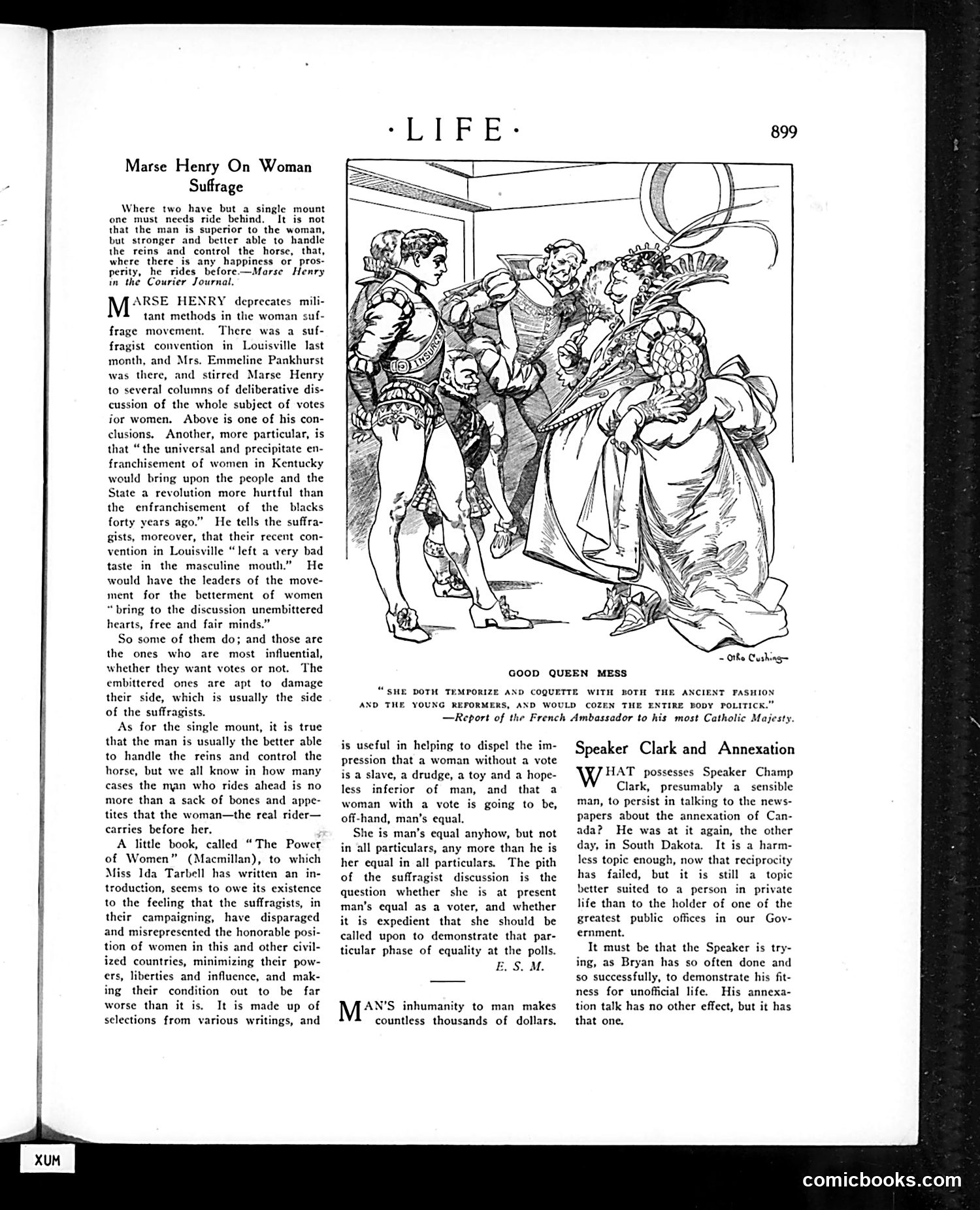
## Main Cartoon: "Good Queen Mess" The cartoon satirizes women suffragists, depicting them as hypocritical and manipulative. A woman in elaborate dress confronts what appears to be male political figures. The French Ambassador's quote (in caption) accuses her of "temporizing and coquetting with both the ancient fashion and the young reformers"—suggesting suffragists are duplicitous, playing both sides while claiming to advance women's rights. ## Context "Marse Henry" (a Louisville newspaper editor) opposes militant suffrage tactics, using a paternalistic metaphor: men should "ride ahead" because they're "stronger," though the text sardonically notes women often truly control events from behind. The piece criticizes both militant suffragists' methods *and* downplayers of women's actual power and influence. It questions whether voting rights are truly necessary to establish women's equality. ## Modern Reading This reflects early 1900s anti-suffrage rhetoric: dismissing activists as shrill/unreasonable while denying women lack real power—a contradictory argument the magazine somewhat mocks even while publishing it.
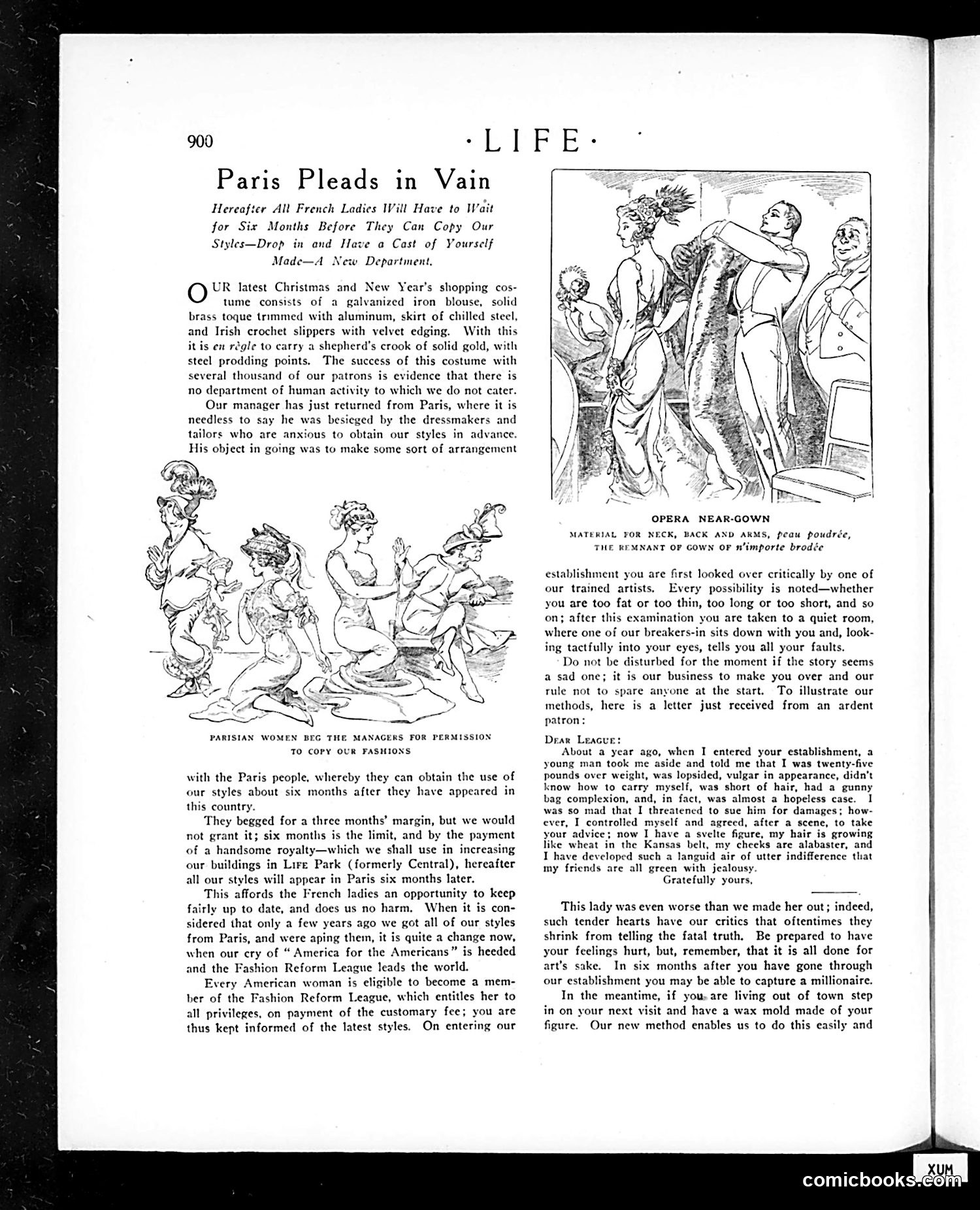
This satirical piece mocks American fashion industry arrogance and nationalist fervor circa the 1910s-1920s. The central joke: an American fashion establishment now dictates styles *to* Paris—reversing the historical reality where America copied French fashions. The cartoons show Parisian dressmakers desperately begging American managers for permission to copy American designs, offering a three-month delay but being refused—they must wait six months and pay royalties. The satire targets: - **American exceptionalism**: The boastful claim "America for the Americans" and that fashion "reform" originates here, not Paris - **Aggressive commercialism**: Profiting by controlling style release dates globally - **Absurdist vanity**: The ridiculous "galvanized iron blouse" and the insulting "makeover" process where customers are brutally critiqued The included testimonial letter satirizes the transformation racket—a woman was called "lopsided" and "hopeless" but now supposedly glows with confidence. The humor relies on inverting real cultural hierarchies (Paris *was* the fashion capital) to expose American arrogance and mercenary exploitation.
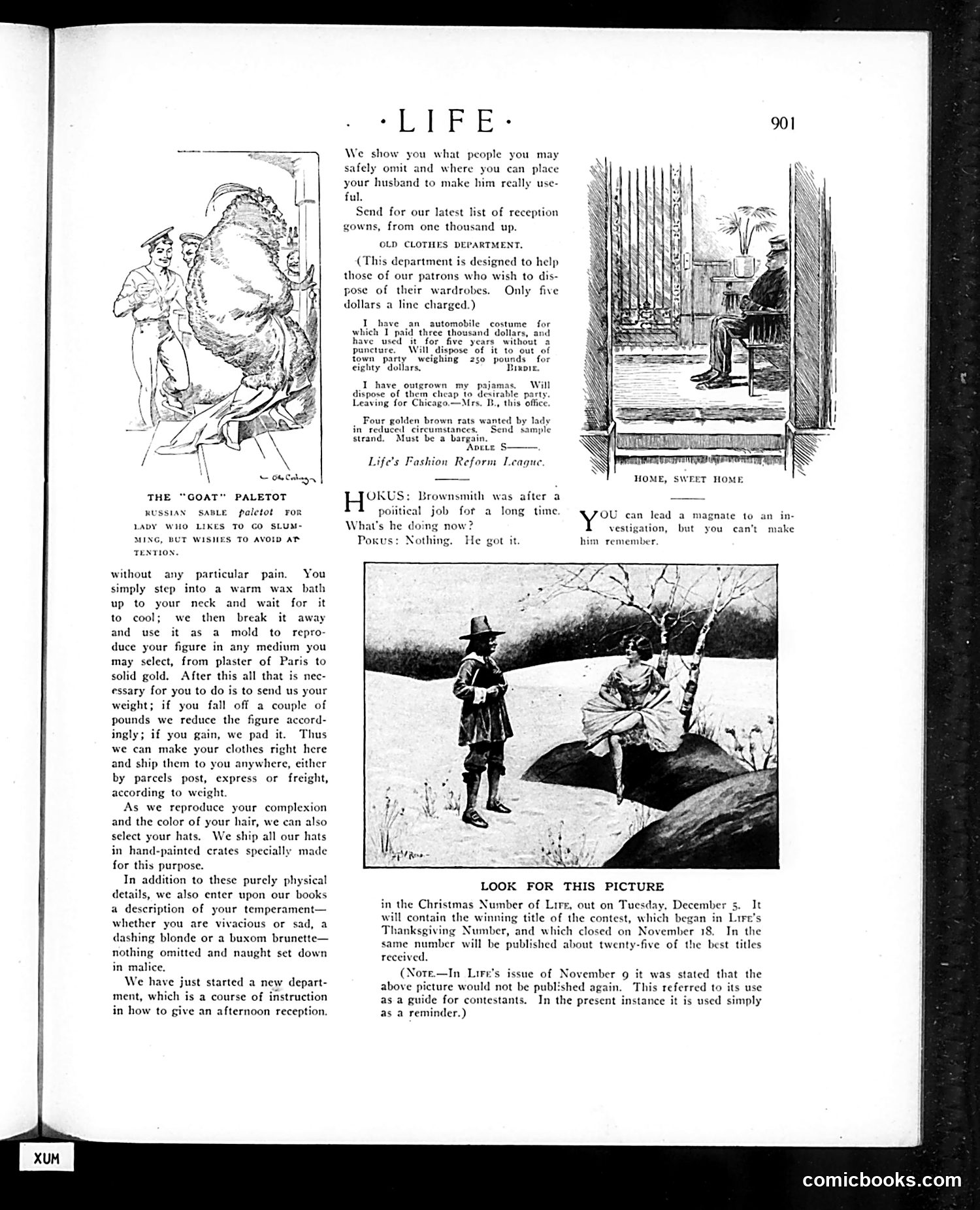
This page satirizes wealthy American society through multiple sketches: **"The Goat Paletot"** (left cartoon) mocks an absurdly expensive Russian sable coat owned by a society lady who wants to slum in poor neighborhoods without being recognized—the joke being that such conspicuous luxury defeats anonymity. **"Old Clothes Department"** advertises a fictional service where wealthy women dispose of used garments. The listings mock extravagance: a $3,000 automobile outfit worn five years, outgrown pajamas, "golden brown rats" (likely furs). The humor targets both wealthy women's wastefulness and their pretense of economy. **Fashion Reform League** offers a custom clothing service using wax molds to create perfectly-fitted garments, including adjustments for weight gain/loss—satirizing the fashion industry's obsession with precise measurements and appearance. The small dialogue joke about "Brownsmith" getting a political job he wanted by doing nothing satirizes political corruption and nepotism. Throughout, Life critiques Gilded Age excess and the frivolous concerns of the wealthy elite.
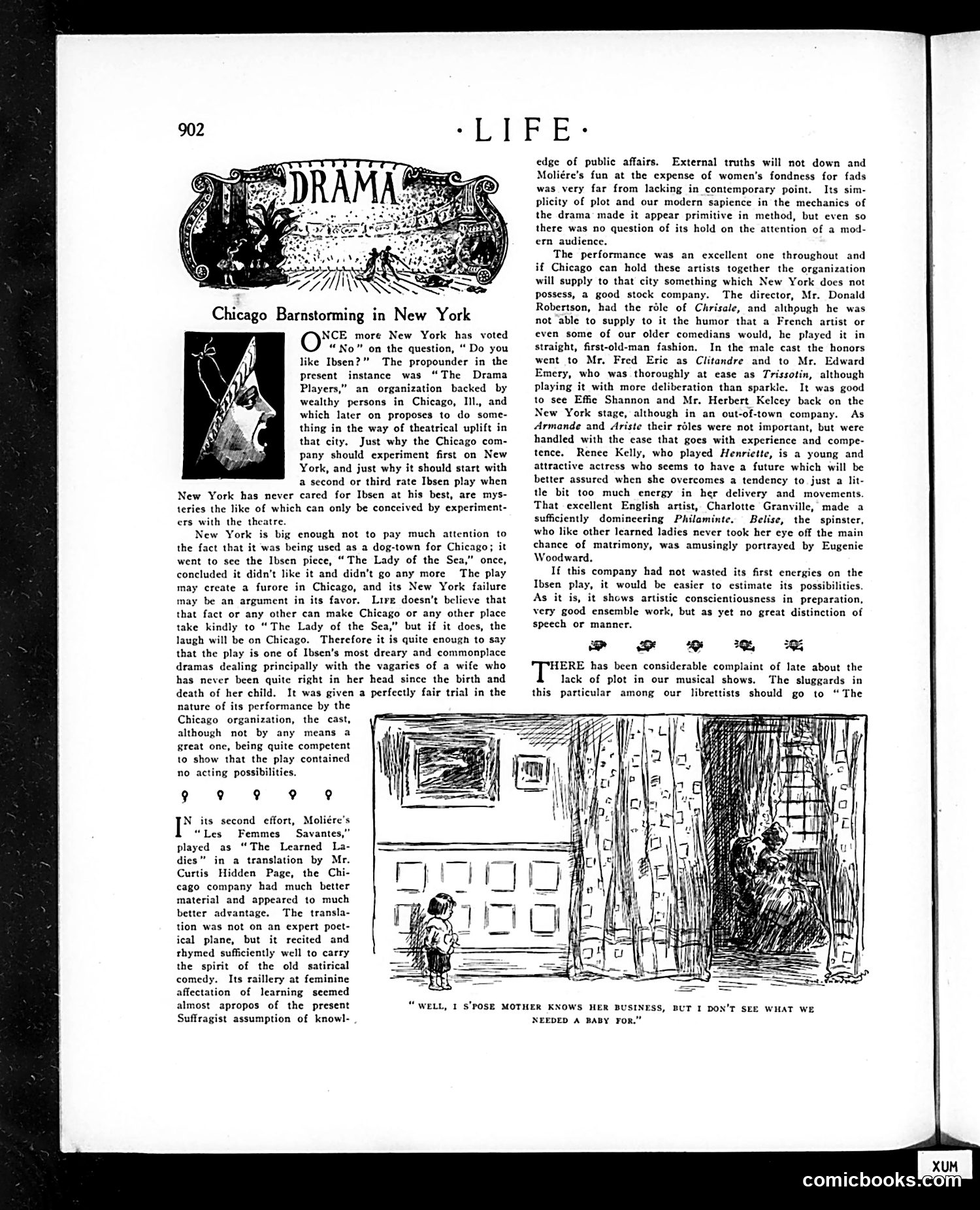
This drama review critiques a Chicago theater company's New York performances. The critic dismisses their production of Ibsen's *The Lady of the Sea* as a poor choice—Ibsen at his weakest—noting New York audiences rejected it (voting "No" on liking Ibsen). The company's second effort, Molière's *The Learned Ladies*, fared better. The review praises the ensemble cast and director Donald Robertson, particularly commending Fred Eric and Edward Emery. However, the critic finds contemporary relevance in Molière's satire of women's intellectual pretensions, noting it feels "almost apropos of the present Suffragist assumption of knowledge"—a pointed jab at women's suffrage advocates, suggesting their political ambitions mirror the foolish female pedantry Molière mocked. The illustration depicts a domestic scene supporting this theme.
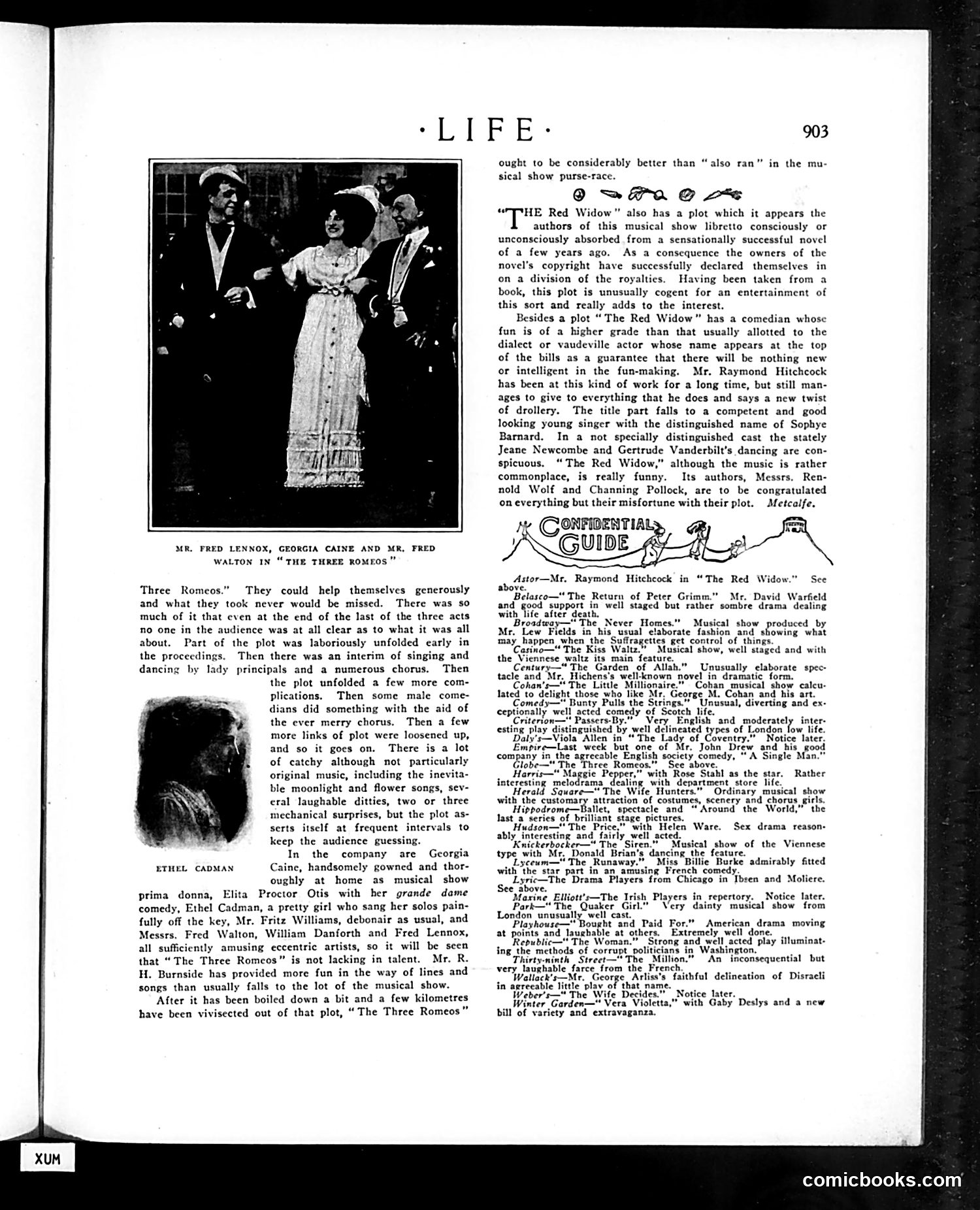
This page reviews two Broadway musical shows from the early 1900s: "The Three Romeos" and "The Red Widow." **"The Three Romeos"** is criticized as a loosely-plotted musical where the narrative keeps getting interrupted by singing, dancing, and comic bits. The reviewer notes the cast (including Georgia Caine and Fred Lennox, pictured) is talented, but the plot is confusing and overly long—it needs cutting down to be competitive. **"The Red Widow"** receives higher praise. Its plot, adapted from a successful novel, is unusually coherent for a musical. The reviewer particularly praises comedian Raymond Hitchcock, whose humor transcends typical vaudeville-style dialect comedy by adding original twists. The music is "commonplace," but the show is genuinely funny. The tone is insider theatrical criticism, assuming readers follow Broadway productions. No political satire is present—this is straight entertainment review.
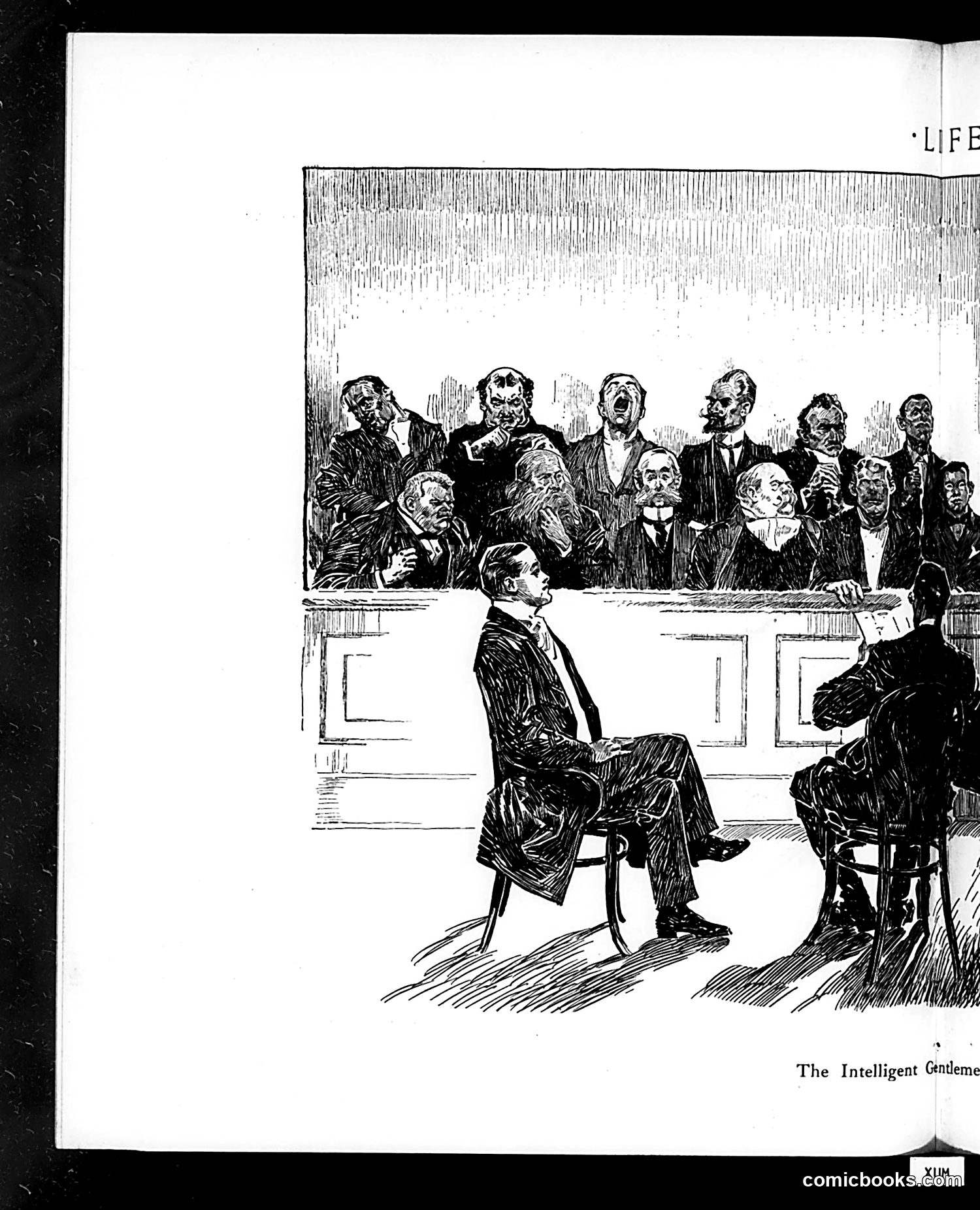
This courtroom sketch depicts a man seated before a jury of twelve men in the gallery box. The caption's title suggests satire about intellect or propriety, likely mocking either the defendant's self-perception or society's judgment of him. The man appears to be on trial, while jurors display varied, animated expressions—some skeptical or disapproving. The composition inverts typical power dynamics by placing him alone below while multiple figures judge from above, emphasizing his isolation. Without clearer context or visible date, the specific case remains unclear. However, Life magazine's satirical style suggests this ridicules either a prominent figure's trial, the pretensions of the accused, or broader commentary on the justice system's treatment of educated defendants. The ironic title implies gap between self-image and reality.
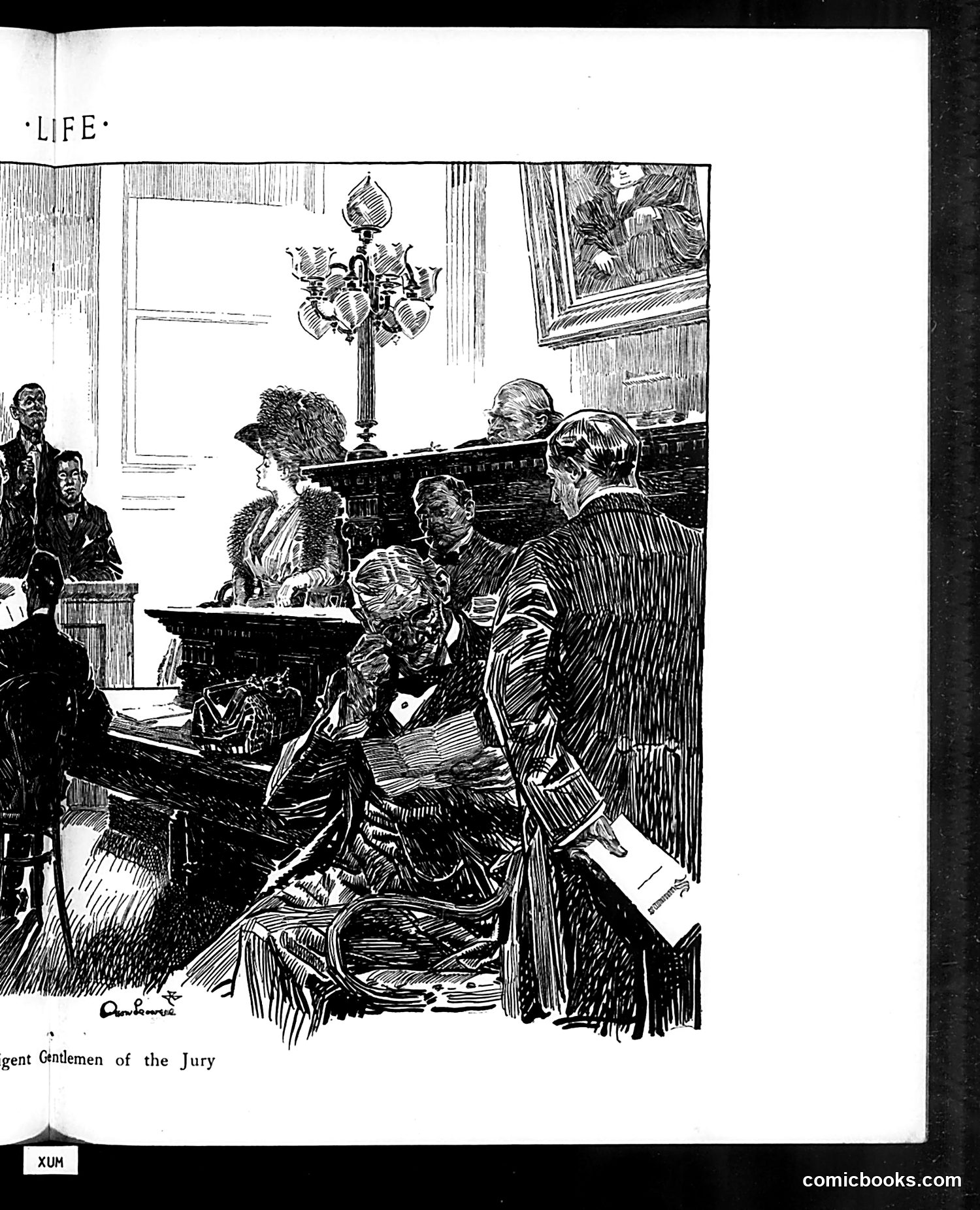
This courtroom sketch satirizes jury deliberation, depicting well-dressed men examining evidence around a table. The title's apparent misspelling ("gent" instead of "intelligent") suggests irony about the jurors' actual competence or intelligence. The scene shows jurors scrutinizing documents or exhibits, with formal furnishings including a decorative lamp and framed artwork. The artistic style—detailed cross-hatching and realistic portraiture—is typical of *Life* magazine's satirical social commentary from the early 20th century. The satire likely mocks either jury selection processes, juror intelligence, or the pretense of careful deliberation versus actual decision-making. Without additional context or caption, the specific legal case or historical reference remains unclear, though the humor targets how "gentlemen" juries actually operated.
This page discusses two recently republished English books—Edward Carpenter's "Love's Coming of Age" and Arnold Bennett's "The Truth About an Author"—using them to illustrate how American and British attitudes toward sexuality and propriety have evolved. The opening anecdote about Uncle Ephraim's mule serves as an allegory: just as the mule needed urging to seize its opportunity, society needed prodding to accept previously "scandalous" works. The satire targets Victorian prudishness. Carpenter's writings on sexuality were once considered so obscene that publishers wouldn't touch them, and even after becoming famous, Bennett's autobiographical work was whispered about shamefully. The text mocks the hypocrisy of a culture that treated frank discussion of natural subjects as inherently immoral while remaining genuinely interested in them. The "Confidential Book Guide" section provides capsule reviews of contemporary books, suggesting modernist literature was increasingly addressing previously taboo subjects openly—reflecting shifting cultural norms toward honesty about human nature.
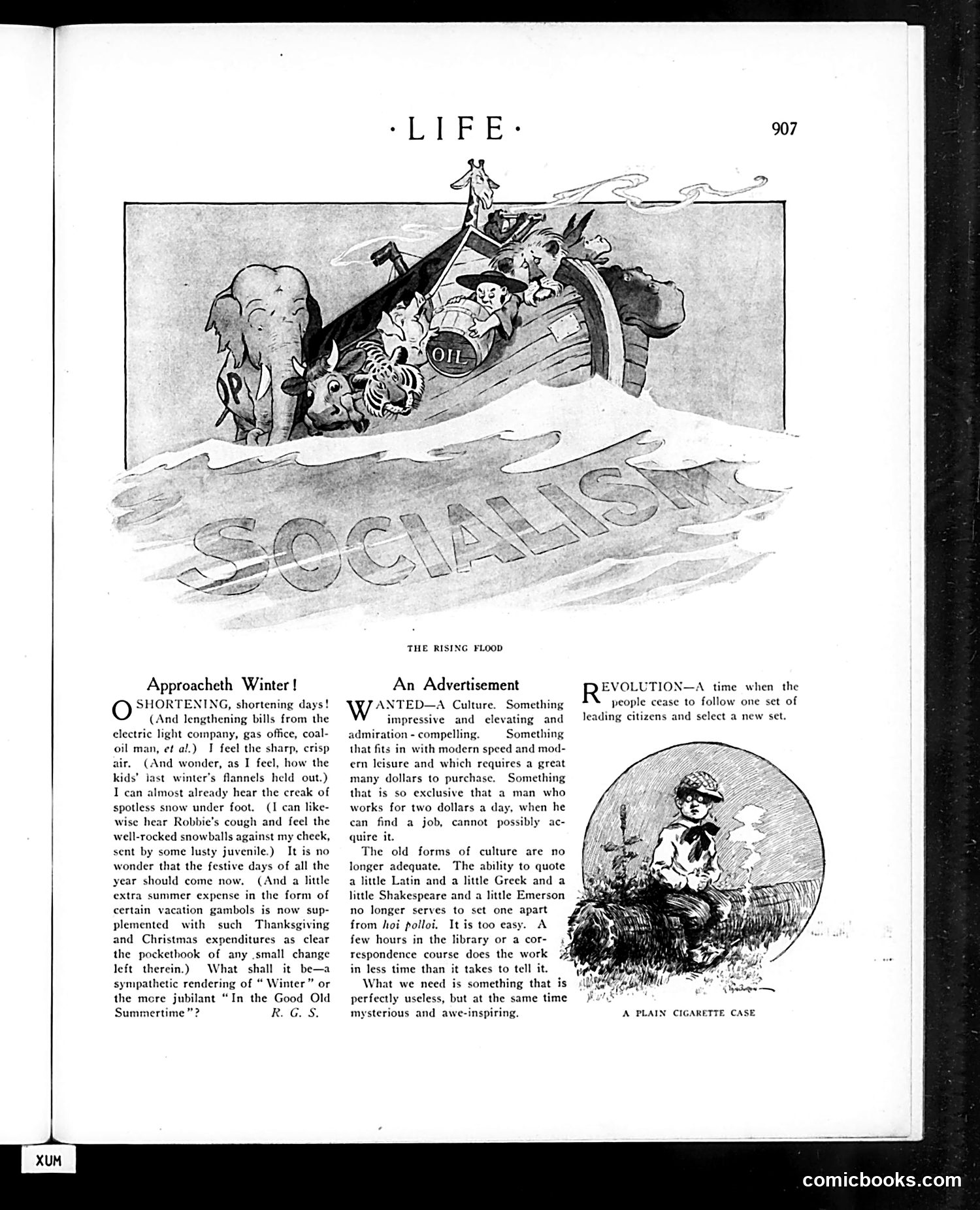
The page contains two satirical pieces critiquing early 20th-century American society. **"The Rising Flood" (top cartoon):** A caricatured boat overflowing with various figures represents "Socialism" threatening to engulf civilization. The image warns of socialist ideology as an overwhelming tide, reflecting anxieties common in this era about labor movements and radical politics. **"An Advertisement" (center text):** This sarcastically mocks wealthy Americans' pursuit of exclusive, expensive "culture"—fashionable status symbols requiring substantial wealth. The satire argues that traditional education (Latin, Greek, Shakespeare) is now "too easy" and insufficiently exclusive, so the wealthy now seek deliberately "useless" but "mysterious and awe-inspiring" luxuries to distinguish themselves from working-class people earning "two dollars a day." **"Approacheth Winter"** (left column): Humorously catalogs winter's mixed blessings—shorter days but longer heating bills, plus nostalgic childhood memories (snow, coughs, snowball fights). The page reflects Progressive-Era social criticism of class inequality and conspicuous consumption.
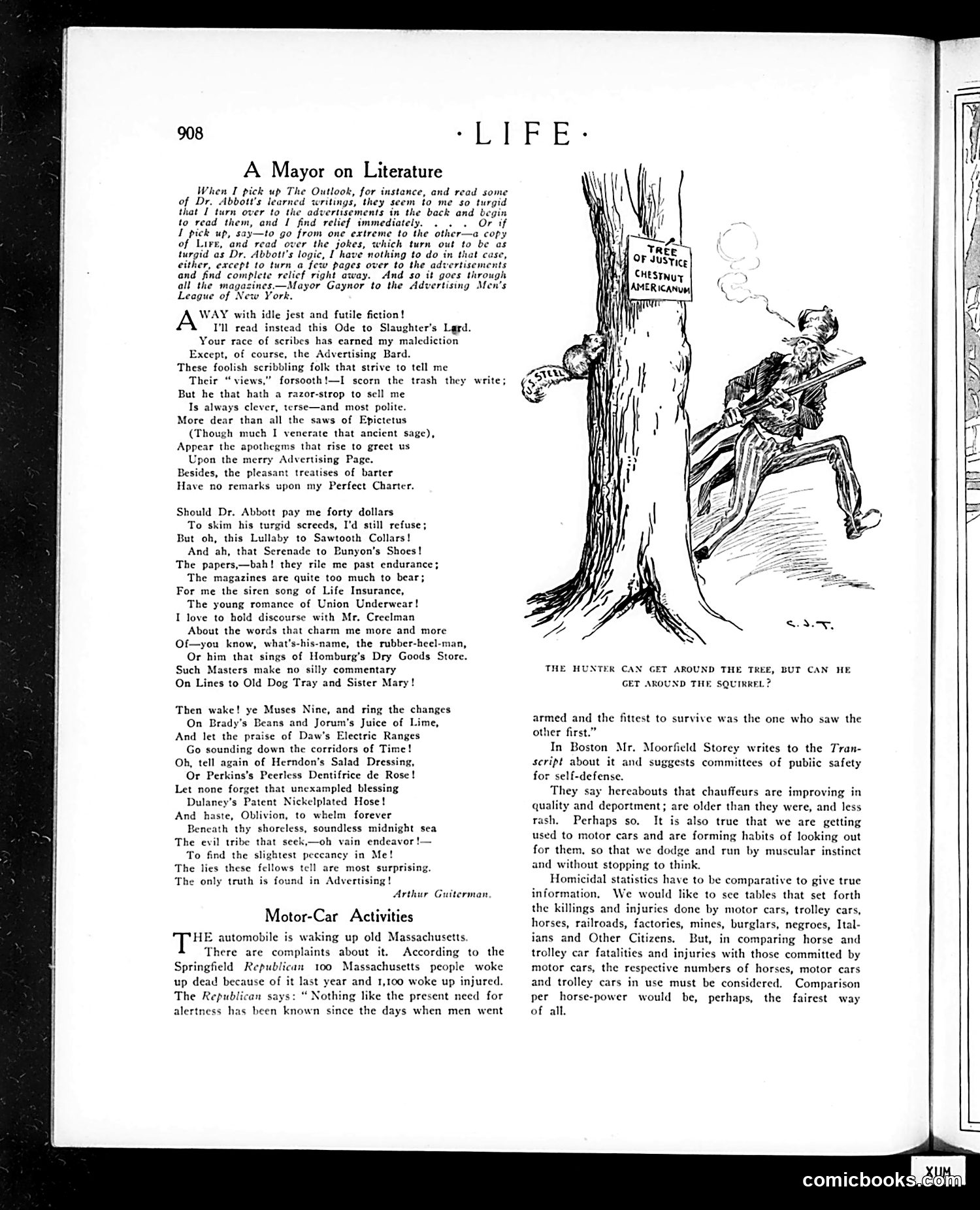
This page satirizes Mayor Gaynor of New York (referenced in the text), who reportedly preferred advertisements to actual journalism and literature. The accompanying poem by Arthur Guiterman mocks this preference through exaggeration, praising commercial advertising copy while dismissing serious writers like Dr. Abbott (editor of *The Outlook*) and literary magazines. The satire criticizes how advertisements prioritize sales language over substance, while implying that a public official values marketing rhetoric more than informed discourse. Guiterman's poem ironically elevates mundane product endorsements—for collars, shoes, insurance, and beans—to the status of great literature, exposing the absurdity of preferring commercial messaging to genuine intellectual content. The second section on "Motor-Car Activities" shifts to automobile safety in Massachusetts, citing injury statistics and debating whether improved chauffeur behavior or public adaptation explains accident patterns. It calls for comparative homicide statistics across different causes.
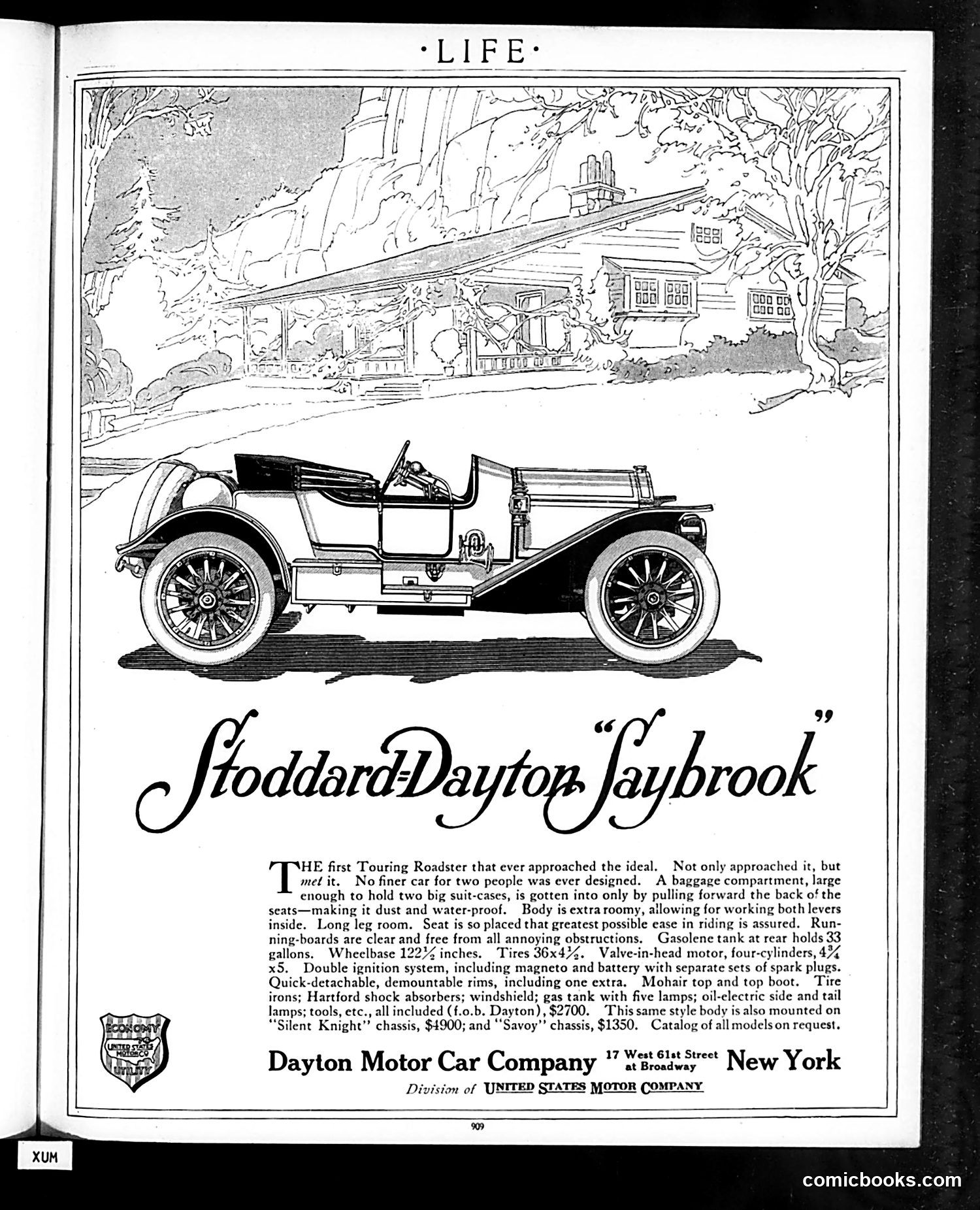
This is **not a cartoon or satire**—it's a straightforward automobile advertisement from *Life* magazine. The page promotes the Stoddard-Dayton "Jaybrook," a touring roadster manufactured by the Dayton Motor Car Company (a division of United States Motor Company), based in New York. The ad emphasizes practical features for early 1910s buyers: dust-proof baggage compartments, roominess, long leg room, and detailed mechanical specifications (valve-in-head motor, four cylinders, etc.). The pricing ($2,700 base model) and mention of alternative chassis options ("Silent Knight," "Savoy") indicate this targeted affluent consumers. The scenic illustration at top shows the car in an idealized landscape setting—a common advertising technique to suggest leisure and freedom. There is no political or social satire present; this is period product marketing.
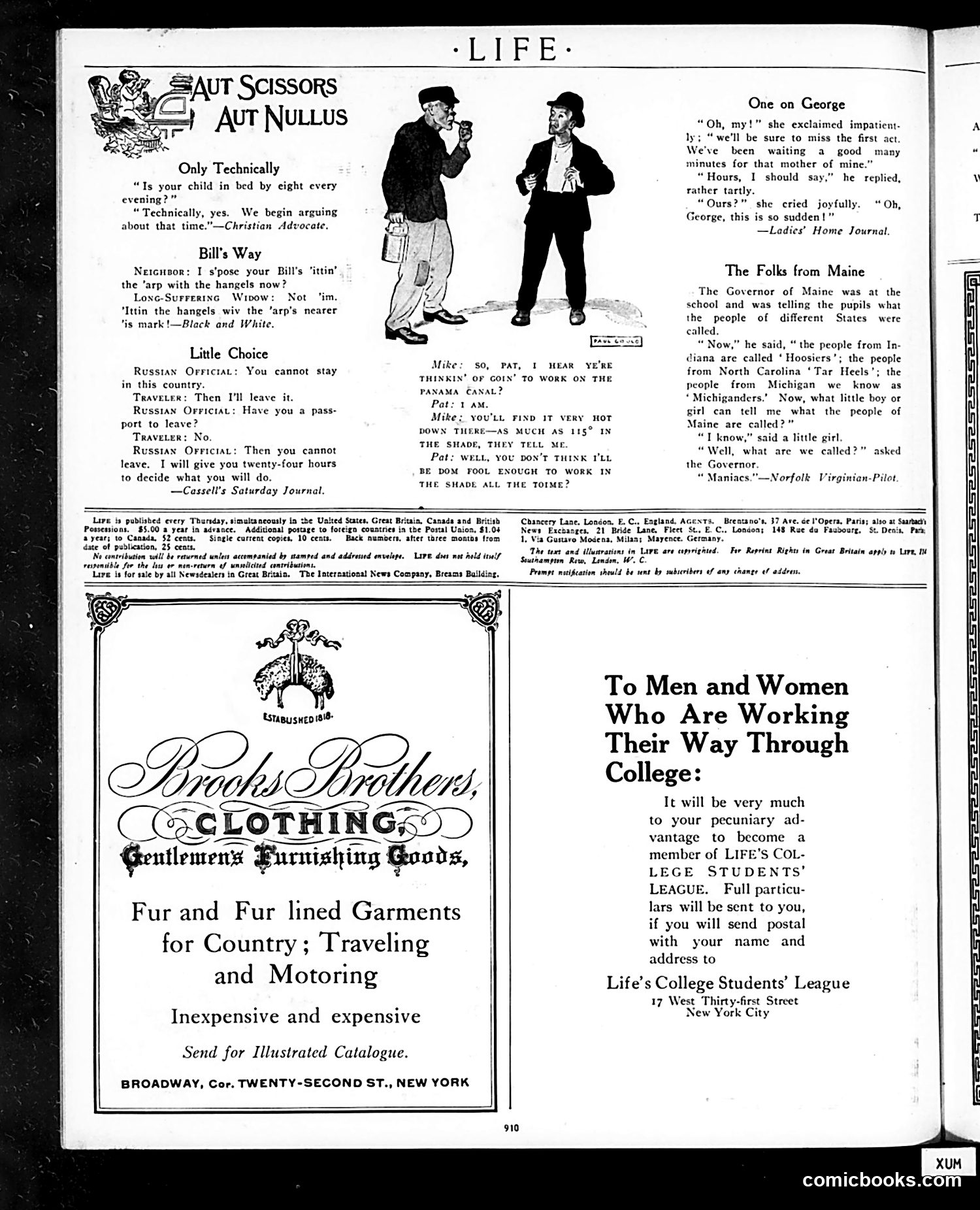
This page from *Life* magazine contains several brief humorous jokes and advertisements typical of early 20th-century American humor. **The Cartoons/Jokes:** The page features short, punchy comedic pieces rather than political cartoons. "One on George" plays on marital delays—a woman impatiently waiting for her mother, then joyfully exclaiming "this is so sudden!" when her fiancé comments on the wait, as if he's proposing. "The Folks from Maine" jokes that Maine residents are called "Maniacs" based on their supposed behavior. "Bill's Way" and other pieces use dialect humor common to the era. The "Panama Canal" exchange satirizes Irish immigrant workers considering dangerous labor there, with Pat naively thinking the 115° heat won't apply in the shade. **Context:** These represent *Life*'s signature style: brief, accessible jokes for middle-class readers, often featuring working-class or immigrant characters rendered in heavy dialect. The humor relies on wordplay, marital comedy, and gentle mockery of regional or ethnic groups—acceptable satirical fare for the period. The advertisements for Brooks Brothers clothing and college student recruitment occupy equal space.
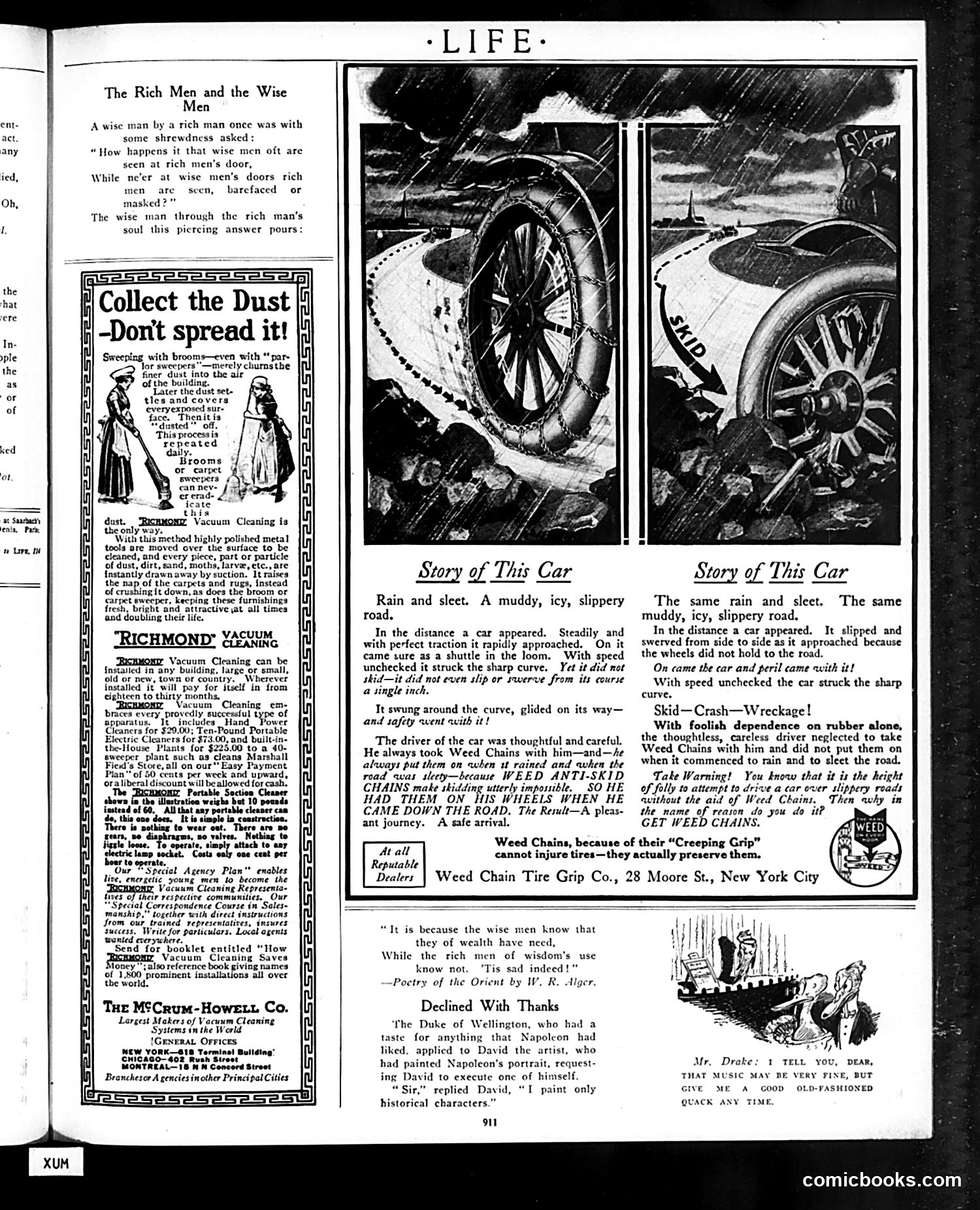
This page presents a **moral lesson through contrasting stories** about automobile safety, wrapped in advertisements and a philosophical poem. **The main content** comprises two parallel narratives about cars on icy roads—one arriving safely, one crashing—designed to promote Weed Anti-Skid Chains. The left car's driver was "thoughtful and careful," installing chains before rain; the right car's driver was "thoughtless, careless," neglecting precautions and causing a wreck. **The satire** is direct: the accident exists solely to advertise a product. The melodramatic language ("Skid—Crash—Wreckage!") treats a preventable tragedy as inevitable without the advertised chains. **The opening poem** ("The Rich Men and the Wise") offers philosophical counterpoint—wealthy people seek wise counsel, but wise people don't need wealth. This likely frames the page's broader message: *wisdom* (like using safety chains) prevents disaster. **The McCrum-Howell vacuum cleaner ad** occupies significant space, using similar logic: proper cleaning methods prevent dust problems. Overall, this is **primarily advertising disguised as editorial content and moral instruction**—a common early-20th-century magazine technique.
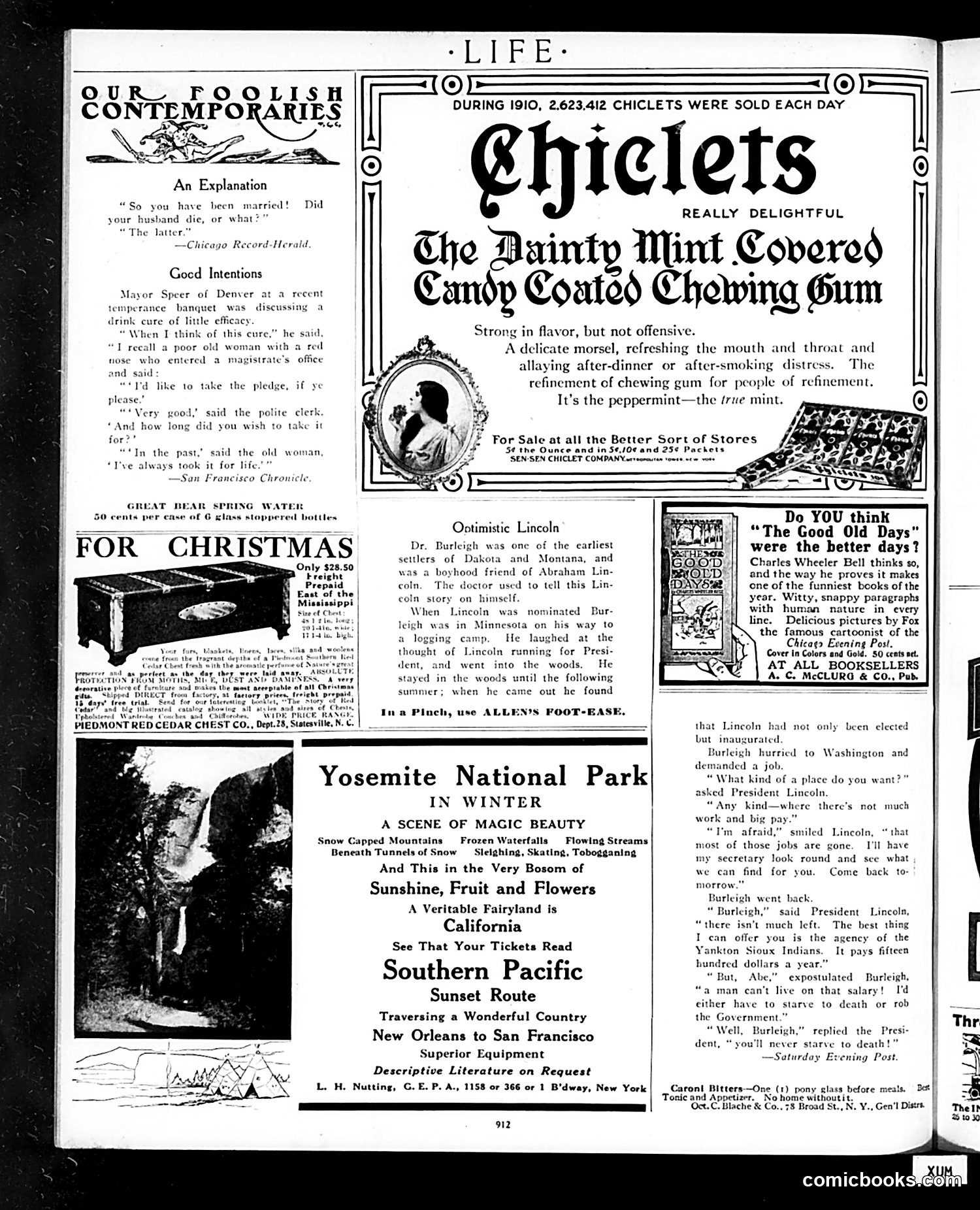
This is primarily an **advertising and humor page** from Life magazine, circa 1910. The main content includes: **"Our Foolish Contemporaries" section**: Brief satirical anecdotes mocking contemporary figures and attitudes—including a joke about a widow's marital history and Mayor Speer of Denver's temperance advocacy. **"Optimistic Lincoln" humor**: A anecdote about Dr. Burleigh meeting President Lincoln, who had just been elected. When Burleigh demands a government job, Lincoln offers him the Yankton Sioux Indians agency at $1,500/year—too little to live on. Lincoln's reply ("you'll never starve to death!") is the punchline, mocking both job-seeking desperation and Lincoln's dry wit. **Advertisements dominate**: Chiclets gum, Yosemite travel, Allen's Foot-Ease, a Christmas cedar chest, and "The Good Old Days" book by Charles Wheeler Bell. The page satirizes early 20th-century American life—political patronage, temperance movements, and nostalgia—while selling consumer goods to middle-class readers.
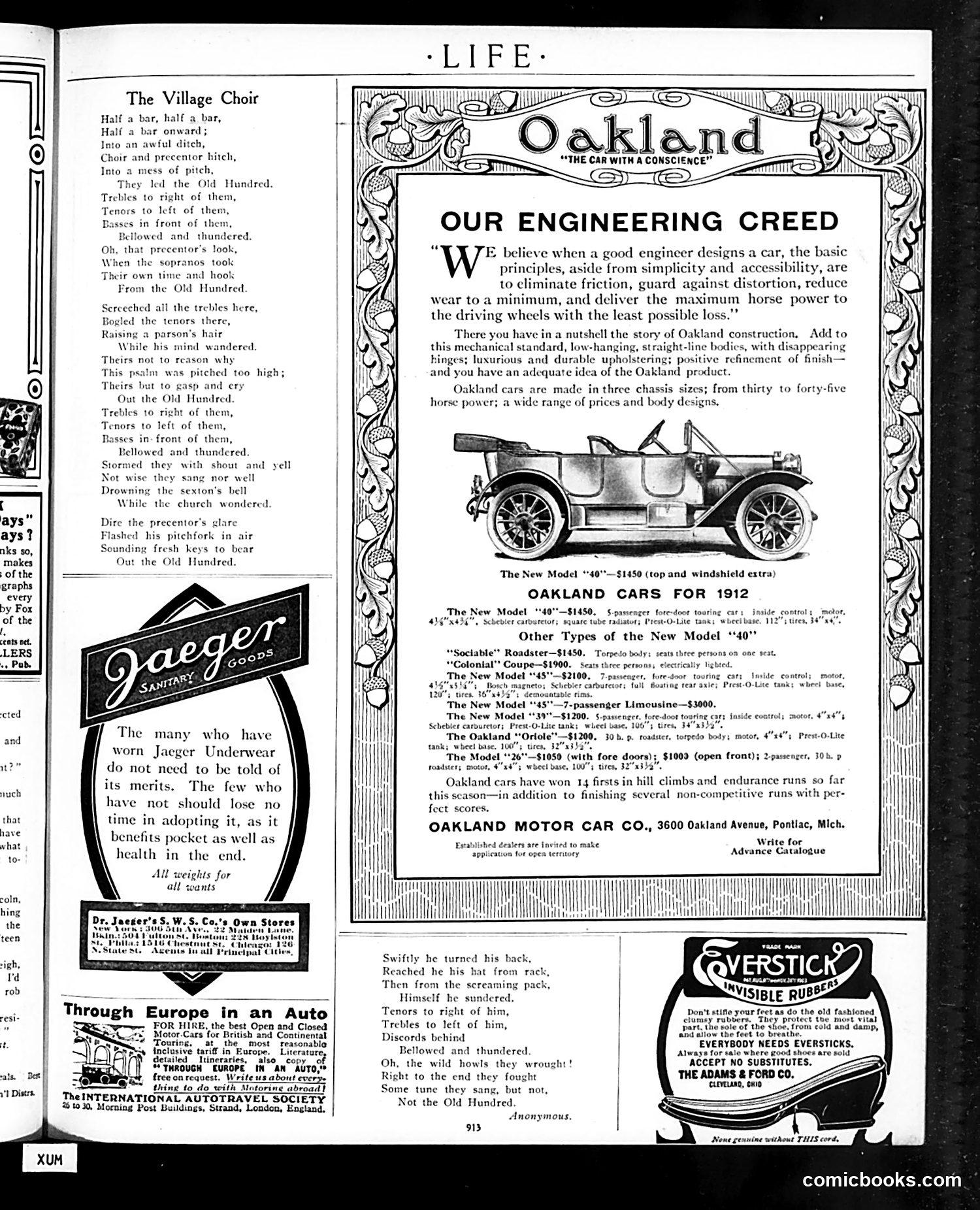
This poem satirizes an incompetent church choir through mockery of Tennyson's "Charge of the Light Brigade." The joke relies on readers recognizing the famous military poem's structure and applying it absurdly to a bungled hymn performance. The satire targets the chaos of amateur church singing: the precentor (choir director) pitches the psalm "too high," sopranos lose control, tenors struggle, and everyone sings off-key while drowning out the church bell. The precentor waves his "pitchfork" in desperation. The punchline comes when he abandons his post entirely, fleeing the "screaming pack." The humor depends on the contrast between the poem's grandiose military language ("Bellowed and thundered") and the trivial domestic setting of a village church service gone wrong—a common source of humor in *Life*, which regularly mocked middle-class American institutions and amateur performances. Modern readers miss the immediate cultural reference to Tennyson.
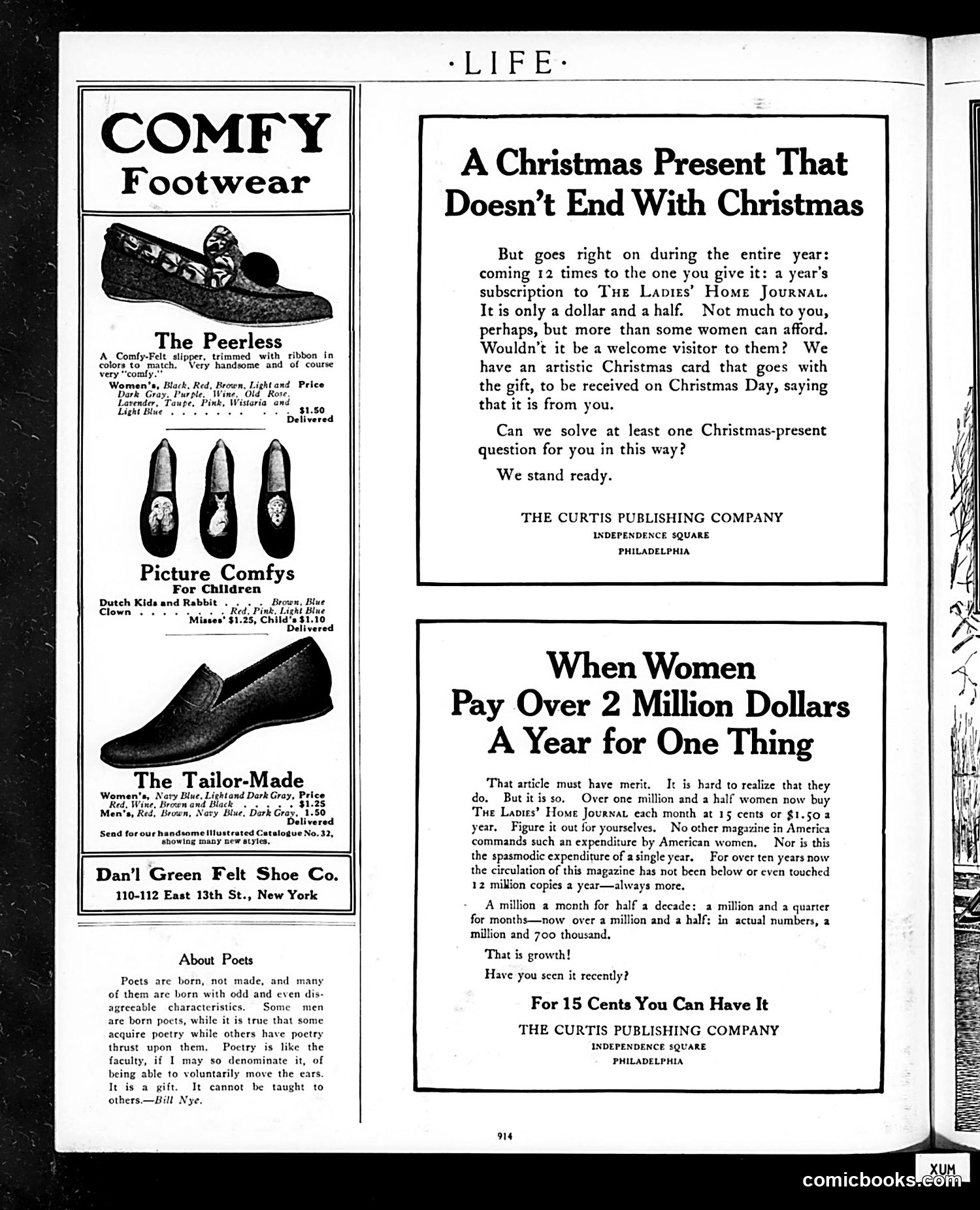
The page contains: **Left side:** COMFY Footwear ads for felt slippers and shoes in various styles and colors ($1.10-$1.50), plus a brief essay "About Poets" by Bill Nye arguing that poetic talent is innate, not teachable. **Right side:** Two advertisements for *The Ladies' Home Journal*, published by Curtis Publishing Company in Philadelphia. The first promotes an annual subscription ($1.50) as an ideal Christmas gift. The second boasts the magazine's commercial success—claiming over 1.5 million women now purchase it monthly at 15 cents, generating over $2 million annually. The ad emphasizes this consistent, decade-long circulation success as proof of the magazine's merit and popularity. There is no political cartoon or satire here. This is a straightforward commercial page from *Life* magazine showcasing period footwear and promoting a major American women's publication through circulation statistics and gift-giving appeals.
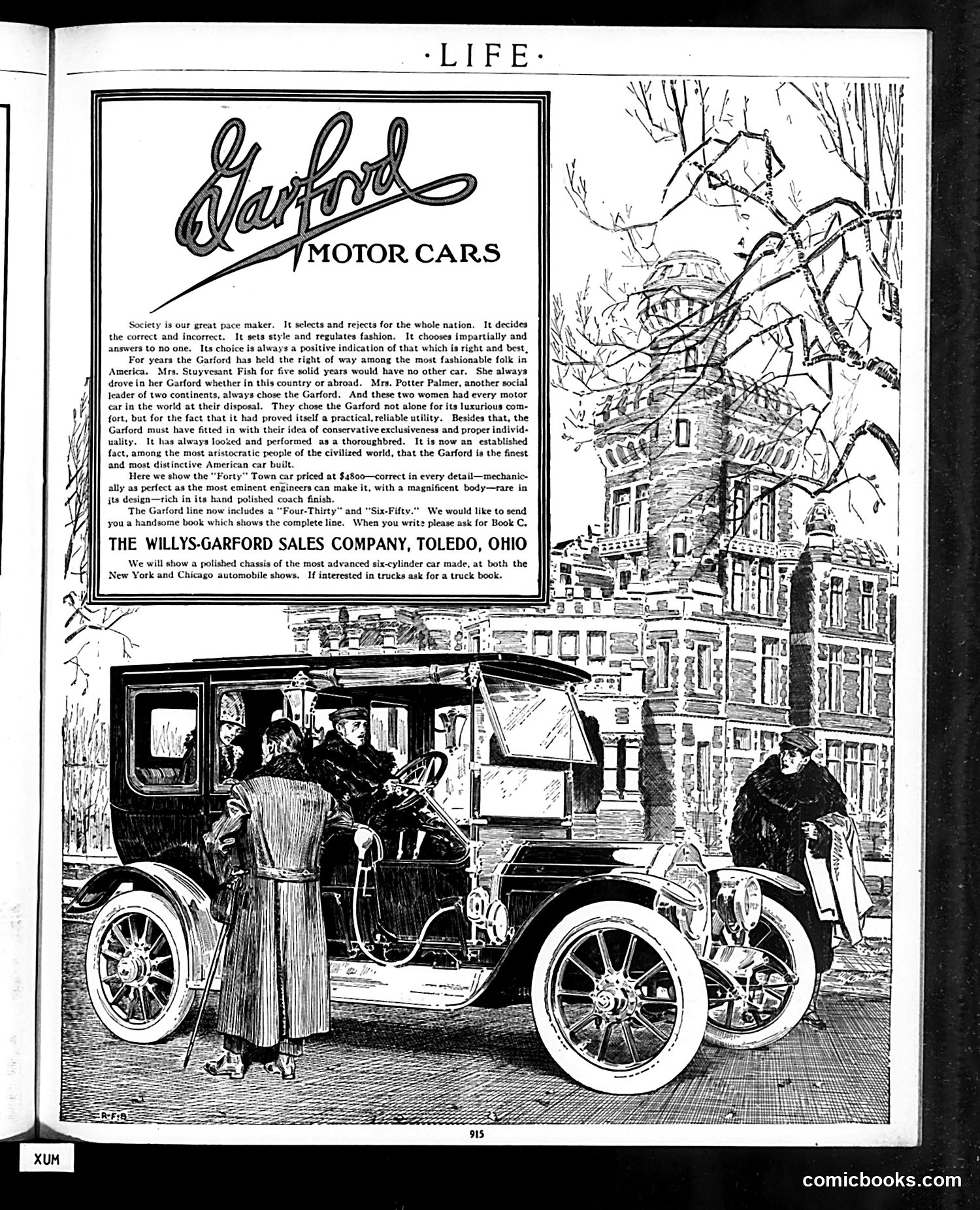
This is primarily a **luxury automobile advertisement**, not political satire. The Willys-Garford Sales Company promotes their "Forty" Town Car (priced at $4,800—extremely expensive for the era) by name-dropping wealthy socialites: **Mrs. Stuyvesant Fish and Mrs. Potter Palmer**, famous society figures who allegedly drove only Garfords. The ad's rhetorical strategy relies on **conspicuous consumption and social aspiration**: the text argues that "Society is our great pace maker" and that owning a Garford signals membership among "the most aristocratic people." The illustration shows well-dressed passengers in an elegant automobile outside an urban apartment building. For modern readers, this reflects early-1900s advertising's direct appeal to **status anxiety**—the implicit message being "buy this car to be like the richest women in America." The ad assumes readers recognize these socialites' names as meaningful status markers.
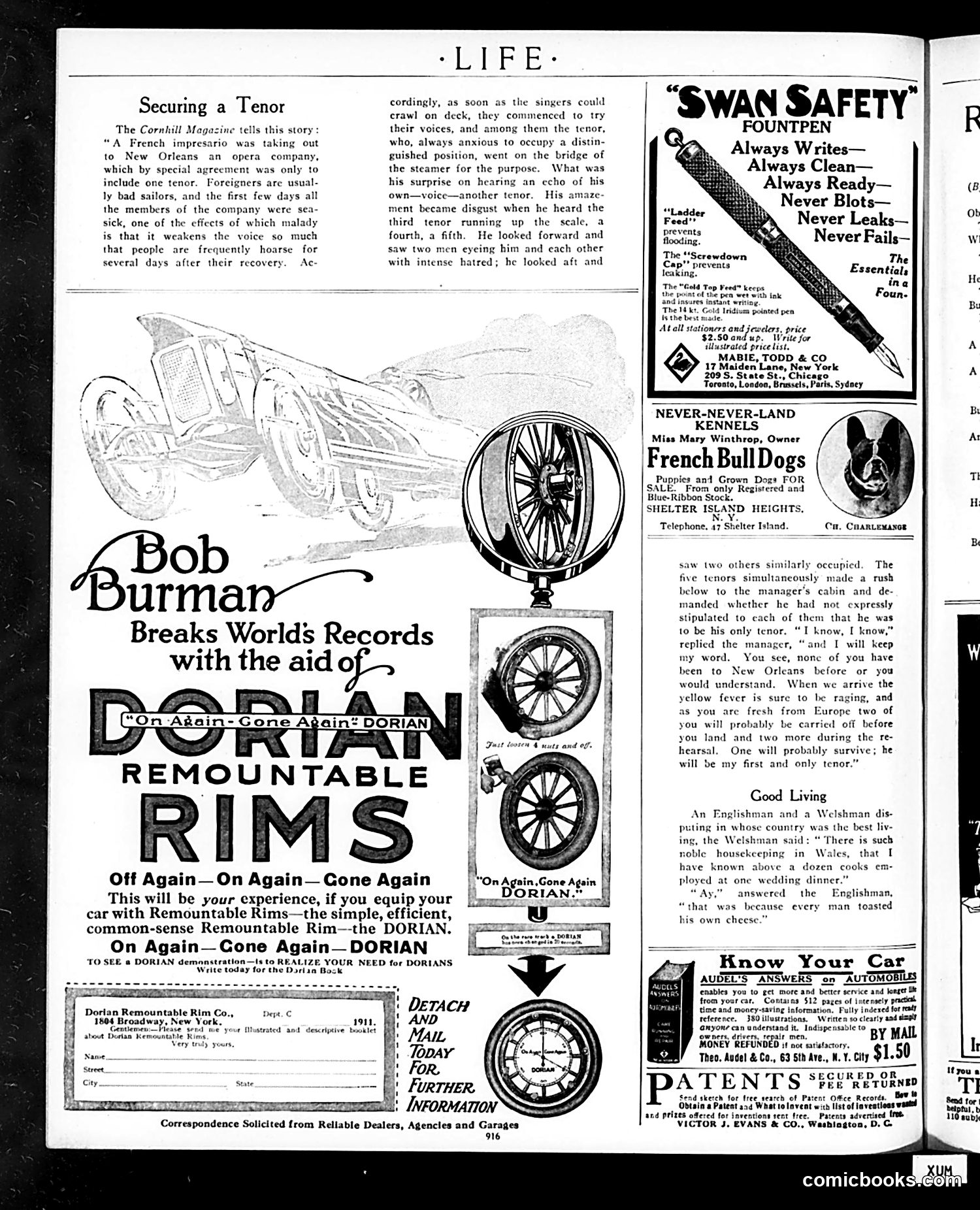
This is primarily a **historical advertisement page** from *Life* magazine, not a political cartoon. The main content is commercial: **The Featured Story ("Securing a Tenor"):** A humorous anecdote about a French opera impresario sailing to New Orleans with supposedly one tenor. When the singers become seasick and recover, multiple tenors mysteriously appear aboard. The punchline: the manager had intentionally hired five tenors because he expected yellow fever would kill most of them during their New Orleans visit, guaranteeing he'd have at least one survivor for his opera. **The Advertisements:** - **Dorian Remountable Rims** for automobiles - **Swan Safety fountain pens** (emphasizing durability) - **French Bulldogs** from a breeder - **Patent services** and automobile reference books The page reflects early 20th-century commercial culture and references period concerns like yellow fever epidemics and the newfound automobile industry. There is no satirical cartoon per se—it's essentially a magazine layout mixing editorial humor with commercial pitches.
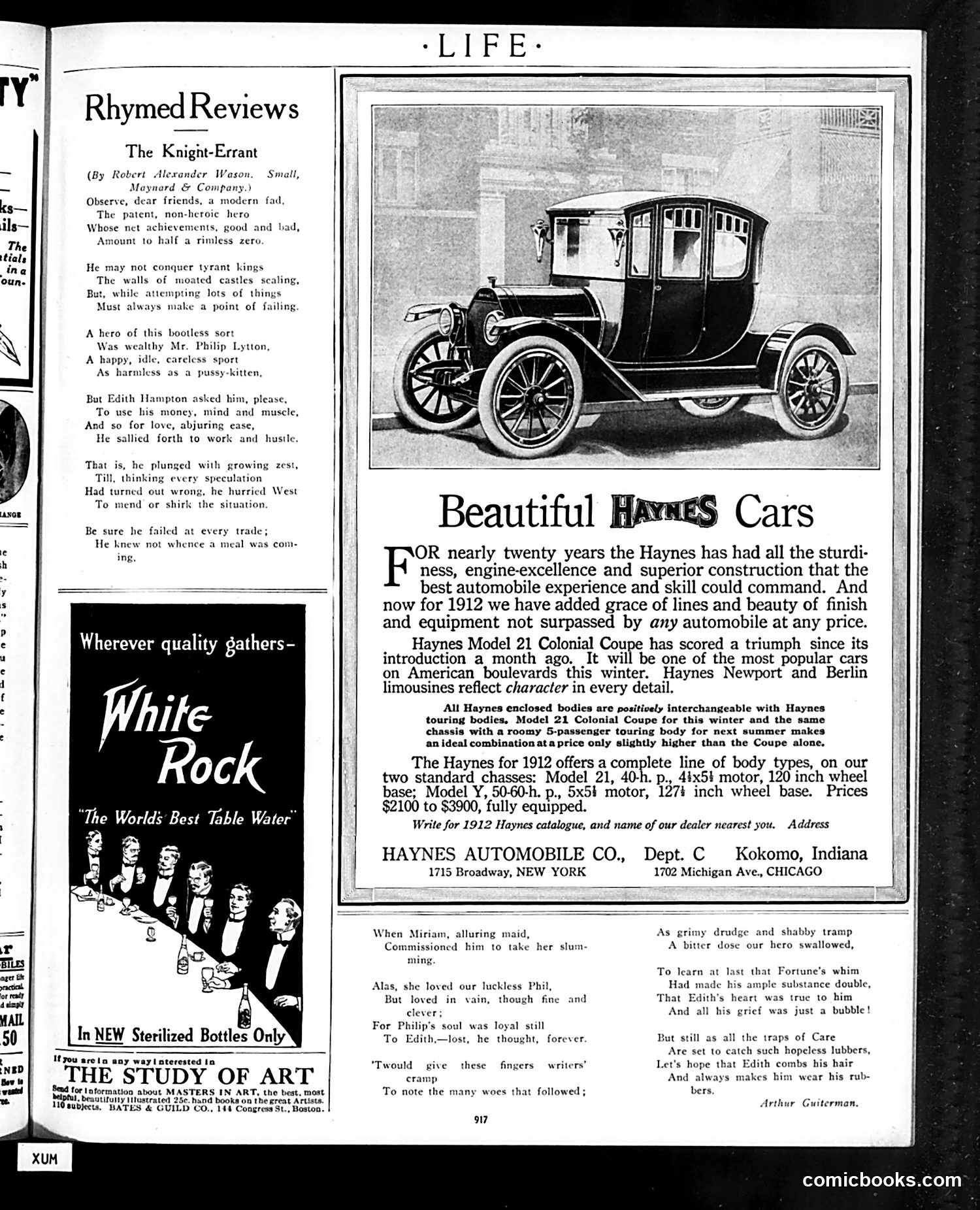
This page contains a **book review in verse** and **automobile advertising**, not political cartoons. **The Book Review ("The Knight-Errant"):** The poem satirizes a contemporary literary trend—the "modern" non-heroic hero. It mocks the protagonist Philip Lytton, a wealthy idle man who becomes heroic only when pursuing romance with Edith Hampton. The satire targets early 1900s fiction featuring ordinary men in mundane struggles rather than traditional adventure-story heroes conquering castles and tyrants. The poem's conclusion—that domestic life requires him to wear rubbers and have his hair combed—is humorous, suggesting that real-life "heroism" is merely accepting domestic responsibility. **The Advertisement:** A full-page **Haynes automobile ad** showcasing the 1912 Colonial Coupe model, emphasizing twenty years of engineering excellence and interchangeable body styles. It's a straightforward commercial, not satire. The page represents typical Life magazine content from this era: literary humor alongside consumer advertising.
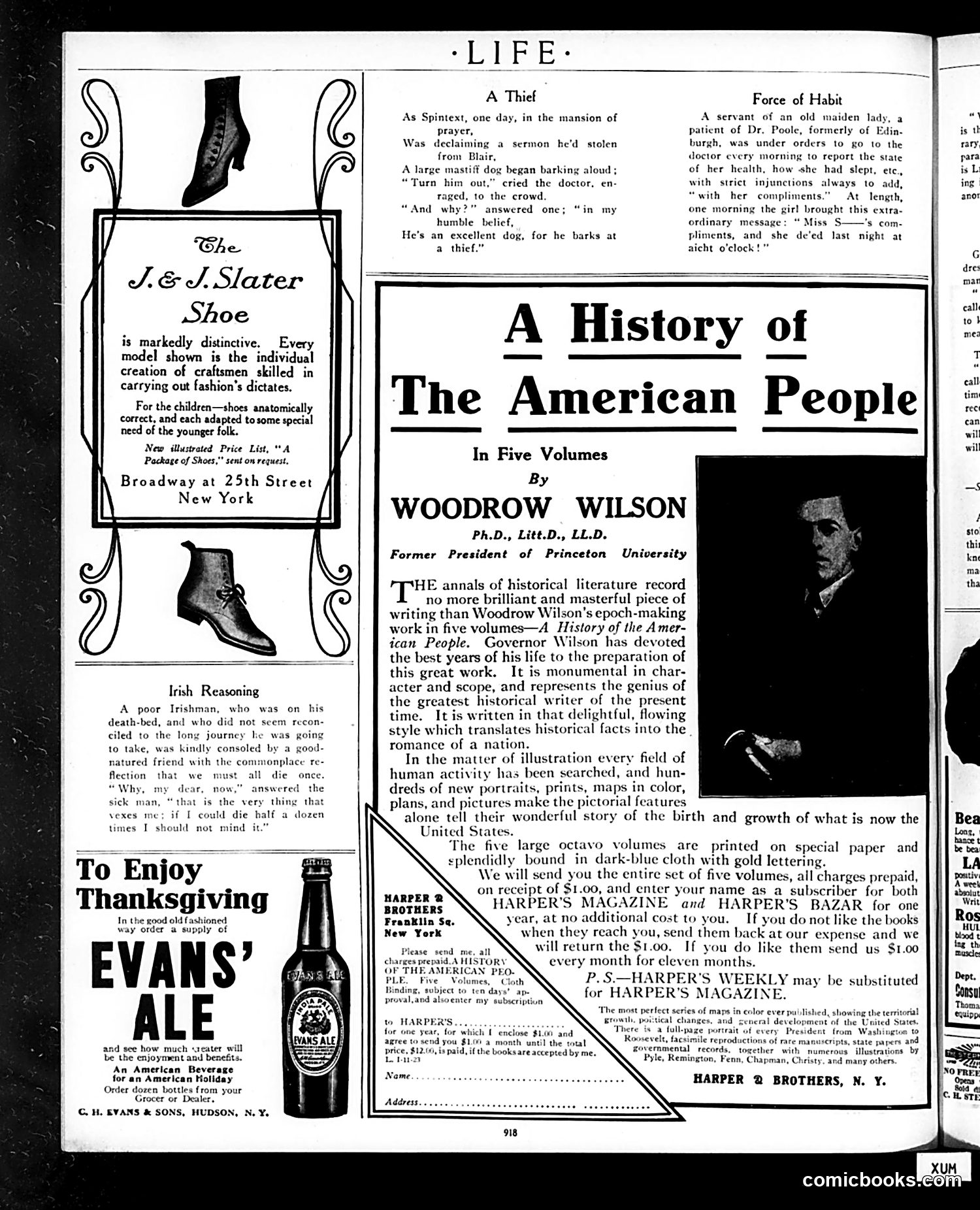
This page consists primarily of **advertisements and humorous anecdotes** rather than political cartoons. The three short jokes—"A Thief," "Force of Habit," and "Irish Reasoning"—are typical Life magazine humor: gentle, domestic comedies about human nature and irony. "A Thief" plays on a dog barking at a sermon-stealing priest. "Force of Habit" jokes about a servant delivering the same compliments even after her employer dies. "Irish Reasoning" mocks Irish fatalism through a dying man's logic. The dominant content is advertising for **S&J Slater shoes, Evans' Ale, and Woodrow Wilson's five-volume *History of the American People***. The Wilson ad emphasizes his credentials as former Princeton president and portrays the work as a masterpiece of historical writing with extensive illustrations. This appears designed to market the history as both scholarly and accessible to general readers. No satire of political figures is evident on this page.
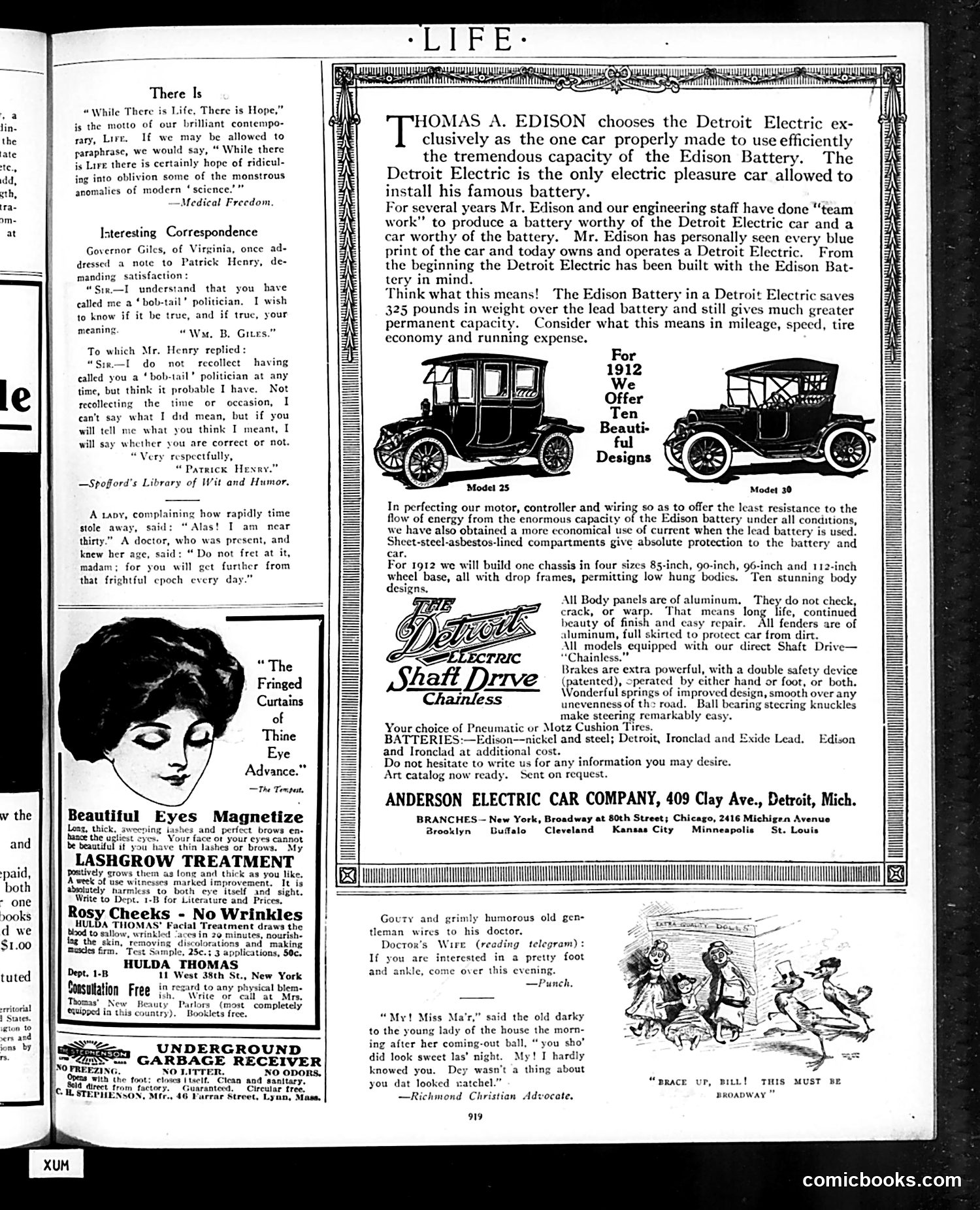
This page from *Life* magazine is primarily **advertising content**, not political satire. The main feature is a prominent advertisement for the **Detroit Electric automobile**, prominently endorsing Thomas Edison's endorsement of the vehicle and its battery technology. The advertisement emphasizes the Detroit Electric's superiority by claiming Edison himself chose it exclusively and personally owns one. It highlights innovations like the Edison Battery's weight savings (325 pounds lighter than lead batteries) and superior efficiency. The copy emphasizes cutting-edge automotive technology of 1912—aluminum panels, shaft drive, pneumatic tires—as selling points to wealthy consumers. The surrounding content includes typical period magazine features: humorous anecdotes about historical figures, advertisements for beauty treatments and cosmetic products (typical for the era), and miscellaneous comic items. The page reflects early 1900s consumer culture: technological innovation as status symbol, celebrity endorsement marketing, and beauty advertising targeting primarily female readers.
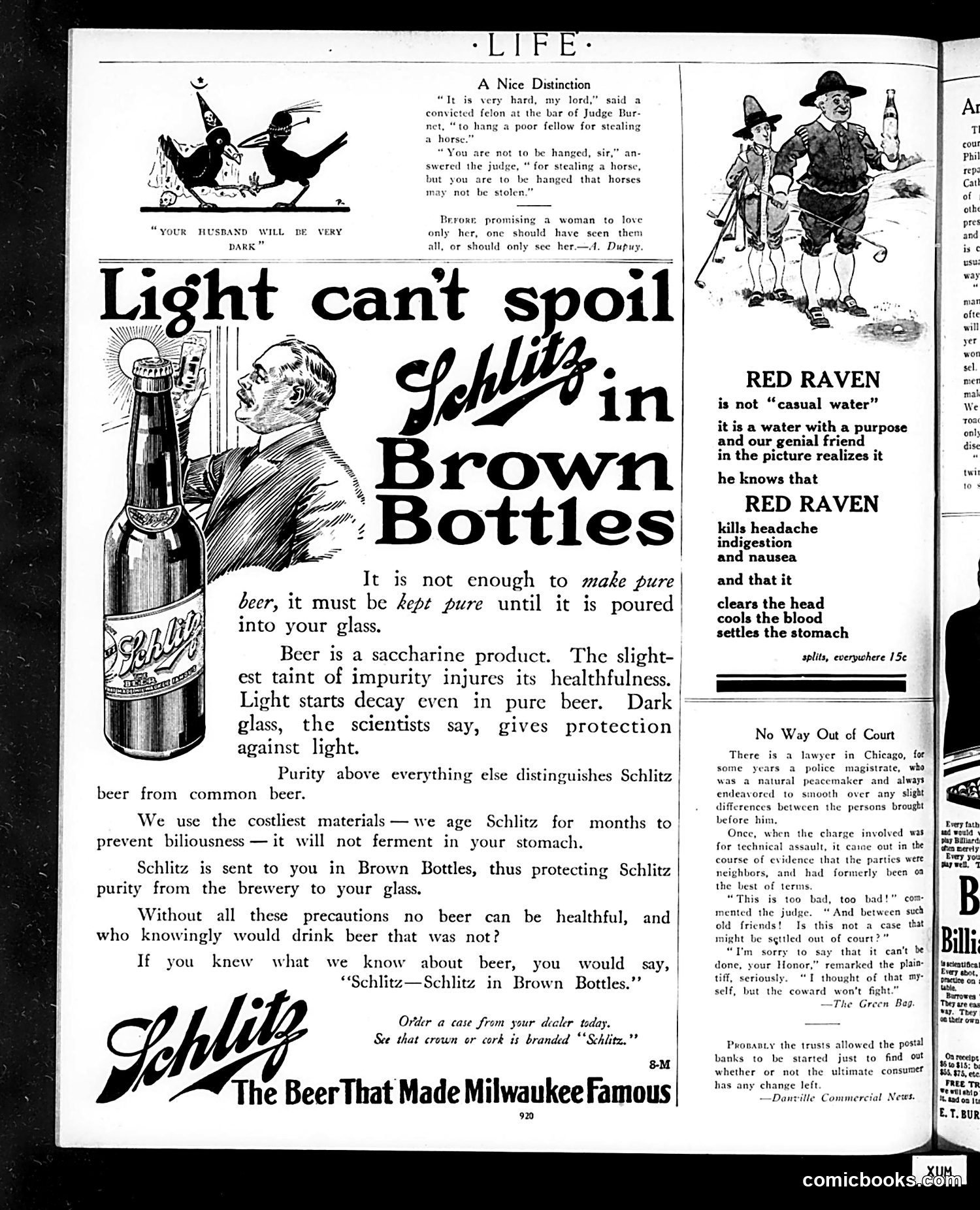
This page contains two distinct elements: **Top Section—"A Nice Distinction" (Satirical Anecdote):** A brief joke about legal hypocrisy. A convicted felon is told he won't be hanged for stealing a horse, "but you are to be hanged that horses may not be stolen." The satire mocks the arbitrary severity of 19th-century British law, which imposed capital punishment for property crimes while distinguishing between the crime itself and its legal consequences. **Main Content—Schlitz Beer Advertisement:** The dominant feature is a large commercial ad for Schlitz beer in brown bottles, claiming its dark glass protects beer from light-induced spoilage and decay. The ad emphasizes purity and scientific superiority ("kept pure until poured"). **Right Column—Red Raven & Miscellaneous Items:** Brief advertisements for Red Raven (a digestive tonic) and a short humor piece ("No Way Out of Court") about a Chicago magistrate unable to settle a technical assault case because the defendant refuses compromise. **Overall:** This is primarily an **advertising-heavy magazine page** with minimal editorial cartooning—mostly commercial content with small scattered jokes.
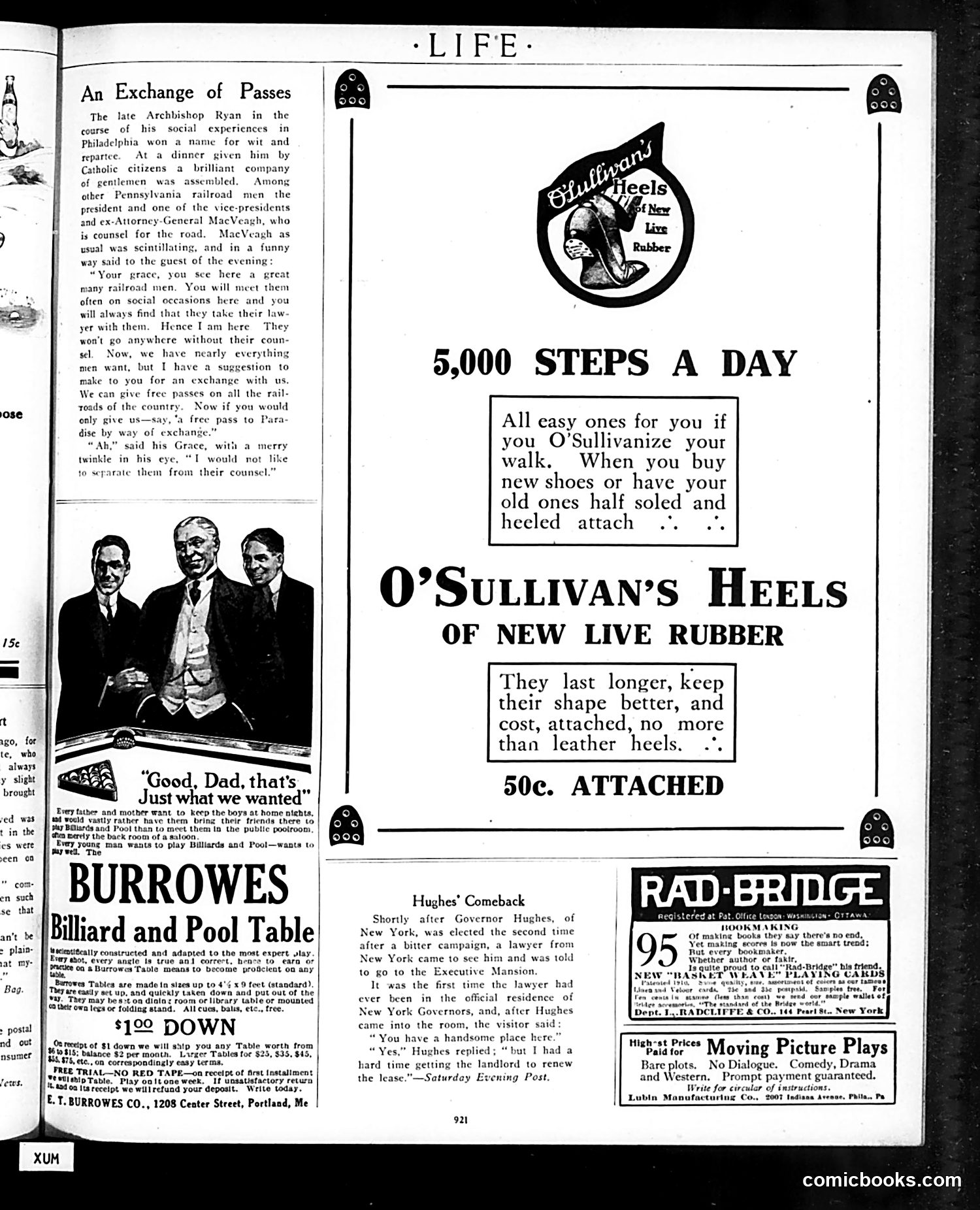
This page features a humorous anecdote about **Archbishop Ryan of Philadelphia**, a real historical figure known for wit. The story depicts a dinner where railroad executives and their lawyer (likely **Wayne MacVeagh**, Pennsylvania's ex-Attorney General and railroad counsel) joke with the Archbishop. **The satire:** The railroad men offer free passes on all U.S. railroads in exchange for a "free pass to Paradise." The Archbishop's witty reply—that he wouldn't want to separate lawyers from their clients even in the afterlife—mocks the lawyers' omnipresence in business dealings. It's commentary on **Gilded Age railroad power** and the lawyers who enabled corporate dominance. **The joke's point:** Lawyers were inseparable from railroad interests, following executives everywhere. The Archbishop's barb suggests even eternal salvation couldn't separate them—a jab at corporate-legal entanglement. The rest of the page contains unrelated period advertisements (O'Sullivan shoe heels, billiard tables, moving pictures).
This is a **magazine advertisement**, not a cartoon. It's a promotion for *Current Literature Magazine* disguised as satirical commentary. The ad uses humor to appeal to diverse readers: it compares wealthy "Mr. H. Percival Beacon-Street" (representing the upper class) with "One-eyed Mike, the Mayor of Hell's Corners, New Mexico" (representing ordinary/working people). Despite their vast differences, both supposedly share the same need—to extract real news from the clutter of murders, divorces, and fake stories in newspapers. The "vivisection" metaphor (surgical cutting) applies this medical term to news analysis, arguing that critical examination of current events is essential to being a "live one" (someone engaged with modern life). The pitch: *Current Literature Magazine* supposedly does this better than its seven competitors, combining news analysis with coverage of "active interests" shaping history. **The satire targets** newspaper sensationalism while promoting this magazine as the intelligent alternative.
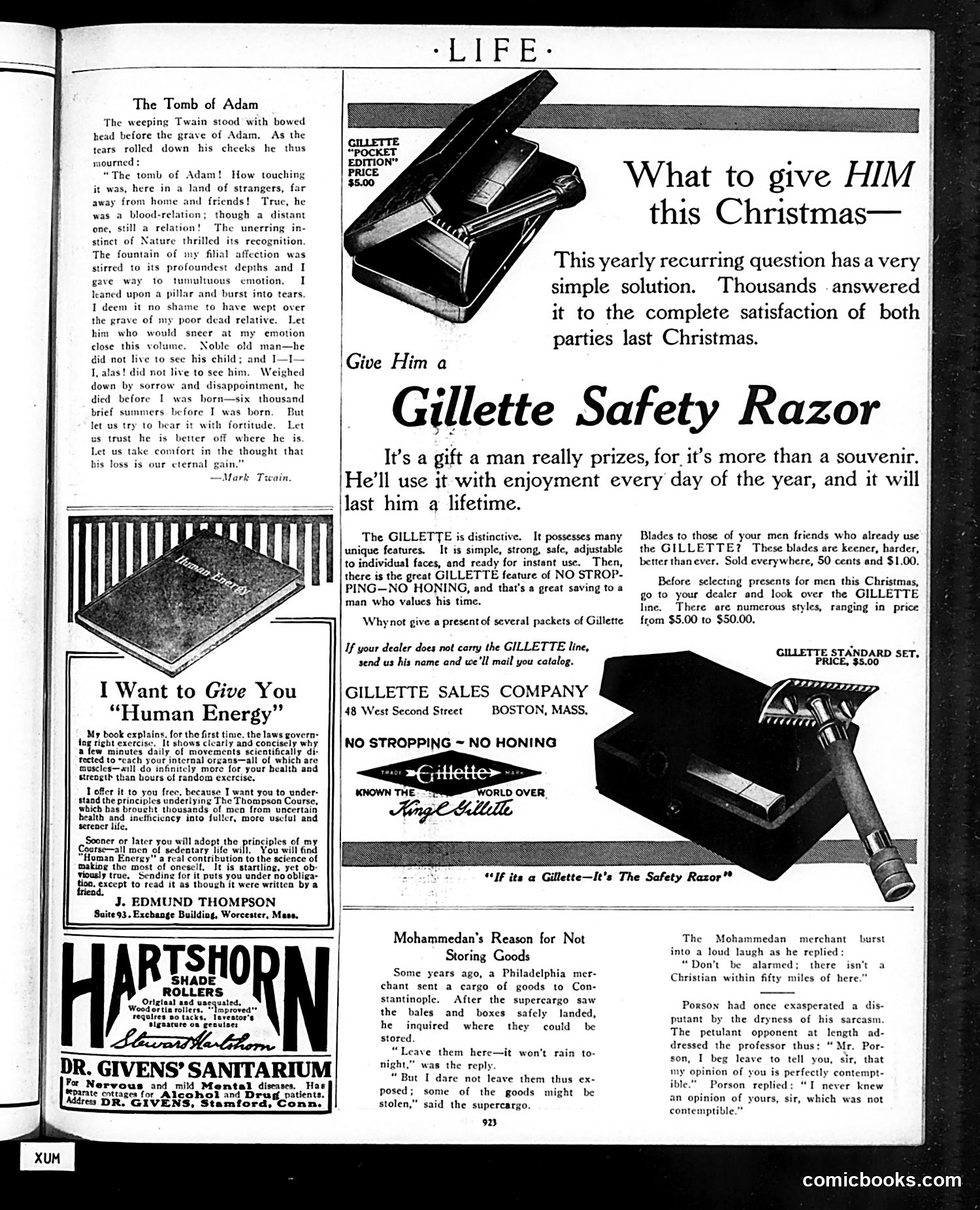
This page contains three distinct pieces: **"The Tomb of Adam"** is a humorous Mark Twain monologue about visiting Adam's grave in the Middle East. The joke relies on Twain's deadpan irony: he expresses exaggerated emotional attachment to a "blood relation" he never knew, who died thousands of years before his birth. The satire mocks sentimental travel writing and pretentious emotion. **The main content is Gillette Safety Razor advertising**, emphasizing the product's convenience ("no stropping—no honing") as an ideal Christmas gift for men. This reflects early 1900s marketing targeting male grooming habits. **"Mohammedan's Reason for Not Storing Goods"** is a brief ethnic joke: a Constantinople merchant refuses to store goods indoors, saying rain won't fall tonight. When warned about theft, he replies implausibly. The humor relies on period stereotypes about Ottoman merchants' unreliability or fatalism. The page is primarily commercial, mixing light satirical content with advertising typical of Life magazine's format.
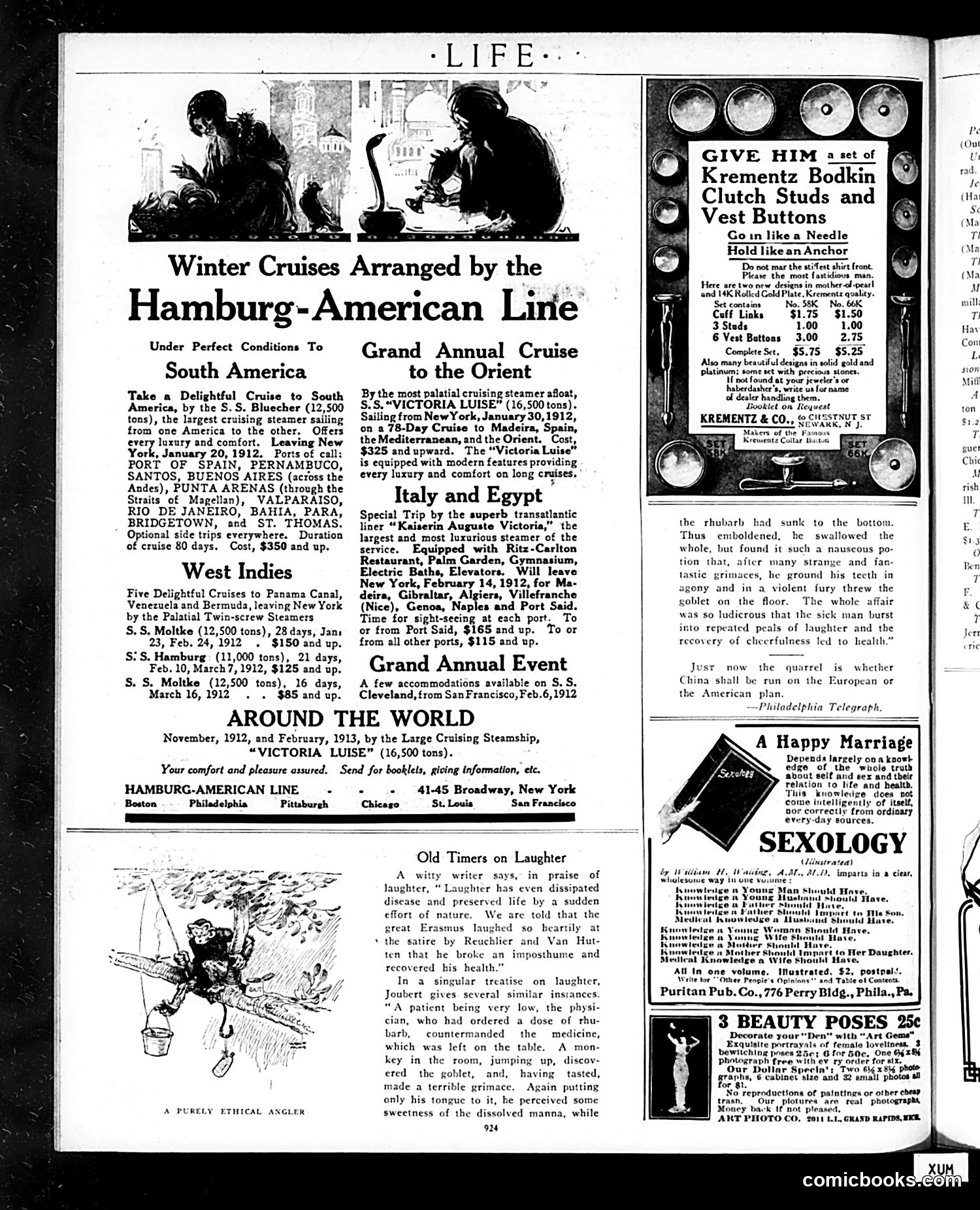
This small cartoon illustrates the accompanying article about laughter's healing properties. It depicts a man fishing while appearing to catch or observe a fish with an exaggerated, grimacing expression—likely meant to be humorous itself. The "ethical angler" reference is satirical: the angler seems to be "catching" laughter or amusement rather than actual fish, playing on the article's theme that laughter can cure illness. The cartoon visualizes the abstract concept discussed in the text—that witnessing something absurd or funny (here, a comical fish) can have genuine medicinal benefits. The page is primarily **advertising** (Hamburg-American cruise lines, jewelry, and books on sexuality), with this article and cartoon serving as filler content typical of Life magazine's mixed editorial-commercial format circa 1912.
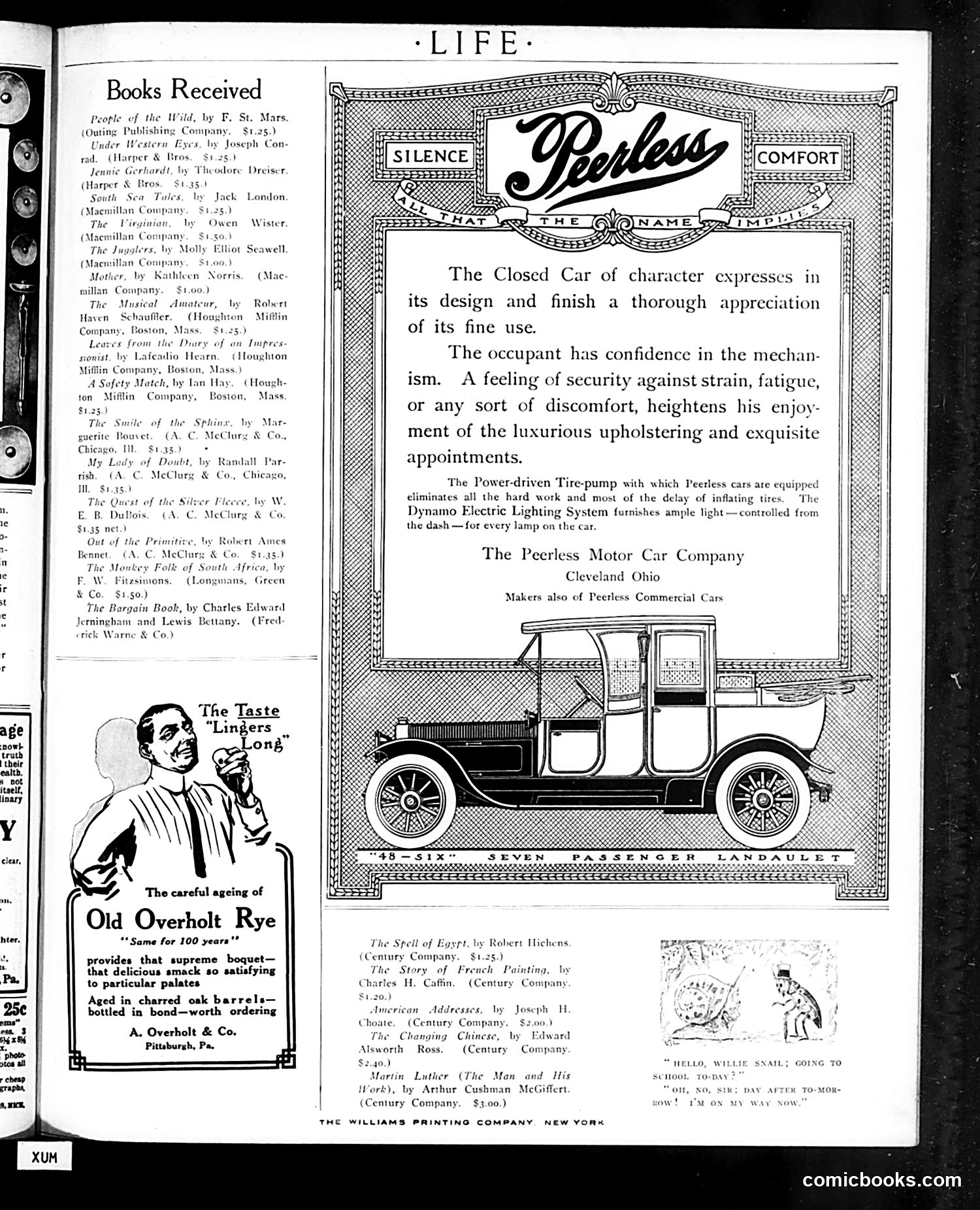
This page is primarily **advertising and book listings**, not political satire. The main content features: **Left side:** A "Books Received" section listing newly published titles (novels and non-fiction from 1910s-era publishers). **Center:** A **Peerless automobile advertisement** showcasing a closed-car landaulet, emphasizing luxury features like secure mechanics, comfortable upholstery, power-driven tire pumps, and electric lighting—marketing automobiles as symbols of refinement and reliability to wealthy consumers. **Bottom left:** An **Old Overholt Rye whiskey ad** using period-typical marketing ("100 years" of tradition, aged quality) to appeal to taste-conscious gentlemen. **Bottom right:** A small cartoon showing a snail declining to go to school, with dialogue about being "on my way now"—a mild children's joke about a snail's slowness. This is a typical Life magazine page blending literature notices, luxury goods advertising, and light humor for an educated, affluent readership.
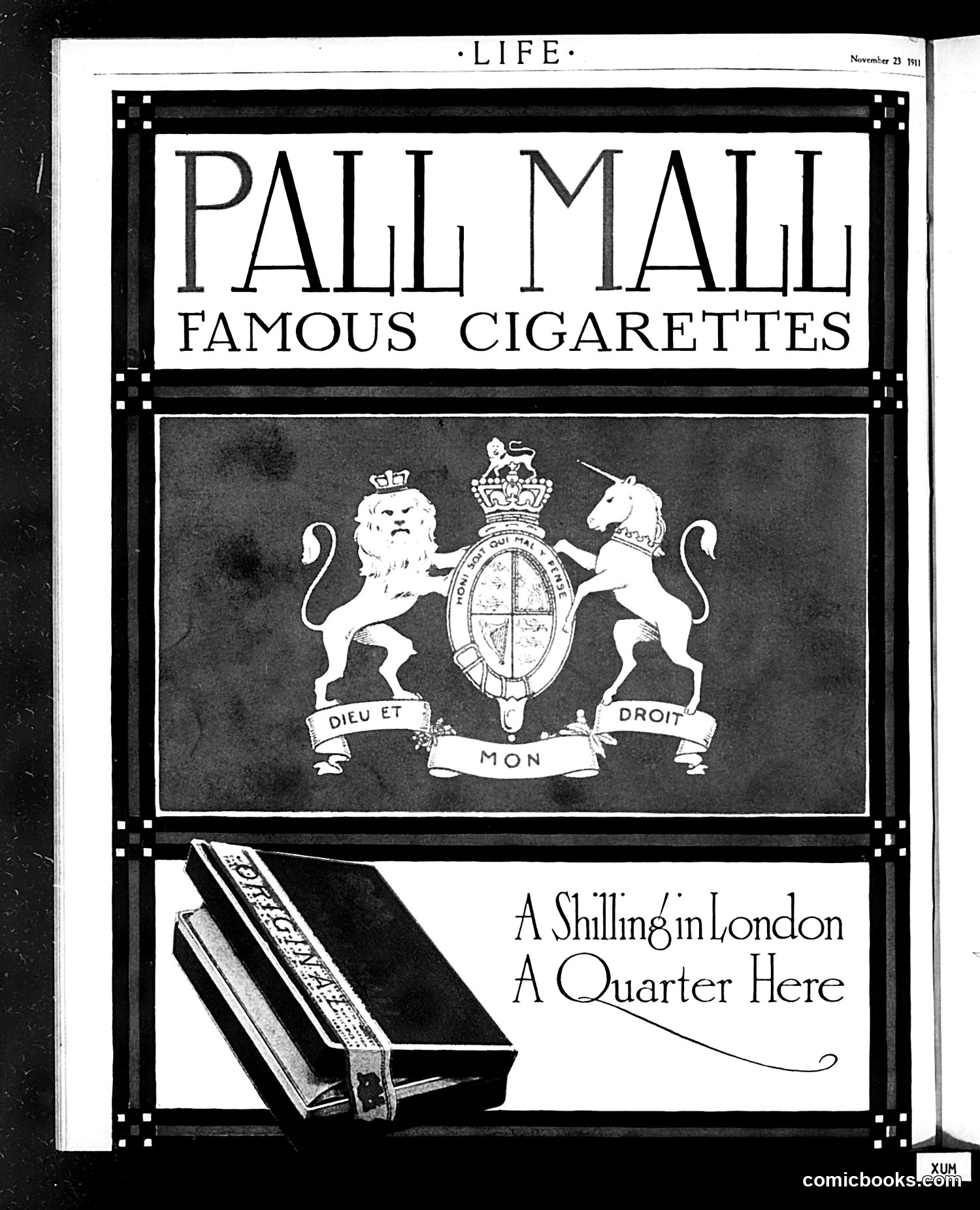
This is a **cigarette advertisement**, not a political cartoon. The page promotes "Pall Mall Famous Cigarettes" with pricing ("A Shilling in London / A Quarter Here"), indicating British and American markets circa 1911. The central image displays a heraldic coat of arms featuring a lion and unicorn (symbols of British royal authority) flanking a shield, with a crown above and a banner reading "DIEU ET MON DROIT" (God and My Right—the British royal motto). The ad uses royal imagery to position Pall Mall as a prestigious, quality product worthy of British imperial status. The heraldry suggests sophistication and legitimacy. A cigarette package is displayed at bottom left. This is straightforward advertising using patriotic/royal symbolism for brand prestige, not satire.