
Life, 1911-11-23 · page 17 of 44
Life — November 23, 1911 — page 17: what you’re looking at
What you’re looking at
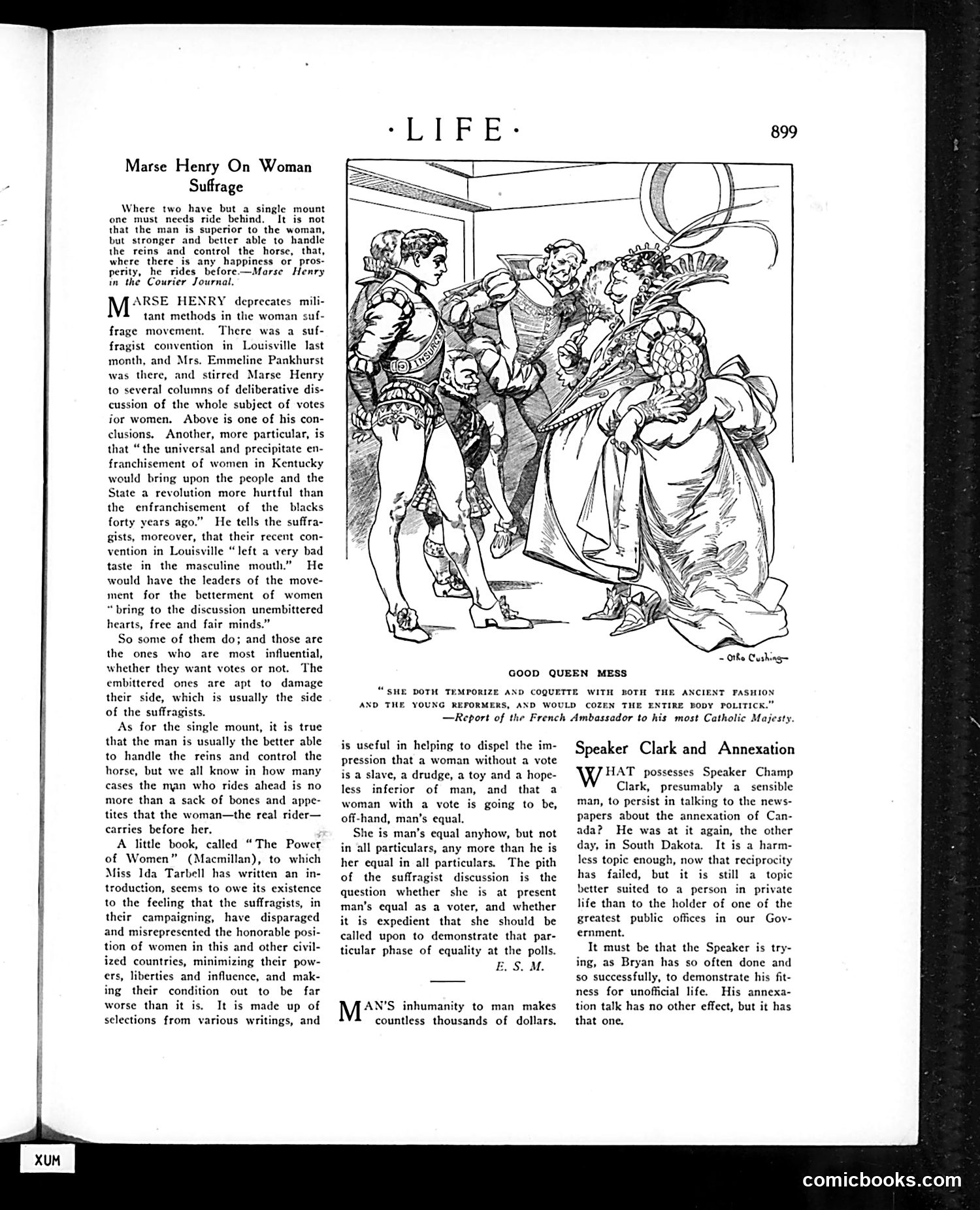
## Main Cartoon: "Good Queen Mess" The cartoon satirizes women suffragists, depicting them as hypocritical and manipulative. A woman in elaborate dress confronts what appears to be male political figures. The French Ambassador's quote (in caption) accuses her of "temporizing and coquetting with both the ancient fashion and the young reformers"—suggesting suffragists are duplicitous, playing both sides while claiming to advance women's rights. ## Context "Marse Henry" (a Louisville newspaper editor) opposes militant suffrage tactics, using a paternalistic metaphor: men should "ride ahead" because they're "stronger," though the text sardonically notes women often truly control events from behind. The piece criticizes both militant suffragists' methods *and* downplayers of women's actual power and influence. It questions whether voting rights are truly necessary to establish women's equality. ## Modern Reading This reflects early 1900s anti-suffrage rhetoric: dismissing activists as shrill/unreasonable while denying women lack real power—a contradictory argument the magazine somewhat mocks even while publishing it.
📄 Transcribed text from this page (OCR, searchable)
Machine-transcribed from the original scan — historical spelling and the odd misread are preserved.
Marse Henry On Woman Suffrage Where two have but a single mount one must needs ride behind. It is not that the man is superior to the woman, but stronger and better able to handle the reins and control the horse, that, where there is any happiness or pros- perity, he rides before—Marse Henry in the Courier Journal, ARSE HENRY deprecates mili- tant methods in the woman suf- frage movement. There was a suf- fragist convention in Louisville last month, and Mrs. Emmeline Pankhurst was there, and stirred Marse Henry to several columns of deliberative dis- cussion of the whole subject of votes ior women. Above is one of his con- clusions. Another, more particular, is that “the universal and precipitate en- franchisement of women in Kentucky would bring upon the people and the State a revolution more hurtful than the enfranchisement of the blacks forty years ago.” He tells the suffra- gists, moreover, that their recent con- vention in Louisville “left a very bad taste in the masculine mouth.” He would have the leaders of the move- ment for the betterment of women “bring to the discussion unembittered hearts, free and fair minds.” So some of them do; and those are the ones who are most influential, whether they want votes or not. The embittered ones are apt to damage their side, which is usually the side of the suffragists. As for the single mount, it is true that the man is usually the better able to handle the reins and control the horse, but we all know in how many cases the man who rides ahead is no more than a sack of bones and appe- tites that the woman—the real rider— carries before her. A little book, called “The Power of Women” (Macmillan), to which Miss Ida Tarbell has written an in- troduction, seems to owe its existence to the feeling that the suffragists, in their campaigning, have disparaged and misrepresented the honorable posi- tion of women in this and other civil- ized countries, minimizing their pow- ers, liberties and influence, and mak- ing their condition out to be far worse than it is. It is made up of selections from various writings, and GOOD QUEEN MESS “SME DOTM TEMPORIZE AND COQUETTE WITH BOTH THE ANCIENT PASHIO: AND WOULD COZEN THE ENTIRE BODY POLITICK. AND THE YOUNG REFORMERS, —Report of the French Ambassador to his most Catholic Majesty. is useful in helping to dispel the im- pression that a woman without a vote is a slave, a drudge, a toy and a hope- less inferior of man, and that a woman with a vote is going to be, off-hand, man’s equal. She is man’s equal anyhow, but not in all particulars, any more than he is her equal in all particulars. The pith of the suffragist discussion is the question whether she is at present man’s equal as a voter, and whether it is expedient that she should be called upon to demonstrate that par- ticular phase of equality at the polls. E. S. M. Mass inhumanity to man makes countless thousands of dollars. Speaker Clark and Annexation HAT possesses Speaker Champ Clark, presumably a_ sensible man, to persist in talking to the news- papers about the annexation of Can- ada? He was at it again, the other day, in South Dakota. It is a harm- less topic enough, now that reciprocity has failed, but it is still a topic better suited to a person in private life than to the holder of one of the greatest public offices in our Gov- ernment. It must be that the Speaker is try- ing, as Bryan has so often done and so successfully, to demonstrate his fit- ness for unofficial life, His annexa- tion talk has no other effect, but it has that one. comicbooks.com