
Life, 1911-11-23 · page 20 of 44
Life — November 23, 1911 — page 20: what you’re looking at
What you’re looking at
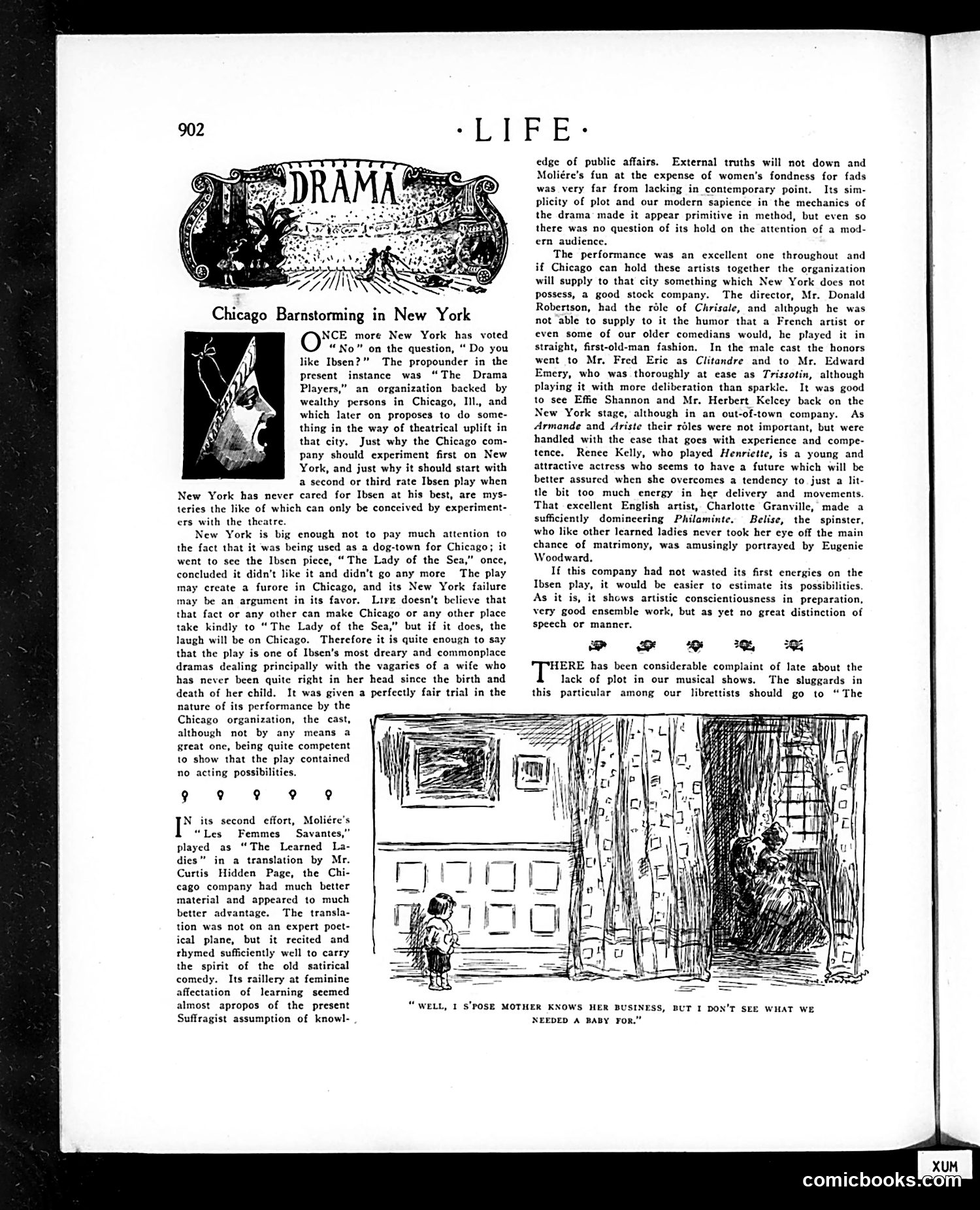
This drama review critiques a Chicago theater company's New York performances. The critic dismisses their production of Ibsen's *The Lady of the Sea* as a poor choice—Ibsen at his weakest—noting New York audiences rejected it (voting "No" on liking Ibsen). The company's second effort, Molière's *The Learned Ladies*, fared better. The review praises the ensemble cast and director Donald Robertson, particularly commending Fred Eric and Edward Emery. However, the critic finds contemporary relevance in Molière's satire of women's intellectual pretensions, noting it feels "almost apropos of the present Suffragist assumption of knowledge"—a pointed jab at women's suffrage advocates, suggesting their political ambitions mirror the foolish female pedantry Molière mocked. The illustration depicts a domestic scene supporting this theme.
📄 Transcribed text from this page (OCR, searchable)
Machine-transcribed from the original scan — historical spelling and the odd misread are preserved.
*LD PE « Chicago Barnstorming in New York NCE more New York has voted “No” on the question, “ Do you like Ibsen?” The propounder in the present instance was “The Drama Players,” an organization backed by wealthy persons in Chicago, Ill, and which later on proposes to do some- thing in the way of theatrical uplift in that city. Just why the Chicago com- pany should experiment first on New York, and just why it should start with a second or third rate Ibsen play when New York has never cared for Ibsen at his best, are mys- teries the like of which can only be conceived by experiment- ers with the theatre. New York is big enough not to pay much attention to the fact that it was being used as a dog-town for Chicago; it went to see the Ibsen piece, “The Lady of the Sea,” once, concluded it didn’t like it and didn’t go any more The play may create a furore in Chicago, and its New York failure may be an argument in its favor. Lire doesn’t believe that that fact or any other can make Chicago or any other place take kindly to “The Lady of the Sea,” but if it does, the laugh will be on Chicago. Therefore it is quite enough to say that the play is one of Ibsen's most dreary and commonplace dramas dealing principally with the vagaries of a wife who has never been quite right in her head since the birth and death of her child. It was given a perfectly fair trial in the nature of its performance by the Chicago organization, the cast, although not by any means a great one, being quite competent to show that the play contained no acting possibilities. 9 9° ¢ & @ I its second effort, Moliére's “Les Femmes Savantes,” played as “The Learned La- dies” in a translation by Mr. Curtis Hidden Page, the Chi- cago company had much better material and appeared to much better advantage. The transla- tion was not on an expert poet- ical plane, but it recited and rhymed sufficiently well to carry the spirit of the old satirical comedy. Its raillery at feminine affectation of learning seemed almost apropos of the present Suffragist assumption of knowl- edge of public affairs. External truths will not down and Moliére’s fun at the expense of women’s fondness for fads was very far from lacking in contemporary point. Its sim- plicity of plot and our modern sapience in the mechanics of the drama made it appear primitive in method, but even so there was no question of its hold on the attention of a mod- ern audience. The performance was an excellent one throughout and if Chicago can hold these artists together the organization will supply to that city something which New York does not possess, a good stock company. The director, Mr. Donald Robertson, had the réle of Chrisale, and although he was not able to supply to it the humor that a French artist or even some of our older comedians would, he played it in straight, first-old-man fashion. In the male cast the honors went to Mr, Fred Eric as Clitandre and to Mr. Edward Emery, who was thoroughly at ease as Trissotin, although playing it with more deliberation than sparkle. It was good to see Effie Shannon and Mr. Herbert Kelcey back on the New York stage, although in an out-of-town company. As Armande and Ariste their roles were not important, but were handled with the ease that goes with experience and compe- tence, Renee Kelly, who played Henriette, is a young and attractive actress who seems to have a future which will be better assurcd when she overcomes a tendency to just a lit- tle bit too much energy in her delivery and movements. That excellent English artist, Charlotte Granville, made a sufficiently domineering Philaminte. Belise, the spinster, who like other learned ladies never took her eye off the main chance of matrimony, was amusingly portrayed by Eugenie Woodward. If this company had not wasted its first energies on the Ibsen play, it would be easier to estimate its possibilities. As it is, it shows artistic conscientiousness in preparation, very good ensemble work, but as yet no great distinction of speech or manner. Pe HR HERE has been considerable complaint of late about the lack of plot in our musical shows. The sluggards in this particular among our librettists should go to “The “WELL, I S'POSE MOTHER KNOWS HER BUSINESS, BUT I DON’T SEE WHAT WE NEEDED A BABY FOR.” comicbooks Meow