
Life, 1911-11-23 · page 26 of 44
Life — November 23, 1911 — page 26: what you’re looking at
What you’re looking at
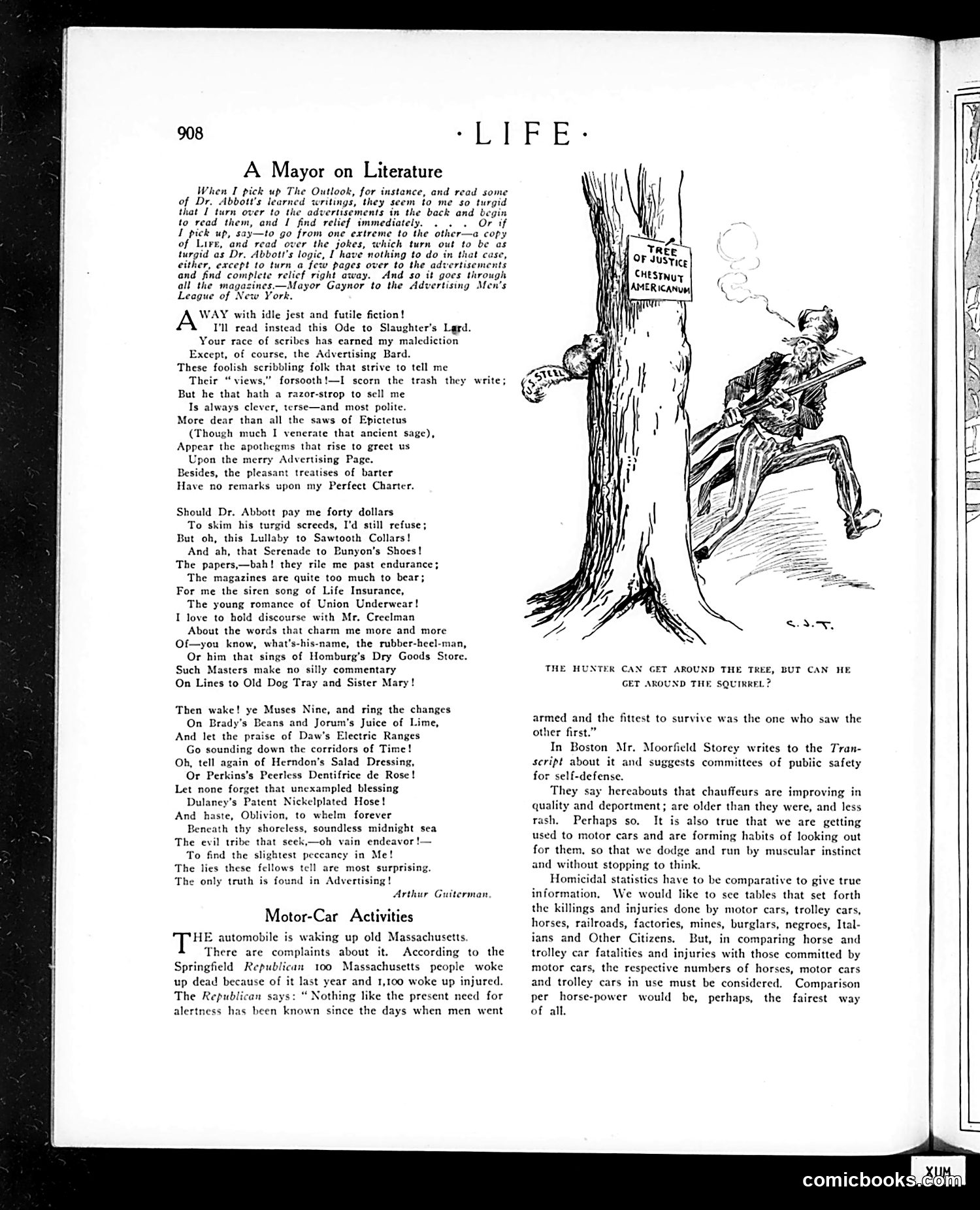
This page satirizes Mayor Gaynor of New York (referenced in the text), who reportedly preferred advertisements to actual journalism and literature. The accompanying poem by Arthur Guiterman mocks this preference through exaggeration, praising commercial advertising copy while dismissing serious writers like Dr. Abbott (editor of *The Outlook*) and literary magazines. The satire criticizes how advertisements prioritize sales language over substance, while implying that a public official values marketing rhetoric more than informed discourse. Guiterman's poem ironically elevates mundane product endorsements—for collars, shoes, insurance, and beans—to the status of great literature, exposing the absurdity of preferring commercial messaging to genuine intellectual content. The second section on "Motor-Car Activities" shifts to automobile safety in Massachusetts, citing injury statistics and debating whether improved chauffeur behavior or public adaptation explains accident patterns. It calls for comparative homicide statistics across different causes.
📄 Transcribed text from this page (OCR, searchable)
Machine-transcribed from the original scan — historical spelling and the odd misread are preserved.
908 -LIFE- A Mayor on Literature When I pick up The Outlook, for instance, and read some of Dr. Abbott's learned writings, they seem to me so turgid that I turn over to the advertisements in the back and begin to read them, and I find relief immediately. . . . Or if I pick up, say—to go from one extreme to the other—a copy of Lire, and read over the jokes, whic turgid as Dr. Abbott's logic, I have nothing to do in that case, either, except to turn_a few pages over to the advertisements and find complete relicf right away. And so it goes through all the maga fayor Gaynor to the Advertising Men's League of N. WAY with idle jest and futile fiction! I'll read instead this Ode to Slaughter’s Lard. Your race of scribes has earned my malediction Except, of course, the Advertising Bard. These foolish scribbling folk that strive to tell me Their “views,” forsooth!—I scorn the trash they write; But he that hath a razor-strop to sell me Is always clever, terse—and most polite. More dear than all the saws of Epictetus (Though much I venerate that ancient sage), Appear the apothegm rise to greet us Besides, the pleasant treatises of barter Have no remarks upon my Perfect Charter. Should Dr. Abbott pay me forty dollars To skim his turgid screeds, I'd still refuse; But oh, this Lullaby to Sawtooth Collars! And ah, that Serenade to Bunyon’s Shoes! The papers,—bah! they rile me past endurance; The magazines are quite too much to bear; For me the siren song of Life Insurance, The young romance of Union Underwear! I love to hold discourse with Mr. Creelman About the words that charm me more and more Of—you know, what’s-his-name, the rubber-heel-man, Or him that sings of Homburg’s Dry Goods Store. Such Masters make no silly commentary On Lines to Old Dog Tray and Sister Mary! Then wake! ye Muses Nine, and ring the changes On Brady’s Beans and Jorum’s Juice of Lime, And let the praise of Daw’s Electric Ranges Go sounding down the corridors of Time! Oh, tell again of Herndon’s Salad Dressing, Or Perkins’s Peerless Dentifrice de Rose! Let none forget that uncxampled blessing Dulaney’s Patent Nickelplated Hose! And haste, Oblivion, to whelm forever Beneath thy shorcless, soundless midnight sea The evil tribe that seek,—oh vain endeavor !— To find the slightest peccancy in Me! The lies these fellows tell are most surprising. The only truth is found in Advertising! Arthur Guiterman Motor-Car Activities automobile is waking up old Massachusetts. There are complaints about it. According to the Springfield Republican 100 Massachusetts people woke up dead because of it last year and 1,100 woke up injured. The Republican sa “Nothing like the present need for alertness has been known since the days when men went armed and the fittest to survive was the one who saw the other first.” In Boston Mr. Moorfield Storey writes to the Tran- seript about it and suggests committees of pubiic safety for self-defense. They say hereabouts that chauffeurs are improving in quality and deportment; are older than they were, and less rash. Perhaps so. It is also true that we are getting used to motor cars and are forming habits of looking out for them, so that we dodge and run by muscular instinct and without stopping to think. Homicidal statistics have to be comparative to give true information, We would like to sce tables that set forth the killings and injuries done by motor cars, trolley cars, horses, railroads, factories, mines, burglars, negroes, Ital- ians and Other Citizens. But, in comparing horse and trolley car fatalities and injuries with those committed by motor cars, the respective numbers of horses, motor cars and trolley cars in use must be considered. Comparison per horse-power would be, perhaps, the fairest way of all. 1 \\ —\ > W ag iS comicbookMee |