
Life, 1911-11-23 · page 24 of 44
Life — November 23, 1911 — page 24: what you’re looking at
What you’re looking at
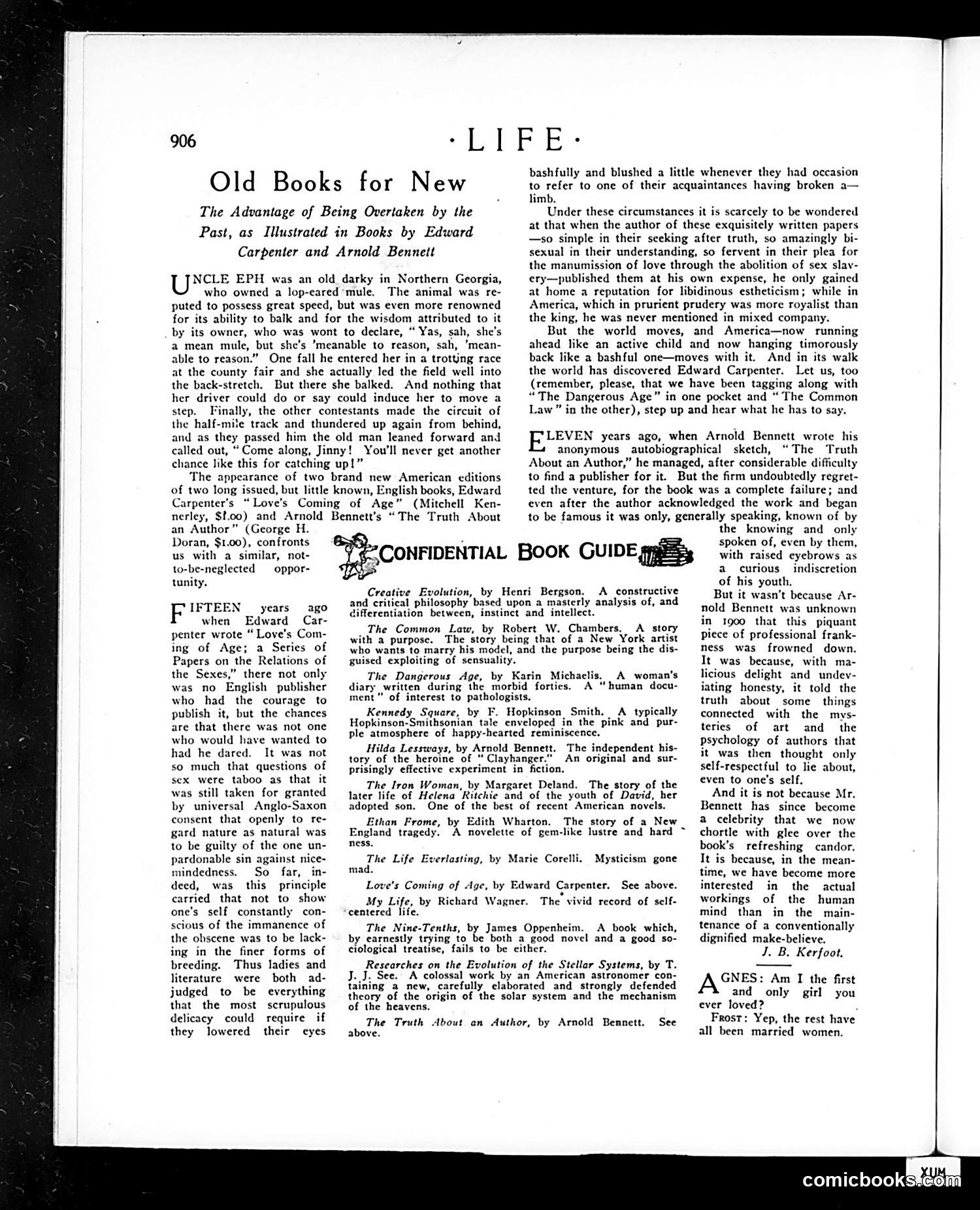
This page discusses two recently republished English books—Edward Carpenter's "Love's Coming of Age" and Arnold Bennett's "The Truth About an Author"—using them to illustrate how American and British attitudes toward sexuality and propriety have evolved. The opening anecdote about Uncle Ephraim's mule serves as an allegory: just as the mule needed urging to seize its opportunity, society needed prodding to accept previously "scandalous" works. The satire targets Victorian prudishness. Carpenter's writings on sexuality were once considered so obscene that publishers wouldn't touch them, and even after becoming famous, Bennett's autobiographical work was whispered about shamefully. The text mocks the hypocrisy of a culture that treated frank discussion of natural subjects as inherently immoral while remaining genuinely interested in them. The "Confidential Book Guide" section provides capsule reviews of contemporary books, suggesting modernist literature was increasingly addressing previously taboo subjects openly—reflecting shifting cultural norms toward honesty about human nature.
📄 Transcribed text from this page (OCR, searchable)
Machine-transcribed from the original scan — historical spelling and the odd misread are preserved.
906 Old Books for New The Advantage of Being Overtaken by the Past, as Illustrated in Books by Edward Carpenter and Arnold Bennett WAS EPH was an old darky in Northern Georgia, who owned a lop-eared mule. The animal was re- puted to possess great speed, but was even more renowned for its ability to balk and for the wisdom attributed to it by its owner, who was wont to declare, “ Yas, sah, she’s a mean mule, but she’s ’meanable to reason, sah, 'mean- able to reason.” One fall he entered her in a trotting race at the county fair and she actually led the field well into the back-stretch. But there she balked. And nothing that her driver could do or say could induce her to move a step. nally, the other contestants made the circuit of the half-mile track and thundered up again from behind, and as they passed him the old man leaned forward and called out, “Come along, Jinny! You'll never get another chance like this for catching up!” The appearance of two brand new American editions of two long issued, but little known, English books, Edward Carpenter's “Love's Coming of Age” (Mitchell Ken- nerley, $f.00) and Arnold Bennett's “The Truth About an Author” (George H. Doran, $1.00), confronts us with a similar, not- ‘LIPE: “CONFIDENTIAL BOOK GUIDE gaits bashfully and blushed a little whenever they had occasion to refer to one of their acquaintances having broken a— limb. Under these circumstances it is scarcely to be wondered at that when the author of these exquisitely written papers —so simple in their seeking after truth, so amazingly bi- sexual in their understanding, so fervent in their plea for the manumission of love through the abolition of sex slav- ery—published them at his own expense, he only gained at home a reputation for libidinous estheticism; while in America, which in prurient prudery was more royalist than the king, he was never mentioned in mixed company. But the world moves, and America—now running ahead like an active child and now hanging timorously back like a bashful one—moves with it. And in its walk the world has discovered Edward Carpenter. Let us, too (remember, please, that we have been tagging along with “The Dangerous Age” in one pocket and “The Common Law” in the other), step up and hear what he has to say. LEVEN years ago, when Arnold Bennett wrote his anonymous autobiographical sketch, “The Truth About an Author,” he managed, after considerable difficulty to find a publisher for it. But the firm undoubtedly regret- ted the venture, for the book was a complete failure; and even after the author acknowledged the work and began to be famous it was only, generally speaking, known of by the knowing and only spoken of, even by them, with raised eyebrows as a curious indiscretion penter wrote “Love's Com- ing of Age; a Series of Papers on the Relations of the Sexes,” there not only was no English publisher who had the courage to publish it, but the chances are that there was not one who would have wanted to had he dared. It was not so much that questions of sex were taboo as that it was still taken for granted by universal Anglo-Saxon consent that openly to re- gard nature as natural was to be guilty of the one un- pardonable sin against nice- mindedness. So far, in- deed, was this principle carried that not to show one’s self constantly con- scious of the immanence of the obscene was to be lack- ing in the finer forms of breeding. Thus ladies and literature were both ad- judged to be everything that the most scrupulous delicacy could require if they lowered their eyes A constructive to-be-neglected —_ oppor- tunity, a . * Creative Evolution, by Henri Bergson, A constructive ETEEN yi and critical philosophy based upon a masterly analysis of, an ABT EEN Egward CEP differentiation between, instinct and intellect. when Edw. . The Common Law, by Robert W. Chambers, A story with a purpose. The story being that of a New York artist who wants to marry his model, and the purpose being the dis- guised exploiting of sensuality. The Dangerous Age, by Karin Michaclis. A woman's diary written during the morbid forties. A “human docu- ment” of interest to pathologists. Kennedy Square, by F. Hopkinson Smith. A typically Hopkinson-Smithsonian tale enveloped in the pink and pur- ple atmosphere of happy-hearted reminiscence. Hilda Lessways, by Arnold Bennett. The independent his- tory of the heroine of “Clayhanger.”| An original and sur- prisingly effective experiment in fiction. The Iron Woman, by Margaret Deland. The story of the later life of Helena ‘Ritchie and of the youth of David, her adopted son. One of the best of recent American novels. Ethan Frome, by Edith Wharton. The story of a New England tragedy. A novelette of gem-like lustre and hard ness. The Life Everlasting, by Marie Corelli. mad. Love's Coming of Age, by Edward Carpenter. See above. My Life, by Richard Wagner. The’ vivid record of self- centered life. The Nine-Tenths, by James Oppenheim. A book which, by earnestly trying to be both a good novel and a good so- ciological treatise, fails to be either. Researches on the Evolution of the Stellar Systems, by T. J. J. See. A colossal work by an American astronomer con- taining a new, carefully elaborated and strongly defended theory of the origin of the solar system and the mechanism of the heavens. The Truth About an Author, by Arnold Bennett. See above. Mysticism gone of his youth. But it wasn’t because Ar- nold Bennett was unknown in 1900 that this piquant Piece of professional frank- ness was frowned down. It was because, with ma- licious delight and undev- iating honesty, it told the truth about some things connected with the mys- teries of art and the psychology of authors that it was then thought only self-respectful to lie about, even to one’s self, And it is not because Mr. Bennett has since become a celebrity that we now chortle with glee over the book's refreshing candor. It is because, in the mean- time, we have become more interested in the actual workings of the human mind than in the mai tenance of a conventionally dignified make-believe. J. B. Kerfoot. GNES: Am I the first and only girl you ever loved? Frost: Yep, the rest have all been married women. comicbookMeom