
Life, 1911-11-23 · page 10 of 44
Life — November 23, 1911 — page 10: what you’re looking at
What you’re looking at
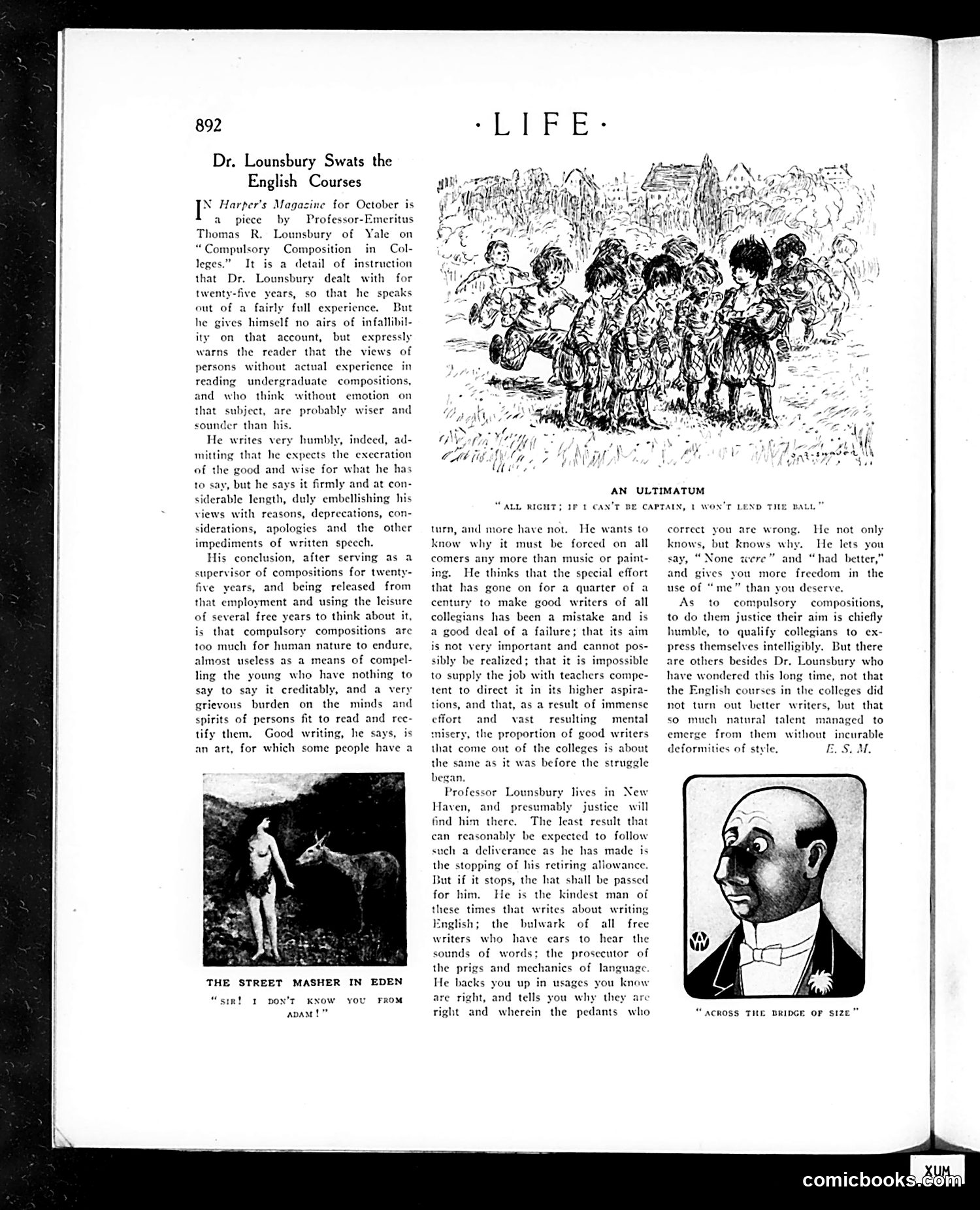
This page discusses **Dr. Thomas R. Lounsbury of Yale**, a literary critic who wrote for Harper's Magazine about university English education. The article critiques his pessimistic views on undergraduate writing composition. The two illustrations appear to be: 1. **"The Street Masher in Eden"** — a sketch showing a man accosting a woman, captioned "Sir! I don't know you from Adam!" This likely satirizes inappropriate social behavior. 2. **"Across the Bridge of Size"** — a caricatured portrait of a bald man in formal dress, presumably Lounsbury himself, used to accompany the critical discussion of his views on English instruction. The page's satire targets Lounsbury's pessimism about teaching writing, arguing his views are overly harsh on both students and composition instruction's potential.
📄 Transcribed text from this page (OCR, searchable)
Machine-transcribed from the original scan — historical spelling and the odd misread are preserved.
892 Dr. Lounsbury Swats the English Courses N Harper's Magazine for October is a piece by Professor-Emeritus Thomas R. Lounsbury of Yale on “Compulsory Composition in Col- leges.” It is a detail of instruction that Dr. Lounsbury dealt with for twenty-five years, so that he speaks out of a fairly full experience. But he gives himself no airs of infallibil- ity on that account, but expressly warns the reader that the views of persons without actual experience in reading undergraduate compositions, and who think without emotion on that subject, are probably wiser and sounder than his. He writes very humbly, indeed, ad- mitting that he expects the exceration of the good and wise for what he has to say, but he says it firmly and at con- siderable length, duly embellishing his views with reasons, deprecations, con- siderations, apologies and the other impediments of written. specch. His conclusion, after serving as a supervisor of compositions for twenty- five years, and being released from that employment and using the leisure of several free years to think about it, is that compulsory compositions are too much for human nature to endure, almost useless as a means of compel- ling the young who have nothing to say to say it creditably, and a very grievous burden on the minds and spirits of persons fit to read and rec- tify them. Good writing, he says, is an art, for which some people have a THE STREET MASHER IN EDEN DON’T KNOW YoU FROM avant!” sin! 1 AN ULTIMATUM “ALL RIGHT; IF 1 CAN'T BE CAPTALN, 1 WON'T LEND TIL turn, and more have not. He wants to know why it must be forced on all comers any more than music or paint- ing. He thinks that the special effort that has gone on for a quarter of a century to make good writers of all collegians has been a mistake and is a good deal of a failure; that its aim is not very important and cannot pos- sibly be realized; that it is impossible to supply the job with teachers compe- tent to direct it in its higher aspira- tions, and that, as a result of immense effort and vast resulting mental misery, the proportion of good writers that come out of the colleges is about the same as it was before the struggle began. Professor Lounsbury lives in New Haven, and presumably justice will find him there. The lIeast result that can reasonably be expected to follow such a deliverance as he has made is the stopping of his retiring aliowance. But if it stops, the hat shall be passed for him. He is the kindest man of ese times that writes about writing English; the bulwark of all free writers who have cars to hear the sounds of words; the prosecutor of the prigs and mechanics of language He backs you up in usages you know are right, and tells you why they arc right and wherein the pedants who correct you are wrong. knows, but knows why. He lets you say, “None were” and “had _ better, and gives you more freedom in the use of “me” than you deserve. As to compulsory compositions, to do them justice their aim is chiefly humble, to qualify collegians to ex- press themselves intelligibly. But there are others besides Dr. Lounsbury who have wondered this long time, not that the English courses in the colleges did not turn out better writers, but that so much natural talent managed to emerge from them without incurable deformities of style. He not only “ACROSS THE BRIDGE OF size” comicbook Gol