
Life, 1911-11-23 · page 21 of 44
Life — November 23, 1911 — page 21: what you’re looking at
What you’re looking at
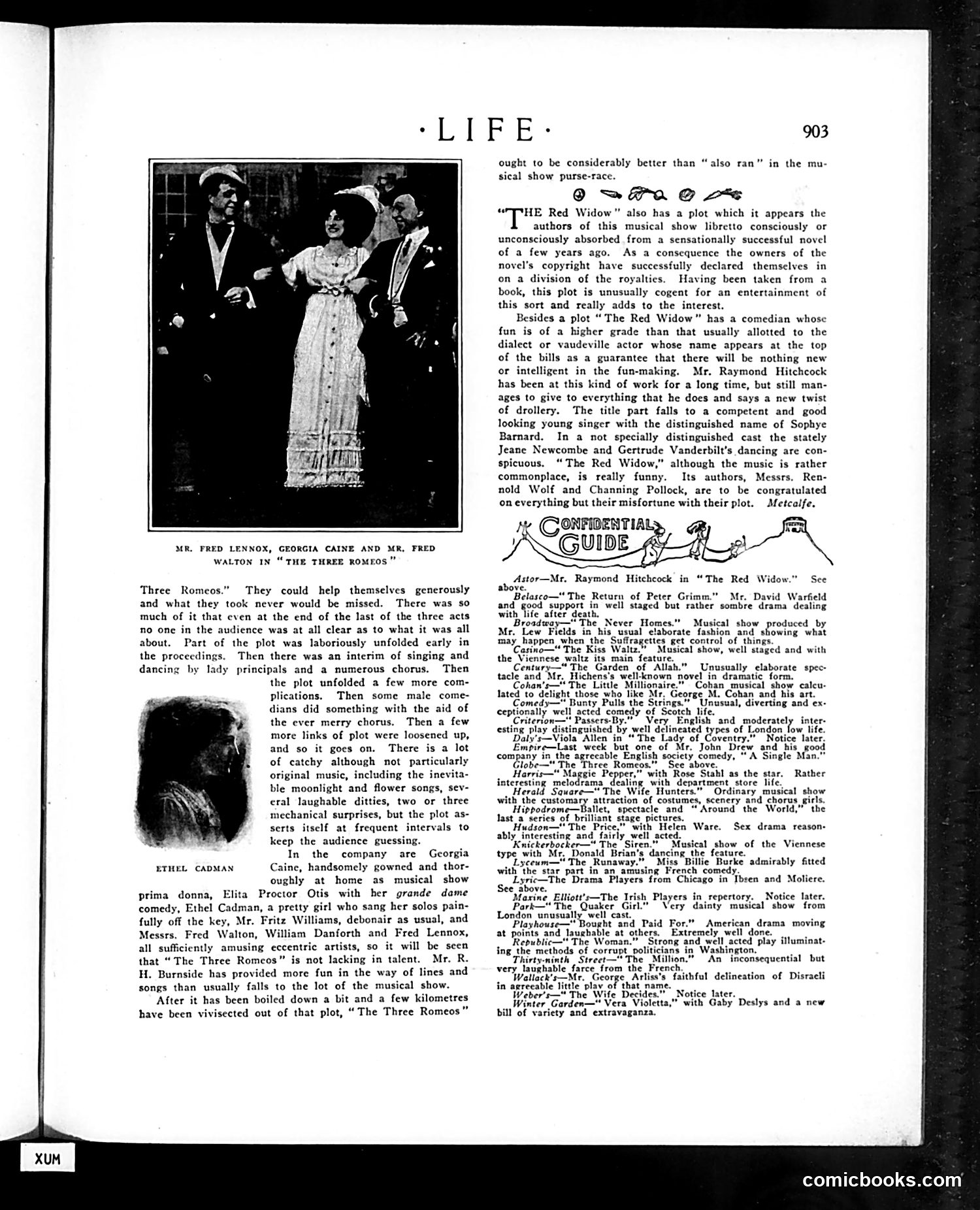
This page reviews two Broadway musical shows from the early 1900s: "The Three Romeos" and "The Red Widow." **"The Three Romeos"** is criticized as a loosely-plotted musical where the narrative keeps getting interrupted by singing, dancing, and comic bits. The reviewer notes the cast (including Georgia Caine and Fred Lennox, pictured) is talented, but the plot is confusing and overly long—it needs cutting down to be competitive. **"The Red Widow"** receives higher praise. Its plot, adapted from a successful novel, is unusually coherent for a musical. The reviewer particularly praises comedian Raymond Hitchcock, whose humor transcends typical vaudeville-style dialect comedy by adding original twists. The music is "commonplace," but the show is genuinely funny. The tone is insider theatrical criticism, assuming readers follow Broadway productions. No political satire is present—this is straight entertainment review.
📄 Transcribed text from this page (OCR, searchable)
Machine-transcribed from the original scan — historical spelling and the odd misread are preserved.
*~LIFE: 903 MR. PRED LENNOX, GEORGIA CAINE AND MR, FRED WALTON IN “THE THREE ROMEOS” Three Romeos.” They could help themselves generously and what they took never would be missed. There was so much of it that even at the end of the last of the three acts no one in the audience was at all clear as to what it was all about. Part of the plot was laboriously unfolded early in the proceedings. Then there was an interim of singing and dancing by lady principals and a numerous chorus. Then the plot unfolded a few more com- plications. Then some male come- dians did something with the aid of the ever merry chorus. Then a few more links of plot were loosened up, and so it gocs on. There is a lot of catchy although not particularly i ic, including the inevita- ble moonlight and flower songs, sev- cral laughable ditties, two or three mechanical surprises, but the plot as- serts itself at frequent intervals to keep the audience guessing. In the company are Georgia Caine, handsomely gowned and thor- oughly at home as musical show prima donna, Elita Proctor Otis with her grande dame comedy, Ethel Cadman, a pretty girl who sang her solos pain- fully off the key, Mr. Fritz Williams, debonair as usual, and Messrs. Fred Walton, William Danforth and Fred Lennox, all sufficiently amusing eccentric artists, so it will be seen that “The Three Romcos” is not lacking in talent. Mr. R. H. Burnside has provided more fun in the way of lines and songs than usually falls to the lot of the musical show. After it has been boiled down a bit and a few kilometres have been vivisected out of that plot, “The Three Romeos” ETHEL CADMAN ought to be considerably better than “also ran” in the mu- sical show purse-race. 0 Ka oO A~*e “THE Red Widow" also has a plot which it appears the authors of this musical show libretto consciously or unconsciously absorbed from a sensationally successful novel of a few years ago. As a consequence the owners of the novel’s copyright have successfully declared themselves in on a division of the royalties. Having been taken from a book, this plot is unusually cogent for an entertainment of this sort and really adds to the interest. Besides a plot “The Red Widow” has a comedian whose fun is of a higher grade than that usually allotted to the dialect or vaudeville actor whose name appears at the top of the bills as a guarantee that there will be nothing new or intelligent in the fun-making. Mr. Raymond Hitchcock has been at this kind of work for a long time, but still man- ages to give to everything that he does and says a new twist of drollery. The title part falls to a competent and good looking young singer with the distinguished name of Sophye Barnard. In a not specially distinguished cast the stately Jeane Newcombe and Gertrude Vanderbilt's dancing are con- spicuous. “The Red Widow,” although the music is rather commonplace, is really funny. Its authors, Messrs. Ren- nold Wolf and Channing Pollock, are to be congratulated on everything but their misfortune with their plot. Metcalfe. w ONFIDENTIA: GUIDE pofster—Mr. Raymond Hitchcock in “The Red Widow.” See above. Belasco— The Return of Peter Grimm.” Mr. David Warfield and good support in well staged but rather sombre drama dealing with life after death, Broadway—" The Never Homes.” Musical show produced by Mr. Lew Fields in his usual elaborate fashion and showing what may_happen when the Suffragettes get control of things. ‘Casino—" The Kiss Waltz.” Musical show, well staged and with the Viennese waltz its main feature. Century—" The Garden of Allah.” Unusually elaborate spec- tacle and Mr, Hichens’s well-known novel in dramatic form. Cohan’s—"* The Little Millionaire.” Cohan musical show calcu- lated to delight those who like Mr. George M. Cohan and his art. ‘Comedy—" Bunty Pulls the Strings.” Unusual, diverting and ex- ceptionally well acted comedy of Scotch life. | *” Very English and moderately inter- esting play disting ll delineated types of London tow life Daly’s—Viola Allen in “The Lady of Coventry.” Notice later. Empire—Last week but one of Mr. John Drew and his good company in the agreeable English society comedy, “A Single Man.” Globe—" The Three Romeos.” See above, __ Harris—" Maggie Pepper,” with Rose Stahl as the star. Rather interesting melodrama dealing with department store life. | Herald Square—" The Wife Hunters.” Ordinary musical show with the customary attraction of costumes, scenery and chorus, girls. Hippodrome—allet, spectacle and “Around the World,” the last a series of brilliant stage pictures. Hudson—" The Price,” with Helen Ware. ably interesting and fairly well acted. ‘Knickerbocker—“ The Siren.” Musical show of the Viennese type with Mr, Donald Brian's dancing the feature. Lyceum—" The Runaway.” Miss Billie Burke admirably fitted with the star part in an amusing French comedy . Lyric—The Drama Players from Chicago in Ibsen and Moliere. See above. . : ‘Marine Eliiott’s—The Irish Players in repertory. Notice later. Park—"The Quaker Girl.” Very dainty musical show from London unusually well cast. . . Playhouse—" Bought and Paid For.” American drama moving at points and laughable at others. Extremely well done. . Republic—" The Woman.” Strong and well acted play illuminat- ing the methods of corrupt politicians in Washington, . Thirty-ninth Street—" The Million.” An inconsequential but very laughable farce from the French, ae mee Wellack's—Mr. George Arliss’s faithful delineation of Disraeli in agreeable little play of that, name. Weber's—" The Wife Decides. Winter Garden—" Vera Violetta, bill of variety and extravaganza. Sex drama reason- ice later. with Gaby Deslys and a new comicbooks.com