
Life, 1911-11-23 · page 8 of 44
Life — November 23, 1911 — page 8: what you’re looking at
What you’re looking at
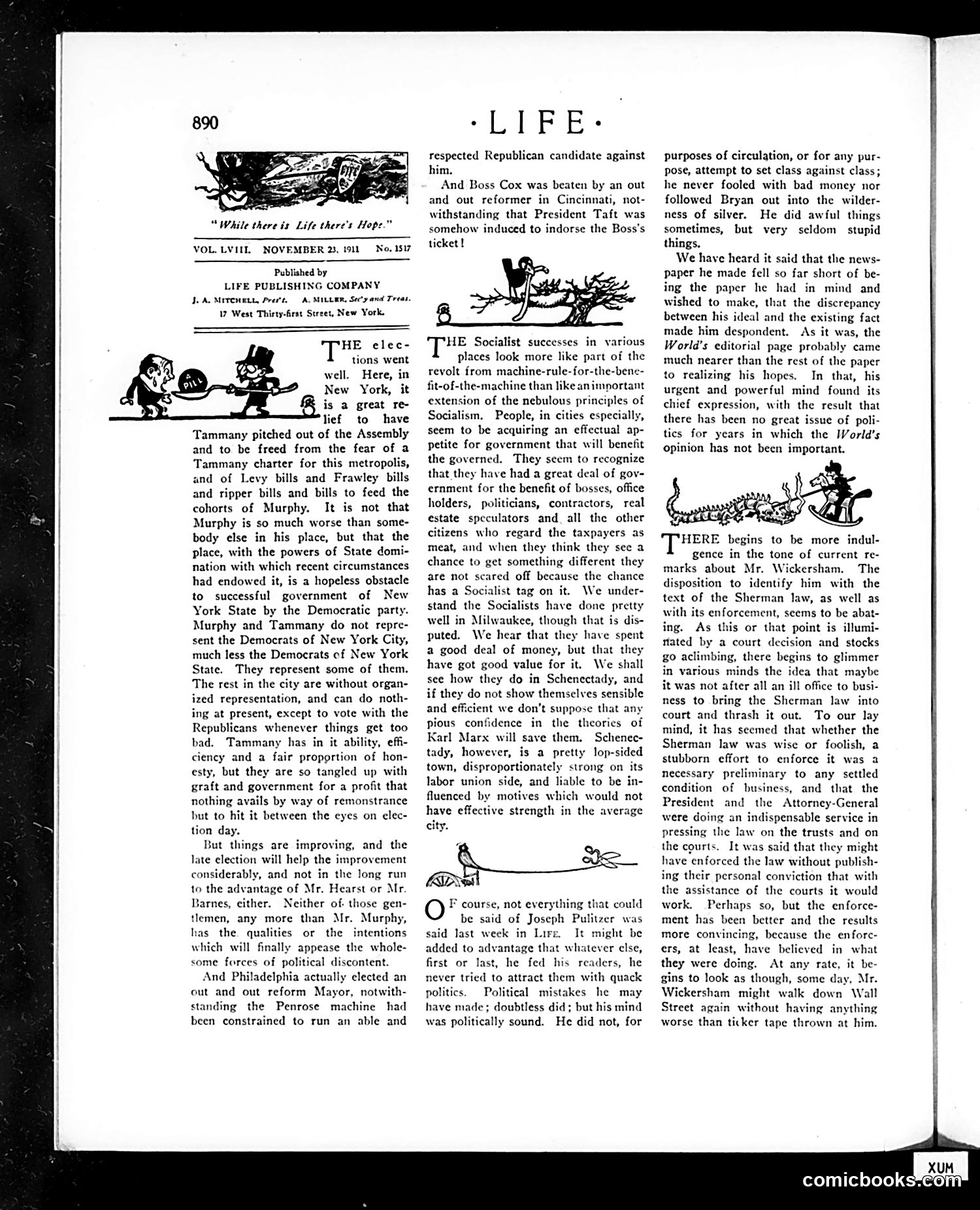
The top cartoon depicts what appears to be a political figure being forcibly removed or ejected—likely referencing "Tammany" (the corrupt Democratic machine controlling New York City politics). The caption mentions Tammany "pitched out of the Assembly" and references freeing the organization from "the fear of Tammany." The text criticizes New York's Democratic establishment, particularly Tammany Hall's influence. It praises recent Republican electoral successes as a rejection of machine politics and corrupt governance. The article distinguishes between honest Democrats and those tied to Tammany's corrupt patronage system of "bosses, office holders, politicians, contractors." The satire targets the persistence of urban political machines despite reform efforts, celebrating their temporary electoral defeat.
📄 Transcribed text from this page (OCR, searchable)
Machine-transcribed from the original scan — historical spelling and the odd misread are preserved.
“While there is Life there's Hope.” VOL. LVIIL NOVEMBER 23, 1911 No, 1517 Published by LIFE PUBLISHING COMPANY SLA. MITCHELL, Prete, A. MILLER, Sec'y and Treas, 17 West Thirty-first Street, New York, HE eclec- tions went well. Here, in New York, it is a great re- lief to have Tammany pitched out of the Assembly and to be freed from the fear of a Tammany charter for this metropolis, and of Levy bills and Frawley bills and ripper bills and bills to feed the cohorts of Murphy. It is not that Murphy is so much worse than some- body else in his place, but that the place, with the powers of State domi- nation with which recent circumstances had endowed it, is a hopeless obstacle to successful government of New York State by the Democratic party. Murphy and Tammany do not repre- sent the Democrats of New York City, much less the Democrats of New York State. They represent some of them. The rest in the city are without organ- ized representation, and can do noth- ing at present, except to vote with the Republicans whenever things get too bad. Tammany has in it ability, effi- ciency and a fair proportion of hon- esty, but they are so tangled up with graft and government for a profit that nothing avails by way of remonstrance but to hit it between the eyes on elec- tion day. But things are improving, and the late election will help the improvement considerably, and not in the long run to the advantage of Mr. Hearst or Mr. Barnes, either. Neither of- those gen- tlemen, any more than Mr. Murphy, has the qualities or the intentions which will finally appease the whole- some forces of political discontent. And Philadelphia actually elected an out and out reform Mayor, notwith- standing the Penrose machine had been constrained to run an able and -LIFE: respected Republican candidate against him. And Boss Cox was beaten by an out and out reformer in Cincinnati, not- withstanding that President Taft was somehow induced to indorse the Boss's ticket | HE Socialist successes in various places look more like part of the revolt from machine-rule-for-the-bene- fit-of-the-machine than like an important extension of the nebulous principles of Socialism. People, in cities especially, seem to be acquiring an effectual ap- petite for government that will benefit the governed. They seem to recognize that they have had a great deal of gov- ernment for the benefit of bosses, office holders, politicians, contractors, real estate speculators and all the other citizens who regard the taxpayers as meat, and when they think they see a chance to get something different they are not scared off because the chance has a Socialist tag on it. We under- stand the Socialists have done pretty well in Milwaukee, though that is di puted. We hear that they have spent a good deal of money, but that they have got good value for it. We shall see how they do in Schenectady, and if they do not show themselves sensible and efficient we don’t suppose that any pious confidence in the theories of Karl Marx will save them. Schenec- tady, however, is a pretty lop-sided town, disproportionately strong on its labor union side, and liable to be in- fluenced by motives which would not have effective strength in the average city. F course, not everything that could be said of Joseph Pulitzer was said last week in Lire, It might be added to advantage that whatever else, first or last, he fed his readers, he never tried to attract them with quack politics. Political mistakes he may have made; doubtless did; but his mind was politically sound. He did not, for purposes of circulation, or for any pur- pose, attempt to set class against class; he never fooled with bad money nor followed Bryan out into the wilder- ness of silver. He did awful things sometimes, but very seldom stupid things, We have heard it said that the news- paper he made fell so far short of be- ing the paper he had in mind and wished to make, that the discrepancy between his ideal and the existing fact made him despondent. As it was, the World’s editorial page probably came much nearer than the rest of the paper to realizing his hopes. In that, his urgent and powerful mind found its chief expression, with the result that there has been no great issue of poli- tics for years in which the World’s opinion has not been important. more indul- gence in the tone of current re- marks about Mr. Wickersham. The disposition to identify him w the text of the Sherman law, as well as with its enforcement, seems to be abat- ing. As this or that point is illumi- nated by a court decision and stocks go aclimbing, there begins to glimmer in various minds the idea that maybe it was not after all an ill office to busi- ness to bring the Sherman law into court and thrash it out. To our lay mind, it has seemed that whether the Sherman law was wise or foolish, a stubborn effort to enforce it was a necessary preliminary to any settled condition of business, and that the President and the Attorney-General were doing an indispensable service in pressing the law on the trusts and on the courts, It was said that they might have enforced the law without publish- ing their personal conviction that with the assistance of the courts it would work, Perhaps so, but the enforce- ment has been better and the results more convincing, because the enforc- ers, at least, have believed in what they were doing. At any rate, it be- gins to look as though, some day, Mr. Wickersham might walk down Wall Street again without having anything worse than ticker tape thrown at him. comicbook eon