
A complete issue · 40 pages · 1911
Life — August 17, 1911
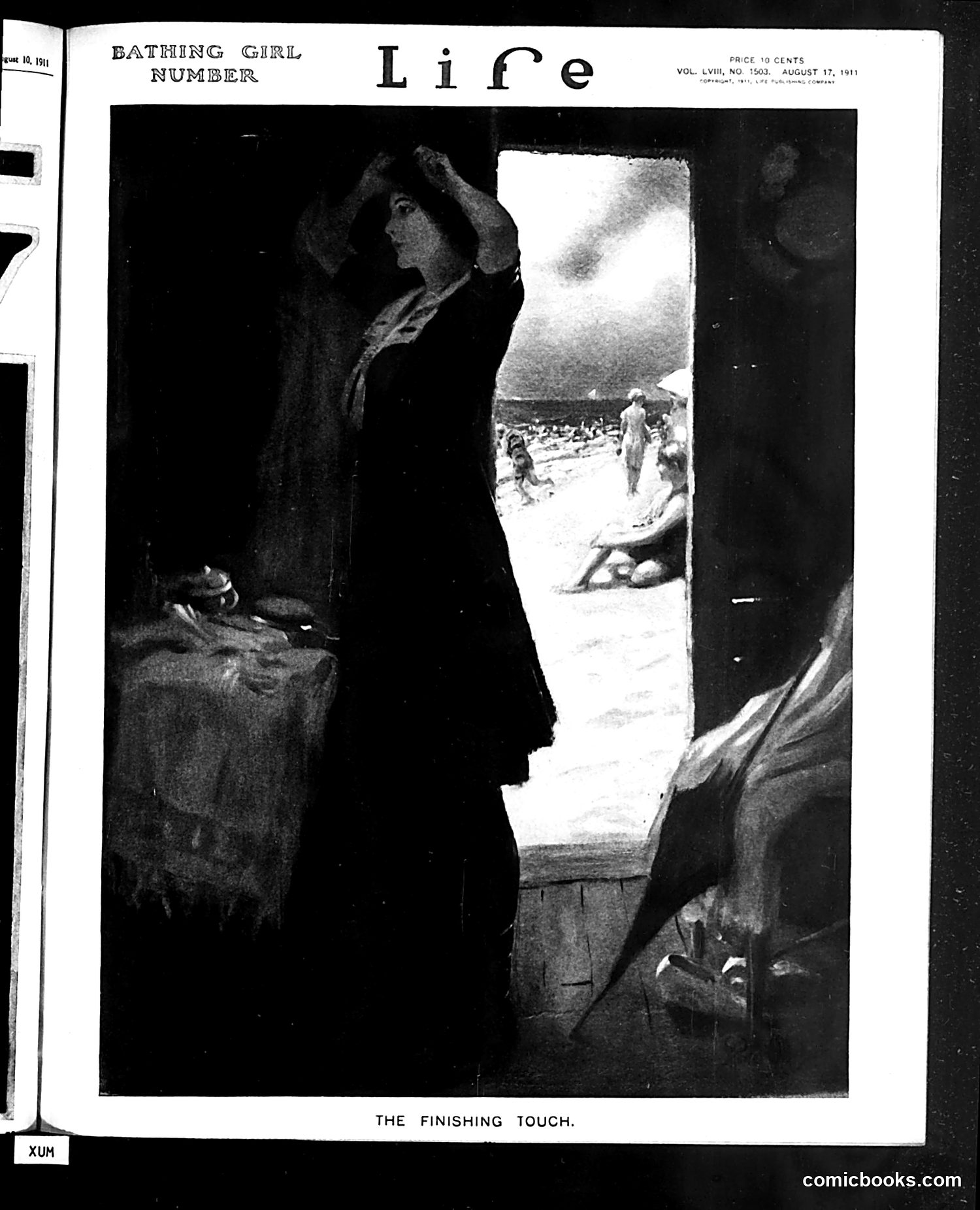
This image appears to be from a "Bathing Girl Number" issue, a popular themed edition of Life magazine. The photograph shows a woman in dark clothing adjusting her appearance (likely her hair or hat) while looking out at a beach scene filled with bathers. The caption "The Finishing Touch" suggests a commentary on women's vanity or grooming rituals, even in casual beach settings. The contrast between her formal dark attire and the informal beach scene beyond creates the humor—she's meticulously perfecting her appearance before venturing into public view. This reflects 1911 attitudes about feminine self-presentation and the elaborate grooming standards women were expected to maintain, even for casual leisure activities.
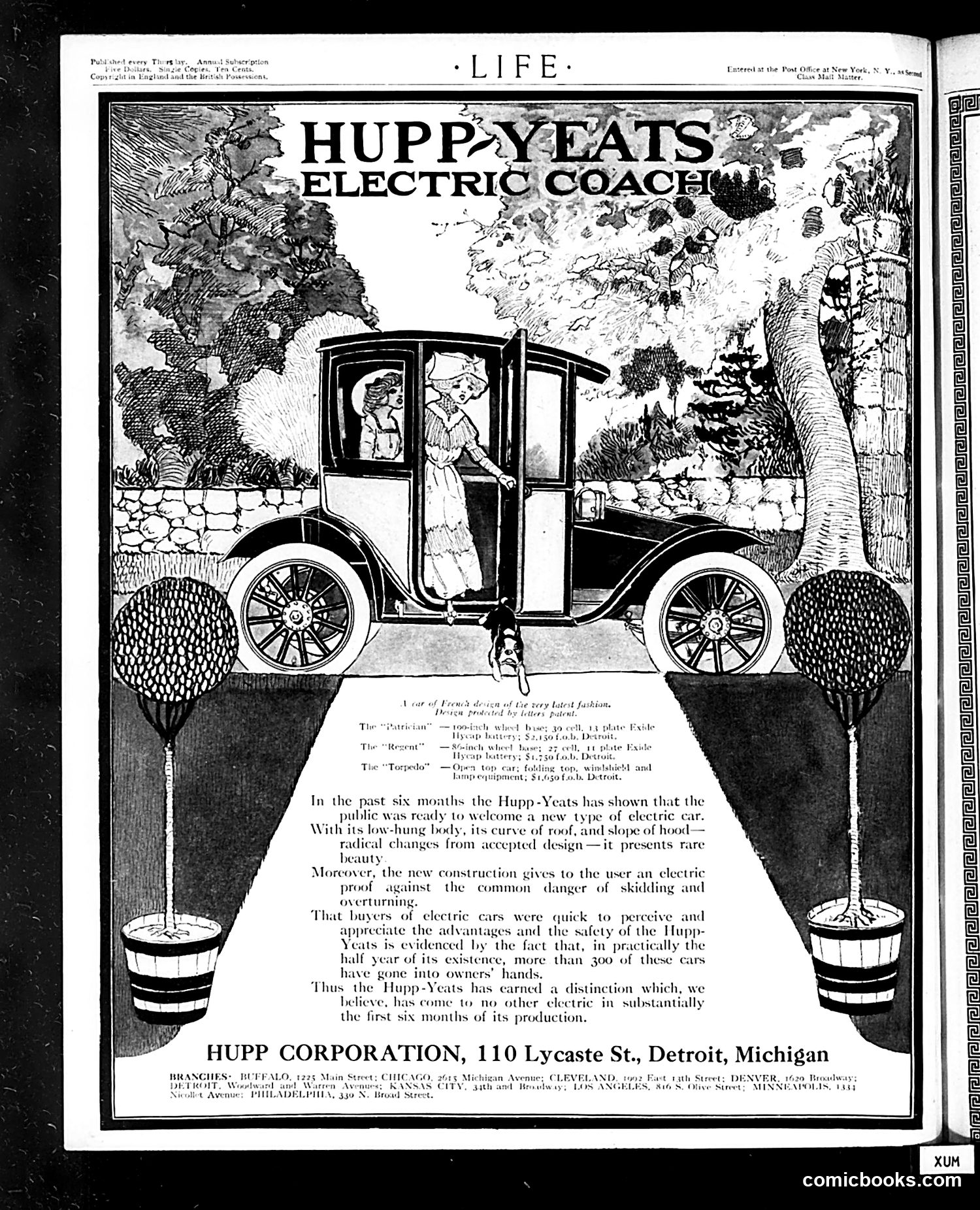
This page is **not a cartoon or satire—it's a straight advertisement** for the Hupp-Yeats Electric Coach, a early electric automobile. The illustration shows an elegantly dressed woman next to the vehicle in a pastoral setting, emphasizing the car's refined design and low-slung body. The accompanying text promotes the Hupp-Yeats as a reliable innovation: over 300 cars have been sold in six months, appealing to buyers concerned about safety (the electric design prevents skidding and overturning risks associated with gas-powered vehicles). The ad lists multiple body styles ("Paris-ian," "Brougham," "Torpedo") and includes branch office locations across America. This reflects the early 1900s electric-car market before gasoline engines dominated.
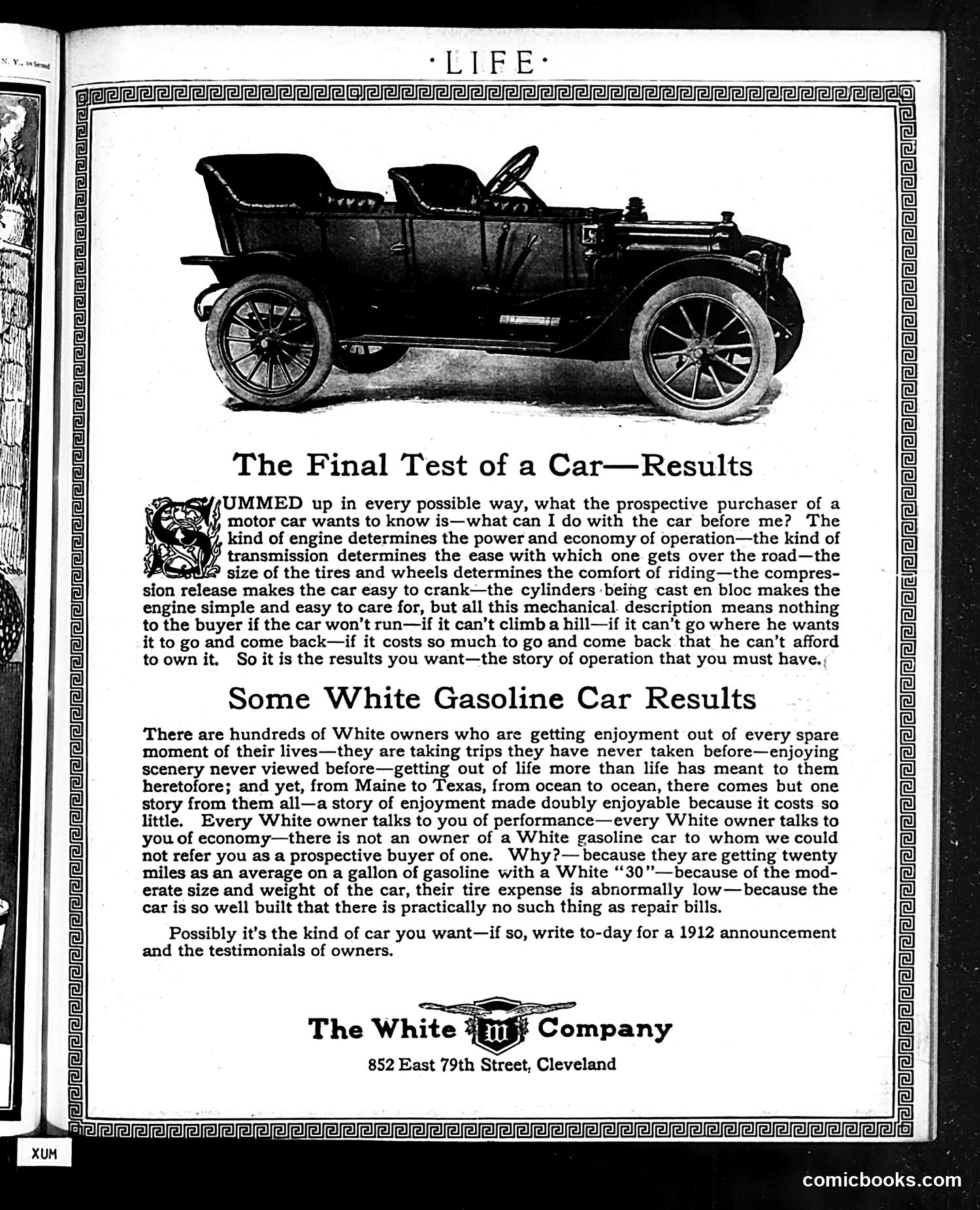
This is **not a cartoon or satire**, but rather a **straightforward advertisement** for the White automobile company, published in *Life* magazine around 1912. The page promotes the White gasoline car by emphasizing its reliability and economy. The text argues that the "final test" of any vehicle is real-world performance—whether it can climb hills, travel long distances affordably, and require minimal repairs. The advertisement appeals to prospective buyers by highlighting that White owners consistently report getting approximately twenty miles per gallon and experiencing almost no repair costs due to the car's solid construction. There is no political satire or caricature present. This is period advertising showcasing early automotive marketing strategies that emphasized durability and fuel efficiency to a consumer audience unfamiliar with motorcar reliability.
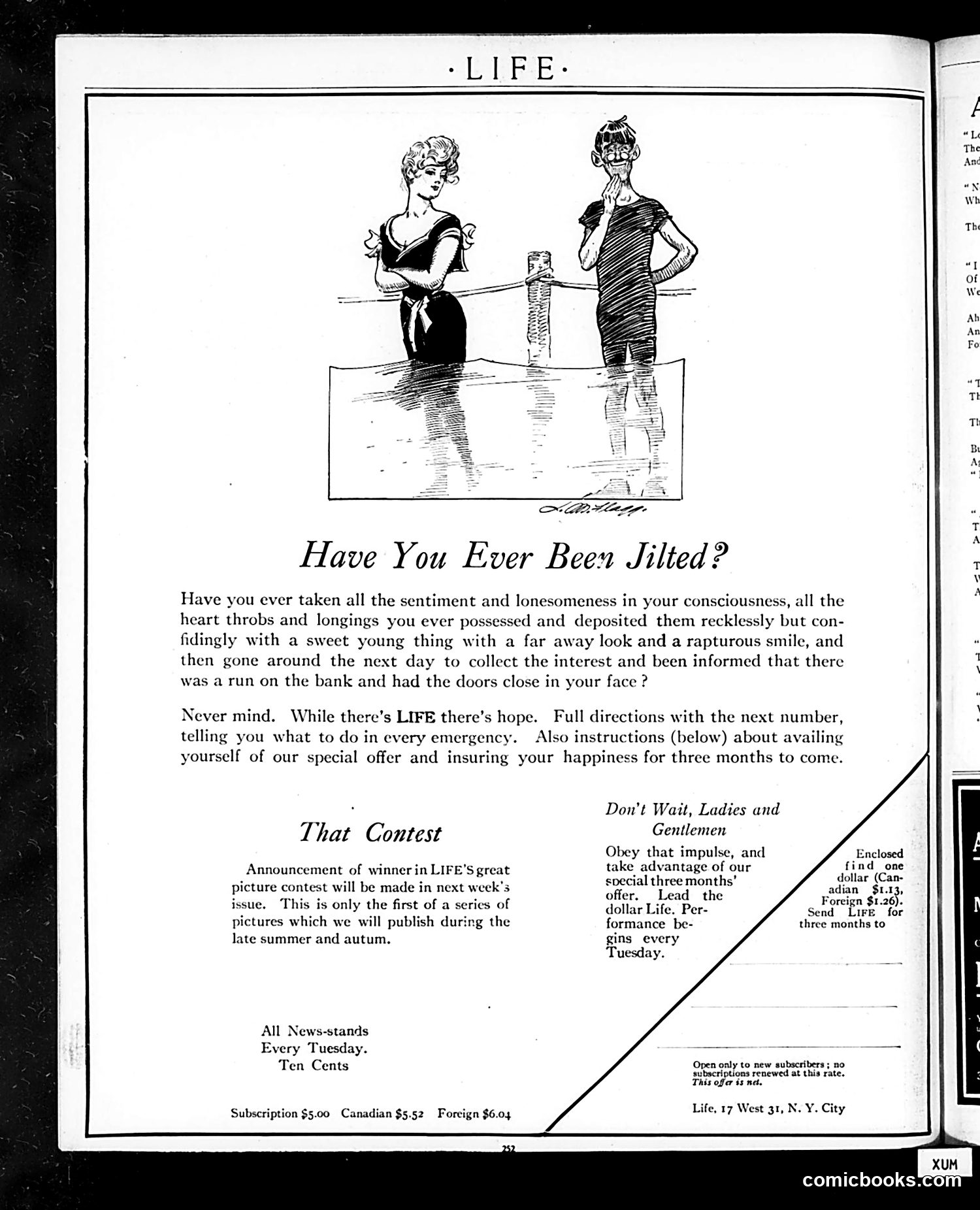
This page is primarily **advertising and promotional content** for *Life* magazine itself, not political satire. The cartoon depicts two women in a bathing scene, illustrating the headline "Have You Ever Been Jilted?" The text uses romantic melodrama—describing emotional vulnerability and abandonment—as a hook to promote *Life's* upcoming picture contest and subscription offer. The satire here is **self-referential**: *Life* mocks sentimental romantic narratives while simultaneously exploiting them to attract readers. The contrast between the sophisticated, knowing tone ("Never mind. While there's LIFE there's hope") and the overwrought romantic scenario creates gentle humor. The page promotes a three-month subscription trial and announces the magazine's summer/autumn picture contest series. This is fundamentally marketing dressed as entertainment—typical of early 20th-century magazine promotional strategies.
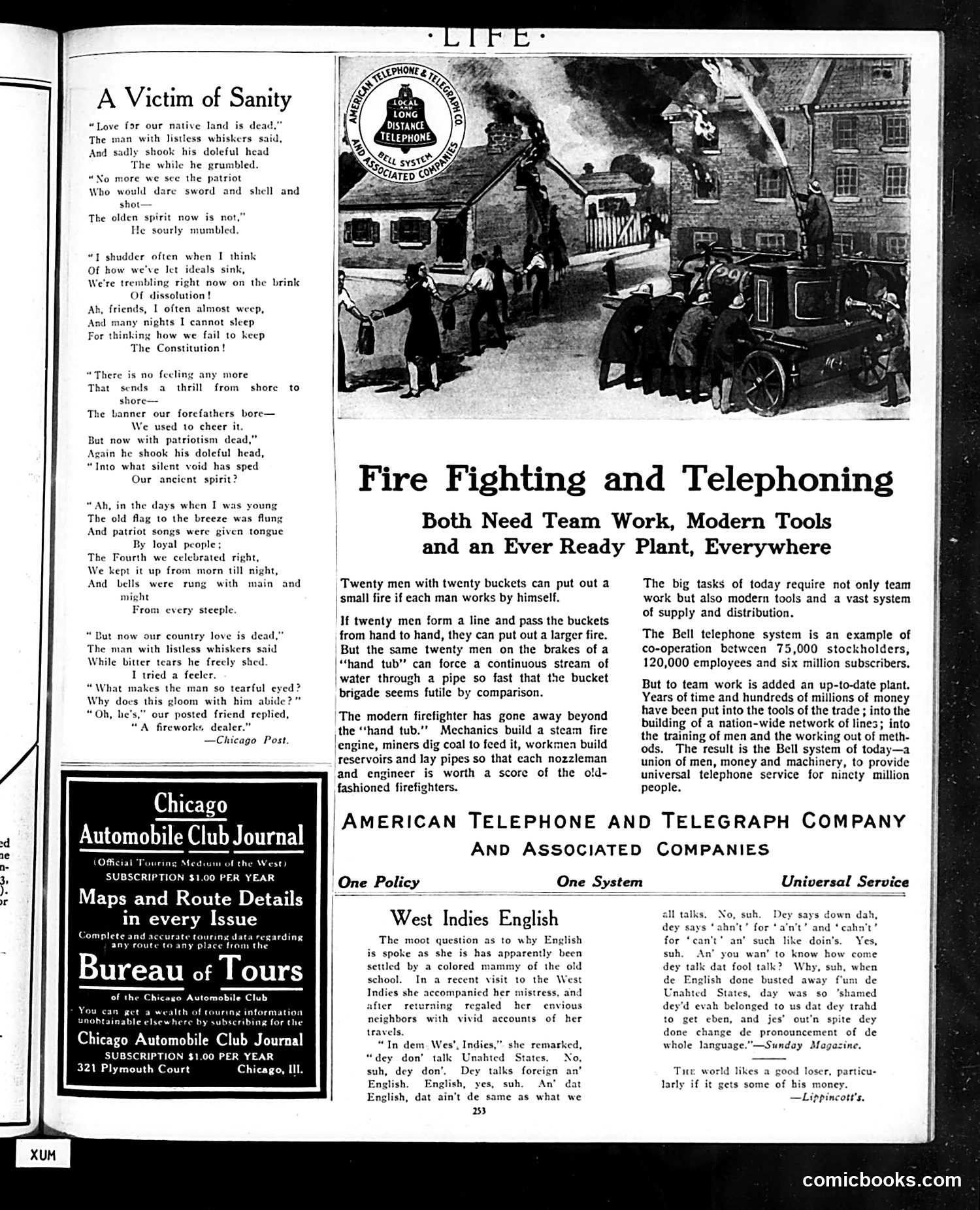
**Left Column - "A Victim of Sanity":** This poem satirizes an elderly patriot lamenting America's loss of idealism. The speaker mourns that the nation no longer values patriotism, constitutional principles, and the fervent patriotic spirit of earlier generations. He grieves that modern Americans have abandoned their "ancient spirit" and that "patriotism [is] dead." The poem presents him as emotionally devastated by this perceived cultural decline—a "victim" of rational, pragmatic modernity that has replaced passionate nationalism. **Right Side - Advertisement:** The page is dominated by an American Telephone and Telegraph Company advertisement celebrating modern infrastructure and teamwork, promoting their telephone system as essential to national progress and service. The juxtaposition suggests *Life*'s ironic commentary: while one figure mourns lost patriotism, modern corporations celebrate progress through technology and organization.
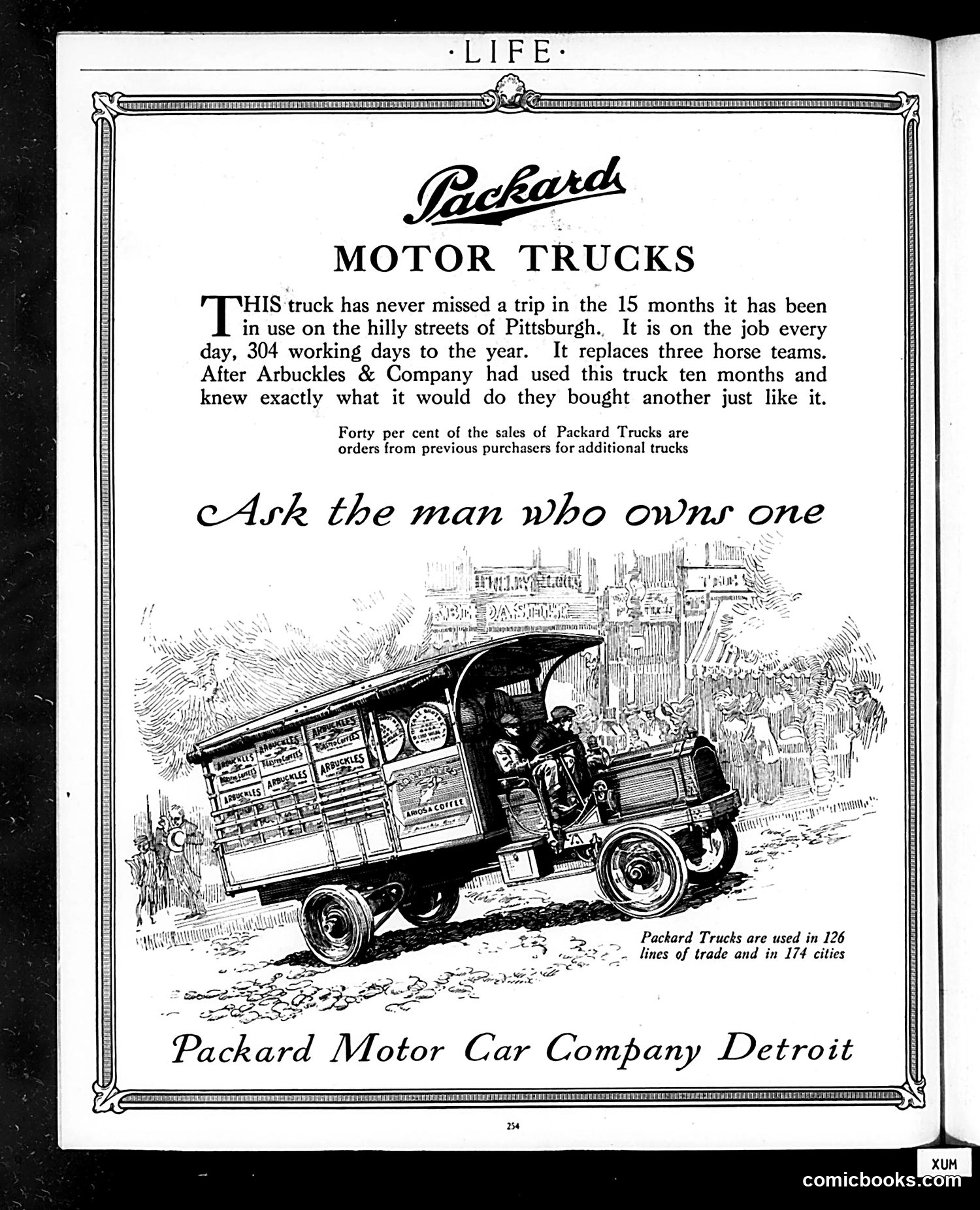
This is **not satire or a political cartoon**—it's a straightforward advertisement for Packard Motor Trucks, placed in *Life* magazine. The ad promotes the reliability of Packard trucks through a specific example: one truck used by Arbuckles & Company in Pittsburgh operated continuously for 15 months without missing a delivery route, replacing three horse teams and working 304 days annually. The illustration shows the truck laden with "Arbuckles" branded cargo boxes traveling uphill through a city. The key selling point: 40% of Packard truck sales come from repeat customers buying additional trucks, suggesting proven customer satisfaction. The ad emphasizes industrial utility and the transition from horse-drawn transport to motorized delivery—a significant business modernization of the early 20th century.
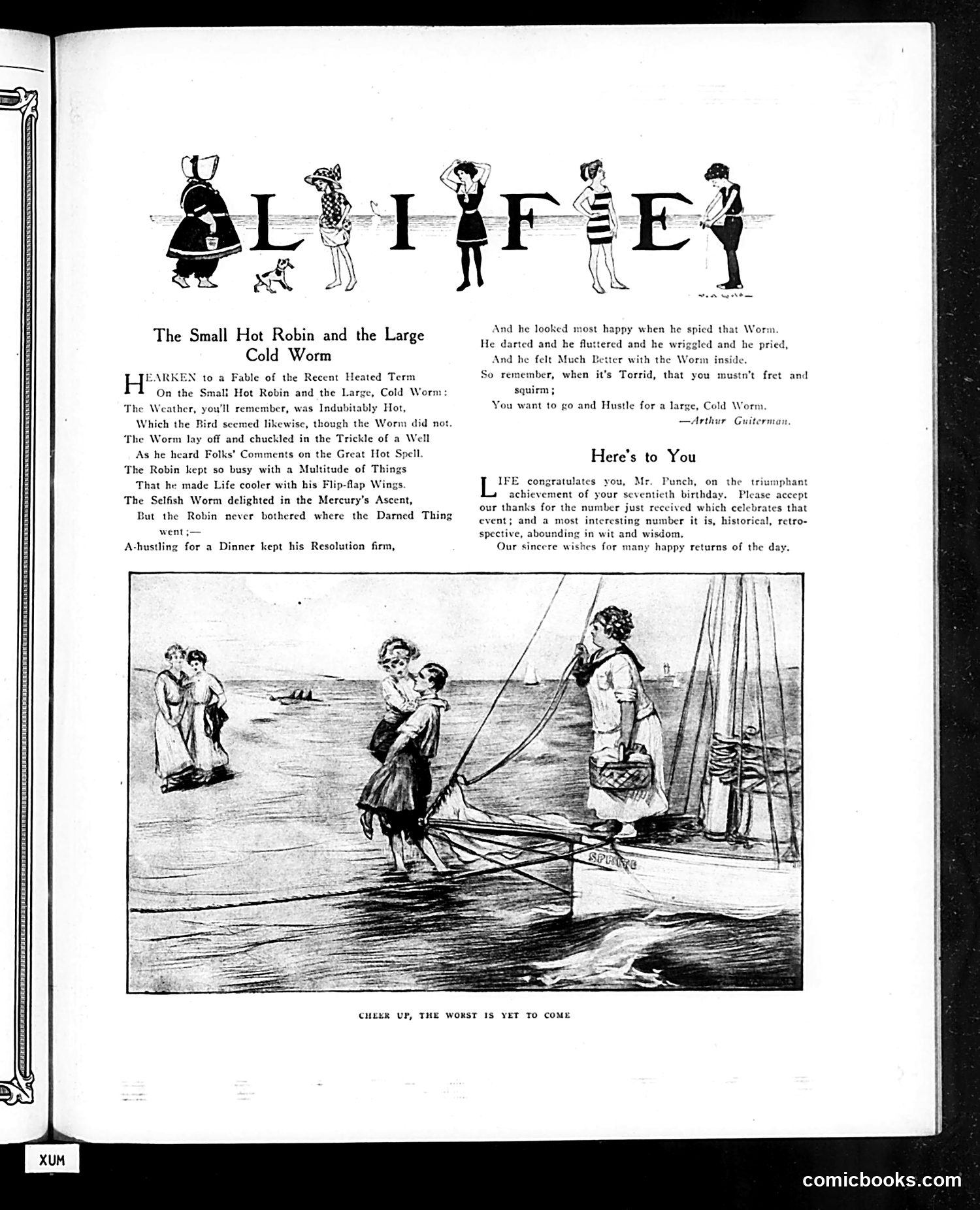
This page contains two distinct items: 1. **"The Small Hot Robin and the Large Cold Worm"** - A fable poem (attributed to Arthur Guiterman) about a bird and worm, using animal characters to teach a moral lesson about caution and persistence. The accompanying header illustration shows figures spelling "AL LIFE," likely indicating this is the magazine's "Life" section. 2. **"Here's to You"** - A birthday congratulations piece for Mr. Punch, celebrating his seventieth birthday. The accompanying illustration shows people at a seaside scene with sailing boats, captioned "CHEER UP, THE WORST IS YET TO COME" - a darkly humorous sentiment typical of the era's satirical humor. The page reflects *Life* magazine's blend of gentle moral fables and sardonic social commentary.
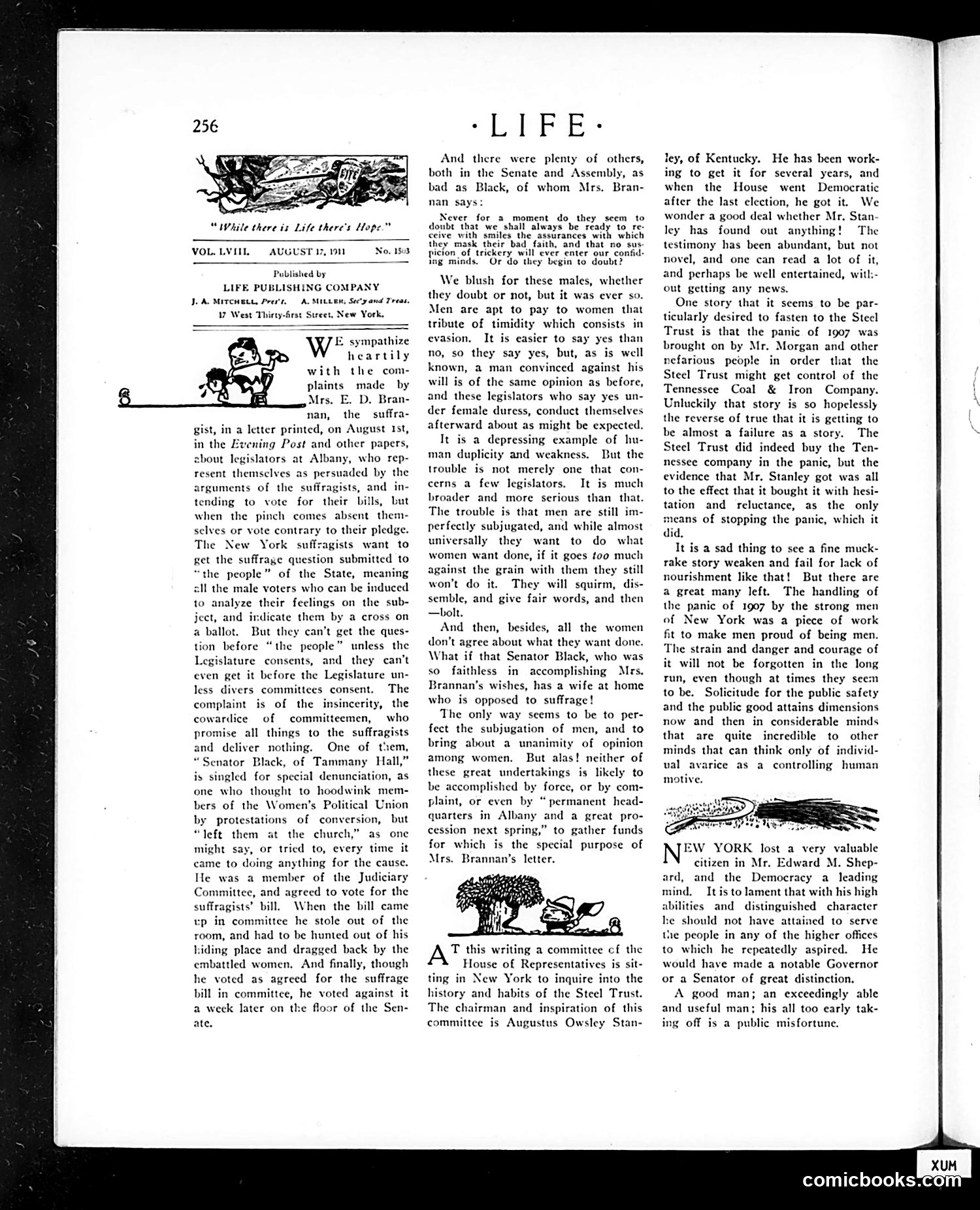
This *Life* magazine page critiques male legislators' hypocrisy regarding women's suffrage. The text attacks Senator Black of Tammany Hall and other New York politicians who claim to support women's rights but oppose the suffrage bill. The satire highlights the contradiction: these men want women's votes on individual issues but deny them actual voting power. The piece mocks their "permanent headquarters in Albany" scheming and their casual broken promises to suffragists. The editorial also mourns Edward M. Shepard, a prominent Democrat who died, noting he would have been a better advocate for women's equality than the self-serving politicians who merely exploit the issue for political advantage. The cartoons (visible but small) likely reinforce these themes of male political cowardice on suffrage.
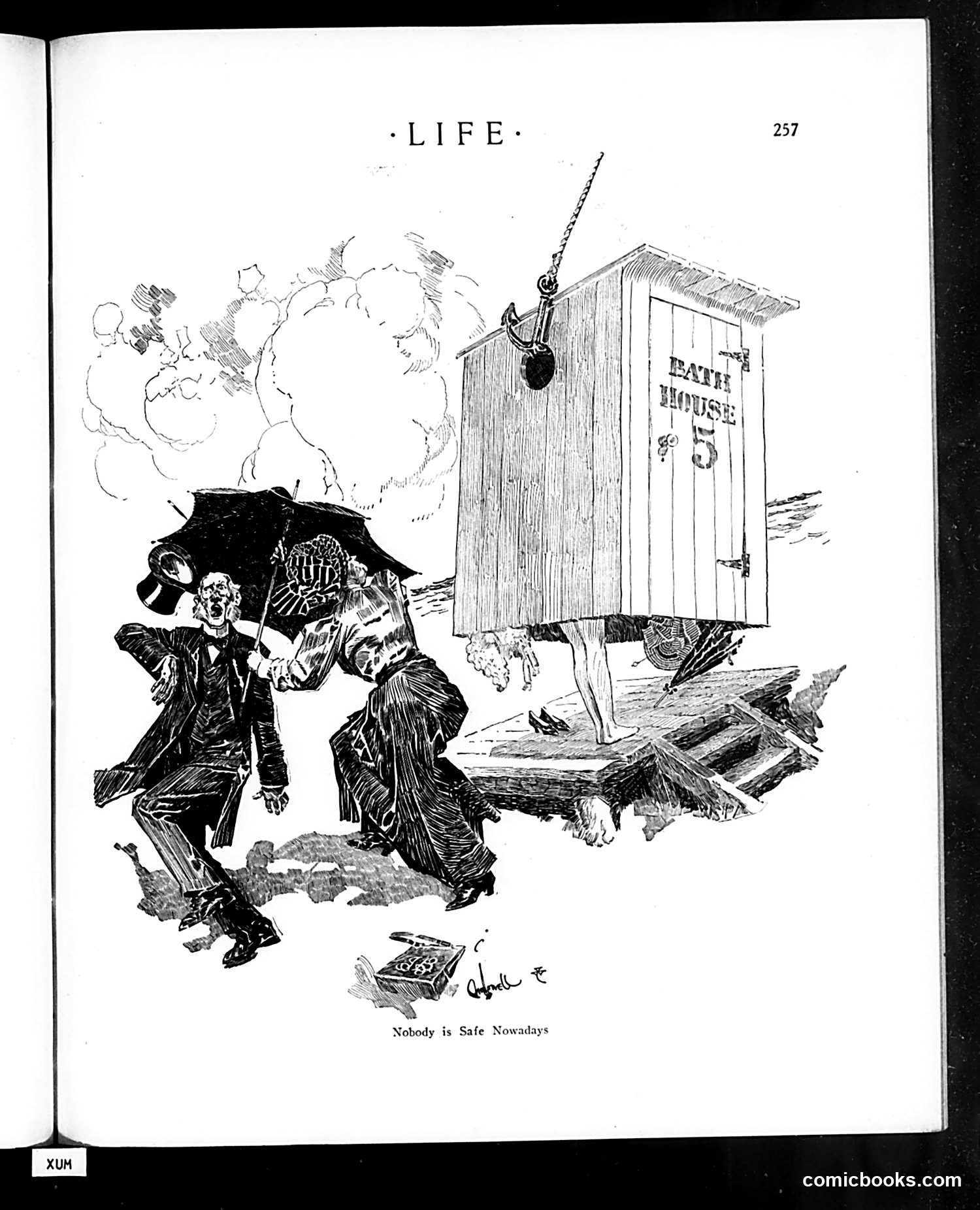
This cartoon satirizes the dangers of public sanitation facilities, specifically bath houses. Two well-dressed men in formal attire approach a rickety, ramshackle "Bath House No. 5" while storm clouds loom overhead. The structure appears dilapidated and unsafe, with a crescent moon cutout on the door—a reference to traditional outhouse design. The joke hinges on the title's ironic claim that "nobody is safe nowadays," suggesting that even basic public services like bathing facilities were unsanitary or dangerous. This likely critiques poor urban infrastructure, public health conditions, or poorly maintained municipal services during the early 20th century. The cartoon mocks both the inadequate facilities and the foolhardiness of anyone attempting to use them.
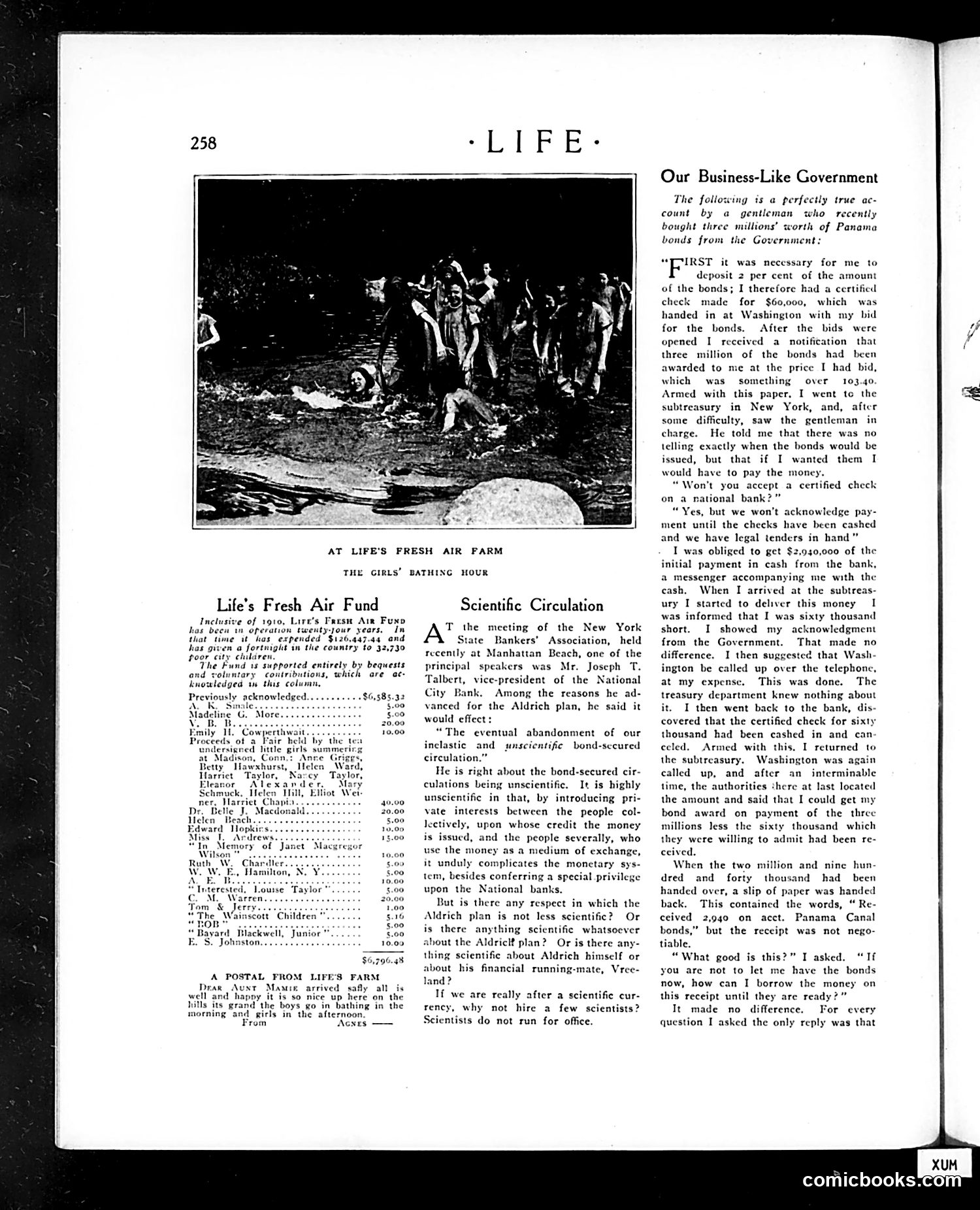
The page contains three distinct sections: 1. **Top image**: A dramatic nighttime scene at "Life's Fresh Air Farm" showing girls bathing. This appears to be documenting a charitable program providing recreational facilities for underprivileged children. 2. **Left column**: "Life's Fresh Air Fund" lists donors and contributions—a fundraising appeal for the charitable initiative shown above. 3. **Right column**: "Our Business-Like Government" and "Scientific Circulation"—satirical articles critiquing bureaucratic inefficiency. The first mocks government red tape when processing Panama bond payments; the second satirizes the National City Bank's adoption of "scientific" principles while actually operating through privilege and unscientific practices. The satire targets how institutions misuse scientific language to justify questionable financial practices.
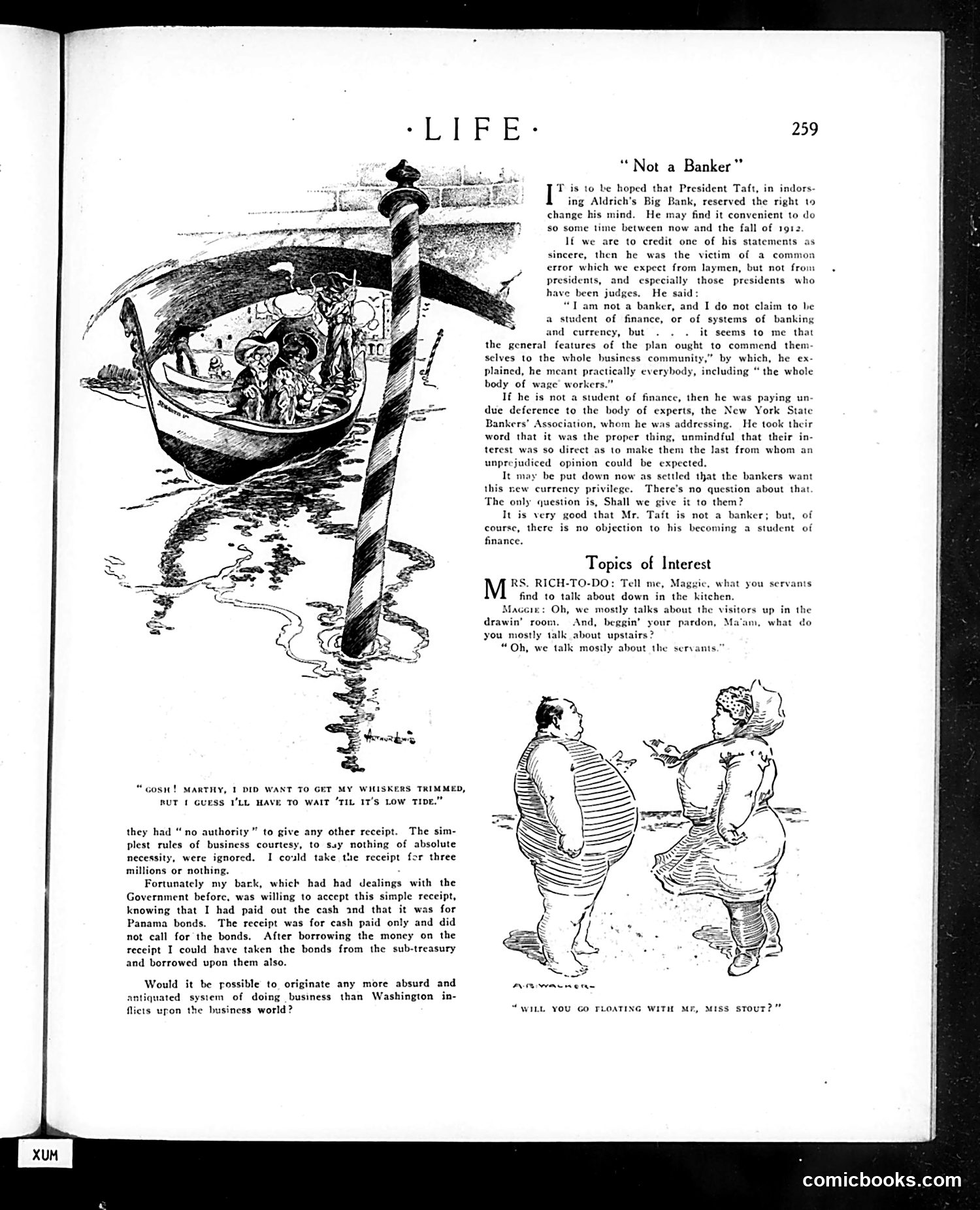
This page satirizes President William Howard Taft's attempt to become a "student of finance" rather than admit banker background. The text defends Taft against criticism that he's too close to banking interests, arguing he's merely *studying* finance, not practicing it—a distinction the satire presents as absurdly thin. The top cartoon depicts a boat or vessel in distress, likely representing the troubled financial system or Taft's sinking political position regarding banking policy. Below, the "Topics of Interest" section humorously contrasts servant-class gossip with upper-class concerns, satirizing class divisions and what different social strata discussed. The humor relies on readers recognizing Taft's defensive posturing about his financial expertise and connections during this Progressive Era period of banking reform debates.
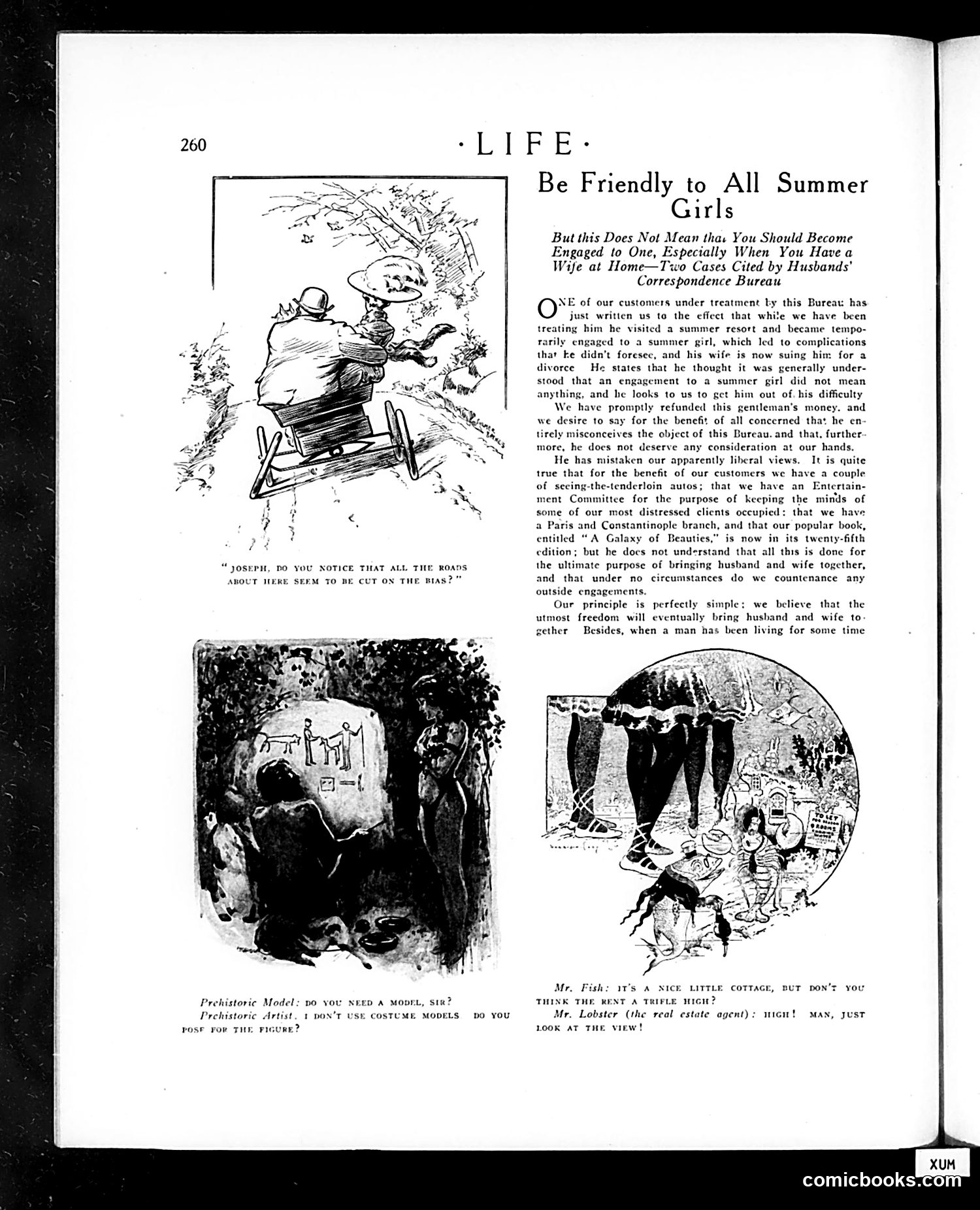
This page satirizes a husband's complaint to Life's advice bureau. A man claims he was engaged to a summer girl, had an affair, and now faces divorce—but insists engagement to summer girls shouldn't "mean anything." The magazine's response is blunt: they reject his premise entirely. They defend summer romances as legitimate, argue husbands and wives should eventually reunite, and criticize his apparent belief that casual summer flirtations excuse infidelity. The cartoons mock various absurdities: a man asking if "roads seem cut on the bias" (nonsensical), a "prehistoric artist" refusing costume models, and a real estate agent hyping a cottage's view over practicality. The satire targets male entitlement and the era's double standards around infidelity and romantic commitment.
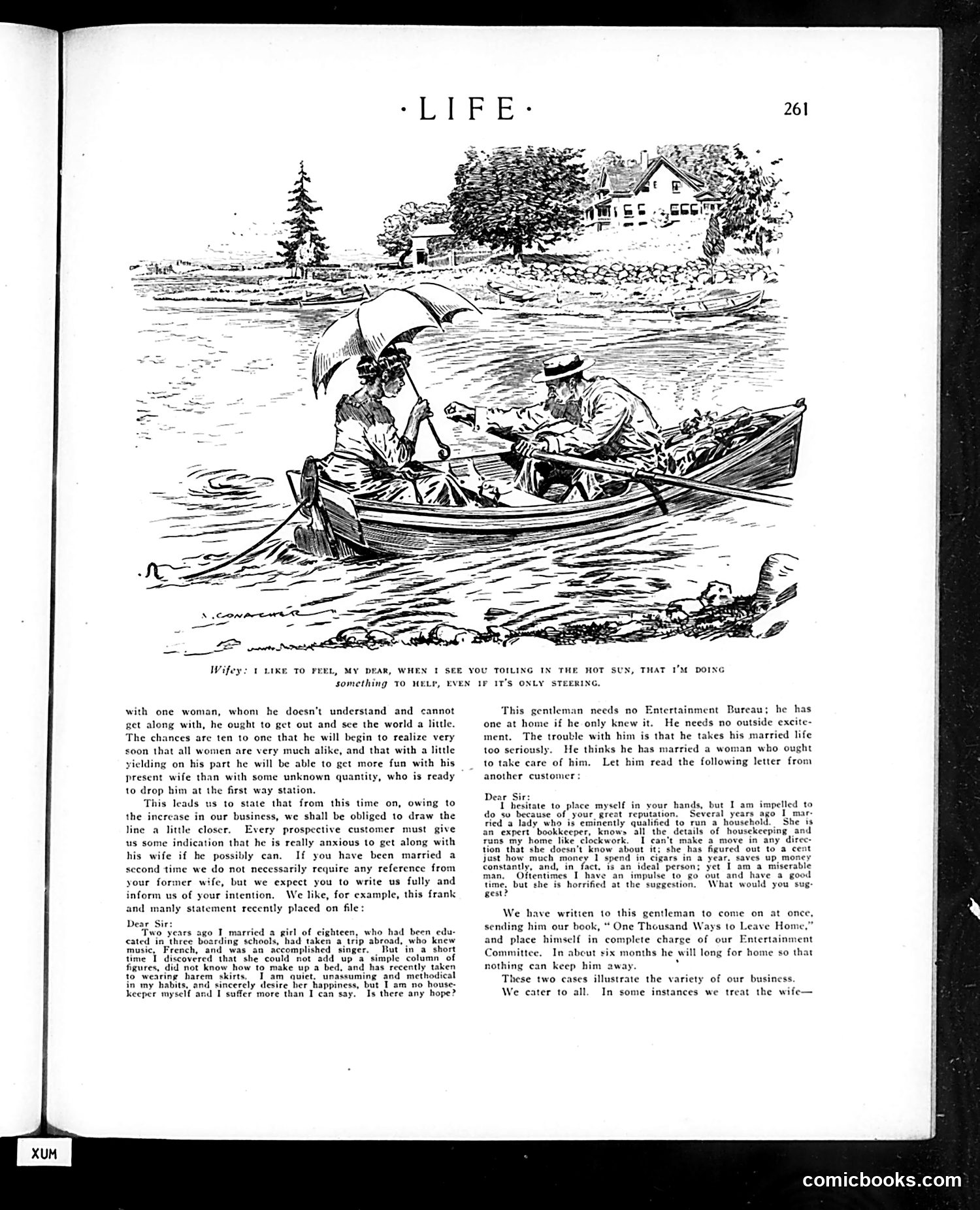
**The Main Illustration**: A couple in a rowboat on a river—the woman holds a parasol while the man rows. The caption reads: "Wife: I like to feel, my dear, when I see you toiling in the hot sun, that I'm doing something to help, even if it's only steering." **The Satire**: This is domestic humor poking fun at the division of labor in marriage. The wife claims to be "helping" by merely holding the boat's direction while the husband does all the physical labor (rowing in the hot sun). It's a gentle jab at wives who claim participation in household tasks while doing minimal actual work—a common marital complaint of the era. **Context**: The accompanying text discusses marriage difficulties and Entertainment Bureau services, suggesting this represents typical relationship dynamics of early 20th-century middle-class America.
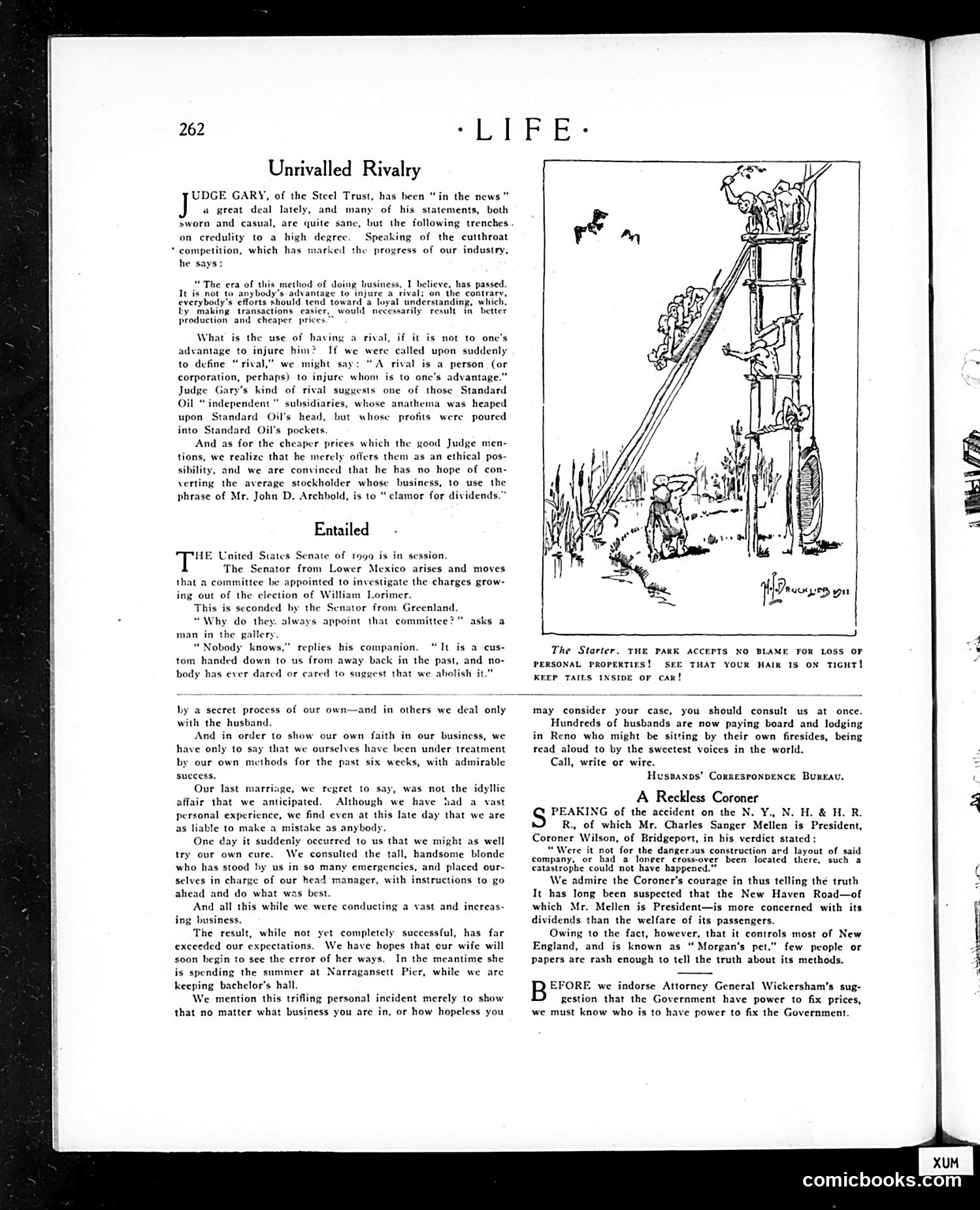
This cartoon satirizes workplace safety violations in early industrial America. The illustration shows workers on a precarious ladder or scaffold structure with minimal safety precautions—one figure appears to be falling or in danger. The caption reads: "THE PARK ACCEPTS NO BLAME FOR LOSS OF PERSONAL PROPERTIES! SEE THAT YOUR HAIR IS ON TIGHT! KEEP TAILS INSIDE OF CAR!" The joke mocks corporate negligence by presenting absurdly inadequate "safety warnings" that blame workers rather than the company for injuries. The phrase about keeping "tails inside of car" suggests this may reference an amusement park, where such reckless conditions endangered patrons. The satire critiques how businesses disclaimed responsibility for preventable accidents during the industrial era.
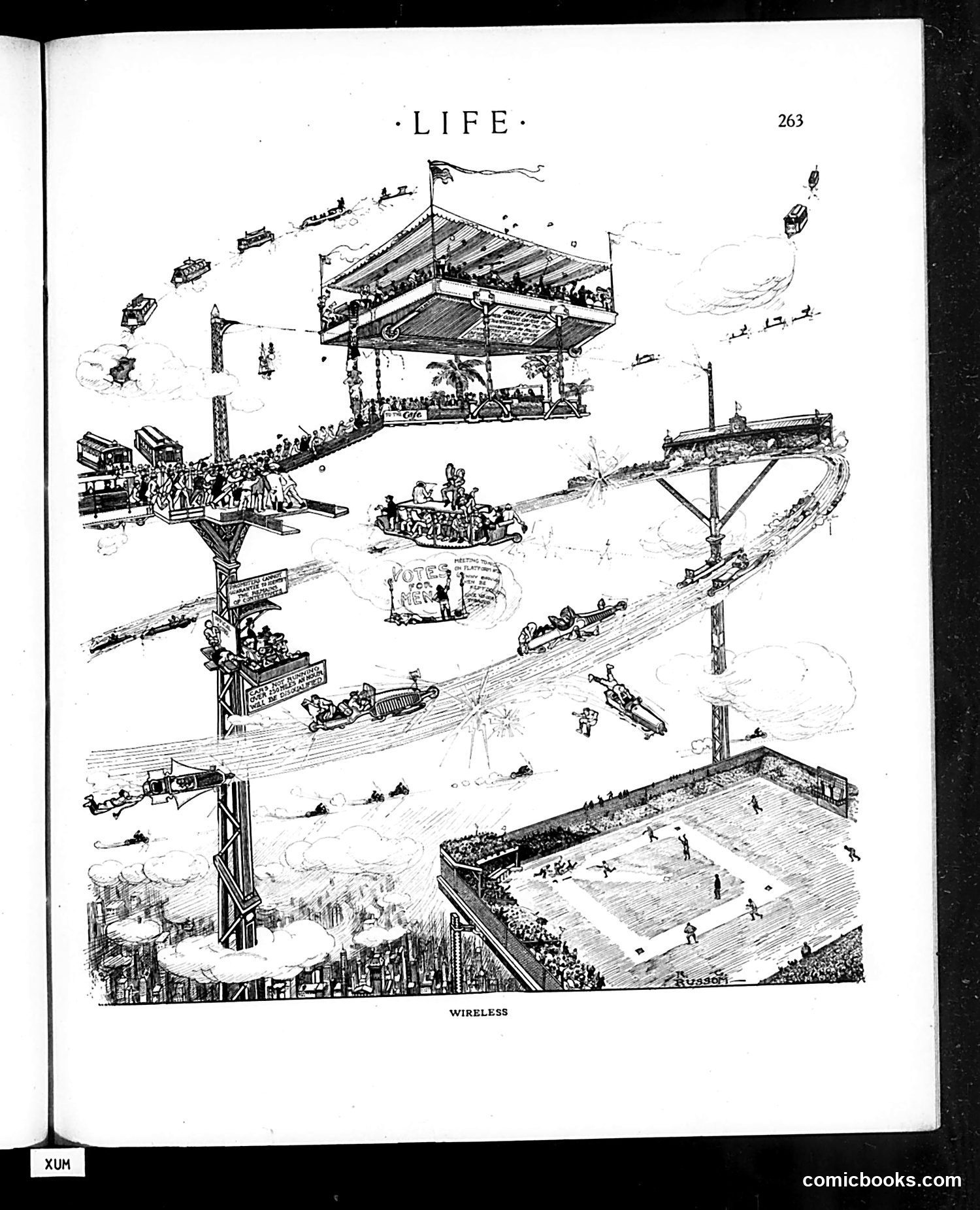
This is an illustration titled "Wireless" from *Life* magazine (page 263). The drawing depicts an amusement park or fairground scene with various recreational facilities arranged vertically: a carousel or bandstand at top, roller coasters, train rides, a swimming pool, and what appears to be spectator areas. The word "Wireless" at the bottom suggests the cartoon's subject. The satire likely comments on wireless technology's growing presence in public spaces around the early 1900s—perhaps criticizing how wireless communication was becoming ubiquitous even in leisure areas meant for escape and entertainment. Alternatively, it may mock how people were becoming distracted by wireless signals even while trying to enjoy themselves at amusement parks. Without clearer caption text visible, the exact satirical point remains somewhat unclear, though the juxtaposition of "wireless" with recreation suggests tension between technology and traditional leisure.
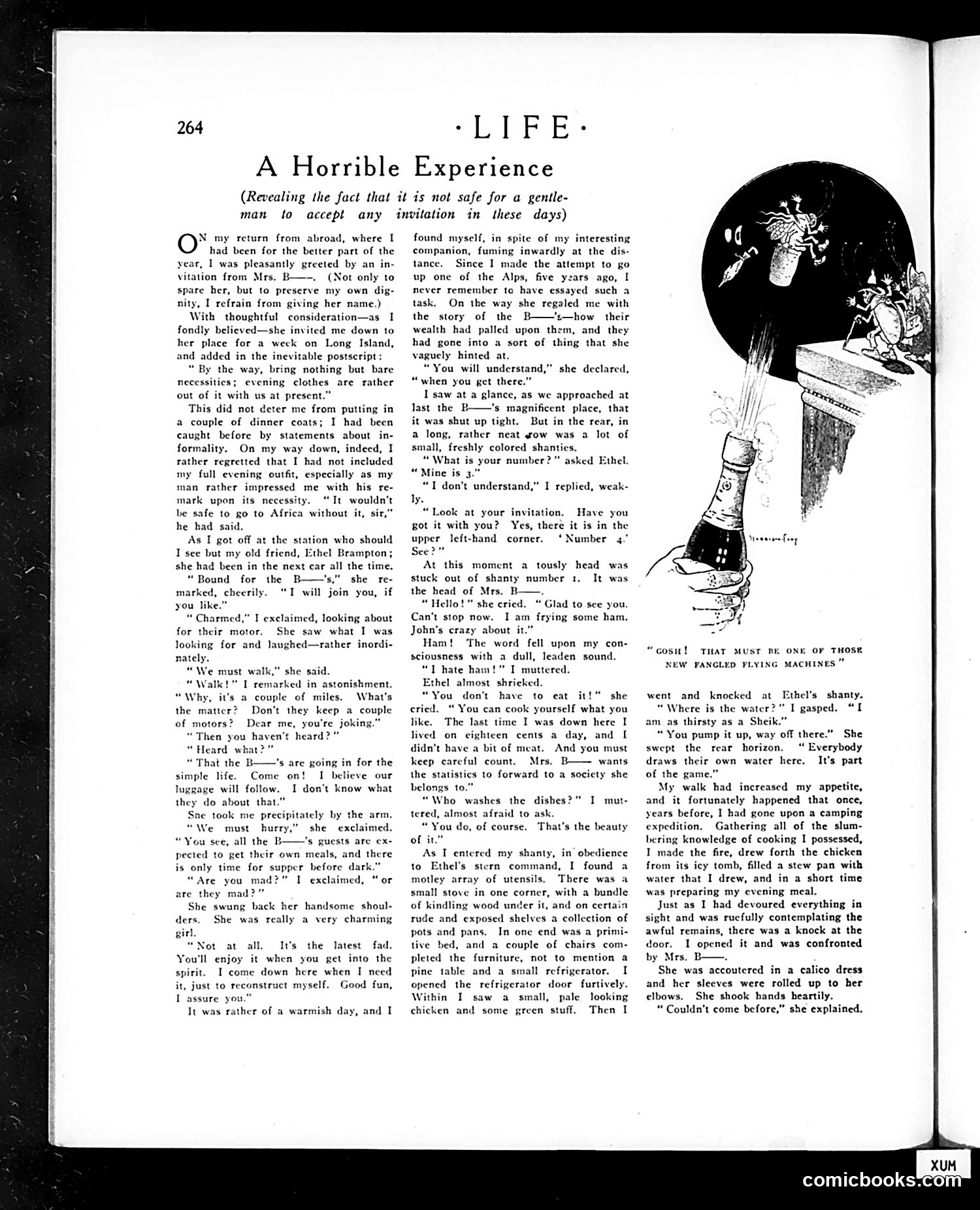
This story satirizes the "simple life" fad popular among wealthy Americans in the early 20th century. The joke: a sophisticated gentleman accepts a Long Island invitation from Mrs. B—, expecting luxury. Instead, he discovers she and her wealthy family have abandoned their mansion and converted to living in small shanties, each guest assigned a numbered shack. The satire targets the contradiction of the ultra-rich performing poverty as a fashionable trend. Mrs. B— serves ham from a shanty while maintaining statistics for a society organization—suggesting this "simple living" is performative rather than genuine sacrifice. The protagonist's mounting horror (forced to walk miles, cook his own meals, eat meager food) contrasts with Ethel's cheerful insistence it's "fun" and "reconstructive." The cartoon illustration (right) appears to show the narrator's distressed reaction to this ridiculous situation. The satire mocks wealthy people playing at hardship as entertainment.
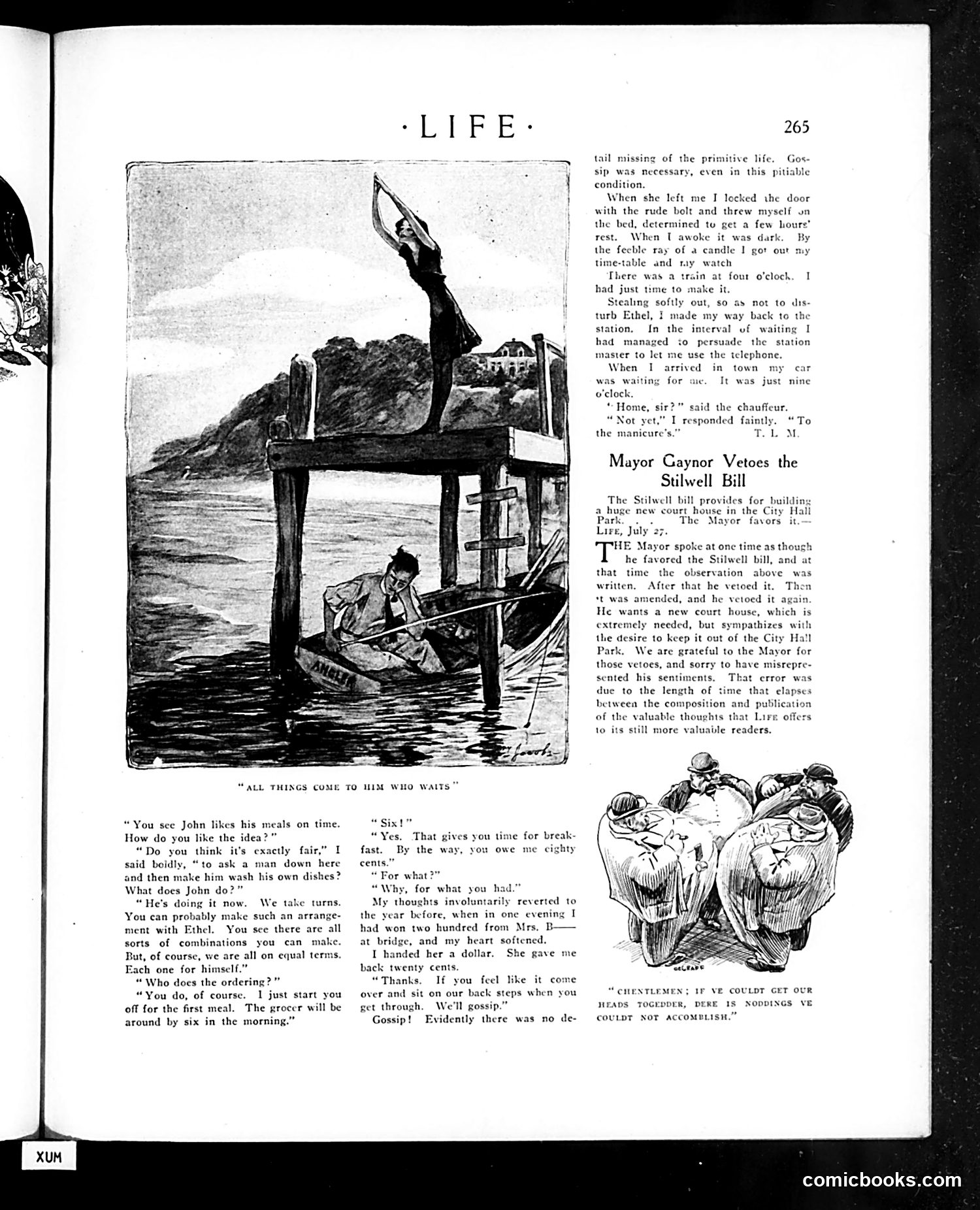
The main illustration, captioned "All Things Come to Him Who Waits," depicts a satirical domestic scene. A woman on a diving board poses elegantly while a man below washes dishes in water—a visual joke about gender role reversal and domestic labor negotiation. The accompanying text describes an arrangement where household chores are shared by turns, suggesting early 20th-century skepticism about such progressive domestic ideas. The dialogue mocks the impracticality of "equal terms" housekeeping: the woman charges the man for meals (demanding eighty cents, later haggling over a dollar tip), undermining the egalitarian premise. The narrator's irritation—he leaves hastily at 4 a.m.—suggests the satire targets both unrealistic domestic experiments and women's penny-pinching pragmatism. Below, a brief note corrects an earlier editorial error regarding Mayor Gaynor's position on the Stilwell Bill (a proposed courthouse), acknowledging publication delays.
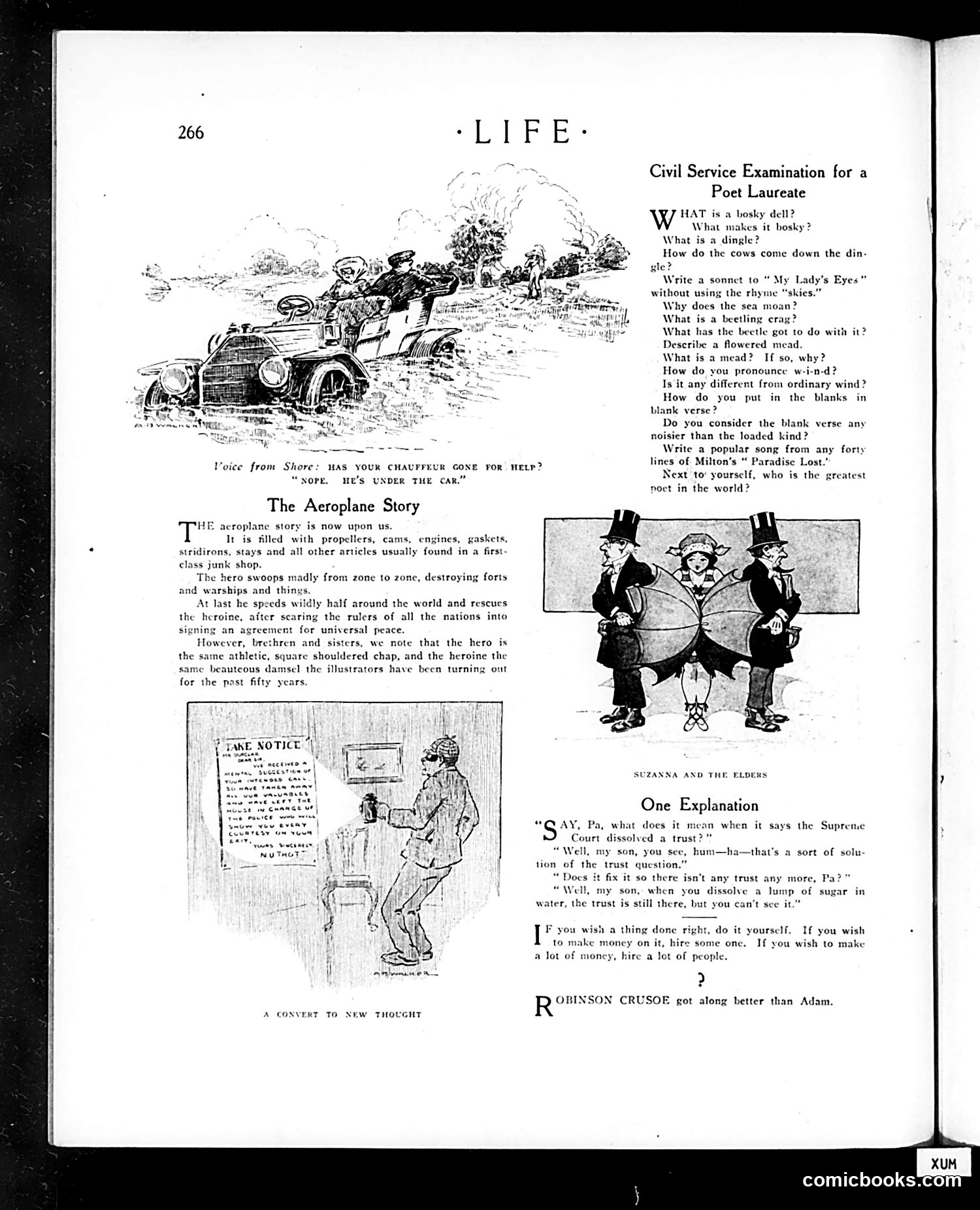
This page contains three distinct satirical pieces: **"Civil Service Examination for a Poet Laureate"** mocks romantic poetry conventions by listing absurd exam questions about archaic poetic terms ("bosky dell," "beetling crag," "flowered mead"). The satire ridicules flowery Victorian poetry language as pretentious and nonsensical. **"The Aeroplane Story"** critiques the then-popular aviation adventure narratives flooding popular culture. It satirizes how these stories—despite featuring cutting-edge technology—recycle tired romantic tropes: the same square-jawed hero, beautiful heroine, and predictable "saves the world" plot unchanged for fifty years. The point: new technology, old storytelling. **"One Explanation"** uses a father-son dialogue to mock legal/political obfuscation. When asked about the Supreme Court "dissolving" a trust, the father explains it like dissolving sugar in water—the sugar remains, just invisible. The satire targets how authorities use technical language to obscure that nothing substantive changes.
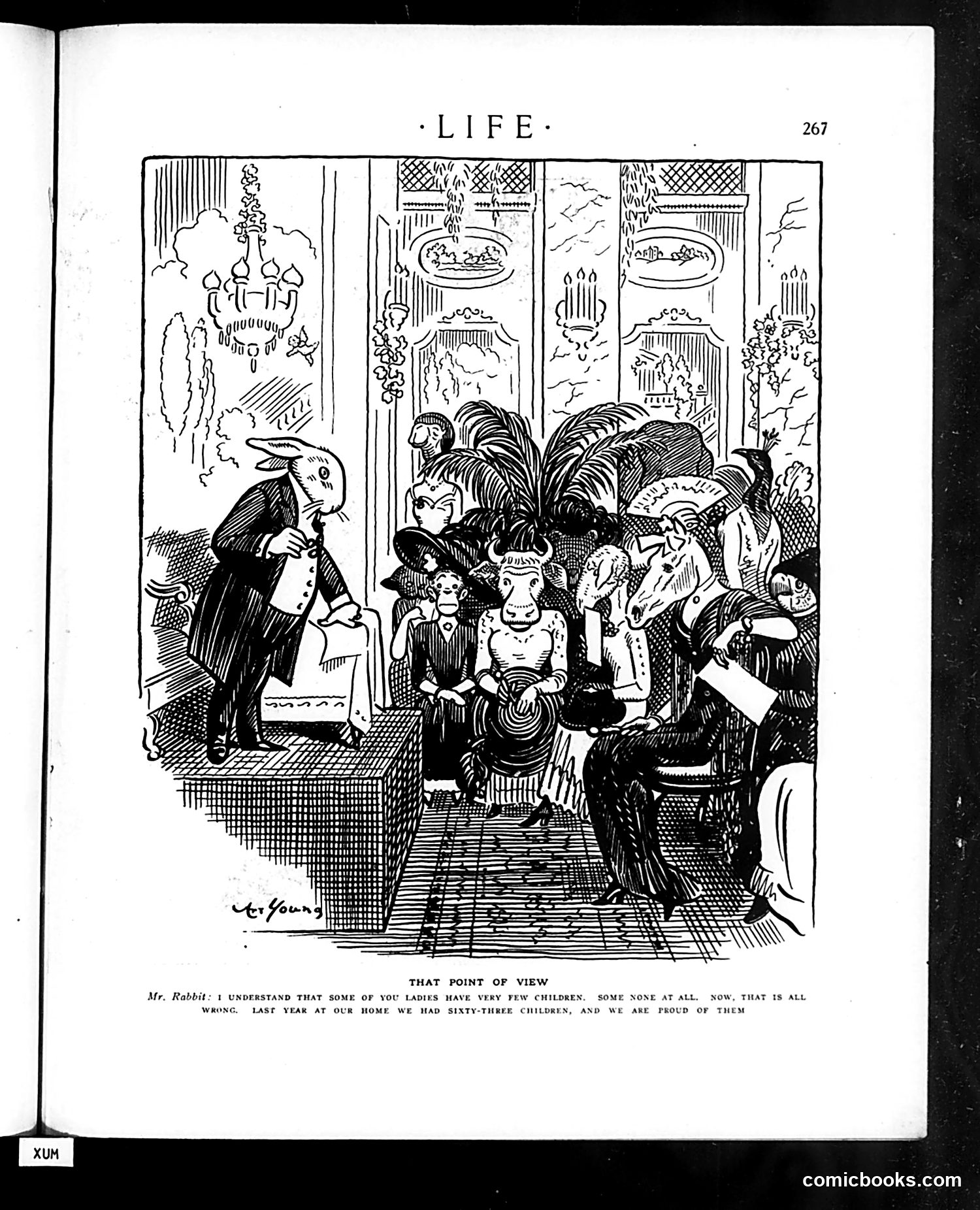
This cartoon satirizes **eugenics and population anxieties** of the early 20th century. A rabbit character addresses society ladies, criticizing those with few or no children as morally wrong. He boasts that his household produced sixty-three offspring, expressing pride in large families. The satire works through **animal substitution**: the rabbit's prolific breeding mocks human arguments about "racial fitness" and population quantity that were common in that era's social discourse. By replacing humans with rabbits, the cartoonist ridicules the serious tone of these debates, suggesting such concerns about reproduction rates were absurd. The ornate interior and well-dressed audience indicate this targets upper-class women specifically—implying critique of both their limited childbearing and the pseudo-scientific rhetoric used to shame them into larger families.
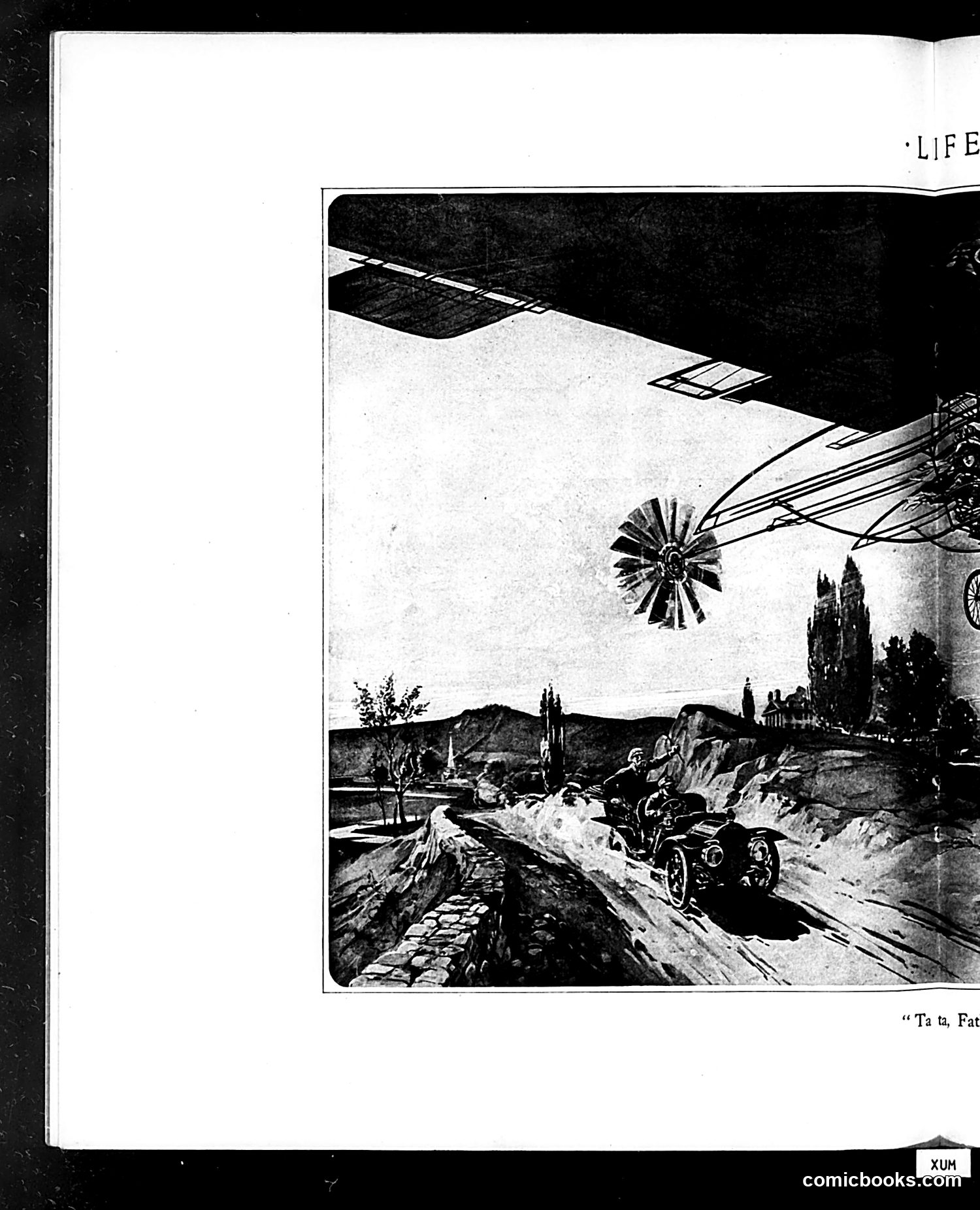
This page from *Life* magazine contains a futuristic illustration depicting an aerial and ground scene with early aviation technology. The image shows what appears to be an early airplane or airship at top, a windmill in the center, and an automobile on a road below, set against a landscape with cypress trees and buildings suggesting a Mediterranean or European setting. The partial caption "Ta ta, Fat" (likely continues beyond the visible text) appears to be making a humorous remark, though the complete joke is unclear without the full caption. The image likely satirizes early 20th-century fascination with modern transportation technology and aviation, possibly commenting on contemporary optimism about technological progress or the comical juxtaposition of old and new technologies in society.
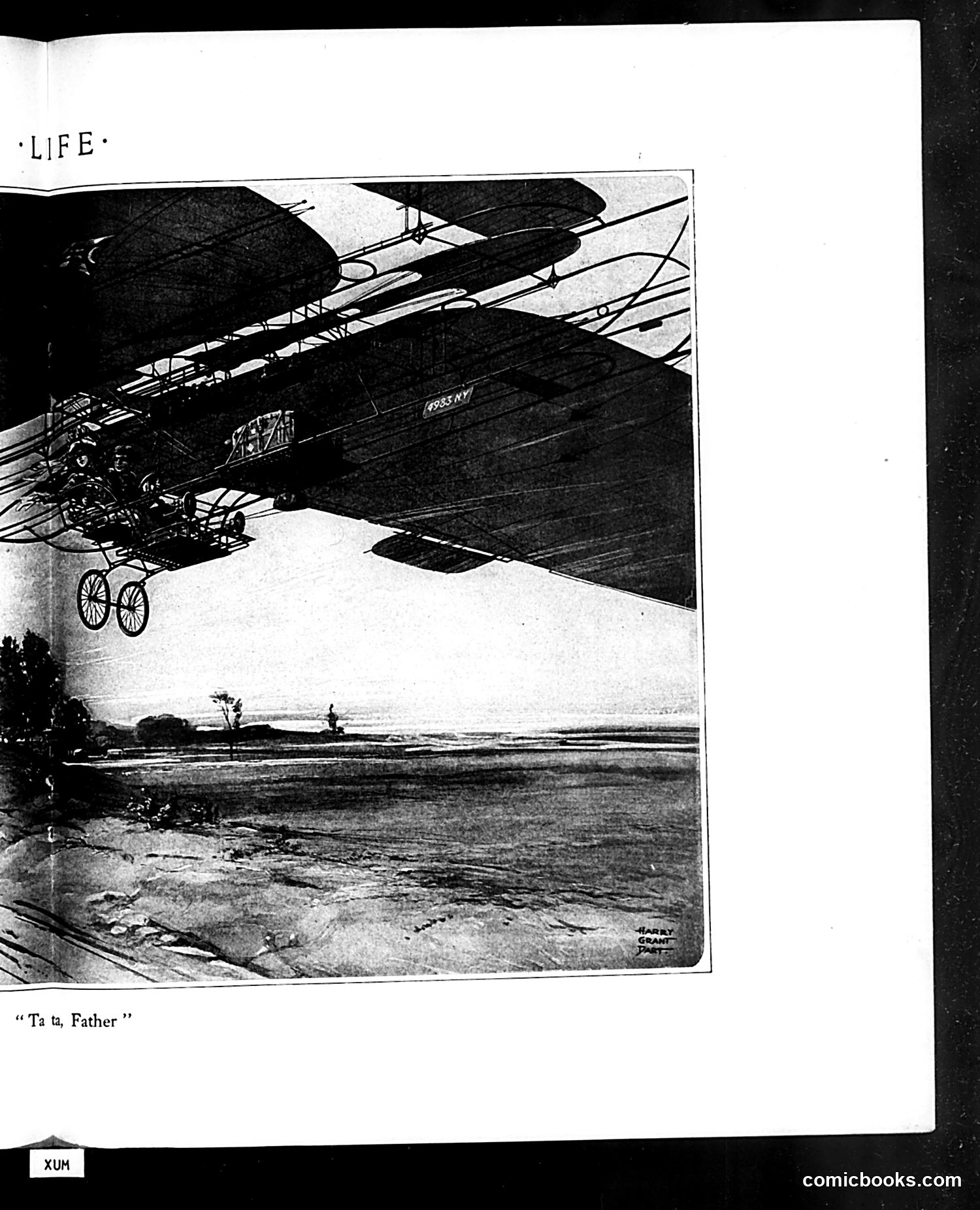
This illustration shows an early airplane in flight, viewed from below as it passes over a coastal landscape. The caption "Ta ta, Father" suggests a farewell scene—likely depicting a son or young person departing by aircraft. The image appears to be satirizing early aviation in the early 20th century, when airplane travel was novel, dangerous, and a sign of modern adventure or recklessness. The casual, cheerful "Ta ta" contrasts with the implicit danger of the primitive aircraft with its exposed framework and bicycle-like wheels, creating gentle satirical humor about the risks of pioneering flight. The artwork is credited to what appears to be "Harry Grant" (visible signature).
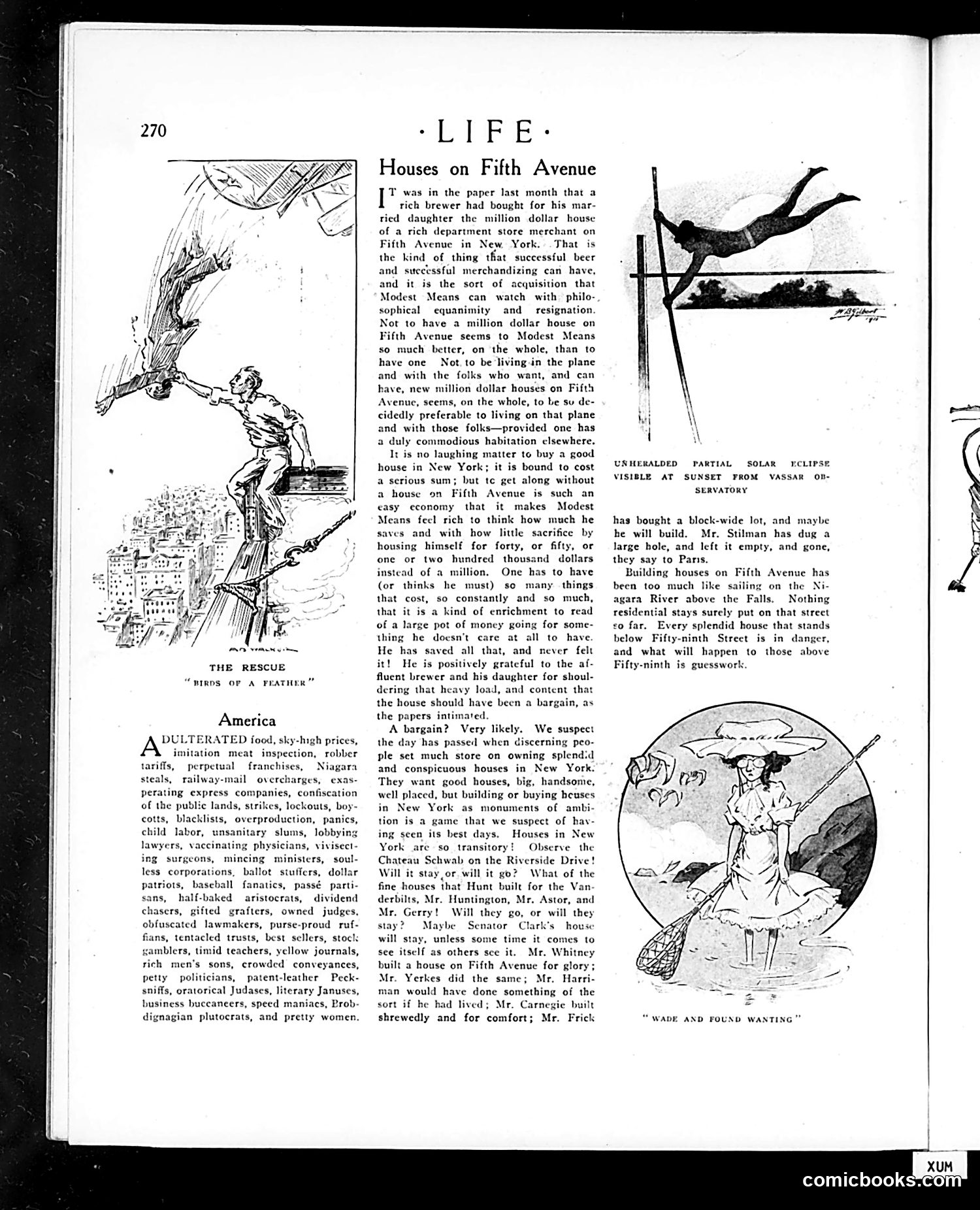
This page combines two satirical pieces about American wealth and excess circa early 1900s. **"Birds of a Feather"** (left cartoon): Shows a figure rescuing another from entanglement with a large bird. The title suggests moral equivalence between corrupt figures—"birds of a feather flock together." **"America" section** (bottom): A scathing list of social ills including monopolies, labor exploitation, corrupt judges, yellow journalism, and "pretty women"—mocking both genuine problems and frivolous upper-class concerns equally. **"Houses on Fifth Avenue"** (main text): Satirizes wealthy New Yorkers' obsession with ostentatious Fifth Avenue mansions. The writer argues that *not* owning a million-dollar house is actually wise—these properties are transitory status symbols. References specific tycoons (Vanderbilts, Astor, Gerry, Carnegie, Frick) building lavish homes as monuments to ambition rather than practical dwellings. The satire suggests old-money confidence has replaced nouveau-riche display as the marker of true sophistication. The humor relies on inverting conventional values: restraint becomes wealth; abstinence becomes luxury.
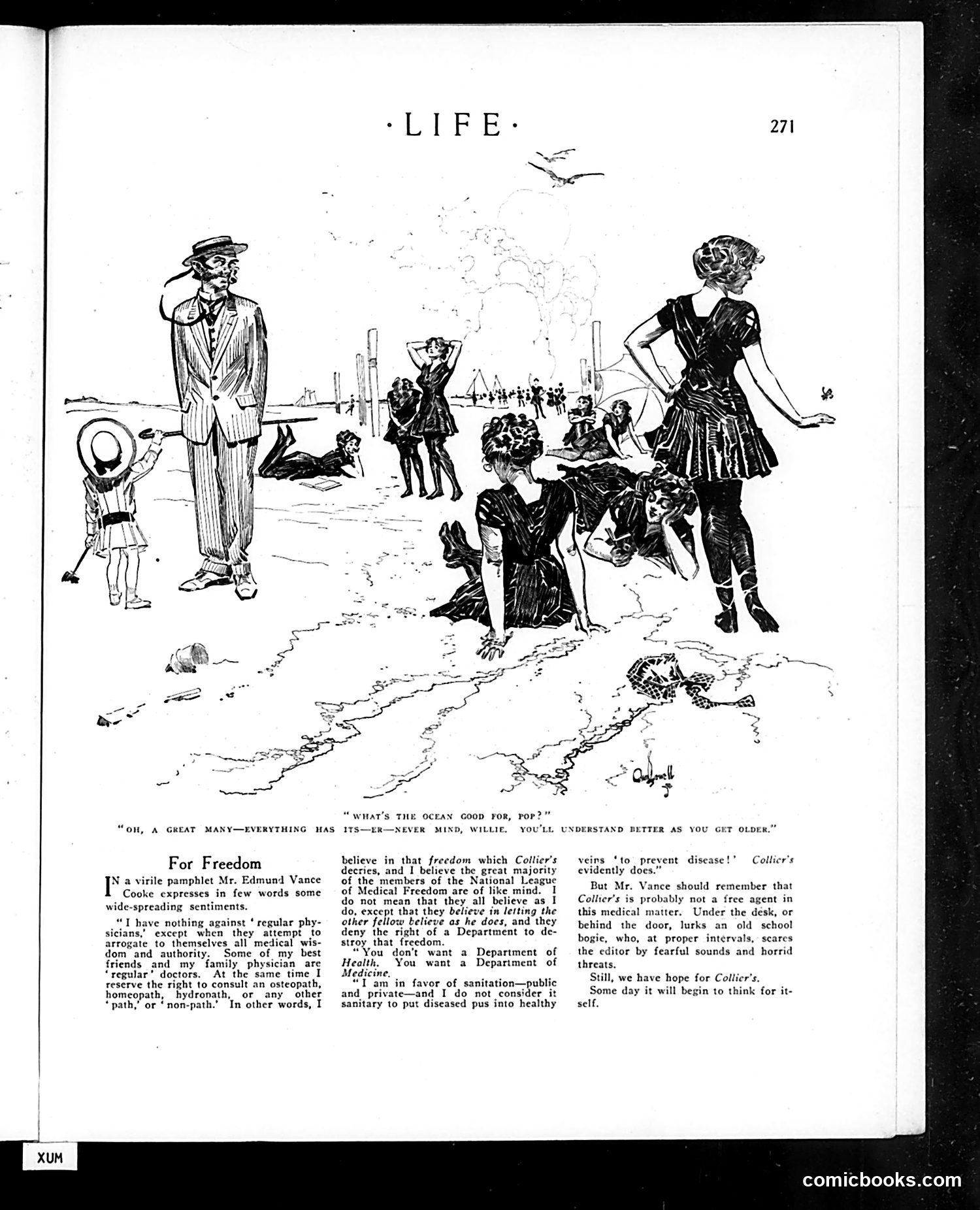
This page satirizes the medical freedom debate of the early 20th century. Edmund Vance Cooke's essay defends the right to consult alternative practitioners—osteopaths, homeopaths, hydropaths—against what he sees as the medical establishment's monopoly on healthcare authority. The beach cartoon depicts a father and child, with the caption suggesting that understanding comes with age. The juxtaposition appears ironic: just as the child cannot yet comprehend the ocean's purpose, society supposedly cannot yet grasp medical freedom's logic. The accompanying text mocks *Collier's* magazine for opposing such freedom, suggesting the publication is controlled by pharmaceutical or orthodox medical interests ("under the desk, or behind the door, lurks an old school bogie"). Life itself takes Cooke's side, advocating for patient choice while criticizing what it views as censorship by established medicine.
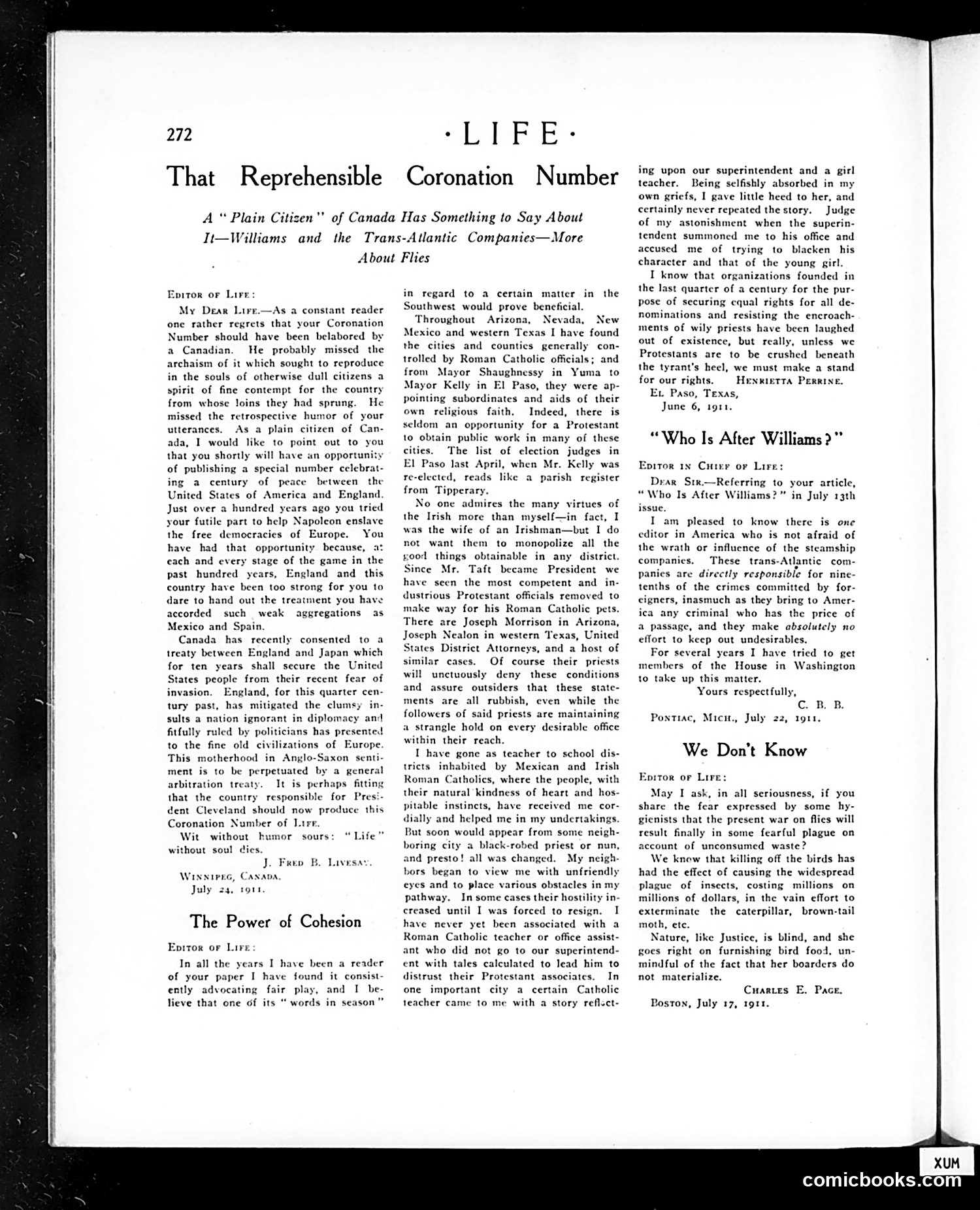
This page contains three separate letters to the editor rather than cartoons. The content reflects early 20th-century American political anxieties: **"That Reprehensible Coronation Number"**: A Canadian reader criticizes Life's coverage of a British coronation, arguing it romanticizes England despite America's historical conflicts with Britain. He notes Canada recently secured peace between the U.S. and England through a Japan treaty, positioning Canada as a mediator between rival powers. **"Who Is After Williams?"**: This letter defends trans-Atlantic steamship companies against criticism, requesting Life investigate their actual practices rather than accept hearsay. **"The Power of Cohesion"**: A lengthy complaint from the Southwest alleging that Roman Catholic officials (particularly Irish-American mayors like Kelly in El Paso) monopolize public employment and discriminate against Protestants. The writer claims this represents religious favoritism under President Taft's administration. These letters reflect period tensions: Anglo-American relations, corporate regulation, and Protestant-Catholic employment discrimination in the American Southwest.
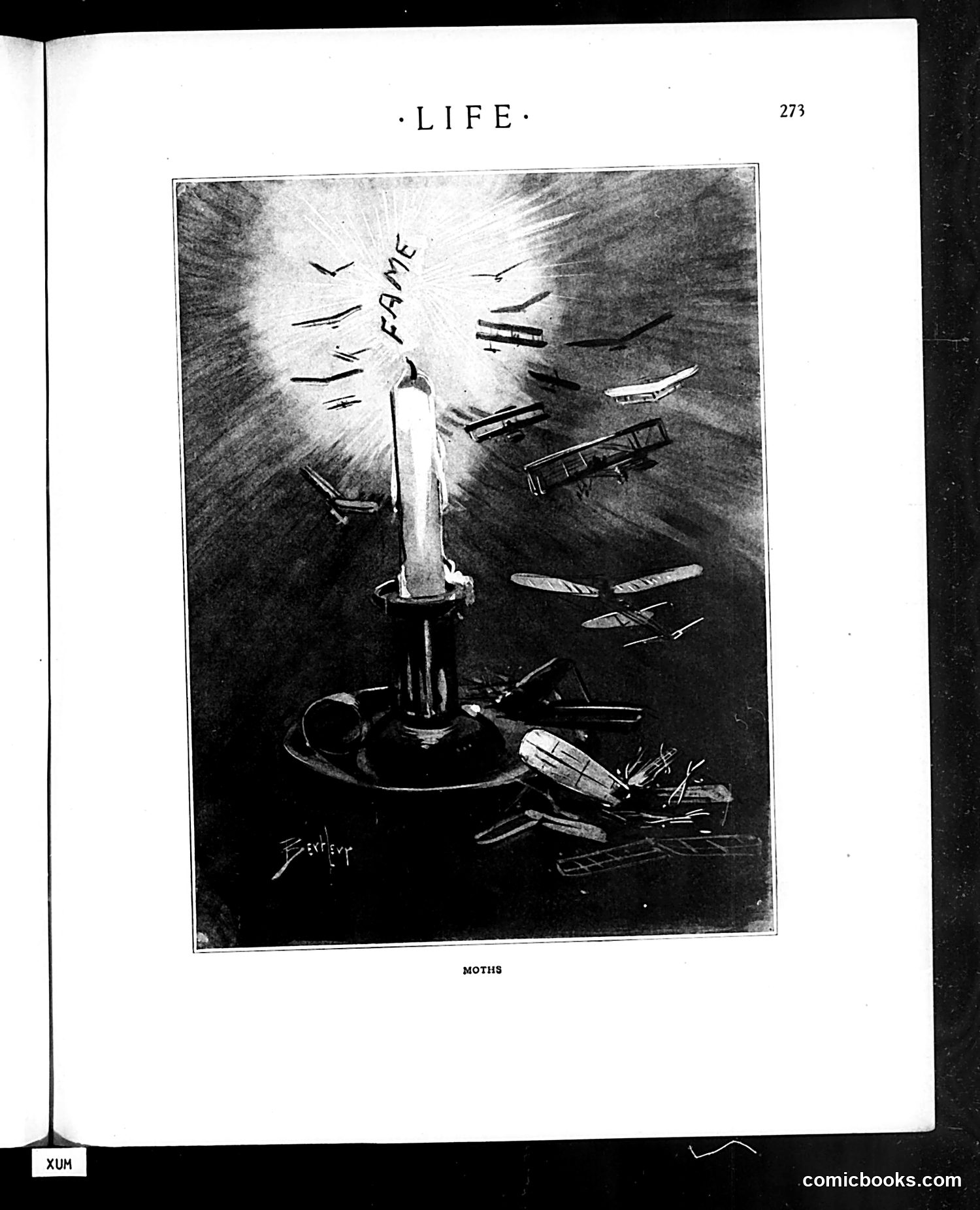
This political cartoon depicts a candle labeled "FRAME" surrounded by moths and aircraft. The bright light emanating from the candle represents the attraction of the frame (likely referring to a political or social issue of the era), while the moths—traditionally symbols of attraction to destructive light—swarm toward it along with military aircraft. The satire suggests that various interests (represented by the moths and planes) are drawn to this particular "frame" or issue, likely to exploit or destroy it. The artist's signature appears in the lower left. Without the specific publication date, the exact historical reference remains unclear, though the military aircraft imagery suggests early-to-mid 20th century context, possibly relating to wartime politics or defense policy debates.
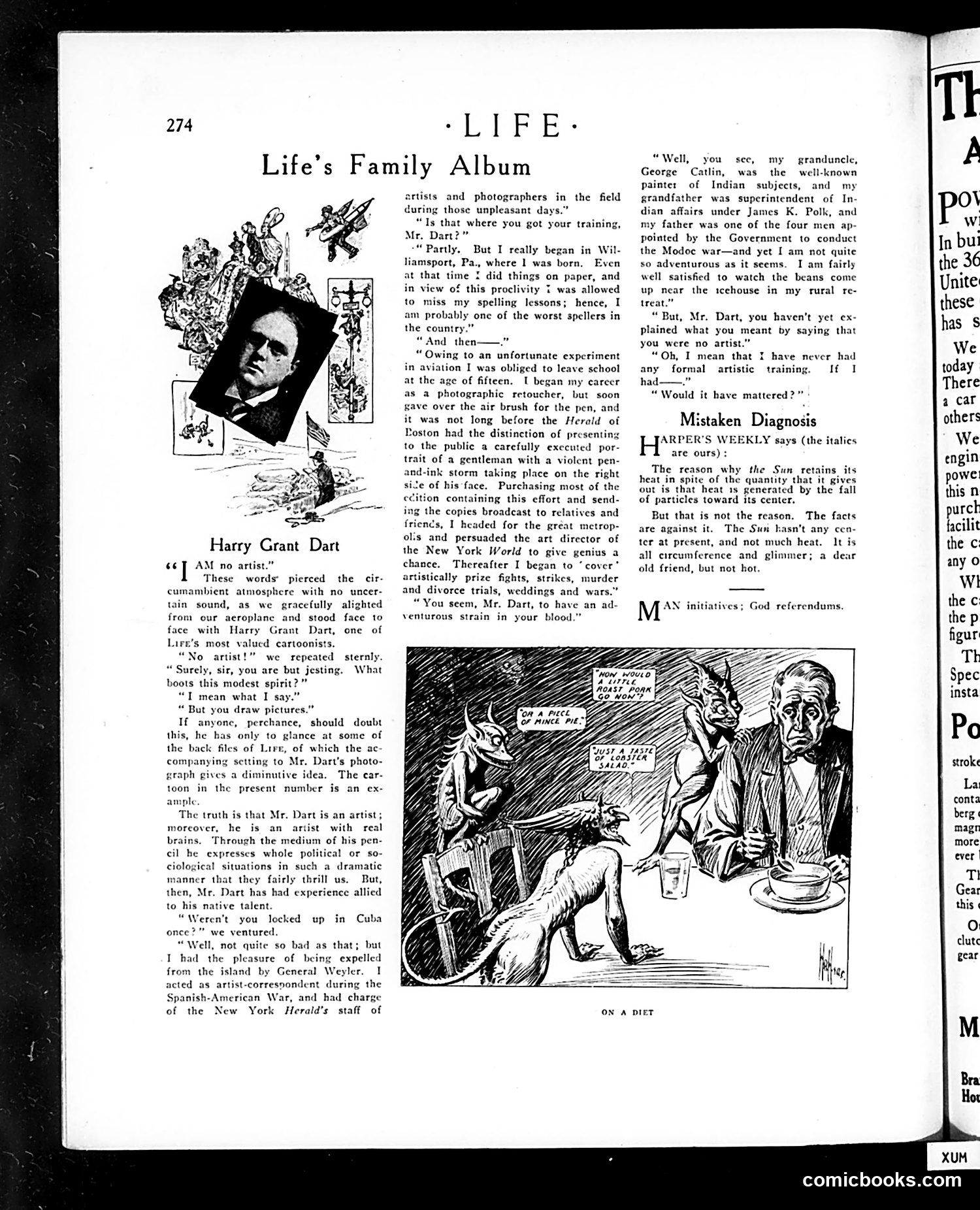
This page profiles **Harry Grant Dart**, a prominent cartoonist for Life magazine. The text is a humorous interview where Dart claims "I am no artist"—a false modesty the interviewer gently mocks. **Key context for modern readers:** Dart's credentials included work as a war correspondent during the Spanish-American War (1898), covering combat for the New York Herald. He was expelled from Cuba by General Weyler (Spanish colonial commander), adding to his adventure credentials. His family lineage included George Catlin (famous 19th-century painter of Native Americans) and his grandfather served under President James K. Polk in Indian Affairs. The humor centers on Dart's self-deprecation despite obvious talent—his cartoons about "prize fights, strikes, murder and divorce trials" apparently "fairly thrill" readers. The accompanying cartoon (captioned "On a Diet") appears to be a sample of his satirical work. Below is a brief satirical note mocking Harper's Weekly's pseudoscientific explanation of solar heat retention—typical Life magazine snark at competitors.
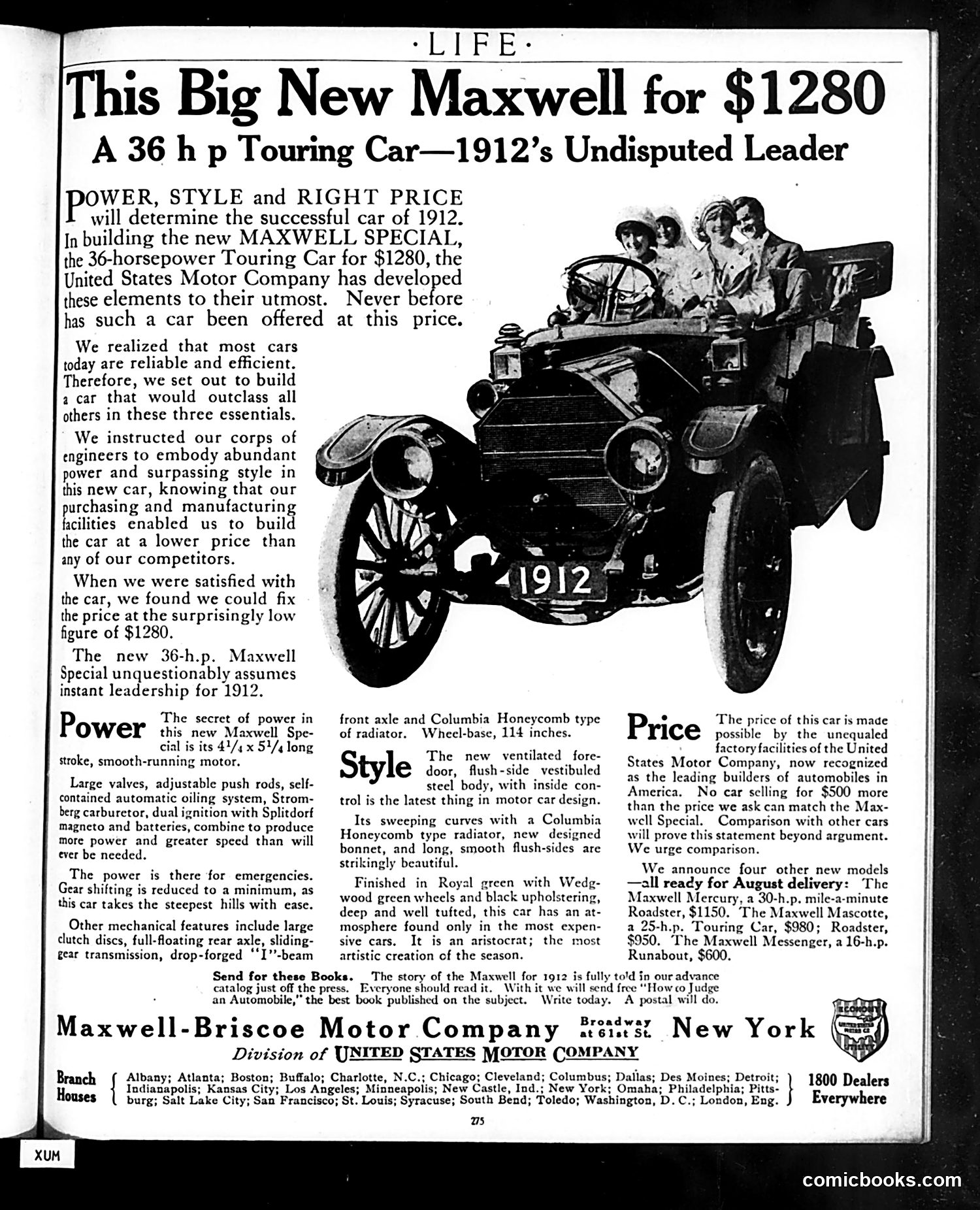
This is a **straightforward automobile advertisement**, not satire or a political cartoon. It's a 1912 Maxwell automobile ad from *Life* magazine promoting a new touring car priced at $1280—positioned as extraordinarily affordable for the era. The ad emphasizes three selling points: **power** (36 horsepower), **style** (described as "aristocratic"), and **price** (claiming no competitor offers comparable features at this cost). Technical details highlight innovations like the "Columbia Honeycomb type radiator" and modern safety/comfort features. The image shows the car loaded with fashionable passengers in period dress, suggesting both practicality and social status. **For modern context:** This represents the early automotive industry's transition toward mass-market affordability, predating Ford's Model T dominance. The ad's confident tone ("undisputed leader for 1912") reflects pre-Great Depression American optimism about industrial progress and consumer access to luxury goods.
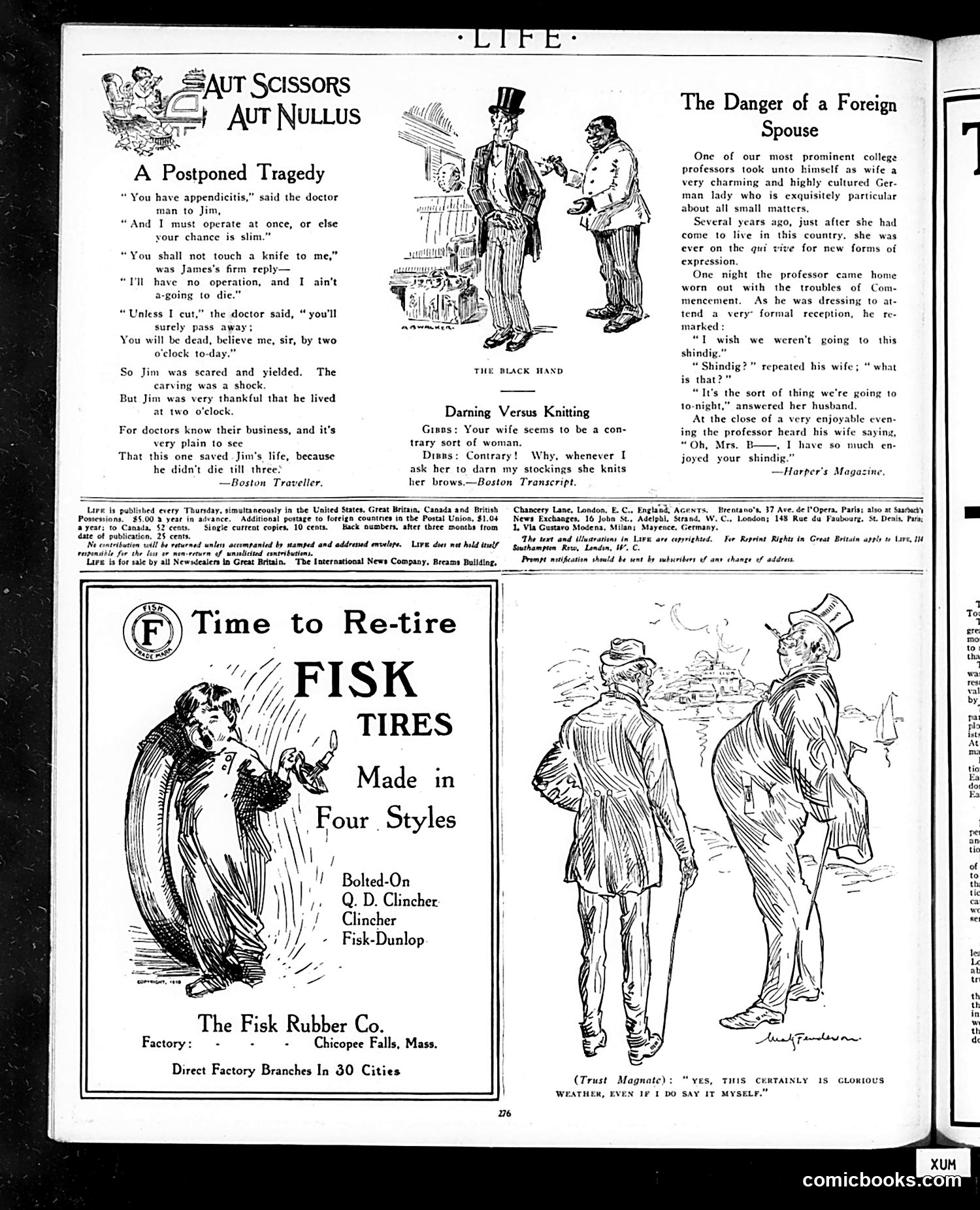
This page contains three satirical pieces typical of early 20th-century American humor: **"A Postponed Tragedy"** mocks a patient's irrational fear of surgery. Jim refuses medical treatment until threatened with death, then consents—only to die anyway at 3 PM instead of the predicted 2 PM. The joke: the doctor was technically correct about the timeline, making his medical authority darkly humorous despite the fatal outcome. **"The Danger of a Foreign Spouse"** satirizes cultural misunderstandings. A German professor's wife, unfamiliar with American slang, mishears "shindig" (party) and later awkwardly uses the term in formal company. The humor targets both the wife's foreignness and Americans' casual speech patterns that confuse immigrants. **"Darning Versus Knitting"** presents a brief domestic joke about marital contradictions—a wife consistently knits her brows (frowns) when asked to darn stockings. The page also features a **Fisk Tires advertisement** with a cartoon figure and a political cartoon titled "Trust Magnate" showing wealthy figures enjoying weather, likely critiquing capitalist complacency.
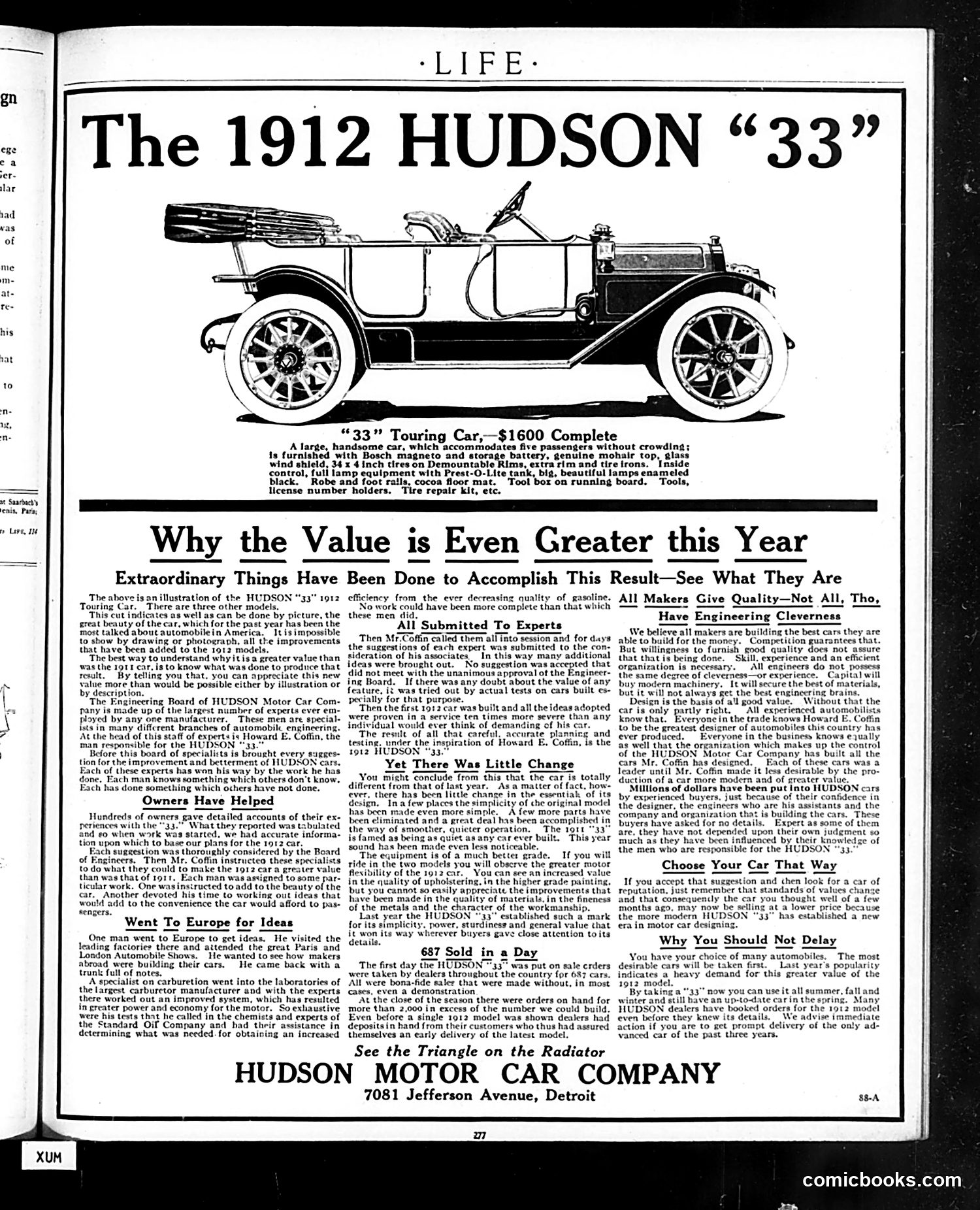
This is primarily **an automobile advertisement**, not satire or political commentary. It promotes the 1912 Hudson "33" touring car ($1,600), emphasizing its engineering quality and value. The page celebrates the car's design process: the Hudson Motor Car Company's engineering board—led by Howard E. Coffin—supposedly improved the 1912 model by consulting hundreds of owners, traveling to European auto factories, and having specialists redesign components like the carburetor (even consulting Standard Oil experts). The advertising copy's tone is almost reverential, portraying American engineering prowess and meticulous craftsmanship as marks of national superiority. This reflects pre-WWI American optimism about industrial innovation and consumer goods. There is **no evident cartoon or satire** on this page—it's straightforward automotive marketing from Life magazine's advertising section, using testimonial-style claims about expert collaboration to justify the car's premium price and quality.
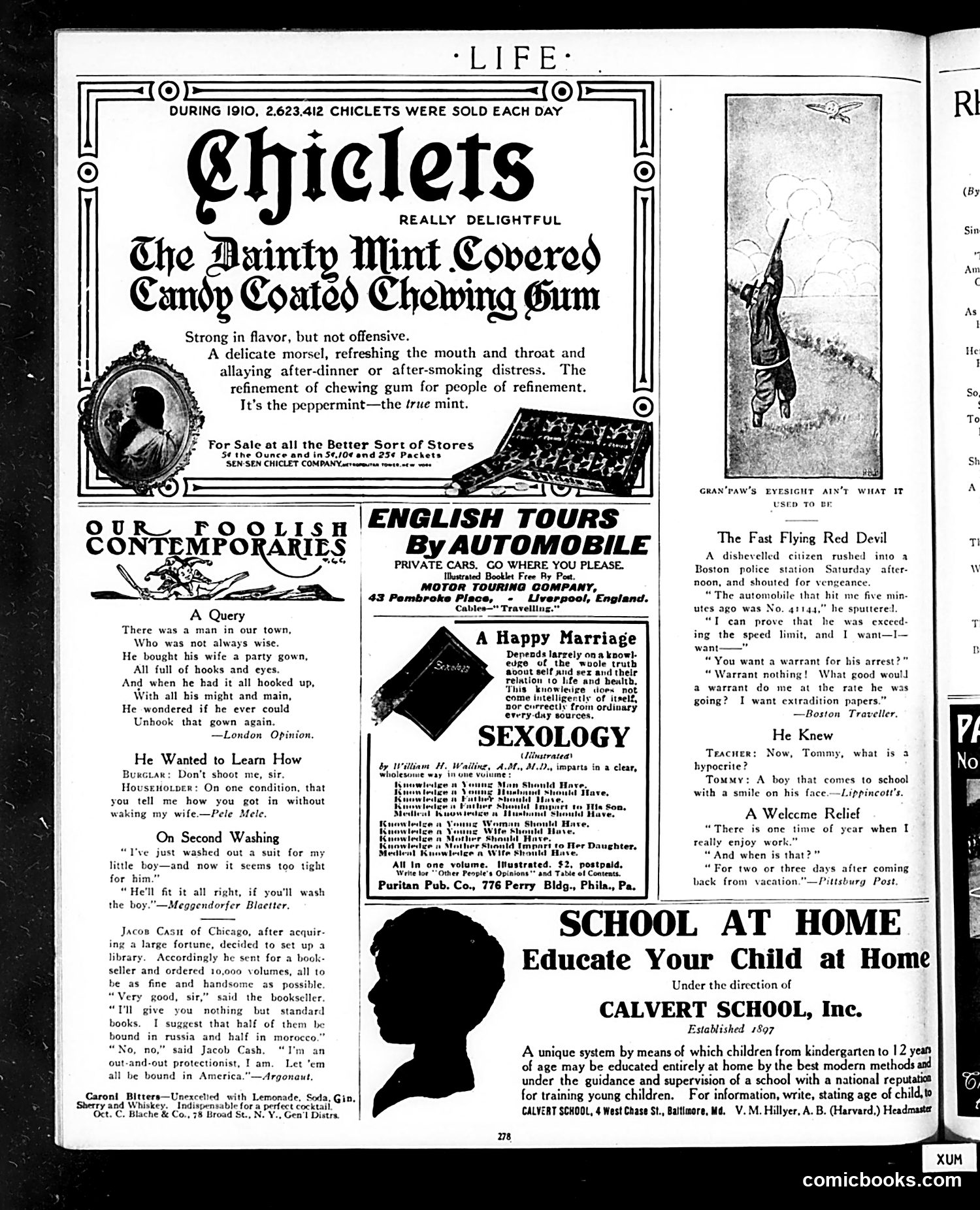
This page is primarily **advertising and humor content** rather than political satire. The main elements include: **Advertisements:** Chiclets gum (prominently featuring sales statistics from 1910), English automobile tours, and Calvert School's home education program dominate the layout. **Humor sections:** Multiple short jokes and anecdotes appear throughout: - "Our Foolish Contemporaries" mocks a man who can't unhook his wife's dress - "The Fast Flying Red Devil" jokes about a motorist demanding extradition papers for a speeding car - Various one-liners about marriage, learning, and domestic life **Notable cartoon:** "Gran'paw's Eyesight Ain't What It Used to Be" appears at top right—a visual gag about aging vision. The page reflects early 1910s concerns (automobiles, education reform, marital humor) but contains **no significant political commentary**. It's essentially a magazine of light entertainment and consumer goods targeting middle-class readers.
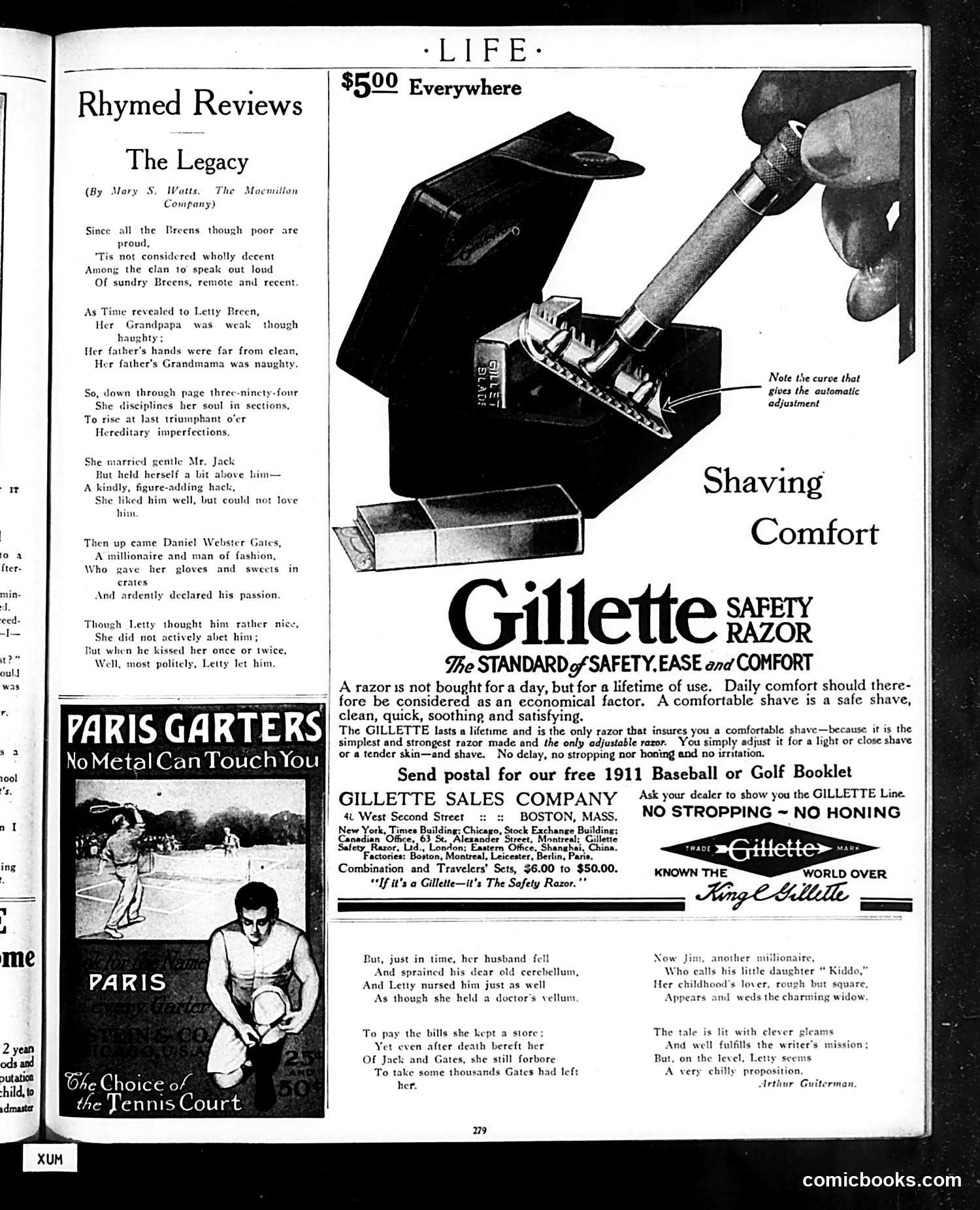
This page is primarily **advertising**, not political satire. The dominant content is a full-page Gillette Safety Razor advertisement (center-right) promoting "Shaving Comfort" with product imagery and sales copy. The left side contains a **book review in verse** by Arthur Guiterman of Mary S. Watts's novel *The Legacy*. The review summarizes a romantic plot: a woman named Letty Breen overcomes family shame, marries a kind man (Jack), attracts wealthy suitors (Daniel Webster Gates, later Jim), but ultimately proves emotionally cold—described as "a very chilly proposition." Below is a smaller ad for **Paris Garters** ("The Choice of the Tennis Court"), a men's garter product. The page reflects early 1910s concerns: **family honor and hereditary morality** (the book's theme of overcoming ancestral "imperfections"), **women's romantic choices** in an era of expanding female agency, and the growing market for **male grooming products** as consumer goods. No specific political figures or events are referenced. This is a typical Life magazine page blending literary criticism with period advertising.
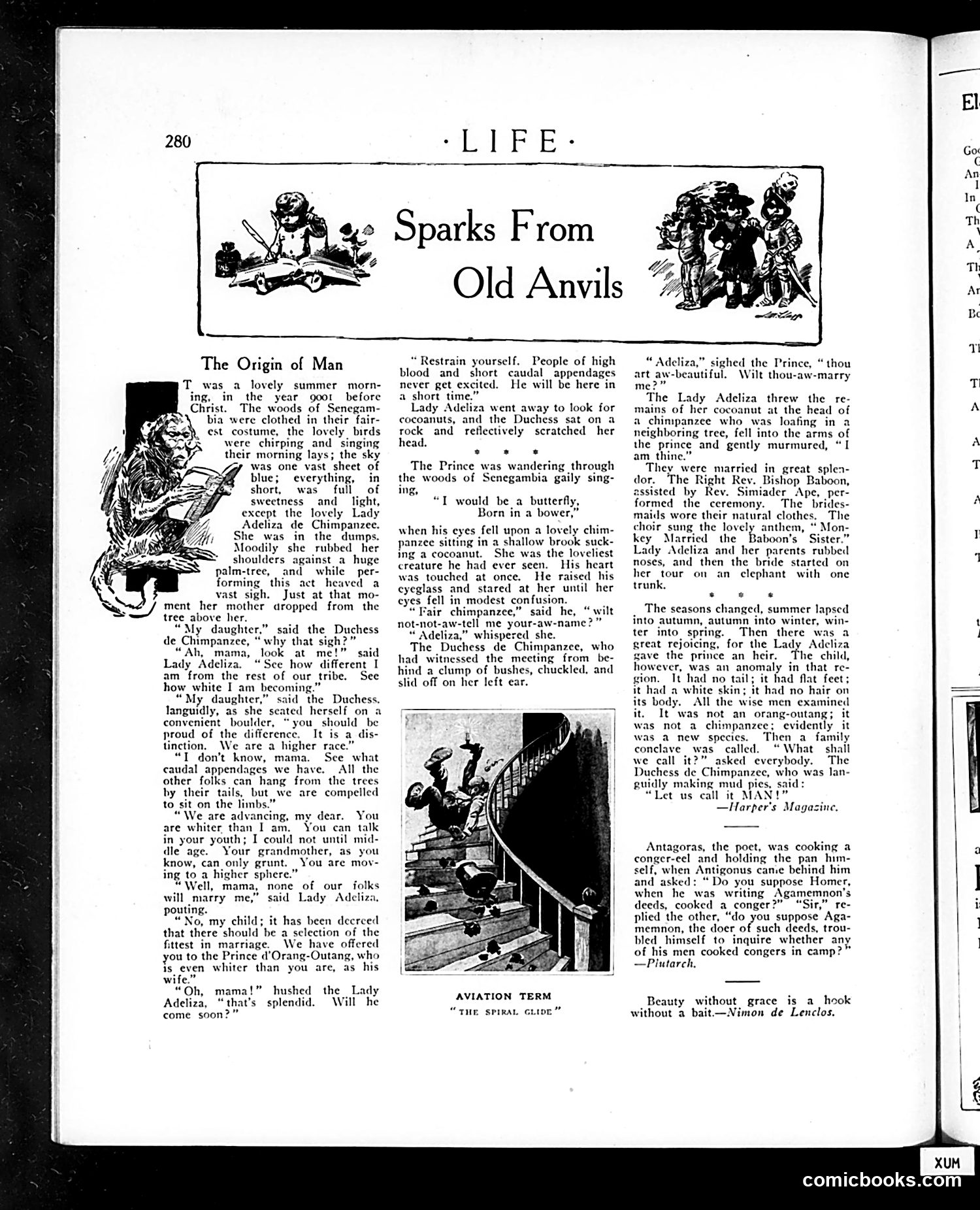
This satirical story mocks 19th-century evolutionary theory and racial pseudoscience. It presents human evolution as originating from apes, specifically depicting a romance between aristocratic chimpanzees who are "advancing" toward whiteness and human characteristics. The satire targets contemporary racial hierarchies: the Duchess celebrates her daughter's "advancement" toward whiteness and reduced tail size as markers of superiority—a direct jab at Victorian-era claims that Europeans represented an evolutionary "higher sphere." The irony deepens when their offspring is born human but represents an "anomaly," suggesting the story questions whether human superiority is genuinely progressing or merely conventional prejudice. The exaggerated dialect ("aw" affectations) and cartoonish names lampoon both ape-human transitions and the pretensions of those claiming racial distinctions. By framing human emergence as accidental and treating it with absurdist humor, Life magazine ridicules both evolutionary discourse misapplied to justify racism and the vanity of those claiming biological superiority. The illustrations show anthropomorphic apes in human situations, reinforcing the satirical point.
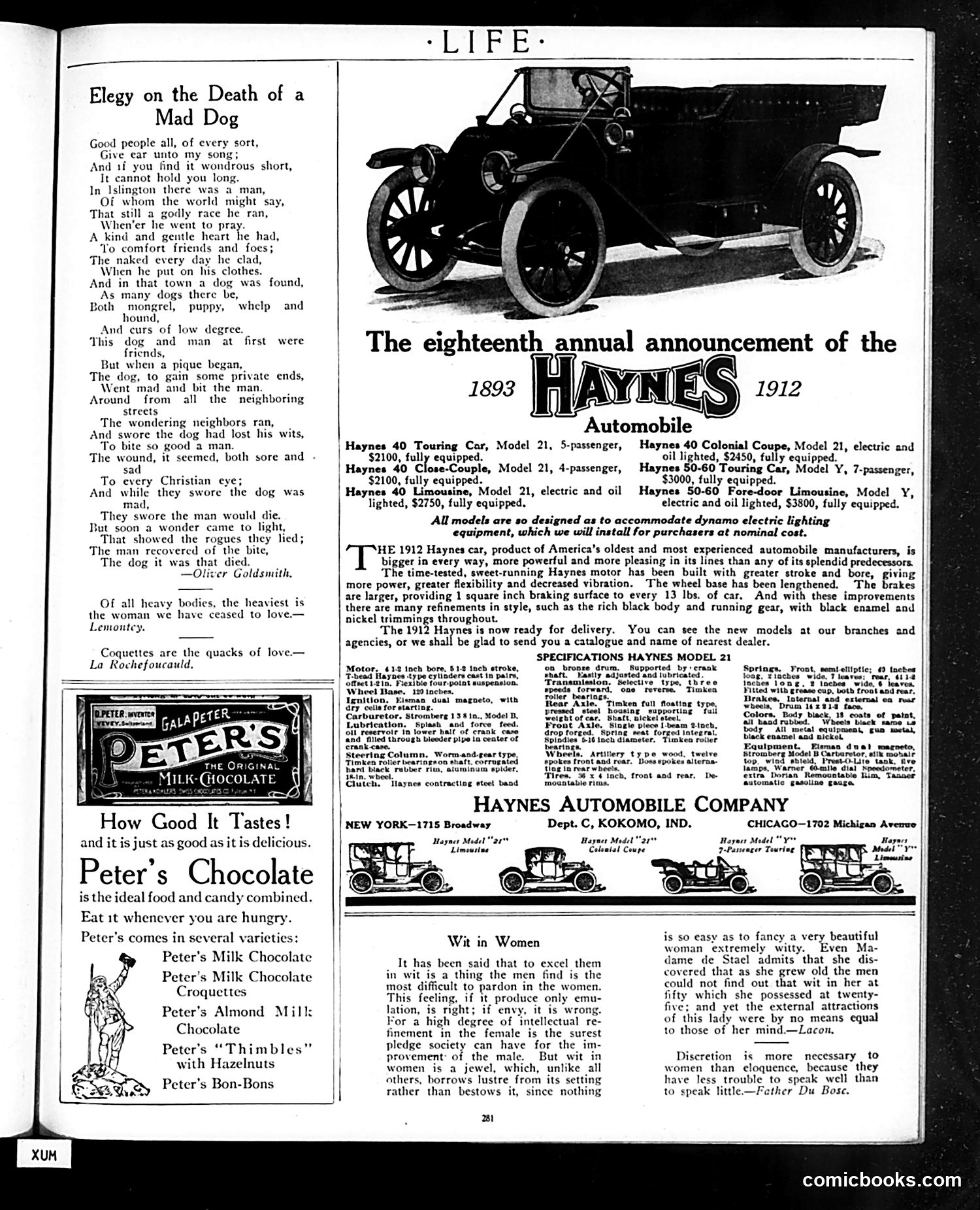
This page is primarily **advertising and light verse**, not political satire. The "Elegy on the Death of a Mad Dog" is a reprint of **Oliver Goldsmith's 18th-century poem**—a moral tale about a virtuous man in Islington who befriends a dog, but when the dog "goes mad" and bites him, the man survives while the dog dies. The poem teaches that appearances deceive: those who assumed the man would die were wrong. The page features advertisements for **Haynes automobiles** (18th annual announcement for 1912 models) and **Peter's Chocolate**, typical of Life's commercial content from this era. The quotes at bottom about love and women ("Coquettes are the quacks of love") are philosophical bon mots rather than satire. There are no political cartoons or caricatures on this page—it's a standard early-20th-century magazine layout mixing classic literature, advertising, and aphorisms.
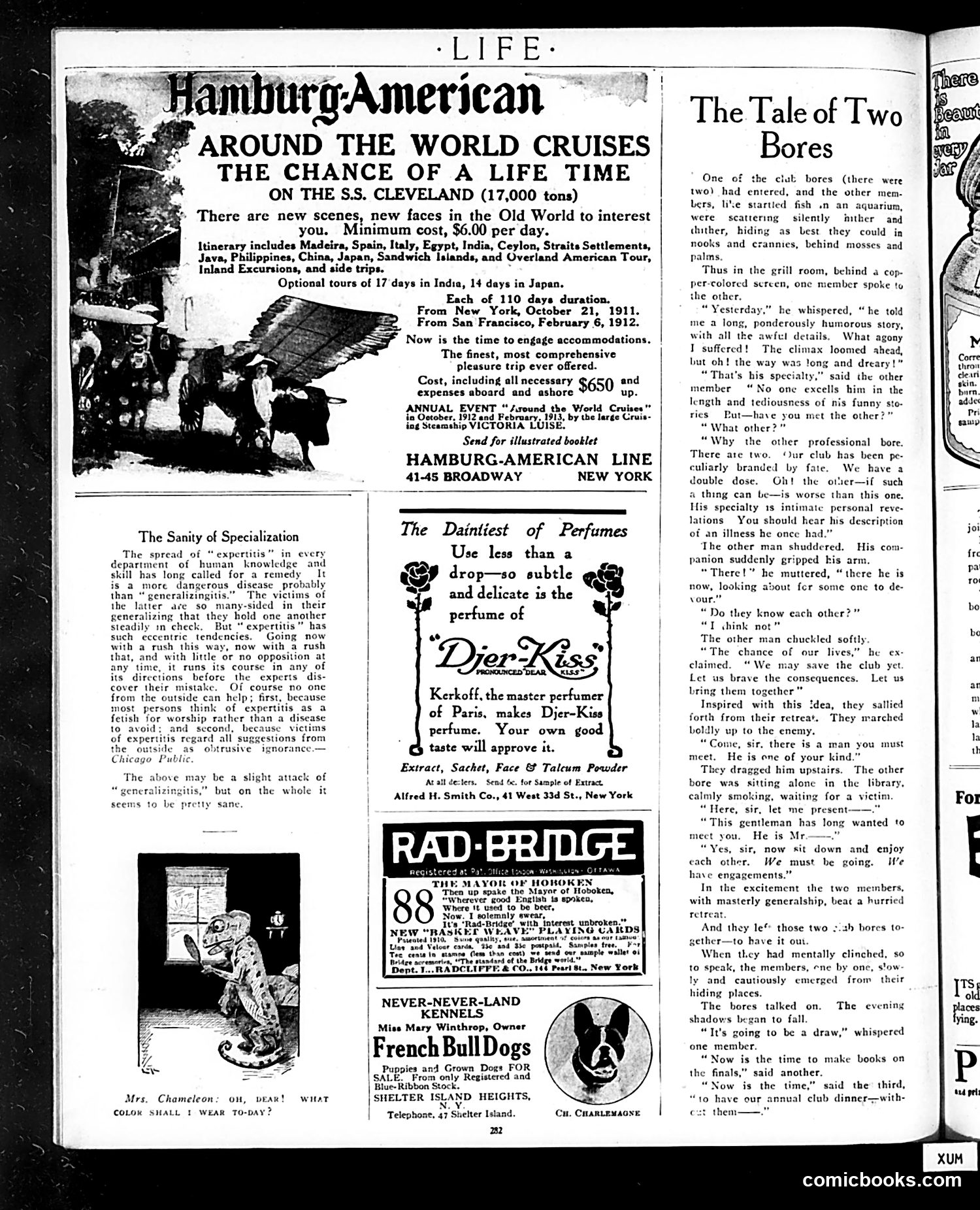
This humorous short story satirizes club life and social tedium. Two club members hide behind a screen to avoid encountering boring fellows. They commiserate about enduring one bore's "ponderously humorous" long-winded stories, only to discover their club is "peculiarly branded by fate" with two such bores—one specializing in tedious anecdotes, the other in tiresome personal revelations about his ailments. The satire targets the social obligation to suffer fools politely in institutional settings. The exaggerated hiding behavior and the revelation of a *second* bore of equal annoyance suggests the inescapability of boredom in respectable society—a witty commentary on club culture's stultifying aspects. The story mocks both the bores themselves and the helpless members forced to endure them.
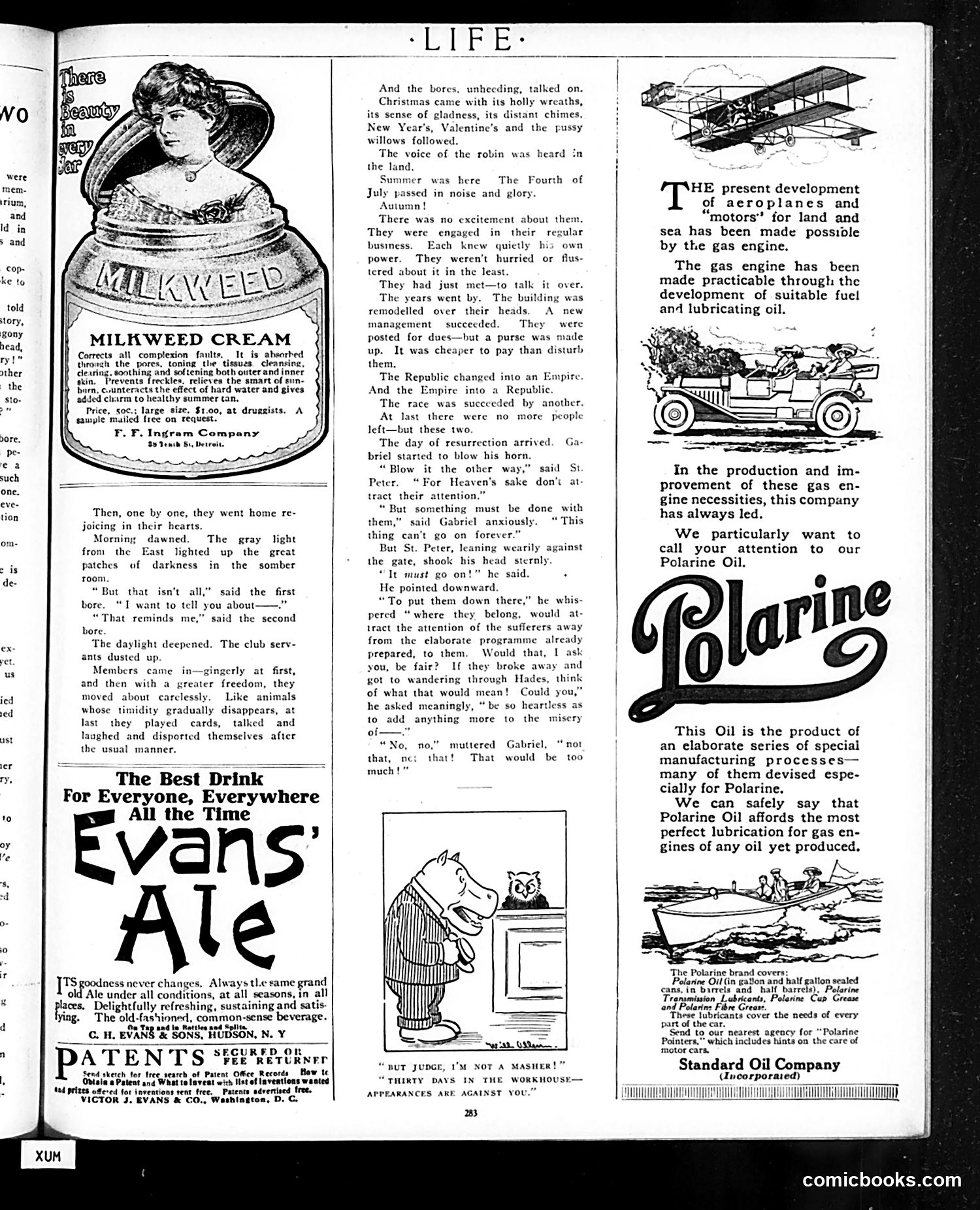
This page contains **a lengthy literary story** about two boring men (called "bores") who talk endlessly through seasons and historical epochs—from summer through the Fourth of July, autumn, winter, and eventually through cycles of republics and empires, until the world ends and even Gabriel and St. Peter debate what to do with them in the afterlife. The **satire targets tedious social bores**—people whose conversation never stops and whose presence is inescapable. The joke escalates absurdly: even at the world's end, during resurrection, these men want to keep talking. St. Peter and Gabriel worry that relocating them to Hell would inflict their boring company on the damned—a darkly humorous suggestion that their chatter represents a fate worse than eternal punishment. The page also contains **period advertisements** (Milkhweed Cream, Evans' Ale, Polarine Oil) typical of early 20th-century magazines, unrelated to the satire.
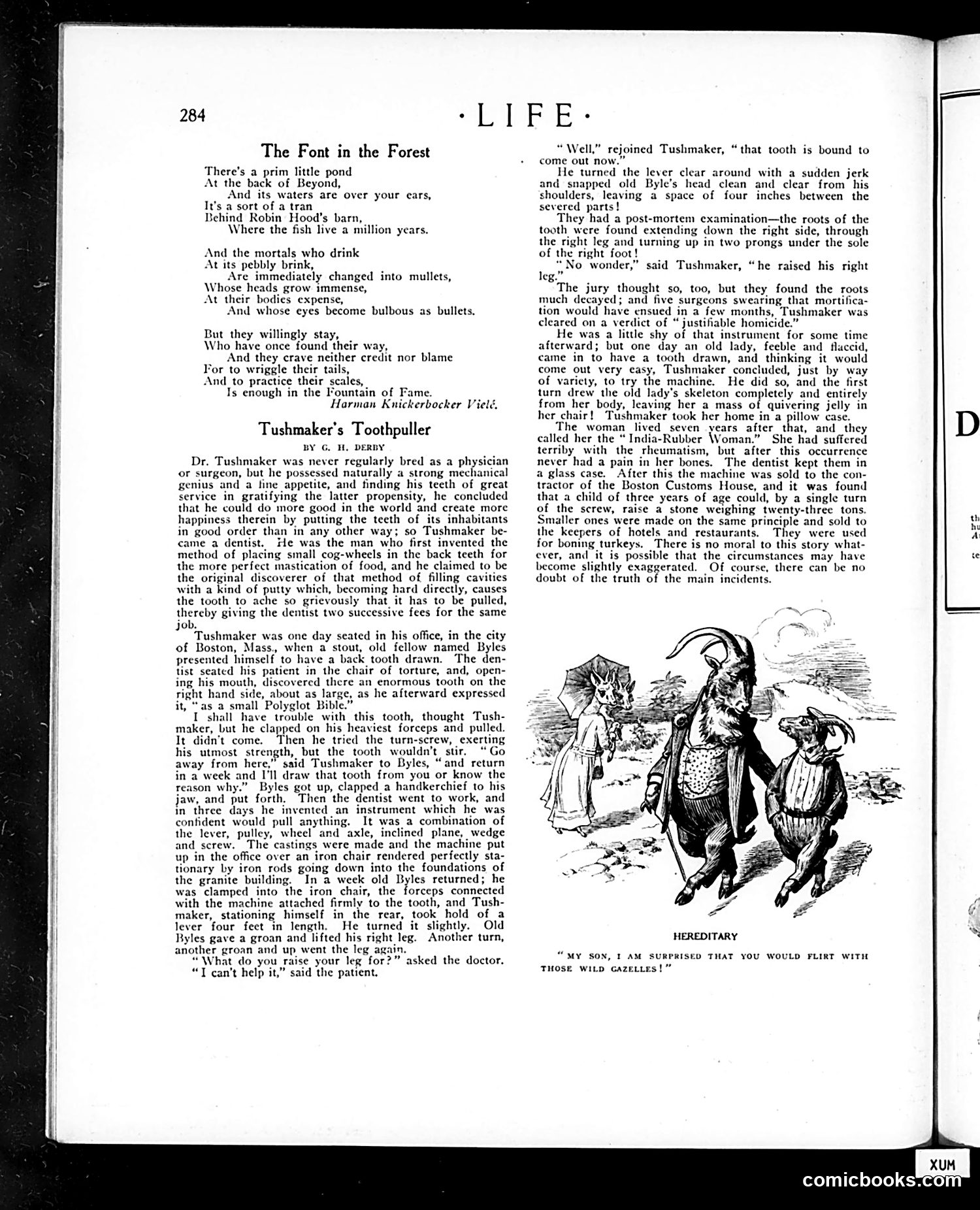
This is a humorous fictional story (not a political cartoon) by C.H. Derby, accompanied by an illustration. It satirizes American industrial-age enthusiasm for mechanical solutions to everyday problems. Dr. Tushmaker represents the overconfident inventor-entrepreneur who applies mechanical engineering to medicine. His increasingly elaborate contraption—combining levers, pulleys, wheels, and screws—parodies the era's faith in machines to solve human problems better than traditional methods. The absurd punchline—where the extraction machine literally decapitates the patient, revealing the tooth's roots extend through his entire leg—exposes the dangers of applying pure mechanical logic without understanding human anatomy. The story mocks both the dentist's hubris and the period's sometimes naive belief that bigger, more complex machines automatically equal progress. It's satirical commentary on industrial-age overreach wrapped in darkly comedic fiction.
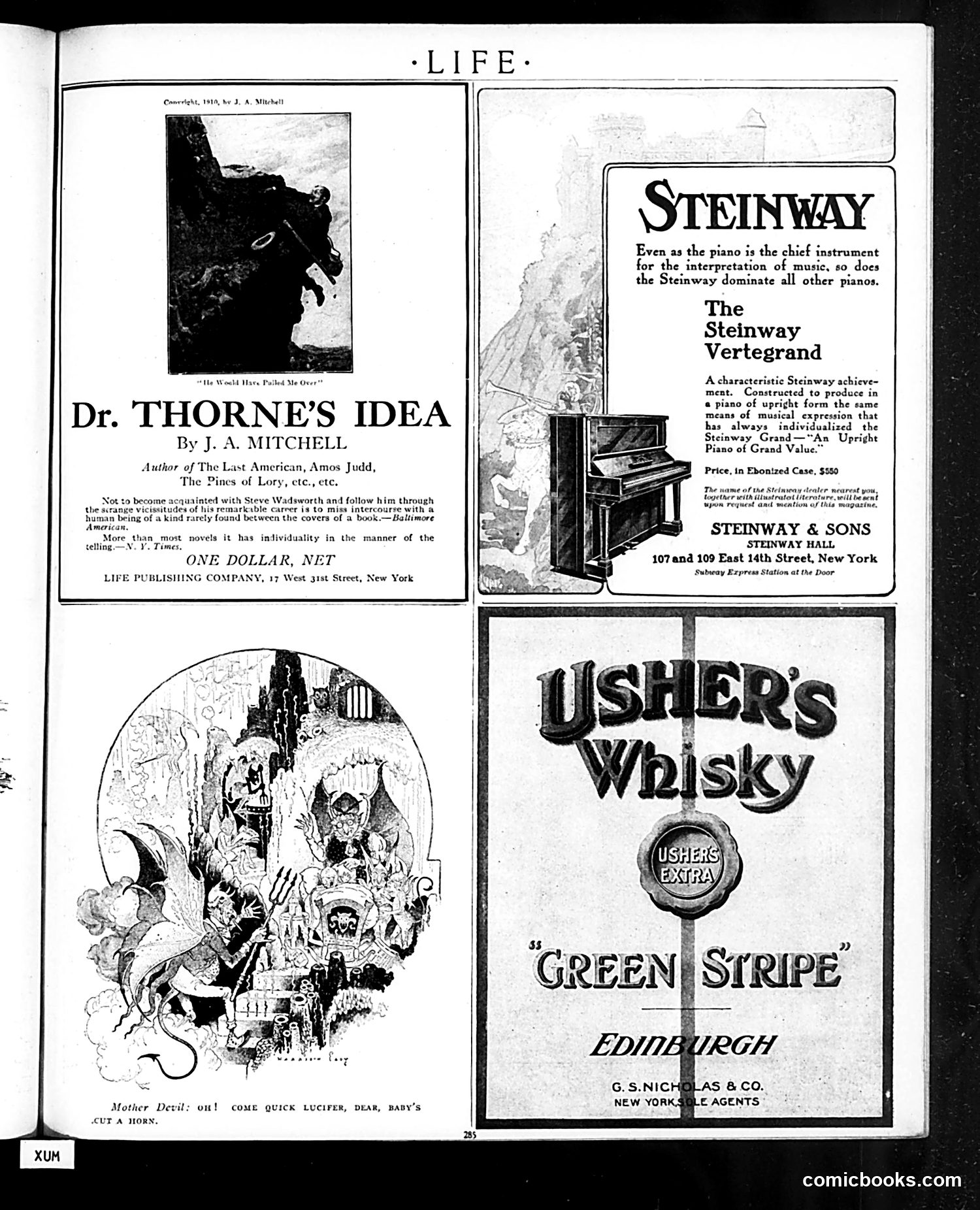
This page is primarily **advertising** interspersed with editorial content rather than political satire. The main elements are: **Dr. Thorne's Idea** (upper left): A book advertisement for a novel by J.A. Mitchell, featuring a dramatic illustration titled "He Would Have Pulled Me Over." The text emphasizes the book's realism and character development. **The cartoon** (lower left) shows a humorous domestic scene where "Mother Devil" calls to Lucifer to "come quick" because the baby has "cut a horn"—a visual pun playing on the devil's iconic horns as literal growths a devil-baby might develop. **Other ads**: Steinway pianos (upper right) and Usher's Whisky (lower right) are standard period product advertisements. The page reflects early 20th-century magazine format, mixing literature promotion with consumer goods advertising and light humor rather than sharp political commentary.
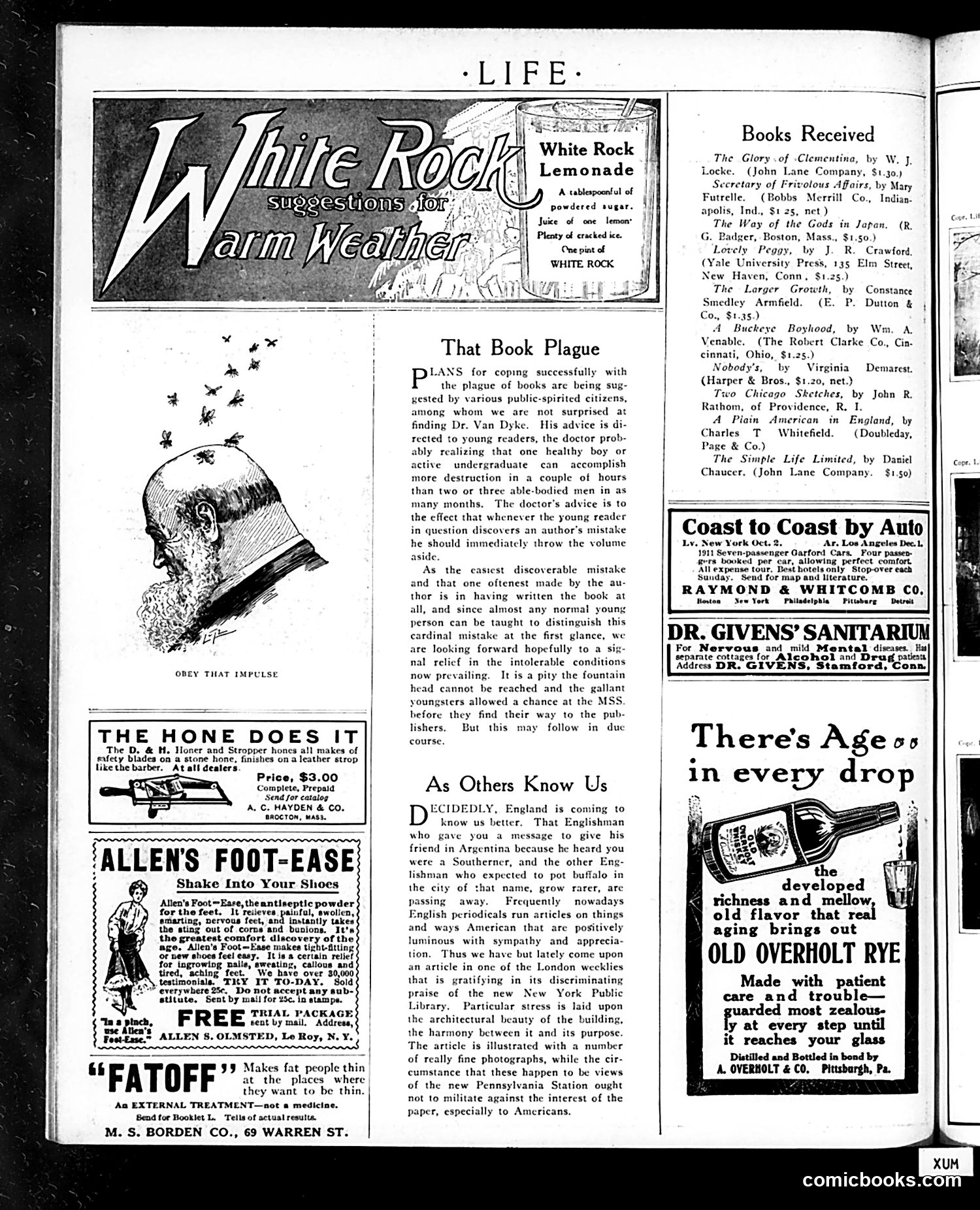
This page is primarily **advertising and book reviews**, with one satirical editorial piece titled "That Book Plague." ## The Satire The main commentary mocks young readers who destroy books by finding authorial errors. The author sardonically suggests that since the "cardinal mistake" is the book's very existence, young people could easily learn to identify this flaw "at the first glance." The piece jokes that if publishers allowed readers to critique manuscripts before publication, there might be blessed relief from the "intolerable conditions" of too many books—implying most books shouldn't be published at all. This reflects early 20th-century intellectual anxiety about mass publication. ## Secondary Commentary "As Others Know Us" discusses improving English perceptions of Americans, praising a London periodical's favorable article on the new New York Public Library—though it's illustrated with Pennsylvania Station photos instead, which the author finds amusing rather than troubling. The rest consists of period advertisements (hone sharpeners, foot powder, lemonade) and a book reviews section listing contemporary titles.
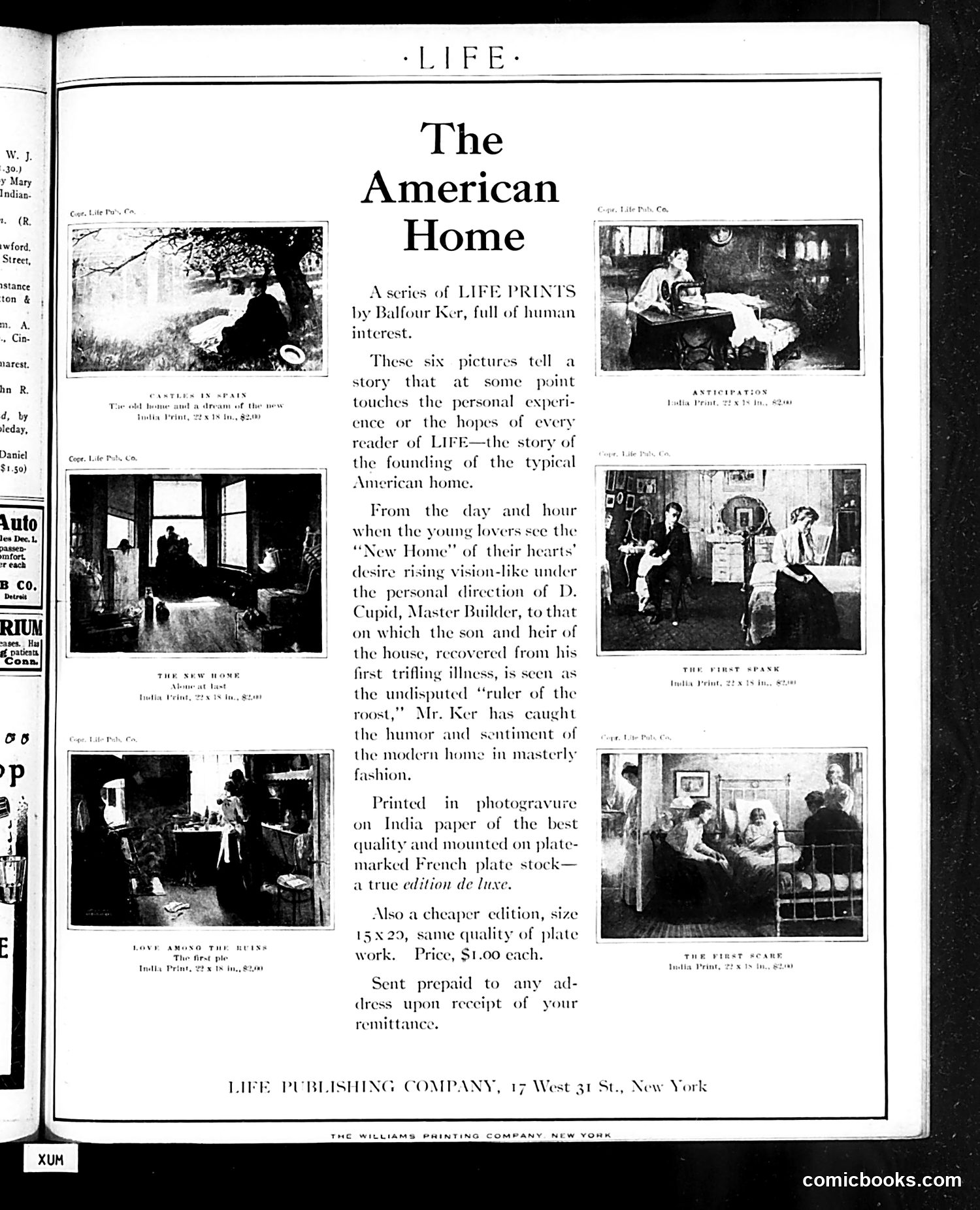
This is primarily an **advertisement** for a series of Life magazine prints by artist Balfour Ker, not a political cartoon. The page advertises six photogravure prints depicting domestic scenes centered on the founding and early life of "the typical American home." The narrative arc follows young lovers building their house under "D. Cupid, Master Builder," through to their son becoming "ruler of the roost" after recovering from childhood illness. The prints are sold in two editions: a luxury version on India paper with French plate-stock mounting, and a cheaper standard edition (15x29 inches), both priced at $1.00 each. This reflects early 20th-century American sentimentality about homeownership, family, and domesticity—celebrating the nuclear family and domestic contentment as central to American identity. The satirical magazine Life here shifts into commercial mode, selling idealized domestic imagery to readers.
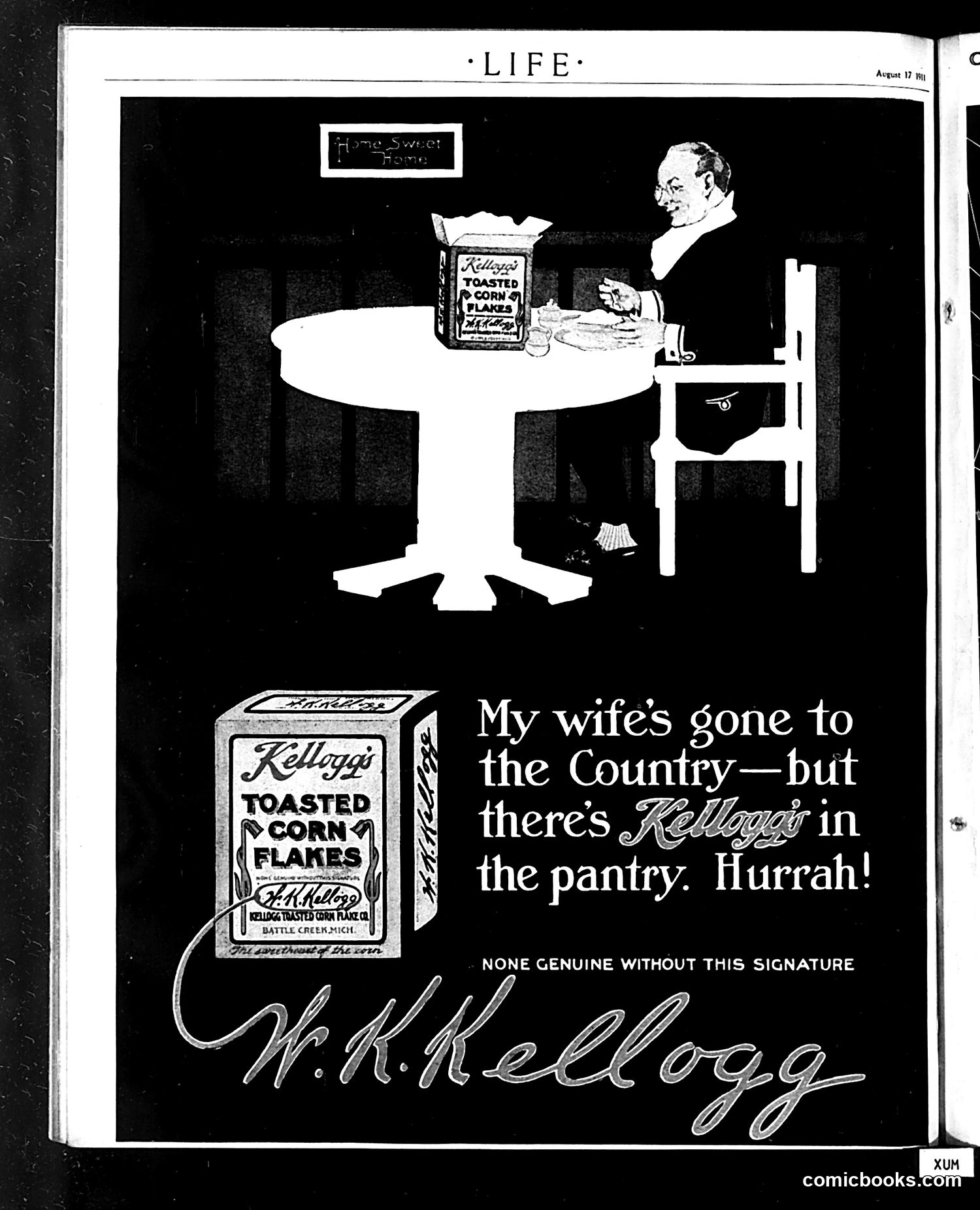
This is a **Kellogg's Toasted Corn Flakes advertisement**, not satire or political commentary. The ad features a man alone at a dining table, cheerfully eating cereal while his wife is away visiting the countryside. The joke is straightforward domestic humor: the husband is delighted to have simple, convenient cereal for breakfast instead of requiring his wife to prepare a more elaborate meal. The text emphasizes that even without his wife present, he can manage fine thanks to Kellogg's product. The signature of W.K. Kellogg at bottom authenticates the endorsement. This reflects early 20th-century attitudes about gender roles—the implication that wives normally handle cooking, while husbands appreciate convenient alternatives when left alone.