
Life, 1911-08-17 · page 36 of 40
Life — August 17, 1911 — page 36: what you’re looking at
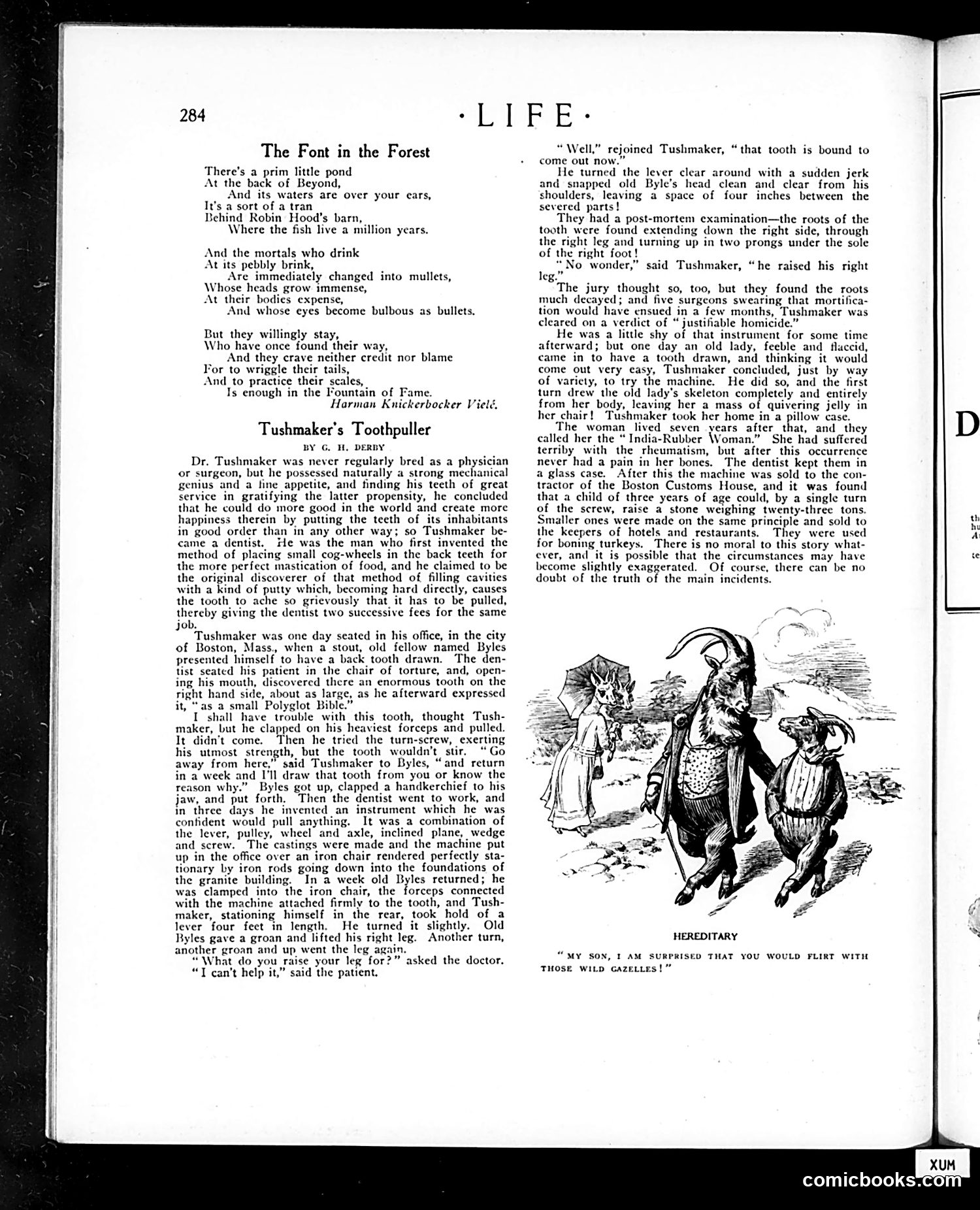
What you’re looking at
This is a humorous fictional story (not a political cartoon) by C.H. Derby, accompanied by an illustration. It satirizes American industrial-age enthusiasm for mechanical solutions to everyday problems. Dr. Tushmaker represents the overconfident inventor-entrepreneur who applies mechanical engineering to medicine. His increasingly elaborate contraption—combining levers, pulleys, wheels, and screws—parodies the era's faith in machines to solve human problems better than traditional methods. The absurd punchline—where the extraction machine literally decapitates the patient, revealing the tooth's roots extend through his entire leg—exposes the dangers of applying pure mechanical logic without understanding human anatomy. The story mocks both the dentist's hubris and the period's sometimes naive belief that bigger, more complex machines automatically equal progress. It's satirical commentary on industrial-age overreach wrapped in darkly comedic fiction.
📄 Transcribed text from this page (OCR, searchable)
Machine-transcribed from the original scan — historical spelling and the odd misread are preserved.
284 -LIFE- The Font in the Forest There’s a prim little pond At the back of Beyond, And its waters are over your cars, It's a sort of a tran Behind Robin Hood’s barn, Where the fish live a million years. And the mortals who drink At its pebbly brink, Are immediately changed into mullets, Whose heads grow immense, At their bodies expense, And whose eyes become bulbous as bullets, But they willingly stay, Who have once found their way, And they crave neither credit nor blame For to wriggle their tails, And to practice their scales, Ts enough in the Fountain of Fame. Harman Knickerbocker Vielé, Tushmaker’s Toothpuller bY GH, DERBY Dr. Tushmaker was never regularly bred as a physician or surgeon, but he possessed naturally a strong mechanical genius and a fine appetite, and finding his teeth of great service in gratifying the latter propensity, he concluded that he could do more good in the world and create more happiness therein by putting the teeth of its inhabitants in good order than in any other way; so Tushmaker be- came a dentist. He was the man who first invented the method of placing small cog-wheels in the back teeth for the more perfect mastication of food, and he claimed to be the original discoverer of that method of filling cavities with a kind of putty which, becoming hard directly, causes the tooth to ache so grievously that it has to be pulled, thereby giving the dentist two successive fees for the same job, Tushmaker was one day seated in his office, in the city of Boston, Mass., when a stout, old fellow named Byles presented himself to have a back tooth drawn. The de: tist seated his patient in the chair of torture, and, open- ing his mouth, discovered there an enormous tooth on the right hand side, about as large, as he afterward expressed it, “as a small Polyglot Bible.” I shall have trouble with this tooth, thought Tush- maker, but he clapped on his heaviest forceps and pulled. It didn’t come. Then he tried the turn-screw, exerting his utmost strength, but the tooth wouldn't stir. “Go away from here,” said Tushmaker to Byles, “and return in a week and I'll draw that tooth from you or know the reason why.” Byles got up, clapped a handkerchief to his jaw, and put forth, Then the dentist went to work, and in three days he invented an instrument which h confident would pull anything. It was a combination of the lever, pulley, wheel and axle, inclined plane, wedge and. screw, The castings were made and the machine put up in the office over an iron chair rendered perfectly sta- tionary by iron rods going down into the foundations of the granite building. In a week old Byles returned; he was clamped into the iron chair, the forceps connected with the machine attached firmly to the tooth, and Tush- maker, stationing himself in the rear, took hold of a lever four feet in length. He turned it slightly. Old Ryles gave a groan and lifted his right leg. Another turn, another groan and up went the leg again. “What do you raise your leg for?” asked the doctor. “T can’t help it,” said the patient, “Well,” rejoined Tushmaker, “that tooth is bound to come out now.” He turned the lever clear around with a sudden jerk and snapped old Byle’s head clean and clear from’ his shoulders, leaving a space of four inches between the severed parts! They had a post-mortem examination—the roots of the tooth were found extending down the right side, through the right leg and turning up in two prongs under the sole of the right foot! “No wonder,” said Tushmaker, “he raised his right The jury thought so, too, but they found the roots much decayed; and five surgeons swearing that mortifica- tion would have ensued in a few months, Tushmaker was cleared on a verdict of “ justifiable homicide.” He was a little shy of that instrument for some time afterward; but one day an old lady, feeble and flaccid, came in to have a tooth drawn, and thinking it would come out very easy, Tushmaker concluded, just by way of varicty, to try the machine. He did so, and the first turn drew the old lady's skeleton completely and entirely from her body, leaving her a mass of quivering jelly in her chair!) Tushmaker took her home in a pillow case. The woman lived seven years after that, and they called her the “India-Rubber Woman.” She had suffered terriby with the rheumatism, but after this occurrence never had a pain in her bones. The dentist kept them in a glass case. After this the machine was sold to the con- tractor of the Boston Customs House, and it was found that a child of three years of age could, by a single turn of the screw, raise a stone weighing twenty-three tons. Smaller ones were made on the same principle and sold to the keepers of hotels and restaurants. They were used for boning turkeys. There is no moral to this story what- ever, and it is possible that the circumstances may have become slightly exaggerated. Of course, there can be no doubt of the truth of the main incidents. leg. HEREDITARY “MY SON, I AM SURPRISED THAT YOU WOULD FLIRT wiTHt THOSE WILD GazeLLEs!” comicbook $.co